
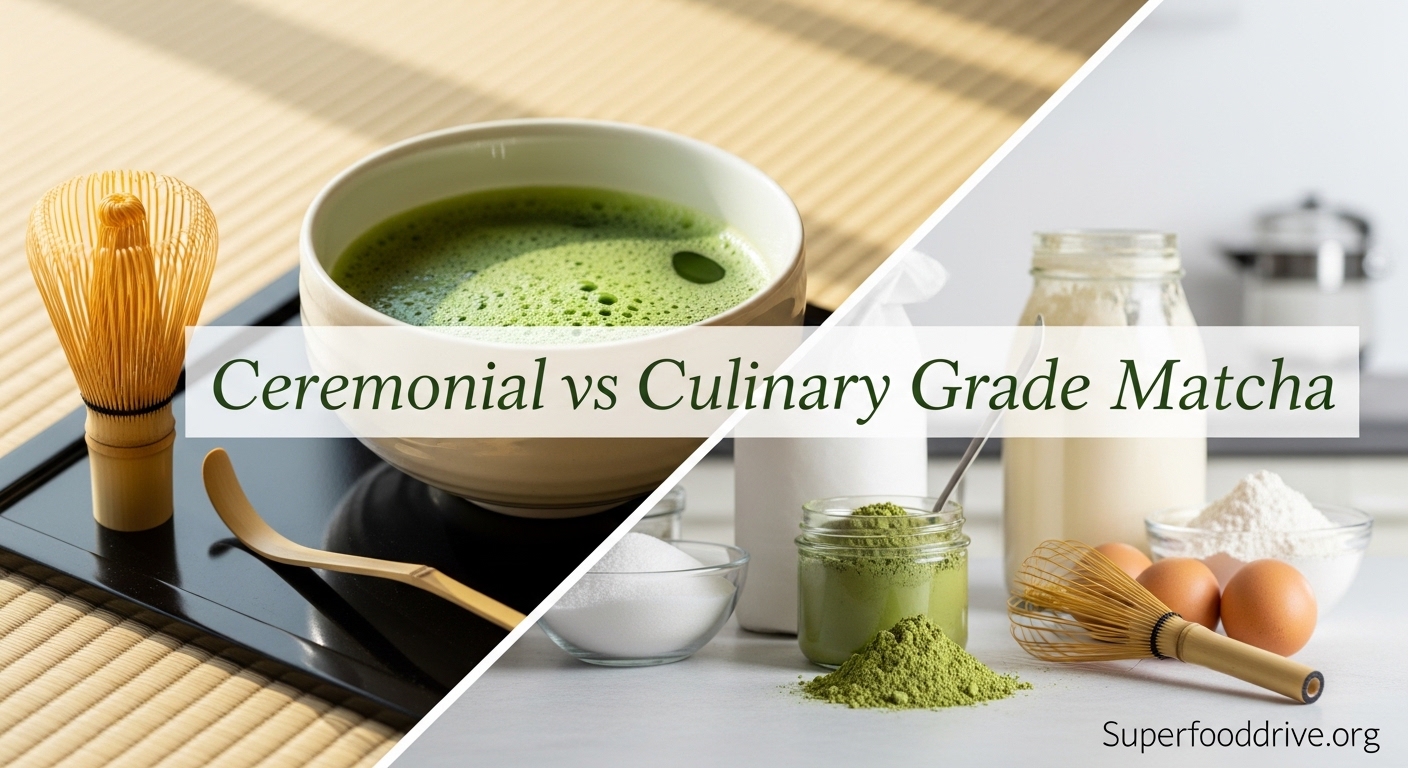
Choosing between ceremonial and culinary grade matcha can feel overwhelming, especially when you’re staring at price tags that range from $15 to $50 or more for what looks like the same green powder. I spent months drinking both grades daily, comparing them side by side, and talking to Japanese tea producers to understand what these labels actually mean. The truth surprised me: neither grade is inherently “better” – it all depends on how you plan to use it.
Ceremonial grade matcha is designed for drinking straight with just water, offering a delicate, umami-rich experience that tea ceremony practitioners cherish. Culinary grade matcha has a bolder, more robust flavor that stands up beautifully to milk, sweeteners, and other ingredients. The real kicker? Those grade labels are primarily Western marketing terms – Japanese producers don’t actually use them.
In this guide, I’ll break down everything I learned about ceremonial vs culinary grade matcha to help you make the right choice for your needs and budget in 2026. Whether you’re a beginner looking for your first tin or a matcha enthusiast wondering if the upgrade is worth it, this comparison will give you the clarity you need.
Table of Contents
What Is Ceremonial Grade Matcha?
Ceremonial grade matcha represents the pinnacle of Japanese green tea powder production, crafted specifically for traditional tea ceremony and drinking straight without any additives. This grade uses only the youngest, most tender leaves from the first harvest (called ichibancha) of shade-grown tea plants. The shading process lasts 20 to 30 days before harvest, forcing the plants to produce extraordinary levels of chlorophyll and amino acids.
The production process is painstaking. Workers hand-pick only the top leaves, then steam, dry, and devein them to create tencha – the raw material for matcha. Traditional granite mills grind the tencha into an ultra-fine powder measuring just 5 to 10 microns in particle size. A single mill produces only 40 grams of matcha per hour, which explains part of the premium price.
True ceremonial grade exhibits a vibrant jade green color that practically glows. When prepared correctly, it delivers a smooth, silky texture with pronounced umami flavor, natural sweetness, and minimal bitterness or astringency. The experience is meant to be savored on its own, whisked with water between 160F and 175F until a delicate froth forms on top.
Expect to pay between $25 and $50 or more for 30 grams of authentic ceremonial grade matcha. While that sounds expensive, I’ll break down the per-serving cost later in this guide – it’s actually more reasonable than it first appears.
What Is Culinary Grade Matcha?
Culinary grade matcha serves a completely different purpose. Producers design this grade for use as an ingredient rather than for sipping straight. While still made from shade-grown tea leaves, culinary matcha typically uses more mature leaves and may come from later harvests (second or even third flush) rather than exclusively the first spring picking.
The shading duration for culinary grade is generally shorter than ceremonial, resulting in less chlorophyll development and a slightly less vibrant green color. The flavor profile is bolder, stronger, and more assertive – characteristics that sound like negatives until you realize they help the matcha stand up to other ingredients. That pronounced bitterness and astringency actually works in your favor when mixing with milk, sugar, or baking into recipes.
Grinding standards are slightly less strict for culinary grade, though quality producers still use stone mills. The particle size may be slightly larger, and the texture, while still fine, might not achieve the same silky smoothness as premium ceremonial grades. The color ranges from green to slightly olive rather than that brilliant jade.
The real advantage? Price. Quality culinary grade matcha typically costs between $10 and $25 for 30 grams, making it far more accessible for daily use in lattes and recipes. Many matcha drinkers, myself included, actually prefer culinary grade for mixed drinks because the stronger flavor cuts through milk and sweeteners better.
Ceremonial vs Culinary Matcha: At a Glance
This comparison table breaks down the key differences at a glance. Use this as your quick reference guide when deciding which grade fits your needs.
| Feature | Ceremonial Grade | Culinary Grade |
|---|---|---|
| Leaf Source | First harvest (ichibancha), youngest leaves only | Later harvests, more mature leaves |
| Shading Duration | 20-30 days | 10-20 days (varies) |
| Grinding | Stone-ground to 5-10 microns | Stone-ground, slightly larger particles |
| Color | Vibrant jade green | Bright green to olive green |
| Flavor | Umami-rich, sweet, smooth, minimal bitterness | Bolder, earthy, pronounced bitterness |
| Texture | Silky, almost creamy | Slightly less refined |
| L-theanine Content | Higher (calm alertness) | Moderate |
| Caffeine (per gram) | 30-40mg | 25-35mg |
| Best Used For | Drinking straight, tea ceremony | Lattes, baking, smoothies, cooking |
| Price (30g) | $25-$50+ | $10-$25 |
| Price Per Serving | $0.80-$1.50 | $0.30-$0.80 |
The Key Differences Between Ceremonial and Culinary Matcha
Understanding the specific differences helps you appreciate why each grade exists and when to choose one over the other. These distinctions go far beyond marketing labels.
Leaf Selection Makes the Biggest Difference
Ceremonial grade exclusively uses ichibancha – the first flush harvest that occurs in early spring. These young, tender leaves contain the highest concentration of nutrients, amino acids, and flavor compounds. Tea plants have been storing energy all winter, and the first spring growth represents the concentrated essence of the plant.
Culinary grade may incorporate leaves from the second or third harvests (nibancha and sanbancha). These later harvests produce more tea but with gradually diminishing complexity and nutrient density. The leaves are more mature and structurally tougher, resulting in a stronger, sometimes coarser flavor profile that works well in recipes.
Shading Duration Affects Chemistry
Both grades come from shade-grown plants, but the duration differs significantly. Ceremonial grade tea plants typically undergo 20 to 30 days of shading before harvest, covered with traditional straw mats or modern black fabric tarps. This extended shading forces the plant to boost chlorophyll production and increase L-theanine (the amino acid responsible for matcha’s calming effects) while reducing catechin development that creates bitterness.
Culinary grade plants receive less shading time, sometimes as little as 10 to 15 days. The result is less chlorophyll (hence the less vibrant color) and more catechins, which increase the astringent, bitter notes. Paradoxically, this higher catechin content actually means culinary grade sometimes contains more antioxidants by volume.
Grinding Standards Determine Texture
Both ceremonial and culinary matcha undergo stone grinding using traditional granite mills called ishiusu. However, ceremonial grade adheres to stricter particle size standards. Quality ceremonial matcha achieves 5 to 10 micron particle size, creating that signature silky texture that suspends evenly in water.
Culinary grade may have slightly larger particle sizes, which can result in a slightly grittier mouthfeel when consumed straight. When mixed into lattes or baked goods, this difference becomes negligible. The grinding process itself generates heat, so both grades must be ground slowly to prevent flavor degradation – another reason for the premium pricing.
Color Tells You Everything
High-quality ceremonial grade matcha displays a brilliant jade green that looks almost electric. This comes from the high chlorophyll content developed during extended shading. If your ceremonial grade looks dull, brownish, or olive-colored, it may be oxidized, old, or not truly ceremonial quality.
Culinary grade ranges from bright green to slightly olive, depending on quality. Premium culinary grades can look nearly as vibrant as lower-tier ceremonial grades. Any yellowish or brownish tones suggest oxidation or poor storage, regardless of the grade on the label.
Flavor Profiles Are Worlds Apart
Ceremonial grade offers a complex, nuanced flavor journey. The initial sip delivers intense umami – that savory, brothy sensation similar to seaweed or parmesan. This gives way to natural sweetness with vegetal notes and a smooth, creamy finish. Bitterness and astringency should be minimal or absent entirely.
Culinary grade hits harder with pronounced bitterness and astringency right from the start. The flavor is bolder, earthier, and more robust overall. Some describe it as “grassy” or “vegetal” in a more aggressive way. These characteristics sound negative for straight drinking but become assets when the matcha competes with milk, sweeteners, or other recipe ingredients.
How Do the Flavors Actually Compare?
I spent three weeks drinking both grades daily, alternating between straight preparation and lattes, to really understand the practical differences. Here’s what I discovered through direct side-by-side comparison.
Ceremonial grade shines when whisked with nothing but hot water. The first time I tasted a properly prepared bowl of usucha using high-quality ceremonial matcha, I understood why tea masters spend years perfecting the ceremony. The umami flavor is unlike anything else – savory, slightly sweet, with oceanic and vegetal undertones that evolve as you drink. The finish is clean and smooth, leaving a subtle sweetness on your palate.
The same preparation with culinary grade was eye-opening. The bitterness hit immediately, followed by astringency that dried my mouth slightly. The flavor was one-dimensional compared to ceremonial – strong and green-tasting but without the depth and complexity. I found myself wanting to add honey or milk to balance the harshness.
Then I tried both in lattes. Here, the script flipped. The ceremonial grade’s delicate flavors got lost entirely behind the milk and sweetener. I could tell something was there, but the subtle umami and sweetness disappeared. The culinary grade, however, held its own beautifully. That bold, bitter backbone cut through the milk and created a balanced, flavorful drink.
Iced preparations told a similar story. Cold water or milk seems to amplify bitterness, making culinary grade challenging for iced drinks unless heavily sweetened. Ceremonial grade produced a smoother, more refreshing iced matcha that needed little or no sweetener.
Does Matcha Grade Affect Caffeine Content?
Many people choose matcha specifically for its caffeine combined with L-theanine, which creates a state of “calm alertness” unlike coffee’s jittery buzz. The grade you choose does affect this experience, though perhaps not as dramatically as you’d expect.
Ceremonial grade typically contains 30 to 40 milligrams of caffeine per gram of powder. A standard serving of usucha uses about 2 grams, delivering roughly 60 to 80 milligrams of caffeine – comparable to a small cup of coffee. However, the L-theanine content is significantly higher in ceremonial grade, creating that smooth, sustained energy without crashes.
Culinary grade averages 25 to 35 milligrams per gram, with a typical latte serving (1-2 grams) providing 25 to 70 milligrams depending on how strong you mix it. The L-theanine content is lower proportionally, meaning the caffeine hit feels slightly more immediate though still gentler than coffee.
Here’s where it gets interesting: because culinary grade often contains more mature leaves, the total catechin and antioxidant content can actually be higher than ceremonial grade. The very compounds that create bitterness also provide health benefits. So while ceremonial grade offers a more refined experience, culinary grade isn’t nutritionally inferior – just different.
Which Matcha Grade Is Healthier?
This is one of the most common questions I see in forums, and the answer surprises many people. Neither grade is definitively “healthier” than the other – they offer slightly different nutritional profiles that may suit different goals.
Ceremonial grade contains higher concentrations of L-theanine, the amino acid responsible for matcha’s signature calm focus and stress-reducing properties. Extended shading increases L-theanine production, and the first-harvest leaves contain the peak amounts. If you’re drinking matcha primarily for mental clarity and sustained energy without jitters, ceremonial grade delivers superior results.
The higher chlorophyll content in ceremonial grade also supports detoxification and alkalizing effects. That vibrant green color indicates chlorophyll density, which some research suggests may help bind to and eliminate heavy metals and toxins from the body.
Culinary grade, however, often contains higher levels of catechins – particularly epigallocatechin gallate (EGCG), the antioxidant most associated with matcha’s metabolism-boosting and disease-preventing benefits. More mature leaves and less shading time allow these compounds to develop more fully. If antioxidant intake is your primary concern, culinary grade might actually be the better choice.
Both grades provide substantial health benefits including improved metabolism, enhanced focus, immune support, and cardiovascular protection. The difference is more about the ratio of calming compounds versus antioxidant compounds rather than overall healthfulness. For most people, the best grade is the one you’ll actually drink regularly – and enjoy.
When Should You Use Ceremonial vs Culinary Matcha?
The “right” grade depends entirely on your intended use. I’ve developed a simple framework based on months of experimentation and feedback from the matcha community.
Choose Ceremonial Grade For
Traditional tea ceremony practice or any time you want to experience matcha as Japanese tea masters intended. This is the only choice for koicha (thick tea), the concentrated preparation used in formal ceremonies. The intense umami and smooth texture make koicha a transcendent experience that culinary grade simply cannot replicate.
Daily drinking of straight matcha (just whisked with water) is where ceremonial grade justifies its price. If you drink matcha regularly without adding milk or sweeteners, the superior flavor, texture, and L-theanine content make ceremonial worth every penny. I converted to daily ceremonial drinking six months ago and haven’t looked back.
Mindfulness rituals and meditation practice pair beautifully with ceremonial grade. The preparation process itself is calming, and the L-theanine-rich tea enhances meditative states. Many practitioners find the ceremonial preparation and consumption becomes a treasured daily ritual.
Choose Culinary Grade For
Matcha lattes are the primary use case where culinary grade actually outperforms ceremonial. The bold flavor stands up to milk, oat milk, almond milk, and sweeteners without disappearing. Most cafes and coffee shops, including Starbucks, use culinary grade for this exact reason. You’re not missing out by choosing culinary for your daily latte.
Baking and cooking absolutely demand culinary grade. Using ceremonial matcha in recipes is like cooking with expensive wine – the heat, mixing with other ingredients, and sugar completely mask the subtle flavors you’re paying premium prices for. Culinary grade provides the color, antioxidant benefits, and green tea flavor at a price that makes sense for recipes.
Smoothies benefit from culinary grade’s stronger flavor profile. Blending with fruits, protein powder, and other ingredients requires a bold matcha taste to remain noticeable. I use culinary grade in my morning smoothies and save ceremonial for afternoon tea rituals.
Iced matcha preparations can work with either grade depending on your preference. If you drink iced matcha straight or lightly sweetened, ceremonial provides a smoother experience. If you prefer sweetened iced matcha drinks, culinary grade holds up better.
What Starbucks and Cafes Actually Use
Starbucks and virtually all commercial coffee shops use culinary grade matcha for their lattes and beverages. Some may use higher-end culinary grades, but none use true ceremonial grade for mixed drinks. This isn’t about cutting corners – it’s about flavor science. The delicate nuances of ceremonial grade disappear completely behind milk and sweetener, making the premium price pointless.
If you’re trying to recreate the Starbucks matcha latte experience at home, culinary grade is exactly what you need. In fact, you can likely achieve better results than commercial shops by using quality culinary grade and adjusting sweetness to your preference.
Is “Ceremonial Grade” Just a Marketing Term?
This is where the matcha world gets controversial, and I want to give you the honest perspective I learned from Japanese producers.
The terms “ceremonial grade” and “culinary grade” are largely Western marketing constructs. Walk into a tea shop in Kyoto or Uji and ask for “ceremonial grade matcha,” and you’ll likely receive confused looks. Japanese producers and tea masters don’t use these categories. Instead, they evaluate matcha based on origin, cultivar, harvest timing, stone-grinding quality, and most importantly, taste.
The grading system emerged as matcha gained popularity outside Japan, particularly in North America and Europe. Sellers needed a simple way to communicate quality differences to consumers unfamiliar with Japanese tea culture. The ceremonial/culinary binary was born as a shorthand explanation.
Here’s the problem: these terms aren’t standardized or regulated. Any producer can label their matcha “ceremonial grade” regardless of actual quality. I’ve seen oxidized, bitter, dull-green powders sold as “premium ceremonial grade” at inflated prices. Conversely, some exceptional matcha that would qualify as ceremonial by any objective standard is sold as “culinary” or “premium culinary” by producers who reject the Western grading system entirely.
Japanese quality assessment focuses on seven key factors: production region, shading duration, cultivar selection, harvest timing, processing method, storage conditions, and sensory evaluation (color, aroma, taste). A matcha from Uji made from the Asahi cultivar, first harvest, shaded 25 days, properly stone-ground, and exhibiting vibrant color with umami flavor is exceptional regardless of what grade label someone puts on the tin.
What this means for you: don’t buy based solely on grade labels. Learn to evaluate matcha quality independently using the checklist I’ll share later in this guide. The best approach is finding a trusted supplier who provides specific information about origin, harvest, and cultivar rather than relying on vague “ceremonial” claims.
How Much Does Each Grade Actually Cost Per Cup?
Breaking down price by serving makes the decision much clearer. Here’s the real cost analysis based on typical usage.
Ceremonial grade at $35 for 30 grams yields about 30 servings if you use the standard 1-gram serving for usucha. That works out to approximately $1.17 per cup. Premium ceremonial grades at $50 per 30 grams cost about $1.67 per serving. This is comparable to a specialty coffee drink but significantly less than café matcha lattes that typically run $4 to $6.
Culinary grade at $18 for 30 grams provides the same 30 servings at about $0.60 per serving. Budget culinary grades at $12 per 30 grams drop the cost to roughly $0.40 per cup. For latte drinkers who use 1.5 to 2 grams per drink, expect 15 to 20 lattes per tin at $0.60 to $0.90 per homemade latte.
The value proposition depends on your consumption pattern. Daily latte drinkers using 2 grams of culinary grade spend roughly $0.80 per day, or $24 monthly. Switching to ceremonial for the same lattes wastes money since the flavor difference disappears in milk. However, straight ceremonial drinkers spending $1.20 daily get a premium experience comparable to high-end tea or wine at a fraction of restaurant prices.
My recommendation: many matcha enthusiasts eventually keep both grades in their kitchen. Culinary grade for daily lattes and recipes, ceremonial for weekend tea rituals or when they want the full experience. This hybrid approach runs about $35-45 monthly and provides the best of both worlds.
How to Tell If Your Matcha Is Actually High Quality
Since grade labels can be misleading, learning to evaluate matcha quality independently is essential. Here’s the seven-point assessment framework I use before purchasing or consuming any matcha.
1. The Color Test
High-quality matcha of either grade should display vibrant green color. Ceremonial grade should be jade green – deep, rich, and almost glowing. Culinary grade ranges from bright green to slightly olive, but should never appear yellowish, brownish, or dull. Oxidation causes color degradation, so dull matcha is either old, improperly stored, or low quality to begin with. Always check color in natural light if possible.
2. The Texture Test
True stone-ground matcha should feel silky smooth, almost like eyeshadow or fine cosmetic powder. Rub a small amount between your fingers – it should feel creamy with no grittiness. Particles larger than 15 microns create a sandy texture. If your matcha feels gritty or coarse, it’s either poorly ground, cut with fillers, or not genuine stone-ground matcha.
3. The Aroma Test
Fresh, quality matcha smells vegetal, grassy, and slightly sweet with oceanic undertones. You should detect hints of seaweed, spinach, or fresh spring greens. Stale matcha smells flat, hay-like, or completely odorless. Any musty, moldy, or chemical smells indicate contamination or spoilage – discard immediately.
4. The Taste Test
This is the ultimate quality assessment. Ceremonial grade should taste umami-rich with natural sweetness, minimal bitterness, and no harsh astringency. The flavor should evolve as you drink, revealing layers of complexity. Culinary grade will have more bitterness and astringency, but quality culinary grade should still taste fresh and green, not stale or overly harsh. Any chemical, metallic, or off-flavors indicate poor quality or contamination.
5. The Origin Check
Japan produces the overwhelming majority of quality matcha. Look for specific region information: Uji (Kyoto), Yame (Fukuoka), and Shizuoka are the most prestigious production areas. Nishio (Aichi Prefecture) also produces excellent matcha. Be extremely wary of matcha labeled only as “product of Japan” without region specifics, or worse, matcha from China or other countries masquerading as Japanese. Chinese matcha often contains higher lead levels and lacks the refinement of Japanese production.
6. The Froth Test
When whisked properly, quality ceremonial grade produces a thick, creamy froth with fine micro-bubbles that persist for several minutes. The foam should look almost like crema on espresso. Culinary grade froths less easily and the foam may dissipate faster, but should still produce some foam if fresh. No froth formation suggests either very poor quality or old, degraded matcha.
7. The Solubility Test
Quality matcha suspends in water rather than truly dissolving (it’s insoluble fiber), but should remain suspended evenly with minimal settling for several minutes. If your matcha immediately sinks to the bottom or forms clumps that won’t break up with whisking, the particle size is too large or the matcha contains additives. Some settling is normal after 5+ minutes, but immediate separation indicates quality issues.
How to Prepare Each Grade for Best Results
Proper preparation makes an enormous difference in your matcha experience. Each grade has optimal preparation methods that maximize its strengths.
For ceremonial grade, start with filtered water heated to 160F to 175F – never boiling. Boiling water scalds the delicate amino acids, releasing excessive bitterness and destroying the subtle umami. Sift 2 grams (about 1 teaspoon) of matcha through a fine sieve into your chawan (tea bowl) to break up clumps. Add 2 ounces of hot water. Using a bamboo chasen (whisk) held vertically, whisk rapidly in a “W” motion rather than circular stirring. This creates the signature froth. Whisk until you have a thick, creamy foam with no large bubbles – usually 15 to 30 seconds. Drink immediately while the froth is still fresh.
Culinary grade is more forgiving with water temperature. You can use water up to 185F without destroying the flavor, and some people prefer slightly hotter water to help manage the stronger taste. For lattes, whisk 1 to 2 grams of culinary matcha with 2 ounces of hot water to create a concentrate, then add your steamed milk. Alternatively, blend matcha powder directly with milk and sweetener using a milk frother or blender for iced lattes.
The equipment matters for ceremonial preparation. Invest in a proper bamboo chasen (whisk) and chawan (bowl). The chasen’s 80 to 100 fine prongs create the proper froth that metal whisks or spoons cannot replicate. For culinary grade lattes, an electric milk frother or handheld frother works wonderfully and requires less technique.
Common mistakes to avoid: using boiling water for any grade, skipping the sifting step (creates clumps), storing matcha in the original opened bag (exposes to oxidation), and using ceremonial grade in recipes (wastes money and flavor).
How to Store Matcha for Maximum Freshness
Matcha is incredibly sensitive to light, heat, air, and moisture. Proper storage preserves flavor and nutritional value for both grades.
Always transfer matcha from original packaging into an airtight, opaque container immediately after opening. Tinted glass jars or metal tins with tight-fitting lids work best. The container should block all light – clear glass containers allow light degradation even in dim rooms.
Refrigerate matcha after opening, especially in warm or humid climates. The cold dramatically slows oxidation. However, prevent condensation by letting the container come to room temperature before opening if refrigerated. Moisture is matcha’s enemy – a single drop ruins the powder.
Use matcha within 2 to 4 weeks of opening for optimal flavor. Ceremonial grade degrades faster than culinary due to its delicate amino acid profile. Unopened, properly stored matcha maintains quality for 6 to 12 months. Check harvest dates when purchasing – matcha is not wine and does not improve with age. Fresher is always better.
Never store matcha near strong-smelling foods. The powder absorbs odors easily, and matcha that smells like garlic or coffee is ruined. Keep it in a dedicated tea storage area if possible.
FAQ: Ceremonial vs Culinary Grade Matcha
Which matcha is better, ceremonial or culinary?
Neither grade is inherently better – they serve different purposes. Ceremonial grade is superior for drinking straight with water due to its smooth, umami-rich flavor. Culinary grade is better for lattes, baking, and cooking because its bolder flavor stands up to other ingredients. Choose based on how you plan to use it, not just price or perceived prestige.
Can you drink culinary grade matcha straight?
Yes, you can drink culinary grade matcha straight, though it will taste more bitter and astringent than ceremonial grade. Many people find culinary grade perfectly acceptable for daily drinking, especially if you don’t mind a stronger, more robust flavor. Some actually prefer the bolder taste. However, if you’re seeking the refined umami experience of traditional tea ceremony, ceremonial grade is necessary.
Does Starbucks use culinary or ceremonial grade matcha?
Starbucks and most commercial coffee shops use culinary grade matcha for their lattes and beverages. This is not about cutting costs – it’s because culinary grade’s stronger, more robust flavor actually works better in milk-based drinks. The delicate nuances of ceremonial grade would be completely lost behind milk and sweeteners, making the premium price pointless for commercial applications.
Is ceremonial grade matcha healthier than culinary grade?
Both grades offer significant health benefits, just in slightly different ratios. Ceremonial grade contains more L-theanine for calm focus and higher chlorophyll content. Culinary grade often contains more catechins and EGCG antioxidants due to more mature leaves. Neither is definitively healthier overall – choose based on whether you prioritize calming compounds (ceremonial) or maximum antioxidants (culinary). Both support metabolism, energy, and wellness.
Can I use ceremonial grade matcha for baking?
You can use ceremonial grade for baking, but it’s not recommended. The delicate, subtle flavors that make ceremonial grade special are completely destroyed by heat and overwhelmed by sugar and other ingredients. You’re essentially wasting the premium price point. Culinary grade provides the same green color and most of the health benefits at a much more reasonable price for recipes.
Why is ceremonial grade matcha so much more expensive?
Ceremonial grade costs more due to several production factors: exclusive use of first-harvest leaves (ichibancha), extended 20-30 day shading period, hand-picking of only the youngest leaves, labor-intensive deveining and processing, and slow stone-grinding at just 40 grams per hour. The limited supply of first-flush leaves and time-intensive production justify the 2-3x price difference over culinary grade.
Is ceremonial grade matcha a real term in Japan?
No, ‘ceremonial grade’ is primarily a Western marketing term not used by Japanese tea producers. Japanese matcha is evaluated by origin, cultivar, harvest timing, and sensory quality rather than binary grades. The terms emerged to help Western consumers understand quality differences, but they’re not standardized or regulated. Focus on specific quality indicators like region (Uji, Yame), harvest (first flush), and cultivar rather than grade labels alone.
Which Matcha Grade Should You Buy?
After months of testing both grades across countless preparations, here’s my straightforward recommendation for your matcha purchase decision in 2026.
If you primarily drink matcha lattes or use matcha in recipes, choose culinary grade without hesitation. The stronger flavor profile actually works better for these applications, and you’ll save 50% or more compared to ceremonial. Many dedicated matcha drinkers, myself included, keep culinary grade on hand specifically for daily lattes and smoothies. The health benefits are nearly identical, and the per-serving cost makes daily consumption sustainable.
If you drink matcha straight with just water, or want to explore traditional Japanese tea ceremony, invest in ceremonial grade. The umami-rich, smooth experience justifies the premium price for this specific use case. Start with a 20-30 gram tin from a reputable supplier and experiment with preparation techniques before committing to larger purchases.
For beginners unsure where to start, I recommend beginning with a quality culinary grade. Learn to enjoy matcha in lattes first, then graduate to ceremonial if you develop a taste for straight preparations. This approach saves money while you discover your preferences.
Many enthusiasts eventually maintain both grades in their kitchen. I use culinary grade for morning lattes and recipes, then switch to ceremonial for afternoon tea rituals when I want the full meditative experience. This dual approach costs about $40 monthly and delivers the best of both worlds.
Remember: the grade labels themselves matter less than the actual quality indicators. Focus on origin (Uji, Yame, Shizuoka), harvest timing (first flush), color (vibrant green), and texture (silky smooth) rather than trusting grade labels alone. A high-quality culinary grade from a premium region often outperforms a mediocre “ceremonial” grade from an unknown source.
The best matcha is the one that fits your budget, suits your preparation style, and brings you genuine enjoyment. Both grades offer remarkable health benefits, rich history, and delicious flavor when chosen and prepared with care.