
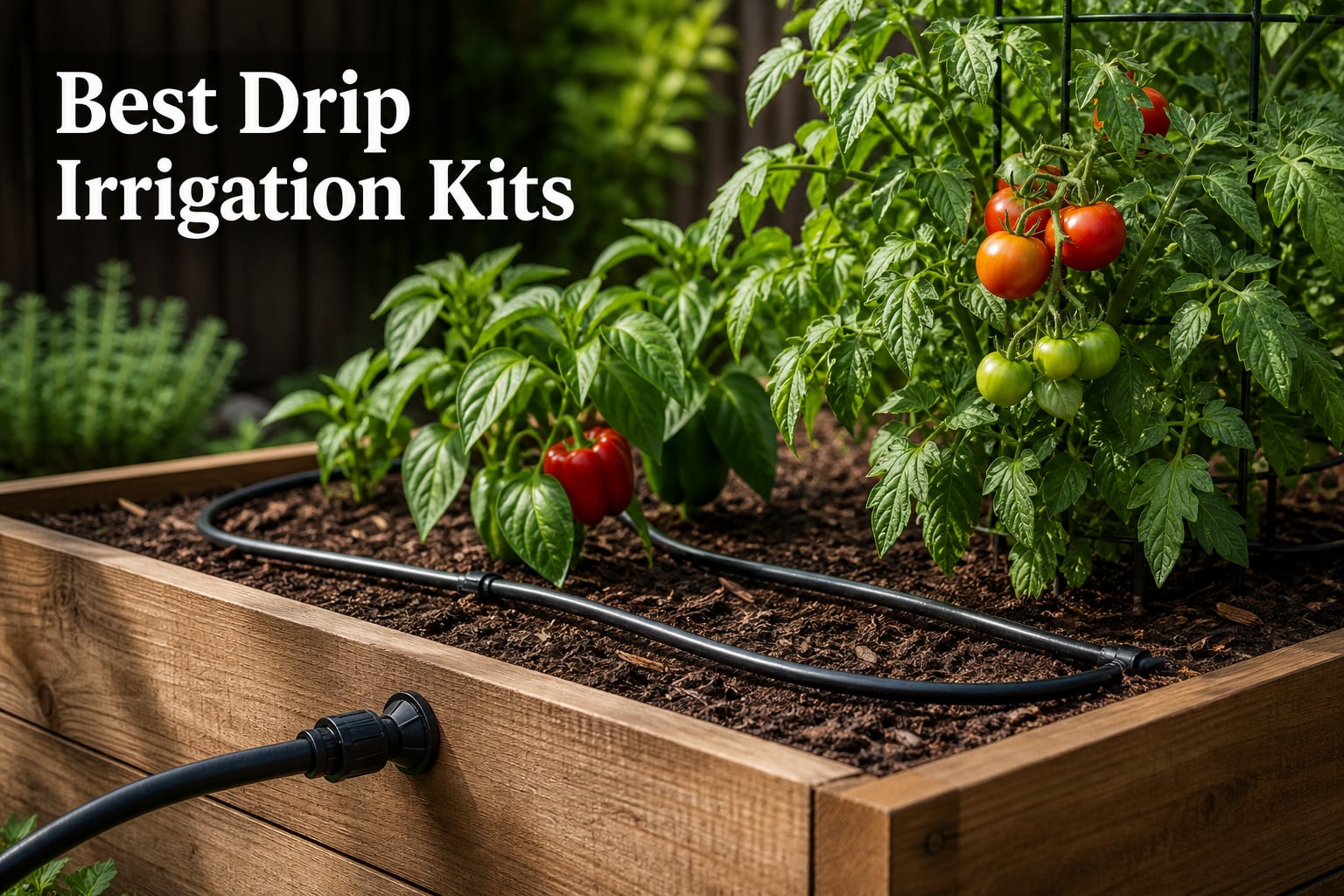
Hand watering a vegetable bed looks simple until a hot week turns it into a daily chore. The best drip irrigation kits deliver water at the soil line through tubing and emitters, so foliage stays drier and each plant can receive a more controlled drink than it would from a sprinkler.
For this 2026 guide, I compared six complete kits using their published tubing lengths, component lists, stated pressure information, fitting styles, ratings, review volume, and stated garden fit. I did not treat a large piece count as an automatic win: a kit has to match the shape of your beds, the number of plants, and the pressure coming from your spigot.
A good garden irrigation setup can reduce the water landing on paths and leaves, but no kit fixes a poor layout or a blocked emitter. Community discussions repeatedly point to the same trouble spots: leaks at loose connections, emitters that clog, not enough tubing for the plan, and instructions that leave first-time installers guessing.
My short answer is this: choose Rain Bird for one defined 4 by 8 foot raised bed, GGAQHLK or MIXC when you need long distribution runs and multiple spray patterns, CARPATHEN for a proven three-bed setup with cleanable emitters, Maotong for the biggest stated layout, and Orbit for a compact 10-plant tomato patch. Every kit below still needs a measured layout and a check of your water pressure before installation.
The top 3 picks answer the most common garden layouts in 2026
GGAQHLK is my Editor’s Choice for gardeners who want 230 feet of tubing, tool-free push connections, and several spray styles in one box. CARPATHEN earns Best Value because its 1,658-review record, UV-resistant tubing, and removable emitter heads make it a practical fit for up to three raised beds.
Maotong is the Budget Pick in the comparison because it brings 240 feet of tubing and 136 accessories for gardeners mapping a broad bed area. If one precise 4 by 8 foot bed is your whole project, Rain Bird is the more purpose-built alternative even though it is not in this three-card summary.
These best drip irrigation kits make comparison quick in September 2026
The table below puts the six kits side by side. Treat tubing length as a planning starting point rather than a promise that every foot will reach a plant; tees, turns, risers, and a route back to the spigot all consume material.
| Product | Specifications | Action |
|---|---|---|
| GGAQHLK 230FT Kit |
|
Check Latest Price |
 CARPATHEN System Kit CARPATHEN System Kit |
|
Check Latest Price |
 MIXC 230FT Quick-Connect MIXC 230FT Quick-Connect |
|
Check Latest Price |
 Rain Bird GARDENKIT Rain Bird GARDENKIT |
|
Check Latest Price |
 Maotong 240FT Kit Maotong 240FT Kit |
|
Check Latest Price |
 Orbit Tomato Garden Kit Orbit Tomato Garden Kit |
|
Check Latest Price |
1. GGAQHLK 230FT Kit is the most flexible all-around choice
230FT Drip Irrigation System for Garden with 38pcs Adjustable Copper Nozzles & Emitters, Automatic Garden Watering System with 1/2″ & 1/4″ Tubing for Raised Bed, Yard, Greenhouse, Potted Plants, Lawn
230 feet
38 nozzles
Push-connect fittings
Pros
- 230 feet of tubing
- Tool-free connections
- Three nozzle types
- Bendable copper nozzles
Cons
- Only 129 reviews
- No timer included
I would start with the GGAQHLK kit for a mixed garden where one line has thirsty containers, another passes a flower border, and a third feeds a vegetable row. Its stated 33 feet of 1/2 inch main tube and 197 feet of 1/4 inch distribution tube give you more routing freedom than the compact raised-bed kits.
The standout feature is choice. The kit lists 10 vortex emitters, 10 stream emitters, 10 misting nozzles, and eight bendable copper spray nozzles, so it can serve different plant positions without forcing every outlet into the same watering pattern.
The 1/2 inch tube is described as built for higher water pressure, and the supplied 1/2 inch tee can split the system into two independent zones. I still recommend running water through one open line before adding emitters, because debris caught during the first flush can cause later clogs.
Push-to-connect fittings are a friendly detail for a first installation: the product states that they do not need tools, heating, or glue. That does not remove the need to push each connection fully home and examine it under water pressure before covering or staking the line.
The GGAQHLK kit suits gardeners who need multiple watering patterns
This is the strongest fit when beds, pots, a greenhouse edge, or a lawn-side border share one water source. A stream pattern can reach a slightly offset root zone, while misting is better kept to uses where wet foliage is acceptable rather than sprayed indiscriminately over disease-prone vegetables.
I like that the eight copper nozzles can bend through 360 degrees, since a fixed sprayer can waste water on a path or sidewall. Put any spray nozzle low and aim it toward soil, then observe the pattern for a full cycle before leaving it unattended.
The GGAQHLK kit needs a deliberate zone map before setup
Thirty-eight nozzles offer range, but a branching design becomes confusing if each run is cut before the plan is clear. Sketch the spigot, mainline, branch points, and every plant group, then cut only after the long main run is in place.
The listing shows a one-year warranty and a 4.7 rating from 129 reviews, which is encouraging but smaller evidence than the high-volume CARPATHEN and MIXC records. Gardeners who want a kit defined around one bed rather than options may find the Rain Bird layout simpler to manage.
2. CARPATHEN is the dependable pick for up to three raised beds
CARPATHEN Drip Irrigation System Kit for Garden Watering, Sprinkler, 100 ft
100 feet
20 to 45 PSI
Cleanable emitters
Pros
- 1658 reviews
- UV-resistant tubing
- Easy-clean emitter heads
- Firm 7.5 inch stakes
Cons
- 100 feet total
- Manual adjustment
CARPATHEN is the kit I would choose when a modest raised-bed garden matters more than long-distance coverage. It includes 50 feet of 5/16 inch tubing plus 50 feet of 1/4 inch tubing and is described as serving up to three raised beds, giving it a more contained scope than the 230-foot systems.
The review history is meaningful context: this kit carries a 4.5 rating from 1,658 reviews. That is not proof that every installation goes perfectly, but it is a substantially larger body of buyer feedback than several other options in this list.
CARPATHEN states a 20 to 45 PSI working range and adjustable emitters that can be changed by rotating the cap. A stated output of up to 60 gallons per hour per emitter is high enough that cap settings and run time deserve attention; start slowly and inspect the soil rather than guessing.
Its UV-resistant tubing is listed for above-ground or underground installation, while the detachable emitter heads are designed to be cleaned. Those two details speak directly to frequent gardener complaints about sun exposure and emitters that eventually stop flowing.
The CARPATHEN kit works best for organized raised-bed watering
The 7.5 inch stakes have a sharp bottom intended to stay anchored in soil, which helps in a tidy bed where emitters must remain near plant bases. The included couplers and five tee splitters also make it reasonable to divide a main run between several nearby rectangular beds.
I would pair this system with a timer only after confirming that the hose connection and timer are compatible with your setup. The kit uses manual adjustment; a timer can automate when water arrives, but it cannot choose the correct emitter setting for a tomato, basil plant, or container.
The CARPATHEN kit is not the answer for a sprawling layout
Its total of 100 feet is the limiting fact. Measure the main path and branches with string first, then add room for tees and the distance from the spigot, because a garden that looks compact from above can consume tubing quickly.
The kit includes 10 vortex emitters and 20 spray emitters, so it favors gardeners comfortable checking several outlet types. If you want a single line with built-in, evenly spaced outlets for one standard bed, the Rain Bird GARDENKIT reduces that emitter-by-emitter decision.
3. MIXC 230FT Quick-Connect is the fastest route to a larger branching system
MIXC 230FT Quick-Connect Drip Irrigation System Kit, Automatic Garden Watering System with 1/4″ & 1/2″ Fast-Lock Tubing – Adjustable Nozzles & Sprinklers for Garden, Greenhouse, Lawn, Potted Plants
230 feet
73 pieces
Up to 32 emitters
Pros
- Quick-connect design
- 230 feet of tubing
- Up to 32 emitters
- Three watering modes
Cons
- 4.3 rating
- No timer included
MIXC is a sensible option for gardeners who want the reach of a 33-foot 1/2 inch mainline and 197 feet of 1/4 inch tube, but do not want to wrestle with a complicated connection method. The product describes its quick-connector system as plug-and-play and claims a 10-minute setup time.
I would treat that timing claim as a connection estimate, not a full garden-installation promise. Measuring, routing tubing around plants, mounting outlets, and checking every branch are the steps that take time, especially in a vegetable garden with uneven row spacing.
The 73-piece kit supports up to 32 emitters and offers micro-droplet, spray, and adjustable watering modes. That makes it a capable garden drip kit for a mix of raised beds, potted plants, greenhouse plants, and a patio edge that need different application patterns.
The available listing data show a 4.3 rating from 1,136 reviews. That is enough feedback to take seriously, though its average score sits below GGAQHLK and CARPATHEN, so I would pressure-test every fitting during the first run instead of assuming a large kit will be leak-free.
The MIXC kit fits gardeners who want many branches without long setup friction
Quick connectors are helpful when you are building a network with several divisions, replacing a route, or working in a greenhouse where you may want to shift container positions. They can make revisions less intimidating than a layout that relies on forcing many small barbed fittings into stiff tubing.
Each nozzle is individually adjustable, so use the same approach for all micro irrigation systems: begin with similar settings, then fine-tune only after looking at the moisture below the mulch or surface. A visible wet circle is not the same as even root-zone watering.
The MIXC kit calls for cautious pressure verification
The listing includes a maximum-pressure figure that does not line up with the practical pressure information supplied by the other kits, so I would not use it as a design target. A pressure regulator and filtration at the source are safer considerations for a dripline system than relying on a broad headline number.
MIXC does not include a timer in the listed component data. For an automatic watering system while you are away, add a compatible timer after the manual layout has passed a few supervised cycles and every emitter is delivering the intended amount.
4. Rain Bird GARDENKIT is the precise solution for one 4 by 8 foot bed
Rain Bird GARDENKIT Drip Irrigation Kit
4 by 8 foot bed
70 built-in emitters
25 PSI
Pros
- Purpose-built 4 by 8 layout
- Pressure-compensating emitters
- Illustrated manual
- Timer compatible
Cons
- Do not extend tubing
- One-bed focus
The Rain Bird GARDENKIT answers a very specific question well: how do I water one 4 by 8 foot raised bed evenly without designing a large branching network? It includes a 35-foot coil of emitter tubing with 70 built-in emitters at six-inch spacing, plus 25 feet of distribution tubing.
Rather than choosing and placing dozens of individual drippers, you arrange the emitter line through the bed. That pattern is particularly attractive for closely spaced greens, carrots, onions, or similar plantings where a single outlet per plant would be tedious to relocate as seedlings fill in.
The kit includes a regulator and is listed at 25 PSI. Its pressure-compensating emitters are designed to keep watering more even along the run, an important advantage when plants at the near end otherwise receive more water than plants at the far end.
I also give Rain Bird credit for including an illustrated manual, because unclear instructions are a regular forum complaint about entry-level kits. The listing says tubing can be surface installed or buried, so gardeners can choose between easy seasonal access and a cleaner-looking bed.
The Rain Bird GARDENKIT is best when bed dimensions are already fixed
This kit is designed for a 4 by 8 foot raised bed, not a loose collection of pots spread across a patio. The built-in emitter spacing makes sense when rows are close together and the goal is broad, even soil coverage rather than a targeted dripper at a single container.
It can be used with the separately sold Rain Bird 1ZEHTMR hose-end timer, according to the product information. I would first run it manually and dig a small inspection hole near both ends of the tubing route to see whether water is reaching the root zone evenly.
The Rain Bird GARDENKIT is intentionally limited in expansion
Rain Bird states that users should not extend the system with additional 1/4 inch tubing. That is a real limitation, not a minor detail: choose this kit when one raised bed is the project, rather than planning to join it to a future greenhouse or row garden.
The current rating is 4.3 from 124 reviews, so the component design matters more here than review scale. For a larger garden, select a system with a longer mainline and ordinary branch fittings, such as GGAQHLK, MIXC, or Maotong.
5. Maotong 240FT Kit covers the largest stated garden area
Maotong 240FT Drip Irrigation System Kit, Automatic Garden Watering Misting System for Greenhouse, Yard, Lawn, Plant with 1/2 inch Hose 1/4 inch Distribution Tubing and Accessories
240 feet
136 accessories
Up to 250 square feet
Pros
- Longest tubing length
- 136 accessory parts
- Two-system option
- Three sprayer types
Cons
- 4.2 rating
- Mixed buyer feedback
Maotong is built around scale. Its listed 240 feet comprise 40 feet of 1/2 inch mainline and 200 feet of 1/4 inch distribution tubing, and its stated coverage reaches up to 250 square feet or two separate areas of about 120 square feet each.
That makes it the most compelling option here for gardeners drawing out a long vegetable plot, a greenhouse plus a nearby bed, or two small gardens supplied from the same source. The 136 accessories and two faucet connectors make its two-system claim more than an afterthought.
It includes stream, vortex, and misting outlets: 10 stream emitters, 10 vortex emitters, and 20 misting nozzles are listed. Use those selections with care, because a broad mist can be useful for a suited application yet counterproductive on vegetable leaves when the goal is root-zone watering.
The kit is rated 4.2 from 1,313 reviews, with a higher 1-star share in the available review breakdown than the other larger kits. I would read that as a reason to keep spare accessories organized, test in short zones, and avoid committing all cuts until the system holds pressure.
The Maotong kit serves gardeners splitting one water source between two areas
The option to build two smaller systems can simplify a yard with a front flower bed and a backyard vegetable patch. Put the 1/2 inch mainline along the high-level route, then branch into the 1/4 inch lines only where you know plants will stay for the season.
Its stated 45 PSI maximum pressure is useful context, but a regulator remains wise where household pressure is variable. Small connectors and emitters respond poorly to unexpected surges, which is one common cause of sprays, popped fittings, and frustrating leaks.
The Maotong kit demands more setup checks than a one-bed kit
More accessories create more possible layouts, but they also create more places for a missed plug or a loose tee. I would set aside the unused parts by type, cap open ends during testing, and inspect branch joints one zone at a time before the final arrangement.
If low-maintenance reliability is your only goal, the pre-spaced Rain Bird tubing makes a cleaner decision for a single raised bed. Maotong makes more sense when its coverage length and configurable parts solve a real layout problem rather than merely adding options.
6. Orbit Tomato Garden Kit is the simple choice for 10 vegetables
Orbit 91944 Tomato Garden Drip Irrigation System – Complete 10-Plant Watering Kit with Push-Connect Fittings, Water-Saving Design for Vegetables & Garden Boxes
10 plants
50 feet
Push-connect fittings
Pros
- Made for 10 plants
- Tool-free push fittings
- Root-zone watering
- Reusable components
Cons
- 31 reviews
- Limited 10-plant capacity
The Orbit 91944 keeps the decision small and specific. It is a complete 10-plant watering kit for tomatoes, peppers, eggplants, and similar vegetables, with 50 feet of tubing, drippers, stakes, tees, and couplings.
I would recommend it to a beginner with a single garden box who wants a plan that has already been sized around a modest plant count. The push-connect fittings are designed to install without special tools, and the system attaches directly to a hose faucet or garden hose.
Orbit describes precision drip technology that delivers water directly to roots and says the parts are reusable from season to season. That direct placement is more useful for tomatoes than overhead watering, which can wet foliage and distribute water where plants cannot use it.
The evidence base is limited: it has a 4.1 rating from 31 reviews. The narrow focus is still a virtue if it matches your garden, but gardeners with plans for more than 10 plants should avoid stretching this kit past the stated design.
The Orbit kit is suited to a first tomato or pepper garden
A focused 10-plant system removes much of the early planning burden. Place each dripper beside the future root area instead of at the stem, and adjust its position outward as tomatoes and peppers establish a wider root system.
The listing says setup can be completed in under an hour, but use the spare time to run a supervised watering cycle. Check that the end plants receive water and that every tee is seated, then use a timer only if the version and hose connection support the schedule you need.
The Orbit kit is not intended for broad garden expansion
This is not the right pick for several raised beds, a long row garden, or containers scattered around a deck. The kit’s 50 feet and 10-plant design make it easy to comprehend, yet they also place a firm ceiling on the project.
Orbit lists a 30 PSI maximum pressure and a version with or without a timer. Confirm which variant you are considering, since the base kit’s water-saving drip design and the convenience of scheduled watering are separate decisions.
These buying rules help match a kit to your garden instead of its piece count
A drip irrigation system succeeds when the water source, bed shape, plant spacing, and emitter type agree. Before picking a box, measure the route from spigot to first bed, trace the mainline path with string, count the branches, and add enough margin for every turn and end cap.
Start with coverage and plant grouping before choosing tubing
Long-tubing kits are appropriate for a greenhouse, multiple beds, or an irregular vegetable garden, while a fixed 4 by 8 foot system is easier for one bed. Do not add every tubing segment together on paper without including the mainline from the faucet; this is how gardeners run short despite buying a kit with a big length claim.
Group plants with similar needs on the same branch when possible. Tomatoes, peppers, and eggplants can form one zone, while a container of herbs or a flower border may need a separate adjustment because potting mix and soil dry at different rates.
Use pressure regulation and filtration to prevent leaks and clogs
A pressure regulator reduces incoming water pressure to a level suitable for low-flow tubing and emitters. Rain Bird lists a 25 PSI setup, CARPATHEN lists a 20 to 45 PSI range, Maotong lists a 45 PSI maximum, and Orbit lists a 30 PSI maximum, so “full spigot pressure” is not a sound universal plan.
Add a filter or screen ahead of small outlets, especially if water carries sediment. Flush the line with the end open before fitting emitters, and clean removable heads periodically; CARPATHEN specifically lists detachable easy-clean emitter heads, while other kits should be checked against their manuals before disassembly.
Choose emitters by how roots need water, not by which spray looks strongest
Built-in emitter tubing, such as Rain Bird’s six-inch spacing, works well for dense rows and a full bed. Adjustable drippers work better where plants are far apart or vary in water needs, and spray or misting heads should be reserved for applications where their wider pattern will not constantly wet vegetable foliage.
A soaker hose can be simpler along a straight row, but it offers less control over individual plants and does not substitute for a branching micro irrigation layout around pots. In any system, hold the outlet near the soil and target the root zone, not the leaves or walkway.
Install the system in a sequence that makes leaks easy to find
First, connect the faucet adapter, filter if used, pressure regulator, and mainline. Second, lay out uncut tubing and use stakes or weights to confirm each branch can reach. Third, cut and attach branches, cap open ends, then flush the system before adding fine emitters.
Finally, run water for several minutes and walk the entire route. Look for a dry outlet, a geyser at a fitting, tubing that has slipped free, or a plant receiving a broad spray rather than a controlled drip, and fix one issue at a time before burying any line.
Use the 30-30 rule as a starting observation, not a fixed schedule
The 30-30 rule usually means watering for about 30 minutes every 30 days in a deep, infrequent schedule, but no universal rule fits every soil, plant, climate, or emitter flow rate. A container in heat can need attention far sooner, while established plants in heavy soil may need much less.
I would use the first cycle to inspect soil several inches down after watering, then change duration and frequency from what the roots actually receive. A timer is valuable for consistency, but it should repeat a measured schedule rather than preserve a poor one.
Winter care keeps tubing and fittings ready for the next season
Before freezing weather, disconnect the water source, drain the mainline and distribution tubing, and remove end caps so trapped water can escape. Coil tubing loosely rather than sharply bending it, dry removable emitters, and keep fittings in a labeled container away from sun and severe cold.
In spring, inspect tubing for cracks, clean filters and emitters, and run a flush before reconnecting every outlet. This modest routine addresses the two-season durability concern gardeners raise often and makes a blocked line easier to spot before seedlings depend on it.
FAQs
What is the best drip irrigation kit?
The best choice depends on the layout. GGAQHLK is the flexible all-around option with 230 feet of tubing and several nozzle types, Rain Bird fits one 4 by 8 foot raised bed, and Orbit is designed for a small 10-plant vegetable garden.
What are common problems with drip irrigation?
Common problems are clogged emitters, loose fittings that leak, uneven watering caused by pressure issues, tubing that falls short of the layout, and emitters placed too far from roots. Flush tubing before adding emitters, use filtration and regulation, and check the system while it runs.
What is the 30 30 rule for drip irrigation?
The 30-30 rule commonly refers to watering for around 30 minutes every 30 days, but it is only a starting point. Soil type, weather, plant maturity, and emitter flow determine the appropriate schedule, so inspect moisture below the surface and adjust run time.
Why will not my drip irrigation work?
Start by checking that the faucet is on, the timer is open, fittings are fully seated, and the end cap is in place. Then flush the line, clean blocked emitters, inspect for kinks or leaks, and confirm a pressure regulator or filter is not restricting flow incorrectly.
The right kit is the one that matches your measured watering plan
Among the best drip irrigation kits in 2026, GGAQHLK is my broad-use pick for its 230-foot layout, push connections, and nozzle variety. CARPATHEN is compelling for up to three raised beds and cleanable emitters, Rain Bird is the specialized 4 by 8 foot solution, Maotong provides the longest stated coverage, and Orbit keeps a 10-plant vegetable garden uncomplicated.
Measure first, regulate and filter the source, flush before fitting emitters, and supervise the first few watering cycles. Pick the kit whose stated capacity fits the garden you have now, not the one that asks you to force a complicated layout into it.