

The Best Well Water Filters do not start with a brand name; they start with a current water test. A private well has no municipal treatment plant managing the water after it reaches your property, so the right system depends on whether the report shows sediment, iron, manganese, sulfur odor, microbial contamination, high dissolved solids, hardness, or a combination.
The CDC statistic cited in our research is sobering: one in five private wells contains at least one contaminant above health-based standards. That does not mean every well needs the same large system, but it does mean taste, color, and odor alone are not reliable safety tests.
We reviewed six products using their listed filtration media, flow rate, capacity, installation design, warranty information, and customer-review patterns. This guide separates whole-house filtration from point-of-use reverse osmosis and UV treatment, because a strong setup for orange staining can still be the wrong answer for bacteria or dissolved solids.
Our main finding is simple: build treatment around the problem. Sediment needs a physical prefilter, sulfur odor needs media that targets hydrogen sulfide, microbial concerns call for properly placed UV or another verified disinfection approach, and a drinking-water goal may justify reverse osmosis at the kitchen rather than trying to treat every gallon in the home.
Top 3 Picks for Best Well Water Filters in 2026
These three picks cover the broadest set of buying situations: a high-flow whole-home system, a no-plumbing drinking-water unit, and a compact entry point for mild iron and sediment concerns. Read the individual reviews before choosing, especially if a laboratory report identifies bacteria, high TDS, or unusually heavy iron.


Best Well Water Filters in September 2026
The six products below are not interchangeable. Three are whole-house cartridge systems, one is a housing for a build-your-own prefilter, one is countertop reverse osmosis for drinking water, and one is a UV unit designed to follow other filtration.
That distinction matters at the tap. Whole-home treatment protects fixtures, laundry, showers, and appliances; a countertop RO unit treats a much smaller drinking-water supply; and UV treats microorganisms only after particles that can block light have been removed.
| Product | Specifications | Action |
|---|---|---|
| Express Water 3-Stage Whole House |
|
View Details |
 Bluevua RO100ROPOT Bluevua RO100ROPOT |
|
View Details |
 AquaWeaver WH-C10HD AquaWeaver WH-C10HD |
|
View Details |
 iSpring WGB31B-KDS iSpring WGB31B-KDS |
|
View Details |
 iSpring UVF20 iSpring UVF20 |
|
View Details |
| PUREPLUS 2-Stage Whole House |
|
View Details |
1. Express Water 3-Stage Whole House System Is the Best High-Flow Whole-Home Pick
Express Water Whole House Water Filter System, Ultimate Protection, 3-Stage
17 GPM
3 stages
100k gallons
Pros
- 17 GPM flow
- pressure gauges
- stainless stand
- anti-scale media
Cons
- Does not reduce TDS
- heavy installation
- cartridge changes
The Express Water system is the clearest fit here for a household that wants filtration at every fixture without accepting a low-flow bottleneck. Its listed 17 GPM rate, one-inch connection, and freestanding stainless-steel frame make it more appropriate for whole-home service than a small under-sink or countertop unit.
Its three stages combine activated carbon, KDF, and polyphosphate. The listed targets include chlorine, heavy metals, and scale-related issues, while the polyphosphate stage is intended to help protect pipes and appliances from mineral buildup.
We like the practical monitoring details: there is a pressure gauge for each stage plus pressure-release buttons for changing filters. Customer feedback in the supplied review summary repeatedly calls out clearer water and improved taste, and the 4.6 rating comes from 412 reviews.
The key boundary is equally important. This system does not reduce TDS, so a salty or metallic result tied to dissolved solids is not a problem it claims to solve; pair a drinking-water RO unit with it only after testing identifies that need.
The Express Water system suits busy homes with strong flow demand
A listed 17 GPM flow rate gives this unit headroom for homes where showers, laundry, and kitchen use overlap. A whole-house water filter should be placed after the pressure tank and ahead of the branch lines, so all indoor fixtures benefit from the treatment train.
The system weighs 63 pounds and measures 29 by 8.5 by 30 inches, so plan a stable service area with room below the housings. The freestanding format can be helpful when wall space is limited, but it is not a casual countertop installation.
The Express Water system needs a separate answer for TDS or microbes
Use the product for the concerns its listed media addresses, not as a blanket promise against every well contaminant. If a lab report finds coliform bacteria or another microbial issue, a correctly sized downstream UV stage or a professionally chosen disinfection method deserves separate attention.
For high dissolved solids, use point-of-use reverse osmosis for drinking and cooking water rather than expecting carbon, KDF, or polyphosphate to do RO work. This is a common source of disappointment in well-water discussions, where one system is often asked to fix several unrelated water problems.
2. Bluevua RO100ROPOT Is the Best No-Plumbing Drinking-Water Choice
Bluevua RO100ROPOT Countertop Reverse Osmosis Water Filter System
6-stage RO and UV
Glass carafe
No plumbing
Pros
- No plumbing
- UV stage
- glass carafe
- TDS monitor
Cons
- Slow output
- needs power
- 500 ppm TDS limit
The Bluevua RO100ROPOT is a drinking-water appliance, not a substitute for a whole-house well water filtration system. Its major appeal is direct: it sits on the counter, needs no plumbing connection, and uses six stages that include a 0.0001-micron RO membrane, UV treatment, and a remineralization filter.
This is the most compelling option in the roundup for renters, smaller households, or anyone who wants more refined water at the kitchen without changing the home’s main plumbing. The borosilicate glass carafe avoids storing treated water in plastic, and the built-in display monitors TDS and filter life.
The product listing reports a 2:1 pure-to-drain ratio, which is a useful efficiency detail for an RO system. Its review record is also the deepest in this group: 4.5 stars from 1,437 reviews, with customer feedback frequently praising the taste and no-installation setup.
We would treat its stated 500 ppm maximum supported TDS level as a firm shopping checkpoint. Test first if the water tastes salty or metallic, because a high-TDS result beyond that limit points to a different solution or professional guidance.
The Bluevua RO100ROPOT makes sense for drinking and cooking water
The 1,700 ml carafe and listed output rate of 0.26 liters per minute frame this as a batch drinking-water machine. Fill the carafe before a day of cooking, coffee, baby-formula preparation, or a household meal rather than expecting instant, whole-home volume.
Its RO membrane can address the dissolved-solids gap left by the cartridge systems in this list. That complementary role matters: many well owners use a sediment and carbon sequence for the house, then keep RO at the kitchen for the water they drink most often.
The Bluevua RO100ROPOT is not built for showers or untreated cloudy water
It cannot supply a shower, washing machine, or several faucets at once, and it requires a power source. The ultraviolet stage also does not turn visibly dirty source water into an appropriate UV feed; sediment should be handled upstream in any whole-home plan.
Use the stated 12-to-24-month filter life as a planning range, not a promise independent of water chemistry. A source with high sediment or a TDS result near the product limit can change maintenance needs, which is why we would retain the initial test report with the unit’s service notes.
3. AquaWeaver WH-C10HD Is the Best Customizable Sediment Prefilter Housing
AquaWeaver WH-C10HD 10″ x 4.5″ Whole House Water Filter Housing, Clear
20 GPM
4.5 by 10 inch housing
Clear monitor
Pros
- 20 GPM
- universal cartridge fit
- double O-rings
- pressure relief
Cons
- Housing only
- few reviews
- needs chosen cartridge
The AquaWeaver WH-C10HD is different from the ready-to-run systems because it is a filter housing, not a complete filter package. That makes it a flexible first-stage choice for a homeowner who has test results, understands the cartridge type needed, and wants to build a treatment sequence around a standard 4.5 by 10 inch cartridge.
Its listed 20 GPM flow rate and one-inch brass ports are well matched to a high-flow sediment filter for well water. The clear reinforced-polypropylene housing lets you see accumulated debris, while the double O-rings and pressure-release button target the two basic worries of cartridge maintenance: leaks and changing a pressurized canister.
The supplied customer-review summary describes a positive response to the seal design and visual monitoring, but the 4.5 rating is based on only 40 reviews. We would give more weight to its construction details and universal cartridge compatibility than to a small review sample.
Do not read “universal” as “automatic.” The housing does not include the cartridge, so its removal performance depends entirely on the media you install and the water conditions it faces.
The AquaWeaver housing works best as the physical first stage
For sand, silt, rust particles, or visible turbidity, a correctly selected sediment cartridge in this housing can protect the finer media that follows. That role can extend the useful life of carbon, specialty iron, and UV components by taking out larger particles first.
Our reading of homeowner discussions matches this setup: multi-stage systems often begin with a coarse prefilter because wells can send unexpected debris after storms, pump work, or seasonal water-table changes. Select a micron rating from the test and sediment pattern rather than buying the smallest rating by default, which can restrict flow and clog too fast.
The AquaWeaver housing requires cartridge choices and light protection
Because it is only the housing, it does not make a contaminant claim by itself. You still need to choose the cartridge, change interval, and whether a second or third stage is needed for your particular iron, manganese, carbon, or sediment goal.
The clear body is convenient for inspection, but the product data warns that clear housings can promote algae growth if exposed to UV light. Mount it out of direct sunlight and leave access for the included wrench, bracket, and pressure-release button.
4. iSpring WGB31B-KDS Is the Best Compact Whole-House Pick for Sulfur Odor
iSpring WGB31B-KDS Ultimate Protection Whole House Water Filter System
15 GPM
3 stages
Hydrogen sulfide and scale focus
Pros
- Sulfur focus
- 15 GPM
- compact wall mount
- technical support
Cons
- Does not reduce TDS
- limited reviews
- 50k gallon capacity
The iSpring WGB31B-KDS is the most targeted whole-house option here for a well with an unpleasant sulfur smell alongside scale and heavy-metal concerns. Its listed three-stage layout combines a heavy-metal filter, a scale inhibitor, and a carbon block, with hydrogen sulfide among its stated targets.
A rotten-egg odor is a familiar well-water complaint, but the cause should be confirmed before purchase. This iSpring model gives a focused option when the test and source assessment support hydrogen sulfide treatment, rather than treating odor as a simple taste issue.
The compact wall-mount body measures 24.5 by 5 by 18 inches and has a stated 15 GPM rate. It is a good physical fit where a larger tank system is impractical, while still being designed for water entering the whole house.
Its 4.5 rating comes from 22 reviews, a much smaller sample than the Express Water or Bluevua products. The product includes a one-year limited warranty and lifetime technical support, which we see as useful when an installer needs clarity on cartridge sequence or maintenance.
The iSpring WGB31B-KDS matches sulfur odor and scale-focused treatment plans
The listed scale inhibitor is intended to reduce calcium and magnesium buildup, while the carbon block contributes to taste and odor improvement. This can be attractive for a house where shower doors, fixtures, or appliances show mineral-related buildup alongside a sulfur smell.
Still, a water softener serves a different purpose from a scale inhibitor. If a hardness test calls for softening, compare the actual hardness result and household water use with softener sizing rather than assuming a cartridge stage will provide the same result.
The iSpring WGB31B-KDS needs testing for iron, bacteria, and TDS limits
The product data states that it retains healthy minerals and does not reduce TDS. It should not be selected as the drinking-water answer for a TDS problem, and it is not a bacterial disinfection device.
The listed 50,000-gallon capacity and 12-month filter cycle give a maintenance starting point, but challenging water can shorten cartridge life. Watch the system’s pressure behavior and inspect the source after major changes in color, odor, or sediment; those events can tell you more than a calendar alone.
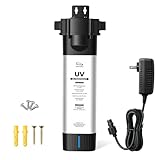
5. iSpring UVF20 Is the Best Long-Life UV Add-On for Microbial Treatment
iSpring UVF20 Whole House LED UV Water Filter, 3/4″ MNPT Inlet Outlet
12 GPM
LED UV
Automatic flow sensor
Pros
- Long-life LED
- mercury-free
- flow sensor
- instant startup
Cons
- Needs prefiltration
- 12 GPM maximum
- limited reviews
The iSpring UVF20 is a specialized downstream component, and that is its strength when it is placed correctly. It uses LED ultraviolet treatment with a listed 8,000-hour module rating, automatic flow sensing, and a claim of up to 99.99% microorganism reduction.
For a well with a confirmed microbial concern, UV is attractive because it operates without chemical dosing and the unit uses a mercury-free LED module. It also starts instantly rather than needing a warm-up period, which is a practical difference from some traditional UV designs.
Its listed service life is up to 11 years, yet that should not distract from the main design rule: UV must be downstream of main filtration. Particles, cloudiness, and mineral scale can interfere with UV exposure, so the source water needs appropriate pretreatment.
The unit’s 4.3 rating comes from 19 reviews. We regard it as a new, purpose-specific component with sensible published design details, not as a single-box solution for untested well water.
The iSpring UVF20 belongs after sediment and media filtration
Install it after the sediment, iron, and carbon stages that make water clear enough for UV treatment to work as intended. The product listing explicitly says it must be installed downstream of the main filtration system, and that placement is non-negotiable for a well that carries visible particles.
At up to 12 GPM, match the unit to actual peak household demand rather than the number of people in the home alone. A home with several simultaneous showers, irrigation, or high-flow fixtures may need a professional flow assessment before a 12 GPM component is chosen.
The iSpring UVF20 treats microorganisms but does not remove minerals or sediment
UV does not filter sand, reduce dissolved solids, remove hardness, or solve iron staining. It addresses a microbial-treatment role, so its best companion is a treatment train that first takes care of the physical and chemical issues documented by the water test.
A failed bacteria test also calls for a conversation about the well itself, including cap condition, flooding, plumbing, and possible shock chlorination under local professional guidance. Treat the filter as part of a source-to-tap plan, not a reason to skip follow-up testing.
6. PUREPLUS 2-Stage Whole House System Is the Best Entry-Level Iron and Sediment Setup
PUREPLUS 2-Stage Whole House Water Filter, Clear Housing, for Well Water
2 stages
Iron and sediment media
Carbon block
Pros
- Iron and sediment stage
- clear housings
- pressure gauge
- compact size
Cons
- Short filter life
- 4.1 rating
- limited heavy-duty coverage
The PUREPLUS 2-Stage system gives a compact starting point for a well with mild sediment and iron or manganese concerns. Its first cartridge combines polypropylene sediment filtration with iron-removal media, followed by a natural coconut activated-carbon block intended to help with chlorine, taste, and odor.
That two-stage sequence is easy to understand and can be useful where space is limited. The standard 10 by 4.5 inch housing size also gives the owner a familiar cartridge format, and a pressure gauge helps show when restriction is building across the system.
We would approach this system with a realistic maintenance plan. The listed cartridge life is three to six months depending on water quality, and the 4.1 rating from 76 reviews includes an 11% one-star share in the supplied rating distribution.
Those facts do not rule it out; they mean it is best reserved for a modest, well-defined job instead of a severe multi-contaminant source. A household with heavy iron, recurring bacteria results, sulfur odor, or high TDS should move up to a more complete treatment plan.
The PUREPLUS system fits mild well-water staining and taste concerns
The dual-function first cartridge targets the common pairing of visible sediment and iron or manganese, while the carbon block supports the taste-and-odor side. Its 30,000-gallon listed capacity makes it a practical entry-level choice when water quality is relatively stable and maintenance access is easy.
Clear housings let you see condition changes without guesswork, and the pressure gauge gives a second signal that a change is due. Use both signals along with the manufacturer’s service guidance instead of waiting for the water to look or taste bad again.
The PUREPLUS system needs more support for demanding wells
The product data identifies a 40-degree Fahrenheit minimum operating temperature, a detail worth checking in an unheated pump room or cold-climate installation. Protect the housing from freezing and do not place any cartridge system where a leak would damage finished living space.
Carbon block filtration has limits with heavy contaminant loads, and no flow-rate figure is supplied for this model. Before making it the main treatment device for a larger house, ask whether its real-world flow under your source conditions can meet shower and appliance demand at the same time.
Choose a Well Water Filter by Testing First, Then Matching the Contaminant
The correct buying sequence is: test the raw well water, identify the contaminants and concentrations, check peak flow demand, then select the treatment stages. Buying before testing can leave you with a nice-looking filter that does not address the actual issue.
At minimum, a well-water test should help you understand bacteria, nitrate, iron, manganese, hardness, pH, total dissolved solids, and the items relevant to local geology or nearby land use. If there is a sudden change in taste, odor, color, flooding exposure, or a new household health concern, retest rather than relying on an old result.
Test results answer what each treatment stage must do
Sediment or sand calls for physical prefiltration. Iron can cause orange or red staining, manganese can leave dark staining, and hydrogen sulfide is often associated with a rotten-egg odor; each points to a different media choice and should not be lumped into “bad water.”
Bacteria calls for disinfection planning, often including a UV stage after filtration. High TDS is a separate dissolved-solids question, and the Bluevua’s RO design is the only reviewed product positioned for that type of drinking-water treatment.
Hardness is also its own measurement. A scale inhibitor may help with buildup, but a well water softener based on ion exchange is a separate treatment category when a hardness result warrants it.
Whole-house, RO, UV, and cartridge systems solve different problems
A whole-house system belongs at the main entry point and protects all household water. The Express Water, iSpring WGB31B-KDS, and PUREPLUS products fill that role in different degrees, while the AquaWeaver housing provides the structure for a custom first stage.
Reverse osmosis is usually point-of-use, producing smaller volumes of refined water for drinking and cooking. UV is a microbial-treatment stage that should follow sediment and media filtration, not replace it.
For a multi-contaminant well, a common treatment train starts with sediment, then contaminant-specific media, then carbon if appropriate, then UV for a verified microbial need. Add a kitchen RO unit only if the drinking-water goal and test result support it.
Flow rate tells you whether the system will feel normal at home
GPM means gallons per minute, and it is a practical comfort measurement. A household can have safe water and still dislike the system if a restrictive filter makes showers weak when a washing machine fills.
Compare listed flow with your peak use, not quiet overnight use. The Express Water’s 17 GPM, AquaWeaver’s 20 GPM housing, iSpring WGB31B-KDS’s 15 GPM, and UVF20’s 12 GPM are published figures, but fittings, cartridge loading, pressure, and source conditions change what happens after installation.
We would use a qualified plumber or water-treatment professional when flow demand is uncertain. That is especially sensible for a large home, a deep well with variable pump performance, or an existing setup that already loses pressure.
Cartridge capacity and service access determine the maintenance burden
Do not compare only the number of filter stages. Look at the stated capacity, filter-life interval, whether pressure gauges are included, whether housings have pressure-release buttons, and how much room is available to remove a cartridge without making a mess.
The Express Water lists 100,000 gallons and a six-to-12-month life range; iSpring WGB31B-KDS lists 50,000 gallons and 12 months; PUREPLUS lists 30,000 gallons and three to six months. These are manufacturer figures that vary with well quality, so a pressure drop and changing water appearance should trigger inspection.
Homeowner discussions gathered in the research repeatedly warn that cartridge changes can become frequent on sandy or high-iron wells. A properly chosen sediment first stage can reduce that burden on the finer stages that follow.
Installation should include shutoffs, bypasses, and a protected service area
A whole-house system is much easier to service when there are shutoff valves on both sides and a bypass that can keep water moving during maintenance. Install equipment after the pressure tank, leave clearance below housings, and keep it in a location protected from freezing and direct sunlight.
DIY can be reasonable for a compact, accessible cartridge system if you understand plumbing, support the weight of the equipment, and test carefully for leaks. A professional is a wiser call when adding UV, working with a severe contaminant result, changing main-line pipe, sizing for multiple bathrooms, or connecting systems in series.
The countertop Bluevua avoids plumbing work, but it still needs a clean place near power and a routine for cleaning the carafe. Simplicity at the counter can be preferable when a whole-home retrofit is not feasible.
Certification claims should be read for the exact contaminant and product
A certification is useful only when it applies to the specific model and performance claim you care about. The Bluevua product data lists WQA certification against NSF/ANSI/CAN 372 for lead-free status; that is not the same thing as a broad certification for every reduction claim shown in a product listing.
Ask for documentation that matches the tested contaminant, operating conditions, and replacement schedule. Do not assume a general statement about filtration proves performance against bacteria, nitrates, arsenic, or dissolved solids.
This is where a water test makes the research manageable. Once you know the target, you can check the filter media and any certification claim against that one question rather than trying to decode every acronym on the box.
Visible clues can start the investigation but cannot replace a laboratory test
Orange fixture stains can point toward iron, dark stains can point toward manganese, and a rotten-egg odor can point toward hydrogen sulfide. Cloudiness or grit may suggest sediment, while metallic or salty taste can accompany dissolved solids.
Those clues help you decide what to test for, but they cannot confirm concentration or safety. Clear, odor-free water can still contain contaminants that you cannot see, which is why private-well treatment should be anchored to results rather than appearance.
Keep a copy of every test and record filter changes, pressure observations, and unusual weather events. That basic history makes it far easier to spot whether a new issue comes from the well, a depleted cartridge, or a change in household demand.
FAQs
What is the best well water filtration system for drinking water?
The best drinking-water choice depends on a current test. Of the products reviewed, the Bluevua RO100ROPOT is the most direct drinking-water option because it combines reverse osmosis, UV treatment, remineralization, a glass carafe, and no-plumbing setup. It is for countertop drinking and cooking water, not whole-home flow.
What kind of water filter is best for well water?
The best type matches the contaminant: sediment filtration for sand or silt, contaminant-specific media for iron, manganese, or hydrogen sulfide, UV after pretreatment for microbial concerns, and reverse osmosis at the point of use for dissolved-solids drinking-water goals. Start with a laboratory water test rather than choosing one filter type for every well.
Should well water be filtered for drinking?
Well water should be tested before deciding on filtration because private-well owners are responsible for water quality. Research supplied for this guide cites CDC information that one in five private wells has at least one contaminant above health-based standards. Filter choice should address the specific results, and a current test is more reliable than taste or appearance.
What is the best water filter for a deep well?
A deep well does not automatically require one specific filter. Choose based on raw-water results, pump capacity, and household peak flow. A high-flow whole-house system such as the listed 17 GPM Express Water model can suit broad filtration needs, while UV, RO, iron media, or sediment stages should be added only when the test identifies those needs.
How can I naturally purify my well water?
Do not rely on natural remedies to make unknown well water safe. Protect the well cap and surrounding drainage, test the water regularly, and use treatment matched to verified results. Sediment filtration, certified contaminant-specific media, reverse osmosis, or UV are mechanical treatment methods; a water test and local professional guidance are appropriate for bacteria or serious contamination.
The Best Well Water Filters Choice Is the One That Matches Your Test
The Express Water 3-Stage system is our top whole-home choice for its 17 GPM flow, three treatment stages, 100,000-gallon listed capacity, and useful pressure monitoring. Bluevua is the focused pick for countertop RO drinking water, while the iSpring UVF20 belongs downstream when a properly prepared water supply needs microbial treatment.
For Best Well Water Filters in 2026, do not buy based only on odor, a neighbor’s setup, or the number of stages. Start with a current well-water test, match each treatment stage to the documented problem, and choose a configuration you can service safely for the long term.