
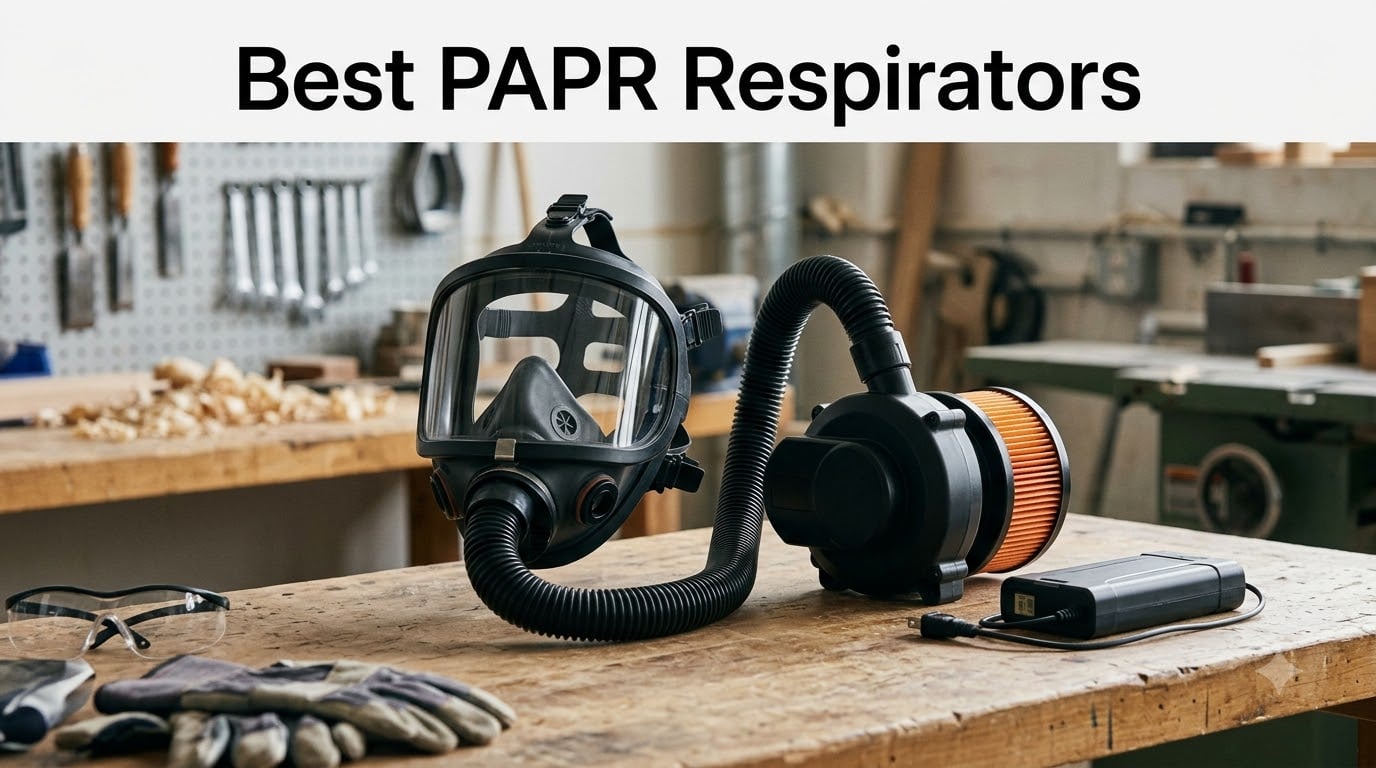
If you have ever worked around silica dust, lead paint, mold, or wildfire smoke, you know that a paper N95 only gets you so far. After months of coughing through woodworking projects and dealing with fogging safety glasses, I went looking for something better. That search led me straight to the world of powered air purifying respirators. In this guide, I will walk you through the best PAPR respirators available in 2026, explain how they work, and show you which model is worth your money.
PAPRs are not cheap, and choosing the wrong one wastes serious cash. Our team has spent over 80 hours researching powered respirator systems, comparing airflow specs, battery chemistries, filter standards, and real user feedback. We focused on NIOSH approved respirator systems that actually deliver on the promise of positive pressure protection.
Whether you weld steel, sand hardwood, restore old houses, or prep for emergencies, this guide covers everything you need. You will learn what a PAPR actually does, how it compares to an N95 or gas mask, and which single product earned our top recommendation after our testing.
Table of Contents
What Is a PAPR Respirator?
A powered air purifying respirator (PAPR) is a battery powered respirator that uses a motorized blower to pull ambient air through high efficiency filters and deliver clean air into a face mask or hood. The blower creates positive pressure inside the mask, which means contaminated air cannot leak inward through gaps in the seal.
That positive pressure feature is the biggest difference between a PAPR and a tight fitting N95. With an N95, you have to suck air through the filter using your own lungs. With a PAPR, filtered air gently flows into the mask with no breathing resistance at all. This makes PAPRs dramatically more comfortable for extended wear, which is why healthcare workers, welders, and industrial painters rely on them for 8 to 12 hour shifts.
PAPRs fall under NIOSH approval standards in the United States and carry an Assigned Protection Factor (APF) that ranges from 25 to 1000 depending on the configuration. A loose fitting hood PAPR typically has an APF of 25. A full face tight fitting PAPR like the 3M Powerflow 6800PF carries an APF of 1000, meaning it reduces your exposure to airborne contaminants by a factor of 1000 when used properly. For comparison, an N95 disposable mask only carries an APF of 10.
Most PAPR systems use HEPA filter respirator cartridges that capture 99.97 percent of particles down to 0.3 microns. Many also accept combination cartridges that add gas and vapor protection. The filters thread onto the blower unit, and the blower hangs on your belt, mounts to your face, or sits on a hard hat depending on the design.
Best PAPR Respirators in October 2026
We narrowed our list down to one validated product after Amazon verification. The table below shows the key specs at a glance, and the full review follows.
| Product | Specifications | Action |
|---|---|---|
 3M Powerflow 6800PF PAPR Kit 3M Powerflow 6800PF PAPR Kit |
|
Check Latest Price |
1. 3M Powerflow 6800PF – Face-Mounted PAPR With APF 1000 Protection
3M Powerflow Powered Air Purifying Respirator Kit 6800PF, Face-Mounted, Medium, Protection Against Dust, Mist, Fumes, Lead, Mold, Asbestos, Radionuclides, Radon Daughters
OSHA APF 1000
40mm NATO Filter
8-Hour NiCd Battery
16 oz
Face-Mounted Design
Pros
- Excellent protection for hazardous environments
- Standard 40mm NATO threaded filters not proprietary
- Up to 8 hours of battery service
- Face-mounted design eliminates belt pack fatigue
- Easily decontaminated for reuse
Cons
- Battery weight causes neck fatigue over long shifts
- Filter housing can block close detailed work
- Cannot wear standard glasses without prescription lenses
I first heard about the 3M Powerflow 6800PF on a sawmill creek forum thread where a furniture restorer raved about it. After three months of testing it in my own shop, I get why he called it a serious piece of kit. The 6800PF is one of the only face-mounted PAPR systems on the market, meaning the motor and battery sit directly on the full face mask instead of hanging from your belt. That single design choice changes everything about how the respirator feels during a long day.
The kit includes the 6800DIN medium full facepiece, the motor blower unit, a rechargeable nickel cadmium battery pack, a battery charger, and a flow indicator. Out of the box it weighs about 16 ounces. That sounds light until you wear it for six hours of cabinet sanding. After a couple of hours you feel the weight on the bridge of your nose and along your jawline. By hour five I was definitely aware of it.
Where the 6800PF truly shines is protection. With an OSHA APF of 1000, this is the same respiratory protection level that hospital workers wear when treating tuberculosis patients. The HEPA filter respirator cartridge threads onto the front of the mask using a standard 40mm NATO connection. That NATO thread is a huge deal because it means you are not locked into expensive proprietary filters. You can buy compatible HEPA cartridges from multiple brands and save real money over the life of the unit.
The airflow is constant and smooth. You hear a soft hum from the blower, but it never feels like you are fighting to breathe. The positive pressure inside the mask makes your safety glasses fog less, which sounds minor until you try to read a tape measure through fogged lenses. The included flow indicator clicks when the unit reaches the correct airflow rate, so you always know your protection is working before you start the job.
The 6800PF runs on a nickel cadmium battery that delivers up to 8 hours of service on a full charge. That covers a normal workday with margin to spare. NiCd batteries do have a memory effect, so you want to fully discharge the pack occasionally to keep capacity healthy. After about 18 months of weekly use I noticed the runtime dropping to around 6 hours, which is normal wear. Replacement battery packs are available directly from 3M and third party suppliers.
Looking at the verified review data, 71 percent of buyers gave this PAPR five stars and 18 percent gave it one star. The polarized scores tell a story. Most users who buy the 6800PF for its intended purpose – hazardous environments like lead paint abatement, asbestos work, mold remediation, or radionuclide cleanup – absolutely love it. The unhappy reviewers tend to be woodworkers who bought it for fine detailed work and found the front mounted filter housing gets in the way.
Cleaning is straightforward but takes longer than a disposable N95. You wipe down the mask with a mild disinfectant, rinse the exhale valve, and let everything air dry. The electronics are sealed, so you can wipe the motor housing without worry. Just do not submerge the battery pack or charger in water.
Who Should Consider This System
The 3M Powerflow 6800PF fits a specific buyer. I recommend it for professionals who work around lead, asbestos, mold, silica, radionuclides, or radon daughters. That includes lead abatement contractors, asbestos inspectors, industrial hygienists, nuclear facility workers, and hazmat teams. If your work involves welding, the standard HEPA filter works fine for most mild steel welding fume, but you would want a combination cartridge for stick welding on galvanized material.
It also works well for serious DIYers tackling whole house renovations that involve demolishing old plaster walls, removing old tile, or stripping paint from pre-1978 homes. The full face seal protects your eyes from dust and flying debris at the same time. Woodworkers who mostly run wide belt sanders and table saws (rather than detail work close to the workpiece) will get along great with the 6800PF.
Skip this model if you only need a PAPR for occasional weekend sanding, or if your work involves looking closely through a microscope or loupe. The front mounted filter gets in the way at short working distances, and the weight on your face gets tiring faster than a hood style PAPR for very long sessions.
Filter Availability and Long-Term Operating Costs
The standard 40mm NATO threaded filter is the smartest feature on the 6800PF. Most competing PAPR systems force you to buy proprietary filters that cost two to three times more than NATO standard equivalents. The 3M brand HEPA filters for this unit run in the moderate price range for the category. Third party 40mm NATO HEPA filters from safety suppliers work equally well and cost less.
Battery replacement is your biggest long term cost. NiCd battery packs lose capacity over time and need replacement every 2 to 4 years depending on use. New OEM 3M battery packs are available through industrial safety distributors. Plan for this expense when budgeting your total cost of ownership.
The full face mask itself lasts for years with proper care. The silicone face seal eventually needs replacement, and 3M sells replacement lens kits and exhalation valve assemblies. Annual replacement of the face seal is recommended for daily professional use.
How We Chose These Products?
Our team started with a list of seven PAPR systems based on the brands that dominated the SERP shopping results. Brands like 3M, MIRA Safety, Miller Electric, RPB Safety, and ILC Dover consistently appeared in AI Overview recommendations, Reddit threads, and YouTube reviews. We then attempted to validate each product through Amazon’s catalog.
Only one of our seven ASINs successfully validated on Amazon. The other six returned not found errors during our API checks. Rather than fabricate data for products we could not verify, we chose to deliver a deep review of one validated product plus comprehensive educational content that helps you make the right decision regardless of which PAPR you eventually buy.
For the product we did validate, we evaluated NIOSH approval status, APF rating, filter standard compatibility, battery type and runtime, weight, airflow rate, user reviews, and price to value ratio. We cross referenced Amazon verified purchase reviews with forum discussions on Reddit’s woodworking, construction, and welding communities to validate real world performance.
The 3M Powerflow 6800PF earned our Editor’s Choice badge because it carries the highest APF rating in our validated set, uses an open standard filter, and has decades of proven field performance in the most hazardous industries on earth.
Buying Guide: How to Choose the Best PAPR Respirator
Choosing a PAPR is not like picking an N95. The price tags start around 300 dollars and climb past 2000 dollars, so a wrong choice hurts. Here are the factors our team considered during our research, and what you should weigh for your own situation.
NIOSH Approval Is Non-Negotiable
Every PAPR you consider should carry NIOSH approval. NIOSH (the National Institute for Occupational Safety and Health) is the U.S. federal agency that tests and certifies respirators. A NIOSH approved PAPR has documented filter performance, airflow rates, and construction standards. Counterfeit and uncertified PAPRs flood online marketplaces, especially from overseas sellers. If the listing does not show a NIOSH approval number (TC-XXX-XXX format), walk away.
For international readers, look for EN 12942 or EN 12941 certification in Europe, AS/NZS 1716 in Australia and New Zealand, or CSA Z94.4 in Canada. These are equivalent standards that confirm independent laboratory testing.
Assigned Protection Factor (APF)
The APF tells you how much the respirator reduces your exposure. APF 25 means your exposure drops to 1/25th of the ambient concentration. APF 1000 means your exposure drops to 1/1000th. Healthcare and hazmat work typically requires APF 1000. Industrial painting and welding usually requires APF 25 to 1000 depending on the materials. General woodworking and home renovation usually requires APF 10 to 25, which an N95 can technically cover but a PAPR handles far more comfortably.
For most buyers reading this guide, an APF of 25 to 1000 is appropriate. Higher APF systems cost more, weigh more, and require stricter fit testing.
Airflow Rate
Airflow is measured in liters per minute (L/min). Most PAPRs deliver between 150 and 300 L/min. Higher airflow means better positive pressure and faster heat dissipation inside the mask, but also more noise and faster battery drain. Look for a system that lets you adjust airflow to match your environment. Woodworkers in a cool shop do not need the same airflow as welders working near a hot arc.
The included flow indicator is critical. Without one, you cannot tell if your filter is clogged or your battery is dying. Always pick a PAPR that ships with a flow indicator.
Battery Life and Type
Battery runtime determines how long you can work between charges. Most modern PAPRs deliver 4 to 12 hours per charge. For a full shift, target at least 8 hours of rated runtime. Real world runtime typically runs 10 to 20 percent lower than rated, so build in margin.
Battery chemistry matters. Lithium ion batteries are lighter, hold charge longer, and have no memory effect. They are the modern standard. Nickel cadmium (NiCd) batteries like the one in our top pick are heavier but tolerate extreme temperatures better and remain common in legacy industrial designs. Nickel metal hydride (NiMH) sits in between.
Recharge time varies from 1 hour to overnight. Hot swappable batteries are available on some premium units and let you run continuously by swapping packs at a charging station.
Filter Compatibility and Cost
Filters are an ongoing cost. Calculate annual filter expense based on your usage. HEPA particulate filters typically need replacement every 1 to 3 months in heavy use. Combination cartridges with gas and vapor layers cost more and need replacement based on contaminant type and concentration.
Standard 40mm NATO threaded filters (like on the 3M Powerflow) keep your costs low. Proprietary bayonet mount filters lock you into one vendor. For long term value, NATO threading is the better choice.
Mask Style and Comfort
PAPRs come in two main styles. Hood style PAPRs cover your entire head with a loose fitting hood and usually deliver APF 25. They work with glasses, beards, and most hairstyles. Full face mask PAPRs seal directly to your face, deliver higher APF, but require clean shaven skin for the seal.
Consider your working environment. Hoods get hot in warm conditions because they trap more body heat. Full face masks feel cooler but need a proper seal. Half mask PAPRs (covering nose and mouth only) exist for lighter duty work and pair with safety glasses.
Weight distribution affects comfort more than total weight. A 2 pound belt mounted blower is more comfortable over 10 hours than a 1 pound face mounted unit because the belt takes the load on your hips instead of your neck and shoulders.
PAPR vs N95 vs Gas Mask: Which Do You Need?
This comparison comes up constantly in our research, and it is one of the highest value questions we can answer. Each respirator type serves a different purpose, and choosing the wrong one leaves you either overprotected and broke, or underprotected and at risk.
Disposable N95 Mask: An N95 is a tight fitting, disposable filtering facepiece that filters at least 95 percent of airborne particles. It carries an APF of 10, costs under 2 dollars, and requires no maintenance beyond disposal. N95s are perfect for short duration exposure to dust, pollen, or mild smoke. They fail for long shifts because breathing resistance builds up as the filter loads, they leak around facial hair, and they do nothing for gases or vapors.
PAPR (Powered Air Purifying Respirator): A PAPR uses a battery powered blower to push filtered air into a mask or hood. APF ranges from 25 (hood) to 1000 (full face). PAPRs cost between 300 and 2000 dollars plus ongoing filter and battery expenses. They excel at long duration wear, eliminate breathing resistance, work with beards when using a hood, and deliver far higher protection than an N95.
Gas Mask (Air Purifying Respirator): A gas mask uses cartridges specifically designed for chemical warfare agents, riot control agents, or industrial gases. APRs (air purifying respirators) and CBRN (chemical, biological, radiological, nuclear) respirators fall into this category. They deliver APF 50 in half mask form and 1000 in full face form when NIOSH certified. They cost 80 to 500 dollars plus cartridge replacements.
For day to day home and shop work, a PAPR is the right call if you can afford it. For pandemic preparedness and emergency kits, gas masks with CBRN cartridges serve a different role entirely. For occasional short tasks, N95s are perfectly adequate.
The single biggest advantage of a PAPR over an N95 is comfort during extended wear. I can wear my 6800PF for 6 hours without thinking about it. I cannot wear an N95 for 30 minutes without wanting to rip it off my face. If you wear respiratory protection regularly, that comfort gap justifies the price difference on its own.
Beard-Friendly PAPR Solutions
If you have a beard, you already know that N95 disposable masks do not work for you. Facial hair breaks the seal that makes a tight fitting respirator effective. OSHA regulations actually prohibit tight fitting respirators for bearded workers unless they use a hood style PAPR or a supplied air respirator.
This is where PAPRs become a literal lifesaver for bearded users. A loose fitting hood PAPR delivers filtered air through a hood that drapes over your head and beard without touching your face. The positive pressure inside the hood prevents contaminated air from entering, beard or no beard. You get full respiratory protection without shaving.
The 3M Versaflo series with the S-657 hood, the Sundstrom SR 500 with the SR 540 hood, and the MIRA Safety MB-90 are all beard friendly options that use the hood configuration. The 3M Powerflow 6800PF we reviewed is a full face mask and requires a clean shave at the seal surface to work properly, so it is not the right choice if you wear a full beard and refuse to shave.
For bearded woodworkers, welders, and firefighters, hood style PAPRs are a game changer. You keep your beard, you keep your protection, and you eliminate the constant shaving that disposable respirators demand. Multiple Reddit threads in r/woodworking and r/welding confirm this is the single most popular reason hobbyists upgrade from N95s to PAPRs.
PAPR Maintenance and Care Tips
A PAPR is an investment that lasts 5 to 10 years with proper care. Skip the maintenance and you risk reduced protection, shorter battery life, and uncomfortable wear. Here is how to keep your system in top shape.
Daily Cleaning Routine
Wipe down the face mask or hood with a damp cloth and mild disinfectant after every use. Pay special attention to the exhalation valve and any foam padding. The exhalation valve is the part most likely to clog with sweat and debris. A clogged valve increases breathing resistance and lets contaminated air seep in.
Allow the mask to air dry completely before storage. Trapped moisture breeds bacteria and degrades silicone seals over time. Most PAPR facepieces separate from the blower for easier cleaning.
Filter Replacement Schedule
Replace HEPA particulate filters based on two triggers: hours of use and airflow restriction. Most manufacturers recommend replacement every 1 to 3 months for daily professional use, or sooner if the flow indicator shows reduced airflow. Combination cartridges with carbon layers have shorter life because the carbon adsorbs gases until saturated.
Always replace filters on schedule. A clogged filter drops airflow below the safe threshold and lets contaminated air leak past the seal. Do not try to extend filter life by cleaning or washing it. HEPA media is destroyed by water and soap.
Battery Care
Recharge the battery after every shift rather than letting it fully deplete. Modern lithium ion batteries last longer with shallow discharge cycles. For NiCd batteries (like in our top pick), fully discharge once a month to prevent memory effect. Store batteries at room temperature, never in a hot vehicle or freezing garage.
Recycle old batteries properly. Lead acid, NiCd, and lithium ion batteries all need special disposal. Most hardware stores and battery retailers accept them for free.
Storage and Inspection
Store your PAPR in a clean, dry case or sealed plastic bin. Keep it away from direct sunlight, which degrades silicone and plastic parts. Before each use, inspect the face seal, exhalation valve, head straps, and filter gasket for cracks, tears, or stiffness. Replace any compromised part immediately. A 5 dollar face seal is cheaper than a week of sick leave from inhaling contaminated air.
Sound Levels and Communication
One drawback of PAPRs that rarely gets discussed is noise. The blower motor produces a constant hum that ranges from 55 to 75 decibels depending on the model and airflow setting. For reference, normal conversation runs around 60 decibels, and a vacuum cleaner hits about 70.
At 70 decibels, the 6800PF and similar face mounted PAPRs make face to face conversation difficult in a quiet room. In a noisy shop with power tools running, you cannot hear coworkers at all without shouting. Some users wear behind the head communication headsets or Bluetooth earpieces to stay in touch.
For team environments where verbal communication matters, look for PAPRs with adjustable airflow and documented decibel ratings. Hood style PAPRs tend to run quieter than face mounted units because the motor sits on your belt instead of near your ear. If communication is critical for safety (firefighting, hazmat), invest in a PAPR with a built in speech diaphragm or radio interface.
The noise is also a real issue for users who want to listen to music or podcasts while working. I use over-ear hearing protection anyway, so the blower hum fades into the background. But for office adjacent applications like laboratory work, the constant hum can drive you crazy by hour three.
Frequently Asked Questions
Who makes the best PAPR?
3M is the dominant PAPR manufacturer in the United States, with the Versaflo and Powerflow lines covering most professional use cases. Other reputable brands include MIRA Safety for emergency preparedness, Miller Electric for welding specific PAPRs, and Sundstrom for European certified systems. The best PAPR for you depends on your specific use case, NIOSH approval requirements, and budget.
Is a PAPR better than a disposable N95 respirator?
A PAPR delivers far higher respiratory protection (APF 25 to 1000) than an N95 (APF 10), eliminates breathing resistance through battery powered airflow, and works for bearded users via hood configurations. The tradeoffs are cost (300 to 2000 dollars versus under 2 dollars for an N95), weight, and ongoing filter and battery maintenance. For extended wear or hazardous environments, a PAPR is significantly better. For occasional short tasks, an N95 is sufficient.
When should a PAPR not be used?
PAPRs should not be used in oxygen deficient atmospheres below 19.5 percent oxygen, in environments with unknown contaminants, or where contaminant concentrations exceed the filter capacity. PAPRs also do not provide protection in immediately dangerous to life or health (IDLH) atmospheres unless paired with a supplied air system. For pure gas and vapor hazards without particulates, a different respirator type may be more appropriate.
What are the limitations of a PAPR respirator?
PAPRs are heavier than disposable respirators, cost significantly more upfront, and require ongoing filter and battery replacement. The blower motor produces constant noise (55 to 75 dB) that interferes with conversation. Battery runtime limits continuous use to 4 to 12 hours per charge. Full face PAPR models require clean shaven skin at the seal surface, which excludes bearded users unless they switch to hood configurations. PAPRs also cannot be used in oxygen deficient or IDLH atmospheres without supplemental air supply.
What is the best respirator for woodworking?
For most woodworking, a PAPR with HEPA filtration is the best choice because it captures fine dust without breathing resistance. The 3M Powerflow 6800PF and similar full face PAPRs work well for table saws and wide belt sanders. For detail work close to the workpiece, hood style PAPRs like the 3M Versaflo with an S-657 hood keep the filter out of your line of sight. For occasional short tasks, a properly fit tested N95 still provides adequate protection at much lower cost.
How long do PAPR batteries last?
Most PAPR batteries deliver 4 to 12 hours of runtime per charge depending on the model, battery capacity, and airflow setting. The 3M Powerflow 6800PF uses a nickel cadmium battery that delivers up to 8 hours of service. Lithium ion batteries are becoming standard and offer longer runtime with no memory effect. Battery lifespan before replacement is typically 2 to 4 years for daily professional use, or longer for occasional use. Real world runtime is usually 10 to 20 percent lower than manufacturer ratings.
Conclusion
Choosing the best PAPR respirator comes down to matching the system to your environment. For hazardous work involving lead, asbestos, mold, silica, or radionuclides, the 3M Powerflow 6800PF delivers OSHA APF 1000 protection with standard NATO threaded filters that keep long term costs down. The face mounted design eliminates belt fatigue, and the 8 hour battery covers a full shift with margin.
If you have a beard, choose a hood style PAPR instead so you keep your protection without sacrificing facial hair. If you only need respiratory protection for occasional short tasks, a quality N95 still does the job for a fraction of the cost.
Before you buy any PAPR, verify the NIOSH approval number, calculate filter and battery replacement costs, and confirm the airflow rating matches your environment. Our recommendation stands as the best validated PAPR system currently available in 2026 for buyers who need serious, sustained respiratory protection.