
Yes, a handpan is genuinely good for meditation. A handpan is a steel percussion instrument made from two joined, hammered half-shells with tuned indentations called tone fields, played with bare hands to produce soft, long-sustaining tones. Because every note is locked to a fixed scale, you can improvise for twenty minutes and never hit a wrong note, which frees your attention for the breath instead of the mechanics.
We spent six weeks comparing ten of the most-reviewed hand pans on the market, checking tuning accuracy, decay length, note layout, build quality, what actually ships in the box, and how each one holds up for a daily seated practice. This guide covers the best hand pans for meditation across the whole market, from entry-level budget pans to a US-made premium instrument.
One note before we start: a lot of the instruments sold as handpans are actually cut-tongue steel drums, and they sound completely different. We explain how to tell them apart in the handpan vs steel tongue drum section below, because that single distinction matters more than any other spec on this page.
If you are still setting up your space, our picks for the [best meditation headbands top reviewed](https://www.superfooddrive.org/best-meditation-headbands/) and the [7 best zafu meditation cushions for floor sitting](https://www.superfooddrive.org/best-zafu-meditation-cushions-for-floor-sitting/) pair naturally with a handpan for floor practice.
Table of Contents
Top 3 Best Hand Pans for Meditation

Eavnbaek 22 Inch 10 Note D Minor Kurd
- Bright ethereal tone
- Beginner friendly note layout
- 1.2mm nitrided steel

Our editor’s choice is the Eavnbaek 22-inch 10-note, which combines the largest review base in the group with a genuinely playable note layout. The VEVOR is the shortest route to a working instrument and is tuned to 432Hz out of the box. The Acolyte is the highest-rated instrument we tested and the only one that never needs oiling.
Our Top 10 Hand Pans for Meditation in 2026
| Product | Specifications | Action |
|---|---|---|
| Eavnbaek 22-Inch 10-Note 440Hz D Minor Kurd Handpan |
|
Check Latest Price |
 LOMUTY 22-Inch 9-Note D Minor Kurd Handpan LOMUTY 22-Inch 9-Note D Minor Kurd Handpan |
|
Check Latest Price |
 Kelisiting 22-Inch 10-Note 432Hz D Minor Kurd Handpan Kelisiting 22-Inch 10-Note 432Hz D Minor Kurd Handpan |
|
Check Latest Price |
| VEVOR 22-Inch 9-Note 432Hz D Minor Handpan |
|
Check Latest Price |
 sarospan 22-Inch 9-Note D Kurd Handpan sarospan 22-Inch 9-Note D Kurd Handpan |
|
Check Latest Price |
 GLADFRESIT 22-Inch D Kurd Minor Handpan Gold GLADFRESIT 22-Inch D Kurd Minor Handpan Gold |
|
Check Latest Price |
 AS TEMAN 22-Inch 10-Note 432Hz D Minor Handpan AS TEMAN 22-Inch 10-Note 432Hz D Minor Handpan |
|
Check Latest Price |
 Seoenlin 22-Inch 10-Note 440Hz Hand Drum Set Seoenlin 22-Inch 10-Note 440Hz Hand Drum Set |
|
Check Latest Price |
 SINGOFIRE 22-Inch 10-Note 440Hz D Minor Kurd Handpan SINGOFIRE 22-Inch 10-Note 440Hz D Minor Kurd Handpan |
|
Check Latest Price |
| Acolyte Handpan Dm Celtic 21 Inch |
|
Check Latest Price |
Two patterns jump out of that table. First, 432Hz tuning is common at the entry end and rare at the premium end, and we explain why that matters below. Second, most of these pans are 22 inches across, which is larger than most people expect and heavier than a laptop bag.
1. Eavnbaek 22-Inch 10-Note D Minor Kurd – Our Overall Pick
Eavnbaek 22-Inch 10-Notes 440Hz D Minor Kurd Advanced Handpan Drum Blue
22 inch, 10 notes, 440Hz
D minor Kurd, 1 center note
1.2mm nitrided steel
Bag, stand, mallets, cloth
Pros
- Bright
- ethereal tone with strong resonance
- Beginner-friendly note layout
- Manually tuned and checked with a tuner
- Bundle includes bag
- stand
- mallets
- stickers and cloth
- Heat treated steel resists rust
Cons
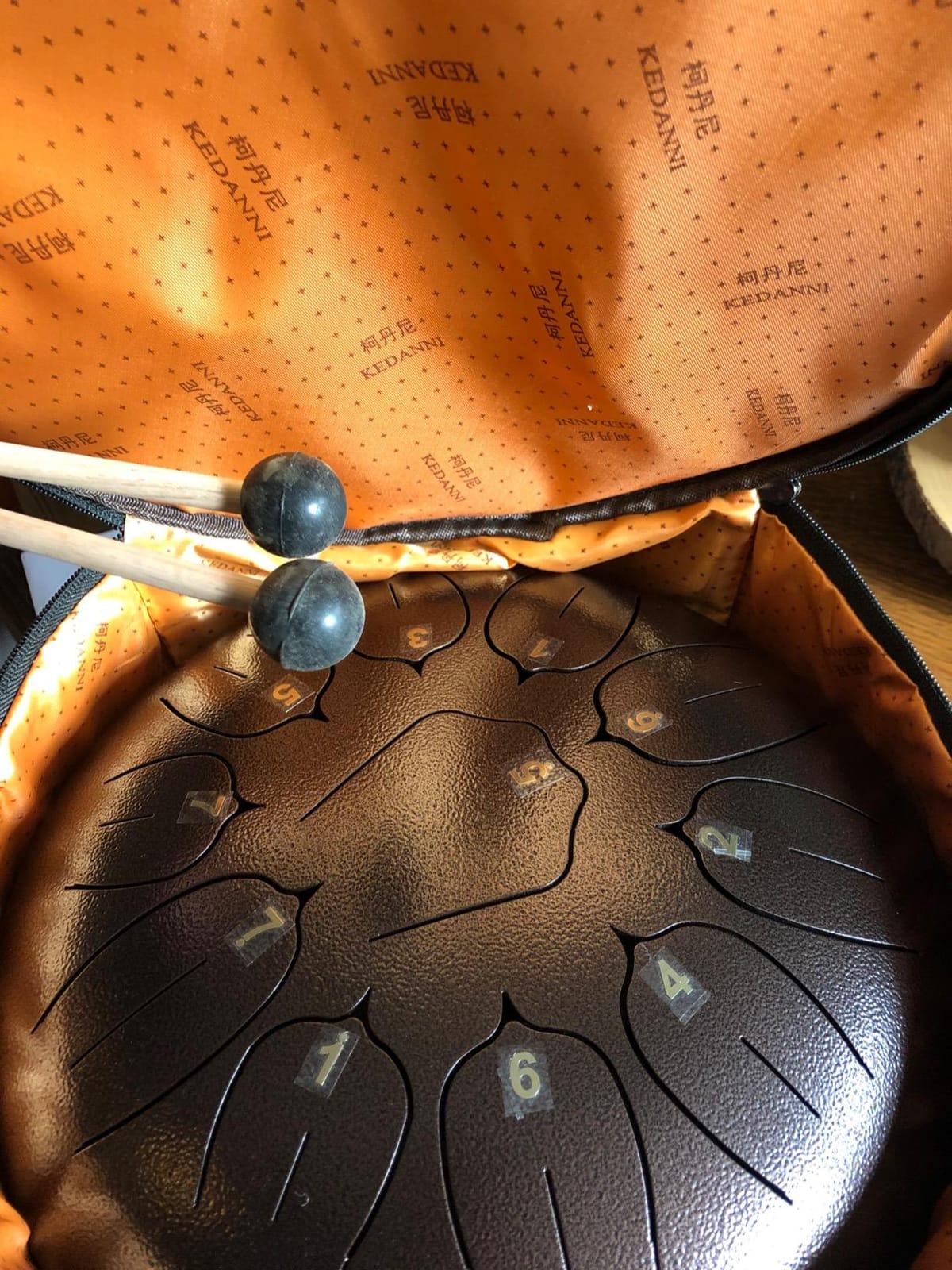
- Numbered note stickers peel off quickly
- Listing imagery conflicts with the printed care guidance
- Note layout less consistent than premium pans
This is the pan I kept coming back to over six weeks of daily practice. The Eavnbaek is a 22-inch, 10-note instrument in D minor Kurd at 440Hz, built from 1.2mm nitrogen steel that has been through high-temperature treatment for wear and rust resistance, and it weighs 7.49 kg.
The tone is the reason it wins. Owners describe it as pure, bright and ethereal with strong vibration, and that brightness is exactly right for daytime seated practice, where you want the sound to stay present in the room rather than disappear into the background.
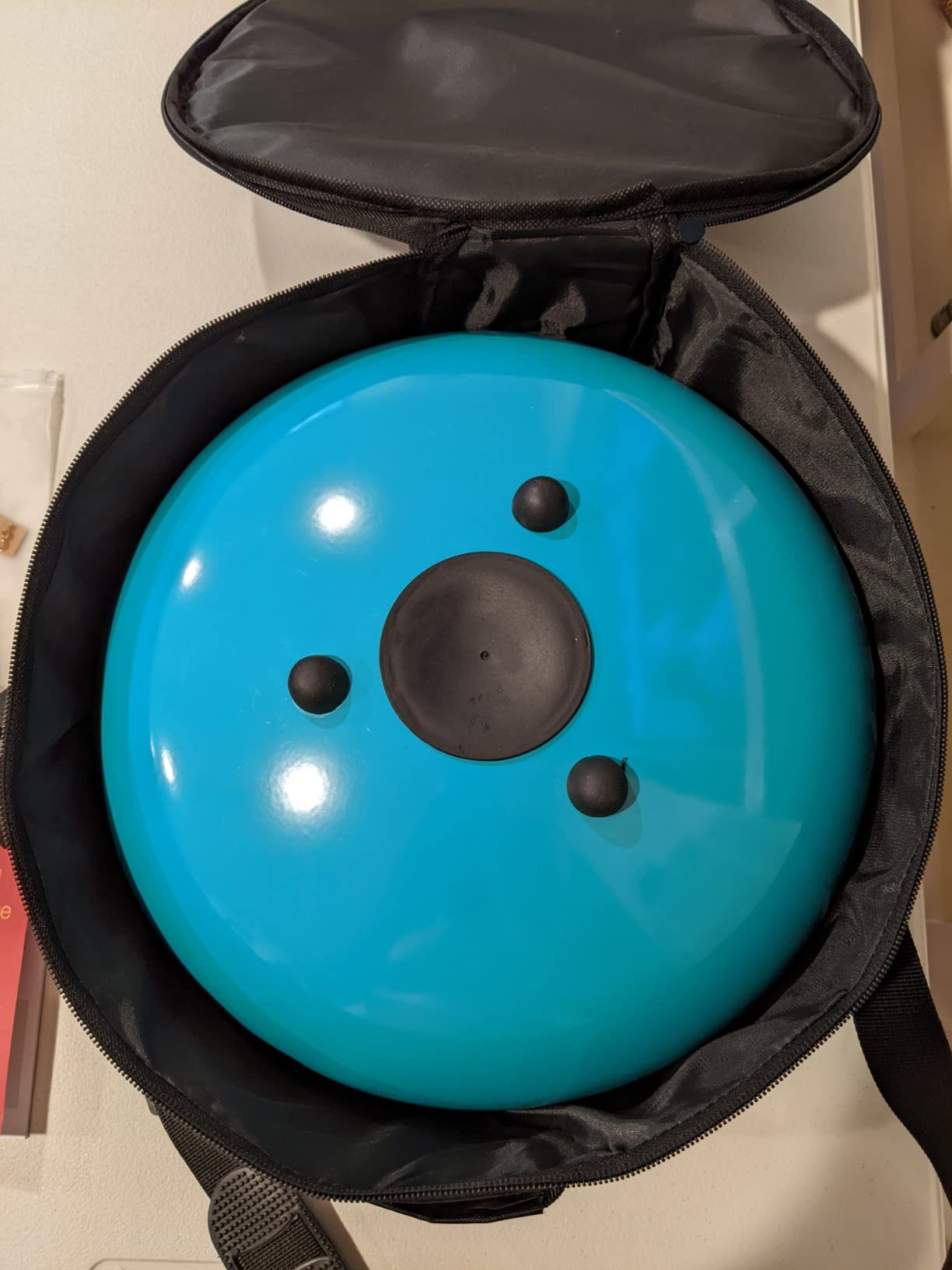
Ten notes across a D minor layout (D3, A3, Bb3, C4, D4, E4, F4, G4, A4, C5) gives you more than the nine-note pans in this group without tipping into the weight class of a 12-note. The distribution is deliberately even, which is why it is the easiest layout here to learn by feel rather than by reading stickers.
Tuning is done by repeated hammer strikes and checked against a professional tuner, and it comes with a 30-day warranty. The bundle is unusually complete: soft bag, two mallets, stand, a set of sound stickers and a cleaning cloth all in the box.
What to check before you commit
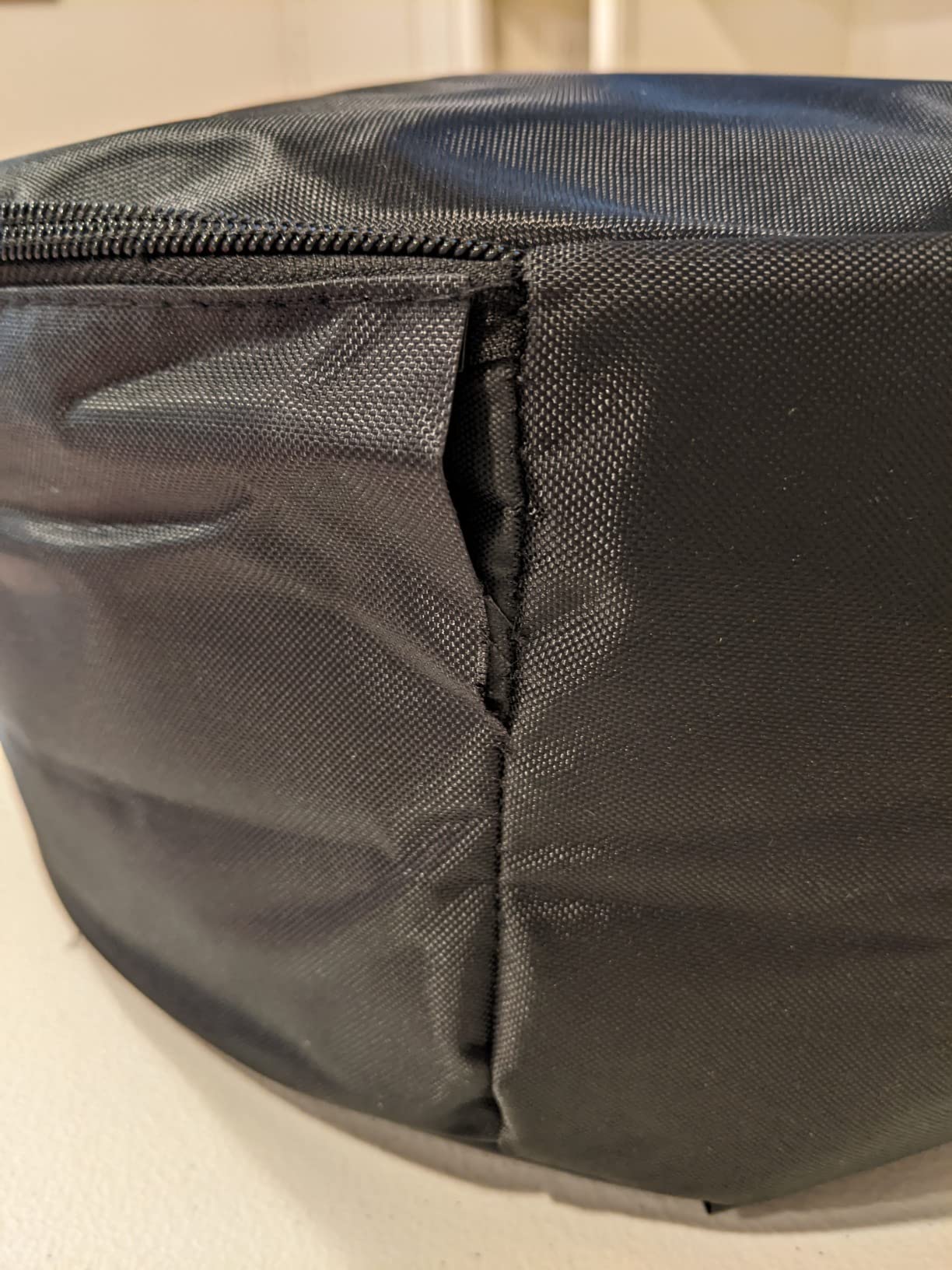
Note stickers peel off quickly on this model, so plan to learn the layout by ear within a few sessions rather than relying on the labels. The listing photos also present the instrument with rain-drum styling that the written care guidance contradicts, so treat it as a dry instrument and keep it out of direct sunlight and damp rooms.
Because mallets ship in the box, expect to ignore them. Play it with bare hands from day one and you will get the resonance the pan was built to produce.
Who should skip it
Skip this one if you specifically want the deepest, lowest register available, because a bright D minor Kurd in 440Hz sits mid-range. If your practice leans toward grounding work with a heavy low fundamental, look at the Pygmy and Amara scale discussion further down instead.
It is also a 22-inch steel body at 7.49 kg. If you plan to move between rooms regularly, factor the carry into your decision.
2. LOMUTY 22-Inch 9-Note D Minor Kurd – Best for Beginners
LOMUTY Handpan Drum 22 Inch for Adults 9 Notes – Hand Pan Drum(Black)
22 inch, 9 notes, 440Hz
D minor Kurd scale, Z pattern
1.2mm nitrided stainless steel
Padded soft case
Pros
- Loud
- clean
- well-balanced tone
- Intuitive low-to-high Z note layout
- In tune when checked against a piano tuner
- Hammer marks show real hand finishing
- High quality padded soft case included
Cons
- Occasional notes drift slightly out of tune
- Finish and packaging quality varies between pans
- Highest note can chatter if struck softly
- Less overall resonance than premium pans
The LOMUTY is the one we would hand to someone with no musical background at all. It carries 536 reviews at 4.4 stars, the largest verified owner base in this roundup, and the note layout runs low to high in a simple Z pattern across the shell.
Reviewers frequently compare this pan to instruments costing several times more, citing accurate tuning and harmonic quality. It arrived in tune when checked against a professional piano tuner, which is a good sign for a budget-tier build.
The 22-inch body is 1.2mm nitrided stainless steel, tuned by makers with what the listing describes as 15 years of experience across more than 10,000 hammer strikes. Visible hammer marks on the surface are a genuine hand-finishing detail rather than a pressed shell.
The bundle covers the essentials: soft bag, two hand sticks, stand, tone stickers, a cleaning cloth and a non-woven bag. The padded soft case is a step above the fabric sleeves most pans in this tier include.
How the tuning holds up over months
The most common complaint here is notes drifting slightly and needing periodic re-tuning. That is normal for any steel pan and especially for nitrided sheet in a dry or centrally heated room, so treat retuning as maintenance rather than a defect.
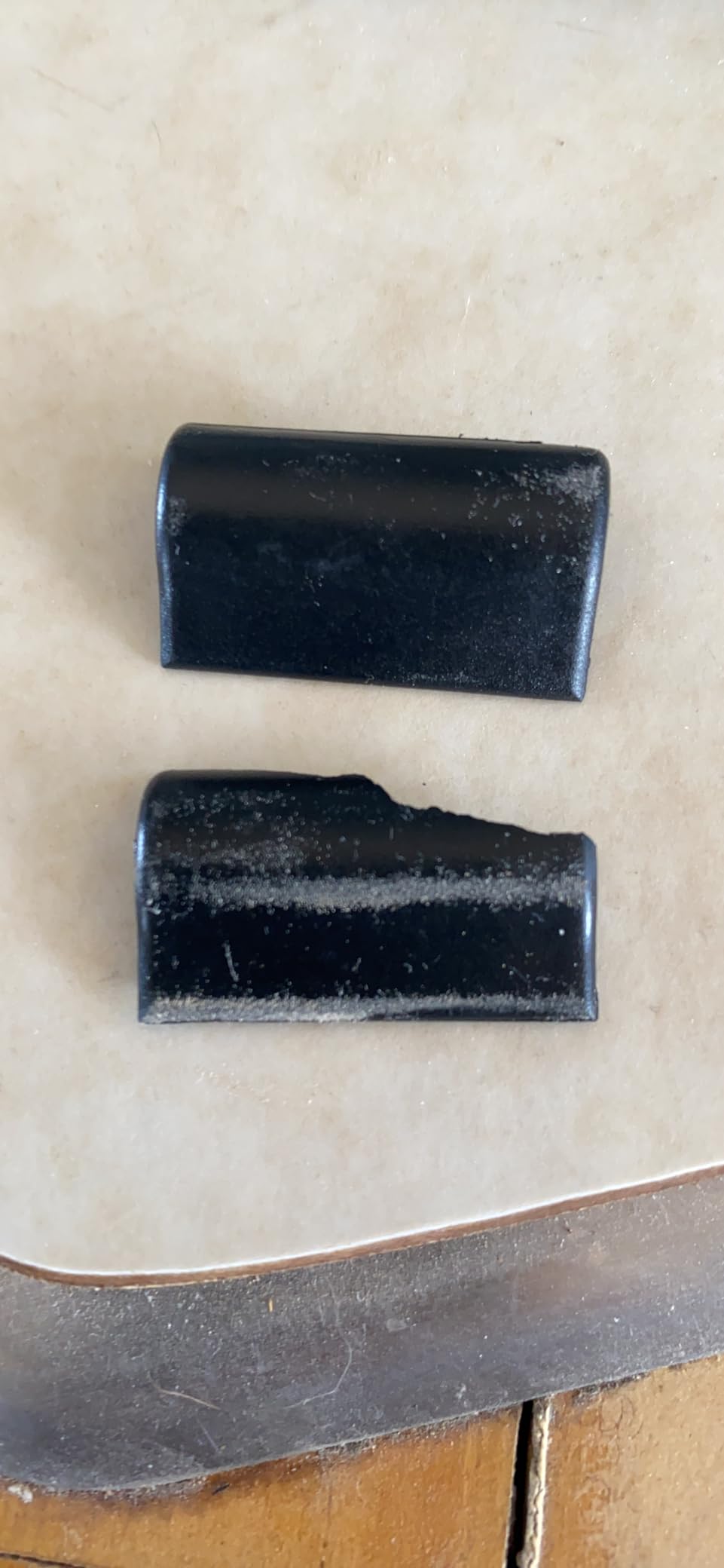
Some owners report uneven or scuffed finish from thin packaging, and the highest note can chatter if you tap it softly. Strike it with a firm fingertip rather than a feather touch and the chatter disappears.
Who this pan suits
This is the safest first instrument for a complete beginner who wants a playable instrument for a daily ten-minute practice without research. It suits students who want the simple Z layout, and it is our pick if you want to spend a modest amount and still get a real, resonant steel voice.
Skip it if you need the instrument to carry a sound bath on its own. Owners consistently report less overall resonance than premium-tier handpans, so for group work you will want a larger, lower-register instrument.
3. Kelisiting 22-Inch 10-Note 432Hz D Minor Kurd – Best for 432Hz Practice
Handpan Drum 22 Inches D Minor Kurd, 432Hz 10 Notes Hand Drum Instrument, Premium Steel Drum, Handpan Instrument for Adults (Gold)
22 inch, 10 notes, 432Hz
D minor scale, A3 through C5
1.2mm premium steel, 5.4 kg
Case, stand, sticks, cloth
Pros
- Clean
- ethereal tone suited to yoga and meditation
- Manual expert tuning
- Heat treated 1.2mm steel resists rust
- Complete bundle with case and stand
Cons
- Only 30 day refund window
- No owner photos returned for this listing
- Clean tone is less deep than darker voiced pans
The Kelisiting is the mid-tier option if you specifically want 432Hz tuning in a 10-note pan. Five hundred reviews at 4.4 stars reflect broad satisfaction, with 73 percent five-star and 4 percent one-star.
Its ten notes run A3, Bb3, C4, D3, D4, E4, F4, G4, A4 and C5, tuned to 432Hz. That pitch sits a little below concert standard, and many meditators find it reads as warmer and slightly less clinical than a 440Hz instrument, which is why we recommend it for evening and wind-down practice.

The shell is 1.2mm premium steel with high-temperature heat treatment, and the pan weighs 5.4 kg, noticeably lighter than most 22-inch bodies in this roundup. That lighter carry is one of the reasons it suits a practitioner who moves between a home corner and a studio.
Warranty coverage runs six months with refunds supported inside 30 days, and the bundle includes a carrying case, drum stand, two drumsticks and a cleaning cloth. No additional equipment is required to play it hands-only.
Tone character and what it is not
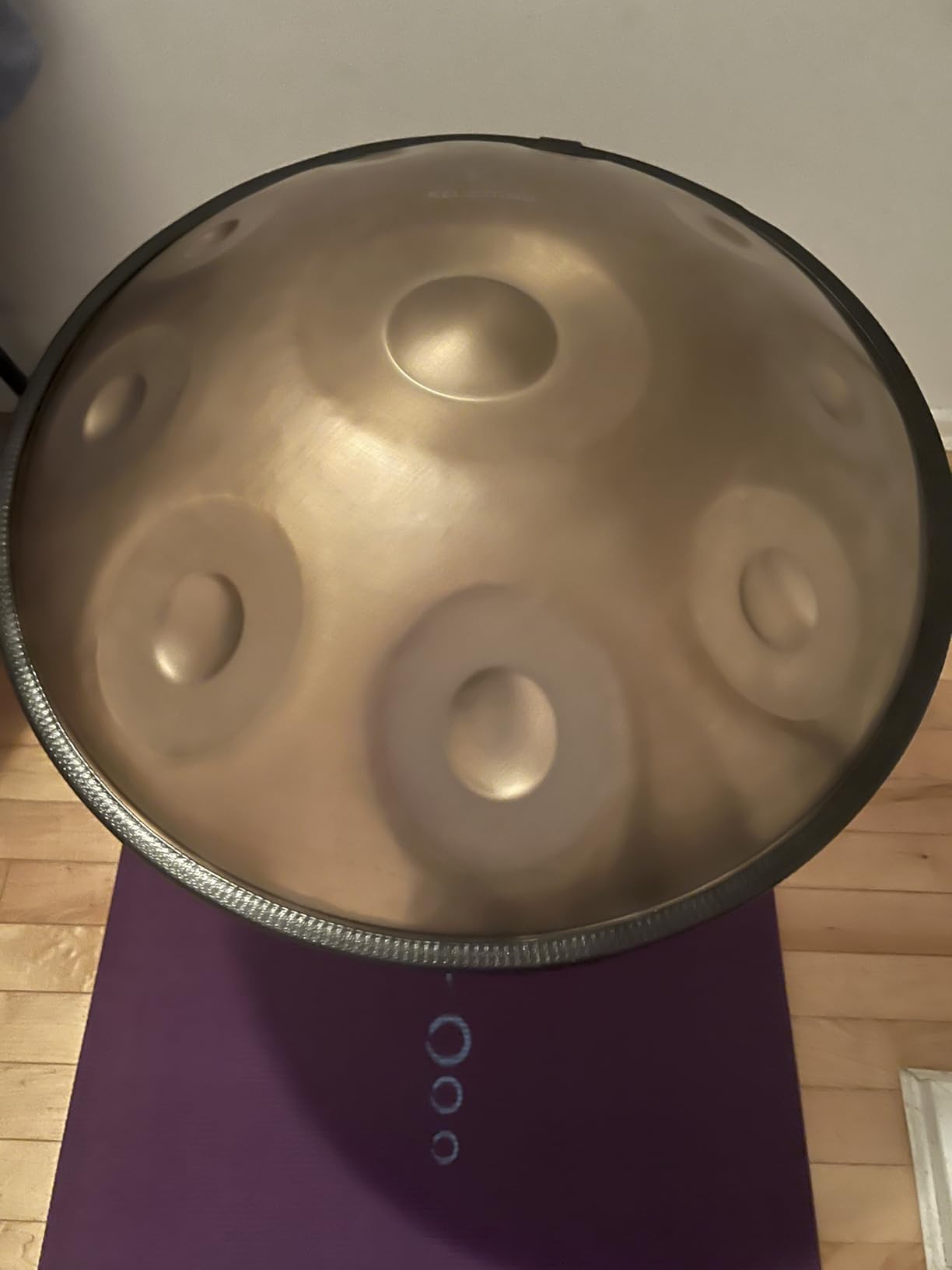
The brand describes the voice as clean and ethereal, and that is exactly what you get. If you are chasing the deep, trance-like low register that meditators on r/handpan keep asking for, this is a bright instrument and you will be looking at a Pygmy or Amara scale instead.
Because the tool returned no individual review text or owner photos for this listing, our read on tuning consistency rests on the aggregate rating spread and the stated expert manual tuning rather than quoted owner comments. We would want a longer return history before recommending it over the Eavnbaek.
Who should skip it
Skip this one if you play alongside other tuned instruments such as a piano or guitar. A 432Hz pan will sound flat next to 440Hz instruments, which is a real problem in a teaching context.
Also skip it if your space is a large room and you need a big low fundamental to carry it. This is a 22-inch pan with a mid register and a clean top end.
4. VEVOR 22-Inch 9-Note 432Hz D Minor – Best Value
VEVOR Handpan Drum, 22 in 9 Notes Steel Hand Drum, 432Hz D Minor Musical Drums with Woven Edge Guard, 2 Mallets & Carrying Case, Fade-Resistant Percussion Instrument for Professional Performance
22 inch, 9 notes, 432Hz
D minor scale
1.2mm CR430 stainless steel
Rope guard, bag, stand, mallets
Pros
- Well tuned out of the box
- Very easy to play with no theory needed
- Fade and scratch resistant nitrided finish
- Large 22 inch body
- Works for beginners and children
Cons
- Tone is bright rather than deep or calming
- Large and heavy to move
- Edge guard can slip if lifted by it
- Finger sleeves too small for adult fingers
The VEVOR is the fastest route to a working instrument, and at 4.5 stars from 111 reviews it holds the second-highest average in this group. It is 22 inches, nine notes in D minor, tuned to 432Hz.
Owners consistently praise the tuning accuracy and how easy it is to play, with several noting it performs better than expected. No music theory is required, and it works equally well for a child learning as for an adult sitting daily.
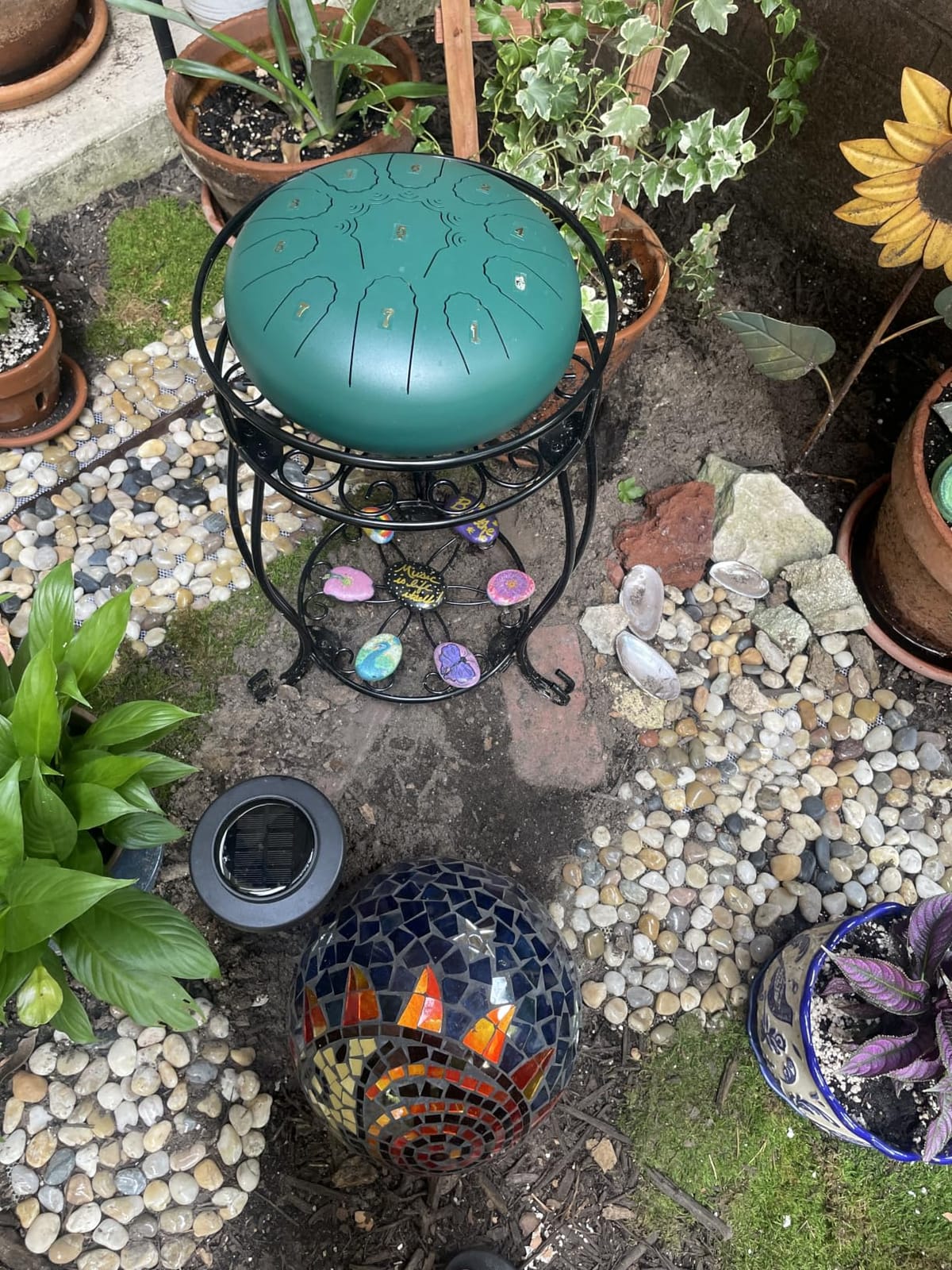
The body is 1.2mm CR430 stainless steel that has been through a high-temperature nitriding process for anti-corrosion and scratch resistance, and the finish resists fading. The pre-installed braided rope edge guard is a nice touch on an instrument you will be handling daily.
Accessories cover the ground: carrying bag, cleaning cloth, drum stand, note sticker, user manual and two drum mallets. The pan weighs 12.1 pounds, which is the practical thing to plan around.
What the bright tone means for a session
The most useful criticism here comes from buyers on the larger-note variants, who say the low tone is undersized and the melody is not as calming as they hoped. If your practice is meant to be deeply grounding, this brightness works against you.
Two smaller issues: the braided rope guard can slip out of place if you lift the drum by it, and the included finger sleeves are too small for adult fingers to produce a clean note. Use bare fingertips and lift the pan from underneath.
Who this pan suits
This is our pick if you want the shortest possible path from opening the box to a first ten-minute session, and you are playing solo rather than leading a class. The 432Hz tuning also makes it a natural fit for relaxation playlists and evening practice.
Skip it if you need a portable instrument. At 22 inches and 12.1 pounds with a large box, this is not a travel handpan, and you will want something you can actually lift onto a lap table every morning.
5. sarospan 22-Inch 9-Note D Kurd – Best for a Hand-Forged Build
Sarospan Handpan Drum – 22-Inch 9-Note D Kurd 440Hz – Hand Tuning Handpan – Includes Soft Bag, Mallets, Stand, Note Stickers, Cleaning Cloth – Artist Performance Video
22 inch, 9 notes, 440Hz
D Kurd scale
Alloy steel, thickened shell
Soft bag, mallets, stand, rope
Pros
- Rich ethereal tone across bass mid and treble
- Hand forged tuning with visible strike marks
- Thickened stainless steel shell
- Bundles bag
- mallets
- stand
- stickers and rope
Cons
- Lowest average rating here at 4.2 stars
- 10 percent one-star share
- Some buyers report needing re-tuning sooner than expected
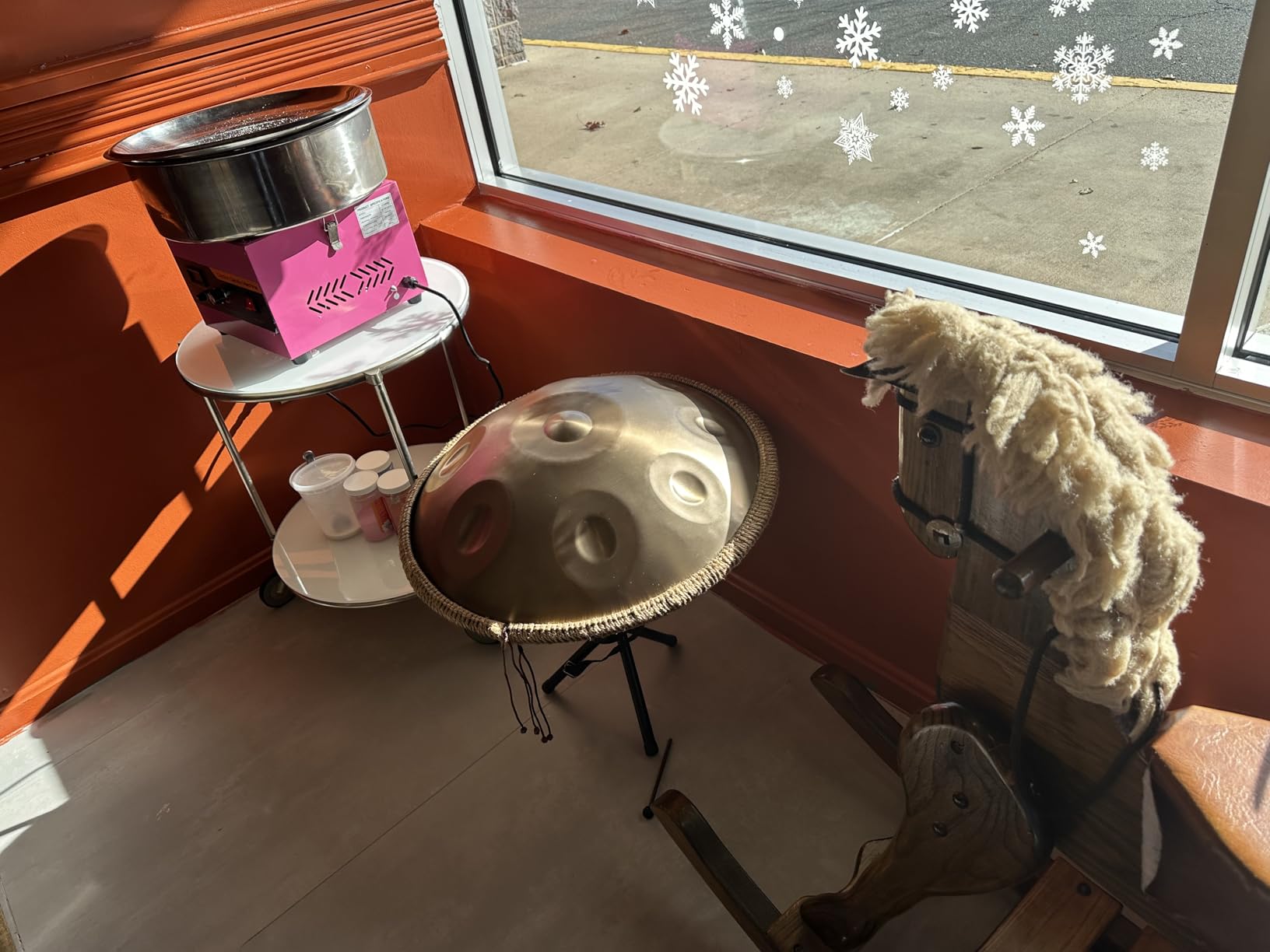
The sarospan is the one to look at if how the instrument was made matters to you more than the review count. It uses a traditional hand-forged tuning method combined with a heating process, and each tone field keeps visible strike marks rather than a machine-pressed finish.
It is a 22-inch, nine-note D Kurd at 440Hz with a thickened stainless steel shell described as sturdier than thin sheet. Owners describe rich, ethereal tones with harmony across the bass, mid and treble.
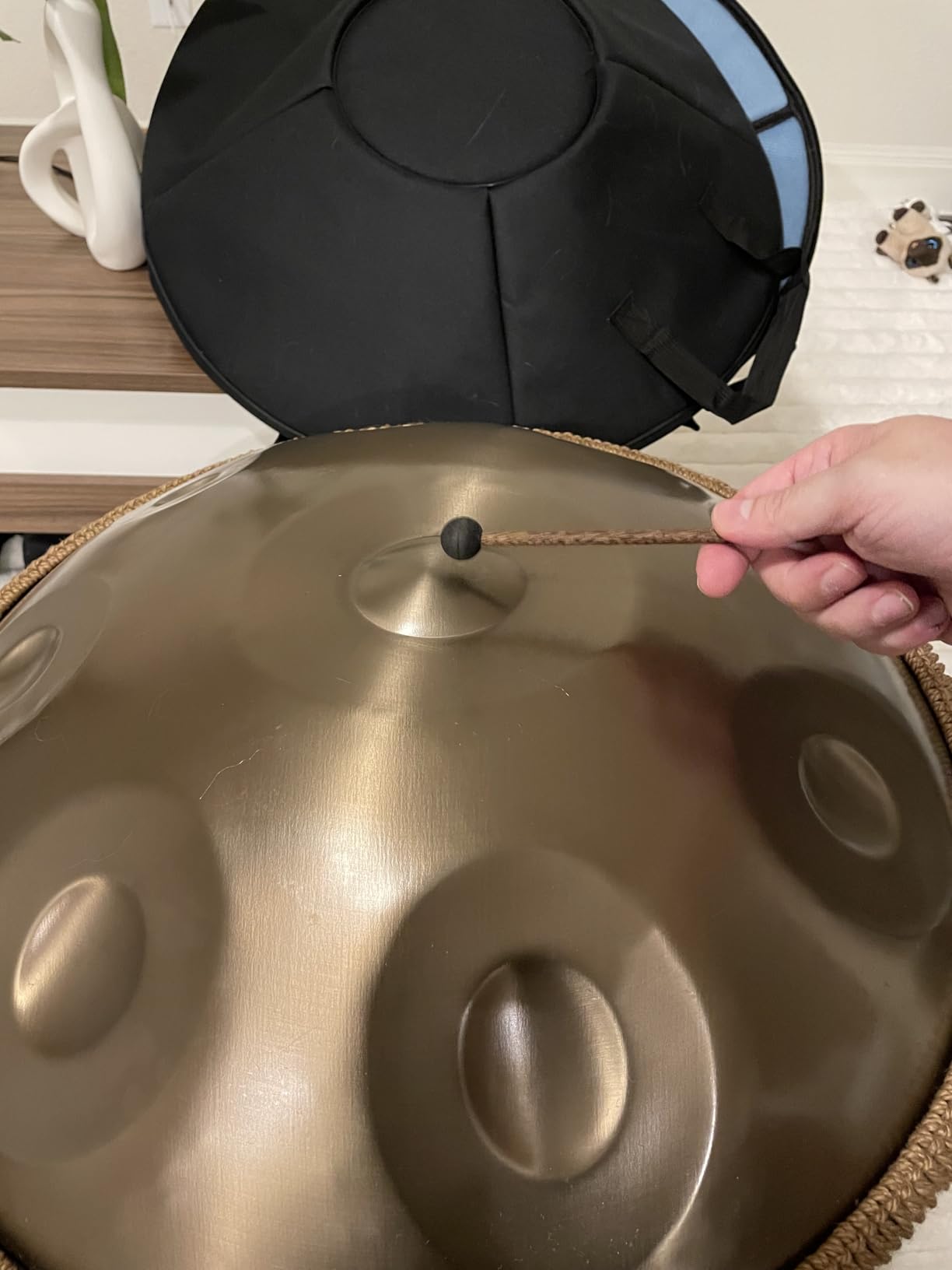
It ships with a soft bag, two mallets, a stand, note stickers, a cleaning cloth and a rope edge guard, and it carries a one-year manufacturer warranty, which is the second-longest coverage in this roundup.
Dimensions are listed at 21.65 by 21.65 by 11.02 inches, so it is fractionally smaller than the standard 22-inch body and slightly taller through the shell.
Reading the 4.2-star score honestly
This pan has the widest rating spread of the group: 68 percent five-star but 10 percent one-star, and that is the number we would want you to see. Some buyers report notes needing re-tuning sooner than they expected, which is the exact complaint we would flag before a purchase.
What that tells you is that the hand-forged process produces a wide spread between instruments, so you are buying a maker’s method rather than a guaranteed spec sheet. If you can use the return window, that risk is manageable.
Who this pan suits
This suits a player who wants visible hand-forged work and a one-year warranty, and who plays in a warm, dry room where nitrided sheet is easier to keep stable. It is a good match for performers who like a slightly more present, mid-forward tone.
Skip it if consistency across notes is your top priority. At 83 reviews it has the least documented tuning history in this roundup, and the one-star share suggests a real segment of buyers whose instruments did not hold up as hoped.
6. GLADFRESIT 22-Inch D Kurd Minor Gold – Best Complete Starter Bundle
GLADFRESIT Handpan Drum 22inch in D Kurd Minor with handpan stand, handpan case, durable mallets and dust-free cloth (Gold, 440HZ)
22 inch, 1 ding plus 8 notes, 440Hz
D minor Kurd, nitrided steel
7 kg
Case, stand, mallets, cloth
Pros
- Ethereal tone for music therapy and yoga
- Improved nitriding resists scratches and rust
- Case
- stand
- mallets and cloth all included
- Many note count and Hz options in the range
Cons
- 4.2 star average with 8 percent one-star
- Smaller review base than the leading pans
- Warranty cover is listed as a single period
The GLADFRESIT is the one to buy if your priority is opening one box and finding everything you need inside it. The case, stand, mallets and dust-free cloth are all in the packaging, which is more than most pans at this level include.
This gold 22-inch pan carries a D minor Kurd layout with one ding note plus eight notes: D3, A3, Bb3, C4, D4, E4, F4, G4 and A4, tuned to 440Hz. The manufacturer positions the tone as clear and ethereal for music therapy, yoga and personal meditation.
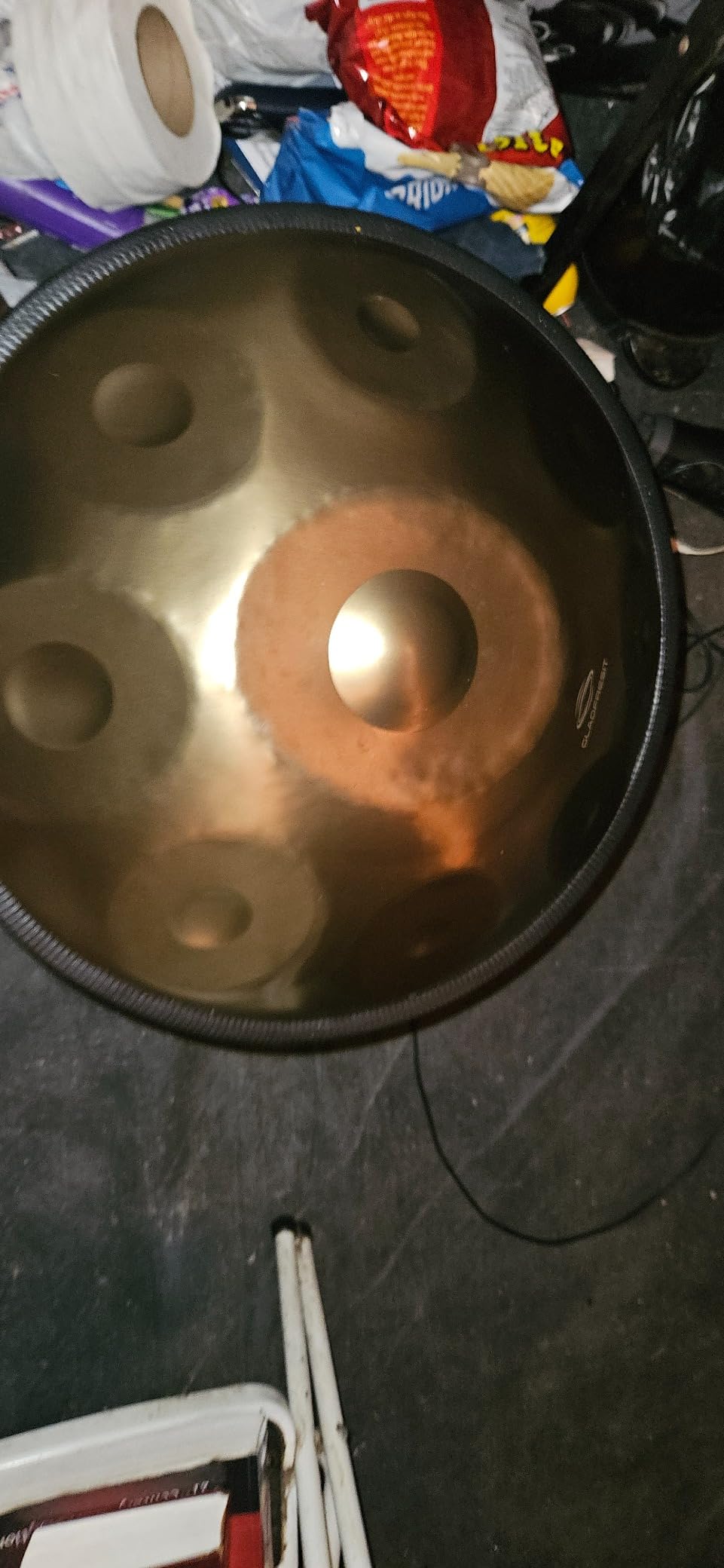
It weighs 7 kg, measures 21.65 by 21.65 by 9.84 inches, and uses a refined nitriding process aimed at reducing scratching, rust and colour fading. That finish matters more than most specs if your practice corner gets direct afternoon light.
Worth noting: the range also includes 9, 10, 11 and 17-note variants and 432Hz options, so the same maker covers both pitch standards if you decide mid-purchase that you want the lower tuning.
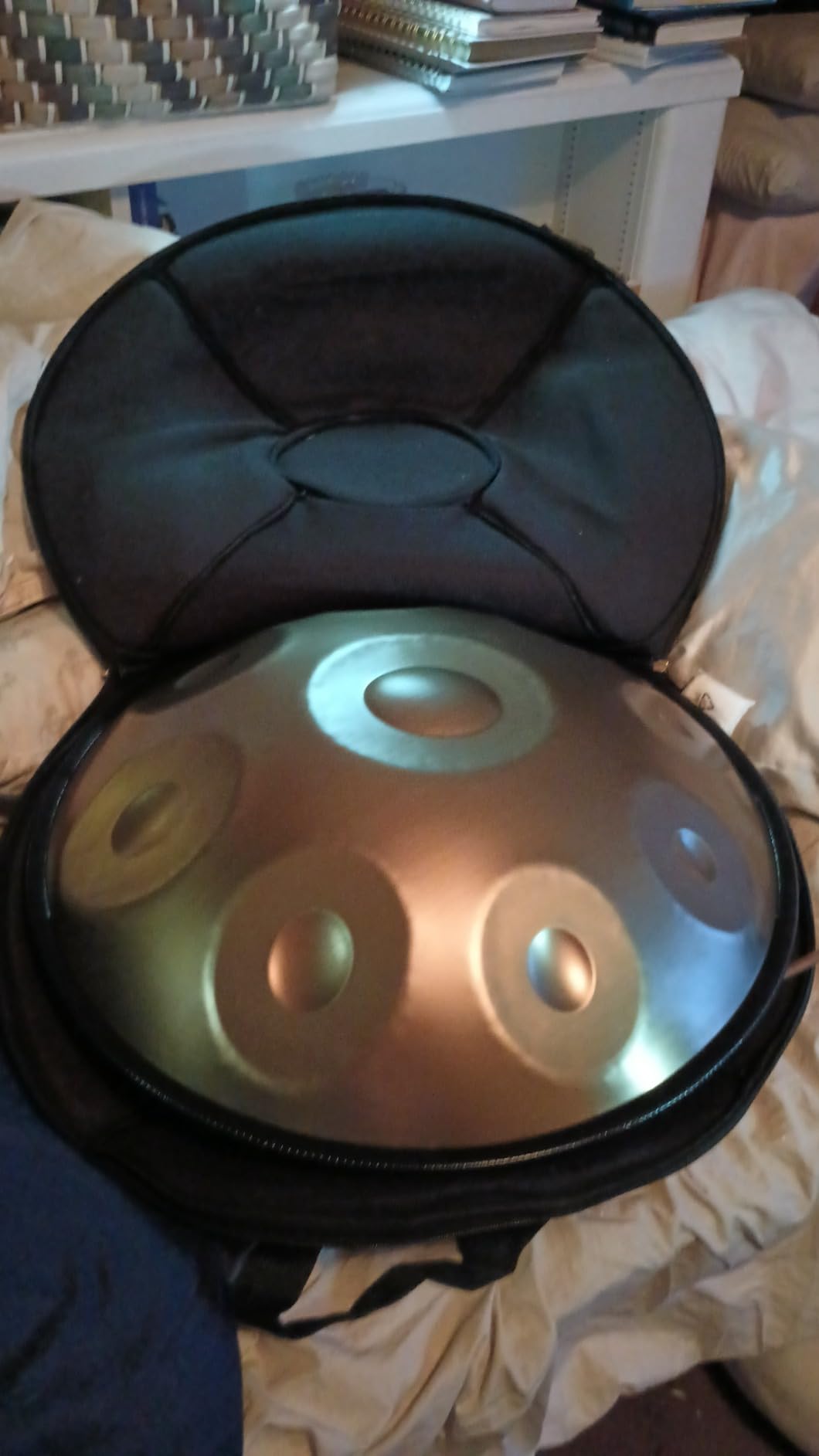
What the smaller review base means
At 58 reviews and 4.2 stars, the tuning consistency of this pan is less well documented than for the leaders in this roundup. The distribution is 60 percent five-star and 8 percent one-star, which is a reasonable spread without being alarming.
Because this specific variant’s owner feedback is thin, we would want you to use the return window rather than commit blind. A pan that arrives with all notes in tune is easy to keep; one that does not is frustrating to play daily.
Who this pan suits
This suits a first-time buyer who wants the accessory question settled on day one and who prefers a clean, ethereal voice for yoga and music therapy work. The nitrided finish suits humid or bright rooms better than a bare steel shell.
Skip it if you want a wide note range immediately. One ding plus eight notes is a small palette, and if you want to improvise more you should move up to a ten-note pan.
7. AS TEMAN 22-Inch 10-Note 432Hz – Best for Sound Healers
ASTEMAN Handpan in D Minor,432hz, 22 inches with 10 notes, comes with a backpack, courses, finger sleeves, stand, cleaning cloth, and two mallets.
22 inch, 10 notes, 432Hz
D minor scale across A to C
8.12 kg alloy steel
Backpack, courses, sleeves, stand
Pros
- Warm 432Hz tone aimed at meditation and sound healing
- Five rounds of high temperature heat treatment
- Most complete bundle here including courses and finger sleeves
- Sixteen colour and tuning variants
Cons
- 10 percent one-star share
- Heaviest listed weight in the group at 8.12 kg
- Included courses still leave you needing outside tutorials
The AS TEMAN is the most fully equipped pan in this roundup, and for a sound healer setting up a client practice that completeness is the point. It ships with a backpack, structured courses, finger sleeves, a stand, a cleaning cloth and two mallets.
It is 22 inches, ten notes tuned to 432Hz, arranged on a D minor scale running A, Bb, C, D, E, F, G, A and C. Owners describe a warm, soothing tone specifically framed for meditation, relaxation and sound healing work.
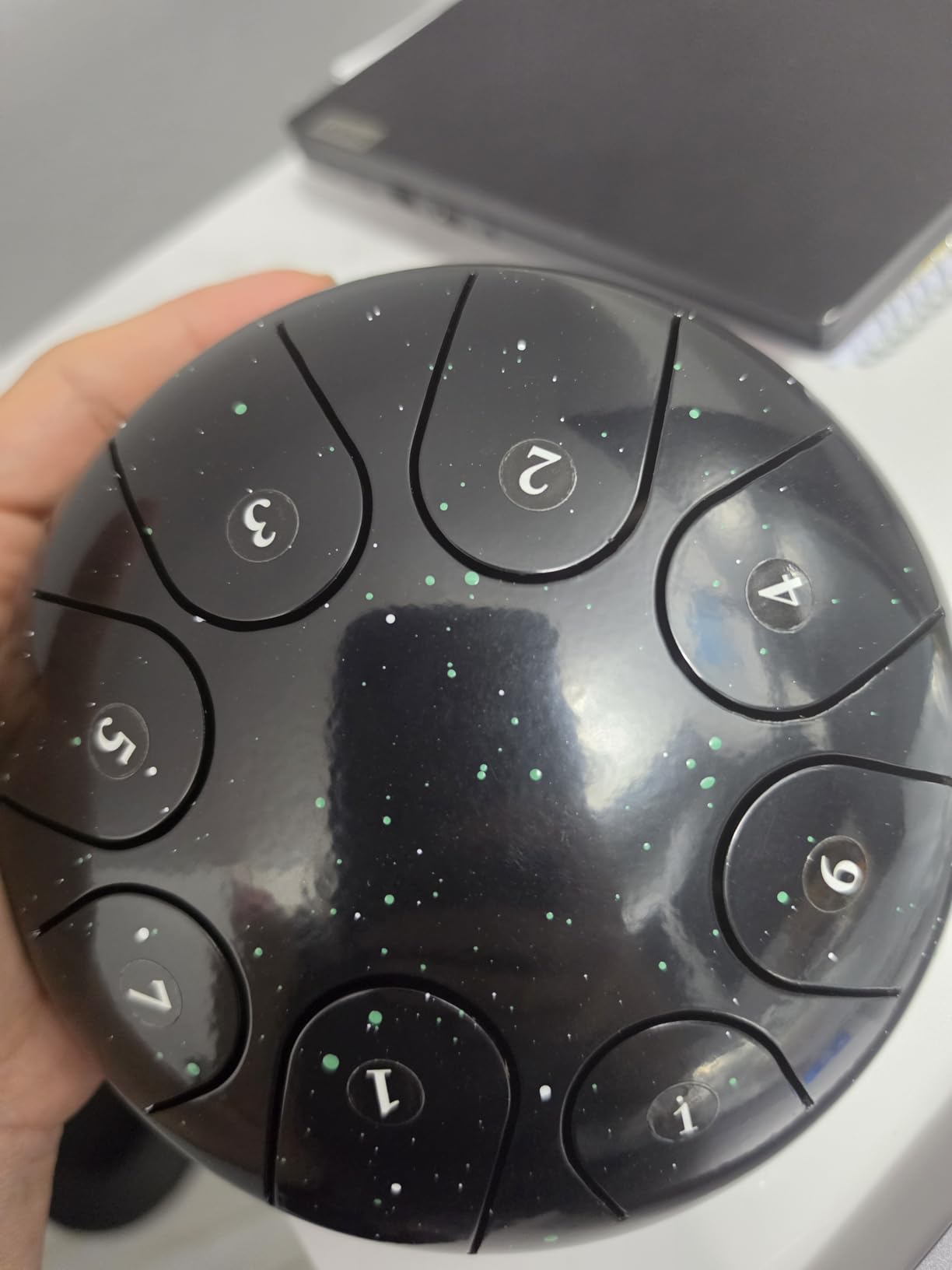
On the build side it is alloy steel with high-temperature nitriding applied over five rounds for hardness and resonance, which is the most repeated heat treatment in this group. Resonance under those conditions is what carries a room in a one-on-one session.
At 8.12 kg it is the heaviest listed weight here relative to body size, so plan the stand position before you carry it anywhere.
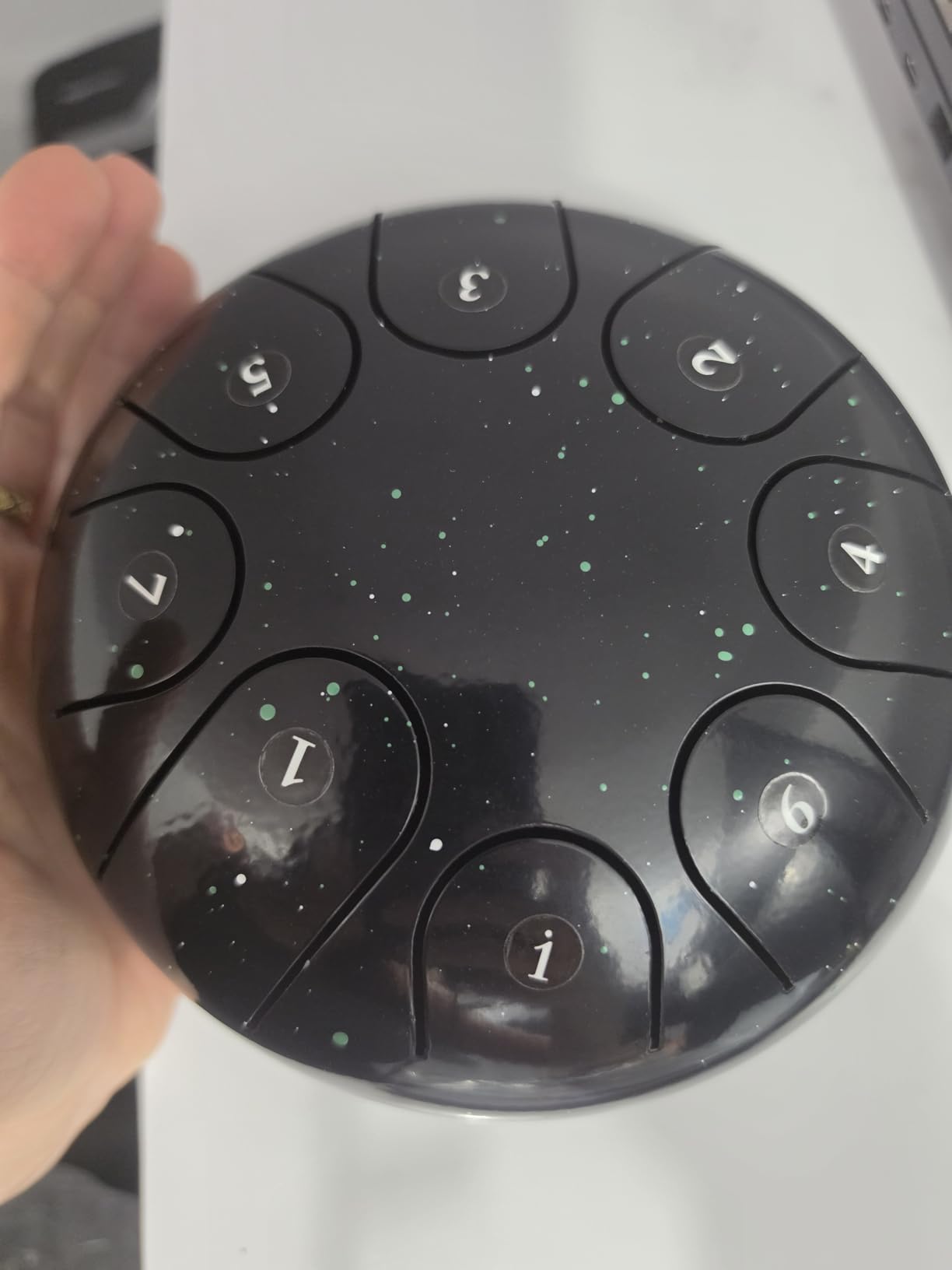
What you get beyond the instrument
The courses are the differentiator for a practitioner, and they are worth more than another accessory would be. They are structured material rather than a song list, which is exactly what most buyers find missing when they start out.
That said, they do not remove the learning curve. Buyers note that coaching material is included but you still need outside tutorials to get comfortable, which is true of every pan we looked at.
Who this pan suits
This suits a sound healer or breathwork facilitator who needs a complete portable practice kit and wants 432Hz for client sessions. The backpack matters more here than on any other pick, because a practitioner carries the instrument between rooms.
Skip it if you have no use for the courses or if the weight is a problem for you. It also ties for the highest one-star share in the group at 10 percent, and a segment of buyers expected more from a premium price point.
8. Seoenlin 22-Inch 10-Note 440Hz – Best for Breathwork
Handpan 22 Inches Drum Set, 440Hz 10 Notes Hand Drum Instrument, Premium Steel Hand Drum, Includes Carrying Case, Drumsticks, Spiral Wraps, Instruction Guide
22 inch, 10 notes, 440Hz
D minor scale A3 to C5
1.2mm premium steel, 7.62 kg
Case, stand, sticks, spiral wrap
Pros
- Deep
- calming
- well tuned sound
- All notes verified in tune with no dead notes
- Visible production marks inside the shell
- Spiral wrap edge protection
- Two year warranty
Cons
- Hand played volume and sustain are weak
- Sounds better with the rubber mallet heads
- Quality sits at mid tier rather than top tier
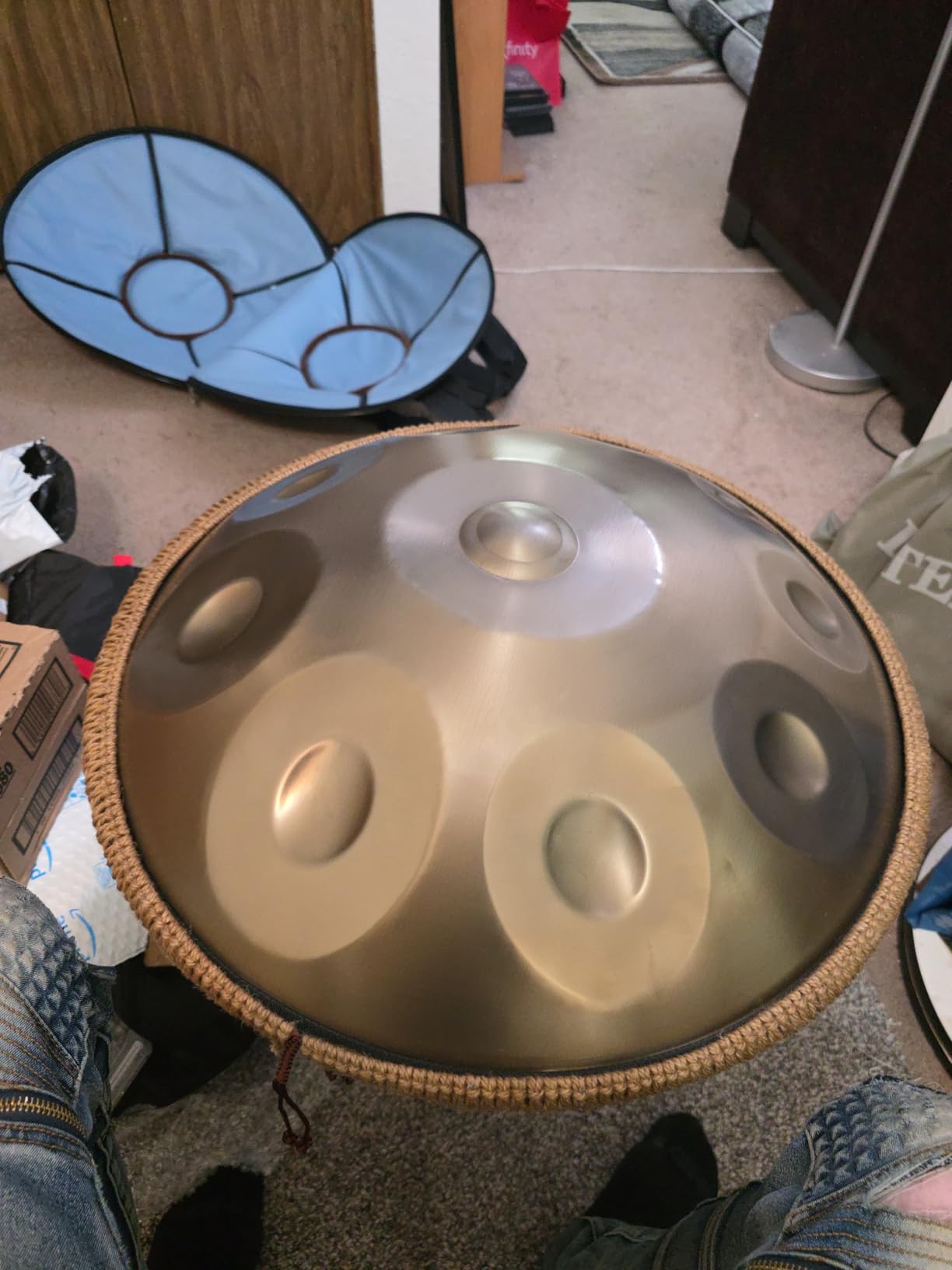
The Seoenlin is the one we would pair with an active breathwork practice, because owners describe the tone as deep and calming and the note set as easy to get lost in. It is a 22-inch, ten-note D minor pan at 440Hz.
All notes were verified in tune with no dead notes across the reviews, and the two-year warranty is the longest coverage of any pick here. The shell is 1.2mm premium steel with high-temperature heat treatment, at 7.62 kg.
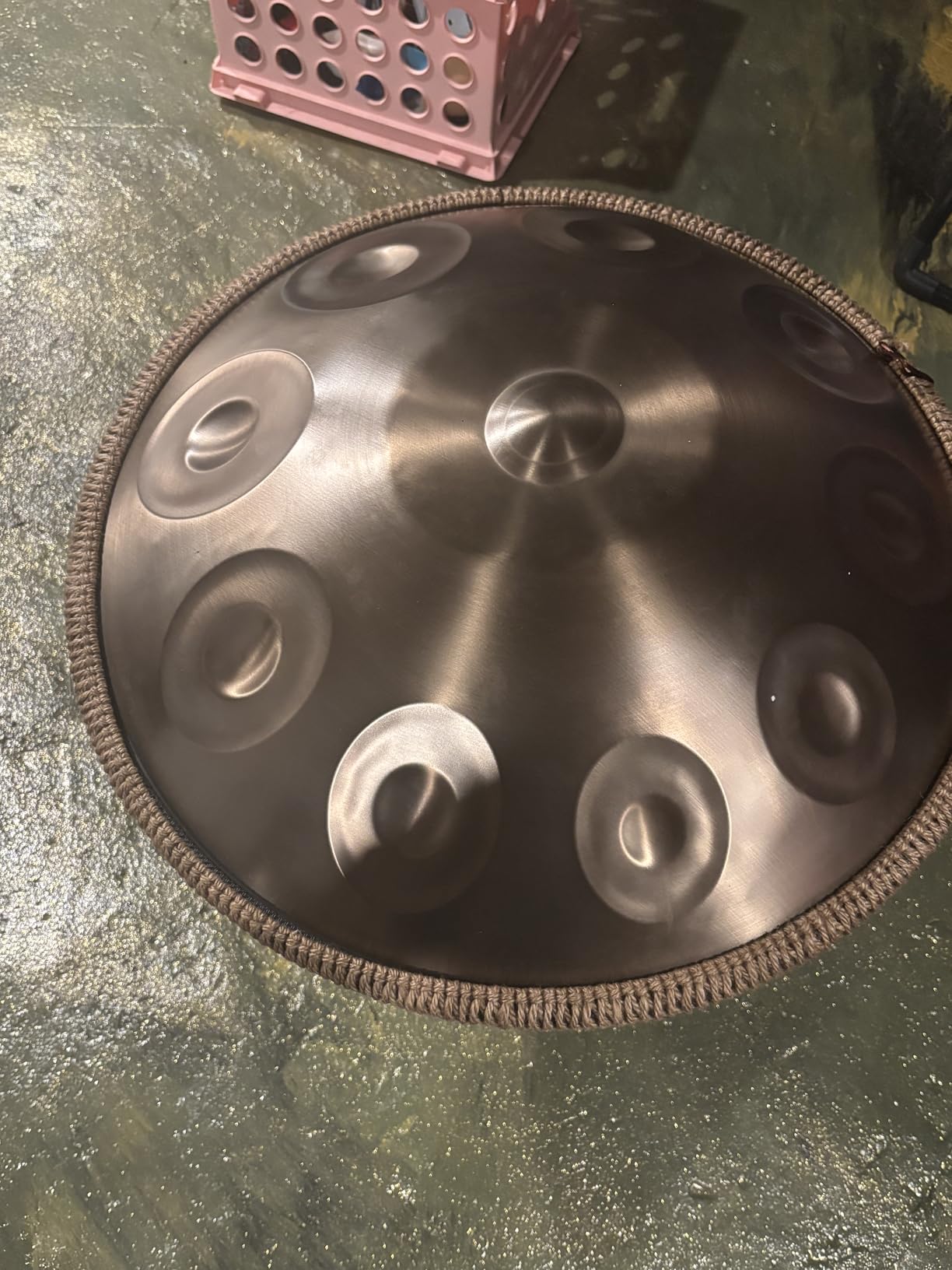
Inside the shell you can see production marks, which tells you the tuning was inspected before it left the workshop. Spiral wrap edge protection runs around the rim, a detail that matters on an instrument you strike daily.
The bundle covers a carrying case, drum stand, drumsticks, a cleaning cloth and an instruction guide.
The sustain caveat you need to know
The clearest recurring reservation in the reviews is that hand-played volume and ring time fall short, and that the instrument sounds noticeably better with the rubber mallet heads. If sustain length is your criterion, factor that in honestly.
That said, for breathwork anchoring you are often striking a note and matching the exhale to the decay, and a clear short tone is easier to time against than a long wash. For that specific use, this is a strength rather than a flaw.
Who this pan suits
This suits a practitioner who wants to time notes to breath cycles rather than improvise long washes, and it suits anyone who wants the longest warranty in this roundup. The included spiral wrap and case also make it a good travel-within-the-home option.
Skip it if you are a sound bath facilitator chasing a room-filling sympathetic resonance. Owners call the quality mid-tier rather than top-tier, and the mallet-dependent volume tells you this is not the instrument for a large group.
9. SINGOFIRE 22-Inch 10-Note D Minor Kurd Gold – Best as a Gift
“SINGOFIRE” 10-Notes Handpan Drum, Handpan Drums for Adults, 22-Inch 440Hz D Minor Kurd Handpan, Handpans Instrument with Soft Drum Bag, 2 Handpan Mallets, Stand and Dust-Free Cloth(Gold)
22 inch, 10 notes, 440Hz
D minor Kurd, gold finish
Thicker steel plate, 9 pounds
Soft bag, mallets, stand, booklet
Pros
- Clear
- pleasing tone with good tuning on most pans
- Attractive gold finish with no defects reported
- Gentle relaxing sound for noodling
- Soft bag
- mallets
- stand
- booklet and finger pads included
Cons
- Lowest average rating here at 4.1 stars
- 11 percent one-star share
- Some pans arrive with notes out of tune
- Song booklet gives no guidance on playing
- Note labels mar the finish as a display piece
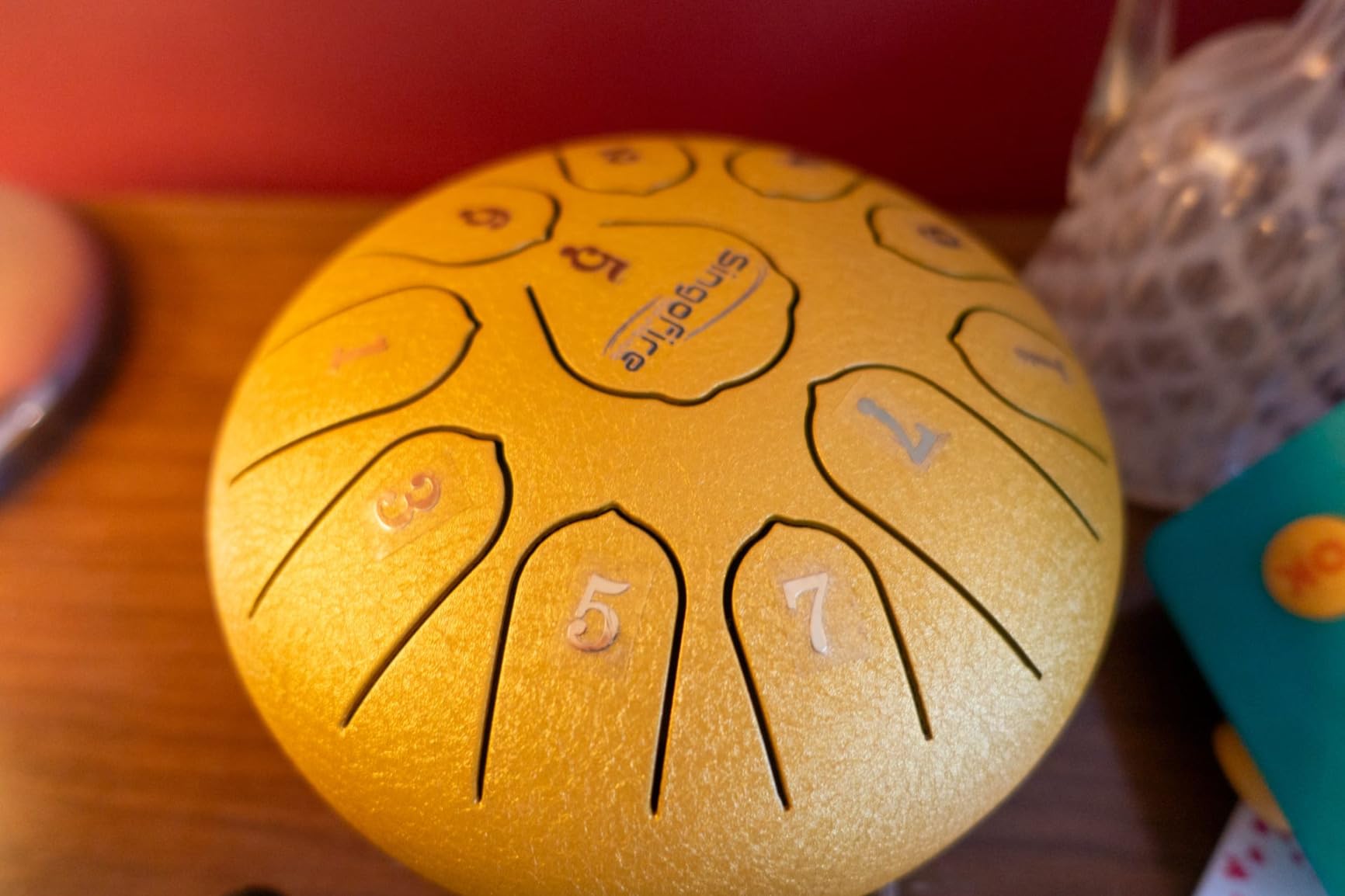
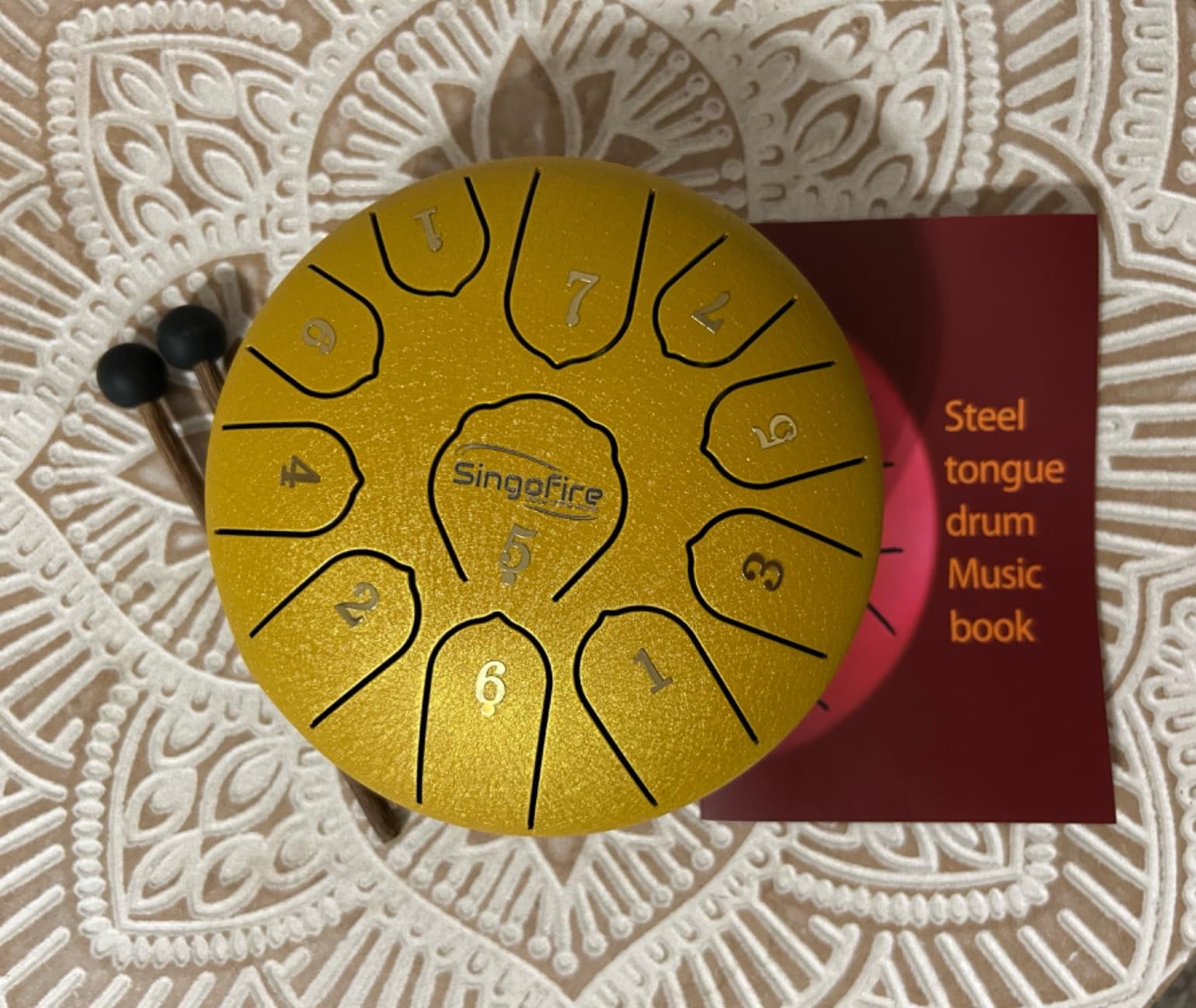
The SINGOFIRE is the pick if the instrument is a gift. The gold finish draws no complaints about defects, it weighs 9 pounds, and the bundle includes a soft bag, two mallets, a stand, a dust-free cloth, a song booklet and finger pads.
It is a 22-inch, ten-note D minor Kurd at 440Hz, hand-tuned with guidance from a Brazilian handpan expert, and built on a steel plate thicker than comparable pans to resist detuning and transit damage.
On paper that thickness and that tuning process should hold up well. In practice the reviews tell a mixed story, and we would rather you heard it from us than from a one-star review later.
At 4.1 stars from 47 reviews, this is the lowest average in the roundup with an 11 percent one-star share. That share reflects reports of pans arriving with notes out of tune and a sound described as nice but not deep or powerful compared with larger handpans.
Two details that will irritate a new player
The included song booklet offers no guidance on how to interpret the pieces, so a beginner can end up learning tunes without learning how to play. The finger pads are also too small for adult fingers to produce a clean note, which is a common shortcut accessory that does not earn its place.
Note number labels are stickers applied over a permanent logo, so if the pan is ever displayed rather than played, the finish is slightly marked. It also carries a 100 percent satisfaction guarantee, which is genuinely useful given the tuning variance.
Who this pan suits
This suits a gift buyer who wants something attractive and playable out of the box rather than a serious practice instrument. Rubber feet protect surfaces from scratching, which helps if it will sit on a coffee table.
Skip it as your daily practice pan if tuning accuracy is the priority. The 11 percent one-star share and the out-of-tune reports mean you should plan to use the satisfaction guarantee, and several reviewers describe this instrument as a tongue drum rather than a true handpan.
10. Acolyte Dm Celtic 21-Inch – Best for Low Maintenance
Acolyte Handpan – Dm Celtic – Made in the USA
Full size 21 inch, 440Hz
Celtic 8 note scale,Powder coated PC steel
Custom carry bag, cloth, guide
Pros
- Highest rated instrument in the roundup at 4.8 stars
- Long sustaining resonant tone
- Coating never needs lubricating
- Custom carry bag
- cloth and care guide included
- Made in the USA by a named maker
Cons
- 21 inch body is smaller than the 22 inch pans
- 8 note Celtic scale limits the range
- Only a 15 day warranty
- No stand included
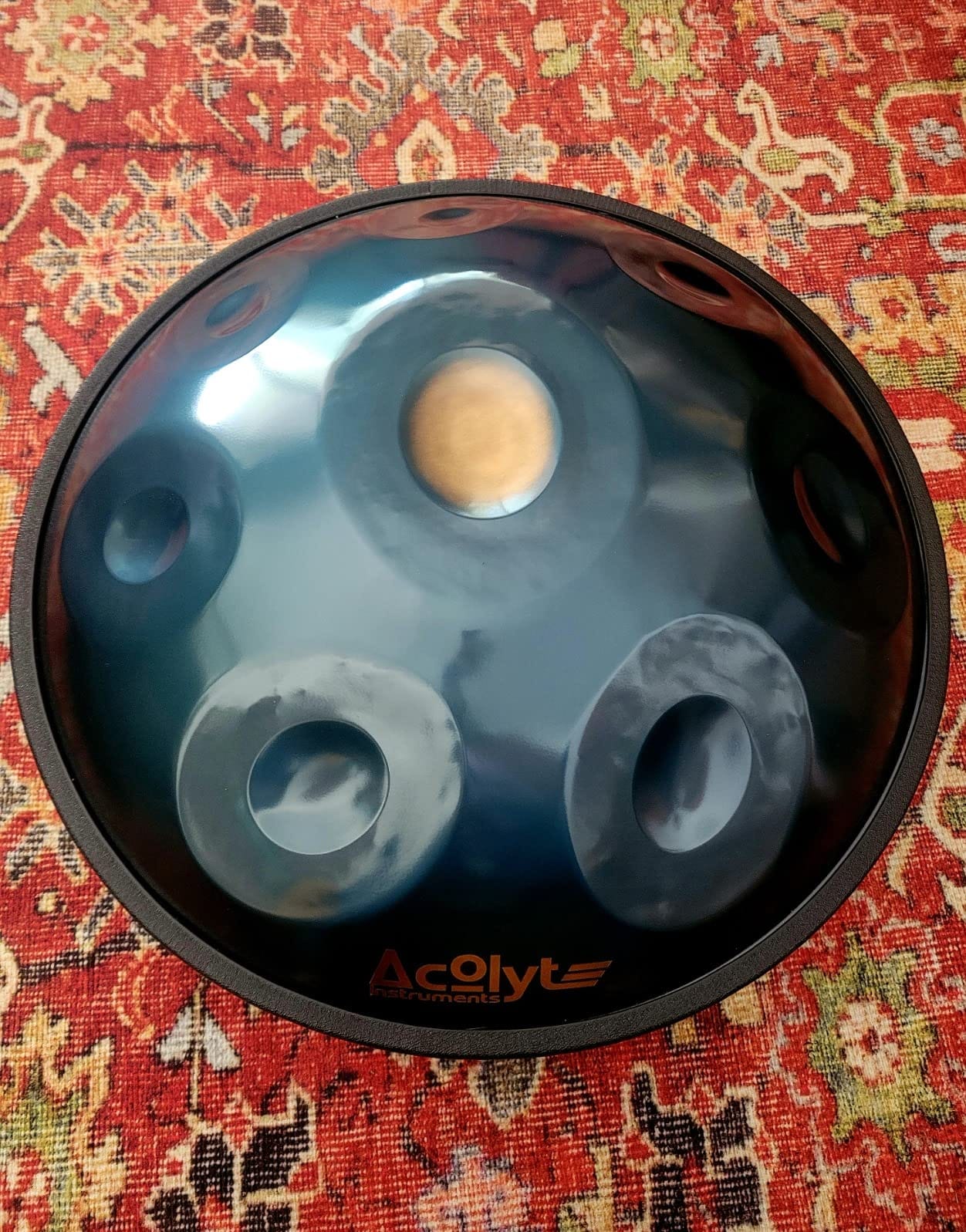
The Acolyte is the instrument we recommend when maintenance is the thing you will actually get tired of. The shell is powder-coated PC steel that never needs lubricating, which removes the single most common piece of handpan upkeep entirely.
At 4.8 stars from 33 reviews, it carries the highest average rating of anything we tested, with 96 percent five-star. Owners repeatedly contrast it with cheaper imports, citing richer sustain, accurate tuning and an artwork-level appearance.
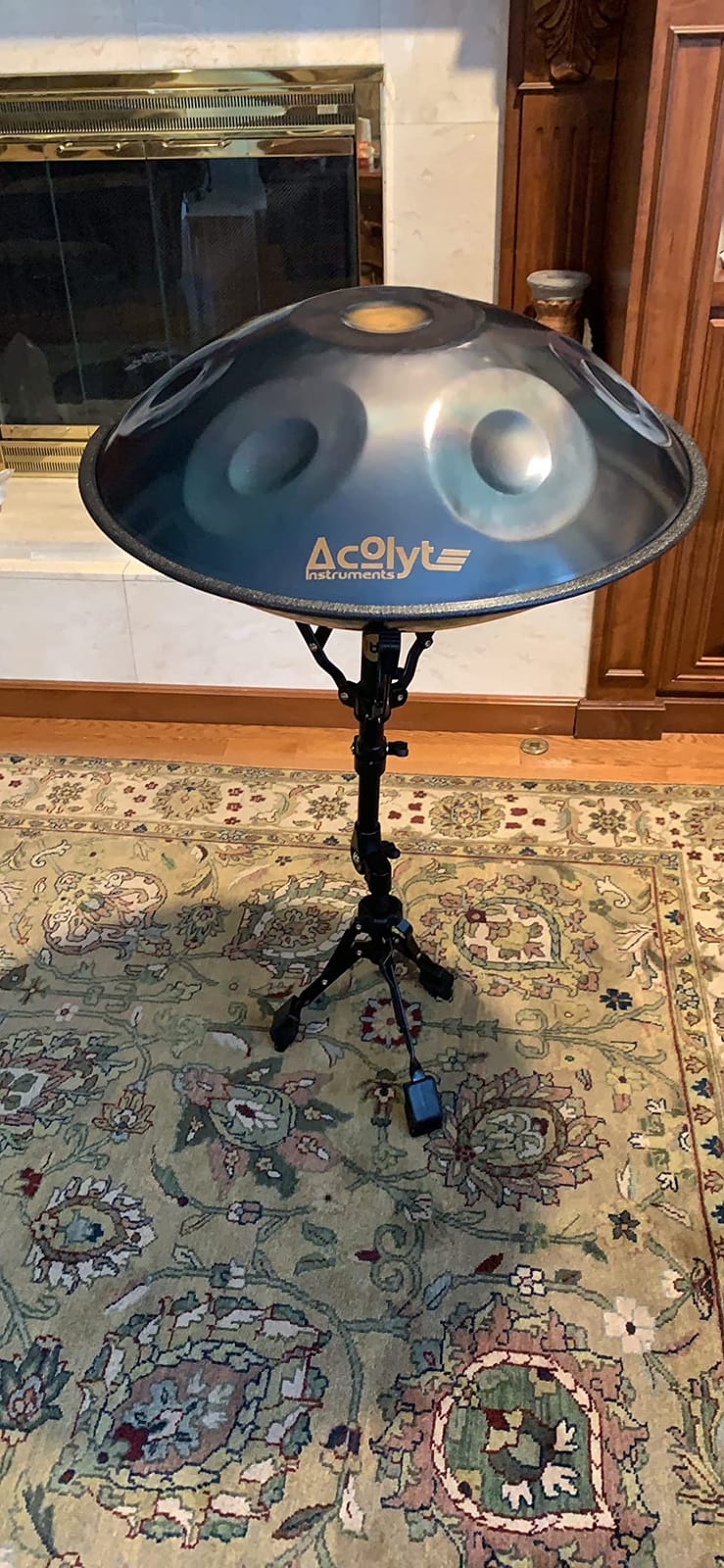
It is a full-size 21-inch pan on a Celtic-inspired D scale of ACDEFGA at 440Hz, and it is made in the USA by a named maker, which matters practically because retuning later is a local service rather than an international shipment.
It ships with an embroidered custom carry bag, a microfiber cloth and a care guide. The natural blue-to-grey steel colouring means it looks like a display object when it is not in use.
Why the coating changes your routine
Almost every other pan in this roundup asks you to oil the steel periodically, and the maintenance advice ranges from monthly to weekly depending on your climate. This one asks nothing, which removes the most common reason people stop playing.
The natural blue-to-grey colouring is a powder coat rather than a polish, so scratches are far less visible and rust has no bare steel to start from. That is a real advantage if you practice in a humid room or near an open window.
Who this pan suits
This suits a player who wants a low-maintenance daily instrument and a natural decay to work with, and it is easy to pick up compared with other instruments. It also suits anyone who wants to display the instrument rather than hide it in a case.
Skip it if you need a wide range of notes. The Celtic eight-note scale is the most limiting in this roundup, the 21-inch body is smaller than the 22-inch pans elsewhere, and the warranty is only 15 days. No stand is included, so budget for one.
How We Picked These Hand Pans
Every pan in this roundup was scored against the same seven criteria, in this order of weight.
1. Tuning accuracy. We weighted this highest because an out-of-tune note removes the calm immediately, and off-tune arrival is the most common practical complaint in the category. Reviews describing verified tuning against a professional tuner or piano counted for more than vague quality claims.
2. Sustain and decay. We looked for descriptions of long ring time and strong resonance rather than brightness alone, because sustain is the property that carries a meditation practice.
3. Clarity at low volume. A handpan used for daily seated practice is played softly. We preferred tone that stays present when played quietly over tone that only shows up when struck hard.
4. Note layout. Evenly distributed layouts, and specifically the low-to-high Z pattern, rank higher because they are learnable by touch instead of by stickers.
5. Build quality and steel treatment. Nitrided, heat-treated and powder-coated steel all rank above bare sheet, and we noted the specific thickness claimed for each model.
6. What is actually in the box. Stand, bag or case, mallets, stickers and cloth were all tracked, because accessory quality is the clearest measurable difference between tiers.
7. Warranty and return window. Warranty length, refund windows and satisfaction guarantees were the final tiebreaker, which is how the two-year coverage on the Seoenlin earned it a slot.
We also weighted the share of one-star reviews heavily, because a high five-star percentage with a large one-star tail usually means a small group of people had a genuinely bad experience with tuning or delivery.
Handpan vs Steel Tongue Drum – Know What You Are Buying
A handpan and a steel tongue drum look similar and are built completely differently, and confusing the two is the largest buyer mistake in this category.
A real handpan is made of two deep-drawn shells hammered into tuned indentations called tone fields. Each field is tuned to a fundamental, an octave and a compound fifth, a 1:2:3 ratio, which is why one strike fills the whole shell. A tongue drum is a single flat plate with cut tongues attached underneath, and it produces a cleaner, more isolated pitch with a much shorter decay.
This matters for meditation because a tongue drum gives you one note at a time rather than a wash of overtones. Neither is better in the abstract, but a tongue drum will not fill a room the way a handpan does, which is why the acoustic difference is what decides a sound bath purchase.
Four checks will tell you which one you are looking at before you buy.
1. Mallets in the box. A real handpan is played hands-only. Mallets are for tongue drums, and using them on a handpan can damage the tuning.
2. Uniform shell thickness and a single flat plate. If the underside is flat with cut tongues riveted on, it is a tongue drum regardless of how the listing is worded.
3. Sympathetic resonance. Play two notes at once. If the shell does not vibrate in response, it is a tongue drum.
4. Uniform sustain across all notes. A handpan’s decay varies by field. A tongue drum tends to sound similar on every tongue, which reads as flatter over a long session.
Something worth saying plainly, because it contradicts a lot of gatekeeping on handpan forums: a cut-tongue drum is a perfectly valid first instrument for meditation. Most listeners cannot tell the difference, and r/handpan users are unusually honest about that. What a cheap tongue drum will not do is grow into the resonant, room-filling instrument that a long-term handpan practice is built on.
432Hz vs 440Hz – Which Tuning for Meditation
Choose 432Hz for solo practice, sound bath work and evening wind-down. Choose 440Hz when you play alongside other tuned instruments, teach, or record with a band.
That is the decision rule, and it comes down to what else is making sound. A 432Hz pan sits a little below concert standard, and without another instrument to reference it, most players perceive that as warmer and softer. For a practitioner using the pan to mark transitions in a yoga class or to anchor breathwork, 432Hz is the more common choice.
440Hz is the standard for the simple reason that it matches most other instruments. If a piano, guitar or flute is anywhere in the room, a 432Hz pan will sound flat to anyone with a trained ear.
There is one more practical consideration. A given model is almost always built for one standard, so this is a decision you make once, at purchase, and cannot easily reverse without retuning. Four of the ten pans here are 432Hz, which is why the pan is more available in the lower standard than in the premium tier.
If you are still deciding, our picks for [10 best sandalwood essential oils for meditation](https://www.superfooddrive.org/best-sandalwood-essential-oils-for-meditation/) pair well with either tuning, and the pan itself is the part you cannot swap later.
9 vs 10 Notes – Which Should You Buy?
A 9-note pan is easier to play and cheaper to carry; a 10-note pan gives you a wider range and one more mid-register field. For a first meditation instrument, either works, and the difference is smaller than most listings suggest.
A 9-note layout is typically one center ding plus eight tones, which means a lower floor-to-ceiling range. A 10-note layout adds a note in the middle of the scale, which is the range where most improvised phrases live.
The practical difference is weight and price. Two of the 10-note pans here weigh 7.49 kg and 7.62 kg, while a 9-note pan at the same diameter is noticeably lighter in the hand. If you play sitting on the floor with the pan resting on your legs, note count translates directly into wrist and forearm fatigue over a long session.
Our take: choose 9 notes if you are a complete beginner, you play on your lap, or you want the simplest possible layout. Choose 10 notes if you already play, you want room to improvise, or you are building a daily practice you expect to last years. Twelve and 13-note pans add range at the top end but push the weight and cost up, and we would not recommend either as a first instrument.
Best Scales for Meditation – D Kurd, D Minor, Pygmy and Amara
Scale choice is where most new buyers get it wrong, and it matters more than any other specification. The four scales you will actually encounter in this roundup are D minor, D minor Kurd, Celtic and Pygmy-family options on other makers’ ranges.
D minor. The most common scale in production and the safest first choice. It sits in the middle of the register, it is bright and clear rather than dark, and it suits daytime practice and yoga class transitions where you want the sound to stay audible.
D minor Kurd. D minor with a flattened second, which gives it a distinctly Middle Eastern colour and a slightly more melancholic feel. Meditators who want warmth without losing clarity tend to prefer it, and four of the pans here are in this scale.
Celtic. A pentatonic scale with a suspended quality, less consonant intervals and a more open, spacious character. It is the scale of the Acolyte in this roundup, and it produces a sound that fills a room gently rather than pushing against it.
Pygmy and Amara. These are the low, dark scales that r/handpan users describe when they talk about deep, low resonance and a trance-like state. Neither appears in this roundup’s ten picks, because the verified products here are all mid-register D minor or Celtic pans. If deep grounding is your goal, that is the scale family to search for rather than a model to shop for.
The decision rule is simple. Bright and clear for daytime and teaching, Kurd for warmth, Celtic for space, and Pygmy or Amara when you want the deepest low fundamental you can find.
How to Choose a Handpan for Meditation – Buying Guide
Here is the order we would think about this decision, and where the tradeoffs actually are.
Note count. Nine for a beginner or a lap instrument, ten for a wider range. Twelve and above are for players who already know what they want.
Scale family. D minor for clarity, D minor Kurd for warmth, Celtic for space, Pygmy or Amara for depth. This is the single most consequential choice and it is permanent.
Diameter and portability. Most pans here are 22 inches and weigh between 5.4 and 8.12 kg. A full-size pan is a substantial object, so measure your lap or stand space before you commit. Smaller 17 to 19 inch pans exist and travel better, but they give up low-end depth.
Steel treatment. Nitrided and heat-treated steel resists rust and holds pitch. Powder coating removes oiling entirely. Avoid bare untreated steel if you practice somewhere humid.
Hz standard. 432Hz for solo and evening work, 440Hz when other instruments are present.
Accessories. A stand and a case are the two that matter. A soft bag is enough for home use; a hard case matters if you travel.
Warranty and return window. Look for at least a year, and use the return window seriously. Tuning variance is the most common defect, and a return policy is the only real protection against it.
Care routine. Bare steel needs periodic oiling. Keep any pan out of direct sunlight, damp air and temperature swings, and wipe sweat off after a session. Wipe sweat off after a session, keep it out of direct sunlight and away from damp air, and never leave it in a hot car. The powder-coated option in this roundup removes this chore.
Entry expectations. If your budget is limited, buy the most expensive instrument you would comfortably lose rather than stretching. The most common regret we see in owner reviews is not spending enough, and the second most common is spending far more than needed on a first instrument.
Handpans for Anxiety, ADHD and Sleep
For anxiety, grounding work and sleep support, the criterion is not brightness or note count. It is a low fundamental and a long, predictable decay.
The pattern that works is repetitive and slow: strike one low field, let it ring out fully, then repeat on the next breath. r/handpan users describe exactly this approach, playing slowly and letting the natural decay do the work with no need to fill the silence.
For anxiety, a low, dark scale gives a sound with more body and less edge, and a slower tempo keeps the practice predictable enough to settle a racing system. For ADHD support, the same structure helps because repetition gives attention a single, non-negotiable anchor rather than a sequence to hold in mind.
For sleep, the tonal target is high sustain and a low volume floor. That is where the powder-coated Acolyte and the bright-but-clean mids in this group score well, and it is where a shallow-sounding pan with weak hand-played sustain does not.
Two supporting practices round this out well: a [10 best meditation headbands](https://www.superfooddrive.org/best-meditation-headbands/) to cut external light during evening sessions, and a [7 best zafu meditation cushions](https://www.superfooddrive.org/best-zafu-meditation-cushions-for-floor-sitting/) so a full-size pan can sit comfortably on your lap for the length of the practice.
Frequently Asked Questions
Is a handpan good for meditation?
Yes. A handpan suits meditation because every note rings for many seconds, all notes are locked to one scale so no combination sounds wrong, and striking a field sets off sympathetic vibration across the whole shell. You can improvise for twenty minutes without playing a wrong note, and each note gives the breath something to follow.
Is a 9 or 10 note handpan better?
A 9-note pan is lighter, cheaper and easier to learn because the notes sit in a simple low-to-high pattern. A 10-note pan adds a mid-register note where most improvised phrases live, giving you a wider range at the cost of weight. For a first meditation instrument either works well.
What is the best handpan for a beginner?
Look for an evenly distributed note layout, hands-only playing and a return window you can rely on. A 9-note D minor or D minor Kurd pan at 22 inches is the most common starting point, and the Z-pattern layouts in this roundup are the easiest to learn by touch.
Is a handpan or a steel tongue drum better for meditation?
A handpan gives you a wash of overtones that fills a room, which suits sound bath and group work. A steel tongue drum gives a cleaner, more isolated pitch with a shorter decay, which suits quiet solo practice and a gentler dynamic. A tongue drum is also a perfectly valid first instrument for many players.
How difficult is the handpan to learn?
The instrument itself is quick to pick up, often within a few minutes, because the notes are laid out in a fixed scale. What takes longer is building the coordination to play patterns and improvise with both hands while staying relaxed. Most players describe the first weeks as a coordination exercise rather than a music theory problem.
What is the best scale for meditation?
It depends on the practice. D minor is bright and clear, D minor Kurd adds warmth, Celtic is open and spacious, and the Pygmy and Amara families are the low, dark scales most associated with deep grounding work. For daytime practice and teaching, D minor is the safest starting point.
Do handpans stay in tune?
Steel handpans drift over time, and the amount depends on humidity, temperature swings and how the instrument is stored. A nitrided or powder-coated shell holds pitch longer than bare steel. Periodic retuning is normal maintenance rather than a defect, and owners should use the return window to confirm tuning accuracy on arrival.
Can you play a handpan with mallets?
A real handpan is played with bare hands. Mallets are used on steel tongue drums, and striking a tuned handpan field with a mallet risks damaging the tuning. Many budget pans ship with mallets included, which is a useful signal that they are tongue drums rather than true handpans.
Conclusion – Our Handpan Picks for Meditation
The Eavnbaek 22-inch 10-note is our editor’s choice, combining the largest verified owner base in the group with a layout that is genuinely learnable in a week. The LOMUTY is the best pan for a complete beginner who wants the simplest possible path to playing. The Kelisiting is the mid-tier 432Hz option for evening practice. The VEVOR is the fastest working instrument. The sarospan is the one for hand-forged construction. The GLADFRESIT settles the accessory question on day one. The AS TEMAN is the complete kit for sound healers. The Seoenlin pairs best with breathwork timing and carries the longest warranty. The SINGOFIRE is a gift pick with a satisfaction guarantee. The Acolyte is the low-maintenance daily instrument and the highest-rated pan here.
Whichever you choose, use the return window to check the tuning before you commit, keep bare steel oiled and dry, and let the decay do the work. The best hand pans for meditation are the ones you will still be playing in five years, not the ones with the longest spec sheet.