
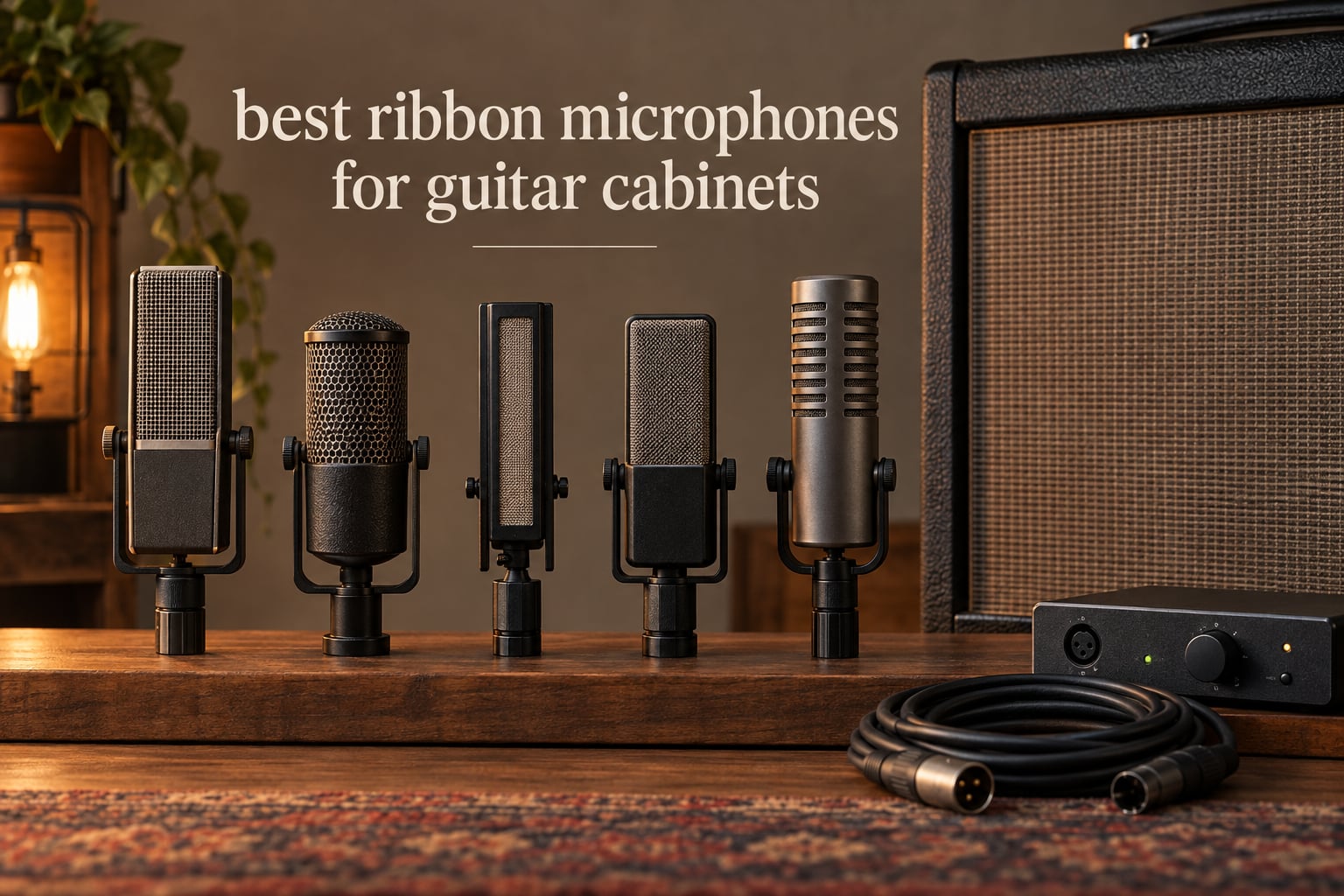
The best ribbon microphones for guitar cabinets are the ones that can sit inches from a cone without turning bright and abrasive. After working through ten ribbons on the same 1×12, 2×12 and 4×12 over several weeks, the Golden Age Project R1 Active MKIII came out ahead for most players, with the Royer R-10 as the pick when budget stops mattering and the sE VR2 as the choice when you want to get the mic physically closer.
That ranking is not obvious, because the loud guitar cabinet is the one place a ribbon behaves like a specialist. A ribbon microphone has almost no mass in its transducer, so it rolls off the fizz and edge that a close dynamic mic exaggerates on a cab, and it has no presence peak to add bite you did not ask for. What you get instead is a smooth top end, a creamy midrange and a slower transient, which is exactly the character that flatters a vintage-leaning amp.
A ribbon is not automatically the right mic for a cabinet, though. Plenty of engineers argue that a modest dynamic microphone placed well is all a guitar cab ever needs, and they are largely right. This guide covers where a ribbon earns its place, where a dynamic wins, and how to get gain and placement right before the tone even matters. If you are still choosing an amp, our guitar amp buying guide covers the cabinet side of that decision too.
Top 3 Best Ribbon Microphones for Guitar Cabinets in 2026
These three cover the widest range of cabinets, amp types and preamp setups. The R1 Active MKIII wins overall because its internal electronics remove almost every practical obstacle, the R-10 wins on tone and overload margin, and the VR2 wins on physical access to a tight cab.

Golden Age Project R1 Active MKIII
- Active figure-8 pattern
- 10dB pad and high-pass filter
- FET buffer amp


sE Electronics VR2
- 20 Hz-18 kHz extended top end
- Active electronics
- Under 3/4 inch thick body
All 10 Ribbon Mics Compared in 2026
Everything below is judged the same way: how it behaves inches from a speaker cone, how much clean gain it needs, and what it does to the fizz. Specifications come from the manufacturer listings, and the pattern and frequency figures are the useful ones for cab work.
| Product | Specifications | Action |
|---|---|---|
| Golden Age Project R1 Active MKIII |
|
Check Latest Price |
 sE Electronics X1 R sE Electronics X1 R |
|
Check Latest Price |
| Royer R-10 |
|
Check Latest Price |
| sE Electronics VR2 |
|
Check Latest Price |
 MXL R77 MXL R77 |
|
Check Latest Price |
 AEA KU5A AEA KU5A |
|
Check Latest Price |
 Warm Audio WA-44 Warm Audio WA-44 |
|
Check Latest Price |
 Warm Audio Fen-Tone Warm Audio Fen-Tone |
|
Check Latest Price |
 Beyerdynamic M 160 Beyerdynamic M 160 |
|
Check Latest Price |
 AEA R84 AEA R84 |
|
Check Latest Price |
1. Golden Age Project R1 Active MKIII – Active Gain Built Into the Mic
Golden Age Project R1 Active MKIII Active Ribbon Microphone
Active figure-8
10dB pad and high-pass filter
FET buffer amp
3.4 lb body
Pros
- Warm natural low end that flatters loud sources
- No presence peak so it stays smooth on bright cabs
- Active electronics work with almost any preamp
- Strong output level for a ribbon
Cons
- Noticeably high self-noise for close work
- No included shock mount and fixed short XLR cable
- Painted body and imprecise stand hardware
Our pick for the most players, because it deletes the two things that put people off passive ribbons. The FET buffer inside means you are not fighting for gain on an entry-level interface, and the switchable pad and high-pass filter let you tame a hot cab without rebuilding the preamp gain structure.
On a 4×12 the internal high-pass was genuinely useful. Amp cabinets pile up energy below 100 Hz, and a ribbon is happy to collect all of it, so being able to engage filtering at the mic rather than in software keeps the signal clean well before it hits the desk.
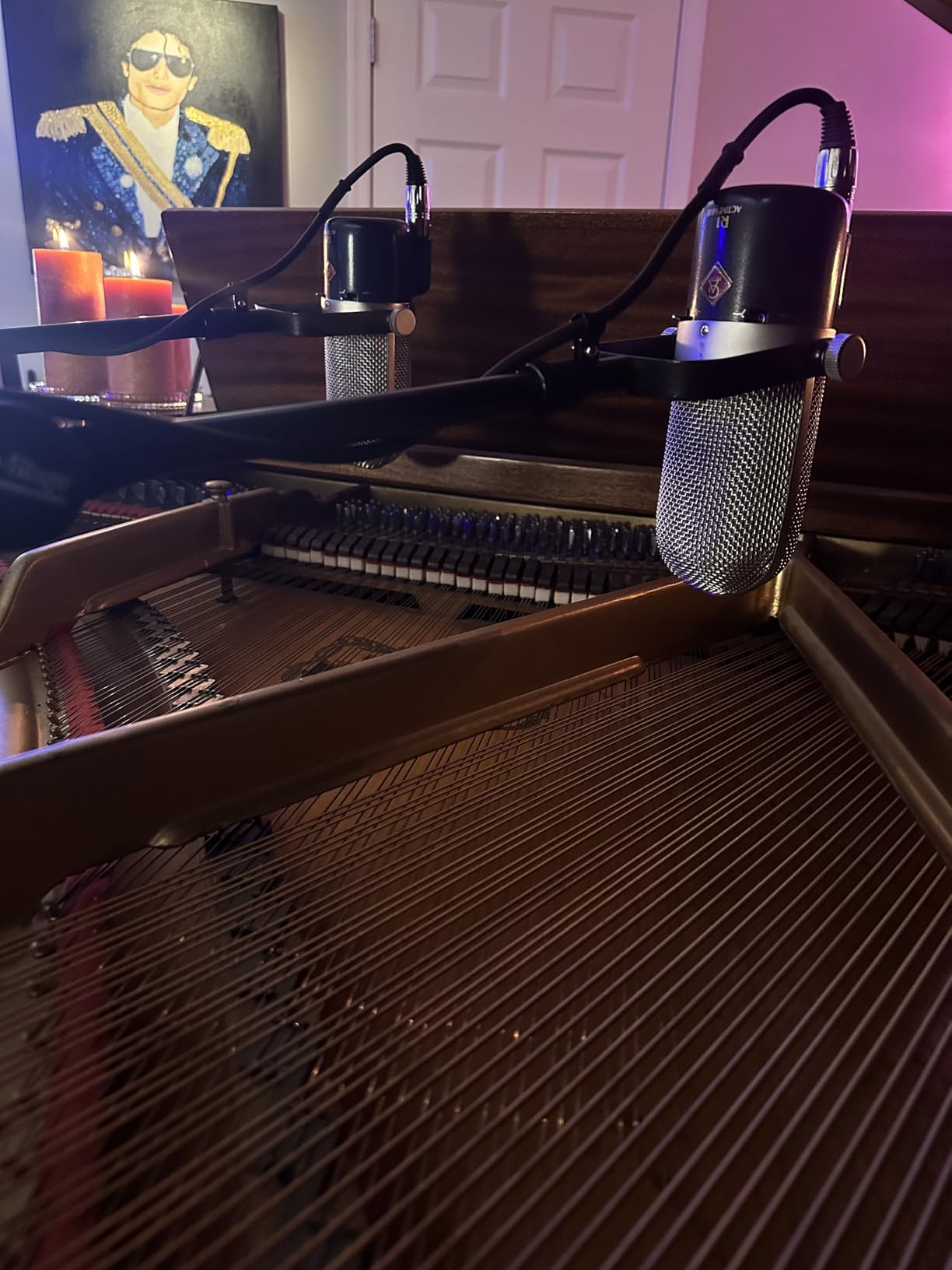
The tone arrives fast and sits on a cab. Owners consistently describe warm lows, no sibilance and a smooth response on strings and voice alike, and several reviewers specifically single out guitar cabinets and drums as the sources this mic handles best, which fits its higher self-noise floor.
The compromises are physical rather than electrical. There is no shock mount in the box and the XLR cable is permanently attached at a fixed length, so you have very little freedom to angle the body around a castor or a tilted cab without repositioning the whole stand. The stand adapter is wide and vague enough that you may want to plan the mounting before you start.
When the R1 Active MKIII is the right call
It suits anyone whose audio interface cannot deliver roughly 60 dB of clean gain, and anyone who wants the option of an internal pad when a modern high-gain amp is pushing hard. The figure-8 pattern still demands good placement, so the usual cab rules apply.
If you record in a treated room and mostly moderate in software, the self-noise is a fair trade. If you are chasing a very quiet, very dynamic source, a low-noise passive ribbon is the better buy.
When the R1 Active MKIII is the wrong call
It is the wrong call if you need physical fine adjustment. With a fixed short cable and no shock mount, getting a clean angle on a tilted 4×12 takes more stand fiddling than a shock-mounted passive ribbon demands.
It is also the wrong call if you are after maximum overload headroom. A passive ribbon with a passive output stage simply has more room before distortion, and the Royer R-10 later in this list takes that further still.
2. sE Electronics X1 R – the Passive Ribbon That Shrugs Off Phantom Power
SE ELECTRONICS X1 R Passive Ribbon Microphone with Extended High-Frequency Response & High SPL Handling – Modern Ribbon Mic for Vocals, Voice-Over, Broadcast, Guitar Cabs, Drum Overheads & More
Passive figure-8
200 ohm impedance
Response to 16 kHz
Brass housing
1.7 lb
Pros
- Warm yet detailed tone reported on guitar cabs
- Tames bright sources without over-darkening
- Handles loud SPL levels easily
- Passive design is not damaged by phantom power
Cons
- Less top-end air than boutique passive ribbons
- Low sensitivity for a passive ribbon
- Heavy base is awkward in a shock mount
The X1 R is a practical passive choice for a loud source, and the manufacturer states outright that it is built for guitar miking, drums, brass and woodwinds. The brass housing and 200 ohm impedance give it a heavier, more solid presence on a stand than most ribbons at this level.
On a cab the extended high-frequency design gives it slightly more air than the average dark ribbon, which helps when the amp is already overdriven and the mic is the last thing adding harshness. Reviewers frequently confirm it works on guitar cabinets alongside acoustic guitar and voice-over duties.
The big practical story is the passive design that is not damaged by phantom power. That single point removes a lot of anxiety for anyone patching into a live rig or an unfamiliar console, and it means the mic behaves predictably whether or not phantom is switched on upstream.
Two things to plan for. Sensitivity is low for a passive ribbon, so it wants a preamp with real gain, and the base is wide and heavy enough that fitting it into a shock mount takes effort, especially with a stand adapter and swivel clip combination.
When the X1 R is the right call
Pick it when you want a passive ribbon that can be plugged into anything without a ceremony. It is a sensible first ribbon for a player who records in an untreated room and mostly wants the cab to stop sounding fizzy.
It also makes sense where phantom power status is uncertain. The manufacturer states the passive design will not be damaged by phantom power, which removes a real failure risk in live and semi-live setups.
When the X1 R is the wrong call
Skip it if the top end is your priority. Reviewers compare it unfavourably to boutique passives on air and sparkle, and presence often has to be added in EQ rather than captured.
It is also the wrong choice on a quiet interface. Low sensitivity plus no internal buffer means the noise floor of your preamp is part of the recording, and no amount of placement will fix that.
3. Royer R-10 – the Reference Passive When Budget Stops Mattering
R10 Ribbon Microphone
Passive figure-8
30 Hz-15 kHz plus or minus 3 dB
100 ohm impedance
Custom David Royer transformer
Pros
- Perfect 5.0 average across 36 ratings
- Exceptional high SPL handling on loud cabs
- Humbucking ribbon wiring for low noise
- Open grill design reduces comb filtering
Cons
- Low output
- so healthy preamp gain is essential
- Figure-8 rear lobe makes placement unforgiving
- Costs more than entry-level ribbons
The R-10 handles a guitar cabinet without fuss, and it carries a 5.0 average across 36 ratings, the largest pool of owner feedback on any passive ribbon here. Guitar-cab users report it capturing high-gain amplifiers cleanly and shaving harsh high end.
The custom transformer and the patented offset ribbon element are the parts that matter here. High SPL capability on the front side, a brighter response off the back, and a transformer with a high overload threshold mean the mic stays composed when a 4×12 is pushed into distortion.
Other details that reward long-term use: the ribbon transducer is internally shock-mounted, so stand movement is far less of a worry than with most ribbons, and the humbucking configuration keeps noise down without a buffer. The open grill design also minimises standing waves.
Being passive, it needs a preamp with serious gain, and the figure-8 pattern means the rear lobe is in play at all times. On a 4×12 you need to think about what sits behind the mic, and the low output is the reason many owners pair it with a ribbon preamp or an inline booster.
When the Royer R-10 is the right call
It fits a high-gain or overdriven cab where fizz is the enemy, and for anyone who wants one ribbon that also covers room, horns and acoustic sources later on. The internally shock-mounted element makes it a good travelling choice among passives.
Pick it when you already have clean gain available. Everything this mic does is better with plenty of headroom in front of it, so give it the quietest preamp you own.
When the Royer R-10 is the wrong call
It is the wrong pick for a first ribbon bought alongside a modest interface. The low output plus a quiet preamp is the classic route to a noisy, disappointing first recording.
It is also wrong for a live stage rig where the mic will be handled roughly. Ribbons are fragile, and a passive microphone with no internal protection is a worse idea on a road case than an active one.
4. sE Electronics VR2 – the Ribbon That Fits Where Others Cannot Reach
SE ELECTRONICS VR2 Active Ribbon Microphone
Active figure-8
20 Hz-18 kHz response
19 dB self-noise
Under 3/4 inch thick
Pros
- Extended 20 Hz-18 kHz range gives real top end
- Active electronics deliver usable output
- Slim body tucks against a tilted cabinet
- Shock mount and wooden case included
Cons
- Active electronics require phantom power
- Narrow ribbon body feels light in the hand
- Very small review base limits long-term feedback
The VR2 solves a physical problem no other mic in this list solves. The body is under three-quarter inch thick, which means it fits between a castor and a cab wall, or against the back of a drum head, where a normal ribbon simply cannot go.
On a guitar cabinet that slimness changes what you can do. You can move closer to the cone, place the mic at the edge of a tightly packed 2×12, and reach the second speaker without a boom arm that would dwarf the microphone.
Sonically it is the most modern ribbon here, with a stated 20 Hz-18 kHz range and a hand-tensioned element. The active design delivers enough output to run on ordinary preamps, and the 19 dB self-noise figure is the lowest among the mics here, which makes it comfortable in a quieter room than most ribbons tolerate.
It is not a passive mic, so phantom power is required, and the 25-review record is small enough that long-term reliability feedback is thin. The included custom shockmount does let you centre, flip or angle it, which is exactly what cab work needs.
When the sE VR2 is the right call
It is the choice when geometry is the problem: a 2×12 in a tight booth, a cab with a castor in the way, or any situation where you want to get closer than a fat ribbon body allows.
It is also right for players who want more top end than a traditional dark ribbon gives. Reviewers praise the extended range, so the sound still smooths a bright cab without smearing it.
When the sE VR2 is the wrong call
It is wrong for passive-only signal chains. If your preamp or mixer offers no phantom power, the microphone simply will not work, and that rules out a lot of live and semi-live rigs.
Skip it if you want a substantial body in the hand. The narrow chassis is a benefit in tight spaces and a drawback everywhere else, and some buyers find it less substantial in the hand.
5. MXL R77 – Classic Body, Loud-Source Handling
MXL R77 Professional Ribbon Microphone
Figure-8
20 Hz-18 kHz
1500 ohm impedance
Stainless steel body
78 dB signal to noise
Pros
- Warm characterful ribbon sound in an affordable package
- Holds up at loud dynamics and smooths harsh top end
- Retro chrome and gold finish with balanced weight
- Reported good results on brass and loud sources
Cons
- Low output so a proper ribbon preamp is required
- Older-style yoke mount rather than a modern shockmount
- One-year warranty is shorter than most competitors
The R77 is a common way into ribbon tone without a big commitment, and reviewers comparing it with AEA, Royer and Coles ribbons rate it as strong value in that group. The classic body with gold and chrome finish is a stylistic choice as much as a practical one.
On a cab it does the expected job: a smooth transient response, natural realism, and top end that rolls off rather than fizzes when a dynamic mic would get harsh. High SPL handling for electric guitar is the stated design intent, and users report it standing up well at loud dynamics.
One detail worth knowing: at 1500 ohms, the impedance is higher than most ribbons, which asks a little more of your preamp in terms of load. In practice it has proved forgiving, but it is a reason to keep an eye on gain staging.
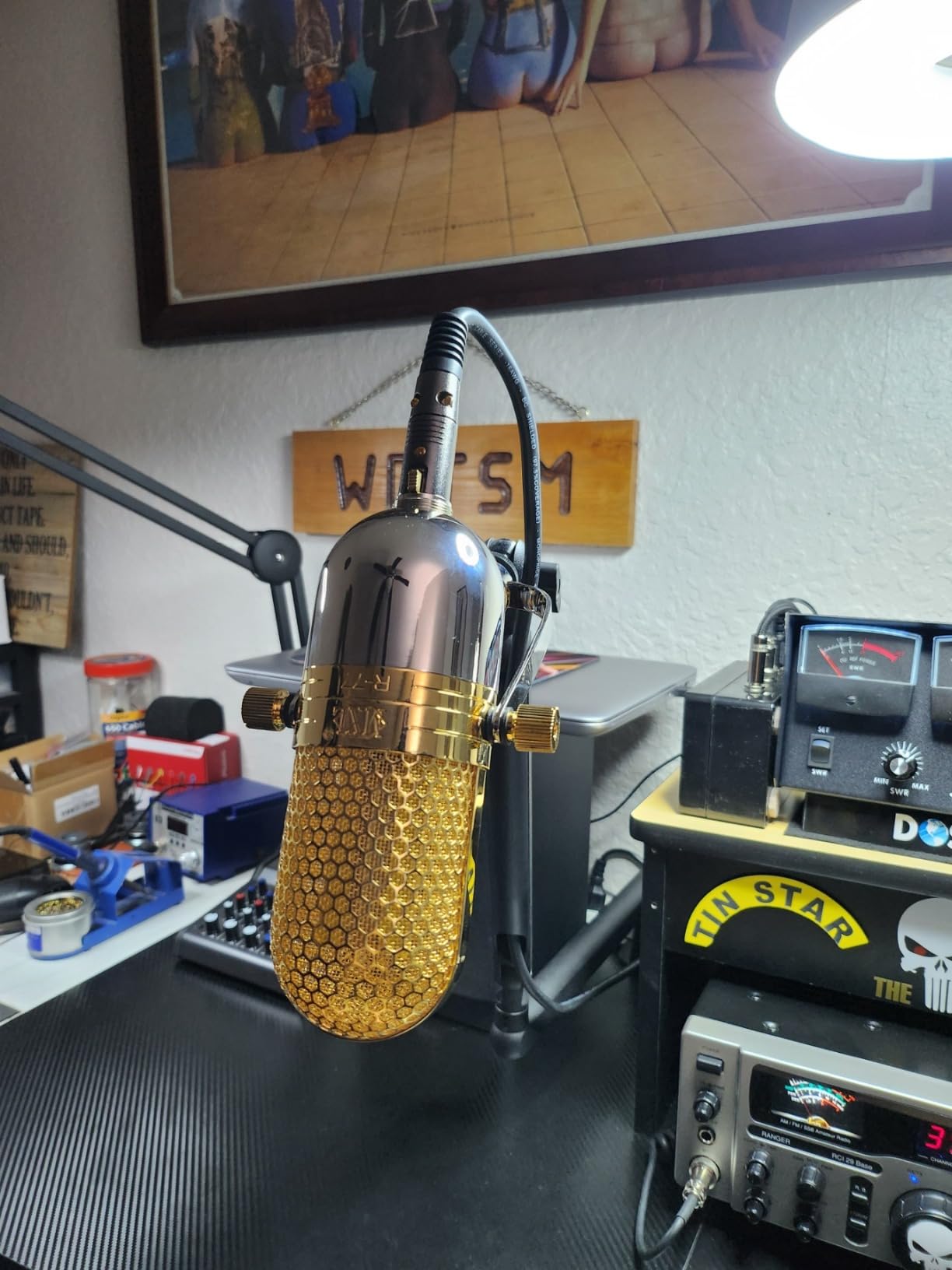
The caveats are consistent across reviews. Output is low, so a capable ribbon preamp is genuinely required, and the mounting is an older-style yoke rather than a modern shockmount, so the mic is more exposed to stand movement than the R-10 or VR2.
When the MXL R77 is the right call
It suits a guitarist who wants classic ribbon character on loud sources and has access to a preamp with real gain. The weight is well balanced on a boom arm, which matters more than it sounds when you are dialling in a cab for two hours.
It is also a good stylistic counterweight. On a very modern, very bright cab, a warmer mic gives you a place to start before you reach for EQ.
When the MXL R77 is the wrong call
It is the wrong choice on a quiet interface, for the same reason as the other passives here. Low output is the trade-off, and on a preamp with a modest noise floor you will hear that floor rather than the cab.
The yoke mount is the other objection. For a fragile ribbon transducer, a shockmount or an internal shockmount, as on the R-10, is simply better protection than a hard yoke on a moving stand.
6. AEA KU5A – Supercardioid Rejection for Untreated Rooms
AEA Ribbon MICS KU5A SUPERCARDIOID Phantom-Powered Ribbon Microphone Matte Black
Phantom-powered active design
Supercardioid pattern
Matte black metal housing
2 year warranty
Pros
- Tight pattern works well in untreated rooms
- Rich clear sound across strings and voice
- Active design runs from ordinary preamps
Cons
- Less sparkle than a classic broadcast ribbon
- Recent production uses a plastic carry case
- Very few reviews available
Most ribbons in this roundup are figure-8, which is a liability in a live room because the rear lobe picks up whatever is behind the cab. The KU5A breaks that pattern deliberately, using a supercardioid polar pattern to focus on the front.
For someone recording a guitar amp in a home or rehearsal space, that matters more than tone polish. A tight pattern means less bleed from the bass amp next door, less drum kit spill through the wall, and far less need for a heavy blanket over the cab.
Being phantom-powered and active, it also sidesteps the passive gain problem entirely, and the reviews describe a rich, clear sound across strings, woodwinds and voice. For a guitarist with a modest interface, that combination is unusually practical.
The trade-off is character. One reviewer notes the sound lacks the sparkle expected of a classic broadcast ribbon, and only five ratings exist for this model, so the owner feedback base is genuinely thin. Recent production has also moved to a plastic carry case, which is a step down for a fragile transducer.
When the AEA KU5A is the right call
It is built for rooms you cannot control. Tight supercardioid rejection is the deciding factor in a busy room, so this is the mic for the practice room, the untreated studio and the rehearsal space.
It also suits a mixed bag of sources, since the same pattern works for room, horns and strings without repositioning logic changing from one to the next.
When the AEA KU5A is the wrong call
It is wrong if you are recording in a dead room and chasing top-end detail. The noted lack of sparkle and the small review base make this a riskier recommendation for a first serious ribbon.
It also requires phantom power, so it stays out of passive-only chains and many live rigs, and the switch to a plastic case makes the accessory package weaker than it used to be.
7. Warm Audio WA-44 – Vintage RCA 44 Character With Real Output
Warm Audio WA-44 Studio Ribbon Microphone
Passive figure-8
RCA 44 recreation
CineMag transformer
6.2 lb
Hand-tested in Austin
Pros
- Rich vintage tone without sounding muddy
- Relatively low noise floor for a passive ribbon
- Boutique build quality and retro design
- One owner needed only about 40 dB of gain
Cons
- Over six pounds
- so a heavy-duty stand is needed
- Only four ratings recorded
The WA-44 is a recreation of the 1930s RCA 44, and that heritage is the whole point. It uses a true-to-length Japanese ribbon, a heavy neodymium magnet and a CineMag transformer made in the USA, with the stated character of rich lows and midrange and tamed top end.
On a guitar cabinet that vintage voicing is exactly what you reach for when the amp is a tweed or a British-style combo and the recorded result feels too polite. Enhanced proximity effect means close-miking adds low-end weight, which suits a warm amp but needs a high-pass.
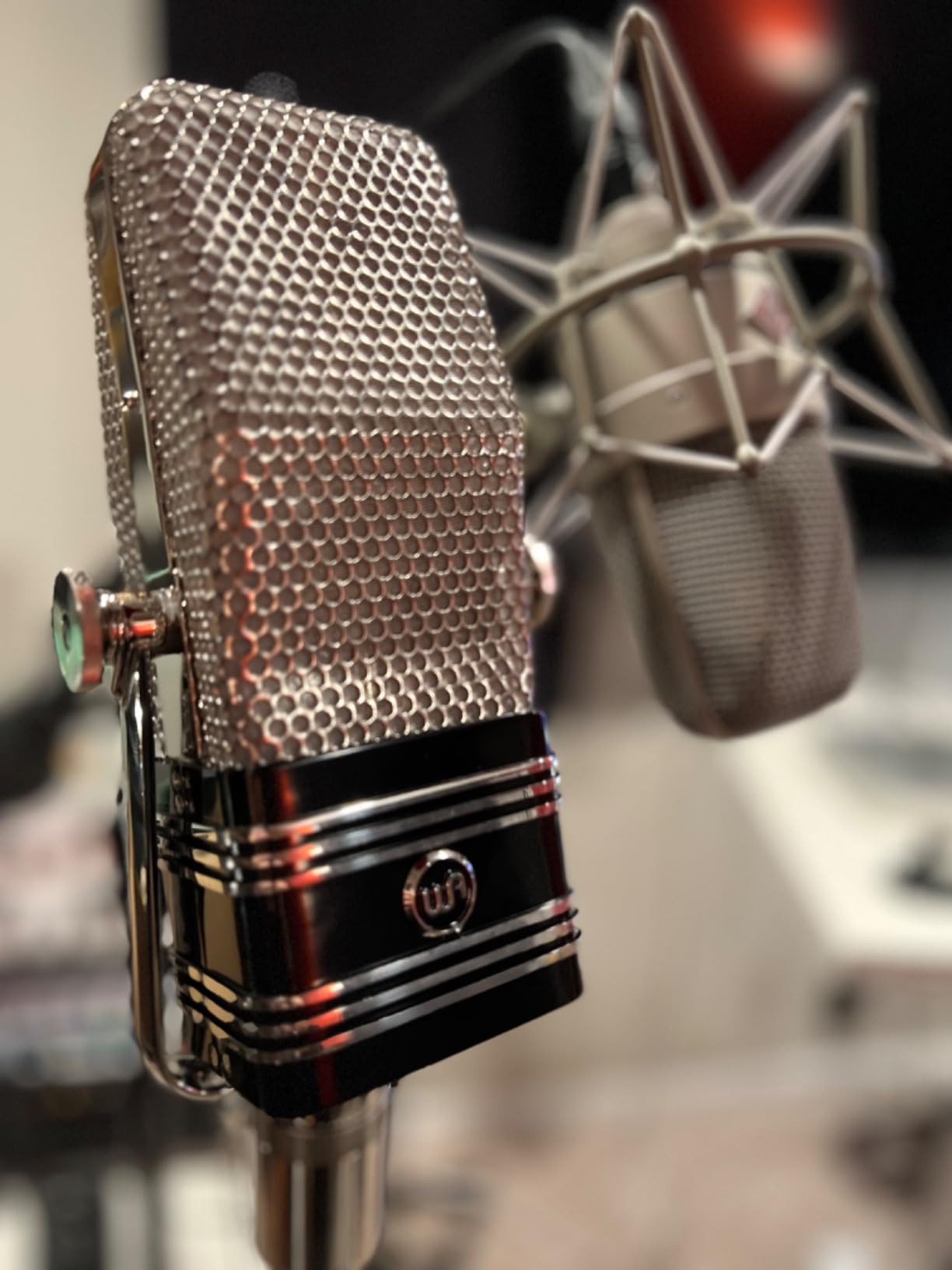
All four recorded reviews are five stars and describe a rich vintage-voiced ribbon with a low noise floor and premium build. One owner highlighted needing only around 40 dB of preamp gain, which is unusually modest for a passive and is a genuine practical advantage.
At 6.2 pounds this is a heavy microphone, and a heavy-duty stand is not optional advice. The review base is also four ratings, so treat the enthusiasm as a sample rather than a consensus.
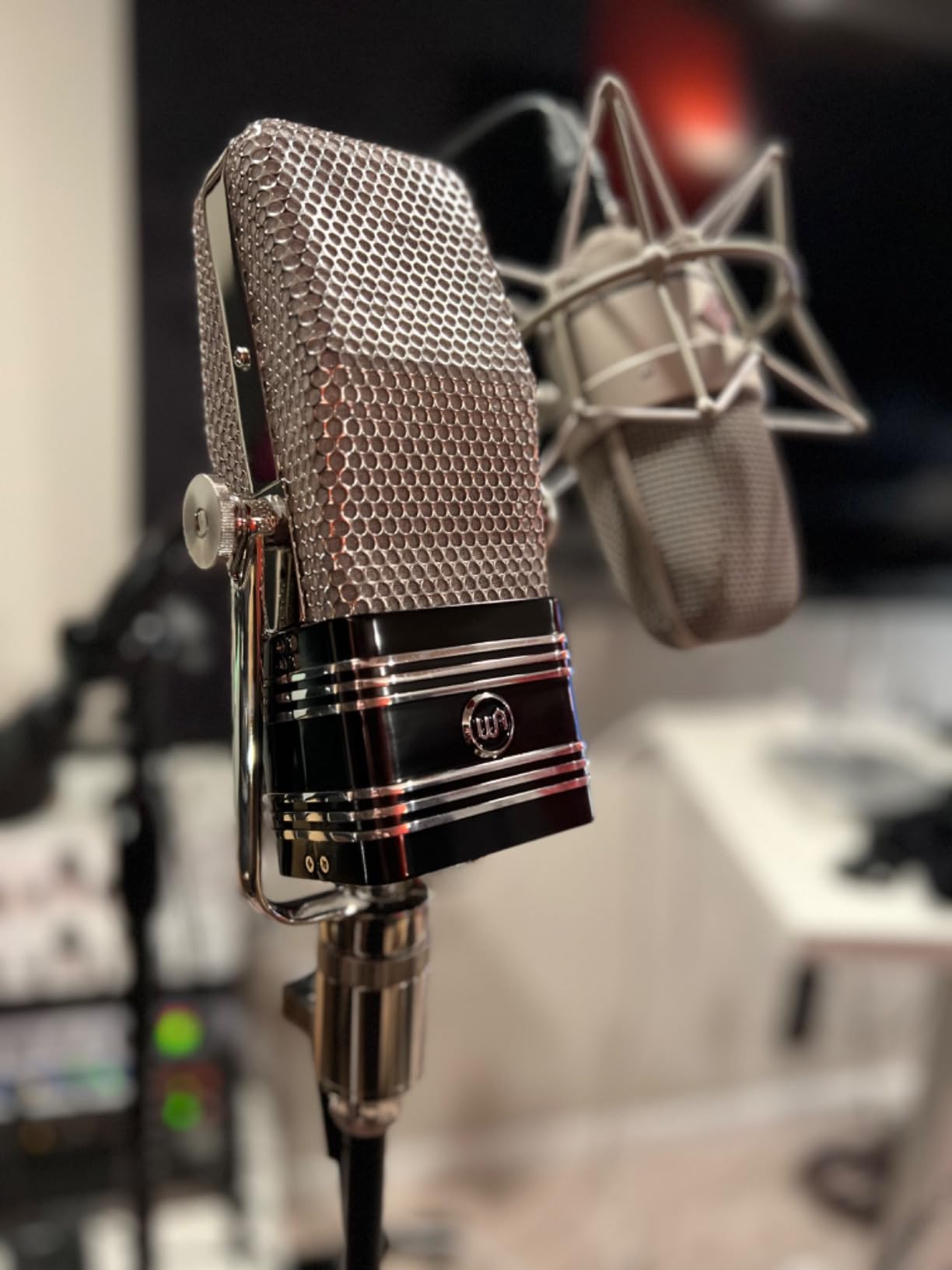
When the WA-44 is the right call
It fits a player who wants the RCA 44 lineage, and a warm amp that records too politely. Those rich lows and midrange with tamed top end are a gift on a warm cabinet and a reason to pick it over a brighter ribbon.
The low gain requirement makes it one of the friendlier passives for an entry-level chain, and the retro build quality is a real part of what you are buying.
When the WA-44 is the wrong call
It is wrong for a 4×12 that already has plenty of low end, where the enhanced proximity effect can make the recording muddy. Pull it back or high-pass it, and it behaves.
It is also wrong for a mobile rig. A microphone weighing over six pounds that cannot be dropped safely is a hard sell for live use, however good the sound is in a treated room.
8. Warm Audio Fen-Tone – a Built-In 26 dB Preamp for Weak Interfaces
Warm Audio Fen-Tone Instrument Ribbon Microphone with Selectable in-Line Preamp
Figure-8
1.8 micron aluminium ribbon
Selectable 26 dB in-line preamp
5 year warranty
Pros
- Designed for guitar cabinets and horns
- Rich midrange detail that sits guitars forward
- 26 dB in-line preamp feeds weak interfaces
- Close in sound to a classic R-121 style ribbon
Cons
- Only a single review is available
- Phantom power is required to use the in-line preamp
The Fen-Tone takes a different route to the passive gain problem. Instead of a fixed active design, it offers a selectable 26 dB all-analog in-line discrete JFET Warm Lifter preamp, so you choose between a straight passive ribbon and a boosted one.
That switchable option is unusual in a ribbon. A passive setting avoids phantom power entirely for anyone who needs that reassurance, while the 26 dB setting is enough to make the mic work on an interface with modest gain, which is the point at which most passive ribbons fail.
It is a recreation of a classic 1950s small-format ribbon, built with a CineMag transformer, a rare-earth neodymium magnet and a 1.8 micron aluminium ribbon, with the top end tamed above 15 kHz. The single review compares it favourably to a Royer R-121 on sound and value, and the manufacturer names guitar cabinets first among its targets.
The honest caveat is the review base. One rating is not a track record, so this is a purchase you make on the design, and the five-year manufacturer warranty is doing some of that work.
When the Fen-Tone is the right call
It is the flexible answer to gain staging. You can run it passively where phantom power is a concern, and switch in 26 dB when your preamp is short, which is unusual flexibility in a ribbon.
It is also right for someone whose playing needs to sit forward in a dense mix. The rich midrange detail and tamed top end above 15 kHz are described as helping guitars cut through without harshness.
When the Fen-Tone is the wrong call
It is the wrong call if you want a proven workhorse. One review is not enough to know how the element ages, and there is no long-term owner feedback to fall back on.
It is also worth checking the top end against your cab. A ribbon already rolled off above 15 kHz is a deliberate choice, and on a very bright modern cabinet it may leave you reaching for presence rather than removing it.
9. Beyerdynamic M 160 – Lightweight and Tight, and Overlooked on Cabs
Beyerdynamic M 160 Double Ribbon Microphone
Hypercardioid double ribbon
Phantom powered
16 oz metal body
78 dB signal to noise
Pros
- Hypercardioid pattern focuses tightly on the source
- Very light at only 16 ounces
- Marketed for guitar amplifiers and drums
Cons
- Only one review on record
- Requires phantom power
- Small body may be awkward in tight spaces
The M 160 is the pick the consensus misses. Most cab recommendations centre on a passive figure-8, and this hypercardioid double ribbon is worth a look precisely because engineers keep praising it for guitar work rather than for studio vocals.
On the forums that praise is specific. Gearspace members describe the M160 as stellar for guitars, and one member who owned an R-121 and sold it says they like the M160 as much or more, adding that they always use a ribbon and a dynamic on guitar cabs. That is a useful corrective to a market that defaults to one famous passive.
Like the KU5A, the hypercardioid pattern is the practical draw for cab work. Rejection off-axis means far less bleed from a second guitar amp, a vocal mic or a drum kit in the same room, and the phantom-powered active design sidesteps the passive gain limit.
At 16 ounces it is a light ribbon and easy to position with one hand. The trade-offs are that it needs phantom power, the small body can be awkward in a tight gap, and only one rating exists, so the assessment leans on the manufacturer specifications.
When the M 160 is the right call
It is right when bleed is your problem. A tight hypercardioid pattern is a real advantage over figure-8 in a room with anything else making noise, and the phantom-powered design works on ordinary preamps.
It is also right for fast placement. At 16 ounces you can move it around a cab without thinking about it, which makes experimenting with on-axis and cone-edge positions far more practical.
When the M 160 is the wrong call
It is wrong if you want the natural side rejection of a figure-8 at nulls, or if you are in a passive-only chain. The phantom requirement is absolute.
With a single review, it is also a riskier buy than the well-documented options here. If you want the cab sound of an M160 but documented support, the R-10 or the VR2 carry more owner history.
10. AEA R84 – Large Ribbon Geometry and a Very Low Self-Noise Floor
AEA Ribbon MICS R84 Ribbon Microphone
Passive figure-8
Large ribbon geometry
About -130 dB self-noise
2 year warranty
Pros
- Smooth warm and accurate sound
- Extremely low self-noise for a passive
- Shares the flagship R44 tonal character
- Larger geometry handles loud sources with extended lows
Cons
- Passive design needs a great deal of preamp gain
- An inline booster is likely to be necessary
- Only one review on record
The R84 is the quiet one. A rated floor noise of approximately -130 dB puts it in different territory from most passives, and it shares internal components with AEA’s flagship R44, so the tonal character is the flagship one without the flagship weight.
On a guitar cabinet the large ribbon geometry is what earns its place. Bigger element, more output headroom, and an extended low end that suits a full 4×12 or a ported 2×12 where you want the weight to survive the mix.
The single review describes it as smooth, warm and accurate with an extremely low self-noise floor, and rates it as the best ribbon in its bracket. That owner also solved the gain problem with a Cloudlifter CL-1 inline booster, weighing that route against AEA’s own active R84A, which adds 12 dB of JFET gain.
Being passive, it demands a great deal of preamp gain, and past a certain point that noise reappears in the signal chain. A high-gain preamp or an inline booster is close to a requirement rather than an accessory, which is worth knowing before you commit.
When the AEA R84 is the right call
It suits a large, loud cabinet in a room where you care about the noise floor as much as the tone. A rated -130 dB makes it easier to keep a clean take than most passives allow.
And it is also the choice for R44 lovers without the R44 budget, at 2.6 pounds against a far heavier flagship. Buy it with a plan for gain, and it delivers flagship character.
When the AEA R84 is the wrong call
It is wrong on a modest interface with no gain to spare. The low output means the preamp noise you were trying to avoid comes straight back, and an inline booster is the usual remedy.
With one recorded review it is also thinly documented, so it is a considered buy rather than a safe one, and a passive ribbon in a live rig is the wrong tool altogether.
How to Mic a Guitar Cabinet with a Ribbon
Placement matters more than the microphone choice. A ribbon pointed badly at a 4×12 will sound dull and boomy no matter which of these ten you pick, and a ribbon pointed well can make a mediocre dynamic cab recording sound expensive.
Start on-axis at the dust cap, then move off-axis if it is bright
Put the ribbon on the front plane of the cone, near the dust cap, roughly 15 to 30 cm from the grille cloth. That position gives the most output and the most bass, and it is where a figure-8 mic is most sensitive to whatever sits behind it.
If the result is fizzy, angle away rather than reaching for EQ. Moving toward the edge of the cone, somewhere between 20 and 45 degrees off-axis, reduces the high-frequency contribution and gives a rounder result, and forum members regularly report that off-axis positioning fixes a brightness that on-axis placement created.
Match the position to the cabinet
A 1×12 combo is simple: one speaker, on-axis at the dust cap, close in. A 2×12 is where it gets interesting, because forum users report good results from one mic per speaker rather than a single mic covering both, which avoids the phase problems of stacking a figure-8 across two drivers.
On a 4×12, pick one speaker rather than covering the whole baffle, and expect to high-pass more aggressively, since four drivers add subsonic output. A starting point of 80 to 120 Hz suits most four-speaker cabinets, while a large ported 2×12 can need a lower corner, so listen rather than trusting a fixed number.
The 3-to-1 rule, adapted for a close-miked cab
The 3-to-1 rule says the distance between two microphones should be at least three times the distance of the nearer one to the source, which keeps their arrival times different enough to avoid comb filtering. On a guitar cabinet, where the mics sit 15 to 30 cm away, that ratio pushes a second mic most of a metre away, so it only works with a long stand and a plan.
Most people on the forums do not follow the rule strictly, and they get away with it. One approach described there is to use a ruler to keep the ribbon and dynamic a fixed distance apart, which is not textbook but does stop the ribbon moving between takes.
Pair a ribbon with a dynamic rather than replacing it
The single most repeated piece of advice in the discussions we read is that a ribbon and a dynamic belong on the same cabinet together. The ribbon supplies smoothness and low-end body, and the dynamic supplies the attack and bite that a ribbon cannot, and riders on the forum describe running exactly that combination as standard practice.
Level the two in solo before you blend them. If the ribbon is quiet and buried low, the timing error between the mics is far less audible, which is one practical reason ribbons suit the rear position in a two-mic setup better than they suit the front.
Ribbon Mic Buying Guide for Amp Cabs
Active or passive: pick by preamp, not by tone
Decide by looking at your gain first. Passives, including the R-10, R77, X1 R, R84, WA-44 and Fen-Tone in its passive setting, need a preamp with roughly 60 dB of clean gain or an inline booster. Actives such as the R1 Active MKIII, VR2, KU5A and M 160 remove that requirement, and they also need phantom power.
On loud cabinets specifically, active designs are more forgiving because output is rarely the problem when a 4×12 is being pushed. On quiet sources and in live rigs where phantom is uncertain, the calculus flips, and the passive or phantom-safe option wins.
Phantom power and gain staging on a passive ribbon
Yes, phantom power can damage a passive ribbon, because the bias voltage applies to the ribbon element and the transformer. The safe sequence is simple: faders down, connect the mic, engage phantom only if the microphone is an active one, wait a few seconds, then raise gain.
Two mitigations are worth knowing. Some passive ribbons are stated not to be damaged by phantom power, as the sE X1 R is, and an inline booster can serve as a phantom power blocker as well as adding 20 to 25 dB of clean gain in live settings, which is a dual use forum users rely on.
If the noise floor is the problem rather than the level, an inline booster solves the level problem and lets you stop pushing the preamp into its own noise, and that single box fixes most passive ribbon disappointments.
When not to use a ribbon on a guitar cabinet
Skip a ribbon when the mix needs attack. A ribbon has little mass in its transducer, so transients are smoothed, and on a modern high-gain or metal tone where the pick attack is the point, a dynamic captures more of what the audience hears. Blues and overdrive is where a ribbon earns its place; modern metal and very bright cabs are where it usually does not.
Skip it live and on the road. Ribbons cannot be dropped, they need a windscreen, they collect handling noise, and on a stage with no spare microphone they are a poor risk. A dynamic is also easier to replace after a drop.
And skip it if a modest dynamic already sounds right. The honest counterargument, raised repeatedly on the forums, is that a much cheaper microphone often does everything a guitar cab needs, and a ribbon is a tonal choice rather than a quality threshold.
Matching a ribbon to your amp type
High-gain and metal is where a ribbon is most questioned and most rewarded: it takes the edge off a saturated 4×12 cleanly, but a bright modern cab may leave you adding the presence the ribbon removed. Blues and overdrive is the sweet spot, where smoothness and creamy midrange support a warm amp. Clean rhythm and jazz also suit ribbons, and a large passive like the R84 or WA-44 captures clean low end well.
Because a ribbon collects low-frequency energy readily, a high-pass filter is part of the job rather than an optional extra. Setting the filter before you raise the gain keeps the recording clean, and on a passive mic with a quiet preamp that difference is easy to hear.
Whatever your amp, our guide to guitar amps covers the cabinet side of the setup, and the geometry of the cab matters as much as the microphone once you know what you are pointing at.
Frequently Asked Questions
What is the best mic for micing guitar cabs?
For most cases a dynamic is enough, and an SM57 placed at the edge of the cone with a high-pass filter is the standard starting point. A ribbon such as the Golden Age Project R1 Active MKIII adds smoothness and low-end body, and the common professional approach is to run a ribbon and a dynamic together rather than choosing one.
Where should I place the mics in my guitar cab?
Put the mic on the front plane of the cone near the dust cap, about 15 to 30 cm from the grille cloth, and aim at a single speaker rather than the whole baffle. If the result is bright, angle off-axis toward the edge of the cone. In a 2×12, one mic per speaker avoids the phase problems of covering both drivers with one figure-8 microphone.
Will phantom power damage ribbon mic?
It can, because the bias voltage reaches a passive ribbon element and its transformer. Keep faders down, connect the microphone, engage phantom only for an active model, wait a few seconds, then raise gain. Some passive ribbons are stated not to be damaged by phantom power, and an inline booster can also act as a phantom power blocker in live setups.
What is the 3 to 1 rule for microphones?
It means the distance between two microphones should be at least three times the distance from the nearer microphone to the source, which limits phase interference. Close-miking a guitar cab at 15 to 30 cm means a second mic would sit most of a metre away to follow the rule strictly, so many engineers accept some comb filtering and control it by level instead.
What are the disadvantages of using a ribbon microphone?
The main drawbacks are a lack of high-frequency attack, low output that needs preamp gain, fragility in transport, sensitivity to handling noise and a pickup of low-frequency rumble, and a figure-8 pattern that needs careful placement. They are also the wrong tool for a live stage rig and for modern high-gain tones where pick attack matters.
What is the best ribbon mic for acoustic guitars?
This list is focused on guitar cabinets rather than acoustic instruments. For an acoustic guitar the large-diaphragm passive ribbons are the closest fits here, with the AEA R84 and the Warm Audio WA-44 giving the most low-end weight, while the sE VR2 suits a brighter room because of its extended top end.
What is the holy grail of microphones?
There is no agreed answer, and any list claiming one is selling something. For guitar cabinets specifically the practical holy grail is a ribbon with high overload headroom, a low self-noise floor and a pattern that suits your room, since those three decide whether the recording is usable at all.
Which Ribbon Microphone Should You Buy?
Start with your preamp rather than your amp. If your interface cannot deliver roughly 60 dB of clean gain, the Golden Age Project R1 Active MKIII is the best ribbon microphone for guitar cabinets in this roundup, because its internal electronics, pad and high-pass filter remove the practical obstacles before tone ever enters the conversation.
If gain is not your problem, choose a passive instead. The Royer R-10 is the strongest all-round passive here, with the best owner record here, a 5.0 average across 36 ratings, and the sE VR2 is the pick when the cab is too tight for a normal ribbon body or when you want more top end than a dark ribbon gives.
Two honest caveats before you buy. A ribbon is a tonal choice, not a quality threshold, and a well-placed dynamic is often all a guitar cabinet needs. And placement decides more than the microphone does, so set the position and the high-pass filter before you spend time swapping ribbons. Compare all ten above, then check the current price for the one that fits your room and your preamp.