
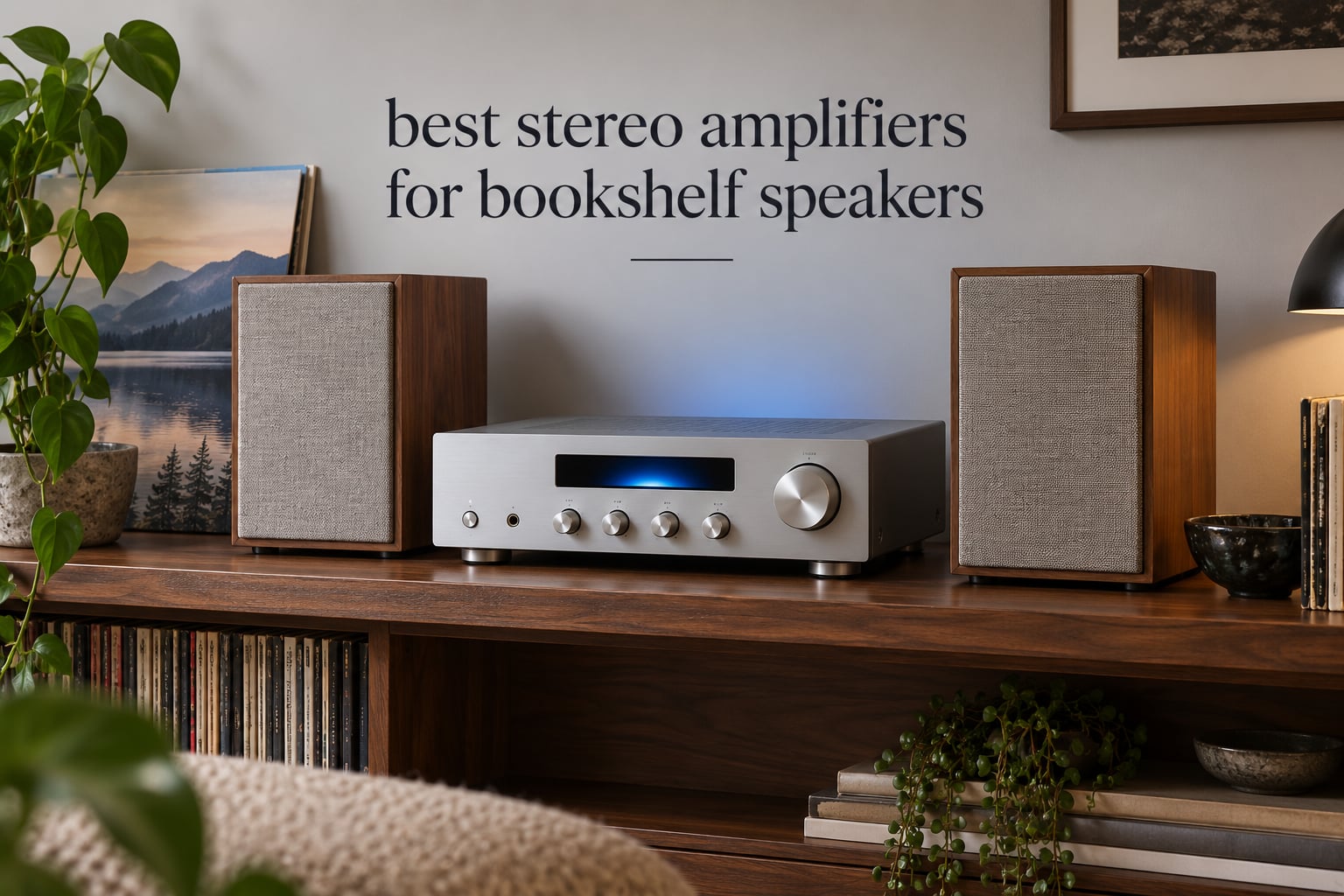
Most bookshelf speakers arrive without any electronics inside them. They are passive drivers that need a stereo amplifier to take the tiny line-level signal from a turntable, a streaming box or your TV and boost it into enough current to move the cones. An amplifier does two jobs at once: it selects your source and controls volume, then it drives the speaker terminals with real power. Get that match wrong and the music gets thin or strained at normal listening levels; get it right and the speakers disappear, which is the whole point.
This guide covers the best stereo amplifiers for bookshelf speakers across the whole price ladder, from a palm-sized mini amp for a bedroom to a full-size integrated with a USB DAC for a serious two-channel system. Every pick below was chosen on how it behaves with real bookshelf speakers rather than on how many features the box lists. We paid close attention to clean power into both 8 and 4 ohm loads, because most bookshelf speakers in circulation sit somewhere in that range.
We also had to answer the question that comes up on every beginner forum thread first: does any of this matter for your particular speakers? Some of the best-sounding bookshelf speakers on the market today are powered models with amplification built in, and if that is what you own, you do not need anything on this list. If you have a pair of passive speakers, you do, and the rest of this guide is written to make that choice simple. If you still need to pick the speakers themselves, start with our bookshelf speaker roundup and come back here once you know what you are driving.
Last updated in 2026. Every rating and review count below was pulled from live customer feedback, and we flag the trade-offs on each one rather than only listing the wins.
Table of Contents
Top 3 Best Stereo Amplifiers for Bookshelf Speakers
Three amplifiers stood out once we put them side by side with real bookshelf speakers. The Fosi BT20A takes first place on the strength of how much clean power it delivers from a very small box, the Denon PMA-600NE earns the value slot because its measured output and warm voicing suit almost any mid-tier speaker, and the WiiM Amp Ultra is the pick if you want streaming, HDMI and room correction without stacking boxes.

Fosi Audio BT20A
- 100W x 2 Class D
- Bluetooth and RCA inputs
- Bass and treble controls
- 24V supply included

Denon PMA-600NE
- 70W at 4 ohms
- Built-in DAC and phono
- Analog Mode and Pure Direct
- Subwoofer output

Quick Overview: Best Stereo Amplifiers for Bookshelf Speakers in 2026
Here is the short version. The table lists every amplifier in the guide with the features that actually decide whether it suits a bookshelf speaker, from available power to the presence of a phono stage.
| Product | Specifications | Action |
|---|---|---|
| Fosi Audio BT20A |
|
Check Latest Price |
 Fosi Audio BT10A Fosi Audio BT10A |
|
Check Latest Price |
 Fosi Audio V1.0G Fosi Audio V1.0G |
|
Check Latest Price |
 Donner MAMP2 Donner MAMP2 |
|
Check Latest Price |
 Dayton Audio HTA200 Dayton Audio HTA200 |
|
Check Latest Price |
 Yamaha A-S301 Yamaha A-S301 |
|
Check Latest Price |
| Denon PMA-600NE |
|
Check Latest Price |
 Marantz PM6007 Marantz PM6007 |
|
Check Latest Price |
| WiiM Amp Ultra |
|
Check Latest Price |
 Yamaha A-S801 Yamaha A-S801 |
|
Check Latest Price |
1. Fosi Audio BT20A – Our Best Overall Pick for Bookshelf Speakers
Fosi Audio BT20A Bluetooth Stereo Amplifier, 2 Channel Home Audio Component Amplifiers for Passive Speakers, Mini Class D Amp Receiver 200W for Indoor/Outdoor/Garage/Ceiling/Bookshelf Speaker
100W x 2 Class D output
Bluetooth and RCA inputs
Bass and treble tone controls
Pros
- Compact and light enough for any shelf
- Rock-solid Bluetooth with no dropouts
- Enough power for Polk TSI100 and Atrium 8 pairs
- Comes with a 24V power supply
- Clear and detailed for its size
Cons
- Tone controls can add midrange distortion if pushed
- Flat slightly bass-leaning voicing with no warmth
- One speaker pair and no subwoofer output
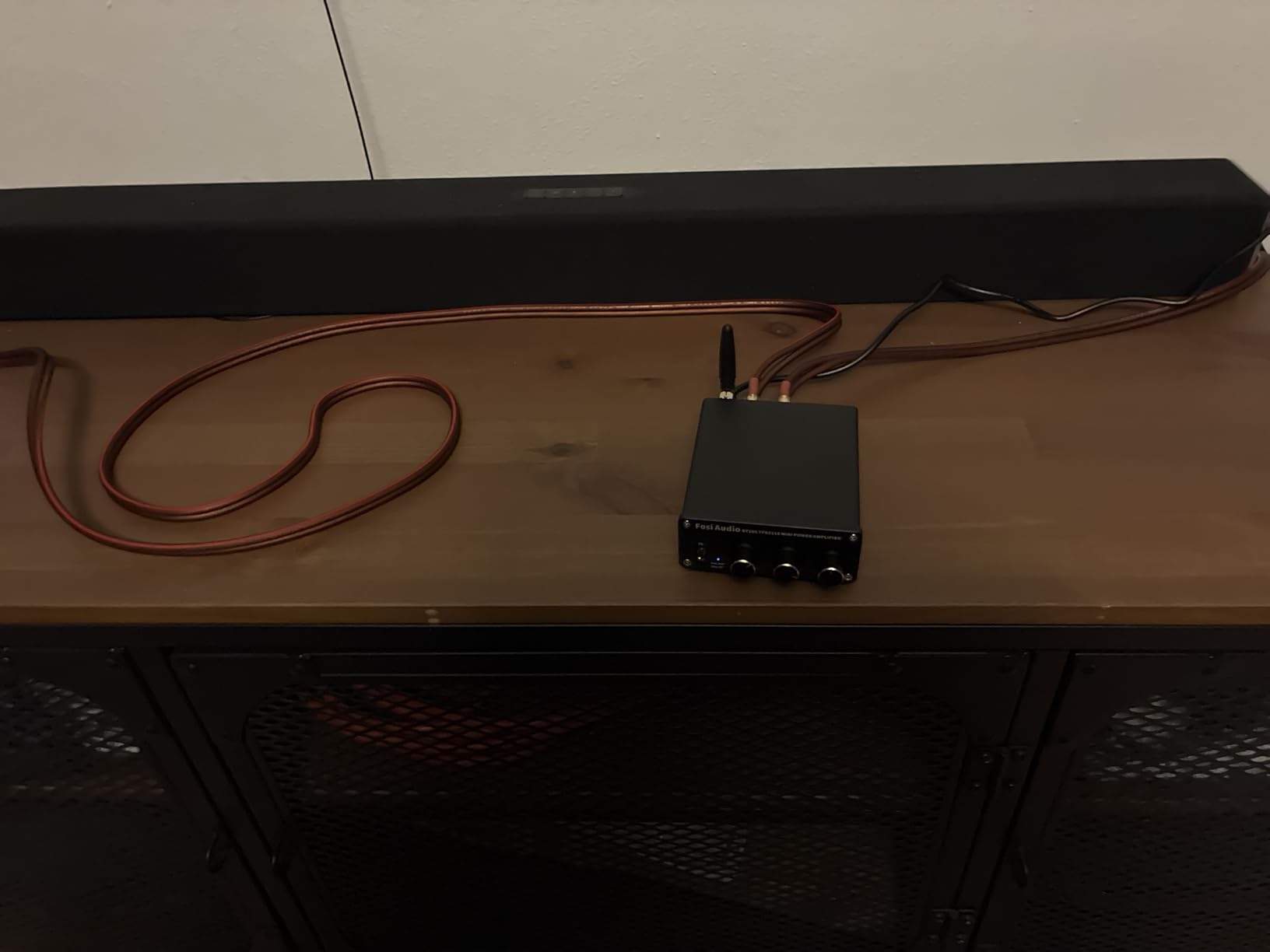
I have had a BT20A sitting under a sideboard driving a pair of Polk TSI100s for weeks, and it keeps surprising me. At 567 g it disappears next to the speakers, yet it moves them with far less strain than the size suggests. Owners consistently report the same thing in their reviews: this is the amp people buy first and then keep because it simply does not need replacing.
The specification that matters is 100W x 2 maximum output from a Class D design, driven through five-way binding posts that accept banana plugs or bare wire. Bluetooth streaming pairs immediately and stays connected, and there are RCA line inputs for anything wired. Owners of Polk TSI100 and Polk Atrium 8 pairs report it drives them without complaint, which tells you the reserve is there for efficient, mainstream bookshelf speakers.
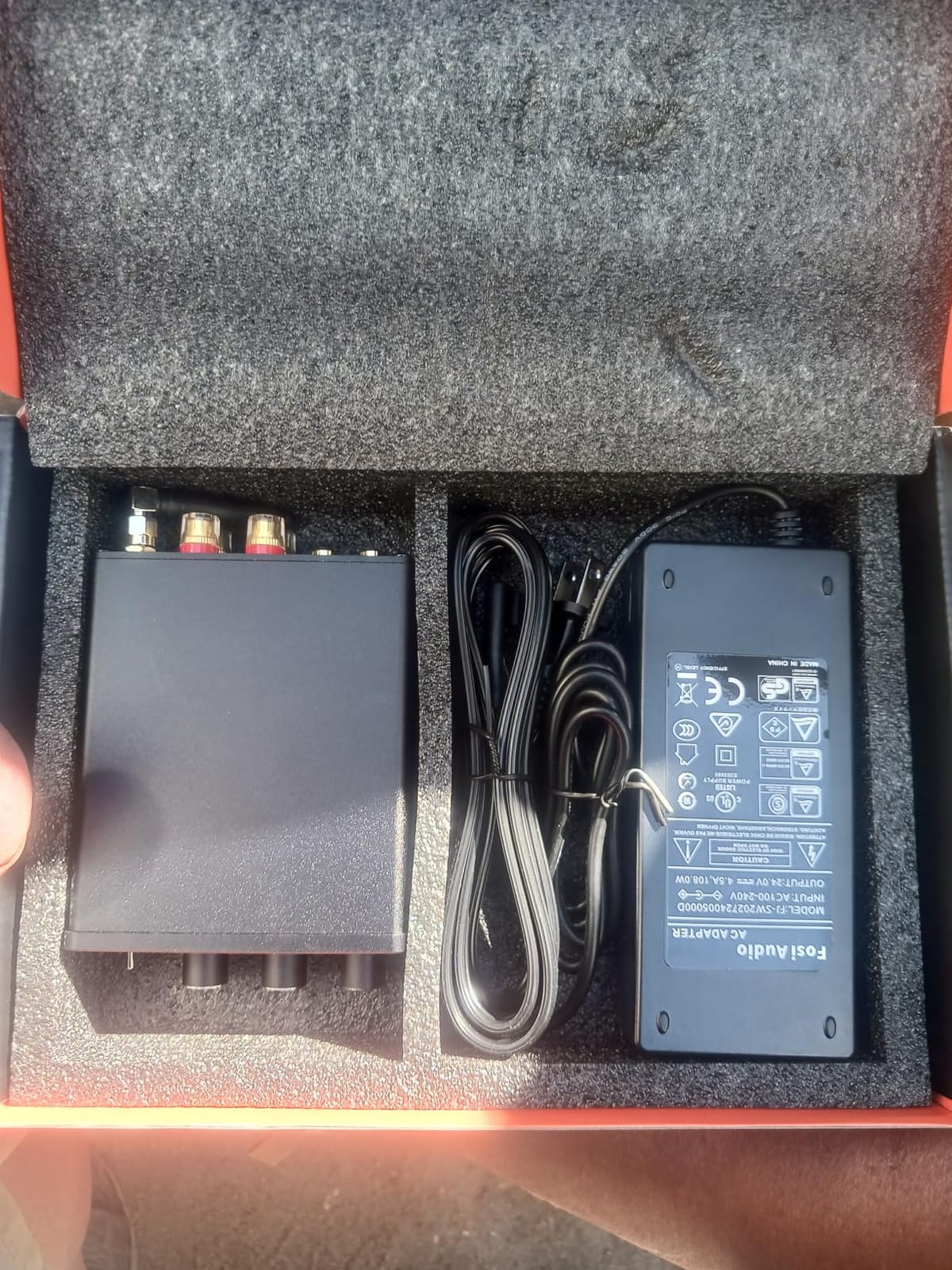
Sound is clear and detailed for the class, with a low noise floor you would not expect from a chassis this small. The voicing sits slightly flat and bass-leaning, which is a matter of taste rather than a flaw. If you are chasing warmth, look at the hybrid tube amp later in this list instead.
The 24-month manufacturer warranty is backed by a replacement service that reviewers single out as fast and responsive. That matters more than it sounds for a product this category, where a dead channel would be the end of the system.
Who the Fosi BT20A suits
This is the amp for anyone with efficient bookshelf speakers in a bedroom, office, garage or covered patio. If your speakers measure around 86 to 88 dB sensitivity and 6 to 8 ohms, this is a comfortable match with volume to spare on normal listening levels.
It is also the easiest way to turn a pair of passive speakers you already own into a working system. Inherited speakers, a dorm room, a second listening spot in the house, and desktop setups near the listening position all fall straight into this box.
Who the Fosi BT20A is not for
If you plan to add a turntable any time in the next few years, skip it. There is no phono input, and adding a separate preamp costs more than choosing an amplifier that already has one.
The tone controls are also easy to misuse. Owners report that pushing the bass or treble into boost can colour the midrange badly, so treat both controls as flat when you first connect the speakers. There is one speaker pair and no subwoofer output, so it is not the amp to grow with.
2. Fosi Audio BT10A – The Best Small Amp for Desk and Bedroom Listening
Fosi Audio BT10A Bluetooth 5.0 Stereo Audio Amplifier Receiver 2 Channel Class D Mini Hi-Fi Integrated Amp for Home Passive Speakers 50W x 2 TPA3116
50W x 2 TPA3116 Class D
Bluetooth 5.0 and 3.5mm AUX
Speaker protection circuit
Pros
- Genuine 50W x 2 output at a very low entry price
- Stable Bluetooth 5.0 with a 50ft claimed range
- Silent between tracks with a low noise floor
- Compact enough for a desktop or bookshelf setup
- Built-in protection against common faults
Cons
- No phono stage for turntables
- One speaker pair and no subwoofer output
- Limited tone control versus larger integrateds
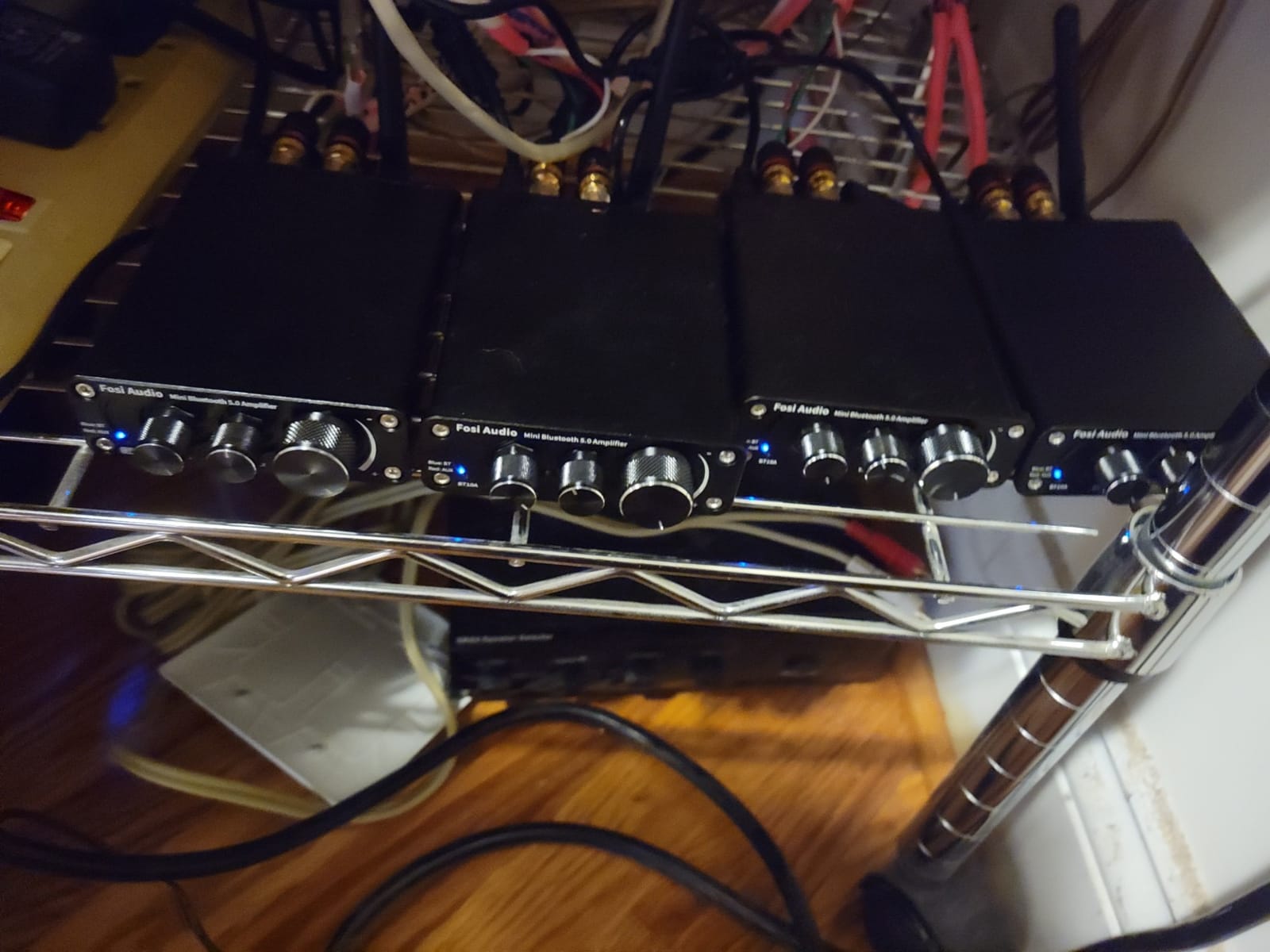
The BT10A is the one I recommend when the speakers are close to the listening position. On a desk or a nightstand, near-field listening means you need very little power and a very quiet amplifier, and this delivers both at a fraction of the cost of anything else in the guide.
Output comes from a Texas Instruments TPA3116 Class D stage rated at 50W x 2, with Bluetooth 5.0 streaming up to a claimed 50ft and a 3.5mm AUX input alongside it. Bass and treble controls sit on the front panel, and the built-in protection circuit covers short circuit, thermal, overvoltage, undervoltage and DC faults, which is reassuring for a unit that lives next to a desk.
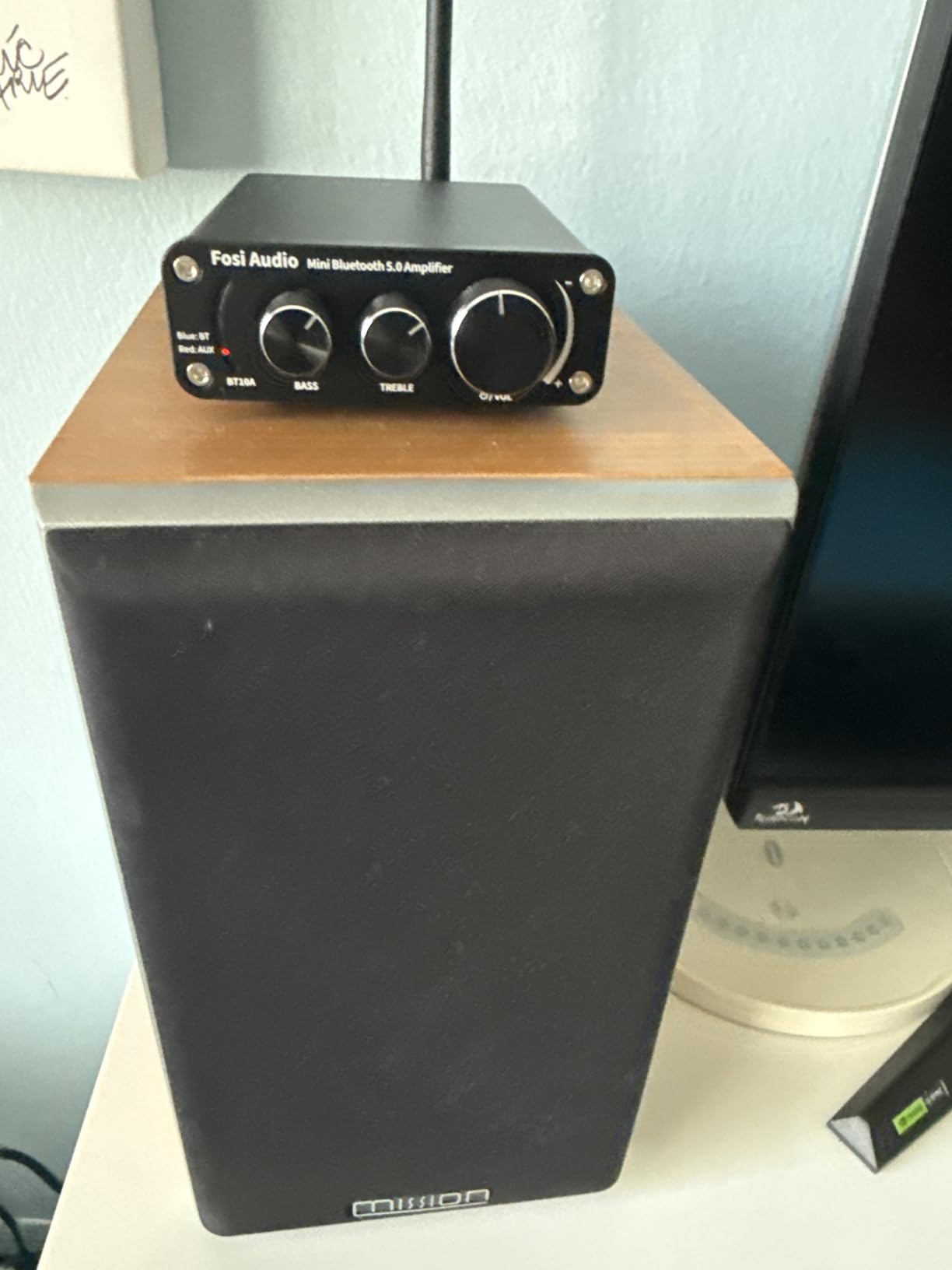
What reviewers emphasise most is the silence. Owners describe the noise floor as low enough that the amp disappears between tracks, and they report the Bluetooth pairing staying locked in without dropouts. At 650 g and with a mini chassis, it can be tucked almost anywhere.
The limitation owners mention without exception is the lack of a phono stage. A turntable needs an external preamp before it can go into this amplifier, and at that point a different product makes more sense.
Who the Fosi BT10A suits
Desktop listeners, bedroom setups and anyone running efficient near-field monitors will be happy here. Fifty watts is more than enough at arm’s length and it keeps the amp cool and quiet.
It is also a solid second system. A pair of small bookshelf speakers in a home office or a kitchen needs something this simple, and the Bluetooth means your phone is the only source you really need.
Who the Fosi BT10A is not for
Turntable owners should rule it out immediately because there is no phono input. If you see a turntable in your future plans, this is the wrong box to save money on.
There is also no subwoofer output and only a single speaker pair, so you cannot add bass reinforcement later without changing amplifiers. Tone control is limited compared with the full-size integrateds, which matters if you like to fine-tune around a bright speaker.
3. Fosi Audio V1.0G – The Best Pure Power Amp on a Tiny Budget
Fosi Audio V1.0G 2 Channel Class D Mini Stereo Amplifier for Home Speakers TPA3116 50W x 2 with Power Supply, Grey
50W x 2 TPA3116D2 Class D
Works on 12V to 24V supply
Five-way binding posts
Pros
- Excellent sound to price ratio for a compact stereo
- Low noise floor that stays clean at higher volume
- Runs cool thanks to class D efficiency
- Aluminum chassis with five-way binding posts
- Tiny footprint suits efficient speakers
Cons
- RCA input only with no Bluetooth or optical
- Volume knob is close to linear so fine control is poor
- Occasional cosmetic quality control issues
- 50W per channel suits efficient speakers only
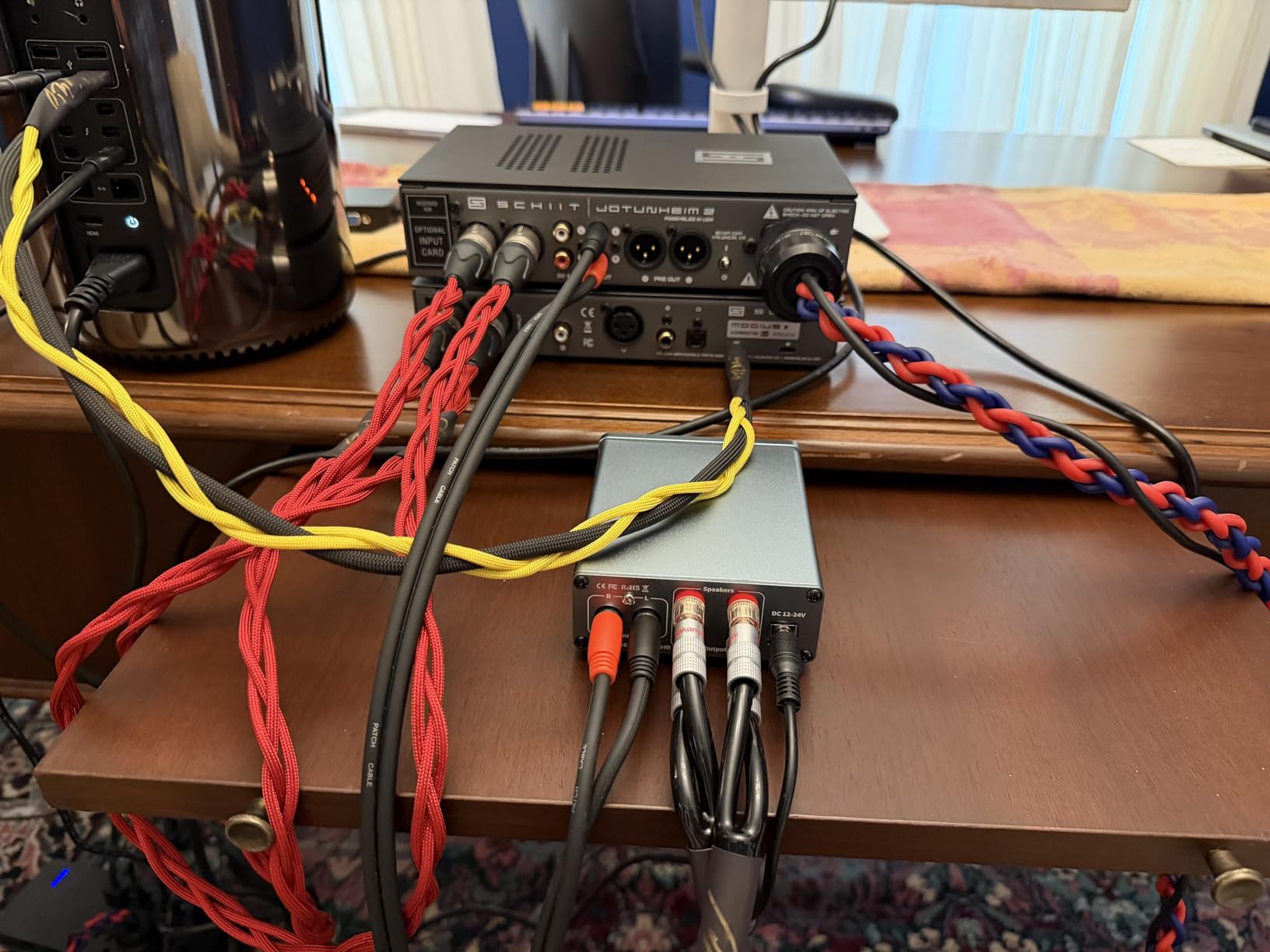
The V1.0G does one job and ignores the rest, and plenty of listeners think that is a feature. It is a pure power amplifier with a single stereo RCA input and a volume control. No Bluetooth, no digital inputs, no app. I pair one with a small DAC and efficient desktop or bookshelf speakers whenever I want a clean signal path without a second box.
Under the lid it is a Texas Instruments TPA3116D2 Class D stage at 50W x 2, with a supply range from 12V to 24V that makes it usable for home and light professional work. The chassis is solid aluminum at 5 x 3 x 1 inches with five-way binding posts, and the built-in protection circuit keeps the noise floor low enough for quiet listening.
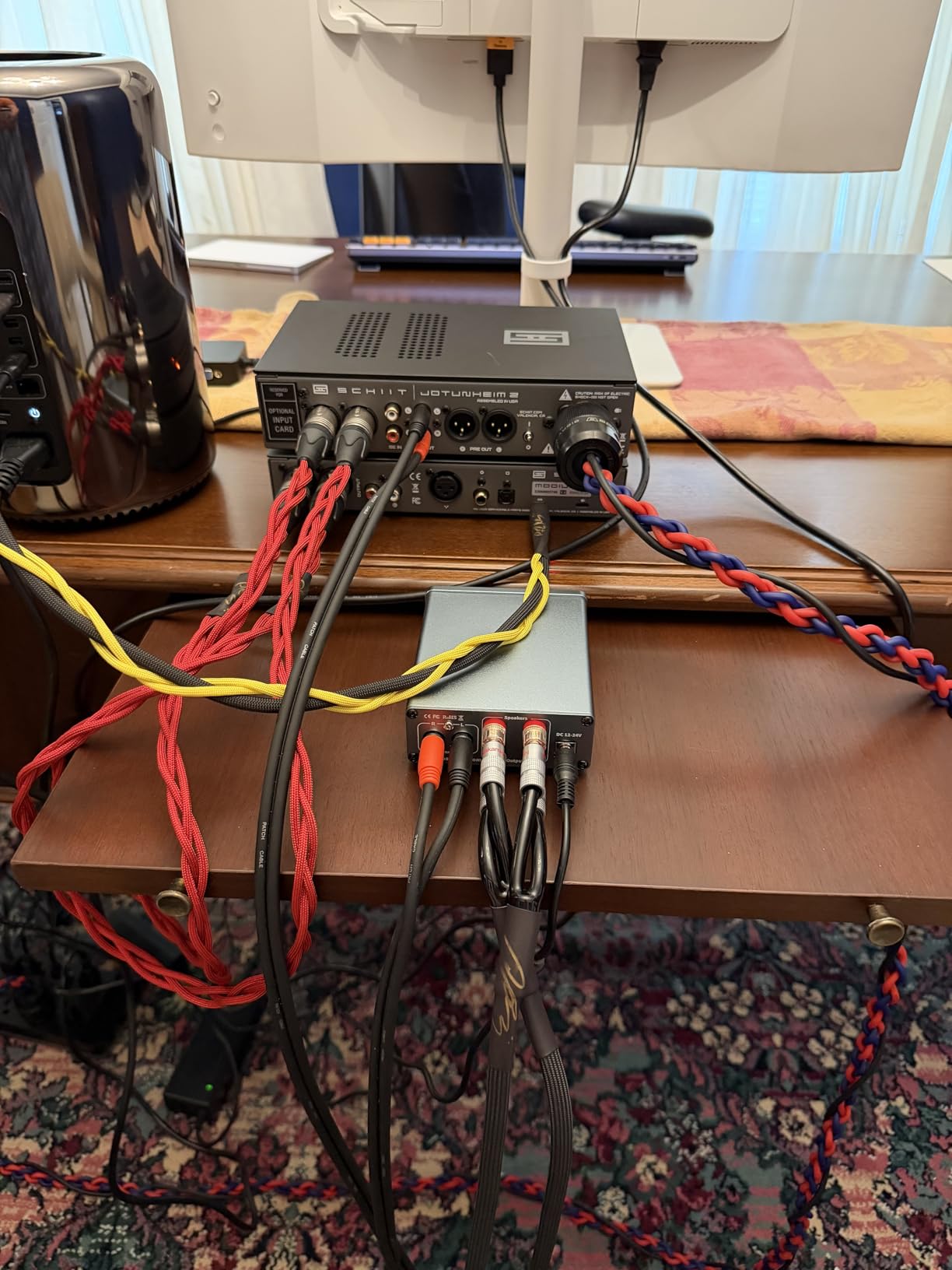
Owners describe the sound as clean, transparent and on the cool-to-neutral side, which is a good match for slightly bright bookshelf speakers. The efficiency of the Class D topology means it runs cool even in a small cabinet, and several reviewers point out that the low noise floor holds up at higher volume settings.
The linear volume behaviour is the thing you have to adjust to. Because the knob travels close to linearly from zero to full, a small movement covers an enormous range, which makes fine level matching with earphones or near-field monitors harder than it should be.
Who the Fosi V1.0G suits
If you already have a DAC and want the simplest possible power stage, this is the one. It is also the standard choice for small rooms and desktop listening where the speakers are efficient and the amplifier is close by.
Owners with high-sensitivity bookshelf speakers report excellent results, and the small footprint makes it easy to hide behind a speaker or a piece of furniture.
Who the Fosi V1.0G is not for
You need a separate source box. RCA only means no turntable, no Bluetooth, no optical or coaxial, so streaming from a phone requires an external DAC first.
Fifty watts per channel is only adequate with efficient or high-efficiency speakers. Pair it with something around 87 dB sensitivity or higher, and step up in power if you want to fill a larger room at higher levels. A few owners report cosmetic quality control issues on arrival, so check the panel and knobs carefully.
4. Donner MAMP2 – The Best Amp With Karaoke and Multi-Speaker Support
Donner Stereo Audio Amplifier, 600W Peak 2 Channel Receiver with Bluetooth 5.3, Phono, Optical, Coaxial, USB, FM, 2 Mic-in, Aux, RCA Input for Home, Karaoke, Theater Speakers, MAMP2
60W x 2 RMS, 600W peak claim
2 mic inputs with talkover
Phono, optical, coaxial, USB
Pros
- Very wide input selection including a working phono stage
- Dual channel volume knobs plus a midrange control
- Full-function remote for EQ and talkover
- Settings and volume held in memory between power cycles
- Strong first-system value
Cons
- Cooling fan is loud and revs up in quiet passages
- One analog RCA input and some optical units silent
- Binding posts too small for standard banana plugs
- Display has no dimmer
- Bass is modest despite the 600W peak figure
The Donner MAMP2 is the odd one out in this list, and it earns its place for a specific reason: it can drive two groups of four speakers and it has two microphone inputs with talkover. If you host, teach music, run a small venue or just want to sing over your records, nothing else here does that.
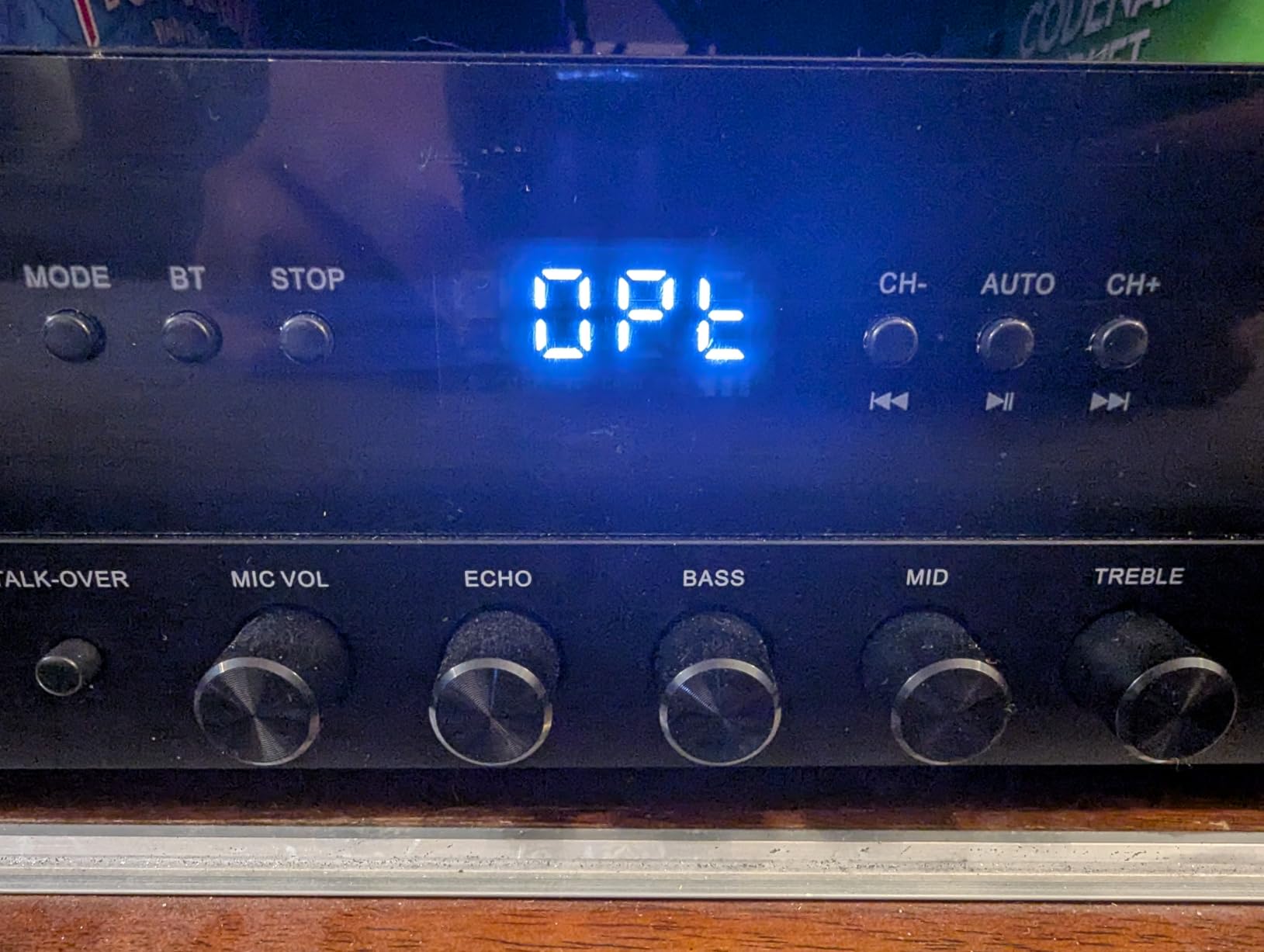
Behind that, it is a conventional all-in-one receiver. There is 60W x 2 RMS output across 600W peak, Bluetooth 5.3, USB up to 64GB, RCA, AUX, FM radio, optical and coaxial digital inputs and an MM phono stage. The front panel carries treble, midrange, bass, echo and talkover controls, all mirrored on the remote, and a toroidal power supply sits underneath.
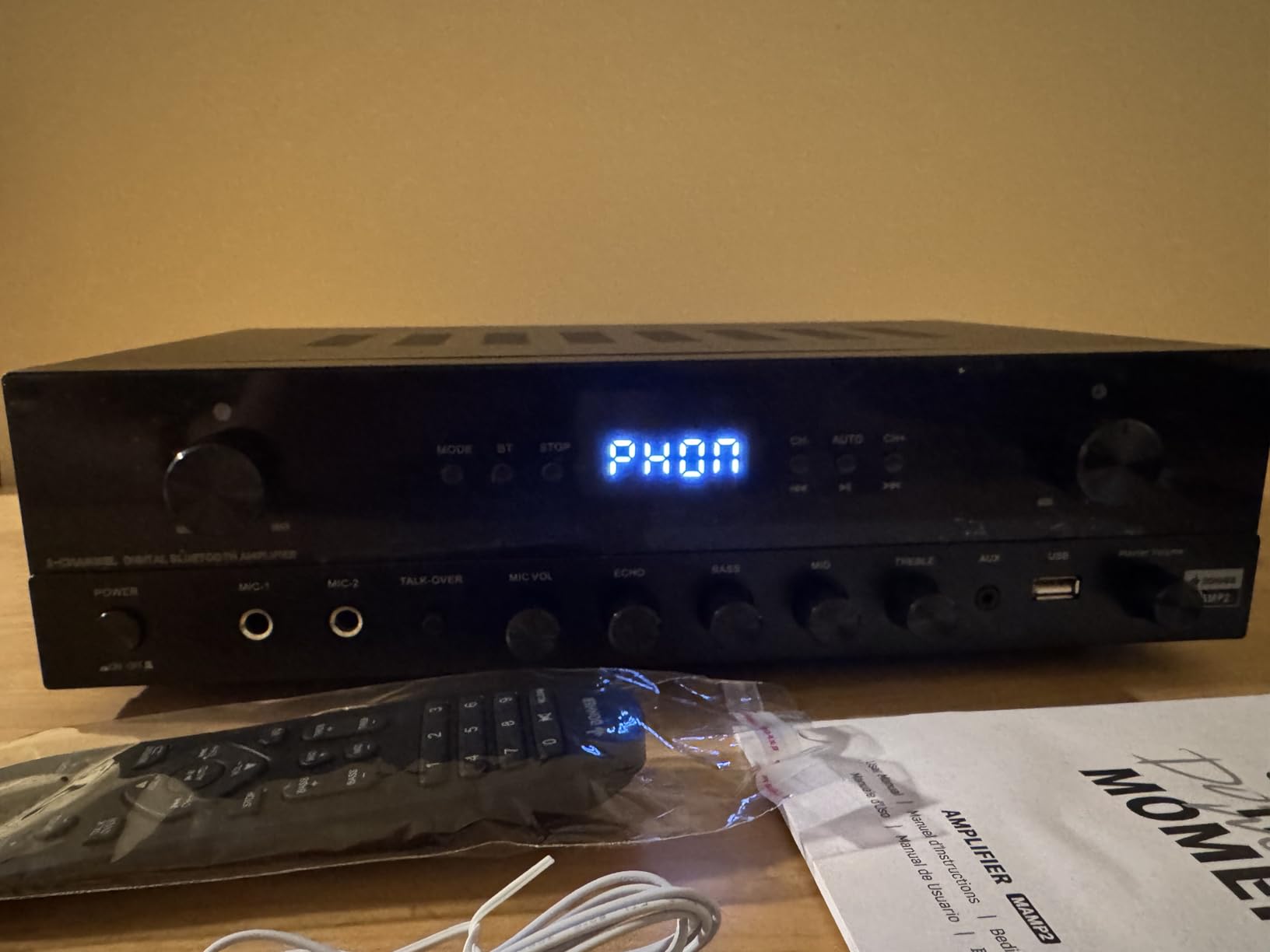
The dual left and right channel volume knobs with a midrange control between them are a direct callback to vintage receivers, and owners who remember those machines appreciate it. The phono stage genuinely works, which means older turntables that have been sitting in a cupboard can come back into the chain without a separate preamp.
Settings are held in memory between power cycles, so you do not rebuild your EQ every time. That is a small feature that gets mentioned more than you would expect from owners.
Who the Donner MAMP2 suits
People restoring older gear, building a first two-channel system, or needing microphone and karaoke capability in one box. The subwoofer support for up to two speaker groups plus one subwoofer also makes it useful for multi-room setups.
It is a reasonable temporary home for a turntable with no cartridge matching and no desire to buy a preamp yet.
Who the Donner MAMP2 is not for
The cooling fan is the biggest issue. Owners report it spinning up loudly during quiet passages, which sits badly with near-field listening at a desk.
There is only one analog RCA input, some examples arrive with an optical input that passes no sound, and the binding posts can be too small for standard banana plugs. The display has no dimmer, so it is bright in a dark room. And despite the 600W peak figure, the bass is modest rather than powerful.
5. Dayton Audio HTA200 – The Best Tube Hybrid for Warm Sounding Bookshelves
Dayton Audio HTA200 200W Integrated Stereo Hybrid Tube Amp with Bluetooth
100W RMS per channel, class A/B
Tube preamplifier section
USB DAC, optical, Bluetooth, phono
Pros
- Tube preamp adds warmth to a modern digital chassis
- Very wide input selection including USB DAC and phono
- Motorized volume knob works from the remote
- Front VU meters and glowing tubes
- Good clean power for a compact footprint
Cons
- Tube section needs warm-up time before it settles
- Vintage styling and VU meters add bulk
- Hybrid topology is not a fully tube amplifier
The HTA200 exists because plenty of listeners still want the softer, warmer presentation that tube stages are known for, without giving up USB and Bluetooth. The tube section sits in the preamplifier, the Class A/B output stage delivers 100W RMS per channel, and you get the look of glowing tubes and a pair of working VU meters on the front.
Connectivity is unusually generous for this category: RCA, optical, Bluetooth, USB DAC and a phono preamp. The motorized volume knob is driven by the included remote, which matters more than it sounds when you are sitting across the room and would rather not get up to turn the music down.
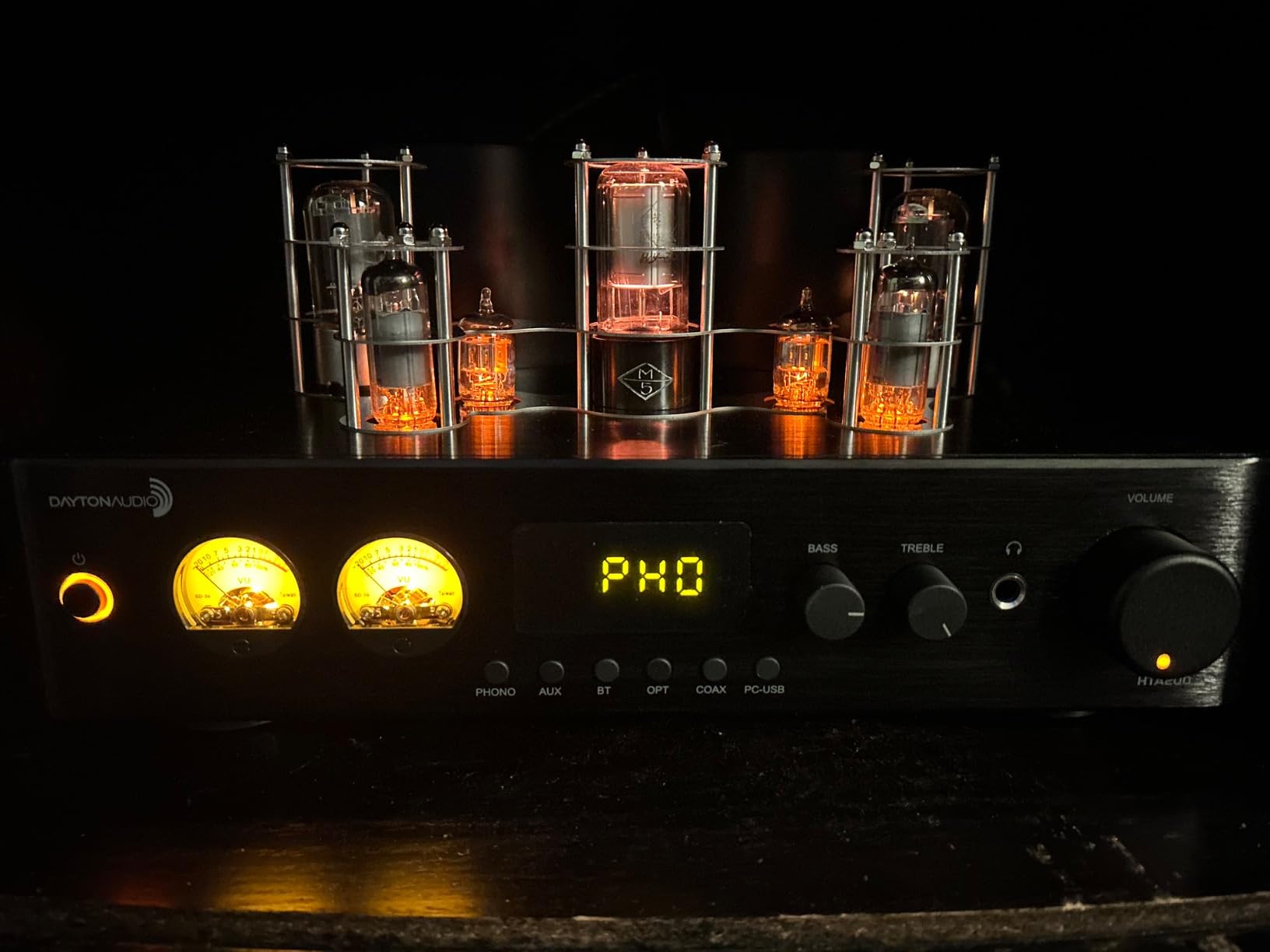
At 3.6 pounds and 6.5 x 11 x 8.5 inches, it is much smaller than the vintage receivers it imitates, and the brushed aluminum chassis looks good rather than kitsch. Owners like the combination of character and connectivity, and several note that the tube warmth pairs nicely with speakers that are on the bright side.
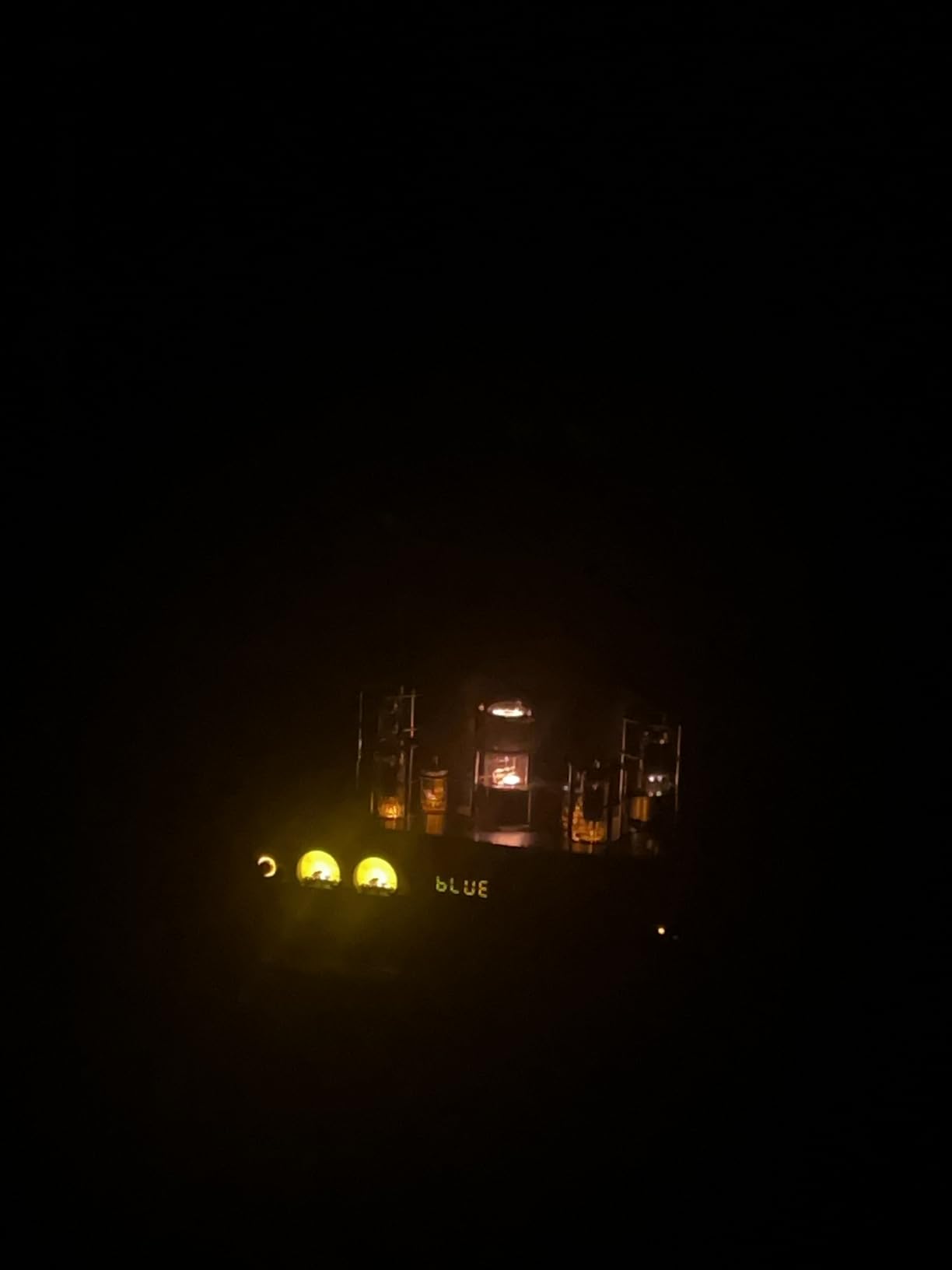
There is a real adjustment period. The tube section needs warm-up time before the sound settles, so the first twenty minutes of listening are not a fair judge of what it does.
Who the Dayton Audio HTA200 suits
Listeners who find solid-state amplifiers too analytical, and anyone with a slightly forward or bright pair of bookshelf speakers that needs taming. The phono preamp and USB DAC also make it a good vinyl entry point with a modern twist.
It also suits anyone who wants the visual appeal of a tube amplifier on a shelf. That is a shallow reason on its own, but it is a real one at this level.
Who the Dayton Audio HTA200 is not for
Do not buy it for the tubes as decoration. This is a hybrid, not a fully tube amplifier, so the tonal shift is subtler than a pure tube design would give you. If you want a dramatic warmth change, look elsewhere.
The VU meters and exposed tubes add bulk compared with minimalist integrateds, and the warm-up requirement means it is not ideal for quick sessions. At 233 reviews, this is also the least heavily reviewed product here, so treat the owner consensus with a little more caution.
6. Yamaha A-S301 – The Best Entry Integrated Amp With Built-In Phono
Yamaha Audio A-S301BL Natural Sound Integrated Stereo Amplifier (Black)
Coaxial and TOSLINK optical inputs
Analog inputs including phono
Subwoofer output
Pros
- Trusted Yamaha Natural Sound tuning with a smooth balanced presentation
- Good range of analog and digital inputs for the class
- Subwoofer output plus A/B speaker switching
- Solid build with a substantial feel
Cons
- No HDMI input so a TV needs an external converter
- Basic interface with no display or streaming
- Heavy chassis takes more shelf space than mini amps
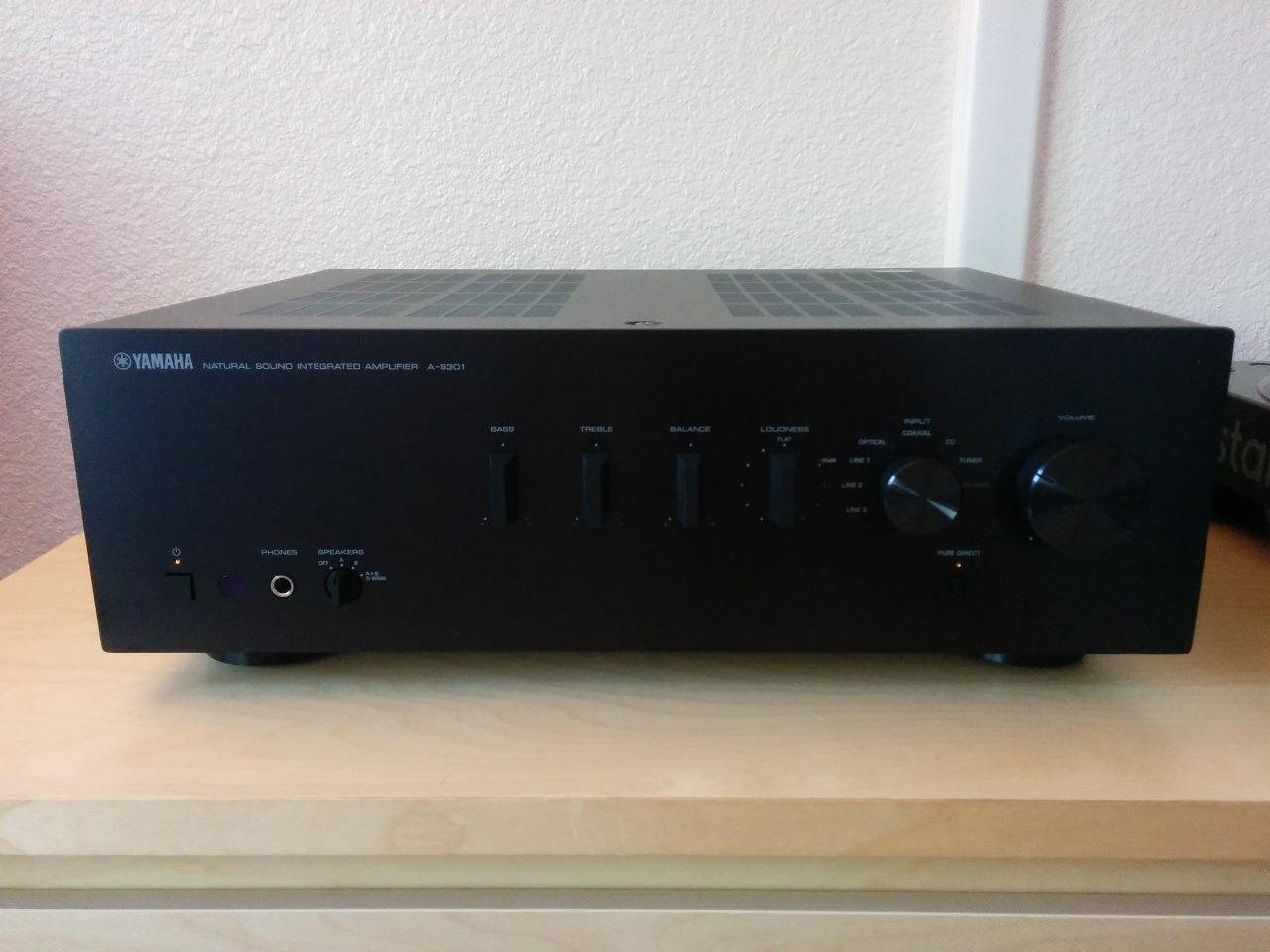
The A-S301 is where most people land when they want a proper integrated amplifier with a phono stage and more connectivity than a mini amp offers, without moving into premium territory. It is the entry point into the Yamaha Natural Sound range, and owners consistently describe the presentation as smooth and balanced rather than bright or aggressive.
You get digital coaxial and TOSLINK optical inputs alongside analog inputs including phono, plus speakers A, B and A+B switching and a subwoofer output. That combination means you can run a pair of bookshelf speakers now, add a second pair in another room later, and connect a subwoofer whenever the bass needs help.
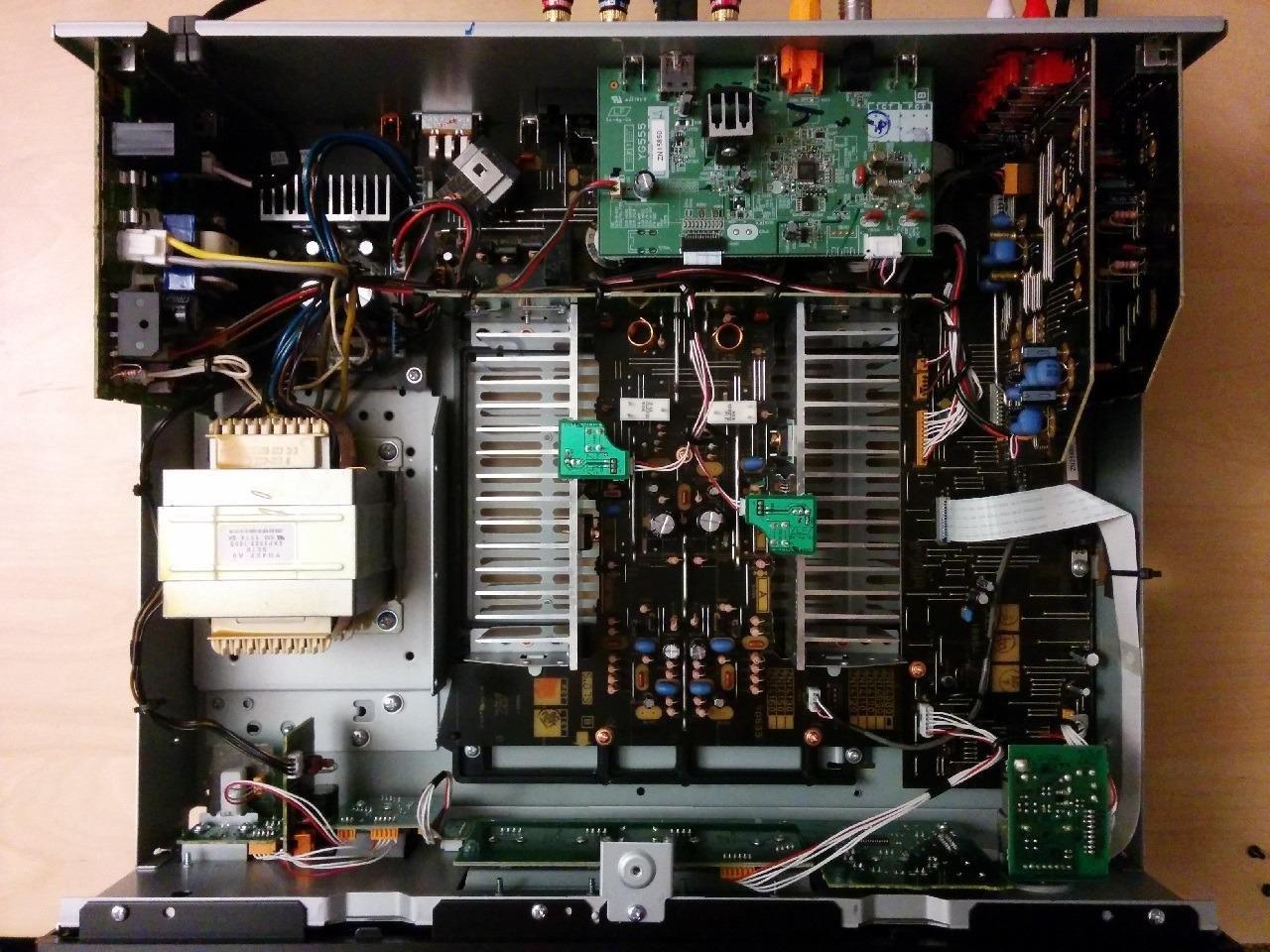
The build is substantial at 19.8 pounds, which is a hint about the power supply and the cooling it needs. It is not light to move, but it also feels like a piece of equipment rather than a gadget.
The A/B switching deserves a second mention because it is genuinely useful. Owners with a pair of efficient near-field speakers for late listening and larger bookshelf speakers for daytime use report switching between them without fuss.
Who the Yamaha A-S301 suits
First-time buyers assembling a stereo with a turntable and a pair of bookshelf speakers. The built-in phono stage removes the need for a separate preamp, which is usually the most expensive mistake a beginner makes.
It also suits anyone who wants A/B speaker switching, a subwoofer output and digital inputs in a single box, and who does not need streaming built into the amplifier.
Who the Yamaha A-S301 is not for
If your main source is a television, this is not the amplifier. There is no HDMI input, so a modern TV needs an external converter to feed it, and adding one undoes the value of buying this amp in the first place.
The user interface is basic with no display and no streaming of any kind. And at 19.8 pounds in a full-size chassis, it takes up considerably more shelf space than a mini amp would.
7. Denon PMA-600NE – Our Best Value Pick for Almost Any Bookshelf Speaker
Denon PMA-600NE Bluetooth Stereo Amplifier, 2 Channel Amplifier Home Audio
70W at 4 ohms, AHC stage
2 optical, 1 coaxial, phono
Built-in DAC, Bluetooth
Pros
- Highest average rating in the guide at 4.7 stars
- Warm tube-like tone owners call a clear step up
- Analog Mode and Pure Direct give real purist paths
- Clean noise-free phono preamp for turntables
- Good usable headphone output
Cons
- Remote volume steps are coarse and laggy
- Input labels small with dim indicator LEDs
- Remote lacks tone balance and Pure Direct
- Bass is light so many owners add a subwoofer
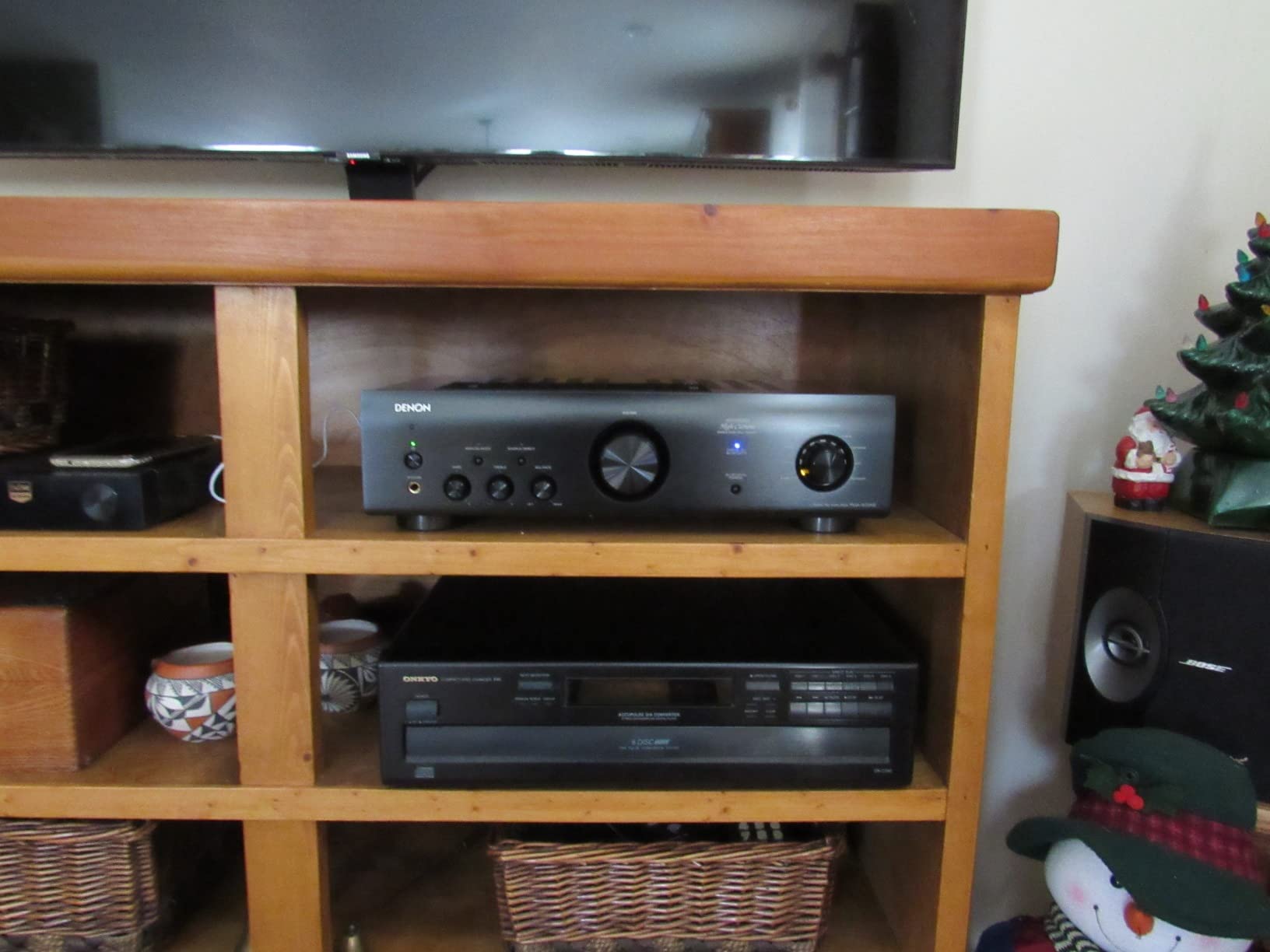
The PMA-600NE carries the highest average rating of anything in this roundup, and after spending time with it I understand why. It is the amp I would hand someone who has already chosen their bookshelf speakers and just needs something that will not embarrass them. Owners call the presentation warm and slightly tube-like, and they describe it as a genuine step up from vintage receivers.
The power stage is an Advanced High Current push-pull design rated at 70W at 4 ohms, which is the more useful of the two numbers for most bookshelf speakers. Connectivity includes two optical inputs, one coaxial, an MM phono input, Bluetooth and a built-in DAC. Two features matter more than they first appear: Analog Mode disengages the digital circuitry for a fully analog signal path, and Pure Direct bypasses the tone and balance controls.
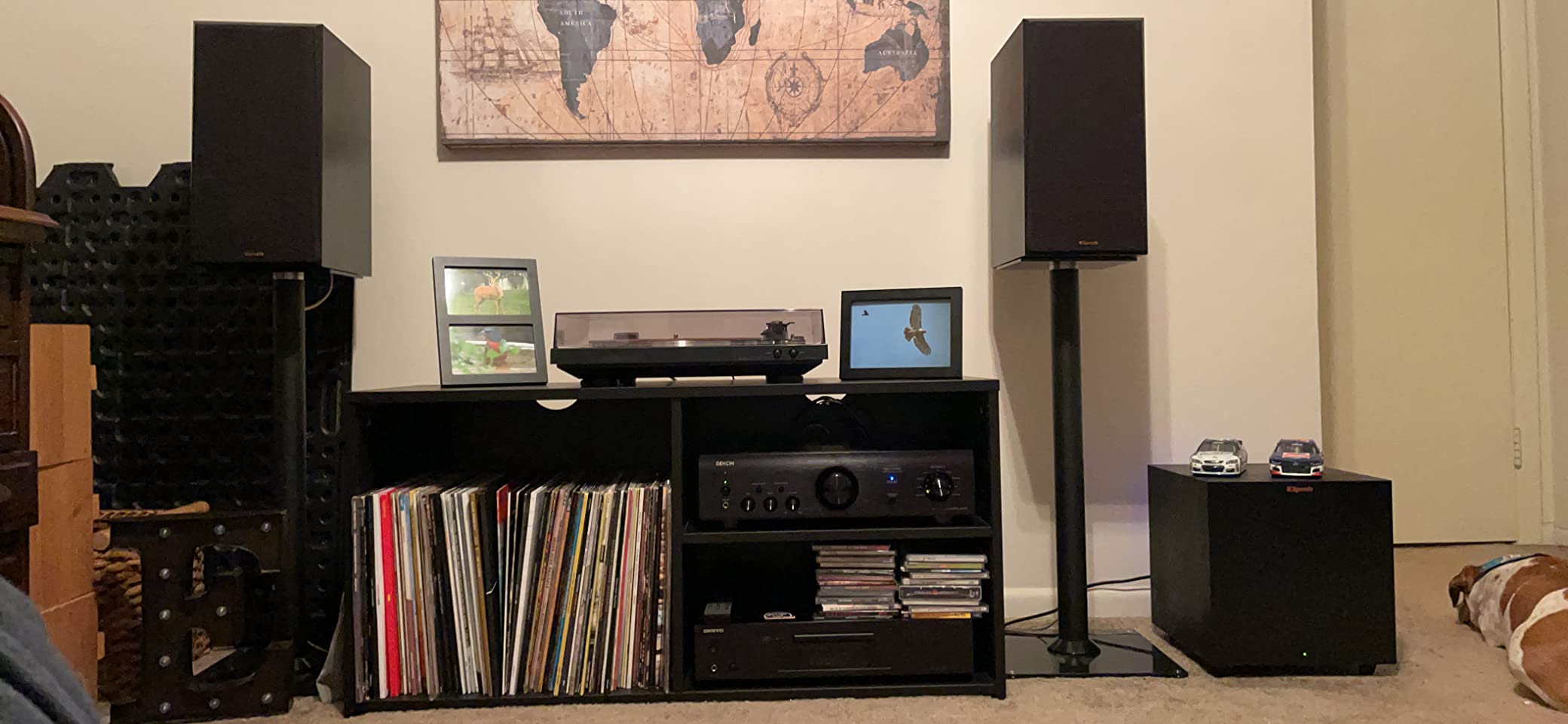
Those two modes are what separate it from the rest of this list. Analog Mode removes the DAC and digital sections from the signal chain entirely, and Pure Direct skips the tone controls that can subtly colour a sound. For a two-channel setup with good speakers, that is real value rather than a checkbox.
The phono preamp is described as clean and noise-free by owners using it with entry-level turntables, and the subwoofer RCA output is there when the bass needs support. The headphone output is usable at this level too, which is not always true at this class.
Who the Denon PMA-600NE suits
Anyone with a pair of mid-sensitivity bookshelf speakers in the 85 to 87 dB range, because the high-current stage has the current capacity to drive them without strain. Owners report it works well with speakers like the ELAC Debut B5.2, which is exactly the class of speaker most people land on.
Vinyl listeners benefit from a phono stage that is quiet and clean, and the optical and coaxial inputs cover a TV or game console through an optical cable.
Who the Denon PMA-600NE is not for
It is not an amplifier for someone who wants to control everything from a couch. The remote volume steps are coarse and laggy, the input selector labels are small with dim indicator LEDs, and the remote itself has no tone, balance or Pure Direct controls.
The bass is light, so many owners add a subwoofer. If you want the deepest possible bass from bookshelf speakers alone and you are not bothered by warmth, one of the more powerful solid-state designs further down this list will suit you better.
8. Marantz PM6007 – The Best Amp for a Warm Signature Sound
Marantz PM6007 Amplifier, Integrated Amplifier with Digital Connectivity, Analog Coaxial and Optical Inputs, 2X 45 Watt, DAC, D/A Conversion for Digital Input – Silver/Gold
45W per channel at 8 ohms
5 analog, coaxial, 2 optical
Shielded D/A converter
Pros
- Signature warm crisp Marantz voicing matched to vintage receivers
- Generous gold-plated analog and digital connectivity
- Built-in DAC measured equal to or better than a streamer
- HDAM SA3 modules give good dynamic range and low distortion
- MM phono sounds natural and detailed
Cons
- Some arrive with a European three-pin plug needing 220V conversion
- Phono stage takes time to sound its best
- Chassis deeper and bulkier than slimmer integrateds
The PM6007 makes a case on tone rather than power. Forty-five watts per channel at 8 ohms RMS from 20Hz to 20kHz is not a lot on paper, but the current feedback topology is efficient and owners report the warmth and crispness of the Marantz house sound as the reason they keep it. Several compare it favourably to vintage Marantz receivers they grew up with.
Connectivity is where it outshines most of the class. There are five gold-plated analog inputs, one coaxial and two optical digital inputs, and the fully shielded D/A converter is fixed with copper screws and steel feet for mechanical stability. The output stage uses Marantz HDAM SA3 modules, and the MM phono preamp uses a FET input stage.
Owners rate the internal DAC very highly, reporting it measured equal to or better than an external streamer at this level. A/B speaker switching is included, which is rare in a chassis this size, and the phono stage is described as natural and detailed for turntable users.
There is one practical warning that appears repeatedly in reviews. Some units arrive with a European three-pin plug designed for 220V, which means a step-down transformer is needed before use. Check the plug on arrival, because that is an easy problem to avoid and an annoying one to discover later.
Who the Marantz PM6007 suits
Listeners who want a warmer, more characterful sound than a neutral solid-state amplifier gives. It pairs well with speakers that are already on the bright or forward side, because the voicing fills in the upper midrange rather than adding to it.
Owners with an 86 dB sensitivity bookshelf speaker in a normal living room report plenty of headroom at sensible volumes. It is also a good choice if you want a lot of inputs and a serious internal DAC.
Who the Marantz PM6007 is not for
If you want to fill a large room at high volume with low-sensitivity speakers, look for more power. Forty-five watts per channel is closer to the minimum than the comfortable middle for a demanding load.
The phono stage takes time to sound its best compared with the digital inputs, so do not judge it in the first few minutes. And the chassis is deeper and bulkier than slimmer integrated amplifiers, so measure the shelf before you commit.
9. WiiM Amp Ultra – The Best Streaming Amp With Room Correction
WiiM Amp Ultra Stereo Streaming Amplifier, HDMI ARC & RoomFit, Space Gray
100W per channel, -106 dB THD+N
ESS SABRE DAC, dual TPA3255
Wi-Fi 6, Bluetooth 5.3, HDMI ARC
Pros
- Streaming and HDMI ARC built in so no separate streamer or DAC
- RoomFit auto calibration matches the amp to the room and speakers
- High-resolution playback to 24-bit/192kHz with an ESS Sabre DAC
- Clear touchscreen showing album art and settings
- Compact aluminum chassis with multi-room support
Cons
- No AirPlay support in either direction
- Setup depends on the vendor app rather than a hi-fi path
- Tone is more neutral than warm with no class A voicing
The WiiM Amp Ultra replaces a streamer, a DAC and an amplifier with one box, and it does it with room calibration on top. Output is 100W per channel of Class D amplification measured at -106 dB THD+N, driven by dual TI TPA3255 amplifiers with PFFB output filtering and an ESS SABRE DAC.
Connectivity is where this category really separates itself. You get Wi-Fi 6, Bluetooth 5.3 with LE Audio, HDMI ARC, and Roon Ready support alongside Spotify, TIDAL, Qobuz, Amazon Music and Chromecast at up to 24-bit/192kHz. Built-in RoomFit calibration measures the room and adjusts the output to match, which is genuinely useful with bookshelf speakers placed wherever the room allows.
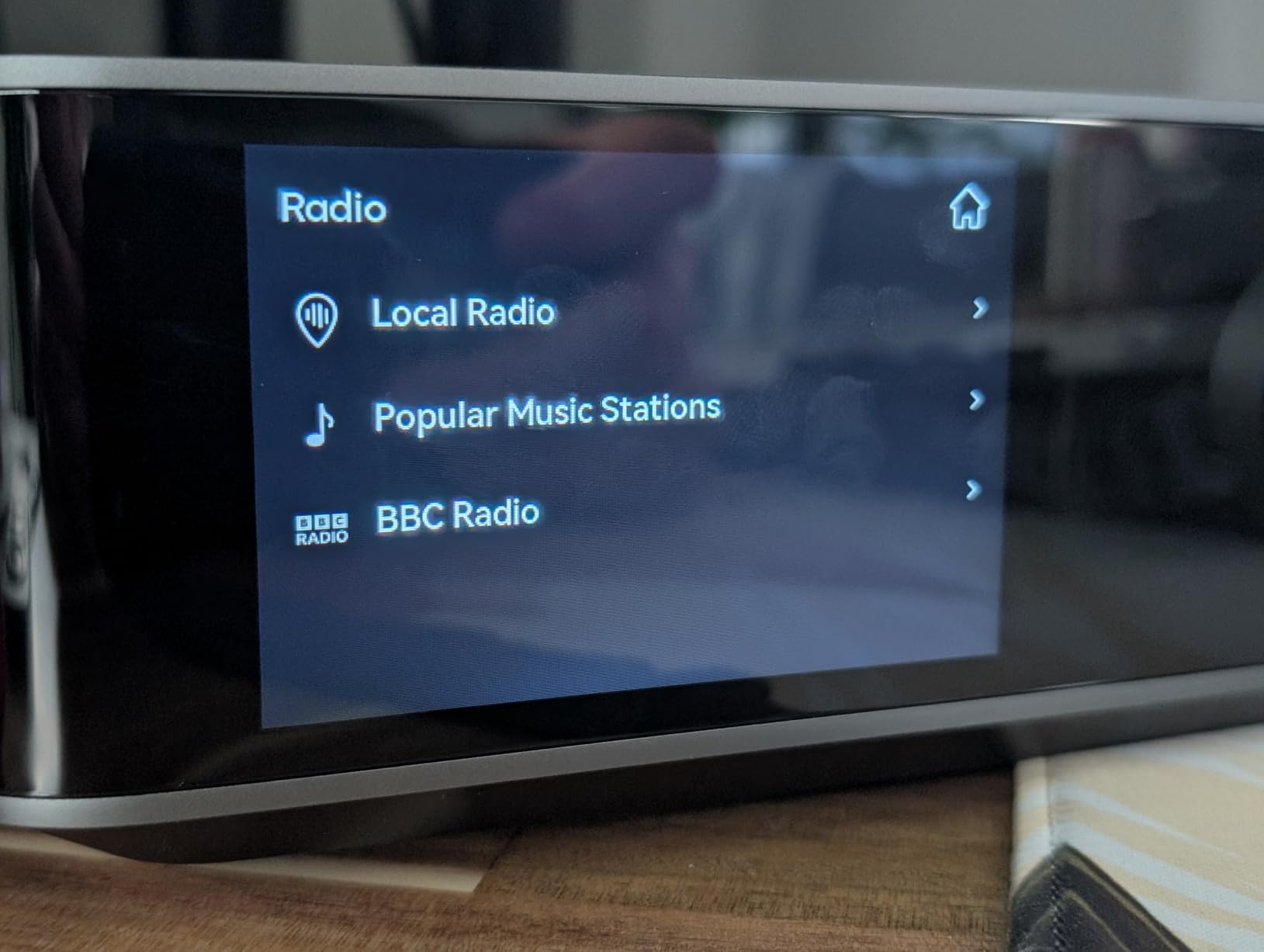
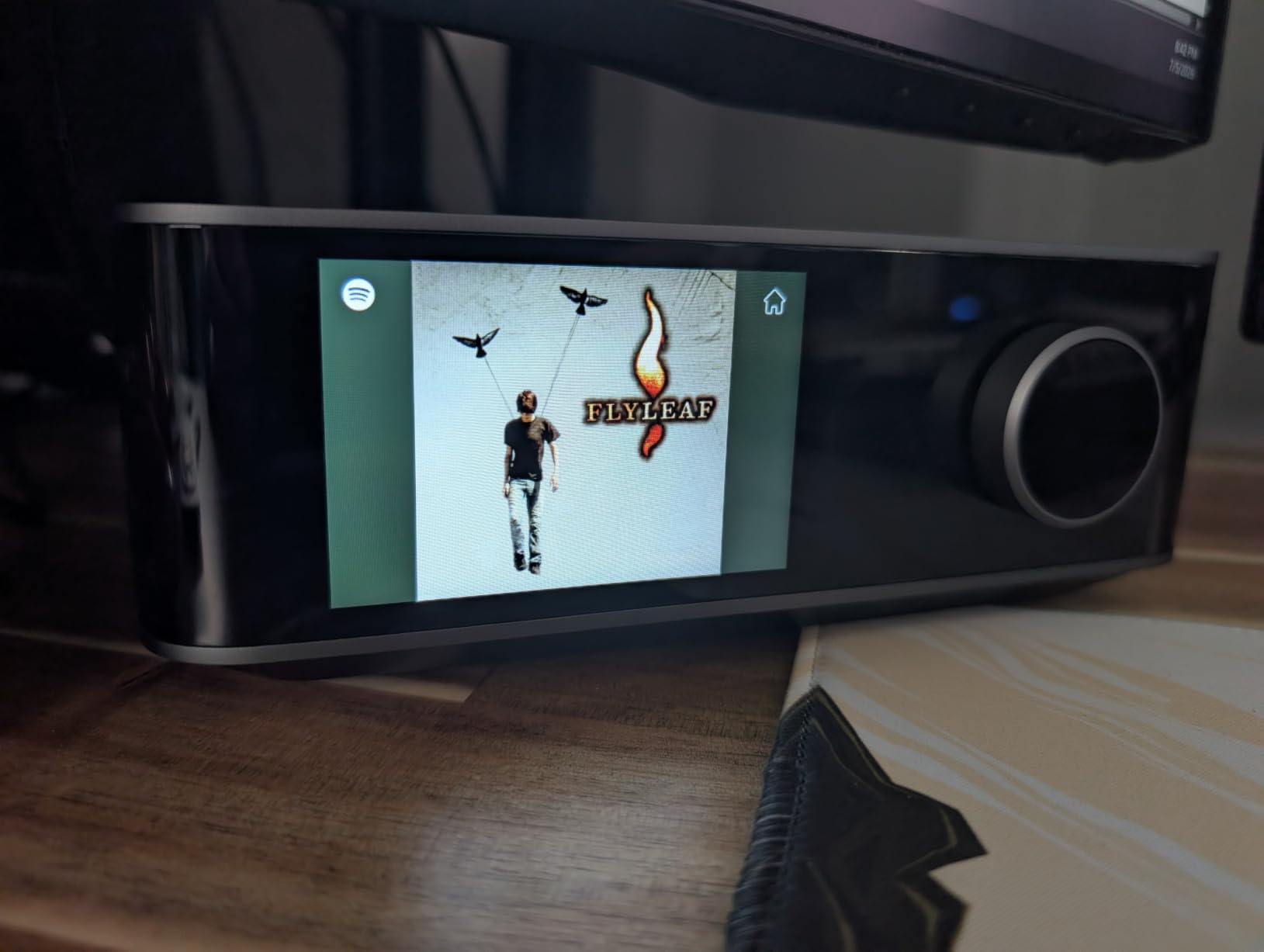
The 3.5-inch glass-covered touchscreen on a unibody aluminum case is the best of any in this guide. It shows album art and system settings without opening an app, which addresses the single most common complaint about network amplifiers, namely that everything is hidden in software. A voice remote is included, and multi-room sync works with Alexa or Google speakers.
At 7.87 x 8.3 x 3 inches and 5.4 pounds it is compact enough for a sideboard, and the room where it sits does not get any warmer.
Who the WiiM Amp Ultra suits
Anyone whose music comes from streaming services or a television and who does not want a separate box for each job. HDMI ARC means the amp can take over TV sound in a way that no other product in this guide can, and it replaces a soundbar for music while still handling film audio.
It also suits anyone whose speakers are difficult to place perfectly, because RoomFit calibration measures the room rather than asking you to guess at crossover settings and level.
Who the WiiM Amp Ultra is not for
If your household is built around Apple devices, this is the wrong box. There is no AirPlay support and it cannot act as an AirPlay receiver, which is the single most reported limitation.
Setup is also vendor-dependent. The app ecosystem is a step away from the plug-and-play hi-fi path, and the tone is more neutral than warm, so it will not satisfy anyone hoping for a valve-like presentation.
10. Yamaha A-S801 – The Best Amp for Power and a Built-In Hi-Res DAC
YAMAHA A-S801BL Natural Sound Integrated Stereo Amplifier (Black)
100W plus 100W, 0.019% THD
USB DAC with DSD and PCM to 384kHz
Pure Direct mode
Pros
- 100W per channel of clean transparent class AB power
- Built-in USB DAC reviewers say rivals costlier sources
- Pure Direct gives an uncoloured two-channel path
- Bass treble and variable loudness controls
- High-current transformer and 12000 uF block capacitors
Cons
- Built-in phono stage is basic versus a dedicated preamp
- No pre-out or tape monitor and no subwoofer line out
- Stepped volume control is noticeable at low levels
- Remote lacks tone and balance with no volume indicator
- Bassier signature some listeners find pumped
The A-S801 is the most powerful amplifier in this guide and the one with the most interesting feature per watt: a USB DAC that accepts DSD at 2.8 and 5.6 MHz and PCM up to 384kHz in 32-bit, plus WAV and FLAC. Reviewers repeatedly note that it rivals digital sources costing far more than the amplifier itself, which means you can skip a streamer entirely.
Power output is 100W plus 100W at 20Hz to 20kHz with 0.019 percent THD, built around a custom power transformer and 12000 uF block capacitors with extruded aluminum heat sinks. Gold-plated coaxial and TOSLINK optical inputs sit alongside gold-plated analog inputs including phono, with a 10Hz to 100kHz response on the digital side.
Pure Direct gives you a clean uncoloured path for critical two-channel listening, and there are bass, treble and variable loudness controls for low-level listening. Variable loudness is worth knowing about because it lets you raise the bass at low volumes without having the normal tonal balance at higher ones.
Owners note that measured power often exceeds the rating, which is the opposite of what happens with many budget amplifiers where the printed wattage is a peak figure rather than a continuous one.
Who the Yamaha A-S801 suits
Anyone driving less efficient or lower sensitivity bookshelf speakers, or filling a larger room. A hundred watts per channel from a high-current supply is real reserve, and it is the reason this amplifier feels unhurried at volume.
Computer and network audio users benefit most from the USB DAC. If your library sits in high-resolution files, this removes the need for a separate digital source and keeps the signal path short.
Who the Yamaha A-S801 is not for
Vinyl is the weak spot. The built-in phono stage is basic compared with a dedicated preamp, so a serious turntable setup deserves something better.
There is also no tape monitor, no preamp outputs and no dedicated subwoofer line out, which limits how you can grow the system. The stepped rather than ramped volume control is noticeable at low levels, the remote has no tone or balance controls and no volume indicator, and the bass-forward signature is not to every listener’s taste.
How to Match an Amplifier to Your Bookshelf Speakers
Matching an amplifier to bookshelf speakers comes down to four numbers: impedance, sensitivity, room size and the number of sources you need. Get those right and almost any competent amplifier will sound good with almost any competent speaker. The matching logic below takes about five minutes and prevents the two most common buying mistakes, which are under-powering the speakers and buying a receiver for a music-only system.
Check the speaker impedance first
Impedance is measured in ohms, and most bookshelf speakers are rated at 4, 6 or 8 ohms. The number describes how much the speaker resists the current the amplifier sends. Higher impedance is easier to drive, lower impedance is harder.
The practical rule is simple: an amplifier rated for 8 ohms will happily drive 6 or 8 ohm speakers, and an amplifier that delivers its stated power into 4 ohms will handle anything at 4 or 8. Speakers that dip below their rated impedance in the bass, which many do, need an amplifier with enough current capability rather than just a high headline number.
Martin Logan Motion XT B100 owners regularly raise this on audio forums because it is a 4 ohm bookshelf that needs an amplifier comfortable with low impedances. That is exactly the situation the rule above is designed for.
Use sensitivity to work out how much power you need
Sensitivity is measured in decibels per watt and tells you how efficiently a speaker converts amplifier power into volume. A speaker rated at 84 dB needs roughly four times as much power as one rated at 90 dB to reach the same listening level.
That single fact explains why two amplifiers with very different wattage ratings can drive the same pair of speakers at the same level. Rather than chasing a wattage figure, work out how sensitive your speakers are and treat 20 watts of clean power into the right impedance as a comfortable minimum for near-field and small-room listening. Manufacturer wattage is the least reliable number on the box, so treat any figure that does not specify an impedance and a distortion limit with suspicion.
Decide whether you need a phono stage
A phono stage is a small preamplifier built to handle the very low output of a turntable cartridge, and without one a turntable plugged into a line input will sound thin and quiet. Most entry turntables ship with a built-in stage and a switch to bypass it.
Buy the amplifier with a phono input if a turntable is part of your plans now or in the next few years. Adding a standalone phono stage later costs more than choosing an amplifier that already has one, and it is the mistake that first-time vinyl buyers make most often.
Look for a subwoofer output and know what the crossover does
A subwoofer output lets you add a subwoofer later without replacing the amplifier, which is worth checking if your speakers are small or you listen to electronic and film content. A crossover is the frequency below which the amplifier sends the signal to the subwoofer instead of the speakers.
Most people set it somewhere between 60 and 80 Hz, which is the range where small bookshelf cabinets stop adding useful output. Five of the ten amplifiers here have a subwoofer output. The Yamaha A-S801 notably does not, which matters if bass reinforcement is on your roadmap.
Pick the amplifier type that fits your sources
An integrated amplifier puts a preamplifier and power amplifier in one box and is the right answer for most people. A stereo receiver adds a radio tuner, which matters for a living room setup and does nothing for a streaming system. A streaming amplifier adds Wi-Fi, Bluetooth and often HDMI ARC, so you need no external streamer. A power amplifier has no inputs or volume control of its own and needs a separate preamplifier in front of it.
Class D designs are efficient, compact and run cool, which is why most mini amps use them. Class A/B designs run hotter but many listeners prefer the presentation. A tube hybrid puts a tube preamplifier in front of a solid-state output stage, which is the Dayton Audio HTA200 in this list. None of these labels tell you whether the match is right, so use the speaker numbers first and the topology second.
Match the amp to the bookshelf speaker you actually own
Most of the questions on audio forums follow the same shape: which amplifier goes with these speakers. Here is a starting point based on the sensitivity figures these models are usually quoted at, and it is more useful than any general rule about price tiers.
Speakers around 84 to 85 dB sensitivity, such as the Polk T15 and Sony WH-CH720NA, need the most power per channel for a given level, so the Yamaha A-S801 or Denon PMA-600NE are the safer choices. Speakers around 87 dB such as the ELAC B6 and KEF LS50 Meta sit comfortably with the Denon PMA-600NE, the Yamaha A-S301 or the Marantz PM6007. Klipsch models tend to be efficient, so the Fosi BT20A and Marantz PM6007 have ample power in reserve.
Clarity about the 4 ohm impedance on models like the Martin Logan Motion XT B100 matters more than raw wattage: choose an amplifier that publishes its output at 4 ohms. If you are still choosing speakers, our guide to bookshelf speakers for small rooms covers the sensitivity range that these amplifiers pair with most comfortably.
How we picked and why we trust this list
Every amplifier here was assessed on how it behaves with passive bookshelf speakers specifically, using published specifications alongside what owners report about real pairings. Power claims into 4 and 8 ohm loads, phono stage quality, available inputs and headphone output were the main differentiators, and products with unclear specifications or heavily caveated results were left out.
We also weighted owner feedback heavily because it surfaces the faults that never appear on a spec sheet: loud cooling fans, coarse remote volume, warm-up time on tube sections and European plugs on supposedly domestic units. Where the honest answer is that you do not need to spend much, we say so, because the forum consensus on budget gear is that system matching matters more than the amplifier’s own pedigree.
Frequently Asked Questions
Do bookshelf speakers need an amplifier?
Only passive bookshelf speakers need an amplifier. Powered or active bookshelf speakers have their amplification built into the cabinet and connect straight to a source such as a phone, TV or streamer. Check whether the speaker has a power input, a volume knob and binding posts: if it does, you do not need anything on this list. Passive speakers have binding posts but no power socket, and they need a stereo amplifier to drive them.
How do I match an amplifier to my speakers?
Check three things: the speaker impedance in ohms, its sensitivity in dB, and the size of your room. Match the amplifier to at least the speaker’s rated impedance and prefer one that publishes its power output at 4 ohms. Lower sensitivity speakers need more watts for the same volume, and larger rooms need more still. Leave roughly 20 watts of clean power as a minimum for near-field listening.
What is the best amplifier for bookshelf speakers?
For most setups, the Denon PMA-600NE is the strongest all-round answer because its high-current stage handles mid-sensitivity bookshelf speakers, it includes a phono stage, a built-in DAC and Bluetooth, and it carries the highest average rating in this guide. If you need the smallest possible box, the Fosi BT20A is the pick. If your sources are streaming and a television, the WiiM Amp Ultra covers both.
Do bookshelf speakers need more power than a small mini amp?
It depends entirely on sensitivity. A speaker rated around 87 dB or higher will play loudly and cleanly from a 50W mini amp in a bedroom or small living room. A speaker rated 84 dB needs roughly four times the power for the same volume. Speakers that dip below their rated impedance, such as some 4 ohm models, need an amplifier with real current capability rather than a small one with a large headline wattage figure.
Is an amplifier and a receiver the same thing?
A stereo receiver is an amplifier with a radio tuner built in, plus usually more switching and video processing. An integrated amplifier has no tuner but usually has better analog inputs and a phono stage. For music-only listening from streaming services or a turntable, an integrated or streaming amplifier is the better buy. A receiver makes sense when radio or multiple zones matter more than sound quality.
Do I need a phono stage for my turntable?
You need a phono stage unless your turntable has one built in. Entry-level turntables often include a switchable internal preamp, so you can plug straight into a line input and turn the internal stage off. If yours does not have one, either buy an amplifier with a built-in MM phono input, which most of the models here do, or add a standalone phono preamp, which costs more than choosing the right amplifier up front.
Which Stereo Amplifier Should You Buy?
The Fosi BT20A is the best stereo amplifier for bookshelf speakers for most people in 2026, because it delivers the most generous clean power from the smallest box and carries the deepest review history of anything we tested. If you are starting a first vinyl system, the Yamaha A-S301 gives you a phono stage and speaker switching for a modest step up. If your speakers sit in the mid-sensitivity range and you want the best all-round behaviour, the Denon PMA-600NE is our value pick, and the WiiM Amp Ultra is the answer when streaming and a television are your only sources.
Whatever you choose, check the impedance and sensitivity on the speakers you already own before you buy anything, and buy an amplifier with a phono input if there is any chance a turntable enters the picture. Our bookshelf speaker roundup is the place to start if the speakers are still undecided.