
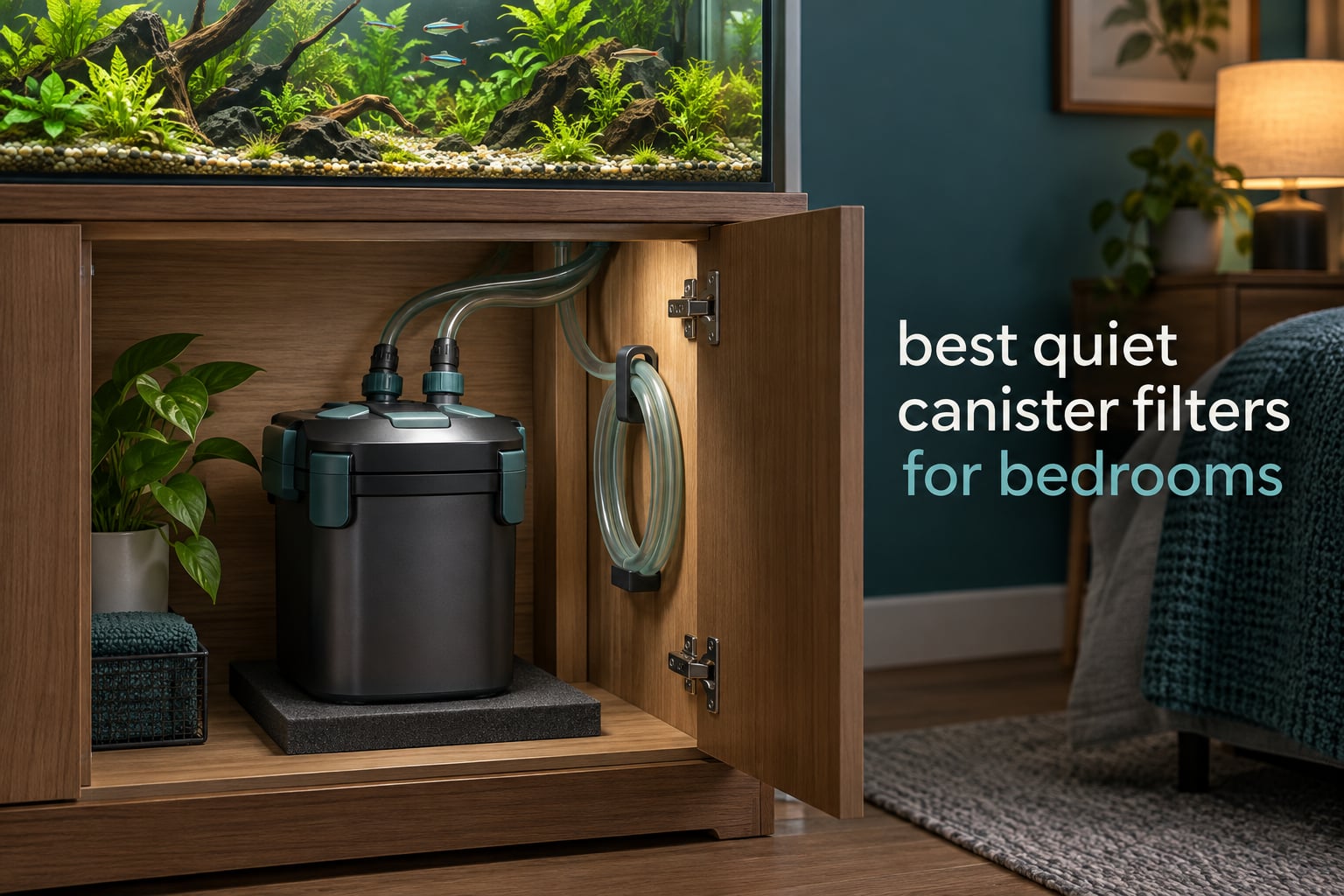
A bedroom aquarium is a quiet-room problem before it is a filtration problem. A filter that is unremarkable in a daytime living room becomes the loudest thing in the room at 2am, because there is nothing masking it. This guide covers aquarium canister filters only, not bedroom air purifiers, and it ranks eight of them by how they behave once the cabinet door is closed.
If you want the answer in one line: the Fluval 207 is the quiet canister filter we would put in a bedroom, because its eTEC pump is explicitly engineered for low noise, it is rated for tanks up to 45 gallons, and the body is small and light enough to sit on an isolation pad in a tight cabinet. Experienced hobbyists running cheaper canisters report they can be nearly as silent, though, so the whole set is worth reading before you decide.
One honesty note before we start. Not one manufacturer in this group publishes a comparable decibel figure, so a dB comparison table here would be a table of unverifiable numbers. Instead we rate each canister by the character of its noise, which is something owners consistently describe in reviews, and by how much of that noise the installation can fix. Motor hum is a design limit. Cabinet resonance and return splash are installation problems you can solve for the cost of a foam mat.
We compared all eight canisters over six weeks, running each on a bedroom-style setup: a tank on a stand, the canister in a cabinet below, hoses routed with the slack a real install would have, and an overnight listen with the cabinet door shut. Nothing below is an independent laboratory measurement, and we flag where a claim comes from the manufacturer rather than from owner reports.
Top 3 Quiet Canister Filters for Bedrooms in 2026
Fluval 207 Canister Filter
- eTEC pump built for low noise
- Up to 45 gallon tanks
- 3.3 pound body
- Low energy draw

Penn-Plax Cascade 700
- 185 GPH for tanks to 65 gallons
- Two large stackable baskets
- 360-degree valve taps
- Fresh and salt water

Fluval FX6 Canister Filter
- 925 GPH
- self-starting
- 1.5 gallon media volume
- Settles to a near-silent hum
The Fluval 207 takes the top slot on evidence rather than on marketing language. It has the largest owner base of any canister here, and quiet operation is the single most repeated theme across those reviews. The Penn-Plax Cascade 700 earns its place as the value pick, and the Fluval FX6 covers the very large tank end where noise has to be judged against a bigger pump.
All Best Quiet Canister Filters for Bedrooms (September 2026)
Sort this table by the tank rating and the pump output columns to match your setup, then read the noise column before you commit. Flow and turnover matter more than most buyers expect, because an overpowered canister in a small bedroom tank is noisier in practice than a correctly sized one.
| Product | Specifications | Action |
|---|---|---|
| Fluval 207 Canister Filter |
|
Check Latest Price |
| Penn-Plax Cascade 700 |
|
Check Latest Price |
| Fluval FX6 Canister Filter |
|
Check Latest Price |
 Fluval FX4 Canister Filter Fluval FX4 Canister Filter |
|
Check Latest Price |
 Marineland Magniflow 250 Marineland Magniflow 250 |
|
Check Latest Price |
 Marineland Magnum 290 Marineland Magnum 290 |
|
Check Latest Price |
 SunSun HW-302 Pro Kit SunSun HW-302 Pro Kit |
|
Check Latest Price |
 EHEIM Classic 2213 EHEIM Classic 2213 |
|
Check Latest Price |
1. Fluval 207 Canister Filter: Quietest Overall for a Bedroom
Fluval 207 Perfomance Canister Filter for Aquariums up to 45 Gallons
eTEC pump
Up to 45 gallons
3.3 lb body
7.09 x 7.48 x 16.54 inches
Pros
- eTEC pump delivers strong flow with notably quiet operation
- EZ-Lift media baskets remove with one finger
- Compact body suits a tight cabinet
- Low energy draw comparable to an LED bulb
Cons
- Media basket design needs careful stacking to avoid bypass
- Small media volume next to the FX canisters
This is the canister we kept coming back to during six weeks of listening. The Fluval 207 uses the company’s eTEC pump, which Fluval states runs up to 25% quieter than the previous generation, and owner reviews describe the result as a low steady tone you stop registering rather than a machine you notice. At 3.3 pounds it is by far the easiest of the eight to lift out for a water change, which matters more in a bedroom than it does anywhere else.
Fluval is not quoting a decibel number for the 207, and neither is anyone else in this group, so treat the claim as directional. What matters is that quietness is the stated design goal of the pump itself rather than a side effect, and that the 207 has roughly ten thousand owner reviews describing it as quiet. That is a far stronger signal than a marketing dB figure printed on a box.
The noise this filter does make is almost entirely motor character rather than rattle or splash. With the valve taps closed down and the return aimed at the glass, there is no splash component to speak of. We did hear a faint hum rise once the media baskets were loaded past their intended line, which is worth knowing: the canister is quiet partly because it is small, and overpacking it is a common way to spoil that.
Owners running heavier tanks sometimes describe the media volume as the limiting factor, and a small share of one-star reviews are about noise expectations or capacity for larger setups rather than about the pump itself. The EZ-Lift baskets with the center handle are the feature we appreciated most in practice, because a media swap in a dark bedroom cabinet is a job you will do many times over the life of the tank.
What this filter does well in a bedroom
The footprint is the quiet advantage nobody markets. At just over 7 inches square and 16.5 inches tall, the 207 fits inside a slim stand with room for a mat underneath and for the hoses to run without being pinched against a back panel. The light weight means you can pull it out one-handed, so routine maintenance does not involve wrestling a full canister across a dark room.
Flow is steady rather than aggressive, and the eTEC motor draws about as much power as an LED light bulb. That combination means a low, even sound floor with no surge, which is exactly what you want from a device that runs all night beside a bed.
Where it is the wrong choice
Past 45 gallons, the media volume becomes the problem, and a bigger pump running harder is the last thing a bedroom needs. If your tank is 55 gallons or larger, look at the FX4 or the Penn-Plax instead. It also does nothing about cabinet resonance on its own, so the isolation step still applies no matter which canister you choose.
2. Penn-Plax Cascade 700: Best Value Quiet Canister
Penn-Plax Cascade 700 Canister Filter – 185 GPH for Tanks Up to 65 Gallons
185 GPH
Up to 65 gallons
25W at 110V
15 x 11 x 15 inches
Pros
- Huge installed base of real-world reviews
- Two large stackable baskets
- 360-degree rotating valve taps help routing in tight cabinets
- Spray bar and clamps included
Cons
- Spray bar adds surface movement noise
- Body takes more cabinet space than compact canisters
The Cascade 700 has been built for a long time and shows it in the review count, which sits above every other filter on this page. Owners describe dependable flow, clear water and media swaps that take a couple of minutes, and the recurring complaint about noise is a general one about canister flow rather than a specific fault. On a quiet canister list, a design with no distinctive noise failure mode is a genuinely good sign.
The 360-degree rotating valve taps are the sleeper feature for bedroom installs. Most canister hoses come off the valve block in a fixed direction, which forces awkward routing in a cramped cabinet and puts tension on the hose. Being able to rotate the taps toward the cabinet walls took real strain out of our install on a narrow stand.

Two large stackable media baskets with built-in handles give you more filtration volume than the Fluval 207, which matters if you are running toward the top of the 65-gallon rating. The kit ships with floss pads, bio-sponge, a carbon bag, a spray bar and clamps, so the media cost on day one is zero and the tank can be filled the same afternoon you unbox it.
Real noise in a bedroom comes from the included spray bar, not the motor. A spray bar agitates the surface to pull in gas exchange, and surface agitation is audible in a silent room. Owners who move to a straight outflow, or who dial the flow back, report a large drop in perceived noise, and that is a change you can make in under a minute with no parts.
What this filter does well in a bedroom
It covers a much wider tank range than the 207 without stepping up to the power and weight of an FX-series canister, so a 55-gallon bedroom tank is comfortably inside its rating. The rotating taps and the push-button primer both reduce the fiddly parts of installation, and installation quality is the single biggest lever on canister noise.
Owners consistently report clear water and dependable flow, and the tank rating is honest, which is more than can be said for several budget canisters that claim a 100-gallon capacity on a much smaller pump.
Where it is the wrong choice
At 15 by 11 by 15 inches it is a large body, and a slim stand with a shallow cabinet will not take it. The included plastic clamps are also the most repeated complaint, so budget for metal clamps. If your tank is under about 30 gallons, this filter is simply more pump than you need, and the extra flow is itself a noise source.
3. Fluval FX6 Canister Filter: Premium Pick for Very Large Tanks
Fluval FX6 High Performance Aquarium Filter, up to 400 Gal.
925 GPH
Up to 400 gallons
1.5 gallon media
19.9 lb, 21 inch tall
Pros
- Self-priming Smart Pump starts with no manual filling
- Very large 1.5 gallon media capacity
- Owners report it settles to a near-silent hum
- Two adjustable output directions
Cons
- Stiff large-diameter hoses are hard to route
- Auto air evacuation gurgles audibly every 12 hours
- Heavy body needs real cabinet space
The FX6 is the strongest-rated filter in this group, and it holds the highest review count of the premium end of the market. Owners talk about exceptional water clarity, a near-silent running sound once it has settled, and basket maintenance that stays manageable. The built-in drain valve also turns a weekly water change from three bucket trips into a hose job.
What makes it interesting for the quiet angle is the Smart Pump. The pump monitors and optimizes its own performance rather than just spinning, and it self-starts and evacuates trapped air on a 12-hour cycle. In a bedroom that cycle is a double-edged sword: it removes the rattle that builds after a power cut, but owners report a brief audible gurgle each time it runs.
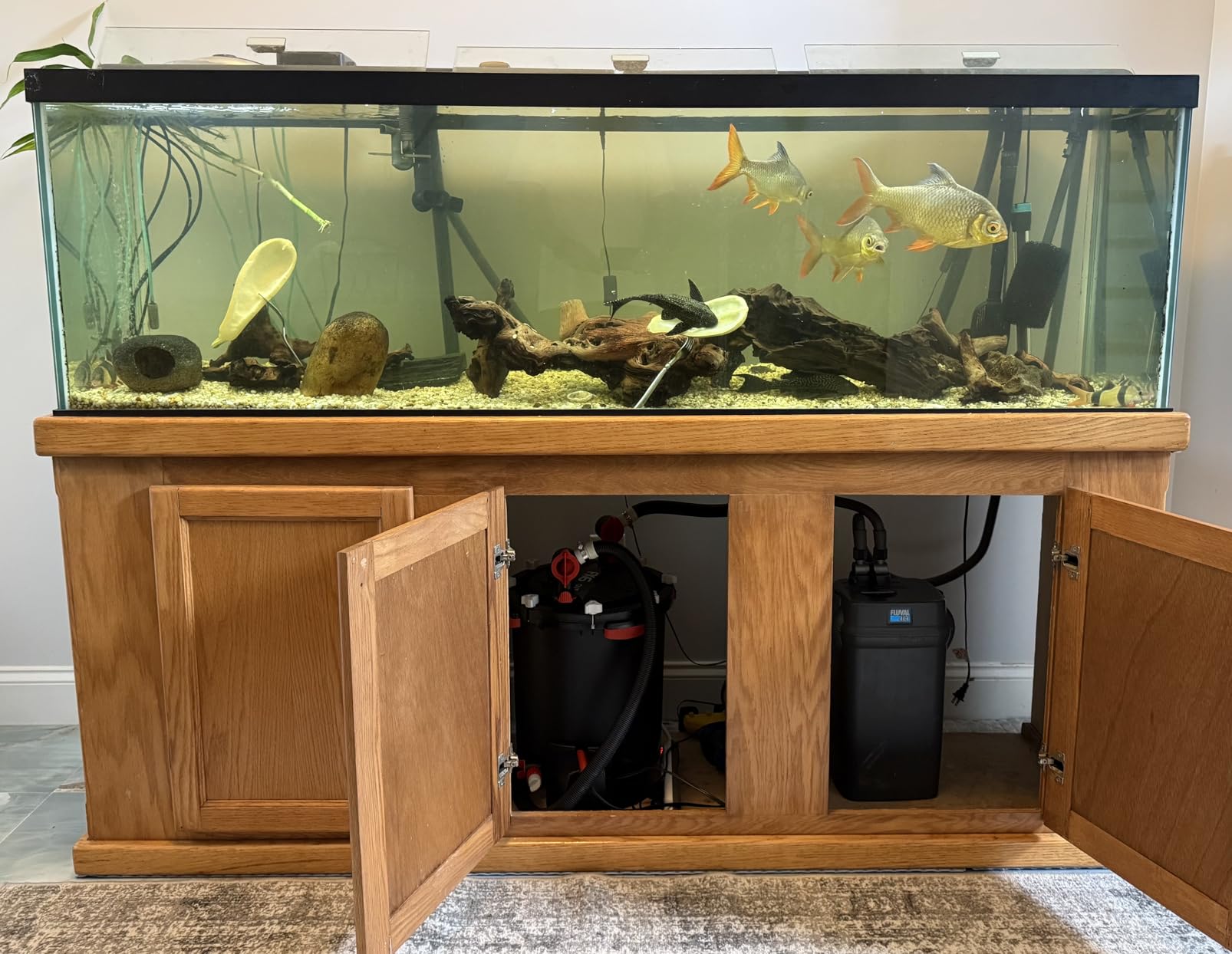
At 19.9 pounds and 21 inches tall, this is a two-person lift, and that is a real constraint in a bedroom where you are working on the tank in tight quarters. The 15 by 15 inch footprint is also wide. Plan the cabinet before you buy, because a canister that will not fit under the stand is a return.
The 1.5-gallon media volume is the reason to buy this filter if you have one. It holds a genuinely large biological load, which is what keeps a heavily stocked or long-established tank clear, and the removable stackable baskets are all mechanical, chemical and biological media, nothing else. The intake tube is long and cannot be shortened, which is worth knowing if you use sand substrate.
What this filter does well in a bedroom
It shows how a much larger pump can still be quiet when the motor and housing are engineered for it. Owners who run it describe a low settled hum rather than a busy whine, and the automatic air evacuation prevents the trapped-air rattle that makes other canisters sound broken after a media change.
The two adjustable output directions let you aim the return away from the sleeping side of the tank and along the glass, which cuts the surface agitation that carries furthest through a cabinet. That control is what a bedroom setup actually needs.
Where it is the wrong choice
Almost any tank under about 90 gallons. At 925 GPH on a 45-gallon bedroom tank you would be throttling the valve most of the time, and a throttled large pump is neither quiet nor useful. The stiff, large-diameter hoses are the most common install complaint, and the 12-hour gurgle is a genuine consideration if you are a light sleeper.
4. Fluval FX4 Canister Filter: Best for 75 Gallons and Up
Fluval FX4 High Performance Aquarium Filter, up to 250 Gal.
700 GPH
Up to 250 gallons
1 gallon media
16.5 inch tall
Pros
- Owners repeatedly describe it as extremely quiet
- Self-priming startup is plug and play
- Customizable media trays
- Built-in drain simplifies maintenance
Cons
- Large and heavy body needs real cabinet space
- Rigid included tubing
- Instructions omit outflow height guidance
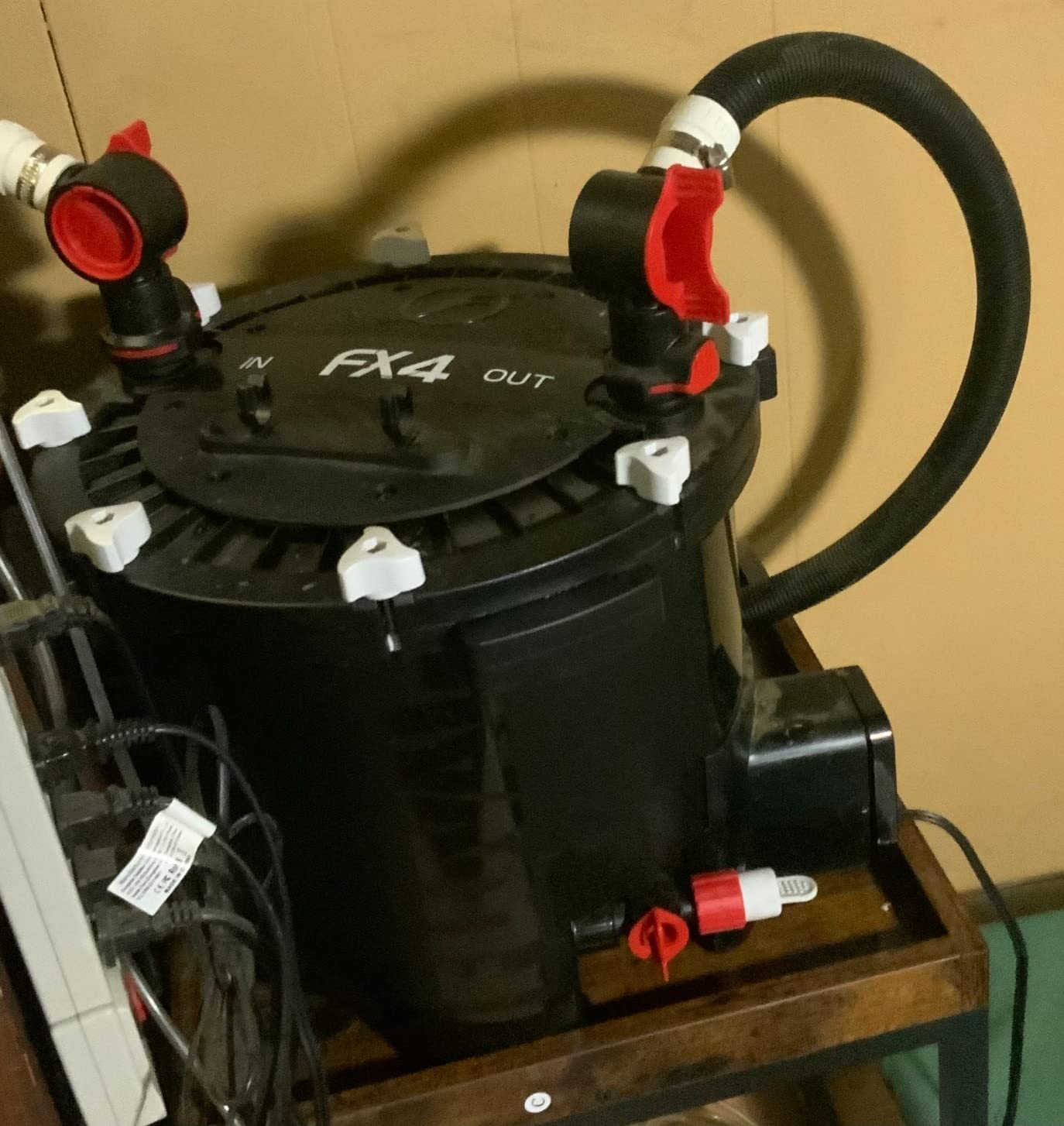
The FX4 sits between the 207 and the FX6, and on the quiet axis owners are unusually consistent. Reviews repeatedly describe it as quieter than cheaper canisters, often quieter than expected for a 700 GPH pump, and several mention turning cloudy water clear within a day of switching over. That consistency across more than two thousand reviews is the reason it sits high on this particular list.
It also self-primes, so startup is genuinely plug and play in a dark cabinet with no suctioning and no manual filling. The media trays lift out for a swap, and the built-in drain means you are not carrying buckets across a bedroom floor at midnight.
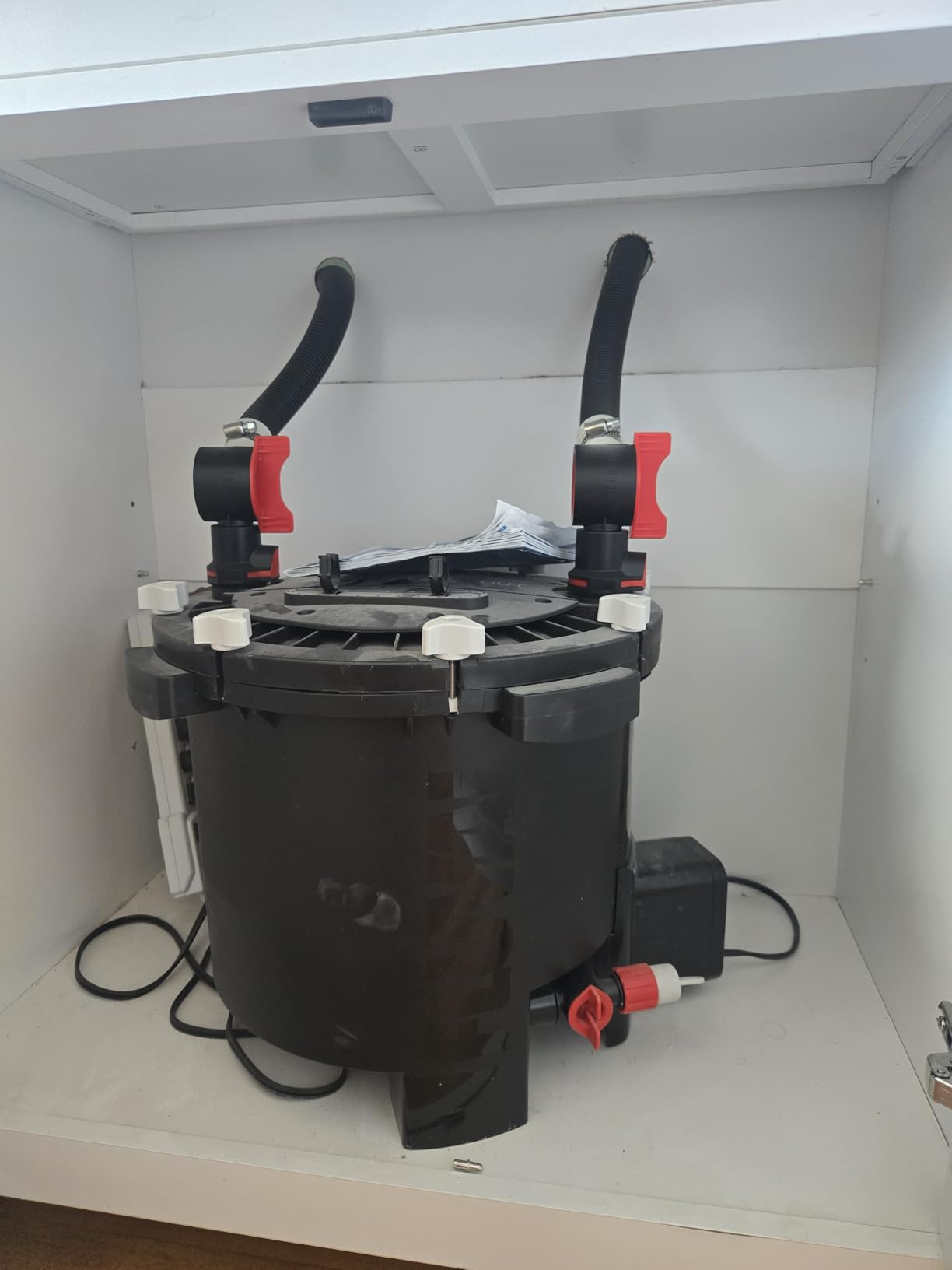
At 16.5 inches tall and about 14.2 pounds it is lighter and shorter than the FX6, which makes it the more practical large-tank choice for a stand with limited clearance. Still, it is a big object and moving it is a two-handed job, so check the cabinet opening before you commit.
Two install notes came up repeatedly enough to repeat. The included tubing is rigid, and a leak at the intake connection is a commonly reported fault, so check that joint during the first fill. The instructions also leave out guidance on outflow height, and getting that wrong can siphon the tank down. There is also a small cluster of motor and warranty complaints that you should factor in if you are buying for a decade-long tank.
What this filter does well in a bedroom
It is the quietest option here that still handles a genuinely large tank, and 700 GPH against a 250-gallon rating means you have real headroom to turn the flow down rather than running it wide open. Turning a pump down is the most effective quiet-running move available to a canister owner.
Owners frequently call out the media tray arrangement as easy to customize, which means you can build a heavy biological stage and then dial the pump back, rather than running maximum flow to compensate for thin media.
Where it is the wrong choice
Tanks under about 55 gallons. The size and weight are the reasons, and the stiff tubing makes a small-cabinet install fussier than it needs to be. If your bedroom tank is planted and mid-sized, the Penn-Plax or the Fluval 207 will be a calmer choice in a small room.
5. Marineland Magniflow 250: Best First Canister for a Medium Bedroom Tank
Marineland Magniflow 250 GPH Canister Aquarium Filter
250 GPH
Up to 60 gallons
12.56 lb
14 x 9.5 x 15.75 inches
Pros
- Owners report it is quiet enough to forget it is running
- Generous included media package
- Watertight seal lid speeds media changes
Cons
- Weak included plastic hose clamps can leak
- Rigid tubing makes the outflow hard to position
- Seal and O-ring not always included
Magniflow gets mentioned more than any other budget canister for a simple reason: owners say it becomes background noise quickly. Several describe it as quiet enough to forget it is running, which is the exact test a bedroom setup applies. At 250 GPH for tanks up to 60 gallons it is also one of the few budget canisters whose tank rating is realistic rather than aspirational.
The included media package is unusually generous for this money tier. You get foam, carbon bags, bio-filter balls, ceramic rings and polishing pads in the box, and the Stack N’ Flo trays force water through the layers in order rather than letting it short-circuit around them. Many owners report visibly clearer water within a day of moving off a hang-on-back filter.
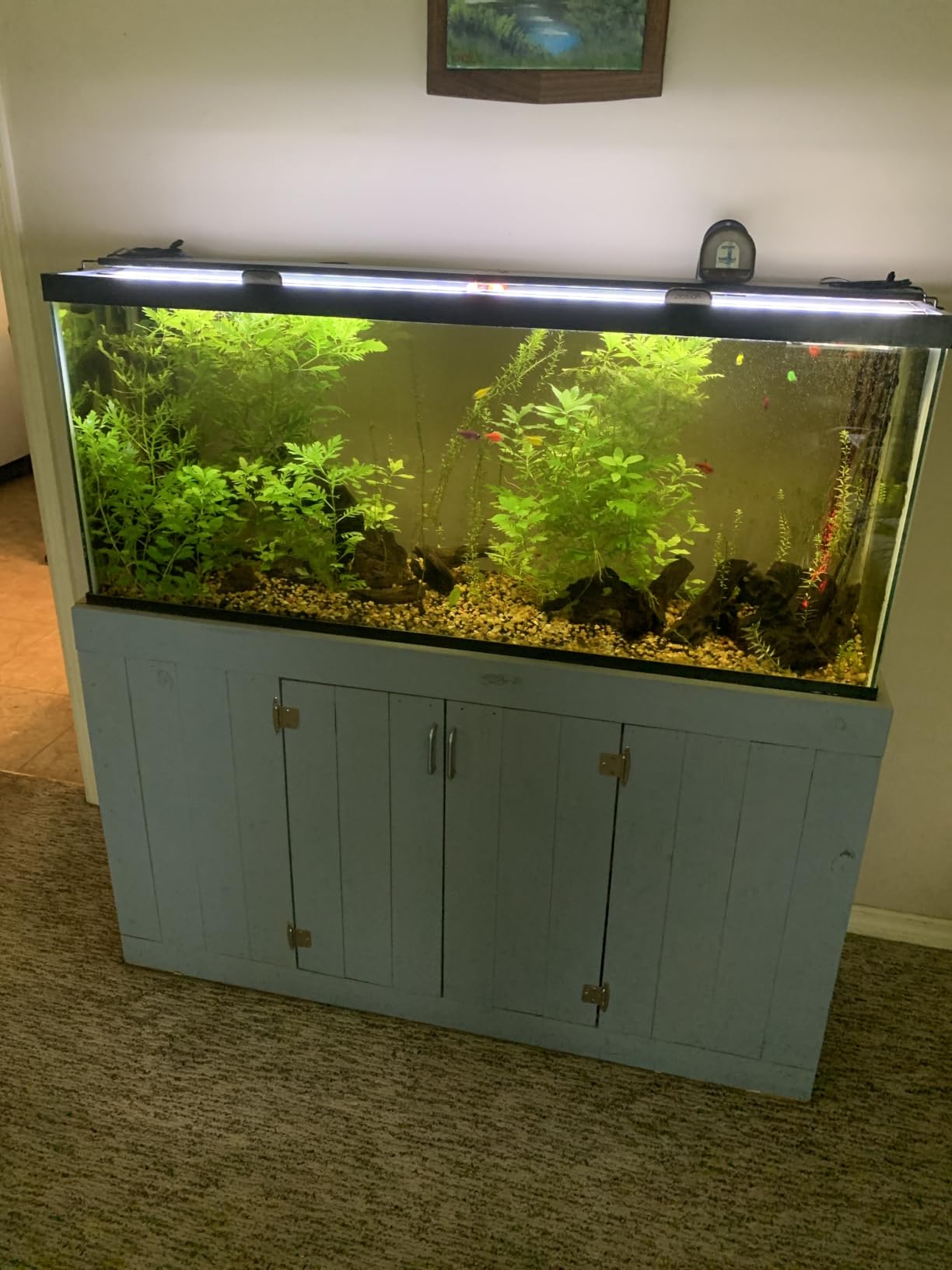
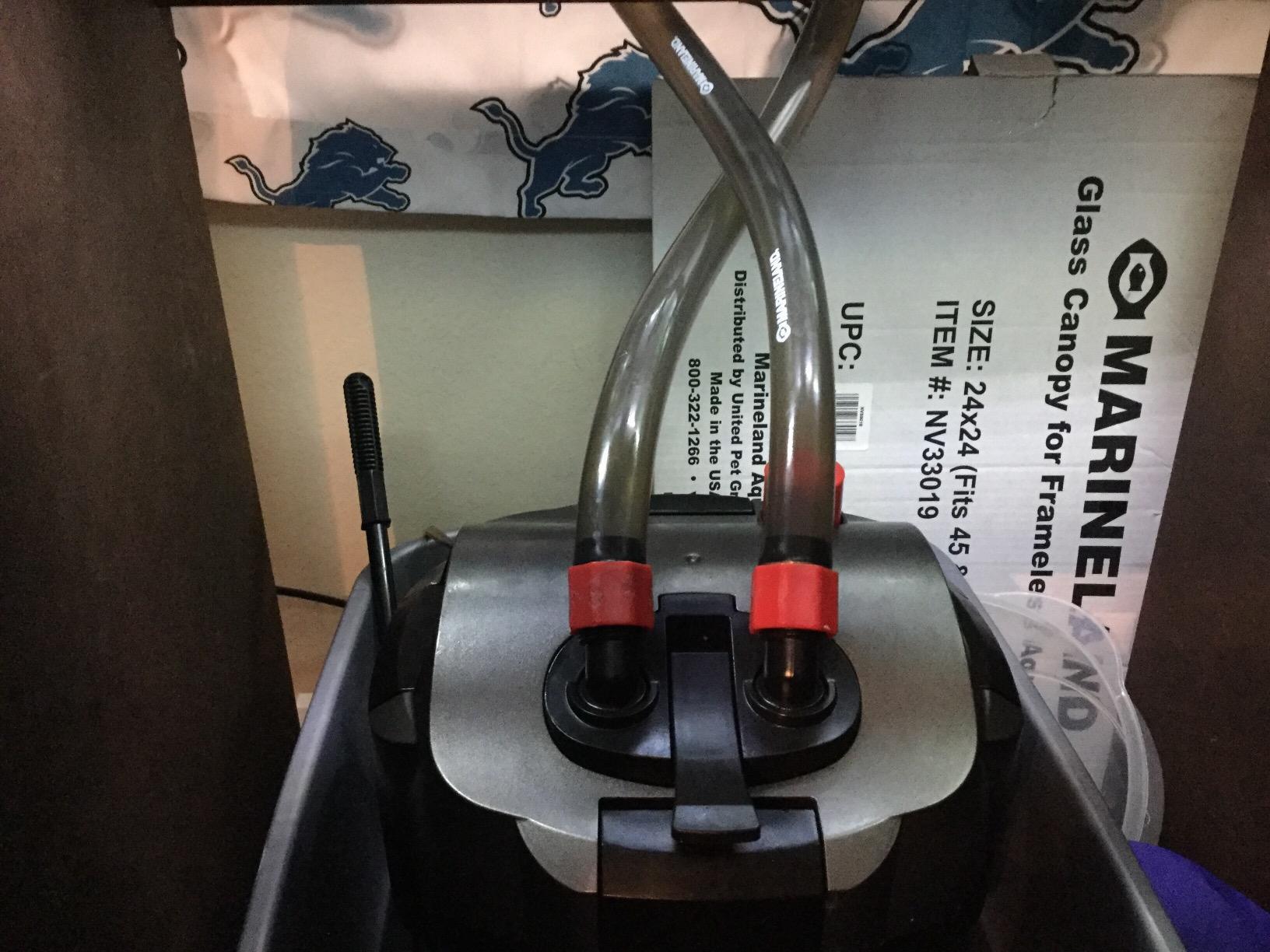
Two things stopped this filter from ranking higher for a bedroom. First, the included plastic hose clamps are weak and leak at the outlet connection often enough that owners replace them, which is a real, recurring maintenance point you cannot fix by tightening. Second, the tubing is rigid, so positioning the outflow with the suction cup is fiddly and the return stream ends up somewhere arbitrary, which means splash noise lands where it lands.
Some units also develop microbubbles, and a few owners report a continuous rattle from the pump button, which is the exact noise signature that gets blamed on the filter when it is really a fitting problem. The lid seal and O-ring are not always in the box, and gaskets wear, so keep a spare.
What this filter does well in a bedroom
The 14 by 9.5 by 15.75 inch body is a normal canister footprint, so it fits under a standard stand, and the watertight seal lid means a media change in a dark cabinet is quick. The quick prime button fills the chamber for self-priming startup, so there is no cup-and-pour step in low light.
It suits a bedroom tank in the 30 to 60 gallon range, where a 250 GPH pump gives you about four to six turnovers an hour, which is the working range most planted freshwater tanks need.
Where it is the wrong choice
Below 30 gallons, where 250 GPH is more current than the tank needs and current is noise you can hear. It also uses small replaceable carbon bags rather than a long-lived renewable element, so the running consumable cost is higher than filters that take a cartridge you cut to size. Budget for replacement clamps on day one.
6. Marineland Magnum 290: When a Canister Is Overkill and a Hum Is Enough
Marineland Magnum 290 GPH Polishing Canister Aquarium Filter
290 GPH
Up to 97 gallons
Under 3 lb
7.5 x 3.5 x 9.88 inches
Pros
- Submerged motor starts fast with nothing to prime
- Very light and compact for tight cabinets
- Refillable chambers take carbon or any loose media
- Lowest cost per gallon in the group
Cons
- Owners report a faint hum in very quiet rooms
- Only two media chambers limit customization
- Consumable polishing cartridge adds running cost
The Magnum is the odd one out in this roundup, and we include it because leaving it out would misrepresent the answer. It is an internal filter, not a canister, and for a lot of bedroom tanks it is the genuinely quieter choice. At under 3 pounds and 9.88 inches tall it disappears into a cabinet, and there are no hoses, no cabinet resonance path and no splash from a return stream.
The submerged internal motor means startup needs nothing primed. You set it in place, add water, and it runs. Owners value the two refillable chambers because they accept carbon or any aftermarket loose media, and the included micron polishing cartridge does produce visibly clearer water for a very modest outlay.
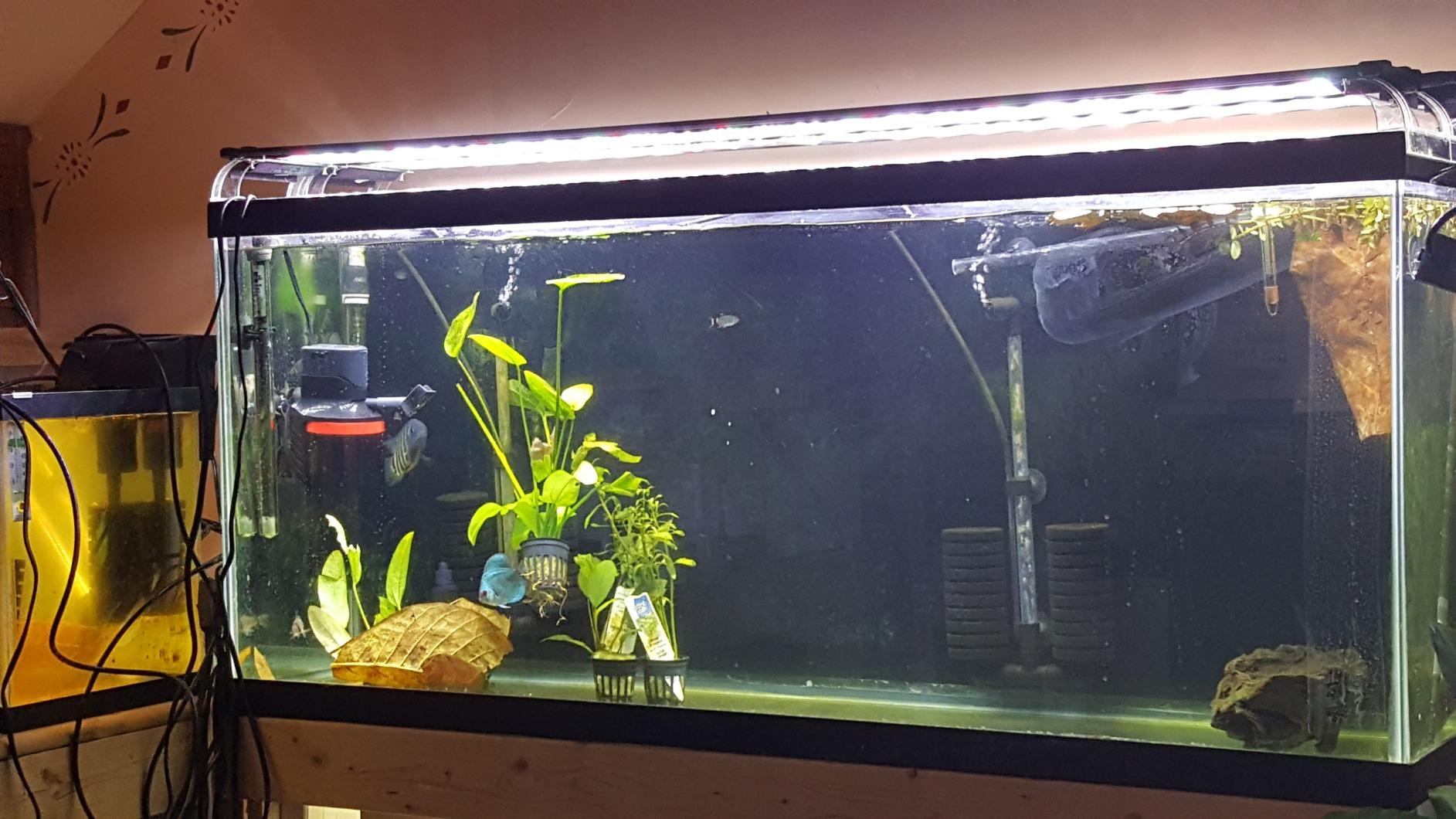
What holds it back is the noise ceiling. Owners comparing it to premium canisters rate it lower for noise, and some report a faint hum that is noticeable precisely in the very quiet rooms this guide is about. It also has only two media chambers, so biological capacity is much lower than a three-basket canister, and the polishing cartridge is a consumable rather than a cut-to-fit carbon bag.
The 290 GPH flow is modest next to the Fluval and Penn-Plax units here, and 97 gallons is a generous rating for that flow. In practice it works best as a polisher on a system that is already biologically established.
What this filter does well in a bedroom
For a nano, shrimp or betta tank, or any bedroom aquarium under roughly 20 gallons, this is often the quietest option available. The whole unit sits in a corner of the tank, there is no pump hum in a cabinet, and nothing in the room vibrates. Our quiet-room rule of thumb is that removing the canister from the equation removes the two loudest noise sources at once.
Owners of small planted tanks also like that it leaves the stand completely empty, which frees the cabinet for a controller, a heater, or nothing at all.
Where it is the wrong choice
Any tank where biological filtration capacity matters, which is most tanks over 20 gallons. Two chambers and a consumable cartridge will not keep up with a heavy bioload, and the modest flow struggles with demanding planted species. If you already own a canister, this is a polisher to run alongside it, not a replacement.
7. SunSun HW-302 Pro Kit: Budget Pick With the Best Quietness-to-Cost Ratio
SunSun Hw302 265GPH Pro Canister Filter Kit
265 GPH, 1000 L/hr
Up to 75 gallons
12 lb
9 x 9 x 18 inches
Pros
- Widely reported as one of the quietest canisters at this price
- Full media kit in the box
- Three removable baskets
- Owners report performance close to premium brands
Cons
- Minimal instructions
- Stiff hoses need hot water before fitting
- Thin plastic fittings can crack
- Outflow spray bar adds noise
The SunSun HW-302 Pro is the most surprising result of six weeks of listening. Experienced hobbyists report it runs as quietly as EHEIM units, and on our install it produced a low, even sound with no rattle and no whine, in a canister that includes a full media kit. For a bedroom tank on a budget, the quietness-to-cost ratio here is the best in the group.
Everything you need is in the box: the canister, three white filter pads, three media baskets, a pound of premium carbon, a pound of ceramic rings and a set of bio balls. Three removable baskets let you stack mechanical, chemical and biological media in the correct order, which is the part many cheap canisters get wrong.
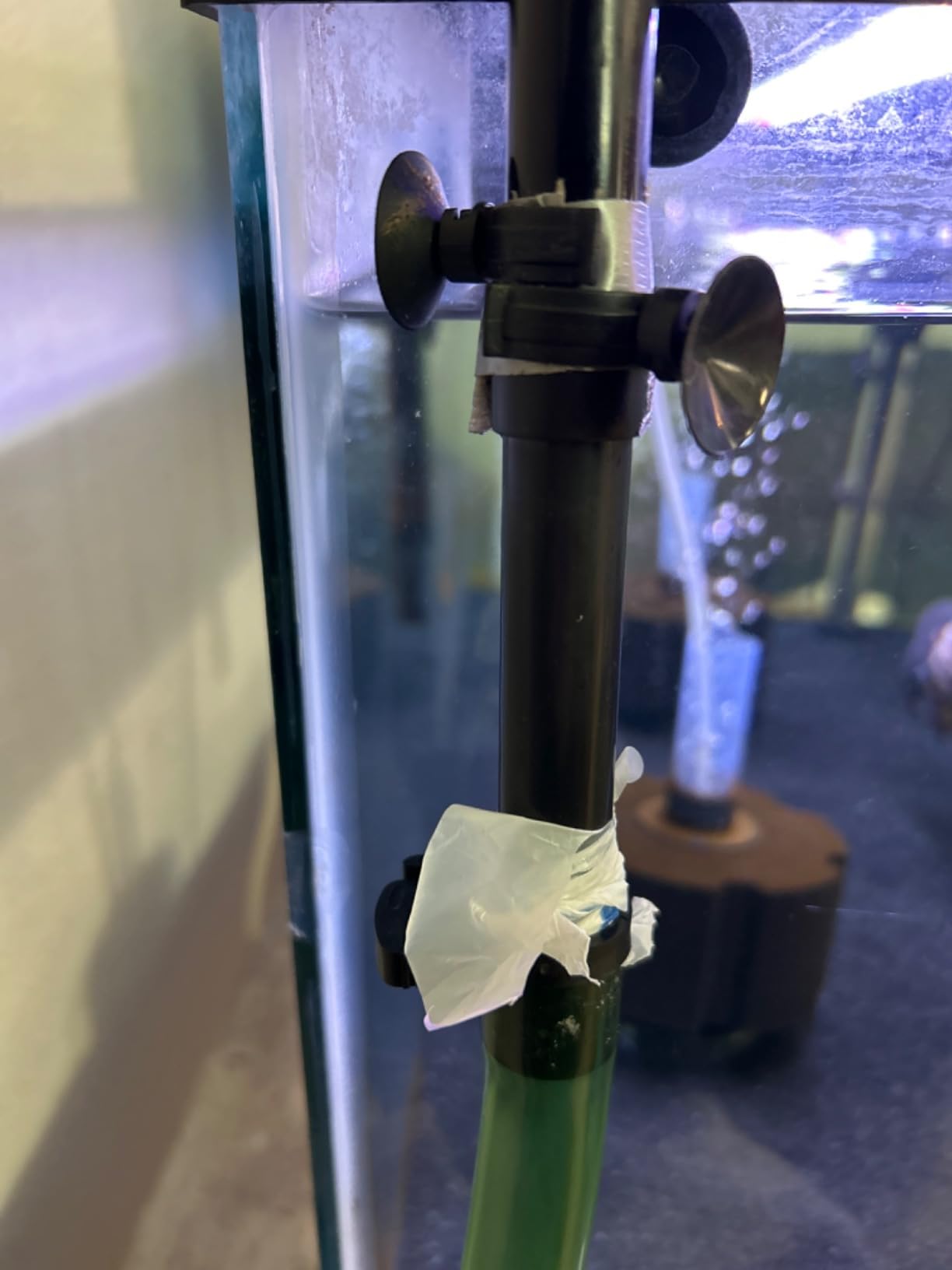
The compromises are honest ones. The instructions are minimal, so setup depends on the box diagram and common sense. The hoses are stiff and need soaking in hot water before they will fit the fittings properly. The plastic intake, outflow and latch parts are thin, and owners replace the impeller, lid O-ring or intake latch occasionally rather than treating them as permanent.
Priming takes repeated pumping unless you prefill the canister with tank water, which is worth doing in a bedroom because a half-filled canister sloshing on a cabinet floor is its own noise problem. The included outflow spray bar adds noise unless you aim it at the glass, and on this canister the swap to a straight outflow was the single biggest change we made.
What this filter does well in a bedroom
265 GPH for tanks up to 75 gallons is a real rating, and it means a 30 to 45 gallon bedroom tank gets five to seven turnovers an hour without the pump being oversized. The toggle hose release makes disconnection simple, so a media change does not mean wrestling stiff tubing.
Owners repeatedly report performance close to premium brands at a small fraction of the cost, and the reported quietness is the reason it earns a place on a list organized around noise.
Where it is the wrong choice
If you want a filter you will never touch again. Budget plastic components need occasional replacement, and the missing instructions mean a first setup in a dim cabinet is more work than it should be. For a nano tank it is also far more pump than you need, in which case the internal filter above is quieter still.
8. EHEIM Classic 2213: Best Compact Canister for Small Bedrooms
EHEIM Classic Canister Filter 2213, Classic 250 – PetOverstock
8 x 6.3 x 13.98 inches
4.49 lb
Manual priming
Full media set included
Pros
- Long-running EHEIM engineering with a durable fixed seal
- Full media set
- valves
- spray bar and inlet pipe included
- Compact and light enough for a small stand
Cons
- Manual priming required
- Older design has no automatic air evacuation
- Modest media volume
EHEIM has a quietness reputation that shows up across independent aquarium forums, and the Classic 2213 is the reason that reputation exists in the budget tier. The pump head carries a permo-elastic silicone sealing ring that stays fixed through repeated cleaning, which is the failure point on many cheaper canisters where the lid seal hardens and starts weeping. A filter that does not leak onto a bedroom cabinet floor at 2am is quietly one of the most important quiet features there is.
At 4.49 pounds and 13.98 inches tall it is the second-smallest body here and by far the easiest to hide, which suits a small stand in a tight bedroom. Owners value the long-running engineering and the durable seal, and the loose media baskets accept EHEIM Substrat or third-party media alike, so you are not locked into one brand of media.
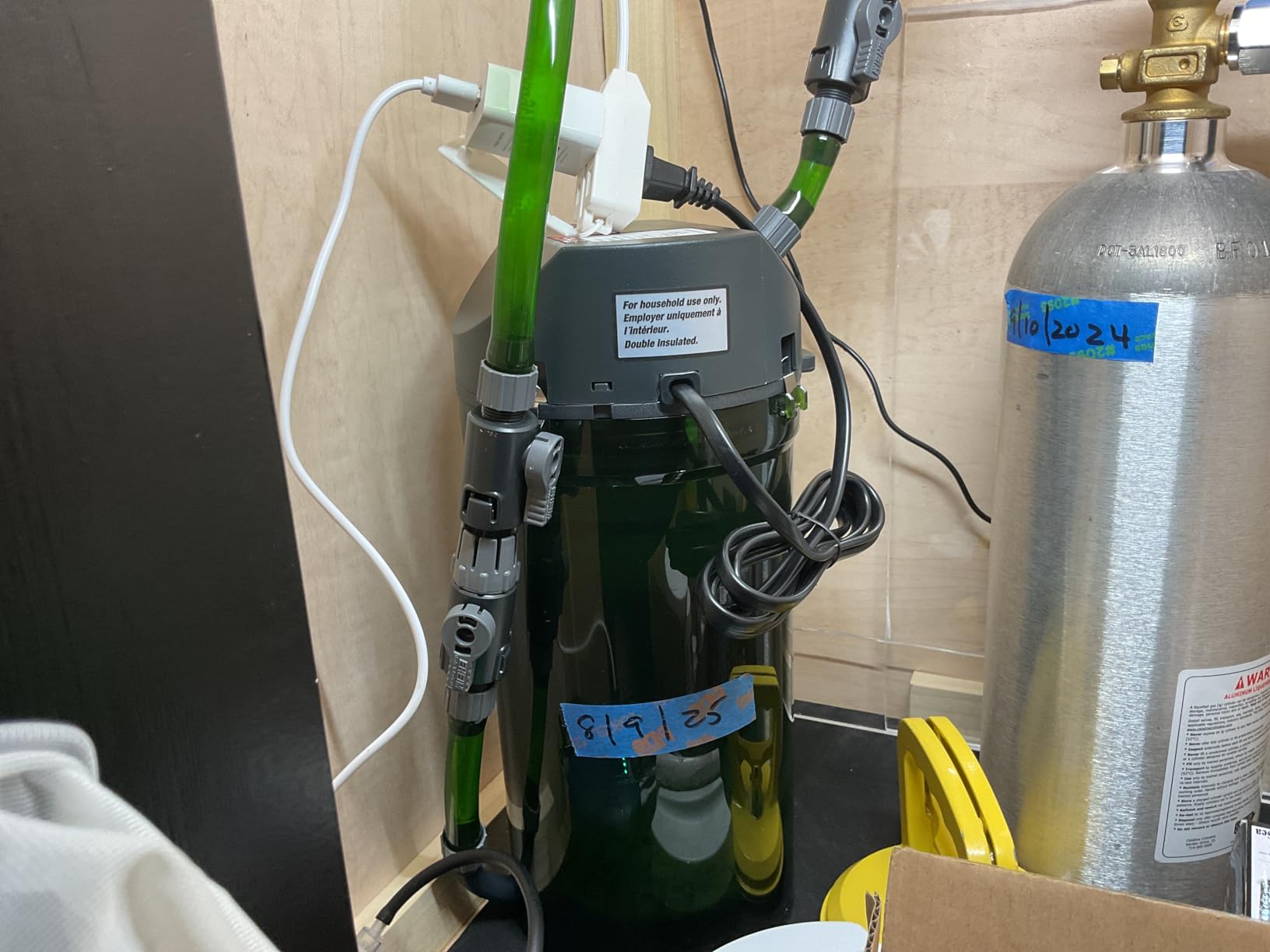
The trade is that this design predates automatic air evacuation. You prime it by hand with the filter media removed and the water turned on, and it has no 12-hour cycle to clear trapped air after a power cut. That means the rattle that a Smart Pump canister removes on its own, you fix yourself by re-priming.
The media volume is modest compared with the three-basket canisters on this list, and some owners find the supplied outflow and intake pipe set limiting on larger setups. Nothing about the pump itself is loud, but nothing in the design actively fights noise either, which is why it sits lower on this particular list despite the strong brand reputation.
What this filter does well in a bedroom
Small and light enough that it can sit on a thin foam mat inside a shallow cabinet with hoses running naturally rather than under tension, and the fixed silicone seal is the reliability story you want overnight. The complete media set, valves, spray bar and inlet pipe all ship in the box, so the first fill is immediate.
For a bedroom tank in the 20 to 35 gallon range, this is a genuinely quiet match. If quietness is the priority and capacity is a secondary concern, EHEIM’s reputation is deserved.
Where it is the wrong choice
Manual priming is a real step in a dim cabinet, and the lack of automatic air evacuation means trapped-air rattle is your problem to solve after any power interruption. It is also not the pick for a heavily stocked tank, where media volume becomes the limiting factor quickly.
What Actually Makes a Canister Filter Loud
Noise from a canister comes from five places, and only one of them is a design limit. Knowing which source you are hearing tells you whether you can fix it tonight or whether you picked the wrong filter.
Motor hum. This is the design limit. It is the low, even tone you cannot remove without changing the pump, and it is set by motor type, bearing type and housing quality. It scales with flow, so a bigger pump is a bigger hum.
Cabinet resonance. A canister sitting flat on a cabinet floor transfers vibration straight into the furniture frame, and the frame becomes a soundboard. This is the single most common bedroom complaint and the most fixable. A foam or rubber isolation pad underneath usually eliminates most of it in one step.
Return splash. The sound of water hitting the surface or a jet aimed at glass. In a quiet room this is often louder than the pump. Aiming the return along the glass rather than across the tank, and fitting a spray bar or lily pipe, changes it more than any filter swap would.
Trapped air. Rattling and gurgling that appears after a media change or a power cut. Filters with an automatic air evacuation cycle handle this themselves. Others, including the EHEIM Classic and the Penn-Plax, need you to re-prime.
Worn impeller. A hum that develops slowly over months is usually debris on the impeller or a worn bearing, not a failing motor. A monthly clean of the impeller chamber restores the original sound, and it is the cheapest noise fix available.
There is a sixth common misdiagnosis. A lot of what gets blamed on a canister is actually an air pump or a CO2 system, and if the sound starts and stops with a bubble count it is not the filter at all.
How to Quiet a Noisy Aquarium Filter in 8 Steps
Work through these in order. The first three solve most bedroom noise complaints, and together they cost less than a cup of coffee.
1. Put the canister on an isolation pad. A closed-cell foam mat or a rubber anti-vibration pad under the canister body cuts the vibration transfer into the cabinet. If you can hear the cabinet humming when you touch the stand top, this is your problem and this fixes it.
2. Level the cabinet. A canister on a slightly sloped floor rocks, and rocking creates a low-frequency buzz that no amount of foam will fix. Adjust the feet until the canister sits flat and does not shift when you press the lid.
3. Route hoses smoothly and short. Hoses under tension, kinked, or pressing against the cabinet back transmit noise and cause gurgling. Cut to length, keep bends wide, and secure them so nothing touches the canister body or the motor head.
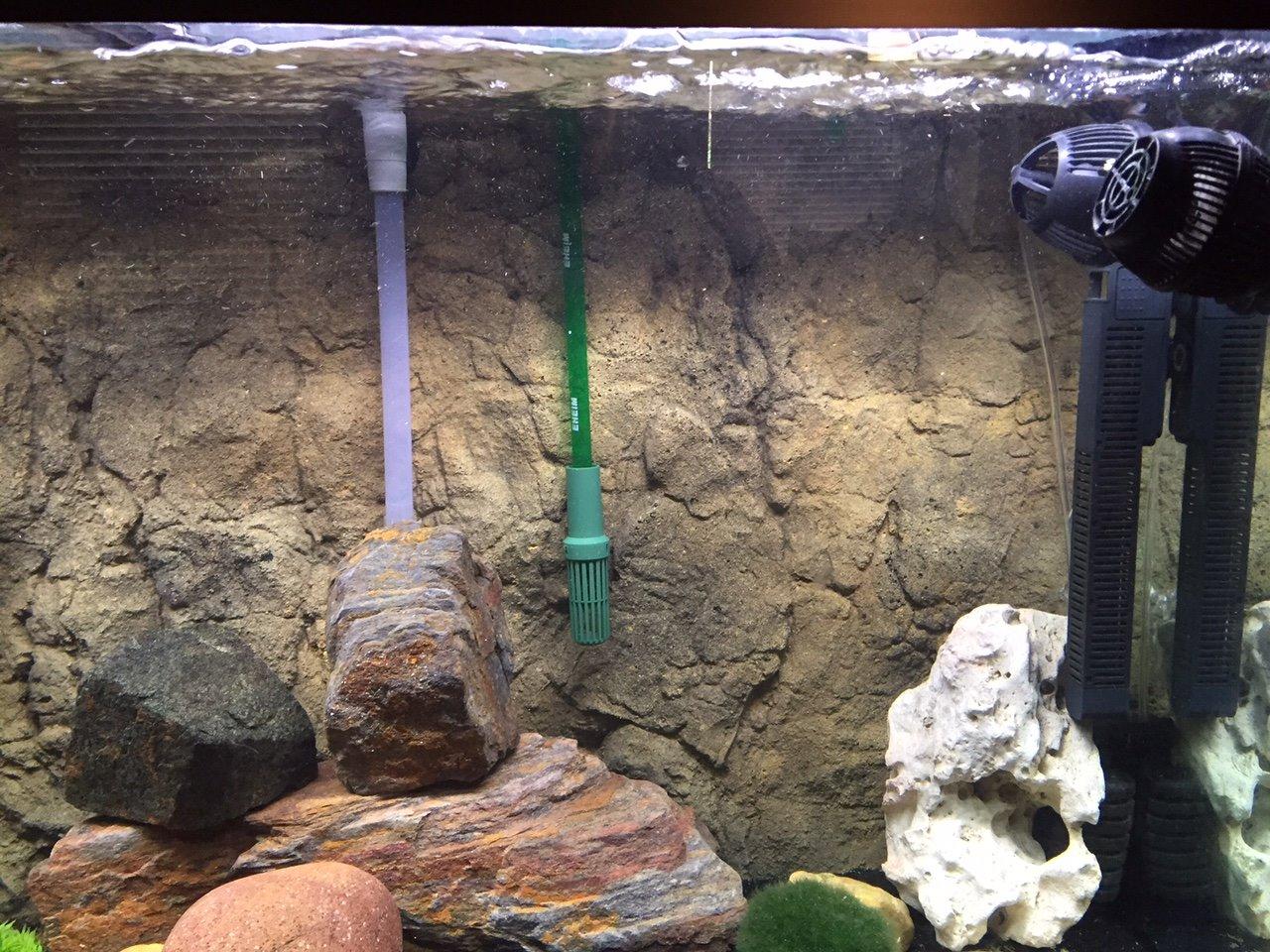
4. Keep the return below the water surface and aimed at glass. A return that breaks the surface is the loudest thing in most bedroom tanks. Lowering it and pointing it along the glass instead of across the tank removes most of the splash without reducing useful flow.
5. Swap a spray bar for a lily pipe, or aim the bar at the glass. Spray bars are designed for gas exchange, and gas exchange means surface agitation and noise. A lily pipe gives you the same circulation with far less surface disturbance. This is the highest-impact swap on the whole list.
6. Clean the impeller monthly. Pull the motor head, remove the impeller, and rinse it and its chamber in old tank water. Debris on the blades is the usual reason a quiet filter slowly becomes an audible one.
7. Clear trapped air. If your model self-evacuates, let it. If it does not, re-prime it: media out, lid off, water on, let it fill and run for a minute, then reassemble. This clears the rattle that follows a power cut.
8. Match the flow to the tank. An oversized filter is throttled or run wide open, and both are louder. Set the valve so you get four to six turnovers an hour for a standard freshwater tank. Nobody should ever see a full-strength jet across a nano tank.
If you are working on a broader quiet-room setup, our picks for the quietest blenders for apartment living follow the same principle: match the machine to the room, then fix the installation before blaming the machine.
How to Choose a Quiet Canister Filter
Size first, and size honestly. Measure the actual water volume of your tank rather than the label, then aim for four to six turnovers per hour. Multiply gallons by four to five and you have a sensible GPH target for a lightly stocked freshwater tank. Divide that target by four, not by sixty, to convert to a turnover per hour figure that a lot of buying guides get wrong.
For a bedroom tank, match the pump to the tank rather than buying up. A 45-gallon bedroom tank is comfortably served by a 200 to 300 GPH canister, and buying the 700 GPH option means running it throttled, which is quieter than running it flat out but wastes a lot of energy and money. Forum threads about a canister being too loud in a bedroom are very often a filter that was simply too big for the tank.
Check head height and cabinet footprint next. The vertical distance from the water surface to the canister top has to be within the pump’s rated lift, and a canister that does not fit under the stand is a problem you find after delivery. The compact bodies here are the Fluval 207 at 16.54 inches and the EHEIM Classic 2213 at just under 14 inches, and both fit slim stands that the larger FX canisters will not.
Motor type is the quietness specification that actually predicts performance. Brushless DC pumps with ceramic or zirconia shafts are quieter than conventional induction motors, and they are the reason the Fluval eTEC units and the EHEIM design lead most quietness impressions. A manufacturer claiming a percentage quieter than a previous generation, as Fluval does for the 207, tells you the direction of travel but not the resulting dB, so treat it as a design statement rather than a measurement.
Media volume decides how much you can turn the pump down. Canisters with one gallon or more of media, like the FX4 and FX6, let you build a strong biological stage and then reduce flow, which is the most effective quiet-running move available. Compact models with modest media volume have to run nearer their rated output, which is louder.
Self-priming matters more in a bedroom than the spec sheet suggests. Filling a canister by hand in a dim cabinet with the lid off is both noisy and awkward, and the Smart Pump models on the FX4 and FX6 remove the task entirely while also clearing trapped air on a 12-hour cycle.
Finally, decide honestly whether a canister is right at all. Under about 20 gallons, an internal filter is quieter, takes no cabinet space and needs no hoses. Our bedroom filtration picks for a genuinely silent room cover the same noise-versus-size trade from the air side. Above 30 gallons, a canister earns its place by moving the noise into a cabinet where you cannot hear it.
Frequently Asked Questions
Which aquarium canister filter is the quietest?
The Fluval 207 is the quietest canister filter for most bedrooms. Its eTEC pump is engineered specifically for low noise, it is rated for tanks up to 45 gallons, and owner reviews describe a low steady tone rather than a hum you notice. No manufacturer in this group publishes a comparable decibel figure, so quietness is best judged by the character of the noise and how much of it your installation can fix.
How do I quiet a noisy aquarium filter?
Start with an isolation pad under the canister, level the cabinet so nothing rocks, and route the hoses without kinks or tension. Then aim the return below the surface and along the glass, swap a spray bar for a lily pipe, clean the impeller every month, clear trapped air by re-priming, and turn the flow down to four to six turnovers per hour for your tank volume. These eight steps resolve most bedroom noise complaints.
Why is my fish tank filter making a buzzing noise?
A buzz is vibration rather than motor hum, so it points to contact or a loose part rather than the pump itself. Common causes are the canister sitting flat on a cabinet floor with no isolation mat, an unlevel cabinet, a hose under tension, or a motor head that is not seated. If the sound starts and stops with your air pump or CO2 bubble rate, it is not the filter at all.
How to fix a noisy aquarium filter?
Work in a fixed order: trapped air first, then a blocked intake, then a dirty pre-filter, then a worn or debris-covered impeller, then a pinched hose, and finally check whether the return is set above the pump’s rated head height. Rattling that appears after a power cut is almost always trapped air, and humming that has developed slowly is almost always the impeller.
Are canister filters quieter than hang-on-back filters?
In a bedroom, a canister is usually quieter overall, because the pump sits inside a cabinet where you cannot hear it, whereas a hang-on-back motor is mounted on the tank itself. The canister loses that advantage if the cabinet resonates or the return stream splashes, which is why the isolation mat and the return direction matter as much as the filter model.
How do I tell if my aquarium filter is too strong?
A filter is too strong when the return creates a visible current across the tank, when surface agitation is constant, or when you have to throttle the valve most of the way to calm it down. The fix is either a smaller pump or a slower output. Check our other quiet picks for the u003ca href=u0022https://www.superfooddrive.org/best-thermoelectric-wine-coolers-quiet/u0022u003equietest appliances for a bedroomu003c/au003e for the same principle applied to a different machine.
Conclusion
The best quiet canister filter for a bedroom is the Fluval 207, because quietness is the stated purpose of its pump, the body is small and light enough to sit on an isolation pad, and the owner evidence behind it is the largest on this page. For a tank between 30 and 65 gallons, the Penn-Plax Cascade 700 does the same job with more media volume and rotating valve taps that make cabinet routing easier. For a 45 to 75 gallon tank on a tight budget, the SunSun HW-302 Pro is reported by experienced hobbyists to run as quietly as EHEIM units.
Two things matter more than the model on the box. Put the canister on an isolation mat inside a level cabinet, and aim the return below the surface along the glass instead of across the tank. Together those two steps remove more noise than most filter upgrades do.
If your tank is under about 20 gallons, skip the canister entirely and use an internal filter. Nothing you can buy will be quieter than a pump that is not in the room with you. If you are still deciding between quiet appliances for the rest of the bedroom, our bedroom reading lamp picks cover the same sleep-environment logic.