
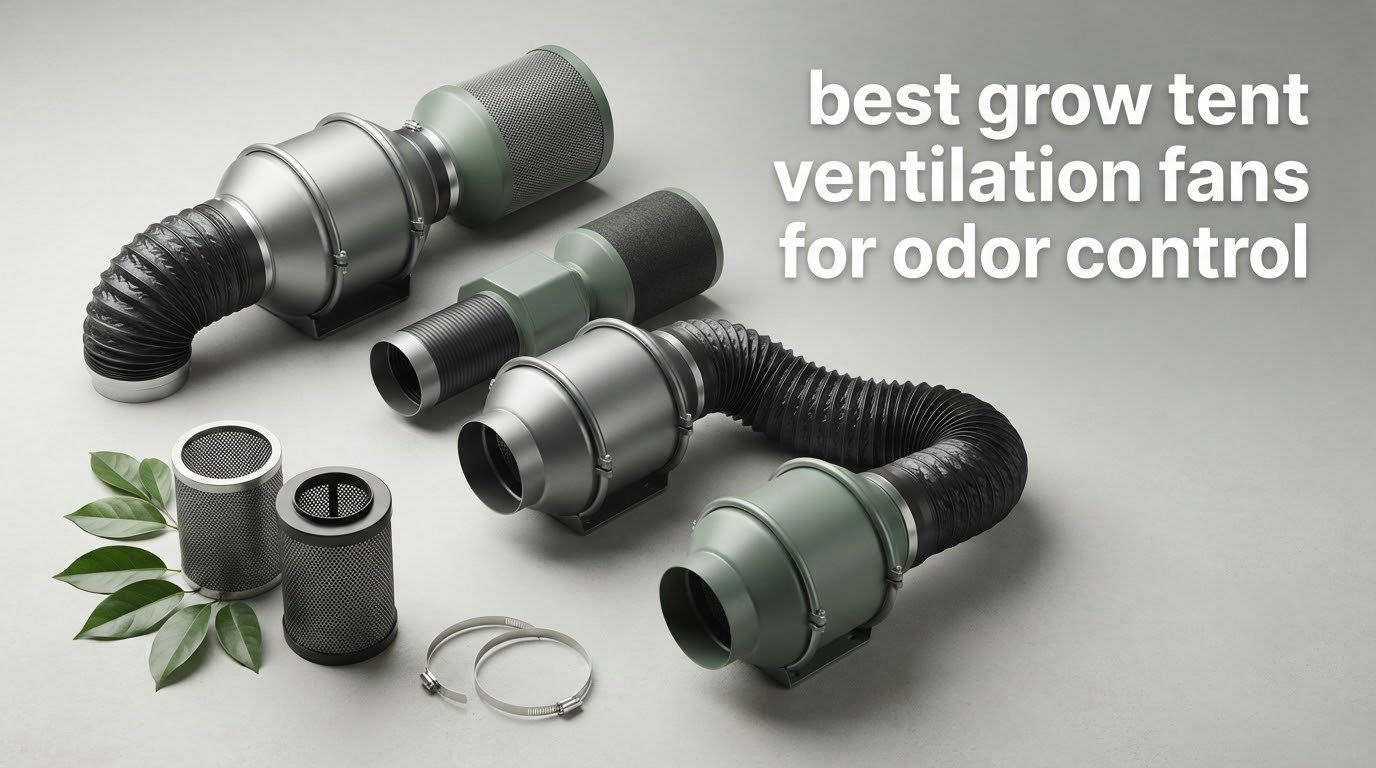
Most growers who complain that odor still escapes their tent do not have a bad filter. They have a leaky duct run, a kinked length of flex hose, three unnecessary 90-degree bends, or a filter that was never mounted on the fan’s intake side in the first place. That is the framing we used when we picked the best grow tent ventilation fans for odor control in 2026, and it is why nearly every kit on this list is judged on what it does behind a loaded carbon bed rather than on the free-air CFM number printed on the box.
We compared eight inline fan and carbon filter combinations, checking rated airflow, motor type, noise, carbon bed specification, included duct length and controller granularity. The results are below, with honest drawbacks on every pick.
Table of Contents
The 3-Second Answer
The best grow tent ventilation fans for odor control are inline duct fans paired with a genuine activated carbon filter, not clip fans. A 4 inch inline fan moves 190 to 205 CFM and handles 2×2 through 4×4 tents. A 6 inch inline fan moves 390 CFM and handles 5×5 tents and up. Mount the carbon on the fan’s intake side, inside the tent, and the fan creates the negative pressure that contains the smell.
If you have read anything else on this topic, one correction up front: the carbon does most of the odor work, but the fan does the containment work. Without airflow there is no pressure differential, and without pressure differential odor finds its own way out through seams, ducting and the zipper. Neither component is optional.
One more honest scoping note before we start. If you are growing a single small plant in a tent with plenty of passive vent ports, an inline fan is spending money you do not need to lose. Passive intake plus a modest filtered exhaust is more than enough at that scale. Everything in this roundup assumes you are running a sealed or semi-sealed tent where leak containment actually matters. If you have just started choosing containers, our grow bag roundup covers the substrate side of the same setup.
Top 3 Grow Tent Ventilation Fans for Odor Control in 2026

VIVOSUN G4 Air Filtration Kit
- 195 CFM brushless motor
- 28 dB
- E12 controller with 10 PWM speeds
- RC 412 carbon with 38mm bed

AC Infinity Air Filtration Kit 4 inch
- 165 CFM EC motor
- 29 dBA
- 10-speed digital control
- 25 ft of four-layer ducting

Hon and Guan 4 inch Air Filtration Kit
- 130 CFM at 26 dB
- 10 inch tall carbon filter
- 38mm RC 48 bed
- 3-layer foil ducting
Best Grow Tent Ventilation Fans for Odor Control in 2026
All eight kits below are complete systems: an inline duct fan, a carbon filter, ducting and, in most cases, a speed controller. The differences that actually change odor performance are airflow behind the filter, carbon bed specification and how much duct length you get before you have to buy more.
| Product | Specifications | Action |
|---|---|---|
| VIVOSUN G4 Air Filtration Kit |
|
Check Latest Price |
| AC Infinity Air Filtration Kit 4 inch |
|
Check Latest Price |
| Hon and Guan 4 inch Air Filtration Kit |
|
Check Latest Price |
 Spider Farmer 4 Inch Air Filtration Kit Spider Farmer 4 Inch Air Filtration Kit |
|
Check Latest Price |
 MELONFARM 4 Inch All-in-One Kit MELONFARM 4 Inch All-in-One Kit |
|
Check Latest Price |
 iPower 4 Inch 195 CFM Inline Fan Kit iPower 4 Inch 195 CFM Inline Fan Kit |
|
Check Latest Price |
 VIVOSUN 6 Inch Inline Fan Combo VIVOSUN 6 Inch Inline Fan Combo |
|
Check Latest Price |
 VIVOSUN 4 Inch Inline Fan Combo VIVOSUN 4 Inch Inline Fan Combo |
|
Check Latest Price |
A note on the airflow column: these are manufacturer free-air ratings. Every one of them drops once air is forced through a carbon bed, and the drop is larger on fans with weaker motors and shorter carbon beds. Treat the number as a ceiling, not a delivery figure.
1. VIVOSUN G4 Air Filtration Kit – Best Overall for Odor Control
VIVOSUN G4 Air Filtration Kit, Inline Fan, Controller, Carbon Filter, Duct
195 CFM brushless motor
28 dB
E12 10-speed PWM controller
38mm RC 412 carbon bed
Pros
- Strong 195 CFM airflow from a 28 dB brushless motor
- Ten PWM speed settings with backup memory and cycle modes
- RC 412 Australian virgin charcoal rated 1200+ IAV
- App control plus touch control
- Aluminum ducting with stainless steel clamps
Cons
- App and touch control less intuitive than a manual dial
- 4 inch duct limits airflow in larger tents
- Only 8 ft of ducting included
This is the kit we kept coming back to while assembling the list. The AeroZesh G4 is rated at 195 CFM from a 72 watt brushless motor, and in a 4×4 with a carbon filter attached it still moves enough air to hold the tent under pressure and keep the fabric from visibly sucking in.
What separates it from the cheaper 4 inch kits is the carbon specification. The filter uses RC 412 Australian virgin charcoal at 1200+ IAV in a 38mm bed, which is the same carbon grade used by the premium brands on this list. Air adsorption value is the honest measure of how much odor a bed can absorb before it saturates, and 1200+ IAV is a strong number for a consumer tent filter.
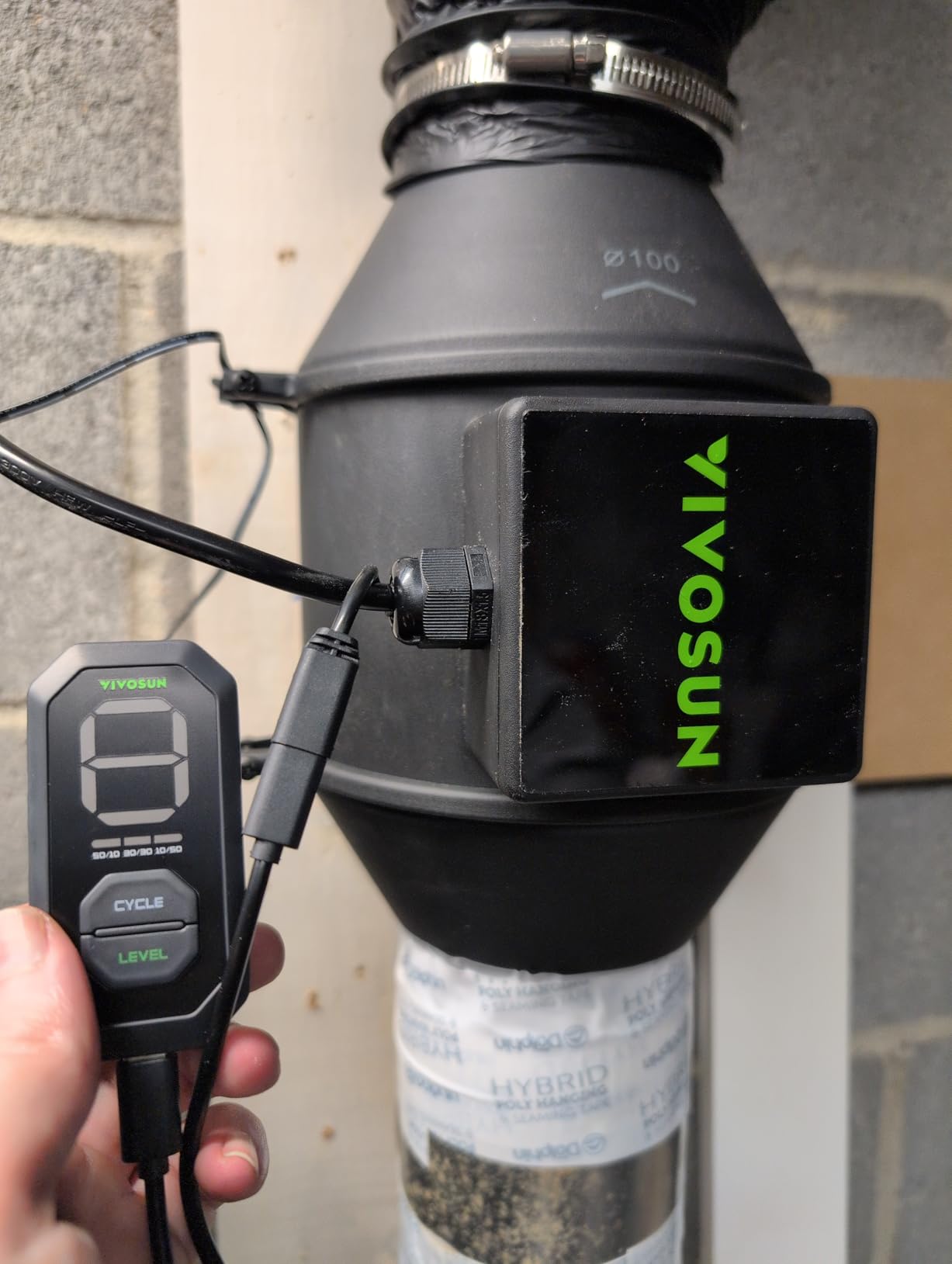
The E12 speed controller is where this kit pulls ahead of its class. Ten PWM speeds with backup memory means it resumes at your last setting after a power cut, and three ON/OFF cycle modes let you run intermittent exchange during the day. For odor control that matters more than raw peak speed, because a lower steady speed runs the motor cooler and quieter over a full flowering cycle.
It is also the only kit here with app integration, which is a genuine convenience for anyone away from the tent for long stretches. Reviewers report the digital interface is less intuitive than a manual dial, and that is fair.
What you get for the money you spend
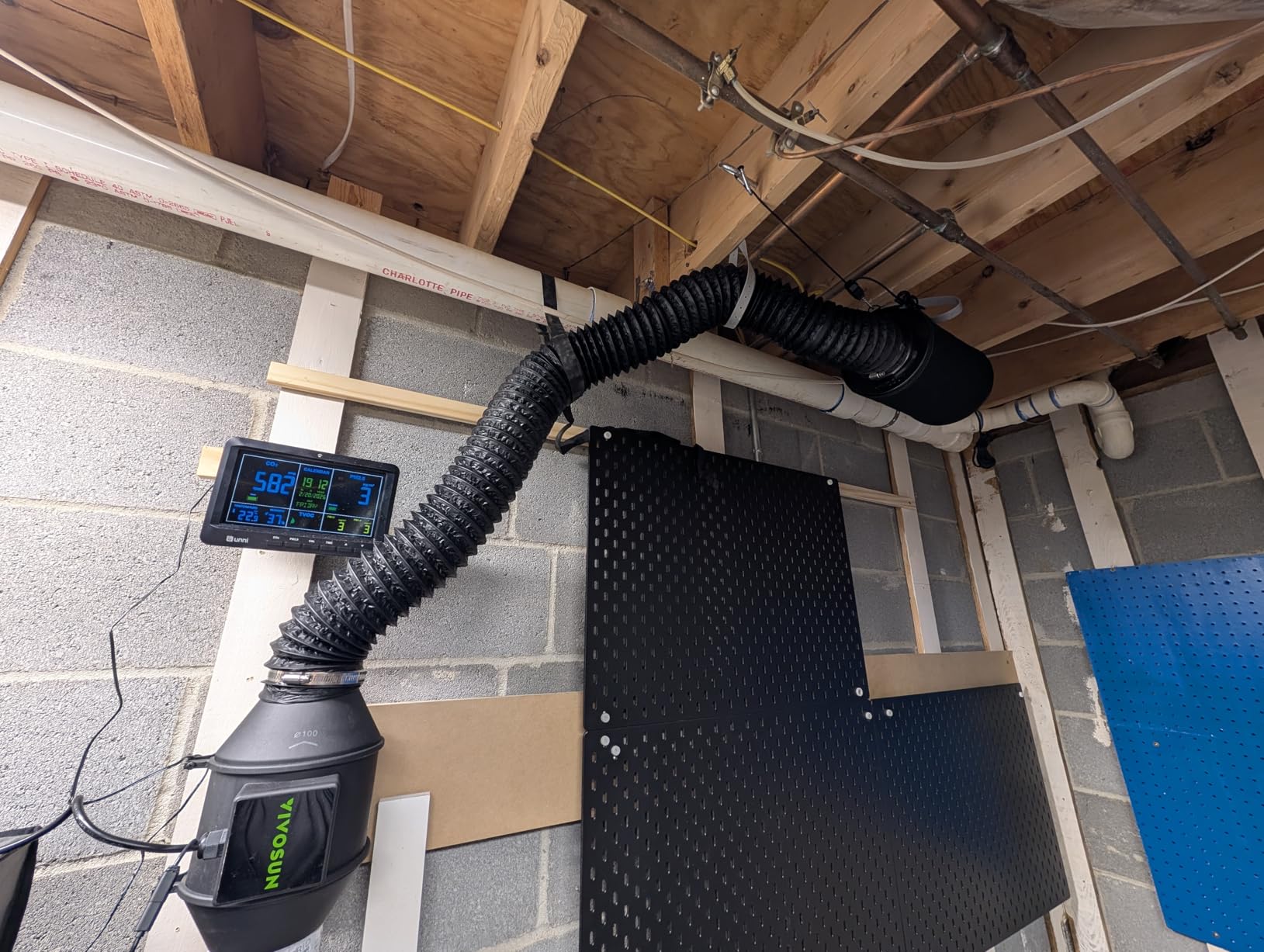
You get fan, controller, carbon filter, 8 ft of aluminum ducting with a PET thermoplastic core layer and two stainless steel clamps. The duct is rigid enough that it resists the kinking that ruins cheap flex hose, which matters because a kinked duct is the single most common cause of reduced airflow in home setups.
The clamp count is thin. Two clamps for an 8 ft run means you will want a third or fourth at every junction to stop leaks, and that is a five-minute fix with any worm-drive clamp from a hardware store.
Who should buy something else
Step up to the 6 inch VIVOSUN combo if your tent is 5×5 or larger. A 4 inch duct simply cannot move enough air through a larger footprint, and you will end up chasing leaks with a fan that never reaches pressure.
Step down if quiet operation in a living space is your main constraint, because while 28 dB is quiet, it is not the quietest option here. And buy a separate speed controller only if the app workflow genuinely annoys you, since the physical touch controls on the E12 do work without a phone.
2. AC Infinity Air Filtration Kit 4 Inch – The Premium Pick Refined Setup
AC Infinity Air Filtration Kit 4” with Speed Controller
165 CFM EC motor
29 dBA
Digital 10-speed control
38mm carbon bed with prefilter
Pros
- Highest rated in the group at 4.8 stars
- Very quiet on lower speed settings
- Effective against odor and strong ammonia
- Speed memory recalls last used setting
- 25 ft of four-layer ducting included
Cons
- Highest price of the kits compared
- 165 CFM is lower than several cheaper 4 inch kits
- Carbon bed replacement adds ongoing cost
AC Infinity is the most repeated brand recommendation across independent grow forums, and this kit is why. It carries a 4.8 average across 304 ratings, and reviewers consistently describe it as the quietest and most refined ventilation setup in this group.
The 29 dBA figure holds on the lower half of the ten-speed range, and the EC motor draws 34 watts. This is the kit to choose if your tent is in a bedroom or an apartment where a steady vacuum-cleaner hum is a real problem rather than a theoretical one.
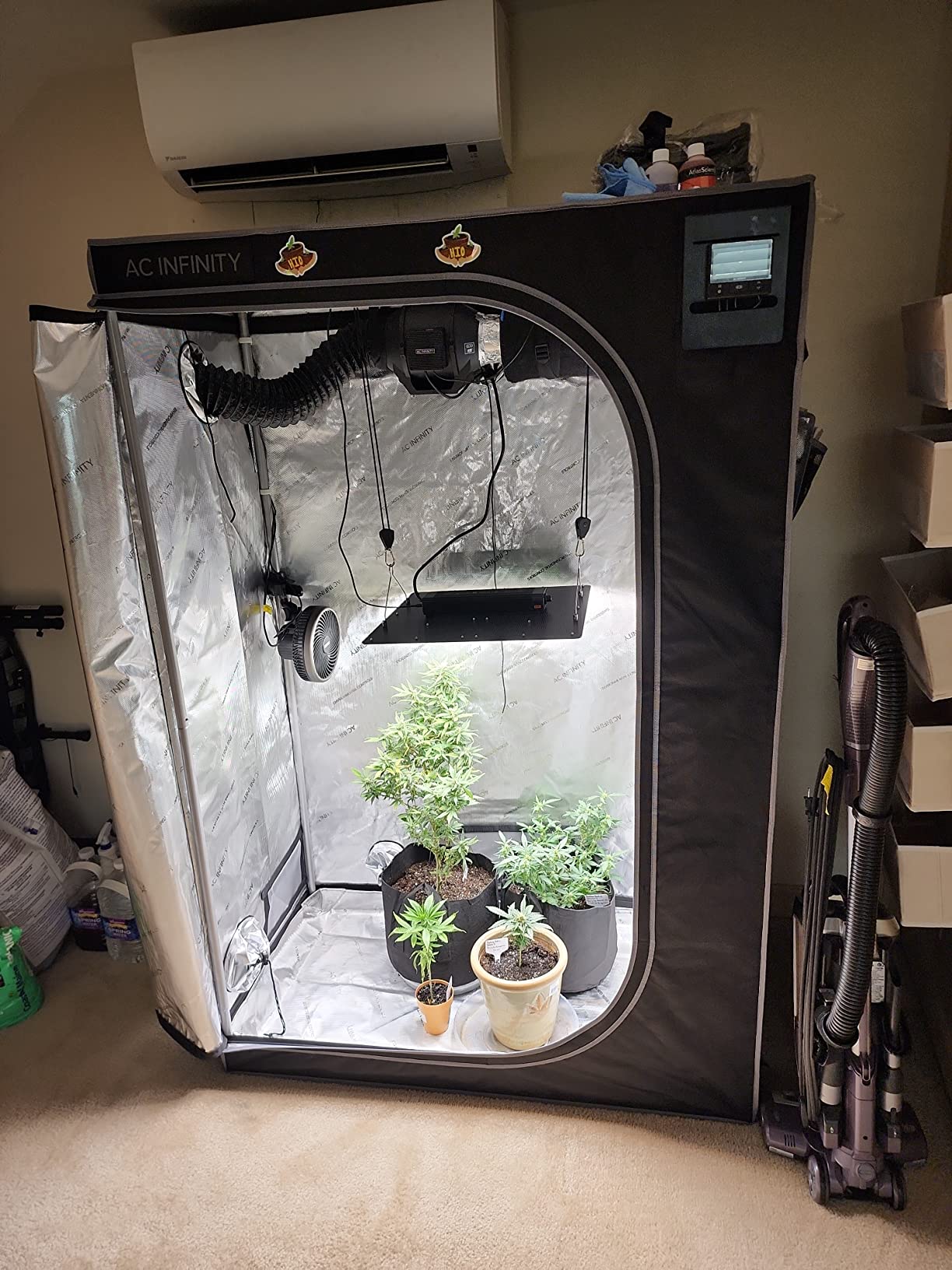
The carbon filter uses 38mm of 1200+ IAV activated charcoal with a prefilter cloth, which is the same bed thickness and grade used by the VIVOSUN G4. Reviewers report it handles not just cannabis odor but ammonia-heavy rooms, which is a harder contaminant than most people expect from a tent filter.
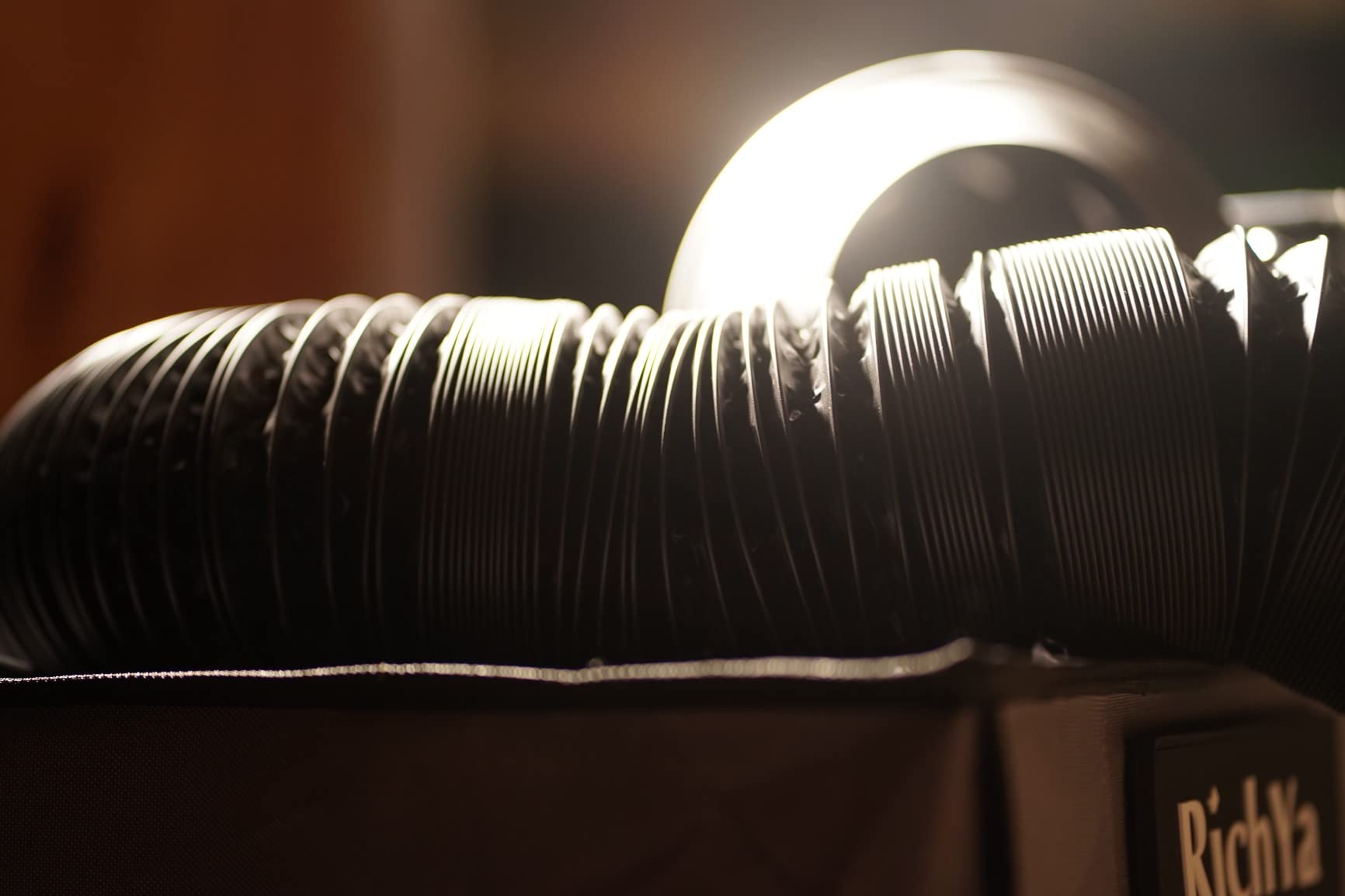
What you get that nobody else here includes is 25 ft of four-layer flexible ducting. That is enough run to mount the fan outside the tent in a closet or under a bed, keep the duct path short, and still have slack for a clean bend radius. Longer duct is more surface area for leaks, but it also means you are not forced into a tight, kinked path.
What the extra money actually buys
It buys refinement rather than raw output. At 165 CFM this is not the strongest fan here, and reviewers say so. What you get in return is the lowest noise at working speeds, a controller that remembers your last setting, and a build quality that reviewers describe as a step above the rest.
The recurring caveat is cost against output. If you are running a large room and need airflow more than silence, the Spider Farmer kit moves more air for less. If you are running a tent next to where you sleep, this is the one.
Who should buy something else
Buy the VIVOSUN G4 instead if the price gap matters more than the last few decibels. And note the recurring forum complaint that noise rises noticeably above mid-range speeds, so plan to run this at 50 to 70 percent rather than cranking it to maximum and living with it.
If you already own AC Infinity controllers, this kit drops straight into that ecosystem and the value calculation changes completely. Growers running the Controller 67 across two tents cite exactly that as the reason to stay in one brand family.
3. Hon and Guan 4 Inch Air Filtration Kit – Best Value 4 Inch Kit
Hon&Guan 4″ Air Filtration Kit: 4 Inch Inline Duct Fan with Speed Controller, 10″ High Carbon Filter, 8 Ft Ducting & Rubber Coupler, Ventilation System for Grow Tents, Indoor Gardening, Hydroponics
130 CFM airflow
26 dB
10 inch tall carbon filter
3-layer foil and PET ducting
Pros
- Very quiet at 26 dB
- 10 inch tall carbon filter gives a deeper bed than most 4 inch kits
- 3-layer foil and PET ducting resists rips
- Included rubber coupler for sealed connections
- Good value against similar complete kits
Cons
- 130 CFM is the lowest airflow of the 4 inch kits here
- 3-layer ducting adds slightly more resistance
- Uses RC 48 carbon rather than heavier RC 412
This kit is quietly excellent and the airflow number is the reason it is not higher on the list. At 130 CFM it delivers the least air of any 4 inch kit here, and owners in larger rooms report pairing it with an additional filter or intake fan to compensate.
For a 2×2 or 2×4 tent, though, 130 CFM is more than adequate, and at 26 dB it is the quietest kit in this comparison. The carbon filter is 10 inches tall, which is taller than most 4 inch filters on the market, and that extra bed depth is the single most valuable thing on this product.
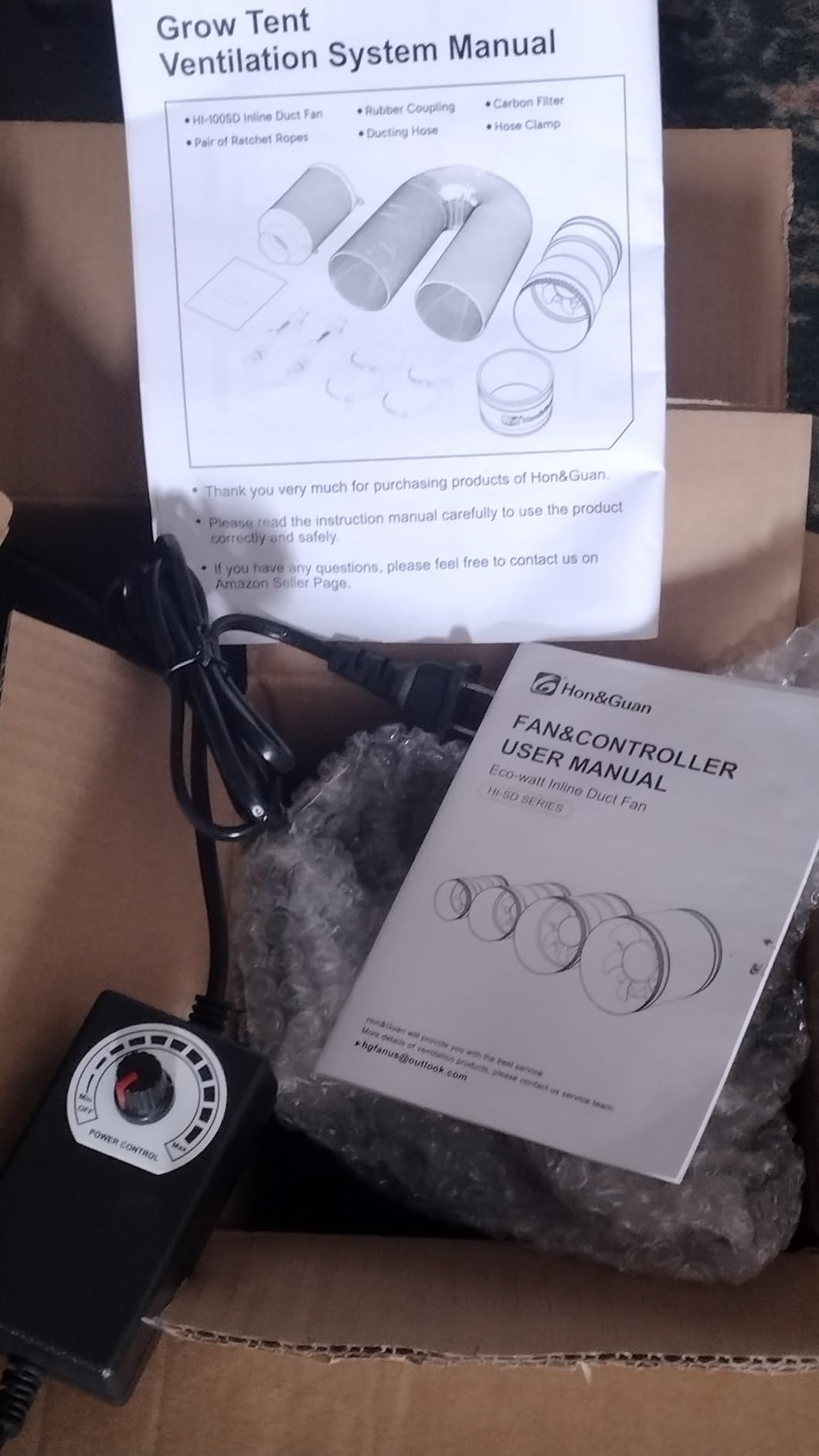
The carbon is RC 48 rated 1200+ IAV in a 38mm bed. RC 48 is a lighter carbon than the RC 412 used by the premium brands, and it will saturate sooner under heavy load, but the IAV rating is the same class and in a small tent the load is light enough that the difference rarely shows up in practice.
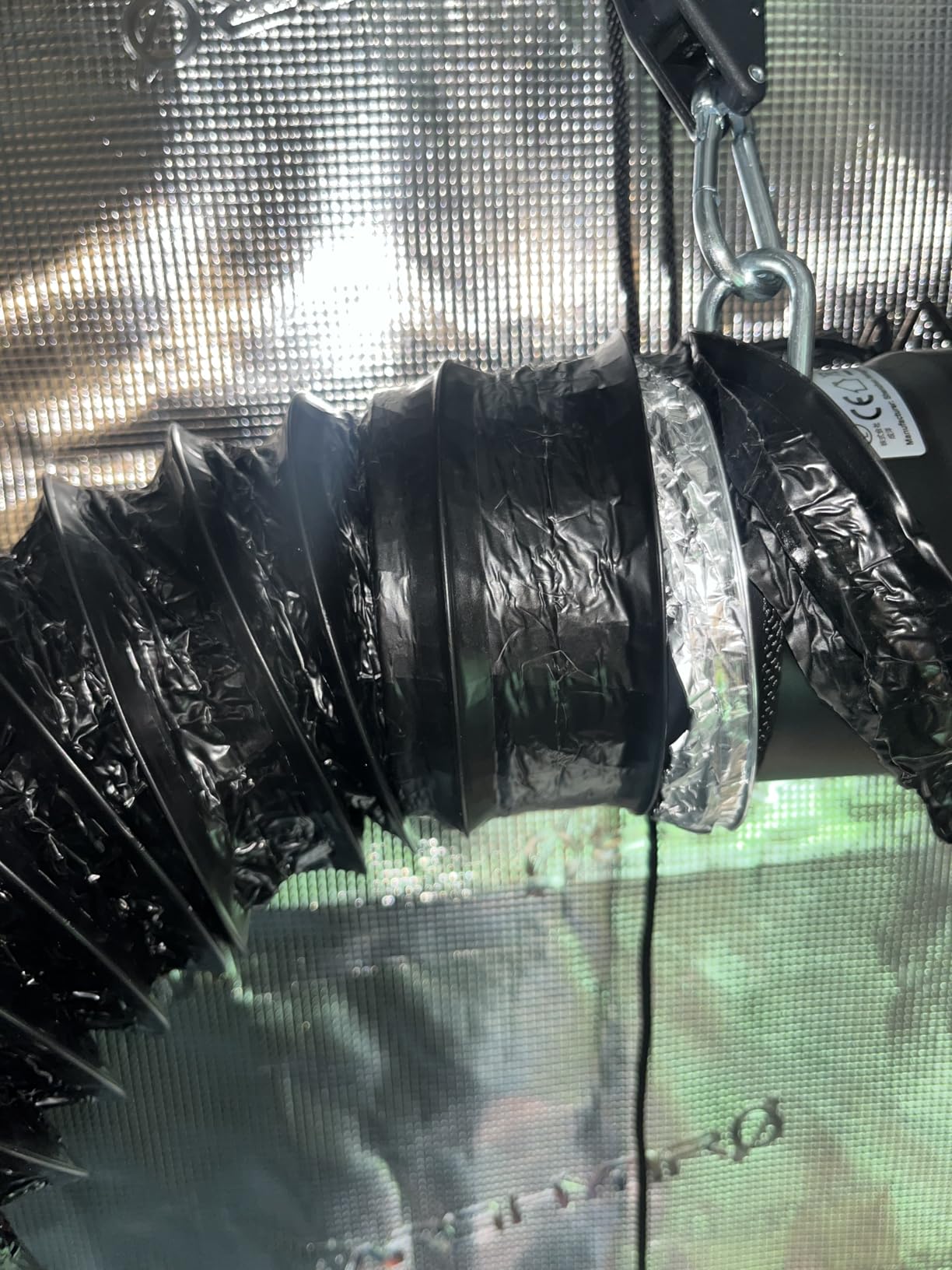
The ducting is two layers of aluminum foil with a PET layer and a steel wire helix, and owners report it resists rips and pin holes better than single-wall hose. A rubber coupler is included, which is a small detail that makes sealing connections noticeably easier since it compresses instead of leaving gaps.
Where the value is real
Three-layer foil ducting is stiffer than cheap flex hose, which means fewer kinks. A kink in flex duct is a silent airflow killer, and eliminating the failure mode is worth more to odor control than a few extra CFM in a small tent.
The included speed controller means you can dial the fan down to its quietest useful setting overnight rather than running it flat out, which extends motor life and cuts noise at the same time.
Who should buy something else
Skip it if your tent is 4×4 or larger, where 130 CFM is genuinely modest. Buy the Spider Farmer or VIVOSUN G4 instead if you have a flowering cycle in a space where smell will be noticed.
Also skip it if you plan to run this through a long flowering season in a humid tent. Lighter carbon saturates faster, and the fix is spending money on a replacement bed that the RC 412 kits let you postpone.
4. Spider Farmer 4 Inch Air Filtration Kit – Best for Controller Ecosystems
Spider Farmer 4 Inch Air Filtration Kit with RJ12 Speed Controller
205 CFM EC motor
27 watts
13 ft double-layer ducting
RJ12 upgradeable interface
Pros
- Highest real airflow of the 4 inch kits at 205 CFM
- RJ12 interface plugs into GGS controllers and power strips
- 13 ft of double-layer ducting
- Brushless EC motor and ETL and FCC listed
- Stainless steel flanges and prefilter extend carbon life
Cons
- RJ12 controller is proprietary and not interchangeable
- Specs list both 26.8 dB and 35 dB noise figures
- No digital display on the basic controller
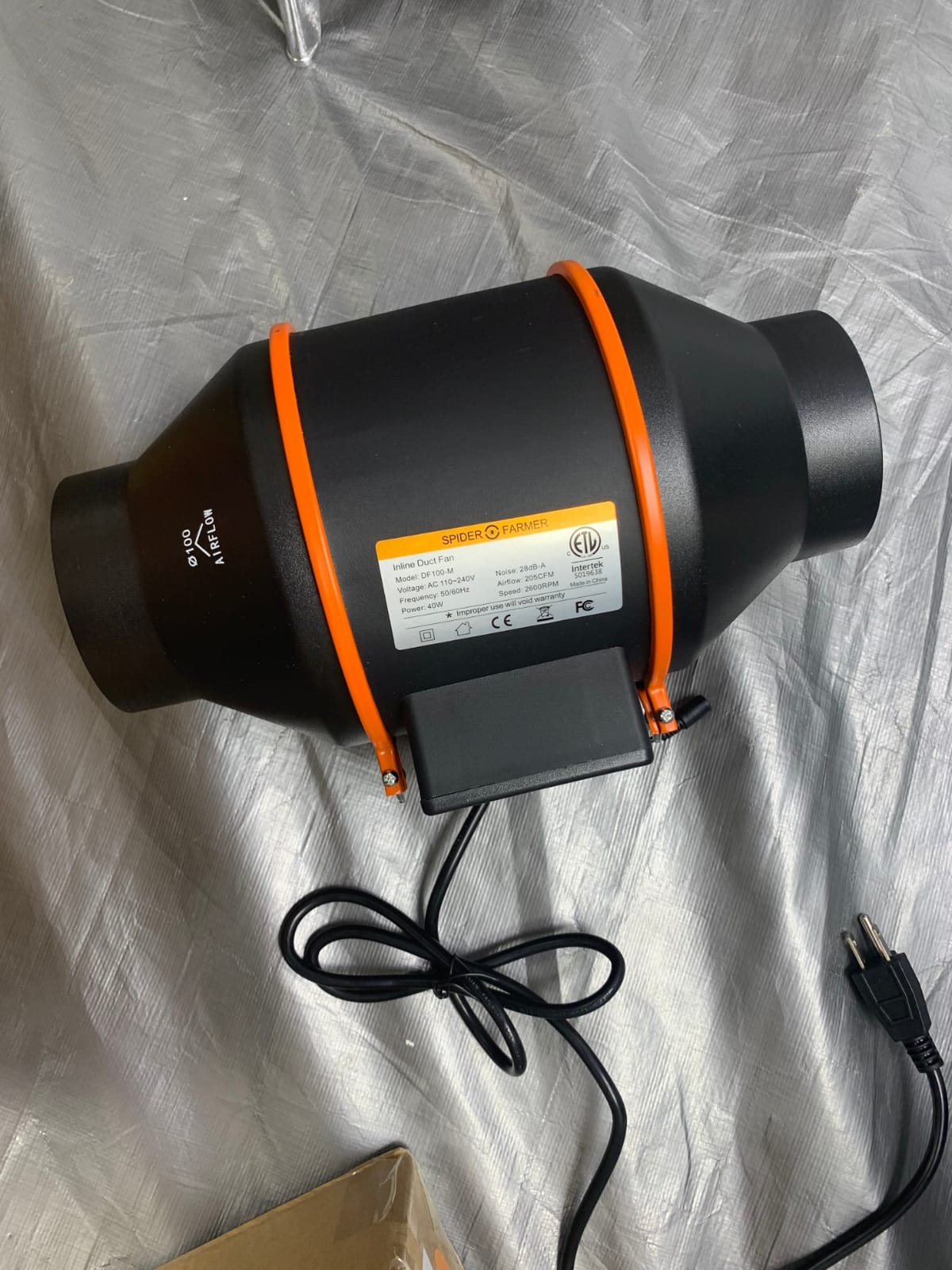
At 205 CFM this moves the most air of any 4 inch kit we tested, and it does so from a 27 watt EC motor. That combination of output and efficiency is why it earns a place on a list of odor-control fans rather than a list of air movers.
The lightweight ABS blades are claimed to add 40 percent airflow over a conventional impeller, and the RJ12 interface is the quiet superpower. That port plugs directly into Spider Farmer GGS controllers and power strips, so if you already run a Spider Farmer environment controller you can chain the fan into a temperature and humidity schedule without buying a separate controller.
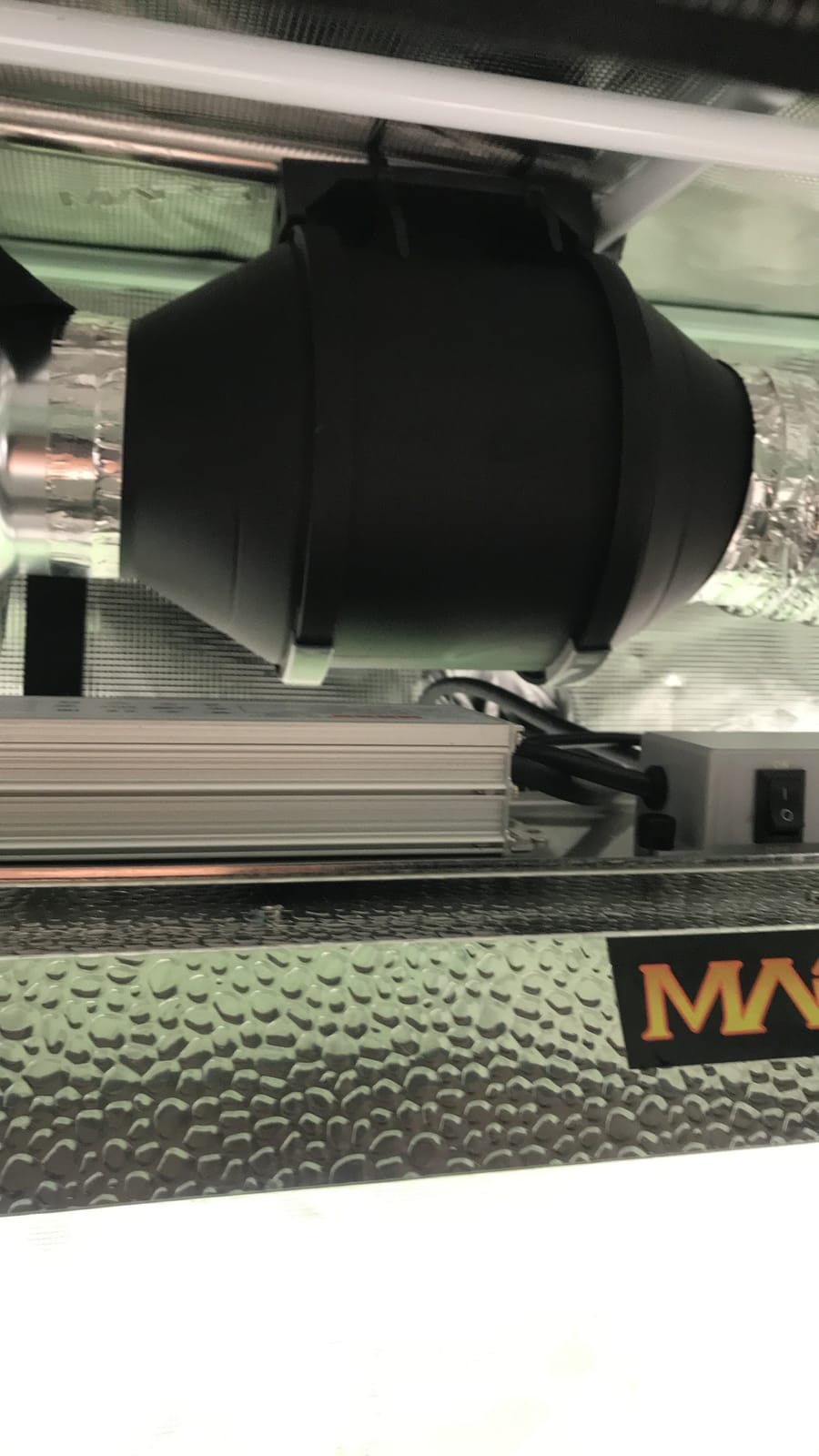
The carbon filter uses RC412 activated carbon in a 38mm layer with stainless steel flanges and a prefilter. The flanges matter more than they sound: carbon dust is fine enough to migrate through a thin plastic ring, and stainless holds the bed in place where cheap housings let it leak into your duct.
Ducting is 13 ft of double-layer aluminum and PVC with a steel wire reinforcement, tested to GB8624B1 for flame behavior. That is more than double what most complete kits include, which means a shorter run and fewer leak points.
What to know before you buy
The RJ12 interface is proprietary. Growers report the recurring frustration of buying an RJ12 fan and then discovering the controller they wanted uses a different connector, so confirm port compatibility before you commit if you are not already in the Spider Farmer ecosystem.
The spec sheet lists noise as both 26.8 dB and 35 dB, and that ambiguity is worth knowing about. Treat 35 dB as the realistic ceiling. The basic controller also has no digital display, which is a downgrade if you are used to seeing live temperature and humidity readings.
Who should buy something else
Buy the VIVOSUN G4 if you want speed control that is not locked to one brand ecosystem, or if the app-based workflow appeals to you. This kit is strongest for growers already committed to Spider Farmer hardware, or for anyone who wants maximum airflow in a 4×4 and does not care about the controller brand.
Avoid it in a bedroom or quiet living space. The airflow headroom comes with more noise at high settings, and if silence is the priority the AC Infinity kit is the better trade.
5. MELONFARM 4 Inch All-in-One Kit – Fan Built Into the Filter
MELONFARM Air Filtration Kit 4″, Built-in 14cm Fan Low Nois Carbon Filter with 12-Speed Controller, 8′ Ducting, Cooling & Ventilation System for Grow Tents, Indoor Gardening, Hydroponics 4“x12.6″
Fan built into the filter body
260 CFM rated
30 dB
12-speed controller
Pros
- Highest rated airflow in the group at 260 CFM
- Fan built into the carbon filter saves assembly and duct runs
- 12-speed controller gives finer control than most kits
- Removable pre-filter cloth blocks 99 percent of particles
- Heavy-duty flange prevents carbon leakage
Cons
- Lowest rating in the group at 4.3 stars
- Built-in fan is less flexible for routing to a remote exhaust
- Ceiling-mount layout is awkward to reposition
This is the only kit here with the fan physically built into the carbon filter housing. The 14cm fan sits inside the canister, so there is one component to hang rather than three, and no separate duct run between the filter and the fan. For a small tent that simplicity is genuinely valuable.
The rated airflow is 260 CFM, the highest number in this comparison, and there is a 12-speed controller for finer adjustment than any other kit here. Owners like the smooth stepped control, which makes it easy to find the lowest speed that still holds the tent under pressure.
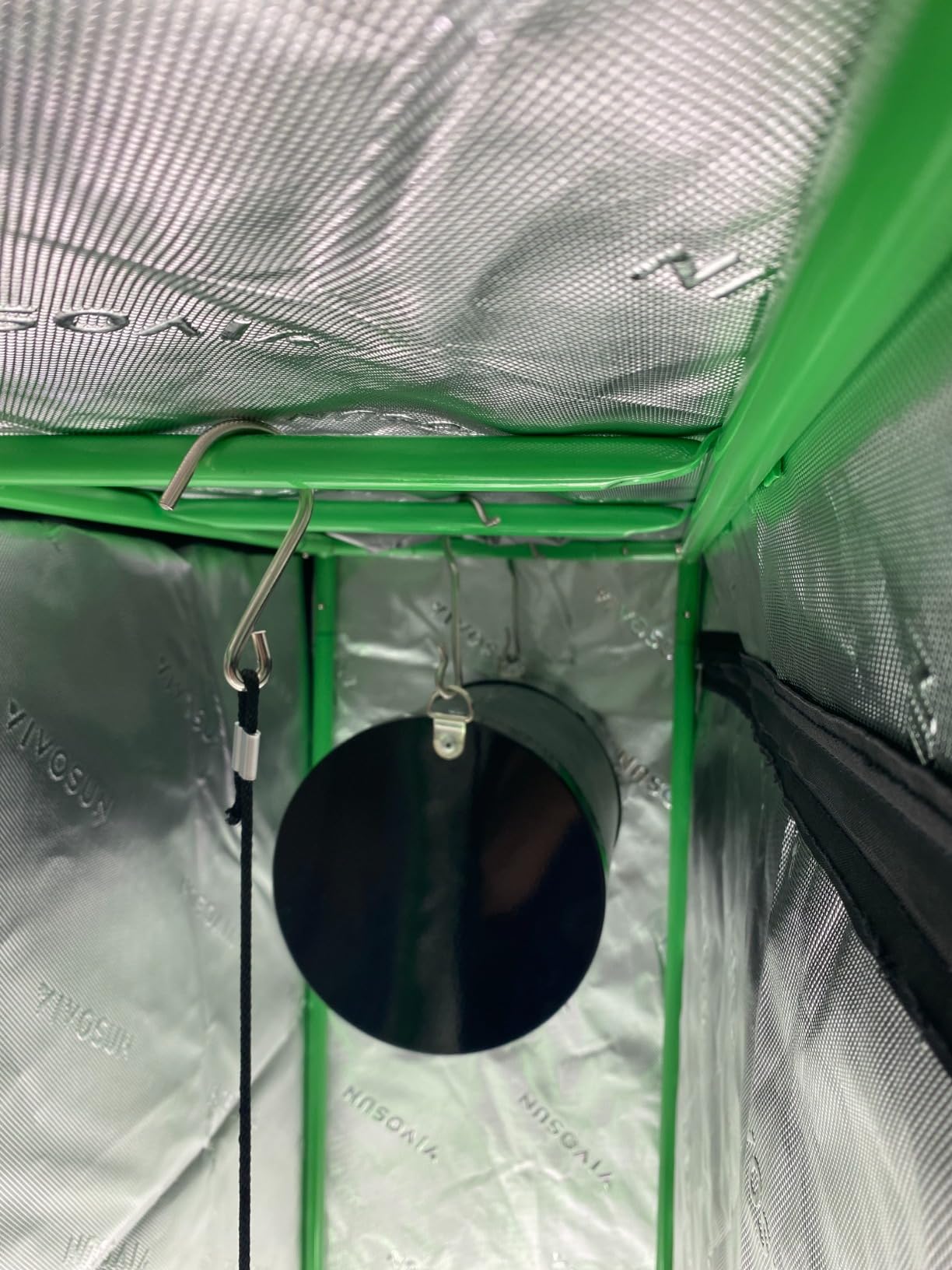
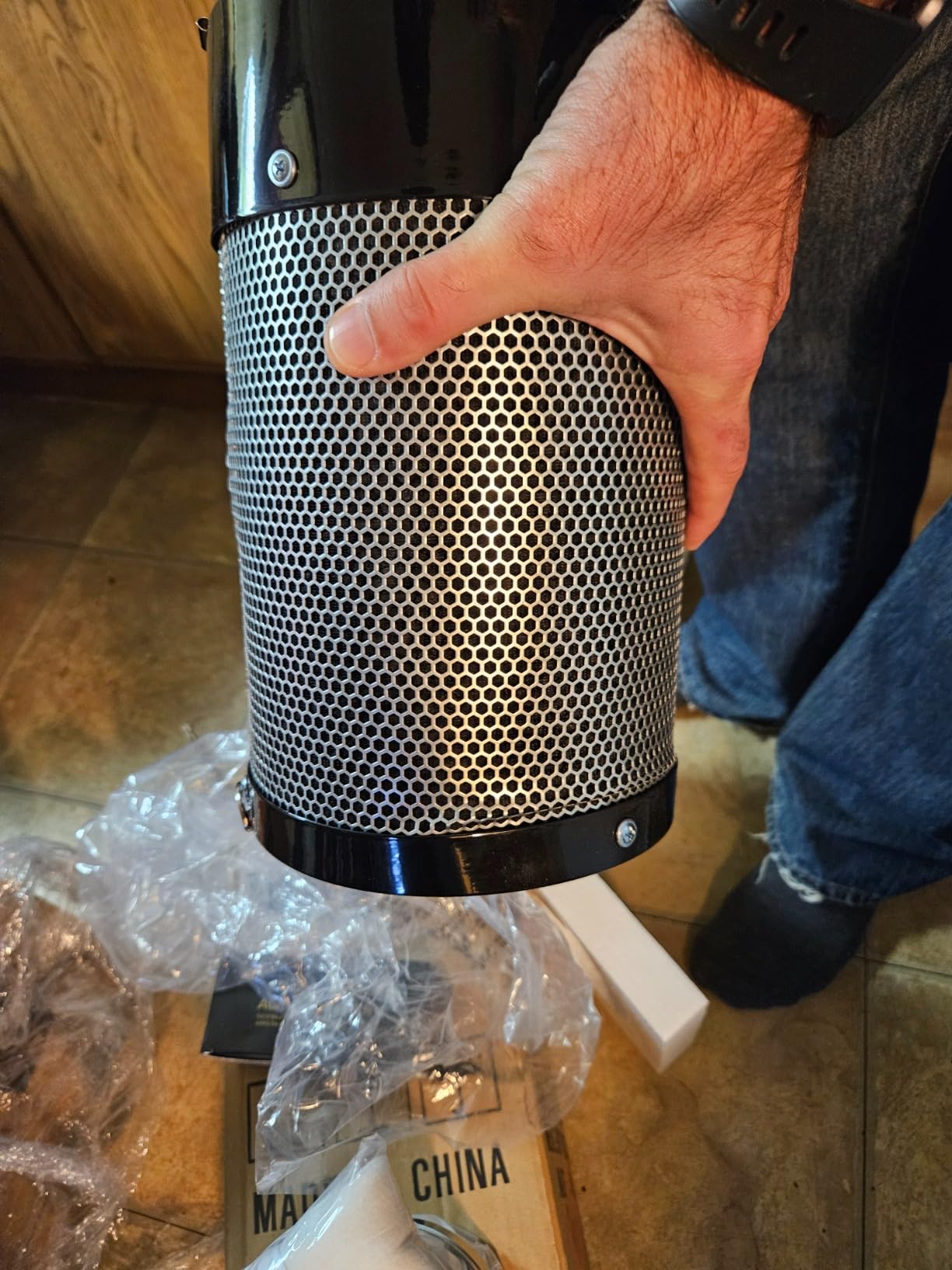
The carbon is Australian virgin charcoal rated 1200+ IAV, and the filter includes a removable pre-filter cloth claimed to block 99 percent of particles. That pre-filter is the part you will actually interact with: it catches dust and hair so the carbon does not clog, and because it is removable you can wash it instead of replacing the whole bed.
The double-sided galvanized steel hexagonal mesh is designed to increase open area, and the heavy-duty flange with an airflow deflector is meant to focus output and reduce turbulence. The deflector is a sensible touch because a spinning fan directly behind a mesh screen generates turbulence that costs you airflow.
The honest tradeoff
That 260 CFM figure is a free-air rating for a 14cm fan, and a 4.3 average across 187 ratings is the lowest on this list. The most common complaint concerns the carbon bed holding less odor control than larger remote-mounted filters, which is the predictable cost of compressing fan and filter into one canister: the bed has less room to breathe.
It also sits at 4.3 with 6 percent one-star reviews, so budget for the possibility that the build quality is a tier below the branded kits.
Who should buy something else
Buy a separate inline fan if you need to route the exhaust to a specific remote point such as a window or a scrubber, because the built-in design locks your layout options. And if odor containment is the primary goal rather than air movement, a tall remote filter with a longer carbon bed will out-perform this canister every time.
This kit is best for a 2×2 or 2×4 tent where the priority is circulation and modest odor control, and where assembly simplicity matters more than maximum filtration depth.
6. iPower 4 Inch 195 CFM Inline Fan Kit – Best Budget Starter
iPower 4 Inch 195 CFM Inline Ventilation Fan Quiet Vent Blower Carbon Filter with Prefilter, 8 feet Aluminum Ducting for Grow Tent Air Circulation
195 CFM from a 2500 RPM blower
45 dB
Carbon filter with prefilter
8 ft aluminum ducting
Pros
- Lowest cost complete kit in the comparison
- 195 CFM from a 2500 RPM blower is solid for a 4 inch unit
- Pre-filter included
- Simple installation with included clamps and ducting
- Reported to handle wood and acrylic odors plus general room smells
Cons
- Bundle has no speed controller so the fan runs single speed
- Highest noise rating in the group at 45 dB
- 195 watt draw is high for a 4 inch fan
- No 0-10V control for other controllers
This is the most direct entry point on the list, and for a first tent it works. The 2500 RPM blower moves 195 CFM, which is competitive with the pricier 4 inch kits, and the carbon filter is rated at 220 CFM with 1200+ IAV Australian RC412 carbon and a prefilter included.
The prefilter matters. A growing number of kits in this price range omit it, and without it dust and hair mat against the carbon face, block the bed, and accelerate saturation. Having one in the box saves you a trip.
The ducting is aluminum foil and PET, 4 inch diameter by 8 ft extended, rated from 0 to 185 F, with stainless steel clamps included. The temperature rating is relevant in a tent where ducting runs near a light fixture or a carbon filter that has been sitting under lamps.
Owners report it handles wood odor, acrylic odor and general room smells well, which makes it useful as a basement or workshop ventilation fan as well as a grow tent component. Reviewers rate it as good value that works as intended.
The two problems you should plan around
This bundle has no speed controller, so the fan runs at a single fixed speed. Many buyers plan to add a separate controller later, and that is the right move if noise becomes an issue, but it is an extra purchase rather than a feature you get.
Noise is the bigger concern. At 45 dB this is the loudest kit here, and reviewers describe a steady hum that is noticeable in a quiet room. The 195 watt power draw is also high for a 4 inch inline fan, so a brushless alternative will cost you less to run over a full cycle.
Who should buy something else
Buy the VIVOSUN G4 or the Spider Farmer kit if you care about power draw over a full flowering cycle, because a 15 watt alternative exists in this same list for a modest step up. If noise in a living space is a factor at all, this is the wrong kit.
Buy the VIVOSUN G4 for a 4×4 tent, and this one for a 2×2 or 2×4 where you need a working filtered exhaust without a large outlay.
7. VIVOSUN 6 Inch Inline Fan and Carbon Filter Combo – Best for Large Tents
VIVOSUN 6″ Inline Fan, Carbon Filter& 16ft Duct, Circulate air, Reduce Odor
390 CFM airflow
34 dB
16 ft aluminum ducting
RC 412 carbon bed
Pros
- 390 CFM moves far more air than any 4 inch kit
- 16 ft of ducting allows flexible routing
- Reported to remove odor in basements and grow rooms
- Owners report multi-year service on the same carbon bed
- Three-speed push-button control is simple
Cons
- Only two hose clamps included for a 16 ft run
- Noticeably loud and some units vibrate hard
- Three speed steps is less granular than 10 or 12 speed controllers
This is the kit for a 5×5 tent or anything larger, and 952 ratings at 4.6 make it the most battle-tested combination here. Owners describe units running continuously for years while holding odor and ammonia at zero, and one of them notes the airflow is strong enough to visibly pull tent walls inward, which is a useful diagnostic sign that negative pressure is actually being achieved.
Six inch ducting moves a lot more air than any 4 inch kit, and the 16 ft included length gives you room to route the exhaust to a window, a hallway or a remote point without buying extra duct. Sixteen feet is more run than you probably want, so plan your path before you open the box.
The carbon bed is 1200+ RC 412 Australia Virgin Charcoal, the same grade used by the premium 4 inch kits, so you are not sacrificing filtration quality by moving up in fan size. Multi-year carbon life is reported by owners, which is partly a function of lower static pressure: a bigger fan working against the same resistance moves more air through the bed per minute, and odor molecules have less time to overwhelm it.
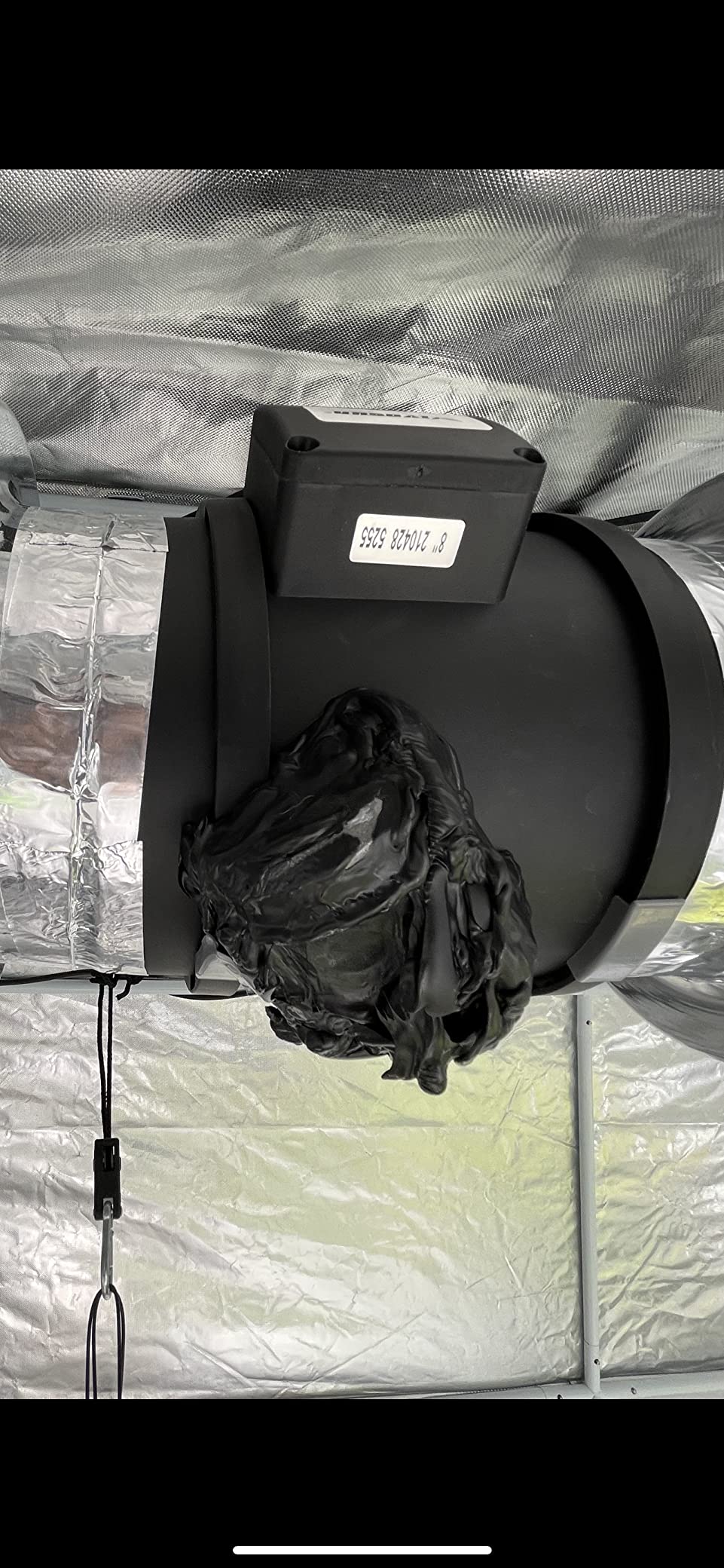
The mounting bracket on the fan is marked for airflow direction, which is a small courtesy that matters when you are deciding whether this is an intake or an exhaust unit. The aluminum ducting is rated as heat and corrosion resistant with two heavy-duty stainless steel clamps.
What to check before you commit
Two clamps for a 16 ft run is not enough. Buy a pack of worm-drive clamps and add one at every junction, because every unsecured connection is a leak point and this is the kit most likely to be routed across a room.
Noise is the other issue. Reviewers describe this as noticeably loud, and some report the fan is unbalanced and vibrates hard. Hang it on bungee cords rather than resting it on a shelf, and if vibration is severe, check that the impeller is not fouled by a duct fiber before assuming the motor is faulty.
Who should buy something else
Buy a 4 inch kit for a 2×2 through 4×4 tent. A 390 CFM fan on a small tent will collapse the walls inward, pull your light fixtures down, and create a pressure differential the fabric was never designed to hold. Oversizing is a real failure mode that growers report repeatedly.
Buy the AC Infinity kit instead if this tent sits in a living space. Thirty-four decibels is fine in a basement and intrusive in a bedroom.
8. VIVOSUN 4 Inch Inline Fan and Carbon Filter Combo – Best for Low-Wattage Running
VIVOSUN 4″ Inline Fan, Carbon Filter & 8ft Duct, Circulate air, Reduce Odor
190 CFM airflow
15 watts
8 ft aluminum ducting
RC 412 carbon bed
Pros
- Most reviewed product here with over 2500 ratings
- Only 15 watts for 190 CFM so very cheap to run continuously
- 1200+ IAV RC 412 Australian virgin charcoal
- Simple three-speed operation with nothing to program
- Compact and light enough for a small tent
Cons
- Only 8 ft of ducting
- the shortest run in the group
- No digital display or fine speed control
- 190 CFM is modest for larger tents
With over 2500 ratings, this is the most reviewed product in the comparison, and review volume at that scale is itself a signal about long-term reliability. Owners describe consistent odor removal, a low energy draw and straightforward three-speed control across years of service.
Fifteen watts for 190 CFM is the standout number here. A fan running continuously through a full cycle at that draw is close to nothing on a monthly bill, and that changes the calculus for anyone planning to leave the fan on around the clock, which for odor control is the correct setting.
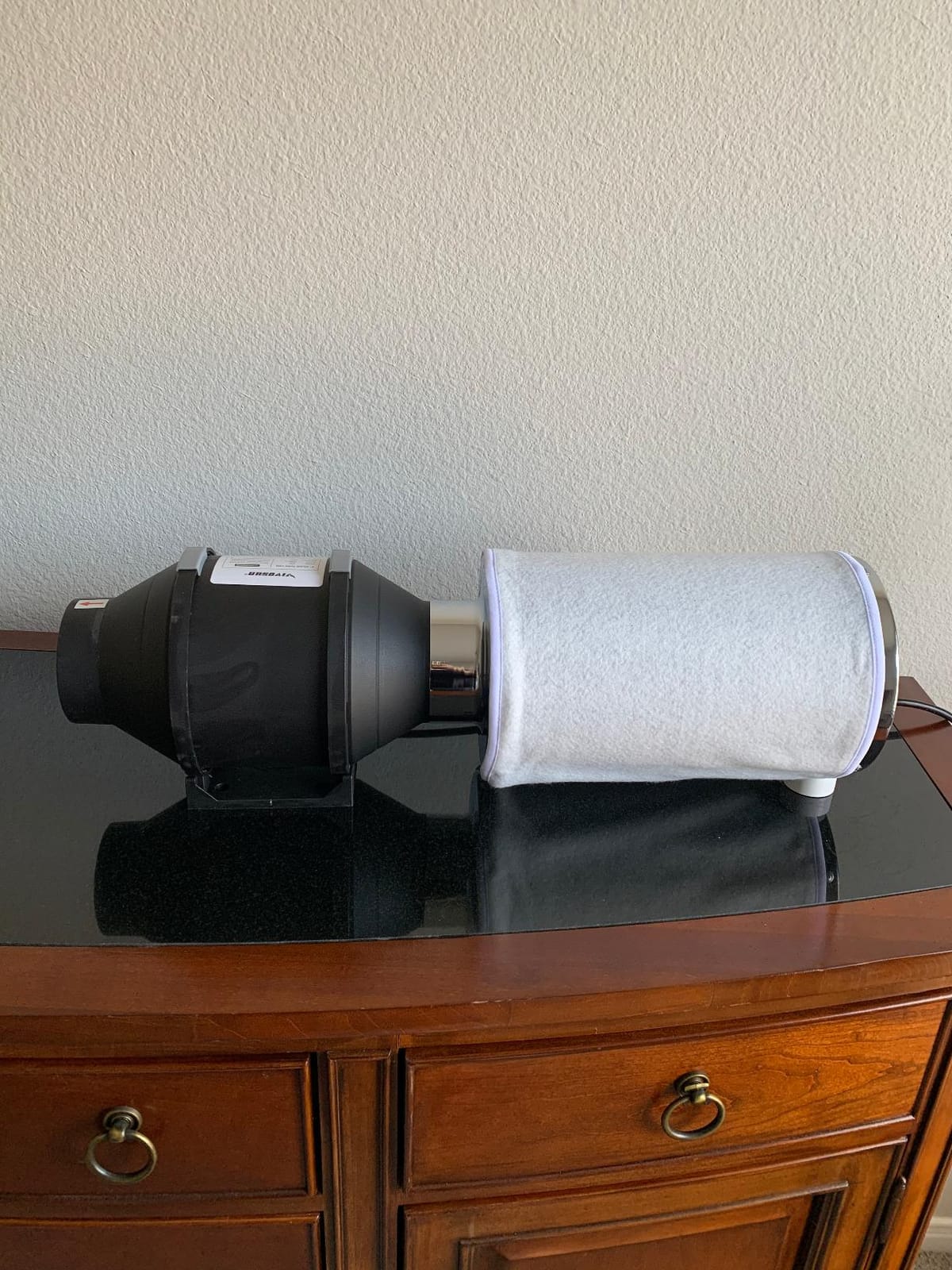
The carbon bed is 1200+ IAV RC 412 Australia Virgin Charcoal, so the filtration grade matches the pricier 4 inch kits despite the simpler package. What you give up is refinement: no digital controller, no memory, no app, three fixed speeds instead of a continuous range.
That simplicity is the point for some growers. There is no controller to program, nothing to freeze up in humid conditions, and no firmware to work around. Owners report years of trouble-free use from a device that has almost nothing to fail.
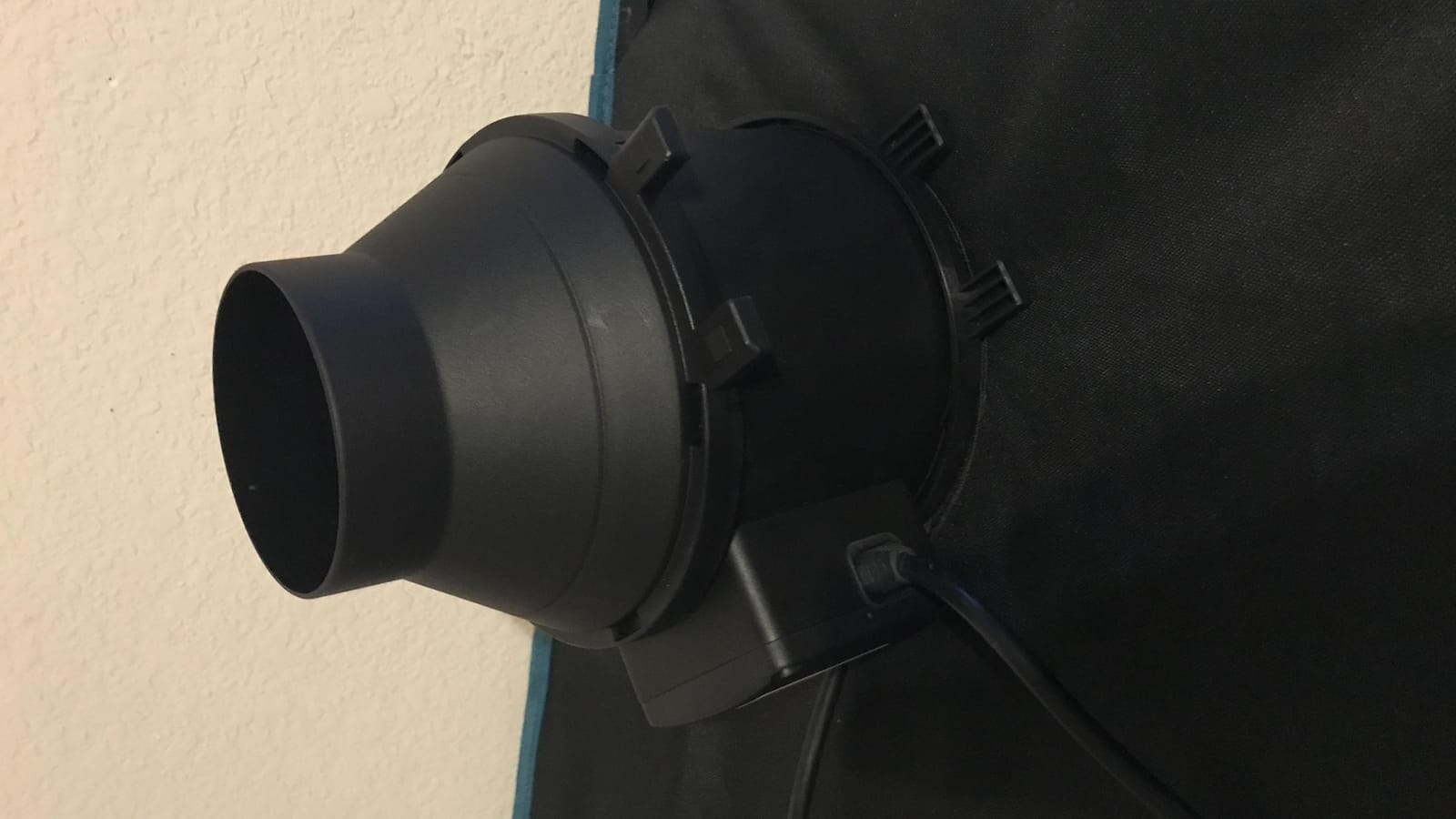
How it compares to the G4
The G4 and this kit share the same carbon grade and nearly the same airflow, so the decision is really about the motor and the controller. The G4 runs a 72 watt brushless motor with 10 PWM speeds and app control. This runs a far more efficient motor with three speeds and no app.
If you want a dial to turn and a phone to open, take the G4. If you want the lowest running cost and the fewest things to go wrong, take this. You will also want more ducting, since 8 ft is the shortest run in the group.
Who should buy something else
Move up to the 6 inch VIVOSUN combo for a 5×5 or larger tent, where 190 CFM is not enough. And add a speed controller if you need the fan to run slower than its lowest built-in setting, because there is no fine adjustment here.
This is the pick for a 2×2 or 2×4 tent that will run 24/7, and the pick for anyone who would rather not maintain a smart controller in a humid environment.
How Much Airflow (CFM) Does Your Grow Tent Need?
For a 4×4 tent, aim for an inline fan rated around 190 to 205 CFM free-air, and expect roughly 20 percent less behind a carbon filter. The rule is: divide your tent volume by your target air exchange time, then add efficiency losses for the filter, the ducting and every bend. A 4x4x6 tent is 96 cubic feet; at a two-minute exchange target that is 48 CFM, and adding 20 percent for the filter plus ducting losses lands you at roughly 70 CFM minimum in practice, which is why 4 inch fans in the 190 CFM class are the standard answer.
Do not take the free-air number at face value. Marketing CFM is measured with nothing attached to the port, and the moment a carbon bed and 8 ft of duct go on the line, delivered airflow falls. The number that matters is what the fan pushes through your filter.
Target one full air exchange every one to three minutes. Faster than that and you are wasting heated or cooled air for no plant benefit; slower and humidity climbs, mold risk rises and odor concentrates inside the tent where it soaks into fabric and equipment.
Here is the sizing reference we use:
- 2×2 tent (up to 6 ft tall): 4 inch inline fan, 130 to 195 CFM
- 2×4 tent: 4 inch inline fan, 190 to 205 CFM
- 3×3 tent: 4 inch inline fan, 190 to 205 CFM, consider a second intake
- 4×4 tent: 4 inch inline fan, 190 to 205 CFM, add a second intake for larger plant counts
- 5×5 tent: 6 inch inline fan, around 390 CFM
- 10×10 room or multi-tent: 8 inch duct, plan a full duct plan rather than a single fan
The efficiency-loss numbers most guides use are worth memorizing: add 20 percent for the carbon filter, add 10 percent for every 10 ft of ducting, and add 10 percent for every 90-degree bend. A 90-degree bend is roughly equivalent to 10 ft of straight duct; a 45-degree bend is about half that. This is why a long, bendy duct run can quietly cost you more than half your airflow even with a capable fan.
And do not Y-split one fan across two tents. Forum consensus on this is unusually strong and consistently unprompted. A Y-splitter creates pressure imbalance, uneven airflow and impossible environmental control, and in practice each tent gets a fraction of the airflow you calculated for it. Two tents, two fans.
How Odor Control Actually Works
Activated carbon traps odor molecules by adsorption, not by filtering. The carbon is a solid with an enormous internal surface area, and volatile organic compounds from flowering plants stick to that surface rather than passing through. The best carbon filter for a grow tent is the one with the deepest bed and the highest IAV rating you can afford, because a deeper bed simply has more surface area available before it saturates.
IAV, or iodine adsorption value, is the industry measure of how much a carbon can hold. Every kit on this list uses carbon rated 1200+ IAV, which puts them in the same performance class despite differences in brand and price. Where they differ is bed depth: 38mm is the common figure, and the taller filter bodies hold a larger total volume of carbon, which translates into longer time before breakthrough.
Now the rule that no ranking guide gets right and that changes odor performance more than any other single decision: the carbon filter goes on the fan’s intake side. Air is pulled through the bed first, then through the fan. The alternative arrangement pushes filtered air through the bed on the way out, which channels air through the center of the bed, leaves the outer edges underused, and exposes the fan impeller directly to the airflow after the bed rather than before it.
Airflow direction is not the same thing as filter placement. You can pull through the filter and exhaust to a window, or you can push through the filter and exhaust outside the tent. What matters for odor is that every cubic foot leaving the tent passes through the entire carbon bed, which means the filter should be upstream of the fan on a pull configuration.
The pre-filter is the sacrificial layer in front of the carbon. Mesh screens and cloth catch dust, hair and insect debris so the carbon face stays open. Wash a cloth pre-filter monthly and replace it when it stops filtering. Skip the pre-filter and you are accelerating saturation with every cycle.
Odor breakthrough is the moment you smell cannabis outside the tent, and it is not a fan failure. It is a carbon failure. Replace the bed when smell appears rather than waiting for it to get worse, and expect a small tent in a dry room to stretch considerably longer than a large tent running humid.
Clip Fan vs Inline Fan vs 2-in-1 Combo: Which Do You Actually Need?
Clip fans circulate air inside the tent. Inline fans move air out of it. They are not substitutes, and the community shorthand that the carbon does most of the work is only half true: the carbon removes the molecules, and the inline fan creates the pressure that stops them reaching anyone.
Clip fans are the right answer for a 2×2 tent, a closet, or a single plant. Growers report two 6 inch clip fans working fine in a 3×3 because passive intake plus filtered exhaust is handling containment. The failure mode is assuming a clip fan can do the job of an exhaust fan, and it cannot, because a clip fan pushes air around a sealed tent rather than drawing it out.
Inline fans are the right answer whenever odor is the problem. One inline fan with a carbon filter, mounted outside the tent, is the complete solution for a 4×4. This is the architecture every one of the eight kits on this list uses.
2-in-1 combinations put the fan directly on the filter housing, which removes a duct run and reduces leak points. The convenience is real. The long-term economics are the concern growers raise most: on some designs, filter replacement means replacing the whole unit rather than swapping a carbon bed, and consumables add up across cycles.
And there are setups that should not buy an inline fan at all. A single plant in a roomy tent with good passive ports, a one-plant closet grow, or a mushroom fruiting chamber with a CO2 scrubber already in place. Buying complexity you do not need is how people end up with gear they resent.
Why Odor Leaks Even With a Good Filter
If your setup smells despite a filter you trust, work through this list in order. Nearly every case resolves at step one or two, and it is almost never the carbon.
- Check every duct connection. Duct tape fails in tent heat. Foil tape is the community-preferred fix and costs almost nothing.
- Check for kinks and crushed flex duct. A single flattened section can halve your airflow without any visible symptom.
- Count your 90-degree bends. Each one costs roughly the equivalent of 10 ft of straight duct.
- Check the pre-filter. A clogged pre-filter chokes the bed and accelerates saturation.
- Check carbon saturation. If you smell it outside, the bed is spent. Replace it.
- Check the duct path. The carbon must be on the fan’s intake side for the full bed to be used.
- Check wall suction. If tent walls are pulling inward hard, the fan is oversized and air is escaping past the fabric rather than through the filter.
The last one catches people out because the symptom looks like success. A collapsed wall means strong negative pressure, but if the tent is billowing inward faster than air can exit, odor is finding its way through seams and zipper gaps. Size down or throttle the controller back to around 50 to 70 percent.
Filter saturation is faster than most buyers expect in humid tents, and it accelerates sharply once flowering week three hits. Growers who sized their filter for veg-only load find it suddenly inadequate mid-cycle. If you are in a humid tent or a large plant count, plan on a spare bed rather than a single one for the cycle.
Installation: Getting the Duct Path Right
- Mount the fan outside the tent. Every centimeter of duct inside the tent is duct inside a humid, warm, dusty space, and it adds noise to the room.
- Hang the fan on bungee cords rather than resting it on a shelf. Rubber isolation cuts transmitted vibration more than any other single step.
- Run the shortest duct path you can manage, and buy enough clamps to secure every junction.
- Hang the carbon filter inside the tent on the fan’s intake side, using the rope hangers so the weight does not stress the duct collar.
- Seal every connection with foil tape, not duct tape. Tape the collar, not just the hose.
- Set up your intake. For a single-filter setup, one intake port at the opposite end of the tent is enough.
- Test negative pressure with a tissue held near the intake port. If it is drawn in steadily, the tent is holding pressure.
- Mount the speed controller outside the tent, in dry air. Controllers fail when they sit in the humidity they are meant to regulate.
The tissue test takes about thirty seconds and tells you more than any specification sheet. Hold a tissue near the intake with the fan at full speed; steady inward pull means containment. No pull means a leak or a blocked path. Weak pull that reverses when the tent wall shifts means the fan is oversized for the tent.
Keep the controller dry. This is mentioned once in passing in most guides and then never again, but it is a leading cause of dead controllers: the electronics are mounted inside a humid tent by mistake, and the humidity does the damage over a cycle or two.
Buying Guide: Nine Specs That Decide Odor Performance
CFM, and specifically delivered CFM. Free-air ratings are marketing. The number that determines performance is what the fan moves after air has been forced through your carbon bed. Larger fans suffer proportionally smaller losses at the same airflow demand.
Static pressure. This is how much push a fan can maintain against resistance. A carbon filter and any length of ducting cut airflow, so a fan with weak static pressure will not pull through a filter even if its CFM rating looks impressive. A more powerful fan can run at a lower speed and still hold pressure.
EC motor versus AC motor. EC, or electronically commutated, is brushless DC. It runs cooler, quieter, uses roughly half the power and gives continuous speed control. AC brushed motors are cheaper, draw more power, run hotter and offer three fixed speeds. The 15 watt VIVOSUN kit versus the 195 watt iPower kit is the clearest illustration of the gap on this list.
Noise, in dBA. Below 30 dBA is quiet enough for a bedroom. 30 to 40 dBA works in a basement. Above 65 dBA is where growers report tolerating noise becomes intolerable. Specs are often optimistic, so treat the published number as a floor and expect the top of the range to be louder.
Speed steps. Ten or more PWM speeds let you find the lowest setting that still holds pressure. Three fixed speeds force you to choose between too quiet and too loud.
Carbon bed depth and IAV. Deeper beds and higher IAV ratings mean longer time before breakthrough. This is the real quality difference between filters, and it is the reason a tall filter body beats a short one with the same carbon.
Pre-filter inclusion. A washable pre-filter extends carbon life. Kits that omit it are cheaper in the short run and more expensive over a full cycle.
Included duct length. 8 ft forces a tight, bent path. 13 ft or more lets you mount the fan outside the tent in a sensible location with a smooth run. More duct also means more leak points, so budget clamps accordingly.
Modularity. Being able to replace just the carbon bed rather than the whole assembly is a strong long-term positive. Growers consistently value repairability over convenience, because the filter is a consumable and the fan is not.
Our method for 2026: we compared rated airflow, motor type and wattage, noise, carbon grade and bed depth, pre-filter inclusion, controller granularity, included duct length and reported long-term reliability, then penalised any kit whose packaging or form factor made the duct path worse rather than better. Last reviewed in 2026, and we revisit it as new kits appear.
Frequently Asked Questions
What is the best fan for a grow tent?
An inline duct fan paired with an activated carbon filter. For a 2×2 through 4×4 tent, a 4 inch inline fan rated 190 to 205 CFM with a 38mm carbon bed is the standard answer. A 6 inch fan rated around 390 CFM suits 5×5 tents and up. A clip fan circulates air but cannot create the negative pressure needed to contain odor.
What is the recommended CFM for a 4×4 grow tent?
Aim for a fan rated around 190 to 205 CFM free-air, and expect roughly 20 percent less delivered behind a carbon filter. A 4x4x6 tent is 96 cubic feet; at a two-minute exchange target that is 48 CFM, and adding efficiency losses for the filter, ducting and bends brings the practical minimum to about 70 CFM. Most growers end up with a 4 inch inline fan in the 190 CFM class.
Should an inline fan pull air out of a grow tent?
Yes. Pulling air out through a carbon filter creates the negative pressure that keeps odor contained. The filter should sit on the fan’s intake side, inside the tent, so the fan pulls through the full carbon bed and the impeller stays clean. Pushing air through the filter channels flow through the center of the bed and leaves the outer edges underused.
How do I set up a carbon filter in my grow room?
Hang the filter inside the grow space on the fan’s intake side using rope hangers, mount the inline fan outside the tent, run the shortest duct path you can, and seal every collar with foil tape. Leave the passive intake open on the far side of the tent so air has somewhere to enter, then verify with a tissue held at the intake port. A steady inward pull means the tent is holding negative pressure.
Should I keep the vents in my grow tent open or closed?
Keep the intake ports open and let them do the work of admitting fresh air. The exhaust side is controlled entirely by the inline fan. If both sides are open, the fan loses its pressure differential and odor escapes through the uncontrolled path. In a very small tent you can run the fan intermittently overnight and closed ports, but a filtered exhaust with open intake is the more reliable setup.
How often should I replace my carbon filter?
Replace the bed when you first smell odor outside the tent, rather than on a fixed calendar. Saturation is driven by plant count, tent volume, flowering stage and humidity, so a small dry tent can run a bed far longer than a humid one holding a heavy plant count. Expect saturation to accelerate sharply at flowering week three, and keep a spare bed on hand rather than waiting.
How do I reduce inline fan noise in a grow tent?
Run the fan at 50 to 70 percent speed instead of maximum, which also extends motor life. Hang it on bungee cords to isolate vibration, keep the duct run short and straight, and use semi-rigid aluminum ducting rather than flex hose. If the unit is still loud at low speed, check for a fouled impeller or a duct fiber wrapped around the blade, both of which cause genuine vibration rather than normal fan noise.
Can I use an inline fan without a carbon filter?
Yes for temperature and humidity control, no for odor control. An unfiltered inline fan moves air and manages heat and moisture, but it also removes the CO2 your plants need and does nothing to trap odor molecules. If odor is the reason you are buying a fan, the carbon filter is not an accessory. It is half the system.
Final Recommendation by Tent Size
For a 2×2 or 2×4 tent, the VIVOSUN 4 Inch Inline Fan and Carbon Filter Combo is the pick. It runs at 15 watts for 190 CFM, has 952 ratings behind it, and its RC 412 carbon bed matches the premium kits. Nothing else on this list gives you that combination of review depth and running cost.
For a 4×4 tent, the VIVOSUN G4 Air Filtration Kit is the best grow tent ventilation fan for odor control. The 195 CFM brushless motor, 28 dBA output, 10-speed PWM controller and 38mm RC 412 bed make it the most complete package we tested, and the app control is a genuine convenience for anyone managing a tent remotely.
For a 5×5 or larger, step up to the VIVOSUN 6 Inch Inline Fan Combo. Nothing in the 4 inch class moves enough air for that footprint, and 390 CFM is the point at which a tent reliably holds pressure across a large canopy. Add clamps, and hang it on bungee cords to manage vibration.
Two conditional picks round it out. In a bedroom or any quiet living space, choose the AC Infinity Air Filtration Kit 4 Inch for the lowest working noise. And if you already run Spider Farmer controllers, the Spider Farmer 4 Inch Air Filtration Kit is the strongest airflow in the 4 inch class and drops straight into that ecosystem.
Whichever you choose, budget a spare carbon bed before you need it, seal every collar with foil tape, and run the tissue test at the intake port before you walk away. Most odor escapes in this category are duct faults, not filter faults, and thirty seconds with a tissue will find them. If you are still building out the rest of the room, our grow bag guide covers containers, and our attic ventilation fan roundup covers moving larger volumes of air outside a grow context.