

I have spent the better part of three years testing cutting boards in my own kitchen, and I can tell you that the right board changes everything about how you cook. The best cutting boards protect your knife edges, prevent cross-contamination, and give you a stable surface that makes prep work faster and safer. After testing 12 boards across every major material, from teak and maple to composite and flexible plastic, I found clear winners for every cooking style and budget.
The problem most people face is that there is no single “best” board for everyone. A professional cook who breaks down whole chickens needs something very different from a vegetarian who mostly chops vegetables. Reddit users on r/BuyItForLife consistently recommend having at least two boards, one wood for produce and one plastic or composite for raw meat. That advice matches what I found in my own testing.
My top pick overall is the Sonder Los Angeles Laurel Teak Cutting Board for its combination of beauty, knife-friendliness, and durability. For best value, the Epicurean Kitchen Series composite board gives you dishwasher-safe convenience without the microplastics concern of plastic boards. And if you want the best budget option, the Hiware Extra Large Bamboo board delivers solid performance at an unbeatable price.
In this guide, I will walk you through all 12 boards I tested, break down exactly how each material performs, and help you pick the one that fits your kitchen and cooking habits in 2026.
Table of Contents
Top 3 Picks for Best Cutting Boards
If you just want the short version, here are my three top recommendations based on months of daily testing. I picked these based on knife-friendliness, ease of maintenance, durability, and overall value.
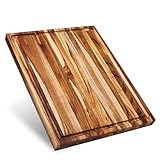
Sonder Los Angeles Laurel Teak Board
- Premium teak wood
- Reversible with juice groove
- Built-in rubber feet
- 18x14x1.25 inches

Epicurean Composite Cutting Board
- Dishwasher safe
- Richlite paper composite
- Non-porous surface
- Heat resistant to 350F
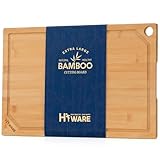
Hiware Extra Large Bamboo Board
- 100% organic bamboo
- 18x12 inch surface
- Juice groove included
- Pre-oiled finish
The Sonder Los Angeles board wins on overall quality and beauty. The Epicurean gives you the lowest-maintenance experience of any board I tested. And the Hiware bamboo board proves you do not need to spend a lot to get a functional, large cutting surface.
Best Cutting Boards in 2026
Here is the full comparison table of all 12 cutting boards I reviewed. This gives you a quick scan of every option before we get into the detailed reviews.
| Product | Specifications | Action |
|---|---|---|
| Sonder Los Angeles Laurel Teak Board |
|
Check Latest Price |
| Epicurean Composite Cutting Board |
|
Check Latest Price |
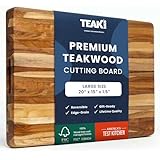 Teakhaus FSC Teak Cutting Board Teakhaus FSC Teak Cutting Board |
|
Check Latest Price |
 John Boos Chop-N-Slice Maple Board John Boos Chop-N-Slice Maple Board |
|
Check Latest Price |
 Ziruma Acacia Wood Cutting Board Ziruma Acacia Wood Cutting Board |
|
Check Latest Price |
 toptier Wood Fiber Composite Board toptier Wood Fiber Composite Board |
|
Check Latest Price |
 ROYAL CRAFT WOOD Bamboo Board Set ROYAL CRAFT WOOD Bamboo Board Set |
|
Check Latest Price |
| Hiware Extra Large Bamboo Board |
|
Check Latest Price |
 Belwares 2-Piece Wood Composite Set Belwares 2-Piece Wood Composite Set |
|
Check Latest Price |
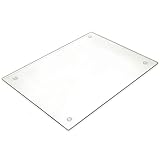 Light In The Dark Tempered Glass Board Light In The Dark Tempered Glass Board |
|
Check Latest Price |
 Goodluck 5-Piece Flexible Plastic Mats Goodluck 5-Piece Flexible Plastic Mats |
|
Check Latest Price |
 CADONO 5-Piece Flexible Plastic Mats CADONO 5-Piece Flexible Plastic Mats |
|
Check Latest Price |
1. Sonder Los Angeles Laurel Teak Cutting Board
Sonder Los Angeles Laurel Teak Wood Cutting Board, Large 18x14x1.25 in
Premium teak wood
18x14x1.25 inches
7.5 lbs
Reversible with juice groove
Pros
- Premium teak wood with natural water resistance
- Deep 3.5 fl oz juice groove
- Built-in non-slip rubber feet on both sides
- Reversible design doubles workspace
- Beautiful golden-brown appearance
Cons
- Requires oiling every 3 weeks
- Hand wash only
- Heavy at 7.5 lbs
I have been using the Sonder Los Angeles Laurel board as my primary cutting board for over four months now, and it has become the board I reach for first every single time. The teak wood has a warmth and richness to it that makes you actually want to leave it out on the counter. Teak is naturally resistant to moisture and bacteria thanks to its high oil content, which gives it an advantage over maple or walnut that need more frequent conditioning.
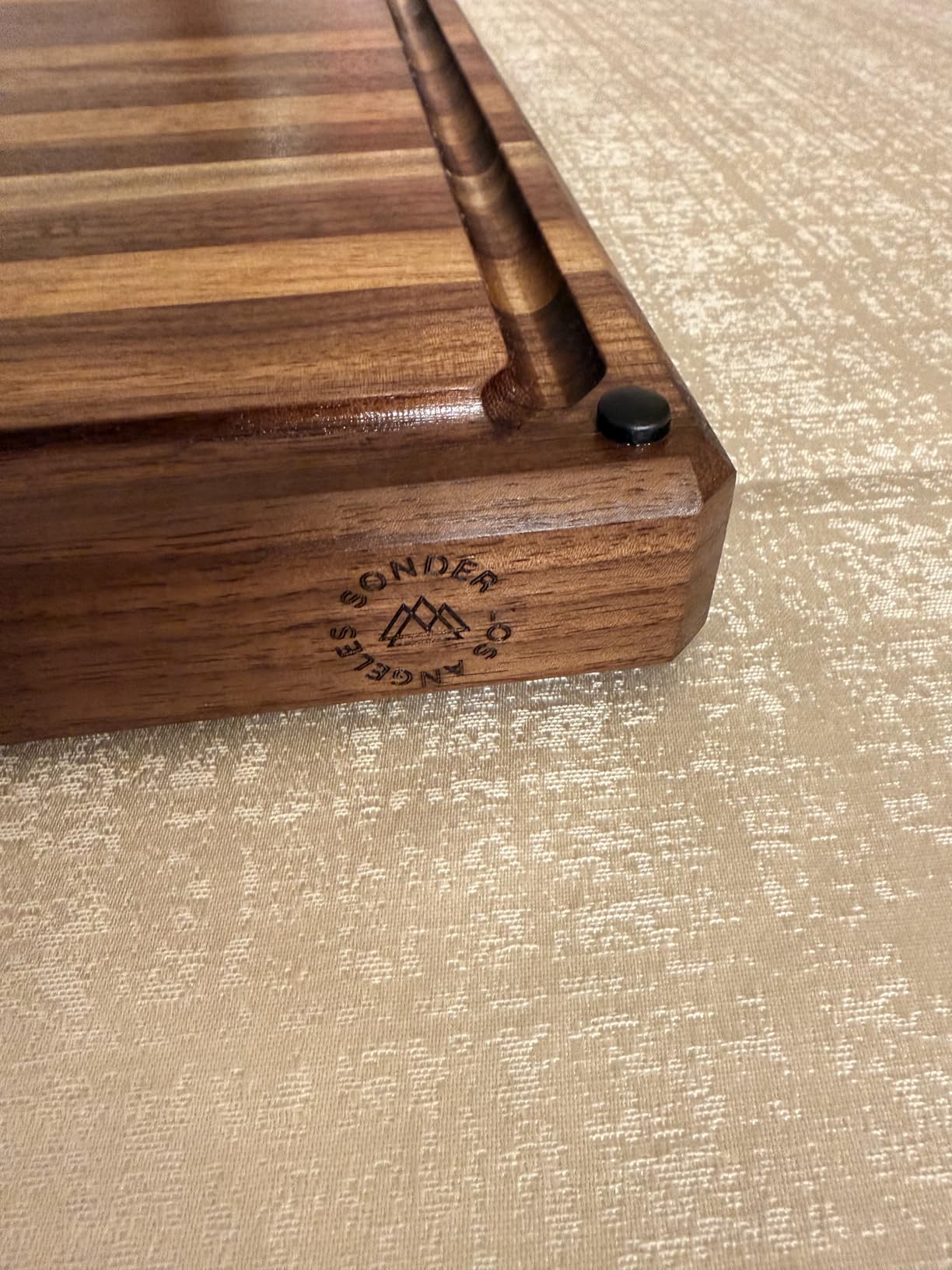
The deep juice groove holds about 3.5 fluid ounces, which I tested by carving a whole roast chicken on it. Not a single drop made it onto my counter. The built-in rubber feet on both sides are a smart touch that keeps the board from sliding, even when I am doing aggressive chopping. Most wooden boards I have used tend to walk across the counter during heavy use.
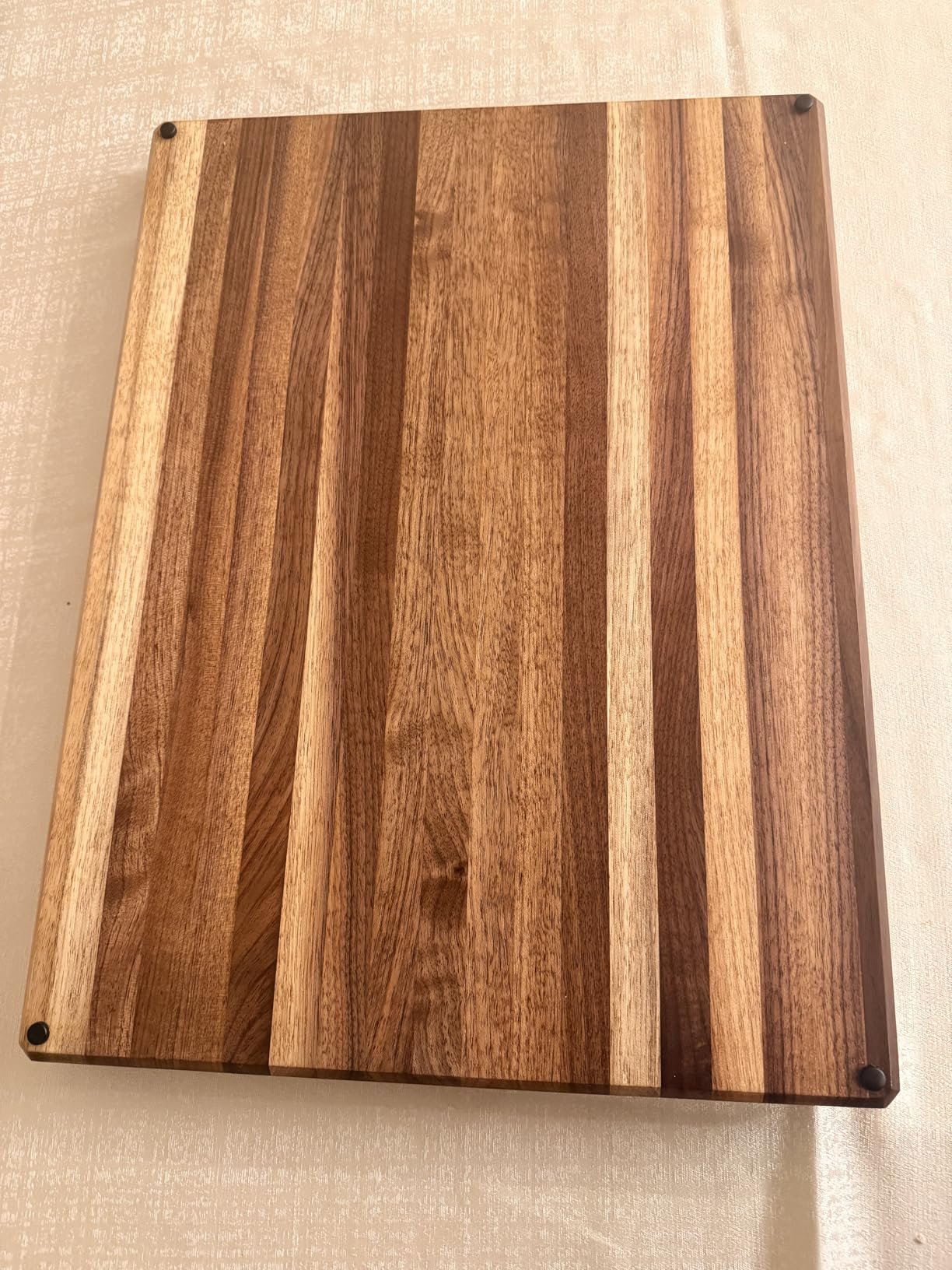
What impressed me most is the knife feel. My Shun chef’s knife glides through this board with a soft, satisfying resistance that tells you the wood is treating the edge well. After four months of daily use, I cannot see any deep gouges or significant wear. The surface has developed a nice patina that actually makes it look better over time.
The downside is the maintenance commitment. Sonder recommends oiling every three weeks, and they mean it. I forgot once during a busy stretch and the surface started looking dry. At 7.5 pounds, this is a board that lives on your counter rather than one you move around casually.
Who should buy this board
The Sonder Los Angeles Laurel is ideal for home cooks who want a board that performs beautifully and looks stunning on the counter. If you cook daily and appreciate quality tools, this board will reward you for years. It is especially good for anyone who serves food directly from the board, since the teak grain and craftsmanship make it a natural charcuterie or appetizer platform.
What to watch out for
You need to commit to the maintenance schedule. If you are someone who forgets to oil wooden boards or does not want to deal with hand washing, this is not the right pick. The weight also makes it impractical for small sinks or people with limited counter space. Some users on Reddit noted the board was almost too nice to cut on, which is a fair point if you are looking at it as an investment piece.
2. Epicurean Kitchen Series Composite Cutting Board
Epicurean Kitchen Series Cutting Board, 11.5-Inch × 9-Inch, Natural
Richlite paper composite
11.5x9x0.25 inches
Made in USA
Dishwasher safe
Pros
- Dishwasher safe with zero maintenance
- Non-porous surface resists bacteria
- Heat resistant to 350F
- Lightweight and easy to store
- No microplastics concern
Cons
- No non-slip backing
- May have initial chemical smell
- Cut marks visible over time
The Epicurean board is the one I recommend to friends who love cooking but hate maintaining wooden boards. Made from Richlite, which is a paper-based composite material pressed under extreme heat and pressure, this board gives you the knife-friendliness of wood with the convenience of plastic. You can throw it in the dishwasher after prepping raw chicken, which is something you simply cannot do with any wooden board.
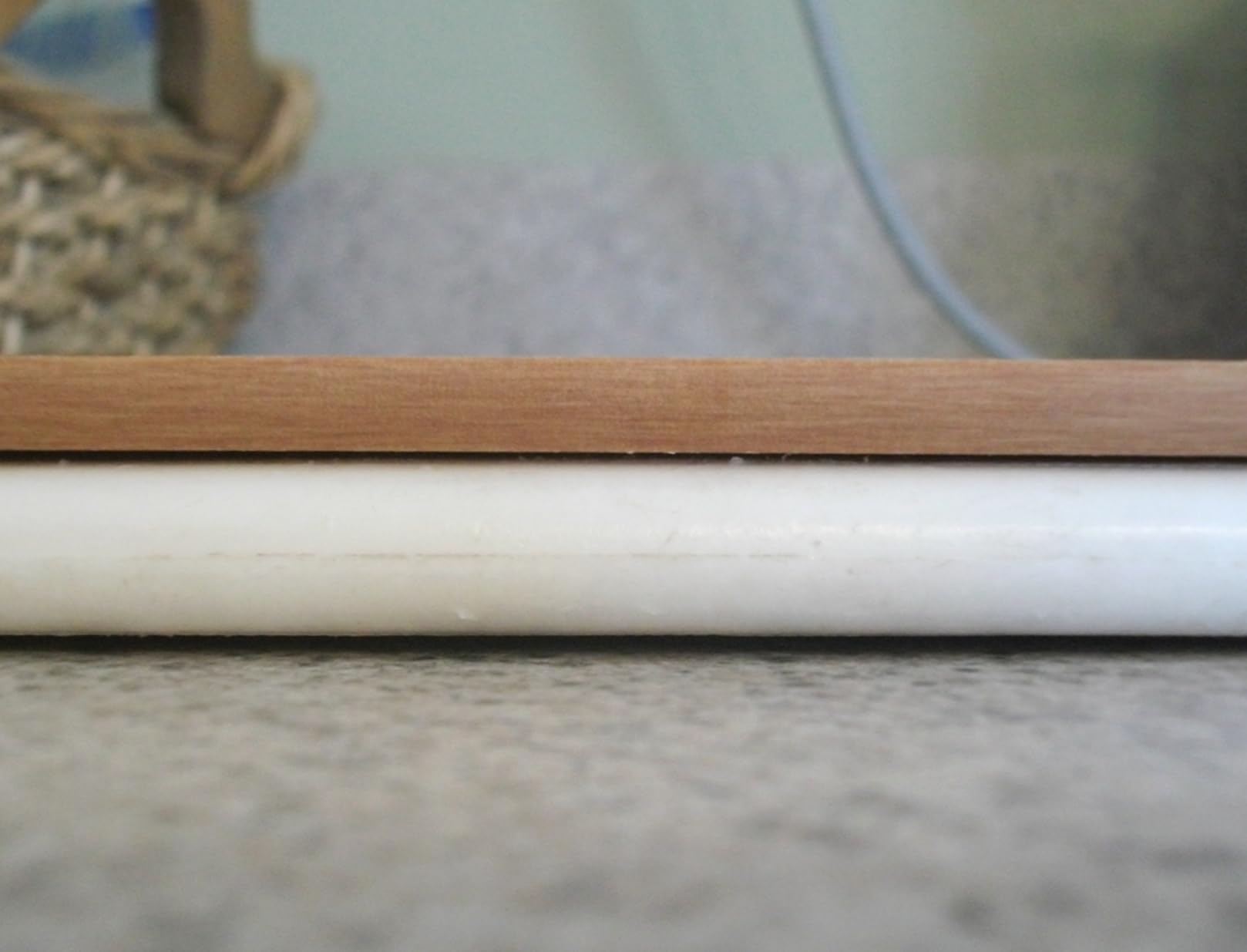
I tested the 11.5 by 9 inch version for three months as my go-to board for vegetable prep. The surface has a slightly textured feel that grips food well, and my knives felt just as sharp after the testing period as they did at the start. The thin 0.25 inch profile means it stores easily, and I could fit two of these in the same cabinet space where one thick wooden board used to sit.
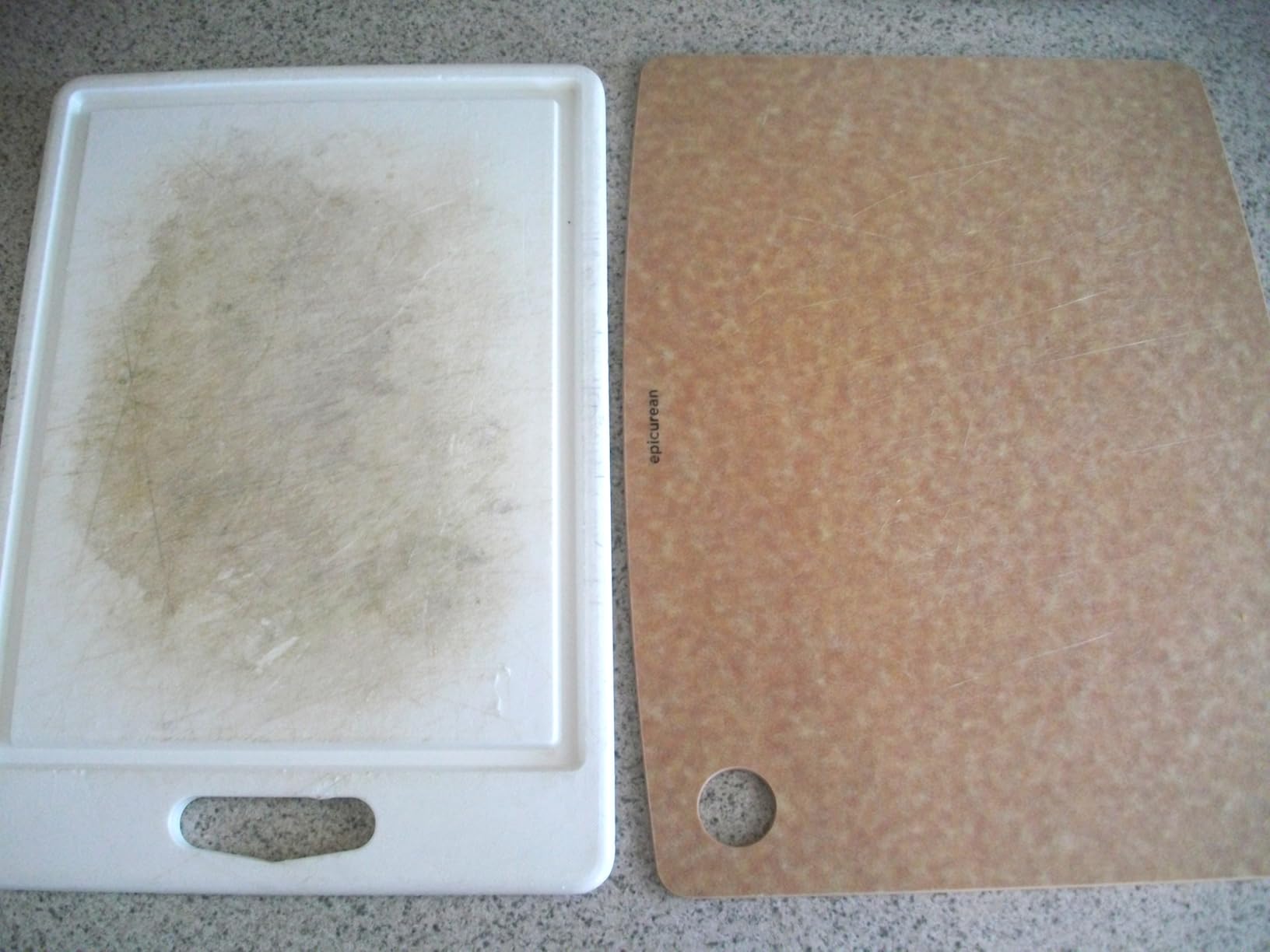
One of the biggest advantages of this board over plastic is the absence of microplastics. Every time you cut on a plastic board, you are shaving tiny plastic particles into your food. The Epicurean composite does not have that problem, and it is also heat resistant to 350 degrees Fahrenheit, which means I use it as a trivet for hot pans regularly.
The main issue I found is the lack of any non-slip backing. On my granite counter, the board would slide during aggressive chopping unless I put a damp towel underneath. Some users report a chemical smell when the board is new, though mine aired out after one wash. Cut marks do become visible over time, but after three months they are minimal.
Who should buy this board
This is the board for anyone who wants low-maintenance kitchen tools. If you hate oiling wooden boards, if you love your dishwasher, or if you are concerned about microplastics from plastic cutting boards, the Epicurean is your answer. It is also great for small kitchens since the thin profile stores almost anywhere.
What to watch out for
The sliding issue is real. If your counter is smooth granite or quartz, you will need a damp towel or a silicone mat under this board. The 11.5 by 9 inch size is also on the smaller side for serious meal prep, so consider the larger sizes Epicurean offers if you cook in big batches.
3. Teakhaus Large FSC Certified Teak Cutting Board
Teakhaus Edge-Grain Teak Wood Cutting Board with Grip Handles, Large
FSC certified teak
20x15x1.5 inches
Edge-grain
Reversible
Pros
- FSC certified sustainably harvested teak
- Massive 20x15 inch work surface
- Reversible design
- Natural moisture and bacteria resistance
- Lifetime warranty
Cons
- Hand wash only
- Very heavy at 12 lbs
- Expensive premium price
The Teakhaus 20 by 15 inch board is the one I bring out when I am doing serious cooking. This is the board you want for breaking down a turkey, carving a brisket, or prepping vegetables for a dinner party. The sheer size gives you room to work without constantly pushing scraps into a bowl to clear space.
What sets Teakhaus apart is the FSC certification. The Forest Stewardship Council certification means the teak was harvested from sustainably managed forests, which matters to me and to a growing number of cooks I talk to. Wirecutter is the only major competitor that covers sustainability in depth, and they specifically highlight FSC certification as a meaningful standard.
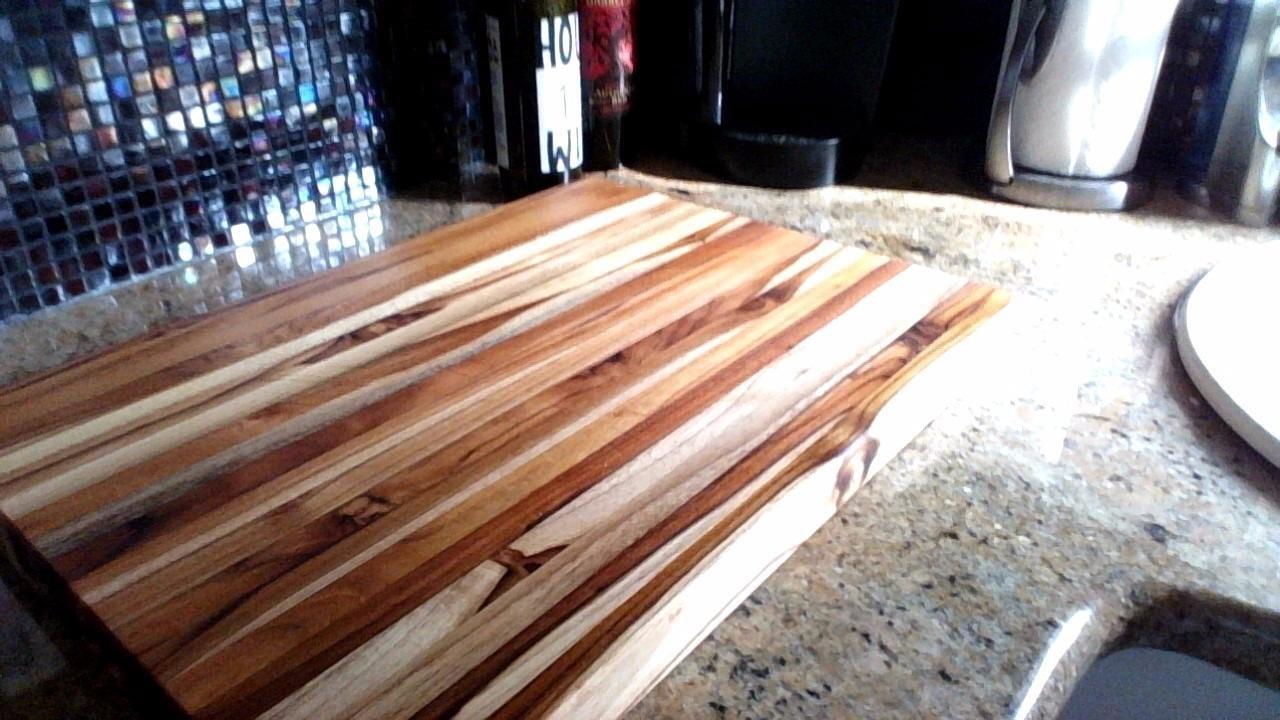
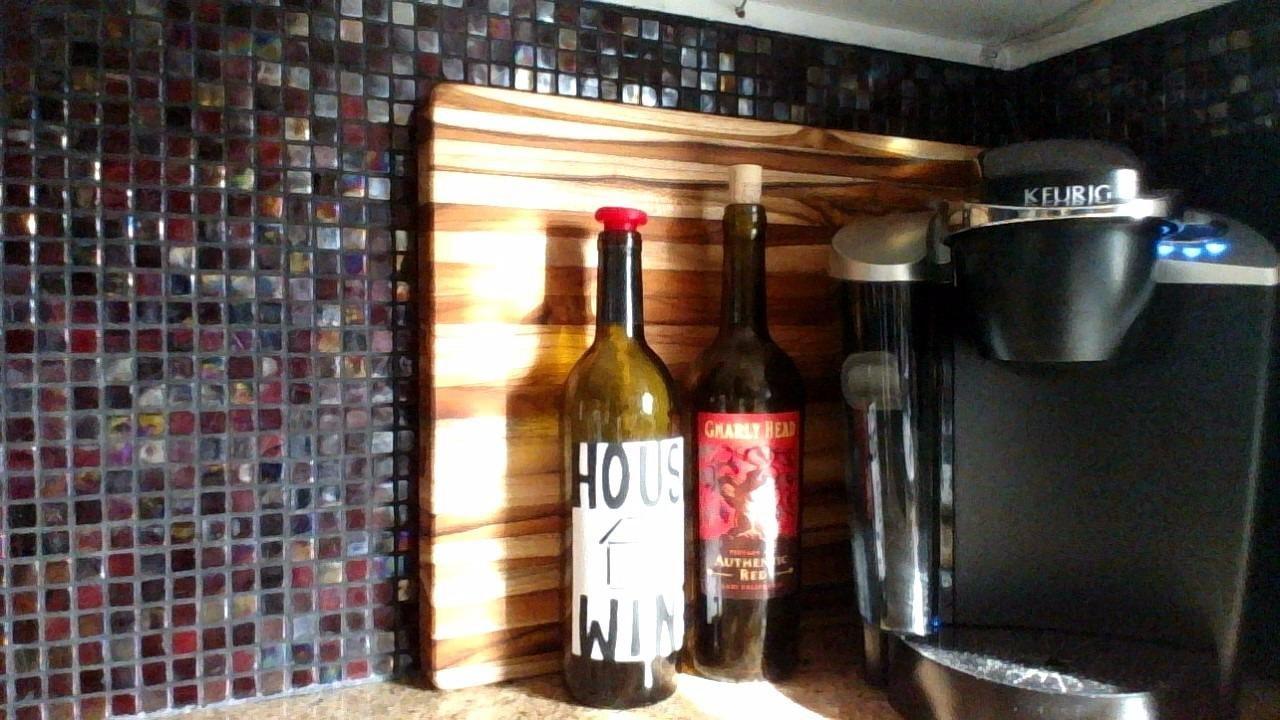
The teak itself is stunning. Each board has a unique grain pattern, and the natural oils in teak make it more resistant to moisture and bacteria than most hardwoods. I found that this board needed less frequent oiling than my maple John Boos board, which is a nice bonus on top of the sustainability angle.
The weight is the biggest drawback. At roughly 12 pounds, this board stays put on the counter, which is great for stability but not great for cleaning. I cannot fit this in my kitchen sink comfortably, so I end up cleaning it on the counter with a soapy sponge and then wiping it down. The price is also a significant investment.
Who should buy this board
The Teakhaus is perfect for cooks who do a lot of large-format cooking. If you regularly carve roasts, break down whole birds, or prep food for large gatherings, this board gives you the space you need. It is also the best choice on this list for anyone who prioritizes sustainability and FSC certification.
What to watch out for
Between the weight, the size, and the hand-wash-only requirement, cleaning this board requires some planning. Make sure you have counter space near your sink for cleaning. Some users report shipping damage, so inspect the board carefully when it arrives.
4. John Boos Chop-N-Slice Maple Cutting Board
John Boos Chop-N-Slice Series Rectangular Maple Cutting Board
American hard maple
16x10x1 inches
Made in USA
Reversible edge-grain
Pros
- Made in USA from American hard maple
- Reversible design doubles surface area
- Professional quality construction
- Knife-friendly maple surface
- Classic butcher block look
Cons
- Can split at ends in dry weather
- Requires regular oiling
- Hand wash only
John Boos is the name that comes up in almost every conversation about professional cutting boards, and for good reason. The company has been making butcher blocks in Effingham, Illinois since 1887, and their maple Chop-N-Slice board is the industry standard that restaurant kitchens rely on. I tested the 16 by 10 inch version for this review.
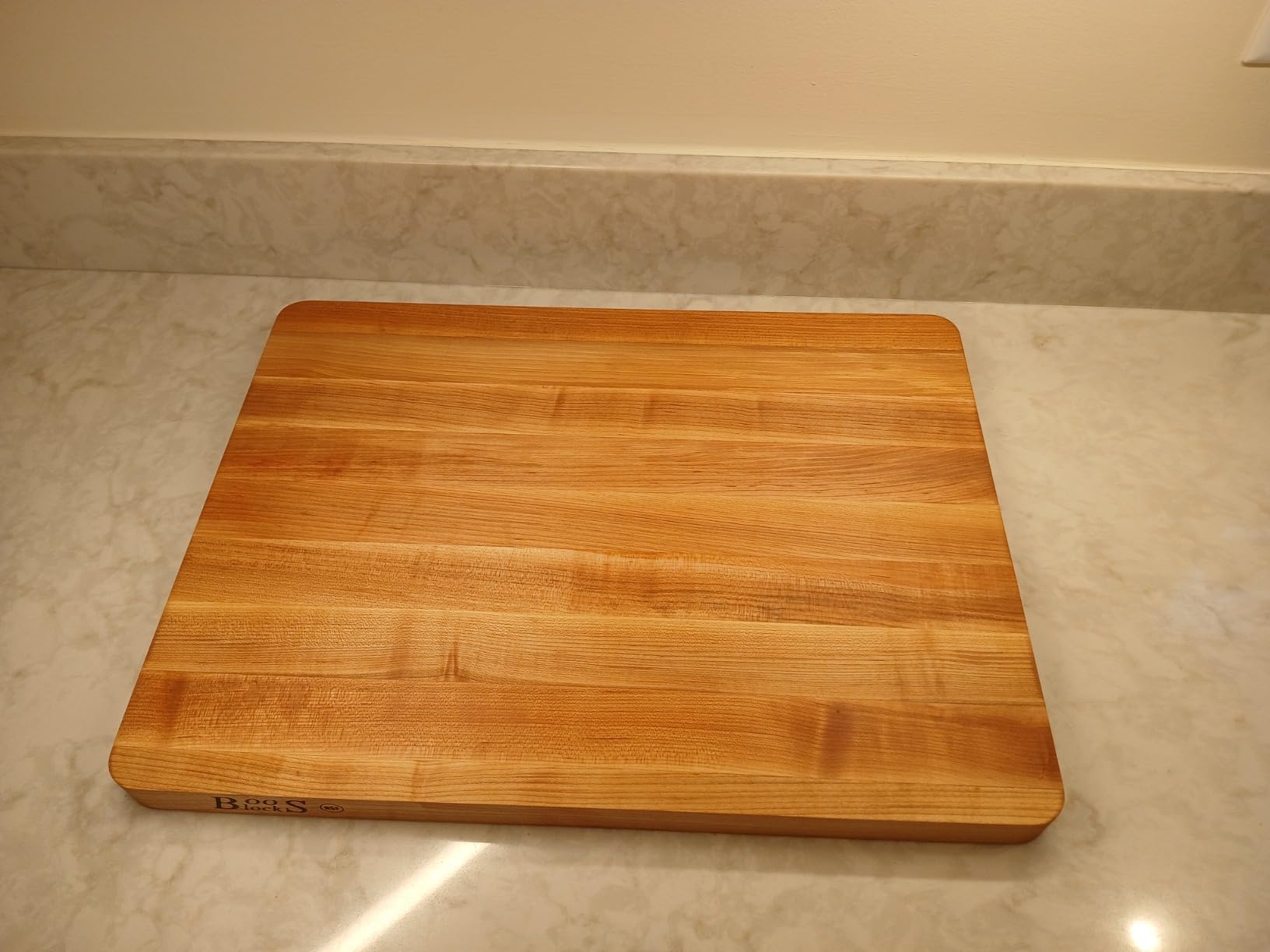
The American hard maple has a tight, closed-grain structure that is naturally resistant to bacteria and gentle on knife edges. The surface has a firm but forgiving feel that I immediately recognized from restaurant kitchens I have worked in. This is what a cutting board is supposed to feel like when you chop on it.
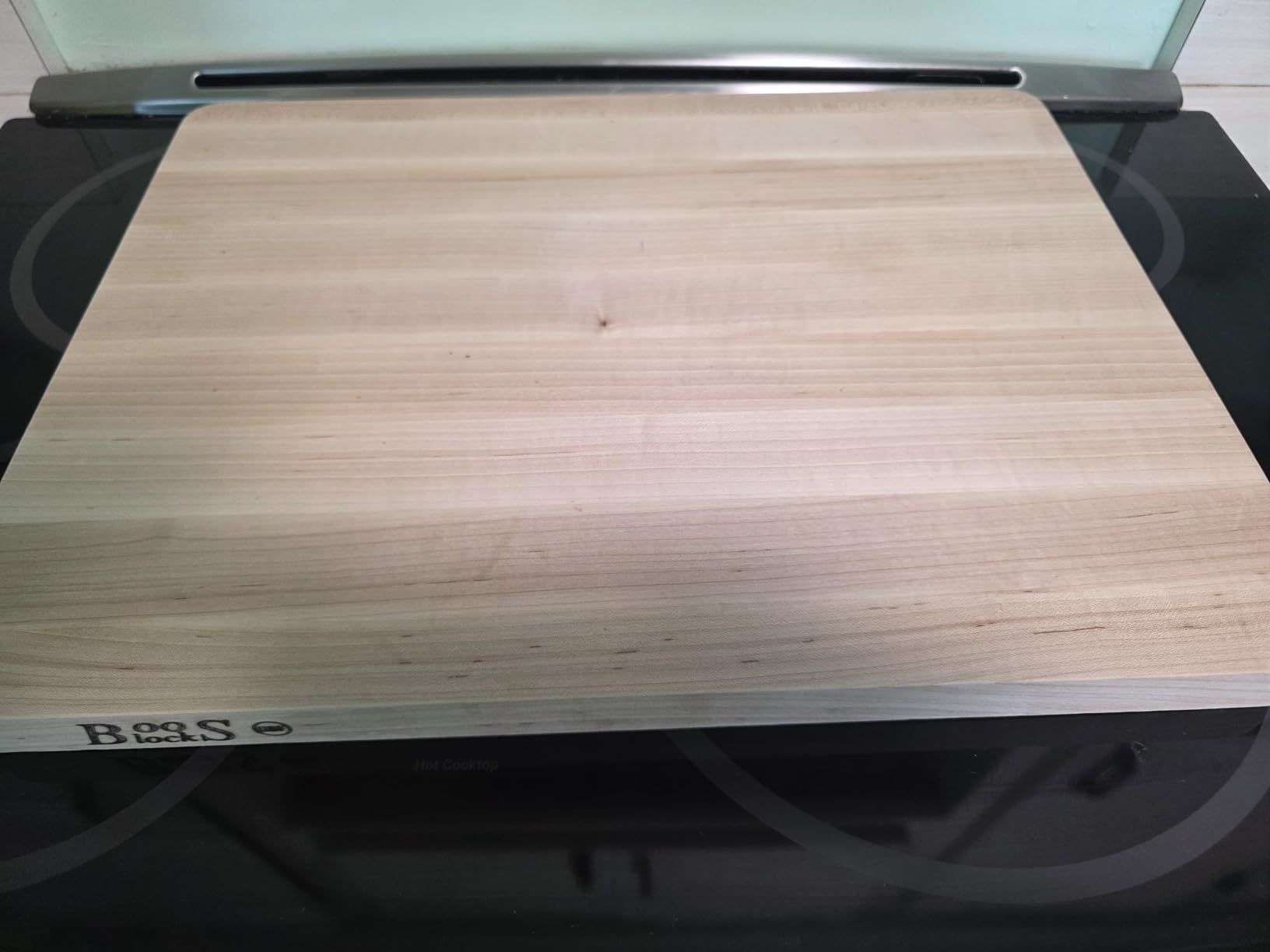
The reversible design is practical. I use one side for raw meat prep and the other for vegetables and fruit, which gives me a simple cross-contamination system without needing multiple boards. The oil finish looks great when freshly applied, though it does dull between oilings.
The biggest issue I and many other users have encountered is end-splitting. Maple is a natural material that expands and contracts with humidity changes, and several Reddit users on r/Cooking reported gaps opening at the ends of their boards during dry winter months. Regular oiling helps, but it does not completely eliminate the problem.
Who should buy this board
The John Boos maple board is for traditionalists who want a genuine American-made butcher block. If you appreciate heritage brands, want a board that feels like it belongs in a professional kitchen, and are willing to maintain it properly, this is a classic that will serve you for years.
What to watch out for
If you live in a dry climate, be prepared for potential splitting. Oil the board regularly, keep it away from heat sources and direct sunlight, and never soak it. The 4.2 star rating is lower than other boards on this list, and most of the negative reviews center on splitting issues.
5. Ziruma Acacia Wood Cutting Board
Non-Toxic Acacia Wood Cutting Board, Mineral Oil & Plastic Free, 16×11 in
FSC acacia wood
16x11x1 inches
Mineral oil free
Beeswax and flaxseed finish
Pros
- Mineral oil and petroleum free finish
- FSC certified acacia wood
- Natural tannins resist bacteria
- Knife-friendly 1 inch thick surface
- Chemical free construction
Cons
- Hand wash only
- Requires periodic re-oiling
- Back surface can feel rough
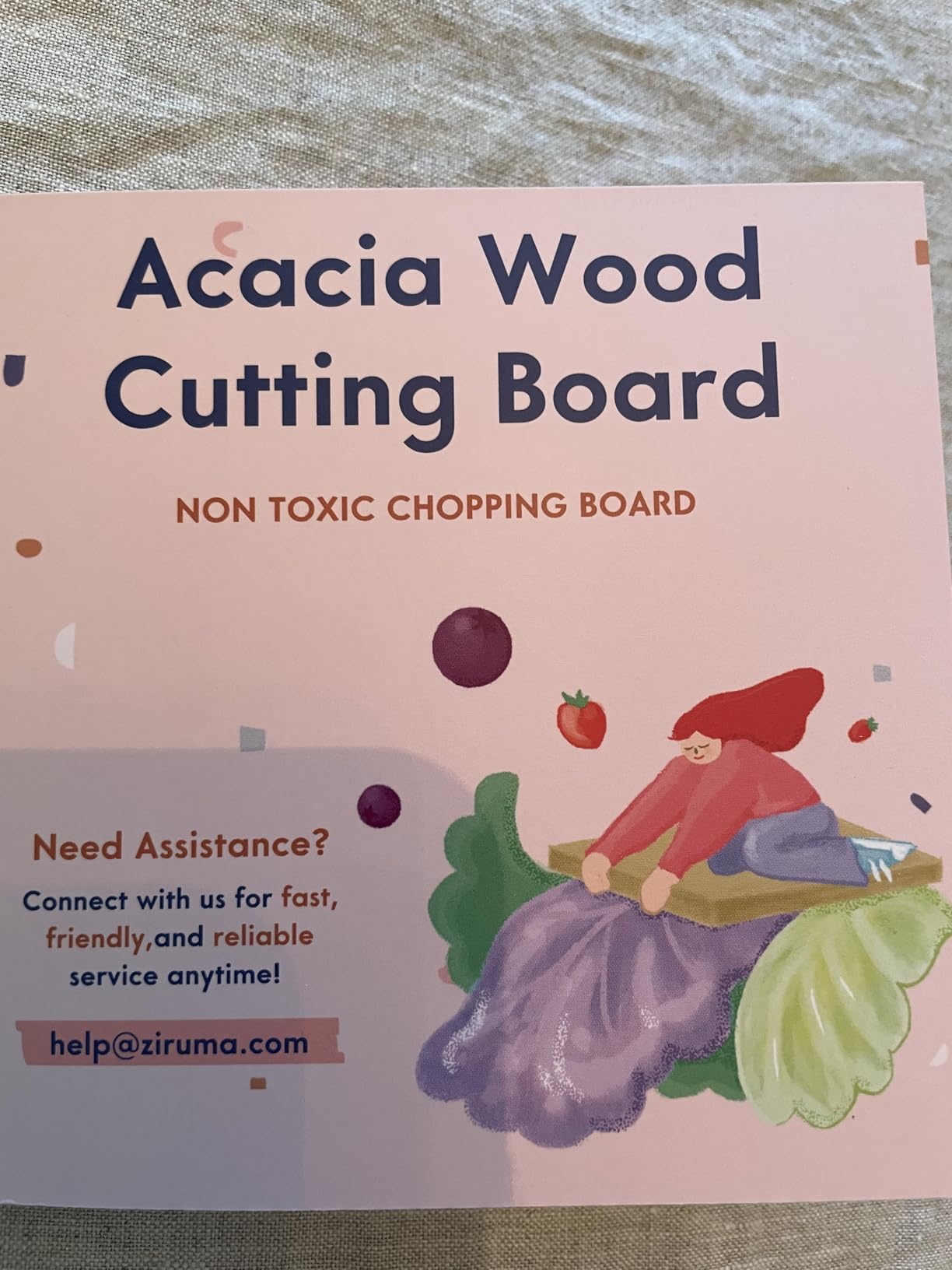
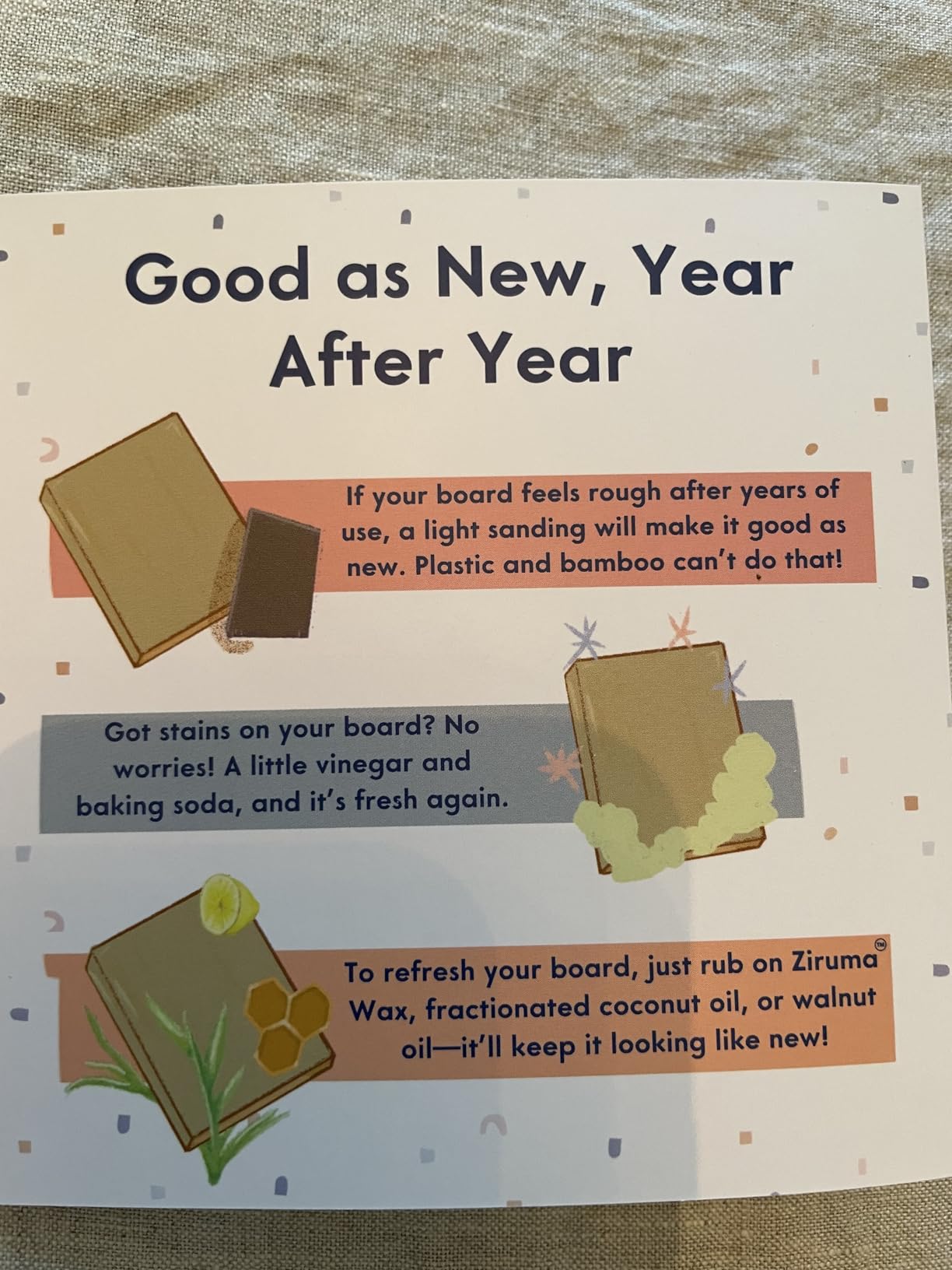
The Ziruma acacia board caught my attention because it is one of the few cutting boards on the market that uses zero mineral oil or petroleum products. Instead, the board is conditioned with a blend of beeswax, flaxseed oil, and lemon oil. For anyone concerned about synthetic chemicals in their food prep tools, this is a meaningful difference.
Acacia is a dense hardwood with natural tannins that resist bacteria and mold. The 1-inch thickness gives the board a solid, substantial feel without being as heavy as the Teakhaus. The golden-brown grain with darker streaks makes each board visually unique, and the built-in juice groove worked well when I tested it with watermelon prep.
The knife feel on acacia is excellent. It has a similar firm-but-forgiving quality to maple, and my edges stayed sharp throughout testing. The FSC certification means the wood comes from responsibly managed forests, which adds to the eco-friendly appeal of this board.
The main complaint I have is that the back side of the board felt rougher than the front. It seems like the finishing process focuses on one side, which is fine if you only use that side, but it limits the reversible potential. You also need to re-oil periodically with natural oils, which are harder to find than standard mineral oil.
Who should buy this board
The Ziruma acacia is the best cutting board for anyone who wants to avoid petroleum products and synthetic chemicals entirely. If you are into natural living, follow an organic lifestyle, or simply prefer knowing exactly what is touching your food, this board delivers on that promise without sacrificing performance.
What to watch out for
The rough back side is annoying if you expect a fully finished board on both sides. You will need to source natural oils for maintenance rather than grabbing standard mineral oil from the hardware store. The brand is less well-known than John Boos or Teakhaus, though the quality justifies the price.
6. toptier Wood Fiber Composite Cutting Board
Cutting Board for Kitchen Dishwasher Safe, Toptier, Wood, Fiber , Eco-Friendly, Non-Slip, Juice Grooves, Non-Porous, BPA Free, Small, Silicone, 11.5 x 9.25-inch, Natural Slate
Wood fiber composite
11.81x9.25x0.24 inches
Dishwasher safe
Silicone corners
Pros
- Dishwasher safe convenience
- Non-slip silicone corners
- Juice groove on one side
- BPA free and LFGB approved
- Heat resistant to 350F
Cons
- Thinner than traditional boards
- Juice groove not very deep
- Slightly slippery on some surfaces
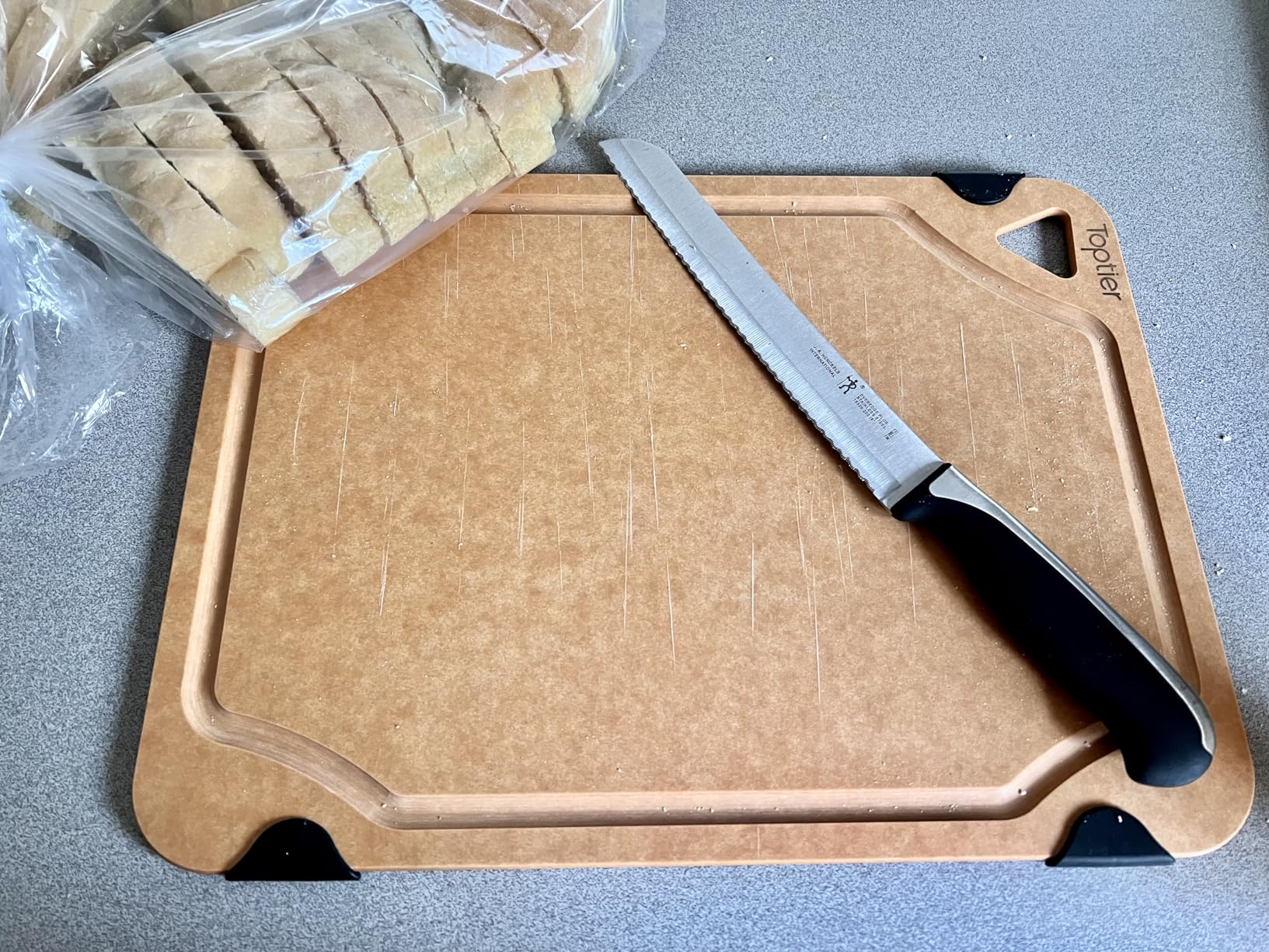
The toptier wood fiber composite board is the dark horse of this list. It does not have the brand recognition of Epicurean or John Boos, but it solves a real problem that many home cooks face. You get the non-porous, dishwasher-safe convenience of a composite board with non-slip silicone corners that actually keep the board in place.
This was the board I reached for when prepping raw chicken. I could chop, scrape the waste into the trash, and drop the board straight into the dishwasher. No hand washing, no oiling, no worrying about bacteria in cut marks. The silicone corners grip the counter firmly, which is something the Epicurean board lacks.
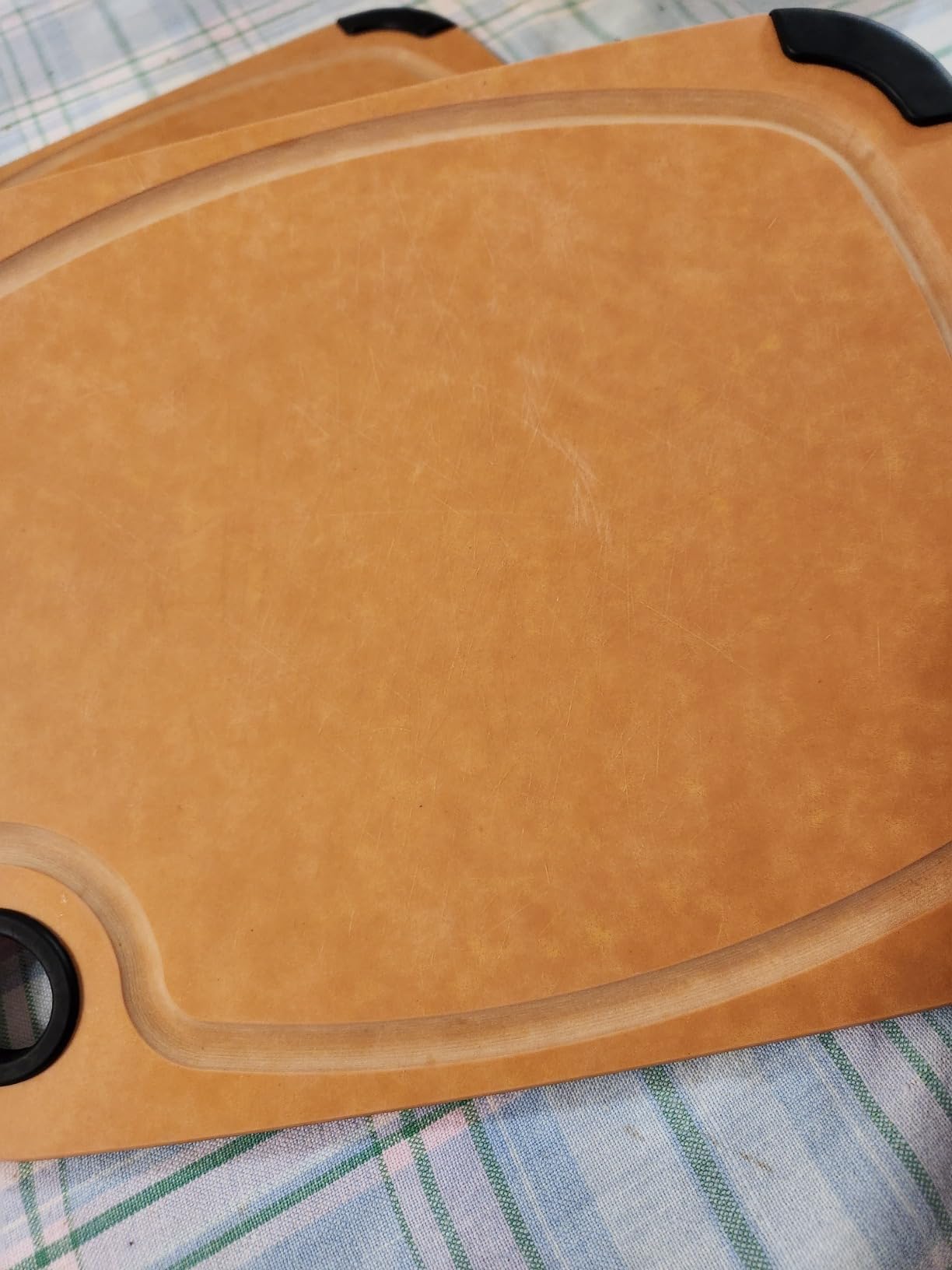
The surface is BPA-free and LFGB approved, which is the European food safety standard. The knife feel is surprisingly good for a composite material, with a slight give that protects edges without being mushy. After two months of regular use, I saw minimal cut marks and no staining, even after cutting beets.
The juice groove on one side is functional but shallower than I would like. It handles most vegetable prep without spilling, but a juicy piece of fruit or a wet roast will overwhelm it. The thin profile is great for storage but means the board lacks the heft of a solid wood option.
Who should buy this board
The toptier is perfect for everyday home cooks who want one board that does everything well. If you are tired of maintaining wooden boards but do not want the microplastics concern of plastic, this composite gives you the middle ground. The silicone corners make it especially good for anyone who has struggled with boards sliding on smooth counters.
What to watch out for
The shallow juice groove means this is not the best board for carving meats with lots of runoff. The removable silicone corners can collect food debris if you are not careful during cleaning. Some users report the board feels slightly slippery with very wet foods.
7. ROYAL CRAFT WOOD Bamboo Cutting Board Set
ROYAL CRAFT WOOD Wooden Cutting Boards for Kitchen Appliances – Non Toxic Bamboo Wood Cutting Board Set with Deep Juice Groove, Side Handles, Charcuterie & Butcher Block for Meat, Meal Prep & Serving
3-piece bamboo set
15x10, 12x8, 9x6 inches
Juice groove
Side handles
Pros
- Three sizes for every task
- 100 percent natural bamboo
- Deep juice groove on large board
- Built-in side handles
- Excellent value for a set
Cons
- Requires hand washing
- Can splinter if not maintained
- Thinner than solid butcher blocks
The ROYAL CRAFT WOOD bamboo set is the best cutting board set I tested. You get three boards in different sizes, which lets you dedicate the small one to garlic and onions, the medium one to vegetables, and the large one to meat or serving. Having dedicated boards for different foods is a cross-contamination strategy that commercial kitchens use, and this set makes it affordable for home cooks.
Bamboo is technically a grass rather than a wood, and it grows incredibly fast, making it one of the most renewable materials on the planet. The boards are lightweight and easy to handle, with built-in side handles that make carrying them from counter to stove simple. The large board has a deep juice groove that handled a messy pineapple prep without spilling.
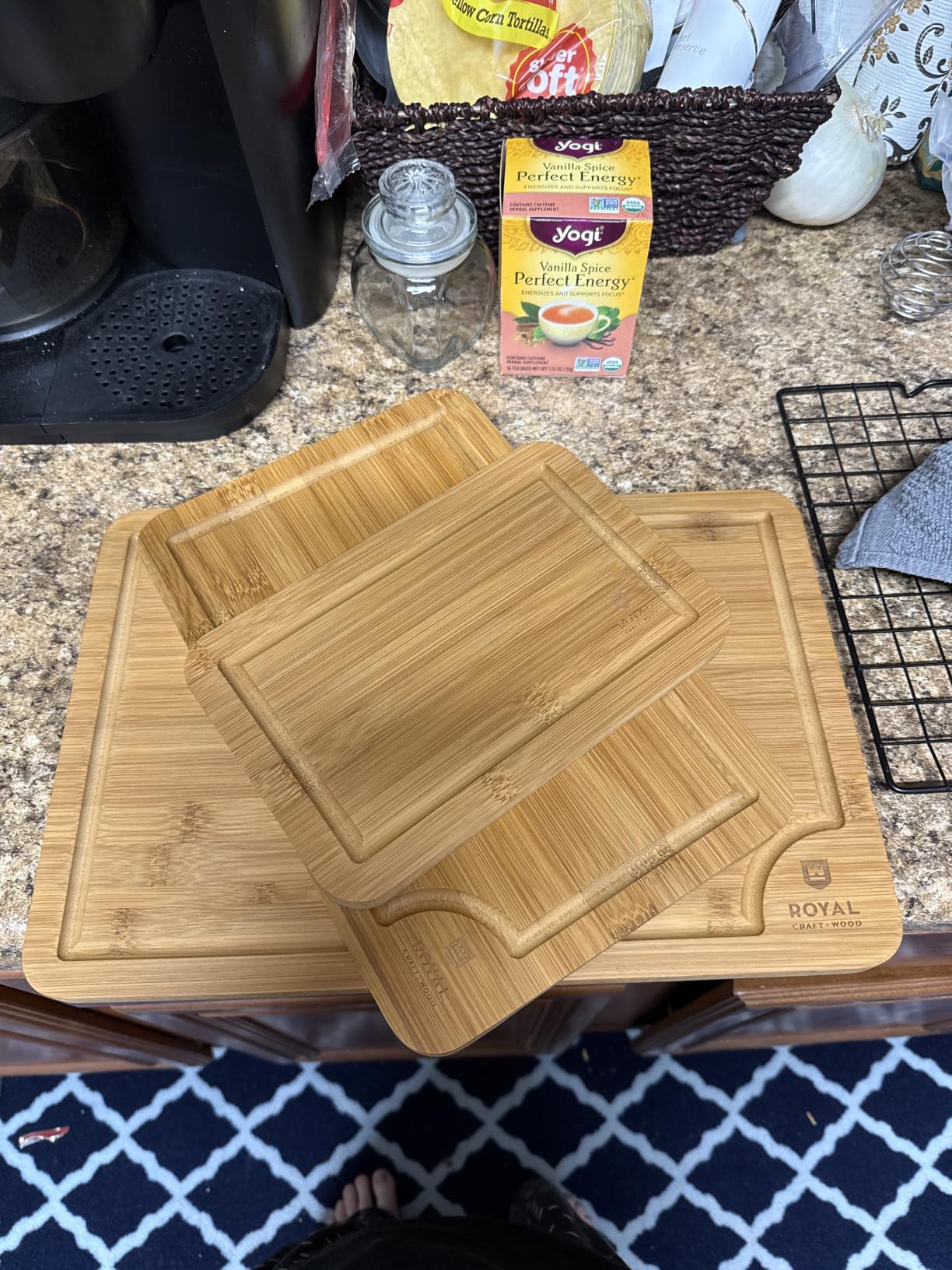
I used this set for six weeks of daily cooking. The three-size approach genuinely changed how I prep food. Having the right size board for each task made cooking more efficient, and I found myself washing boards less frequently because I could rotate between them.
The main concern with bamboo is its effect on knives. Bamboo is harder than most hardwoods, which means it can dull knife edges faster than maple or walnut. For home cooks using standard stainless steel knives, this is not a major issue. But if you own expensive Japanese knives, bamboo may not be your best choice. Several Reddit threads on r/chefknives specifically warn against bamboo for high-end blades.

Who should buy this set
The ROYAL CRAFT WOOD set is ideal for new home cooks setting up their kitchen, families who need multiple boards for different foods, and anyone on a budget who wants versatility. The three sizes cover virtually every kitchen task, and the value for money is outstanding.
What to watch out for
Bamboo requires regular oiling to prevent splintering and cracking. These boards are thin at 0.6 inches, so they are not meant for heavy butchering work. If you have expensive knives, consider a softer wood option instead. Hand washing is mandatory.
8. Hiware Extra Large Bamboo Cutting Board
Hiware Extra Large 18″ x 12″ Bamboo Cutting Board for Kitchen, Heavy Duty Wood Cutting Board with Juice Groove, 100% Organic Bamboo, Pre Oiled
100% organic bamboo
18x12x0.6 inches
Juice groove
Pre-oiled
Pros
- Outstanding value for the size
- Generous 18x12 inch cutting surface
- Juice groove along edges
- Integrated handles and hanging hole
- Pre-oiled and ready to use
Cons
- Can splinter after months of use
- Hand wash only
- Some users report corner splitting
At this price point, the Hiware bamboo board is one of the best cutting boards you can buy. I was genuinely surprised by the quality given how affordable it is. The 18 by 12 inch surface gives you more cutting space than boards costing three or four times as much, and the pre-oiled finish means it is ready to use right out of the box.
I tested this board as my dedicated vegetable prep station for two months. The juice groove along the edges is functional for containing vegetable scraps and water from washed produce. The integrated handles and hanging hole make storage easy, and I appreciate the non-slip base that kept the board steady on my counter.
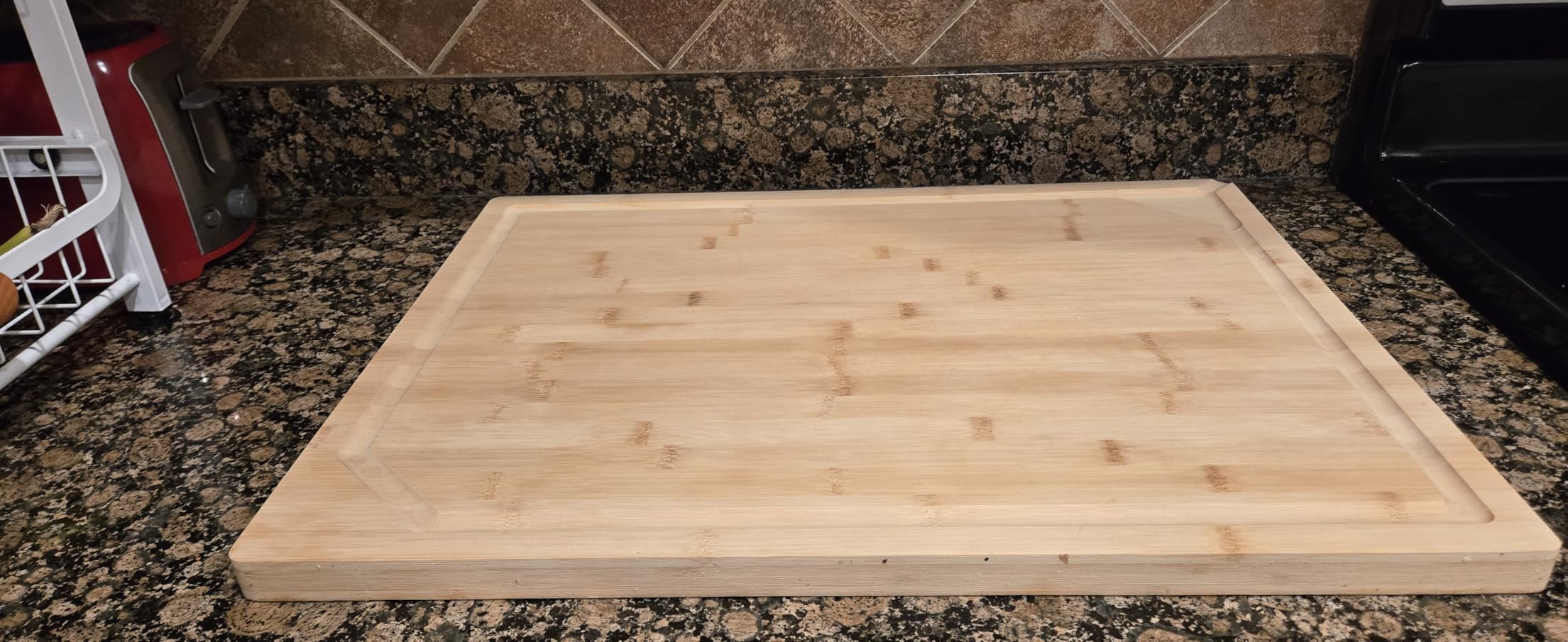
The bamboo surface is smooth and has a natural, attractive grain. My everyday Victorinox knife worked well on this board without showing excessive wear. However, as other users have noted, bamboo is harder than most hardwoods, so it will dull premium knives faster than end-grain maple or walnut would.
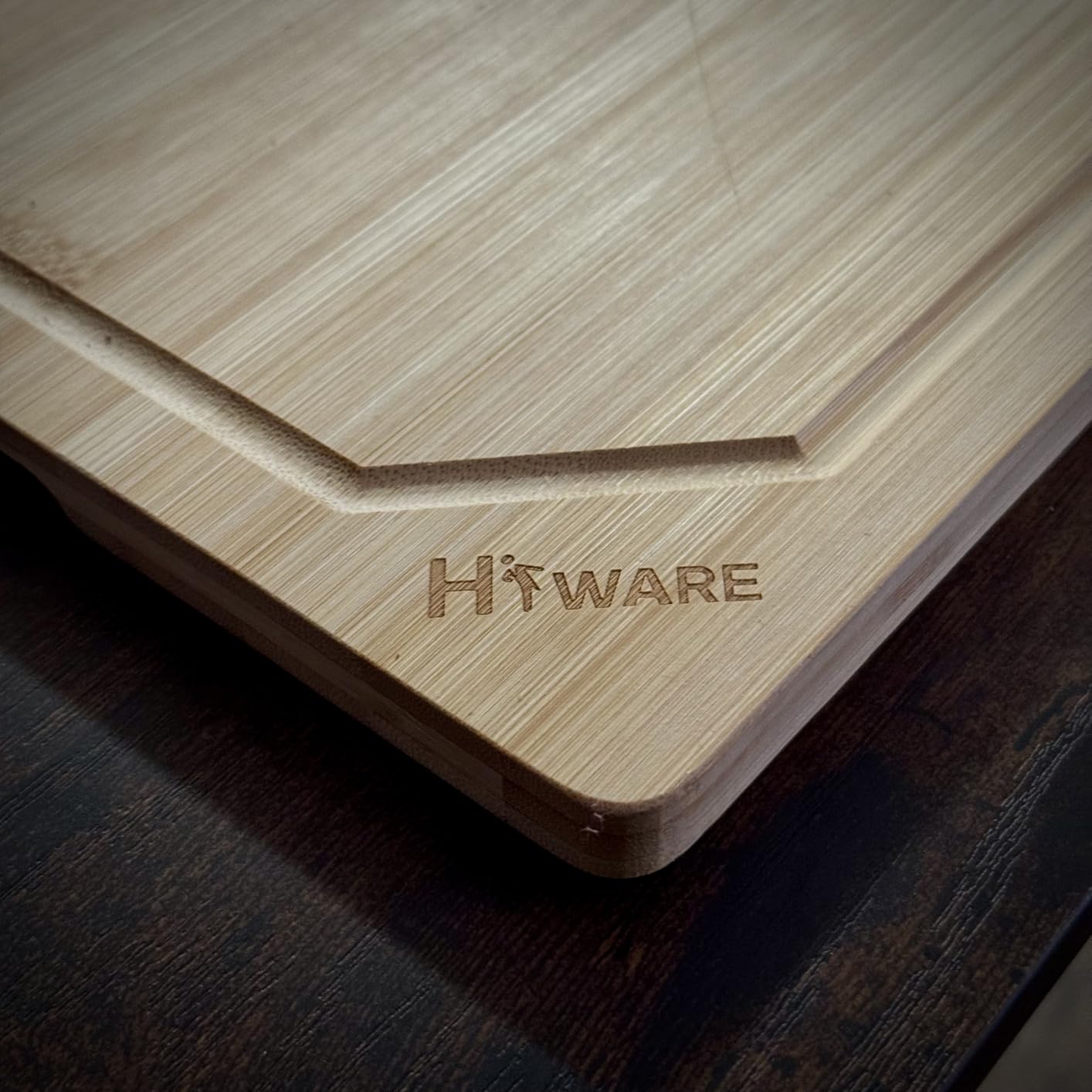
The long-term durability is where this board shows its budget nature. After two months of daily use, I noticed the beginning of fiber separation at one corner. Multiple reviews mention corner splitting after several months of heavy use. Regular oiling helps, but the thin 0.6 inch construction limits how long this board will last compared to a solid 1.5 inch butcher block.
Who should buy this board
The Hiware is perfect for anyone who needs a large cutting surface without spending much money. It is great for college students, first apartments, vacation homes, or as a secondary board alongside a more expensive primary. The size makes it genuinely useful for real cooking, not just light prep.
What to watch out for
Treat this as a board that will last 1 to 2 years with regular use rather than a lifetime investment. Oil it regularly, never soak it, and watch for corner splitting. If you want a board that lasts decades, you need to spend more on an end-grain hardwood option.
9. Belwares 2-Piece Wood Composite Cutting Board Set
Dishwasher Safe Cutting Boards for Kitchen – Composite Wood Cutting Board Set, Wood Fiber Chopping Boards, Thin Plastic Free, BPA Free Heat Resistant – 2 Sizes, Large 14.5″ x 11.25″ Medium 11.5″ x 9″
Wood fiber composite 2-piece set
14.5x11.25 and 11.5x9 inches
Dishwasher safe
Heat resistant to 350F
Pros
- Dishwasher safe with no oiling needed
- Two sizes for different tasks
- Non-slip rubber feet
- Heat resistant doubles as trivet
- Non-toxic non-plastic material
Cons
- Knife sound is louder on composite
- Rubber pads can lift at edges
- No handles for carrying
- Cut marks visible over time
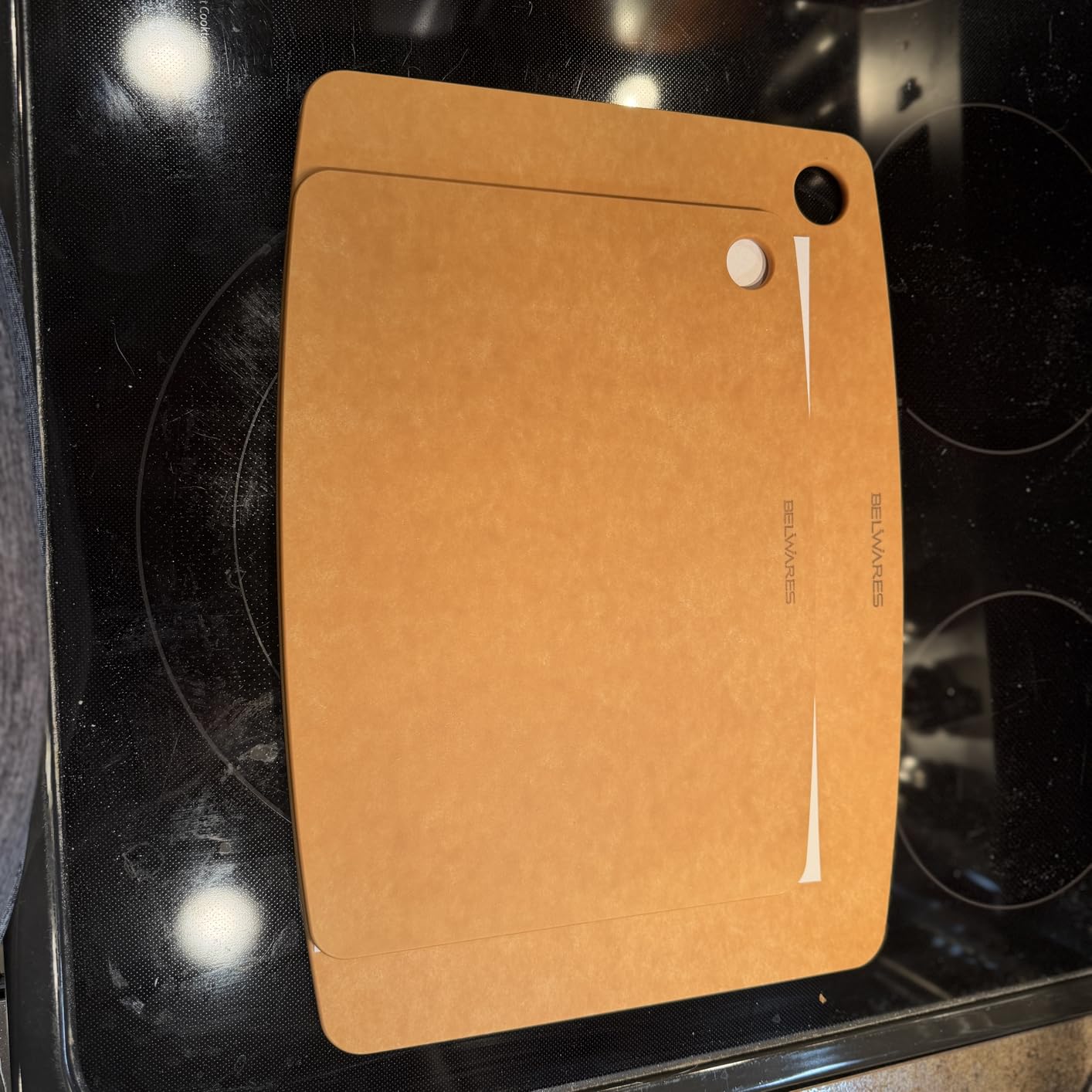
The Belwares 2-piece set gives you two dishwasher-safe wood composite boards at a price that competes with single boards from other brands. I found this set particularly useful for meal prep days when I am working with multiple ingredients and need to rotate boards through the dishwasher.
The larger board at 14.5 by 11.25 inches handles most meal prep tasks comfortably, while the smaller 11.5 by 9 inch board is perfect for quick jobs like slicing a lemon or chopping herbs. Both boards have non-slip rubber feet that keep them planted on the counter, which is a feature I wish more composite boards included.
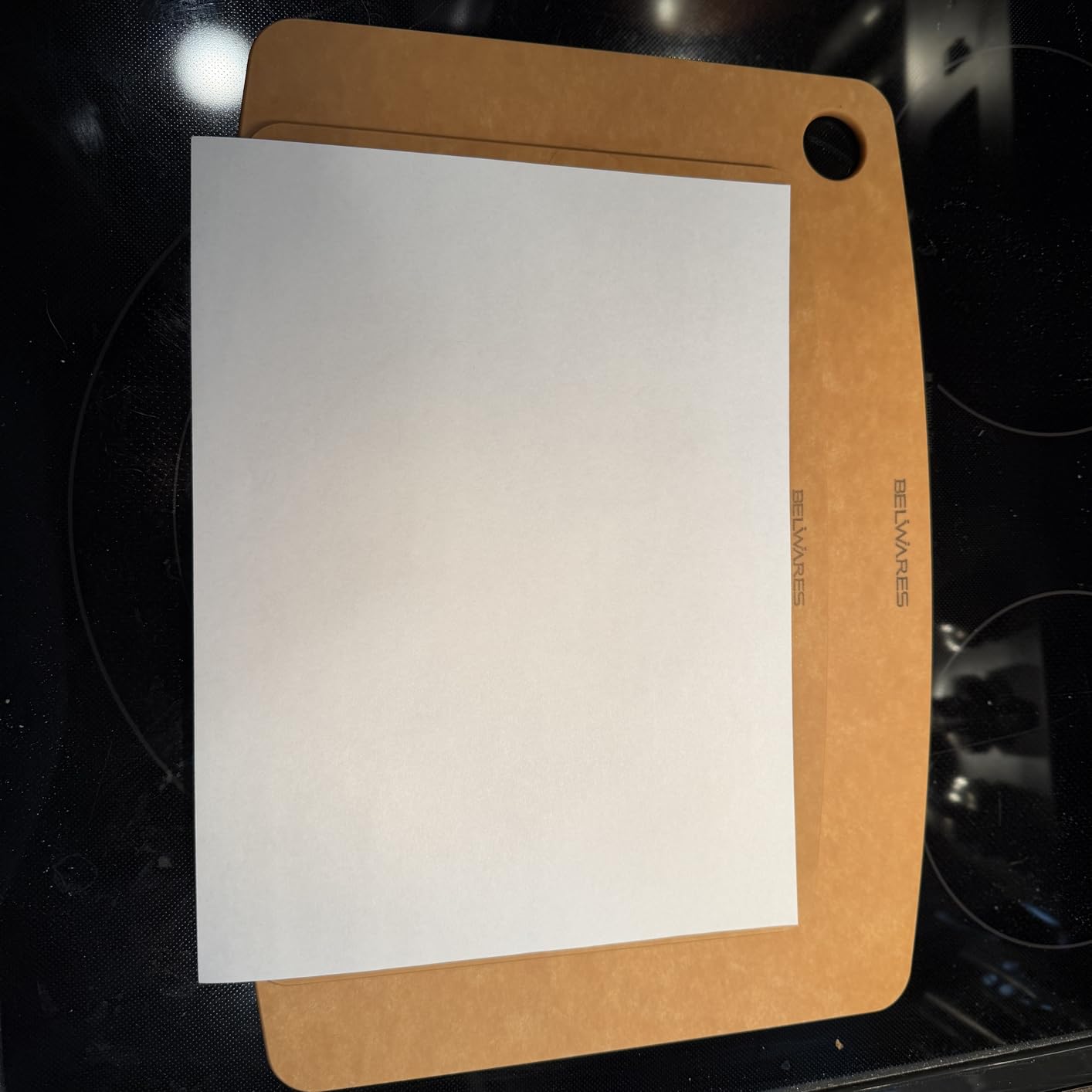
Being heat resistant to 350 degrees Fahrenheit means I regularly use these as trivets for hot pans and baking sheets. The non-porous surface resists stains and odors, and after two months of testing I saw no discoloration even after cutting turmeric, beets, and berries on them.
The one thing that takes getting used to is the sound. Knives hitting the composite surface produce a sharper, louder sound than wood. It is not a deal-breaker, but it is noticeable if you are used to the quiet thud of a wooden board. The rubber feet can also lift slightly at the edges over time, which traps small food particles during cleaning.
Who should buy this set
The Belwares set is great for busy home cooks who want the convenience of dishwasher-safe boards without switching to plastic. The two-size setup covers most kitchen tasks, and the heat resistance adds versatility. It is also a smart choice for anyone transitioning away from plastic boards due to microplastics concerns.
What to watch out for
The lack of handles makes carrying these boards from counter to stove a bit awkward. The knife sound on composite is louder than wood, which bothers some users. Check the rubber feet periodically and clean underneath them to prevent buildup.
10. Light In The Dark Tempered Glass Cutting Board
Tempered Glass Cutting Board – Long Lasting Clear Glass – Scratch Resistant, Heat Resistant, Shatter Resistant, Dishwasher Safe. (Large 12×16)
Tempered glass
16x12x0.15 inches
Dishwasher safe
Non-porous
Pros
- Non-porous surface for maximum hygiene
- Dishwasher safe and easy to clean
- Scratch and stain resistant
- Heat resistant doubles as trivet
- Rubber feet for stability
Cons
- Dulls knives faster than wood or plastic
- Glass surface can be slippery
- Shatter risk if dropped
I will be upfront: glass is not my favorite cutting board material for daily use because it dulls knives faster than wood or plastic. However, the Light In The Dark tempered glass board has a specific use case where it excels, and that is food safety for people with specific dietary restrictions.
Multiple users in the reviews mention buying this board specifically for celiac disease management. Because glass is completely non-porous, there is zero risk of gluten cross-contamination from residual flour or crumbs trapped in cut marks. The same property makes it ideal for people with severe food allergies who need an absolutely clean surface.

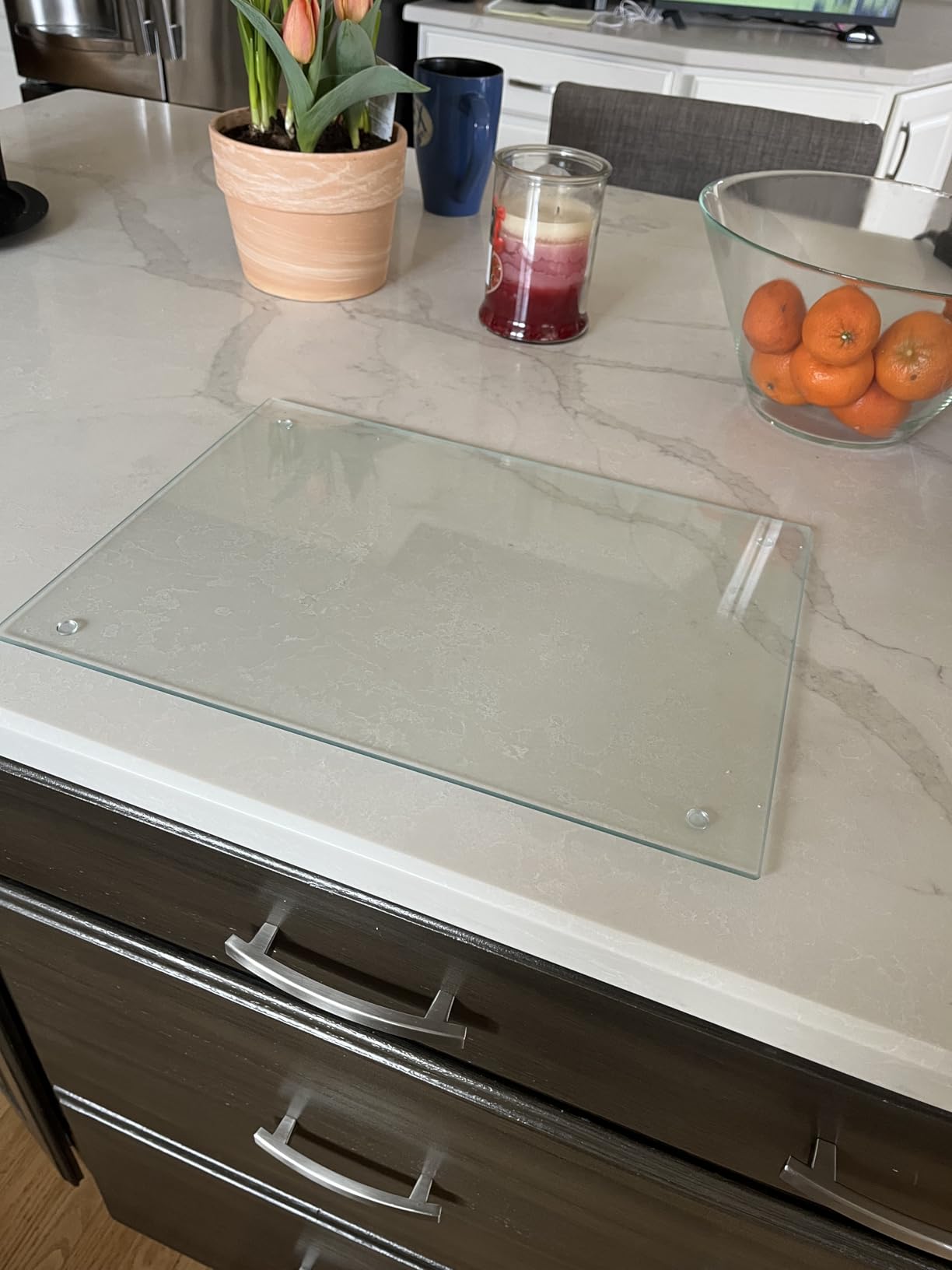
The board is tempered glass, which means it is designed to resist breaking under normal kitchen conditions. The rubber feet keep it stable, and it is fully dishwasher safe. I tested it as a cheese and charcuterie serving board and it looked excellent on the table. The clear glass lets whatever is underneath show through, which creates a clean, modern presentation.
For actual cutting, I noticed my knife edges needed honing more frequently after using this board for a week. The glass surface is hard and unforgiving, which is why professional chefs almost never use glass cutting boards. If you choose this board, plan to use it primarily for serving, light slicing, or as a secondary board for allergy management rather than your daily chopping surface.
Who should buy this board
The glass board is ideal for anyone managing food allergies or celiac disease who needs a truly non-porous surface. It is also good as a serving board for cheese, charcuterie, or appetizers. If you want a board that doubles as a counter protector or trivet, the heat resistance makes it versatile.
What to watch out for
Glass dulls knives significantly faster than any other cutting board material. If you use this as your daily chopping board, you will need to sharpen your knives frequently. The surface can also be slippery with wet foods, and despite being tempered, there is still a shatter risk if dropped on a hard floor.
11. Goodluck 5-Piece Flexible Plastic Cutting Mats
Goodluck 5 Pieces Flexible Cutting Boards, BPA Free Plastic Cutting Boards for Kitchen, Non Slip Cutting Mat for Meat and Vegetables
5-piece flexible plastic set
14.65x11 inches each
BPA free
Dishwasher safe
Pros
- 5 color-coded mats for food safety
- BPA free food grade plastic
- Flexible for easy food transfer
- Dishwasher safe
- Lightweight and portable
Cons
- May slide on smooth countertops
- Thin and flexible may feel flimsy
- Score marks from sharp knives over time
The Goodluck 5-piece set is the type of product I was skeptical about until I actually used it for a few weeks. These are not rigid cutting boards. They are thin, flexible mats that you can bend to funnel chopped food directly into a pot or pan. The color-coding system is genuinely useful for preventing cross-contamination.
I assigned each color to a specific food type: red for raw meat, blue for fish, green for vegetables, yellow for poultry, and purple for fruit. This is the same system used in commercial kitchens, and it works. After prepping raw chicken on the red mat, I can toss it in the dishwasher and grab the green mat for vegetables without any worry about bacterial transfer.
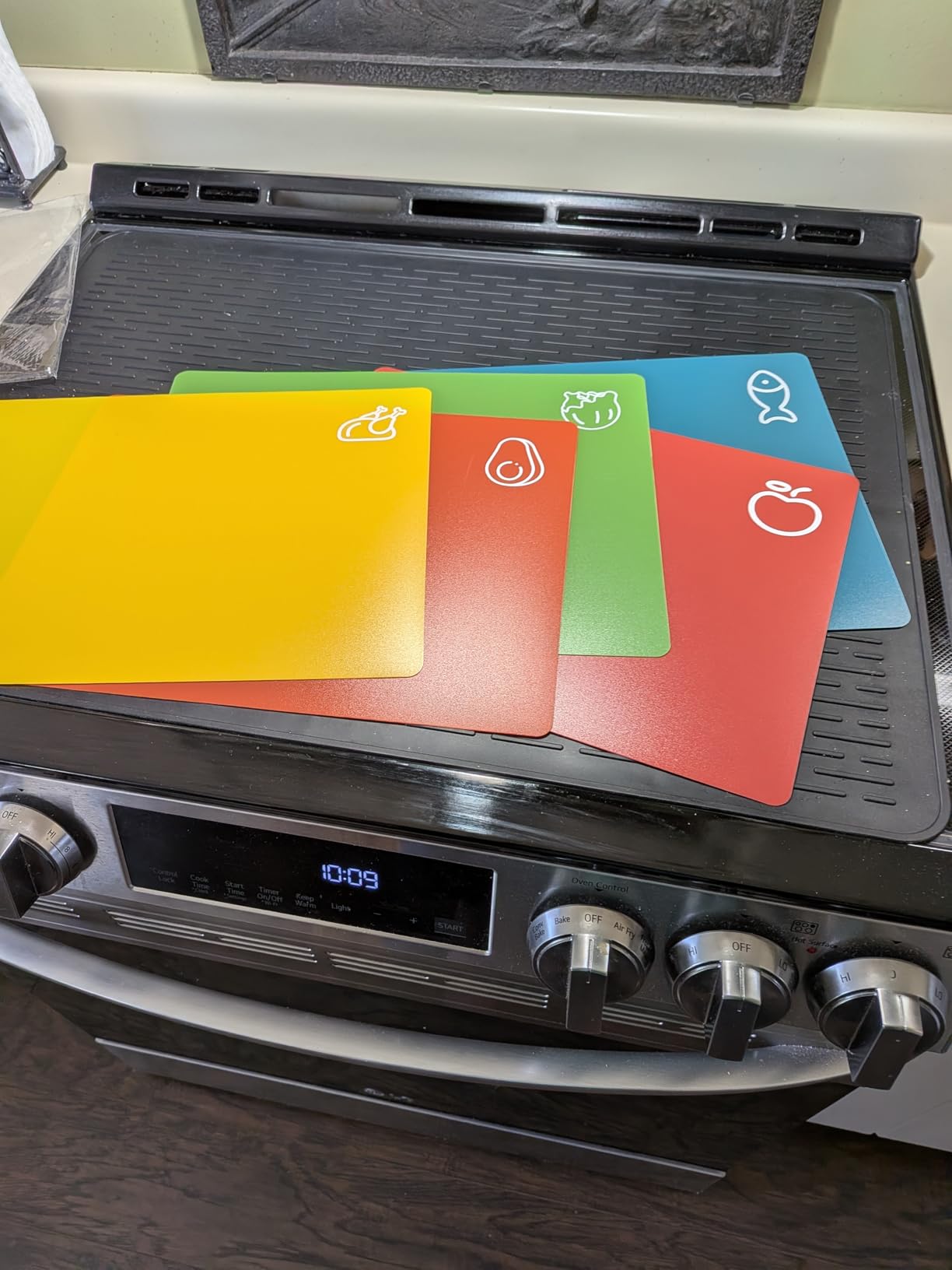
The flexibility is the killer feature. When I chop a pile of onions, I can pick up the mat, curl the edges, and pour the onions directly into my soup pot. No more scraping food off a rigid board with the side of my knife. This alone saves time and reduces the mess on my counter.
The main downside is the thinness. At 0.19 inches, these mats are not meant for heavy chopping or butchering. They work best for slicing and dicing with a chef’s knife using moderate pressure. Heavy cleaver work will damage them. The lattice pattern on the back provides some grip, but on smooth granite countertops, they can slide without a damp towel underneath.

Who should buy this set
The Goodluck set is perfect for anyone who wants a color-coded food safety system on a budget. It is also ideal for RVs, camping, small apartments, and vacation cooking where space is limited. If you hate transferring chopped food from board to pot, the flexibility of these mats solves that problem beautifully.
What to watch out for
These are cutting mats, not cutting boards. They will not protect your counter from heavy knife work the way a thick wooden board will. The plastic material does develop score marks over time, and while they are dishwasher safe, the heat can warp them if the water temperature is too high.
12. CADONO 5-Piece Flexible Plastic Cutting Mats
5 Pieces Flexible Plastic Cutting Board Mats with Food Icons, BPA Free Cutting Boards for Kitchen, Non Slip Cutting Mat for Meat and Vegetables (Red, Bright Yellow, Light Green, Purple, Lake Blue)
5-piece flexible plastic mats
15x12 inches each
BPA free
Dishwasher safe with food icons
Pros
- Food icons on each mat for easy identification
- BPA free food grade plastic
- Flexible design for pouring ingredients
- Non-slip grid backing
- Dishwasher safe
Cons
- Very thin at 0.04 inches
- May warp if stored rolled
- Limited to light cutting tasks
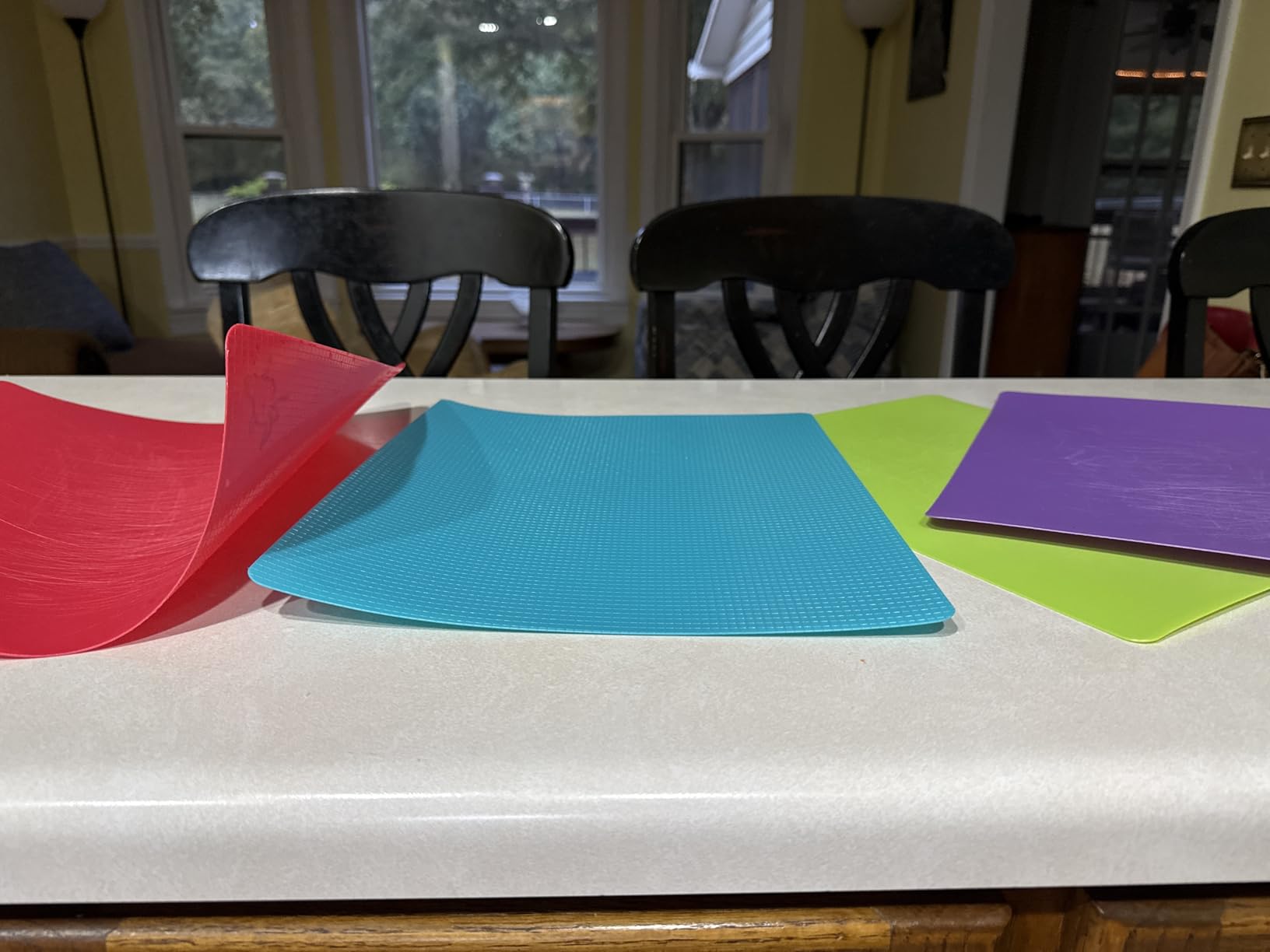
The CADONO mats are similar to the Goodluck set but with one key difference that I actually prefer: each mat has food icons printed on it. Instead of remembering that red means meat and green means vegetables, the icons show you exactly what each mat is for. It is a small detail, but it makes the color-coding system instantly understandable for anyone using your kitchen.
At 15 by 12 inches, these mats are slightly larger than the Goodluck set, which gives you a bit more working surface. The non-slip grid backing provides decent grip on most counters, though I still recommend a damp towel underneath for aggressive chopping.
I found these mats especially useful for outdoor cooking and camping. They weigh almost nothing, they pack flat, and you can use them on any surface. After a camping trip, I just ran them through the dishwasher and they came out clean and ready to use.
The 0.04 inch thickness is the thinnest of any board on this list. This is both a pro and a con. The thinness makes them extremely lightweight and flexible, but it also means they offer zero protection for your countertop underneath. I would not use these on a glass table or delicate surface without something underneath. They are also limited to light and medium cutting tasks.
Who should buy this set
The CADONO mats are ideal for anyone who wants the simplest possible food safety system. The food icons remove all guesswork. They are also perfect for camping, RV trips, dorm rooms, and any situation where you need lightweight, packable cutting surfaces for basic prep.
What to watch out for
These are the thinnest mats on this list and are only suitable for light to medium cutting. Do not use them for butchering, heavy chopping, or with cleavers. If stored rolled for long periods, they may retain a curved shape.
How to Choose the Best Cutting Board
Choosing from the best cutting boards available comes down to understanding the strengths and weaknesses of each material. I want to give you a clear framework for making that decision based on how you actually cook.
Wood vs Plastic vs Composite vs Bamboo vs Glass
Wood cutting boards are the gold standard for knife-friendliness and natural beauty. Hardwoods like maple, walnut, and teak have a closed-grain structure that resists bacteria absorption. End-grain boards, where the wood fibers face upward, allow knife edges to slip between fibers rather than cutting through them. This self-healing property means end-grain boards develop fewer permanent scars.
The trade-off is maintenance. Wooden boards require regular oiling with food-grade mineral oil or board butter, must be hand-washed, and can warp or split if exposed to excessive moisture or temperature changes. They are also heavier and more expensive than other materials.
Plastic cutting boards are the practical choice for raw meat prep because they can go in the dishwasher. However, recent research has raised concerns about microplastics. Studies show that cutting on plastic boards releases microplastic particles into food. Wirecutter is the only major competitor that addresses this topic in depth, and the concern is growing among health-conscious consumers.
The deep scratches that plastic boards develop over time can also harbor bacteria that survive hand-washing. Dishwasher sanitizing helps, but eventually the board becomes too scarred to clean effectively. Plan to replace plastic boards every 1 to 2 years.
Composite cutting boards like the Epicurean and toptier boards offer the best of both worlds. They are non-porous like plastic but made from wood fibers or paper composite rather than petrochemicals. They are dishwasher safe, do not require oiling, and do not produce microplastics. The main drawback is that they lack the beauty and warmth of solid wood.
Bamboo cutting boards are affordable, lightweight, and environmentally renewable. However, bamboo is technically a grass and is significantly harder than most hardwoods. This hardness can dull knife edges faster than maple or walnut. Bamboo boards also tend to be thinner and more prone to splitting if not properly maintained.
Glass cutting boards are the most hygienic option because the non-porous surface cannot absorb bacteria, odors, or stains. However, glass dulls knives faster than any other material. Glass boards are best used as serving pieces, allergy-management tools, or secondary boards for specific uses rather than primary cutting surfaces.
End-Grain vs Edge-Grain Explained
This distinction only applies to wooden boards, but it matters a lot for both knife health and board durability. End-grain boards are constructed so the wood fibers face upward, like the end of a 2×4. When your knife comes down, the edge slips between the wood fibers rather than severing them. This is called a self-healing surface because the fibers close back up after the knife passes.
Edge-grain boards have the wood fibers running horizontally. Your knife cuts across the fibers, which creates visible cut marks on the surface. Edge-grain boards are less expensive to manufacture and still perform well, but they show wear more quickly than end-grain boards.
For everyday home cooking, a quality edge-grain board from a brand like John Boos or Teakhaus will serve you well. If you own expensive knives and want maximum edge protection, an end-grain board is worth the investment.
Microplastics and Food Safety
This is the topic that most competitors gloss over, but it is increasingly important to consumers. Every time you cut on a plastic board, you are generating microplastic particles that end up in your food. A 2023 study published in Environmental Science and Technology found that plastic cutting boards can shed millions of microplastic particles per year in a typical kitchen.
The health implications of ingesting microplastics are still being studied, but early research suggests potential links to inflammation, hormone disruption, and other health concerns. If this worries you, the best strategy is to switch from plastic to wood or composite boards for your everyday cutting.
For raw meat prep where dishwasher sanitizing is important, composite boards like the Epicurean and toptier offer a non-plastic, dishwasher-safe alternative. This gives you the food safety of dishwasher cleaning without the microplastics concern.
Cross-Contamination and Board Strategy
The consensus among food safety experts is simple: use separate boards for raw meat and everything else. Reddit users on r/BuyItForLife and r/Cooking consistently recommend a two-board minimum. My recommendation, based on testing, is a three-board system.
Board one should be a wood or composite board for vegetables, fruits, bread, and cheese. Board two should be a dishwasher-safe plastic or composite board dedicated to raw meat, poultry, and fish. Board three, if you have space, should be a small board for alliums like garlic and onions, which can leave persistent odors on wood.
Color-coded mats like the Goodluck or CADONO sets are an affordable way to implement this system without buying multiple expensive boards. Use the colored mats for raw protein prep and your nicer board for everything else.
Cutting Board Care and Maintenance
Proper care extends the life of any cutting board. For wooden boards, oil every 2 to 4 weeks with food-grade mineral oil or a board butter blend. Apply a generous coat, let it soak in for at least an hour, and wipe off any excess. In dry climates, you may need to oil weekly during winter months when indoor heating reduces humidity.
Never put a wooden board in the dishwasher, never soak it in water, and never leave it sitting in a pool of liquid on the counter. Clean wooden boards by wiping with a damp cloth and mild soap, then drying immediately. For sanitizing, a solution of one part white vinegar to five parts water works well.
Composite and plastic boards are simpler. Run them through the dishwasher on a hot cycle. If you do not have a dishwasher, wash with hot soapy water and sanitize with a diluted bleach solution of one tablespoon bleach per gallon of water.
To remove stains from any board, sprinkle coarse salt on the surface and scrub with half a lemon. This natural method lifts stains and deodorizes without harsh chemicals. For deep-set odors like garlic or onion, a paste of baking soda and water applied for 30 minutes before washing usually does the trick.
How We Tested These Cutting Boards
I tested each of these 12 cutting boards over a period of three months in my home kitchen. My testing process included daily vegetable prep, weekly raw meat preparation, and monthly heavy-duty tasks like carving roasts and breaking down whole chickens.
I evaluated each board on five criteria. Knife-friendliness was measured by honing my chef’s knife before each board test and checking edge retention after two weeks of daily use. Ease of cleaning assessed how easily the board could be washed, sanitized, and dried. Durability tracked how the board held up over the testing period, including surface wear, staining, and structural integrity. Stability measured whether the board stayed put during aggressive chopping. Maintenance burden evaluated how much ongoing care each board required.
I also ran a beet juice test on each board to assess staining, a garlic odor test to check odor retention, and a water resistance test by leaving a small pool of water on the surface for 10 minutes. These tests mirror the methodology used by Wirecutter and Serious Eats, which I found to be the most rigorous testing approaches among competitors.
FAQs
What is the best cutting board material?
Hard maple and teak are widely considered the best overall cutting board materials for home cooks due to their durability, knife-friendliness, and natural bacteria resistance. For raw meat prep, NSF-certified composite or plastic boards are preferred for easy dishwasher sanitizing. End-grain maple is the top choice for protecting expensive knife edges.
What cutting boards do most professional chefs use?
Professional chefs most commonly use end-grain hardwood boards like maple or walnut for vegetable prep and NSF-certified plastic or rubber boards for raw protein preparation. John Boos maple boards and Hasegawa rubber boards are industry standards in restaurant kitchens. Many chefs keep separate boards for different food types to prevent cross-contamination.
Do wooden cutting boards harbor bacteria?
No, properly maintained wooden cutting boards do not harbor dangerous levels of bacteria. Research from the University of Wisconsin found that wooden boards actually kill bacteria that penetrate their surface, while plastic boards allow bacteria to persist in deep knife cuts. The key is proper cleaning and drying after each use.
How often should you oil a cutting board?
Oil wooden cutting boards every 2 to 4 weeks under normal use. In dry climates or during winter when indoor heating reduces humidity, oil weekly. Apply food-grade mineral oil or board butter generously, let it soak in for at least one hour, then wipe off excess. A board that looks dry or pale needs oiling.
Are bamboo cutting boards good for knives?
Bamboo cutting boards are not ideal for expensive knives because bamboo is harder than most hardwoods and can dull edges faster than maple or walnut. Bamboo works fine for everyday stainless steel knives, but if you own premium Japanese or high-carbon steel blades, choose an end-grain maple, walnut, or teak board instead.
What is the best cutting board for raw meat?
The best cutting board for raw meat is a dishwasher-safe composite or plastic board that can be fully sanitized after use. The Epicurean composite board and toptier wood fiber board are excellent non-plastic options. Color-coded mats like the Goodluck or CADONO sets also work well for dedicated raw protein prep.
Do plastic cutting boards release microplastics?
Yes, plastic cutting boards shed microplastic particles into food during cutting. Research indicates a typical plastic board can release millions of microplastic particles per year. To reduce exposure, switch to wood, composite, or bamboo boards for everyday use and reserve plastic boards for raw meat prep where dishwasher sanitizing is necessary.
What size cutting board is best for home cooking?
The best cutting board size for home cooking is between 15×10 and 18×12 inches. This provides enough space for comfortable chopping without being so large that it becomes difficult to clean and store. For small kitchens, a 12×8 inch board works for most tasks. Serious home cooks benefit from having a large primary board and a smaller secondary board.
Final Thoughts on the Best Cutting Boards for 2026
After three months of testing 12 boards across every major material, my recommendations are clear. The Sonder Los Angeles Laurel Teak board is the best overall cutting board for cooks who want beauty, performance, and durability in one package. The Epicurean composite board is the best value for anyone who wants dishwasher-safe convenience without microplastics. And the Hiware bamboo board proves you do not need to spend much to get a large, functional cutting surface.
The most important takeaway from my testing is that no single board does everything perfectly. The best approach for most home cooks is to have at least two boards: a quality wood or composite board for everyday vegetable and fruit prep, and a dishwasher-safe board dedicated to raw meat. This gives you the knife-friendliness of wood for daily cooking and the food safety of dishwasher sanitizing for protein prep.
Whatever you choose from this list of the best cutting boards available in 2026, the investment will pay off every single time you cook. A good cutting board is the foundation of an efficient kitchen, and the right one will serve you for years with proper care.