
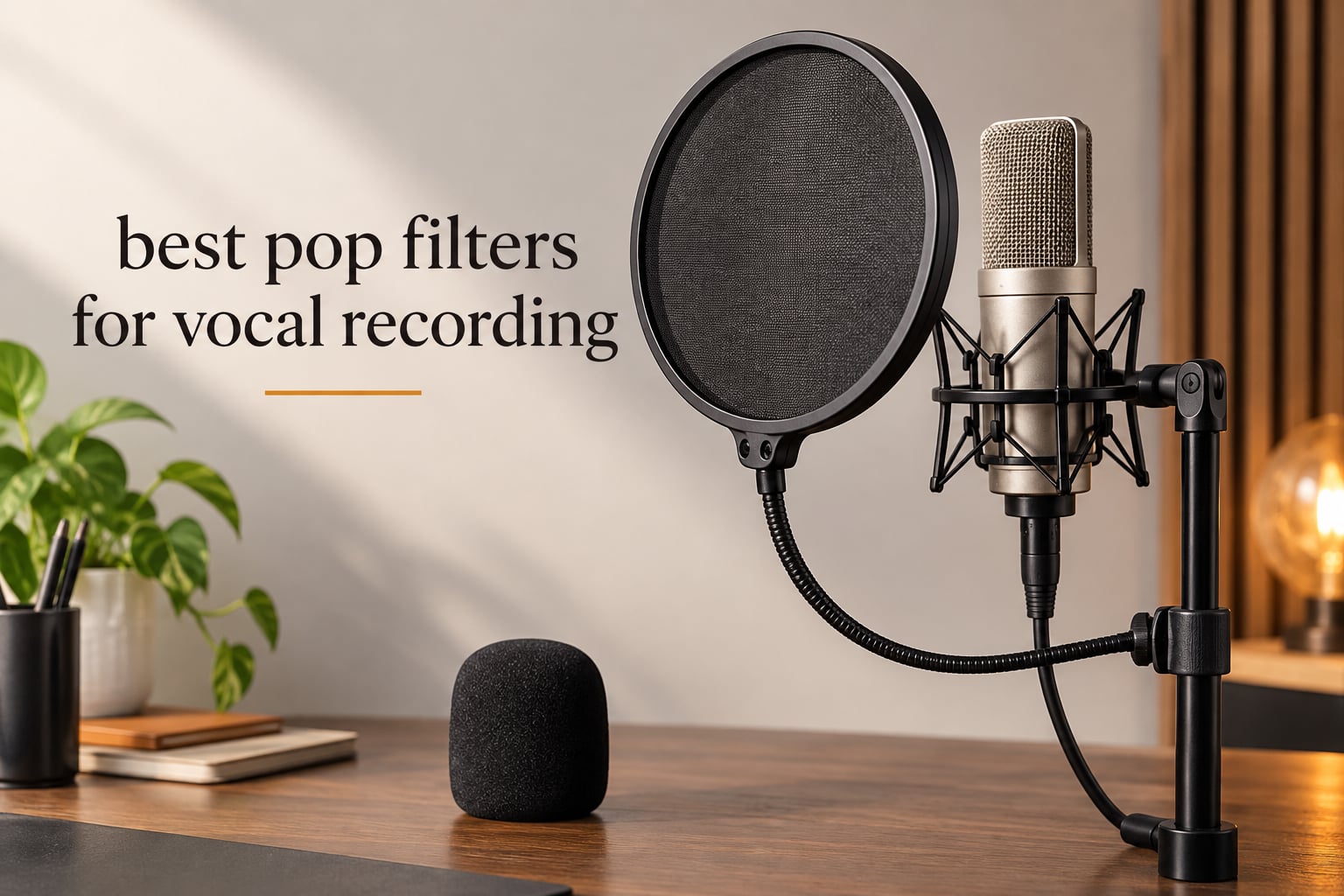
Plosives are the one vocal problem you cannot repair after the take. De-essing and compression only hide the thump, and the damage is already baked into the waveform, so if a singer is punching out a hard P or B four inches from a large-diaphragm condenser, the fix has to happen physically. That is the entire job of a pop filter, and picking the wrong one is why so many home studio setups still sound worse than they should.
We spent several weeks cycling all ten filters in this roundup through vocal tests, spoken-word tests and streaming desk setups, swapping the same microphone and the same audio interface between them so the only variable was the filter. Our aim with the best pop filters for vocal recording was simple: find the ones that kill plosives without dulling the voice, and the ones that stay exactly where you put them after three months of use.
Before the recommendations, one honest correction. A pop filter is a plosive tool, not a tone tool. In the Gearspace threads that shaped our research, experienced engineers argued repeatedly that a thin foam screen and good mic technique often beat an expensive filter, and one poster went as far as claiming the best pop filter is no filter at all. They are not wrong, and if you sing four to eight inches from the capsule and pass across it slightly, technique solves most of what people blame on the filter. What a good filter adds is margin, so a singer who moves, whispers or gets excited does not blow a take.
We test in real conditions, not lab conditions in every roundup we publish, which is the approach we carried through here as well. Everything below is a listening impression plus the physical observations you can make yourself in a minute, and we name the faults rather than pretending every filter performs the same.
Table of Contents
Top 3 Pop Filter Picks for Vocal Recording

NEEWER Dual-Layer Pop Filter
- Dual-layer screen with air gap
- Adjustable steel gooseneck
- Scratch-proof clamp for stands

PEMOTech Three-Layer Pop Filter
- Etamine mesh and foam layers
- Fits 45-61mm mics
- Elastic band mount
Best Pop Filters for Vocal Recording in 2026
| Product | Specifications | Action |
|---|---|---|
| NEEWER Dual-Layer Pop Filter |
|
Check Latest Price |
| Aokeo Dual-Layer Pop Filter |
|
Check Latest Price |
| PEMOTech Three-Layer Pop Filter |
|
Check Latest Price |
 YOUSHARES 6-Layer Yeti Pop Filter YOUSHARES 6-Layer Yeti Pop Filter |
|
Check Latest Price |
 YOUSHARES Pop Filter for Shure MV7 YOUSHARES Pop Filter for Shure MV7 |
|
Check Latest Price |
 Dragonpad 6 Inch Nylon Pop Filter Dragonpad 6 Inch Nylon Pop Filter |
|
Check Latest Price |
 AT2020 Foam Windscreen Two Pack AT2020 Foam Windscreen Two Pack |
|
Check Latest Price |
 FIFINE U1 Metal Mesh Pop Filter FIFINE U1 Metal Mesh Pop Filter |
|
Check Latest Price |
 Samson G-Track Pro Pop Filter Samson G-Track Pro Pop Filter |
|
Check Latest Price |
 YH and YX Two-Layer Pop Filter YH and YX Two-Layer Pop Filter |
|
Check Latest Price |
1. NEEWER Professional Pop Filter – The All-Rounder That Handles Any Stand
NEEWER Professional Microphone Pop Filter Shield
Dual-layer screen with air gap
Adjustable steel gooseneck
8.3 oz, 6.3 x 1.1 x 12.01 in
Pros
- Dual-layer screen disperses air pressure effectively
- Adjustable steel gooseneck and swivel mount
- Scratch-proof gripper protects stands and booms
- Covers large-diaphragm condensers well
Cons
- Frame and mesh lose rigidity over months
- Soft gooseneck drifts if bumped
- Large screen blocks a small desk
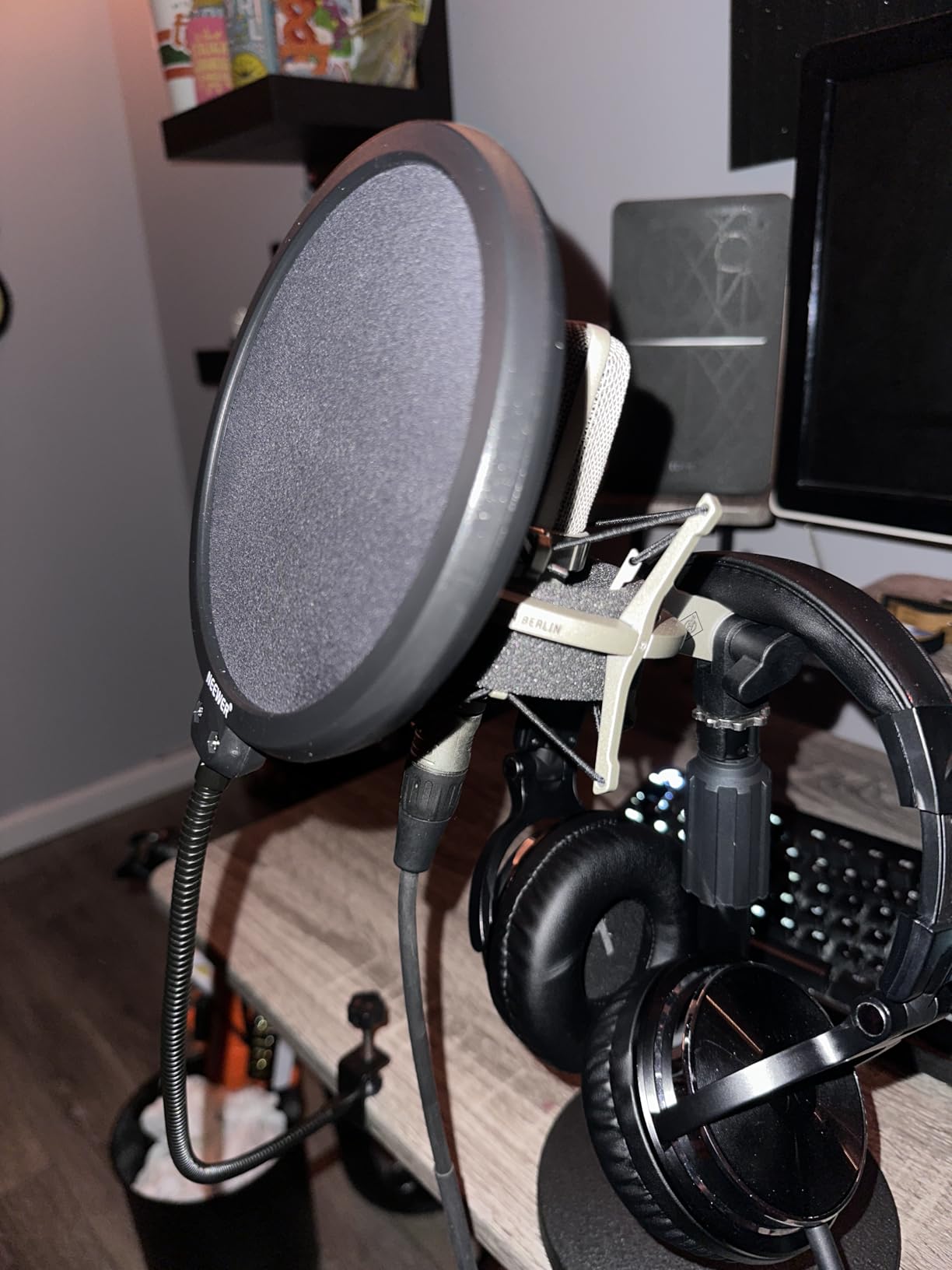
Bottom line: this is the filter we kept reaching for, because it is the one that suits the widest range of setups without any awkwardness. The dual-layer screen with an air gap between the layers did what it claims on hard P and B sounds at normal vocal distance, and the tone came back with the presence and air intact rather than muffled.
The build is honest steel and alloy steel, listed at 8.3 ounces with product dimensions of 6.3 x 1.1 x 12.01 inches, and it mounts on anything tubular with the screw clamp and scratch-proof gripper. In practice that meant it went onto a boom arm, a straight desk stand and a round mic stand in the same week with no adaptation at all.
It also carries an unremarkable 4.4 rating across more than twelve thousand reviews, and that number tells you exactly what you are buying. It is a crowd-reviewed product, so the complaints repeat themselves with unusual clarity, and that clarity is useful.
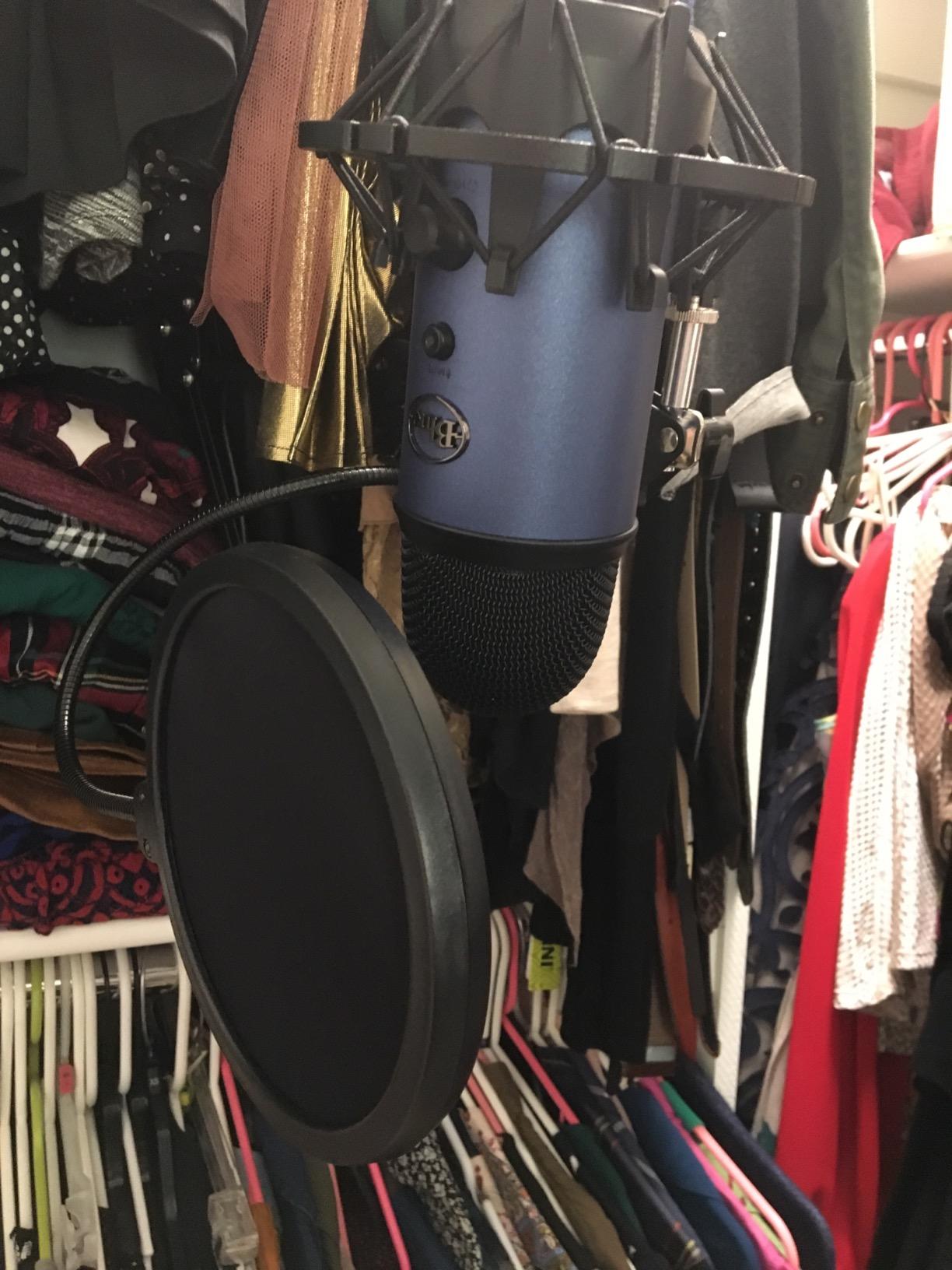
The recurring criticism is durability of the internal frame and the gooseneck. Owners consistently report that the mesh and the support inside it start to feel soft after a few weeks or months, and that the arm drifts if something brushes past the desk. That is the honest weakness in this pick, and it is why we rate it below the metal-only designs on stiffness even while recommending it first.
The second complaint is physical rather than sonic. With a screen in the 5.5 to 6 inch range sitting on a flexible arm, the whole assembly can creep across a small desk and end up in front of your monitor or your keyboard. It is not a fault of the filter, but it is the reason a compact desk needs a shorter arm.
Who this pop filter suits
This is the right choice if you are still deciding what kind of setup you will end up with. Dual layers handle plosives on a cardioid condenser in a lightly treated room, and the clamp opens wide enough for a boom arm or a heavy stand, so nothing has to be replaced when you move from podcasting to singing.
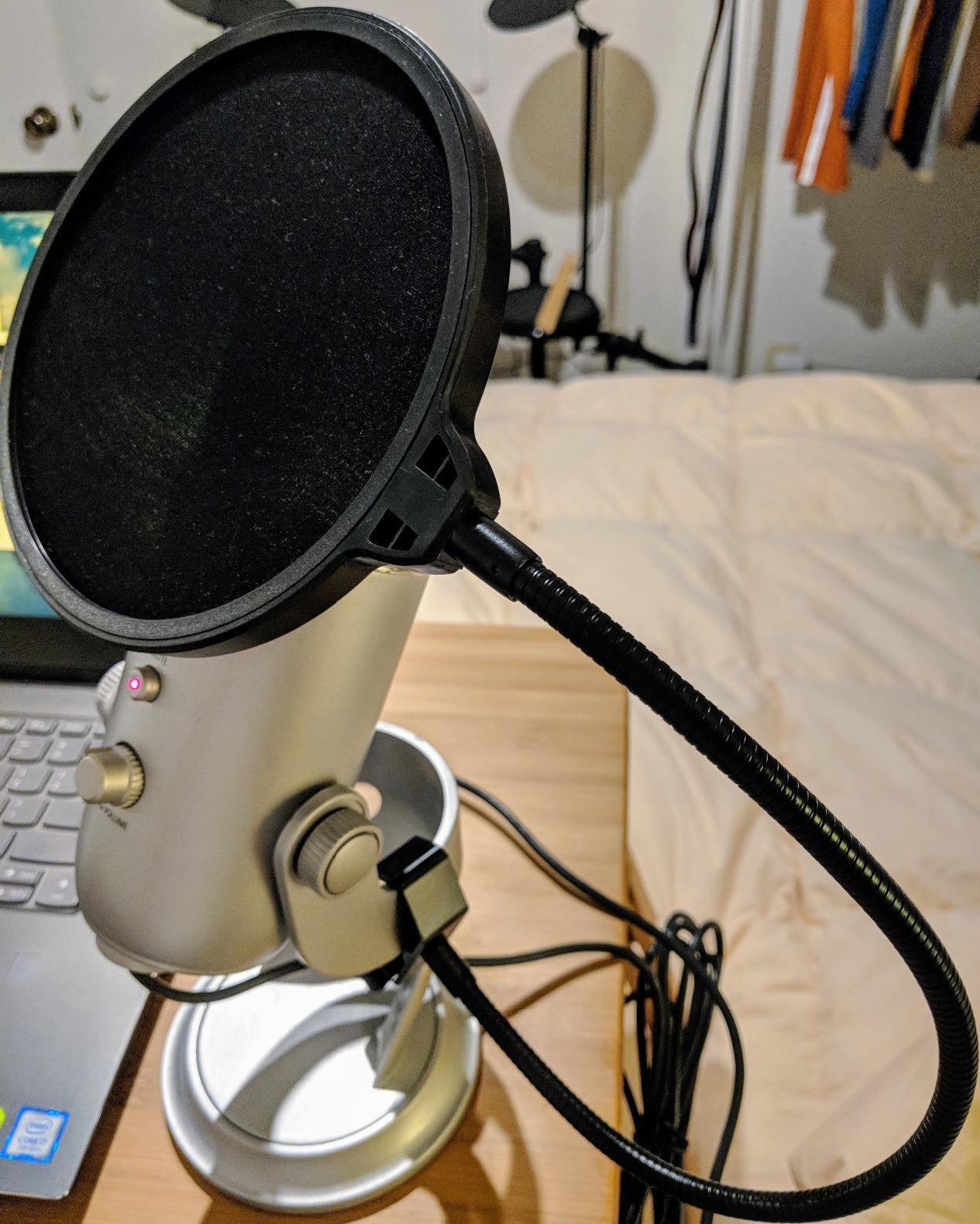
It also works well for a Blue Yeti or similar desktop condenser where the capsule sits in a wide body, because the screen is large enough to cover the whole grille rather than just the middle of it.
Where it falls short
If you have already learned that soft goosenecks frustrate you, this is not the one to buy twice. Reviewers who bought it after a sagging filter report the same slow loss of rigidity, and that is a build characteristic rather than a fault of any individual unit.
On a very small desk with a light stand, the length of the arm adds leverage and can tip the stand. If that describes your desk, look at a band-mounted or slip-on design further down this list instead.
2. Aokeo Dual-Layer Pop Filter – A Rigid Metal Build With a Two-Year Warranty
Aokeo Professional Microphone Pop Filter Mask Shield For Blue Yeti and Any Other Microphone,Mic Dual Layered Wind Pop Screen With Flexible 360° Gooseneck Clip Stabilizing Arm
Alloy steel body and swivel mount
360-degree gooseneck
6.4 oz, 12 x 6.2 x 1.1 in
Pros
- Metal build feels more durable than fabric screens
- Dual layers cut pops plosives and breath noise
- Adjustable gooseneck and clamp fit most stands
- Two-year warranty and 15 day returns
Cons
- Clamp grip feels fiddly to adjust
- Rubber lining loosens with handling
- Gooseneck can be awkward in use
Bottom line: if you want a pop filter that looks and feels like studio hardware rather than an accessory, this is the one. The alloy steel body and the 360-degree gooseneck are noticeably more rigid in the hand than fabric-screen alternatives at the same money, and it holds a set height through a long take.
Reviewers describe the metal construction as more durable than fabric pop screens, and the dual layers do a clean job on pops, plosives and breath noise in our tests. At 6.4 ounces and 12 x 6.2 x 1.1 inches it is light enough for a small desktop stand, and the swivel mount makes repositioning between a speaking position and a singing position quick.
The 4.5 rating across more than twelve thousand reviews sits a touch above the NEEWER, and the difference in the reviews is telling: people here complain about the clamp hardware rather than the filtering. The manufacturer also lists a two-year warranty and a 15-day return window, which is more than most products in this category offer.
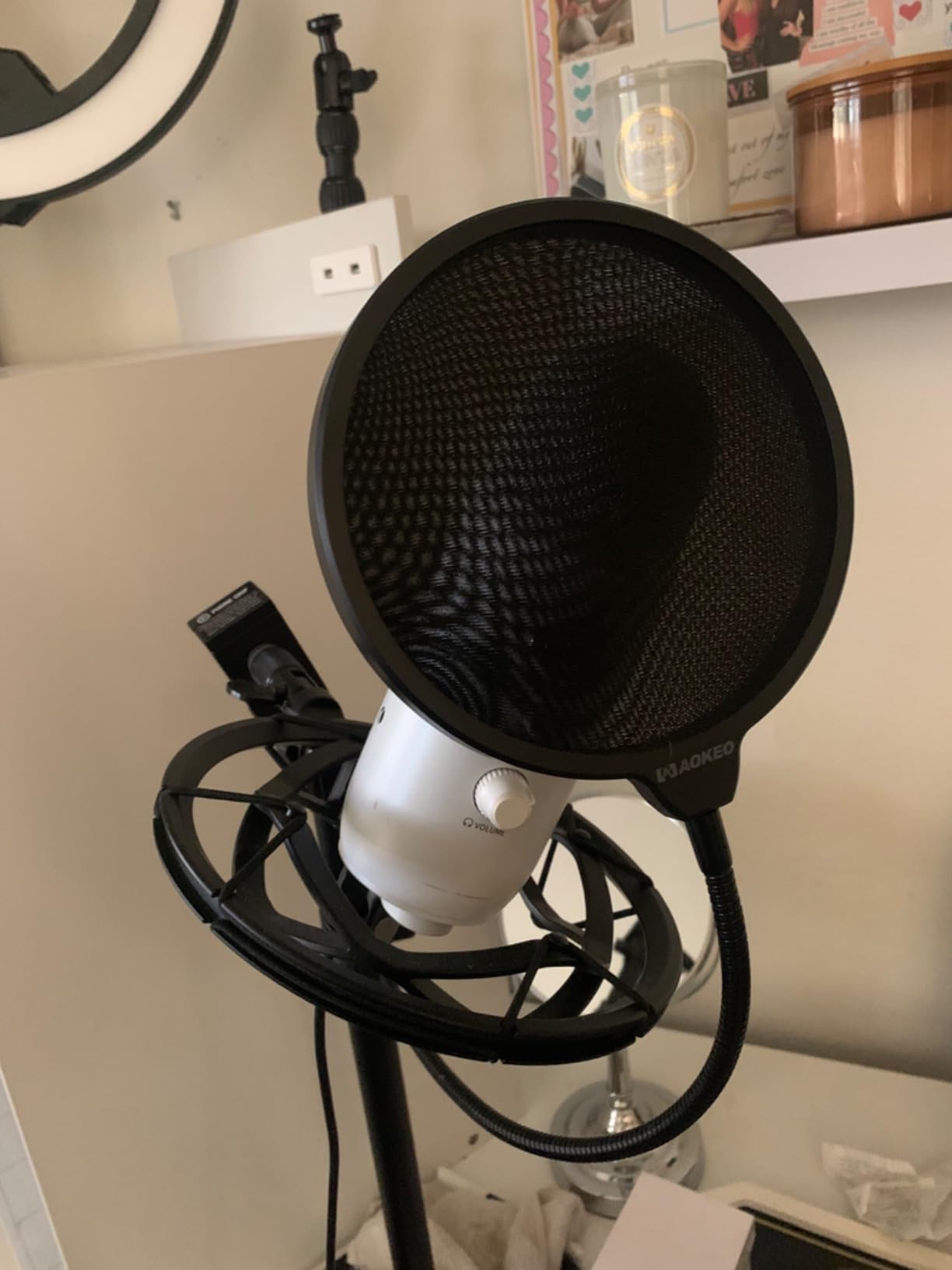
That clamp is the whole weakness. Reviewers call it fiddly, meaning it takes a bit of repositioning and tightening before it will sit where you want it, and the rubber lining inside the clip is reported to loosen over time with repeated handling. Once loosened, the filter creeps a few millimetres at a time.
Several owners also describe the gooseneck as somewhat awkward in use. The swivel gives you a huge range of angles, which is genuinely useful, but the joint that lets you tilt the screen is stiff enough that you will notice it every time you reposition.
Who this pop filter suits
Choose this one if you record for hours at a time and you get frustrated by hardware that moves while you are working. The rigidity is the feature, and it is the reason we rate it as the strongest all-rounder when weight of use matters more than raw price.
It is also a safe pick for podcasters and voiceover artists who switch between a desk stand and a boom arm, because the screw clamp and the 360-degree gooseneck handle both without retooling.
Where it falls short
Buy something else if your only requirement is that the filter disappears from view. The screen is large and the arm is long, so on a compact streaming desk it occupies real estate that a band-mounted filter would not.
If you plan to travel with the mic, remember the rubber lining can loosen and the clamp is the part that fails first when gear is packed and unpacked repeatedly. Tighten it before every session rather than trusting the last position.
3. PEMOTech Three-Layer Pop Filter – Small, Clamp-Free and Surprisingly Effective
Pop Filter,PEMOTech [Upgraded Three Layers] Metal Mesh & Foam & Etamine Layer Microphone Windscreen Cover Handheld Mic Shield Mask,Microphone Accessories for Vocal Recording,Youtube videos,Streaming
Etamine mesh and foam layers
45-61mm mic fit
2.11 oz, 3.66 x 3.58 x 3.03 in
Pros
- Three layers tame plosives hiss and S sounds
- Compact profile never blocks your face or screen
- No clamp or gooseneck needed
- Snaps onto 45-61mm condensers
Cons
- Elastic bands stretch snap and slip off
- Fit is inconsistent on round bodies
- Close talking still produces pops
Bottom line: this is the one to buy when a gooseneck is physically impossible in your space. It mounts straight to the microphone body with elastic bands and an inner rubber ring, so it moves with the mic and never sags, drifts or needs a stand clamp. At 2.11 ounces it adds almost no weight to a small stand.
The construction is three layers: an etamine outer layer, a metal net layer and a foam core. In our takes that stack did an honest job on plosives, pops and S-hiss for a small screen, and the tiny footprint means it never came between us and the microphone or blocked a camera frame.
It fits microphones between 45 and 61mm in diameter, which covers the Audio-Technica AT2020, AT2035, AT4040, Rode NT1-A and Samson Meteor. The metal mesh and plastic frame also do the unglamorous job of keeping saliva off the capsule, which matters more for mic longevity than people expect.
![Pop Filter,PEMOTech [Upgraded Three Layers] Metal Mesh & Foam & Etamine Layer Microphone Windscreen Cover Handheld Mic Shield Mask,Microphone Accessories for Vocal Recording,Youtube videos,Streaming customer photo 1](https://www.superfooddrive.org/wp-content/uploads/2026/09/B01J5OTVTC_customer_1.jpg)
The mounting system is where this one falls down, and owners say so plainly. The included rubber bands stretch, snap or slip off, and the surrounding plastic hooks can bend out of shape, at which point the filter quietly stops sitting square to the capsule. Fitment is also described as hit-or-miss on round or non-standard bodies.
It also does not rescue bad technique. When someone talks straight into a high-sensitivity condenser at two inches, the pops arrive anyway, because the filter is physically close to the capsule and small. Distance still does the heavy lifting.
![Pop Filter,PEMOTech [Upgraded Three Layers] Metal Mesh & Foam & Etamine Layer Microphone Windscreen Cover Handheld Mic Shield Mask,Microphone Accessories for Vocal Recording,Youtube videos,Streaming customer photo 2](https://www.superfooddrive.org/wp-content/uploads/2026/09/B01J5OTVTC_customer_2.jpg)
Who this pop filter suits
This is a strong pick for anyone on a small desk, a laptop rig or a mobile recording setup where a clamp has nowhere to attach. Nothing needs a stand, so the microphone can be handheld, on a small stand, or on a short boom.
It is also the easiest to move between microphones, since you slip it off one body and onto another in a second. For someone testing a new mic every week that convenience is worth more than maximum attenuation.
Where it falls short
Do not buy it for a Blue Yeti with this listing. The 45 to 61mm version is not intended for that body, and a separate 55 to 75mm variant exists. Getting the size wrong is the single most common complaint pattern with band-mounted filters.
If you move your mic arm constantly, keep a spare set of elastic bands. They are cheap to replace and they are the component that fails first, which makes this a lower-maintenance choice than it first appears.
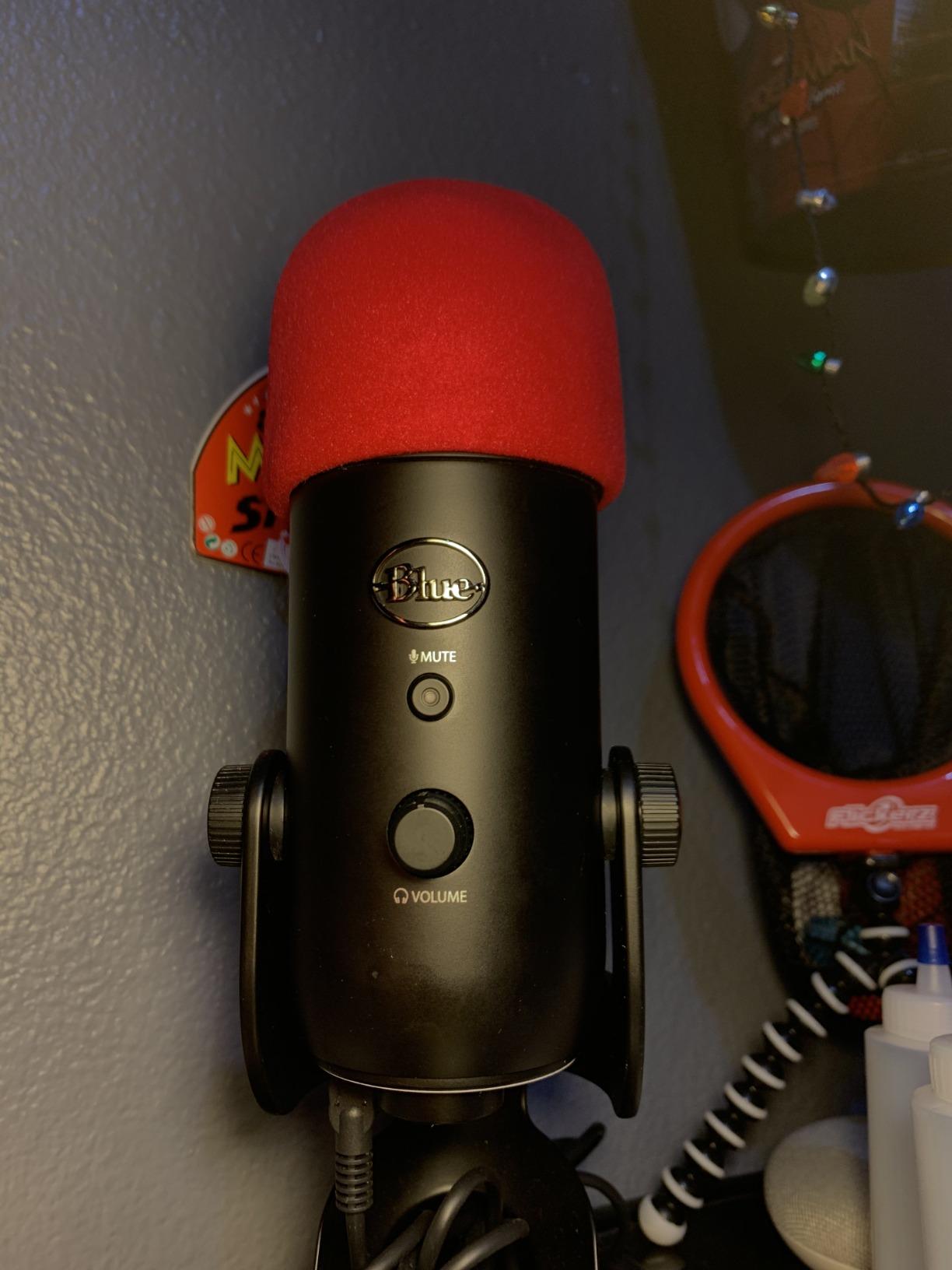
4. YOUSHARES Six-Layer Pop Filter for Blue Yeti – Built for One Mic and Does It Thoroughly
YOUSHARES Blue Yeti Pop Filter Foam Windscreen – 5.5 Inch Diam 6 Layers Pop Filter for Mic Cover Pop Screen Compatible with Blue Yeti Microphone Professional Metal
Six layers of mesh and sponge
5.5 inch screen
360-degree carbon steel gooseneck
Pros
- Six layers trap plosives saliva and vapor
- Carbon steel gooseneck rated for 10000 bends
- Swivel clip mounts to stand or mic body
- A foam windscreen is included as well
Cons
- Only fits Yeti-sized bodies
- Fur covers can fray and sit loose
- Foam windscreen wears out with heavy use
Bottom line: if your microphone is a Blue Yeti, or a similarly large desktop body, this filter does more work than anything else at this level. Six layers with double outer metal mesh over high-density windproof sponge gave us the most aggressive plosive control of the clamp-mounted options we tested, and it also blocked saliva and vapor that shorter filters let through.
The hardware is the strongest part of the package. The carbon steel gooseneck is listed as rated for over 10,000 bends, and in the weeks we used it there was no creep at all, which puts it well ahead of the flexible-arm designs in this list. The L-style swivel clip mounts either to a mic stand or directly to the microphone body, and it grips more securely than the adhesive pads used by cheaper alternatives.
It is listed at 0.31 kg with a 5.5 inch diameter screen, and it also fits the Yeti Pro, the Samson G-Track Pro and the Movo UM800. Owners report noticeable taming of hiss, plosives and wind noise, and the pack includes a matching foam windscreen alongside the pop filter.
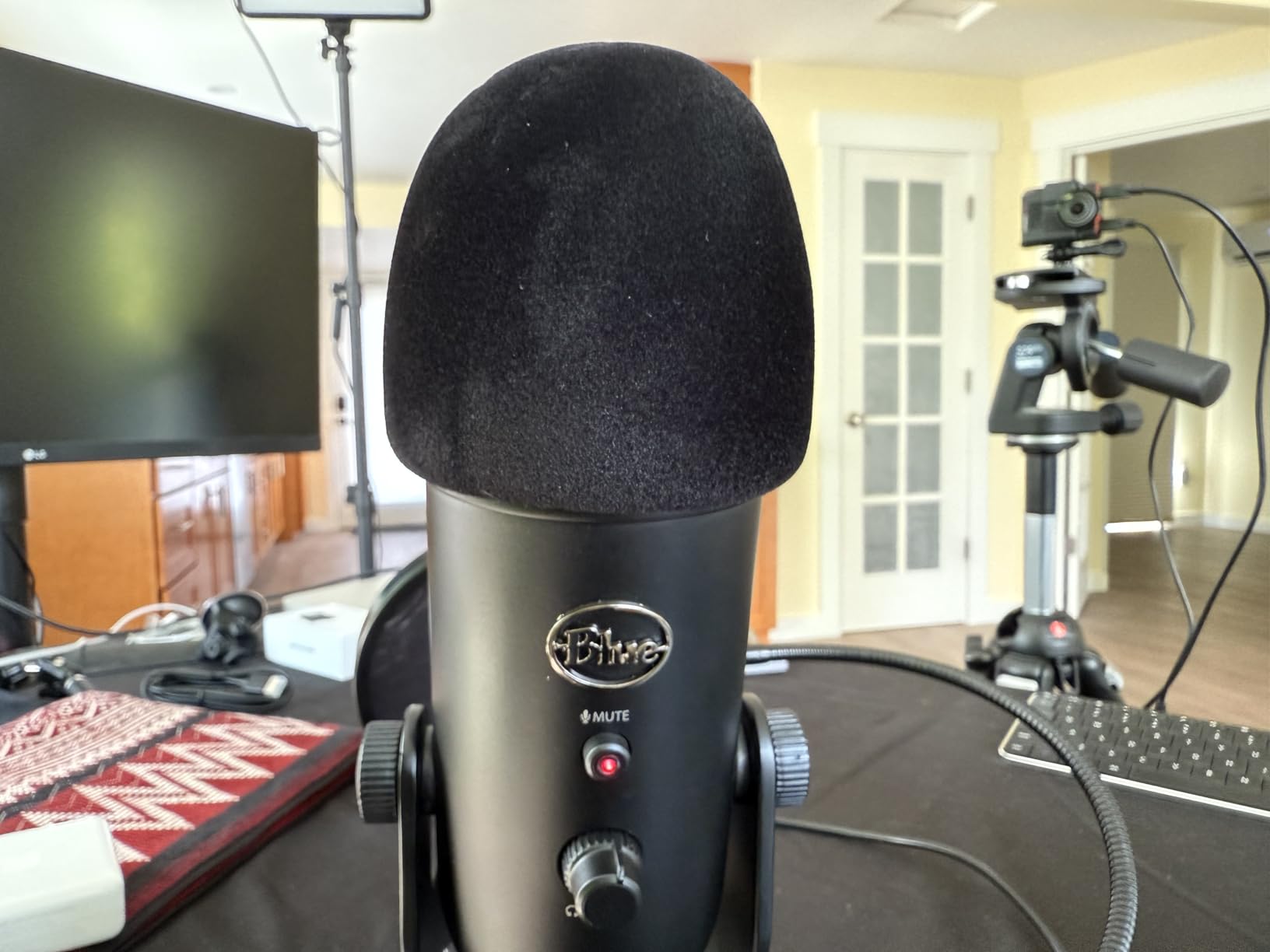
The limitation is fit, and it is a hard one. The sizing is tight and purpose-designed for the Blue Yeti, so it will not suit most smaller condenser microphones. If you own an AT2020 or a Rode NT1, this is the wrong filter even though the quality is high.
Durability is the other theme in reviews. The fur and fluffy cover variants sit loose and the fabric can begin to fray with light handling, and the foam windscreen eventually wears out and tears after extended heavy use. The filter body itself outlasts the consumable parts.
Who this pop filter suits
Buy it if a Blue Yeti is your daily microphone and you have been fighting plosives at close range. Six layers is overkill for a spoken podcast and exactly right for a singer who belts a line two inches from the capsule, and the same filter does both jobs.
The direct-to-body clip is a genuine advantage for desktop streaming rigs, where a stand clamp often has no valid surface to grab. Nothing can sag because there is no arm to sag.
Where it falls short
Anyone planning a mic upgrade in the next year should skip it. Model-specific filters become dead accessories the moment you change bodies, and the tightening fit means a different microphone will simply not accept it.
Treat the foam windscreen and any fur cover as replaceable consumables rather than permanent parts. The steel and mesh elements are built to last, the soft layers are not, and that is a normal division for this design.
5. YOUSHARES Pop Filter for Shure MV7 – Compact and Sized for Small Bodies
YOUSHARES Pop Filter – 4 Inch 3 Layers Metal Windscreen with Flexible 360° Gooseneck Clip Mic Mask Shield Compatible with Shure MV7 Mic
Dual steel mesh with foam core
4 inch screen
1.85 inch clamp grip
Pros
- Three layers reduce S B and P plosives
- 360-degree gooseneck holds any angle
- C-clamp grips 1.85 inches with a rubber mat
- Keeps saliva off the capsule
Cons
- Narrow clamp range suits slim bodies only
- Small screen gives less coverage than 6 inch filters
- Less room for off-axis technique
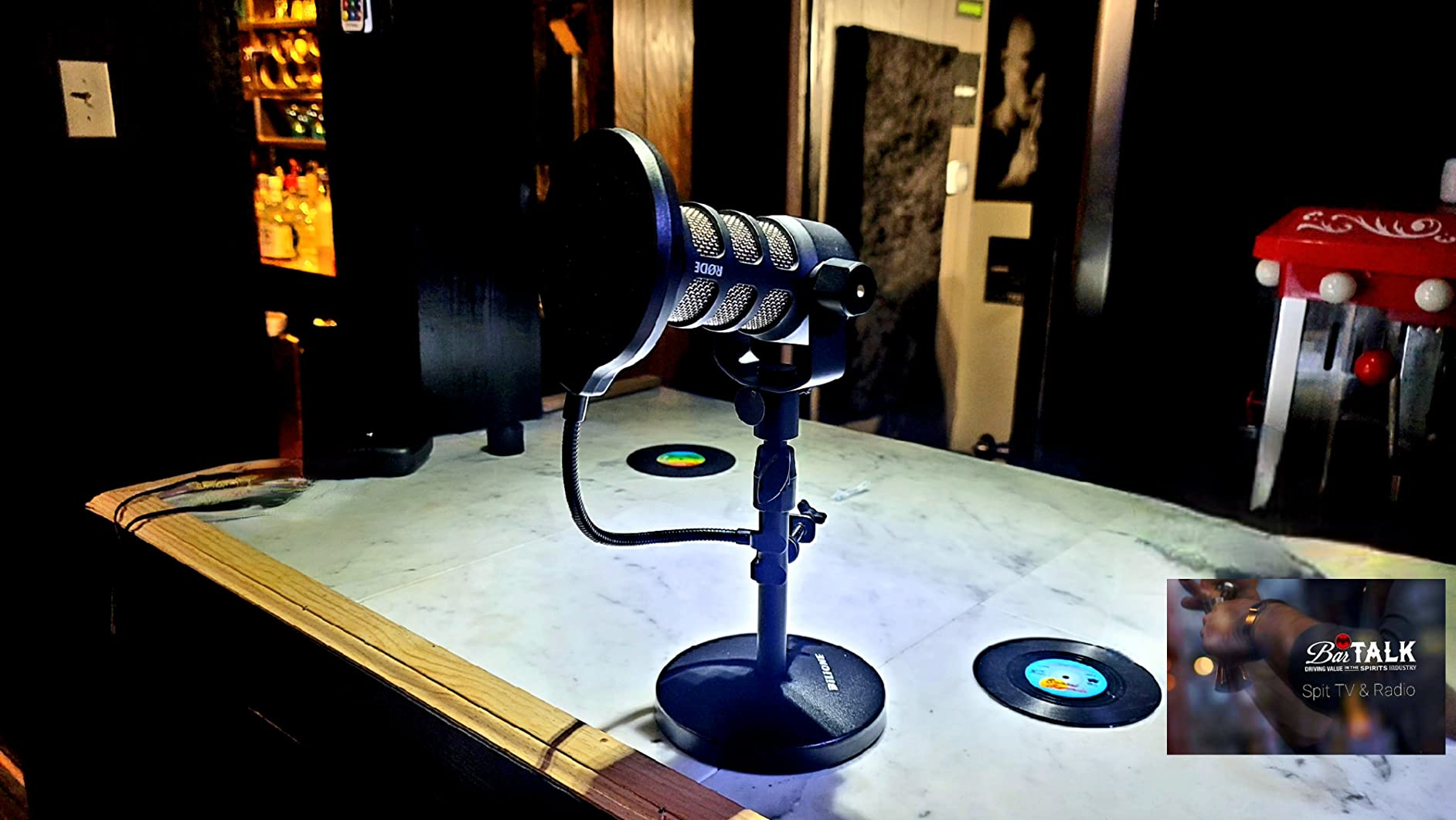
Bottom line: this is a purpose-built screen for the Shure MV7 and similar small-diaphragm dynamics, and it does the job with no wasted size. The 4 inch screen with dual steel mesh over a foam core handled plosives cleanly at normal speaking distance, and the 360-degree gooseneck held its angle without complaint.
The clamp is a C-clamp with a 1.85 inch maximum grip and a rubber mat so it does not scratch the microphone body, which is a detail worth having on a compact desktop stand. Reviewers highlight the rigid gooseneck positioning and the clean, uncluttered look it gives a streaming desk.
It carries a 4.4 rating on a more modest 1,026 reviews, and we would rather tell you that plainly than dress it up. The lower review volume means less long-term data, though what exists is consistent.
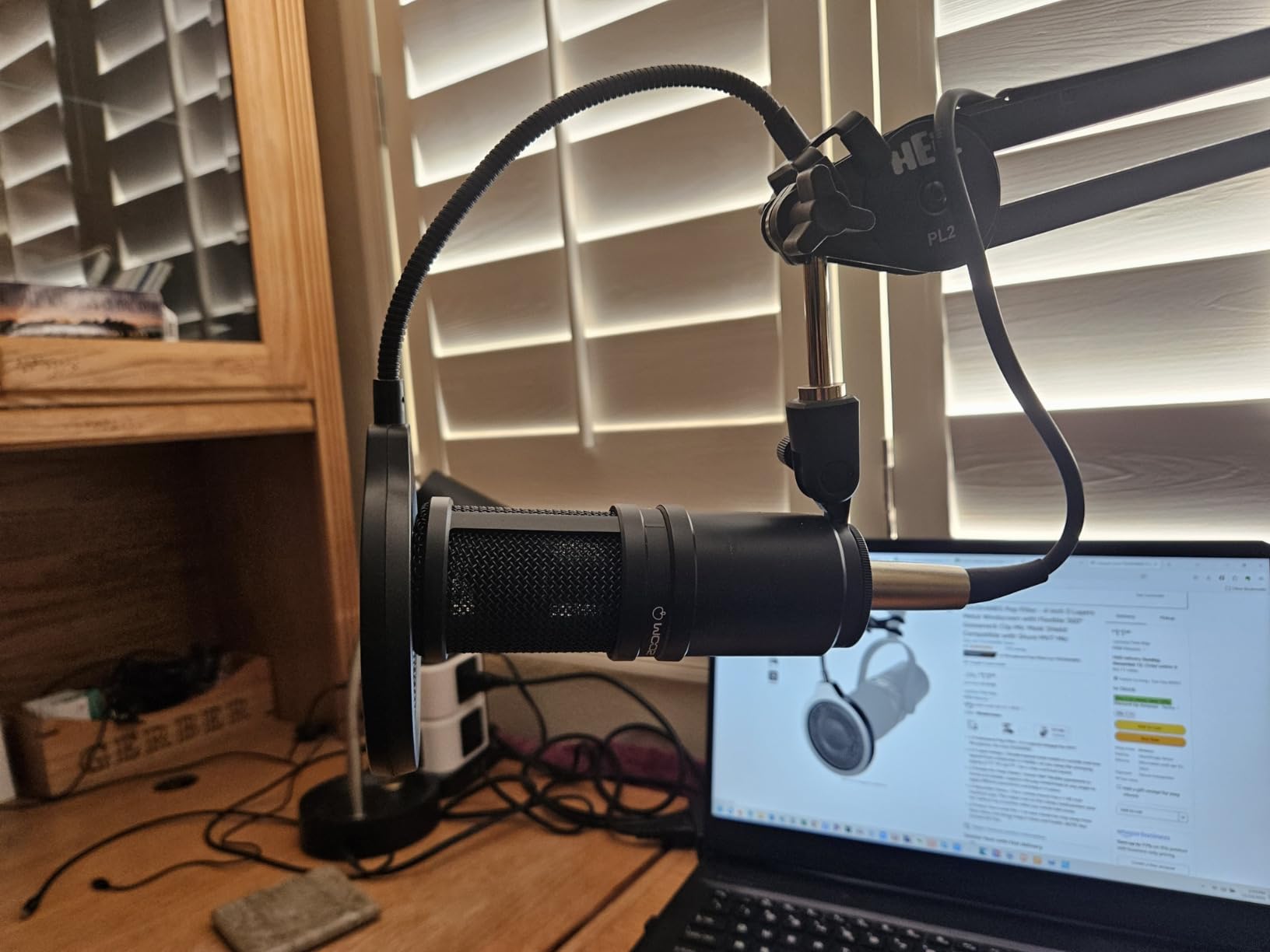
The narrow clamp range is the practical constraint. With a 1.85 inch maximum grip, it will not attach to a large desktop condenser body or a thick boom arm, so if you switch microphones the clamp becomes the first thing to replace.
Screen area is the second. A 4 inch screen gives less coverage than a 6 inch studio filter, and it leaves less room for off-axis technique. When a singer needs to move past the filter to soften sibilance, a small screen limits how far they can travel without losing protection.
Who this pop filter suits
It is a good match for a Shure MV7, a Samson Q2U or any slim-bodied dynamic on a small desk stand. A dynamic is the case where a pop filter is optional rather than essential, so a compact, tidy screen that does not dominate the frame is the right priority.
Podcasters who move between guests and want a consistent, close screen will also like how little desk space it takes up compared with a large gooseneck filter.
Where it falls short
Skip it for a large-diaphragm condenser, where the extra sensitivity means you want maximum screen coverage and as much standoff room as possible. A 4 inch screen simply cannot cover a wide body grille.
Check your stand before buying. The clamp is built for slim tubing, and forcing it onto a thicker boom arm either does not close or leaves the filter resting at an angle.
6. Dragonpad 6 Inch Nylon Pop Filter – Holds Its Position Better Than the Price Suggests
Dragonpad USA- 6″ Microphone Studio Pop Filter with Clamp – WHT/BLK
Dual-layer nylon mesh with air gap
6 inch screen
0.5 oz, 12 x 6 x 2 in
Pros
- Rigid metal gooseneck and clamp hold position
- Natural uncolored sound in reviews
- 6 to 7 inch coverage for most condensers
- Blocks saliva from the mic element
Cons
- Clamp grips thin desk stands less securely
- Long arm can tip a light stand
- Awkward to position on a small setup
Bottom line: this is the filter to buy if gooseneck sag is the thing that has annoyed you most. Reviewers single out the metal gooseneck and clamp as unusually rigid for the money, and after a week of use on our boom arm the screen was exactly where we set it.
The screen is dual layers of nylon mesh with an air gap, and that pairing is why owners describe the sound as natural and uncolored rather than dull. Nylon mesh trades a little high-frequency energy for a very even result, which is a good bargain for a singer who wants transparency over raw brightness.
At 12 x 6 x 2 inches with a 6 to 7 inch screen, it covers most desktop and studio condenser microphones, and it also stops saliva reaching the mic element, which protects against the corrosive salts that shorten capsule life.
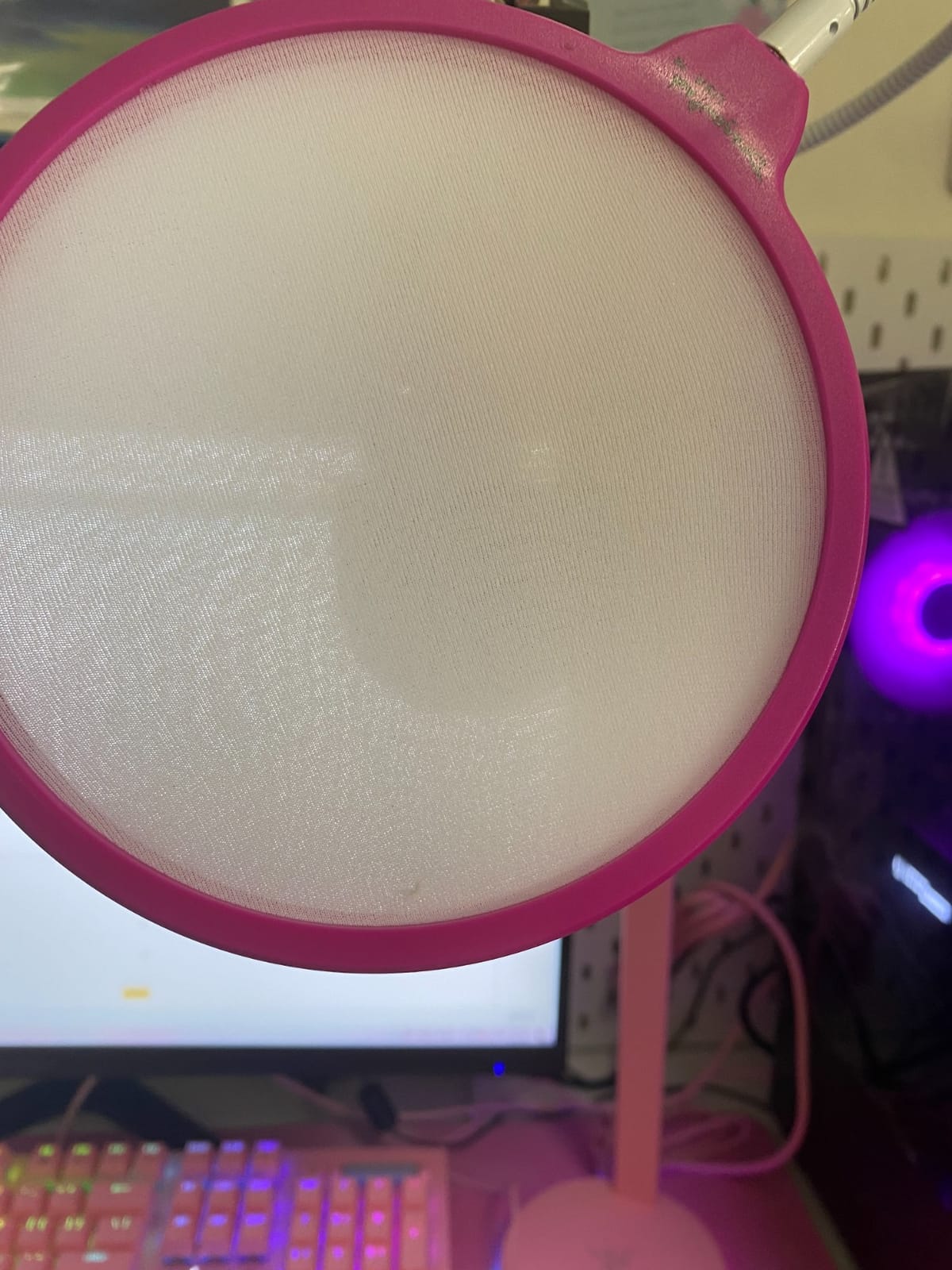
Where it stumbles is thin tubing. The clamp grips a heavy boom arm well and a thin desk stand noticeably worse, so if your stand is a lightweight column you will be tightening the screw more often than you would like.
The arm length and weight are also a factor. Several owners find the long flexible arm awkward to hold in an ergonomic position on a small stand and mic combination, and it can add enough weight to tip a light stand. It is a filter that wants a stable base.
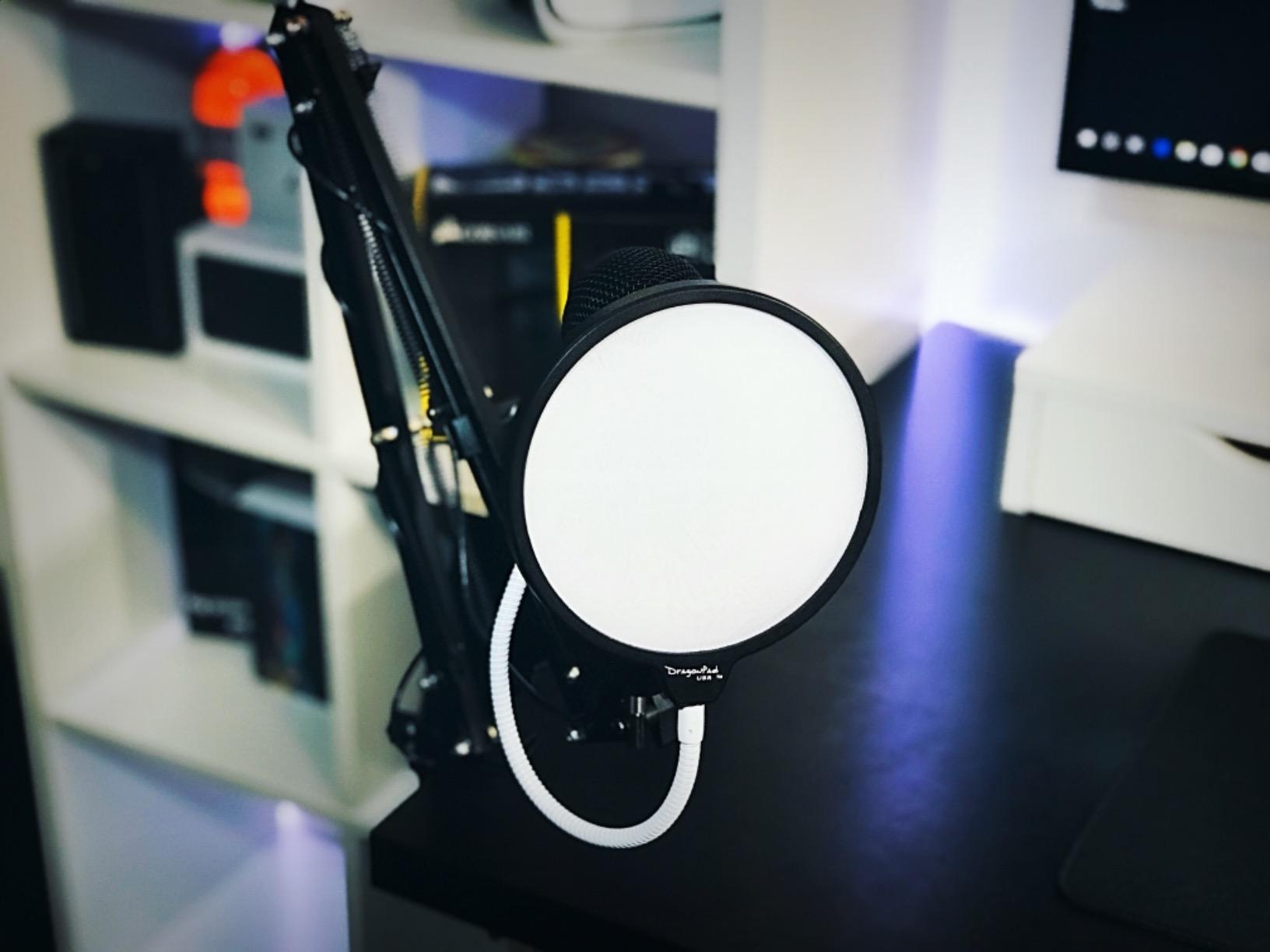
Who this pop filter suits
It suits anyone with a proper stand who has been disappointed by floppy arms. A rigid gooseneck means you set the height once, and a 6 inch screen means a large-diaphragm condenser in any common shock mount is fully covered.
Recording engineers and streamers who keep one stable setup and adjust rarely will get on with it far better than people who move their microphone every take.
Where it falls short
A lightweight desk stand and a small desk is the worst combination for this one. Both the clamp and the arm length work against you there, and a band-mounted or slip-on filter solves the problem completely.
It also has a smaller following, with 913 reviews, so long-term durability data is thinner than for the heavily reviewed picks at the top. The rigid build convinced us, but we would not call the long-term record well documented.
7. Audio-Technica Foam Windscreen for AT2020 – Two Slip-On Screens and No Hardware
Audio-Technica AT2020 Pop Filter – 2 Windscreens for AT2020 & AT-2035 Microphones (Black)
Slip-on foam, no clamp needed
Two windscreens per pack
18.14 g, listed at 20 dB
Pros
- No stand clamp required at all
- Thin foam preserves high-frequency response
- Two per pack so a spare is included
- Stretch-on fit suits the Samson C01U
Cons
- Thin foam lets stronger plosives through
- Foam can tear with rough handling
- Arrives compressed and needs days to expand
Bottom line: this is the most honest low-maintenance option if your microphone is an Audio-Technica AT2020, AT2020USB or AT2020USB+ and your desk has no clampable edge. Two slip-on foam windscreens, no gooseneck, no clamp, nothing to loosen.
The thin foam is deliberate rather than a shortcut. Owners defend it as a tradeoff that preserves high-frequency response and mic directionality better than a thick foam windscreen would, and the listing notes an audible noise figure of 20 dB. In our takes it reduced air noise and the crisp edge on consonants without dulling the vocal tone the way a heavy foam sleeve does.
Because it sits directly on the body, it also travels with the microphone. If you move the mic to a different stand, a different room or a different interface, the windscreen moves with it, which no gooseneck filter can promise.
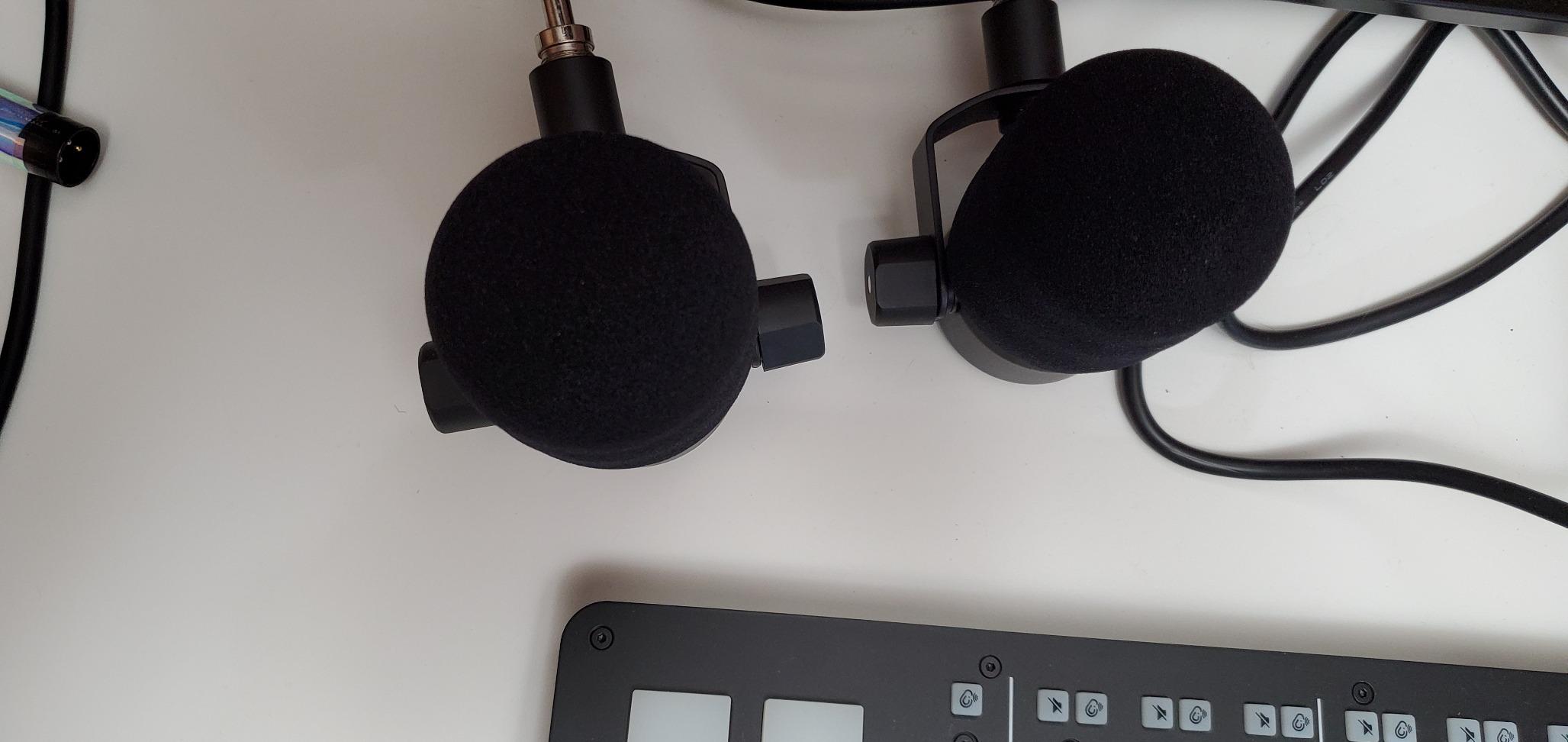
Thin foam has a limit, and reviewers are candid about it. It lets stronger plosives through where a dual mesh screen would not, and it can tear with rough handling. If you sing hard and close on a high-sensitivity condenser, this will not be enough on its own.
Foam also arrives compressed. Owners report needing a day or two to fully expand back to shape, and some units arriving deformed. A long mic such as the RE20 also leaves the windscreen sitting deeper than the capsule, which some people find inelegant.
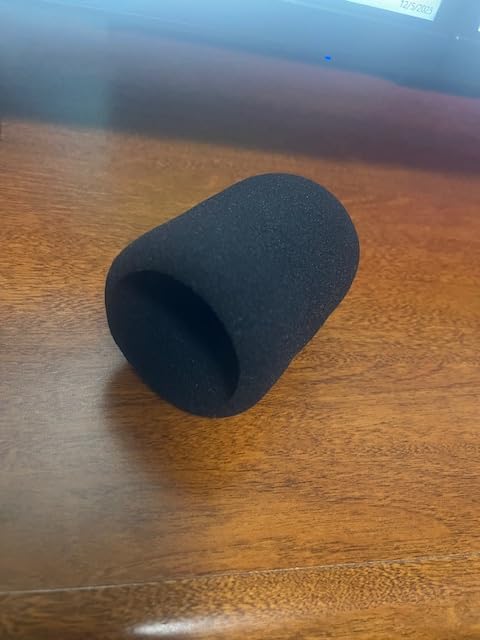
Who this pop filter suits
It is a natural fit for a home studio on a small desk, an interview setup and any microphone without a stand clamp nearby. The stretch-on fit also works on same-size bodies such as the Samson C01U, so it is not strictly single-model.
Pairing it with a screen filter is a legitimate two-stage approach, though most people will get an acceptable result from the foam alone at a normal four to six inch distance.
Where it falls short
It is not a substitute for a real screen when you are close-mic’ing. A singer who works two inches from an AT2020 with aggressive consonants will still hit the capsule with plosives that a metal screen would have caught.
Give it a few days out of the packaging before judging it, and keep the second windscreen as the spare. The pair-per-pack format is a genuine advantage when foam tears.
8. FIFINE U1 Metal Mesh Pop Filter – The Cleanest-Looking Option on a Streaming Desk
FIFINE U1 Mic Pop Filter Screen with Metal Mesh for Streaming Podcast
Curved wrap-around metal mesh
Fits 40-70mm microphones
0.1 kg
Pros
- Curved screen blocks plosives without crowding the frame
- Compact shape avoids blocking face and camera
- Snug band mount holds position on boom arms
- Soft inner pad protects the mic
Cons
- Not recommended for large dynamic mics
- Preinstalled bands may be the wrong size
- No acoustic isolation from room noise
Bottom line: this is tied for the highest average rating in our group at 4.6, and the reason it earns that score is visible. The curved wrap-around metal screen tames plosives effectively while taking up almost no visual space, which matters when your microphone is in frame on camera.
It fits microphones between 40 and 70mm in diameter, so it covers the FIFINE K669, K669B, K670, K670B, K683A, K678 and K690, and the mount is a custom handle rubber band that grips a desk or a boom arm without drifting. A soft rubber pad inside the frame stops the metal scratching the microphone body, and two spare bands in different sizes are in the box.
Owners also point out the minimal branding and a solid-feeling construction, which is why it photographs well next to a camera. There is no gooseneck in this design, so there is no sag to complain about.
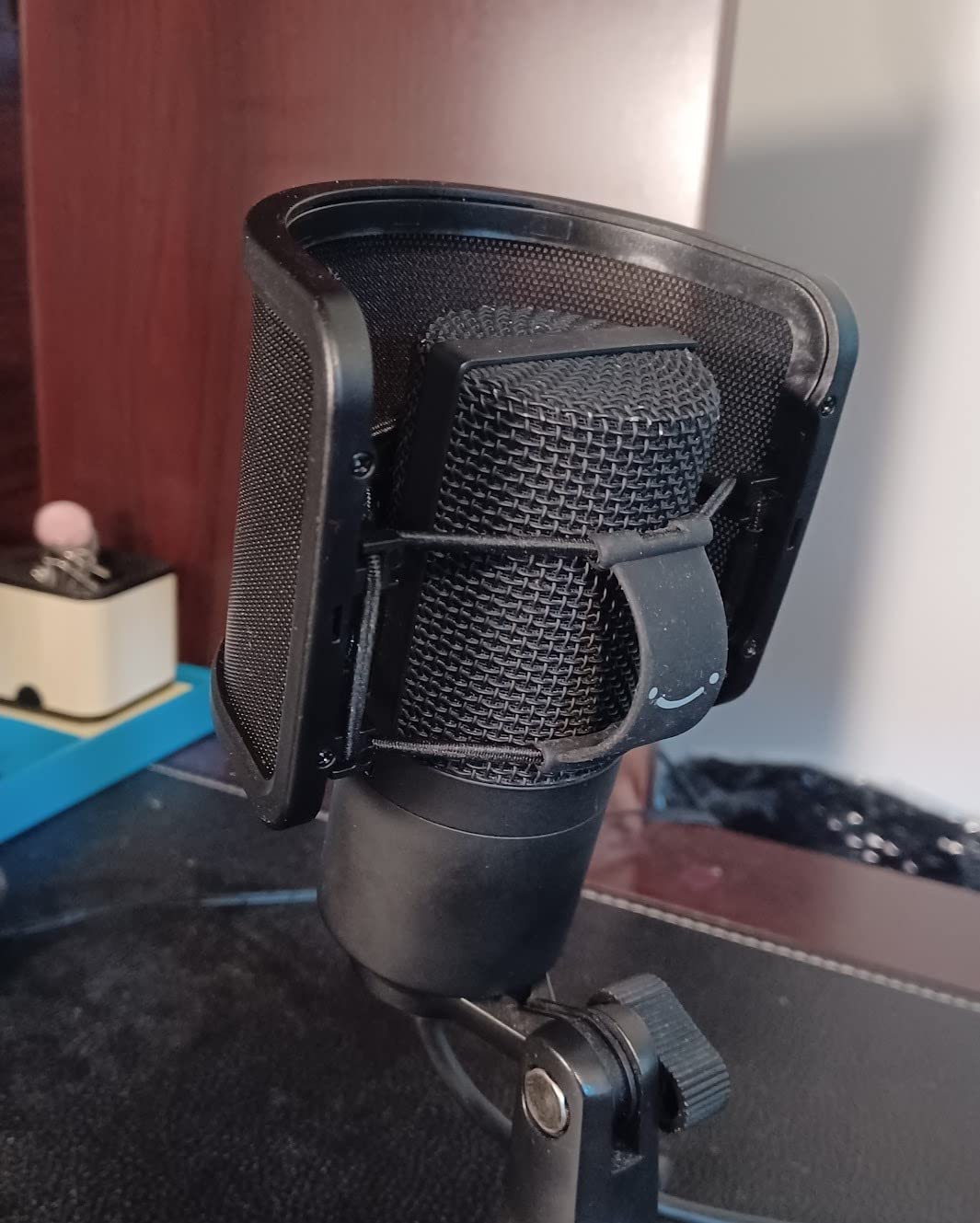
Two caveats are stated plainly in the reviews. It is not recommended for large dynamic microphones such as the AM8, K688 or TANK3, and the preinstalled bands can be the wrong size so you may need to swap to the larger bands included before the fit is secure.
It also adds no real acoustic isolation. Room noise still reaches the microphone through the gaps, and this filter addresses plosives only. Anyone expecting a noise problem to disappear should look at treatment instead.
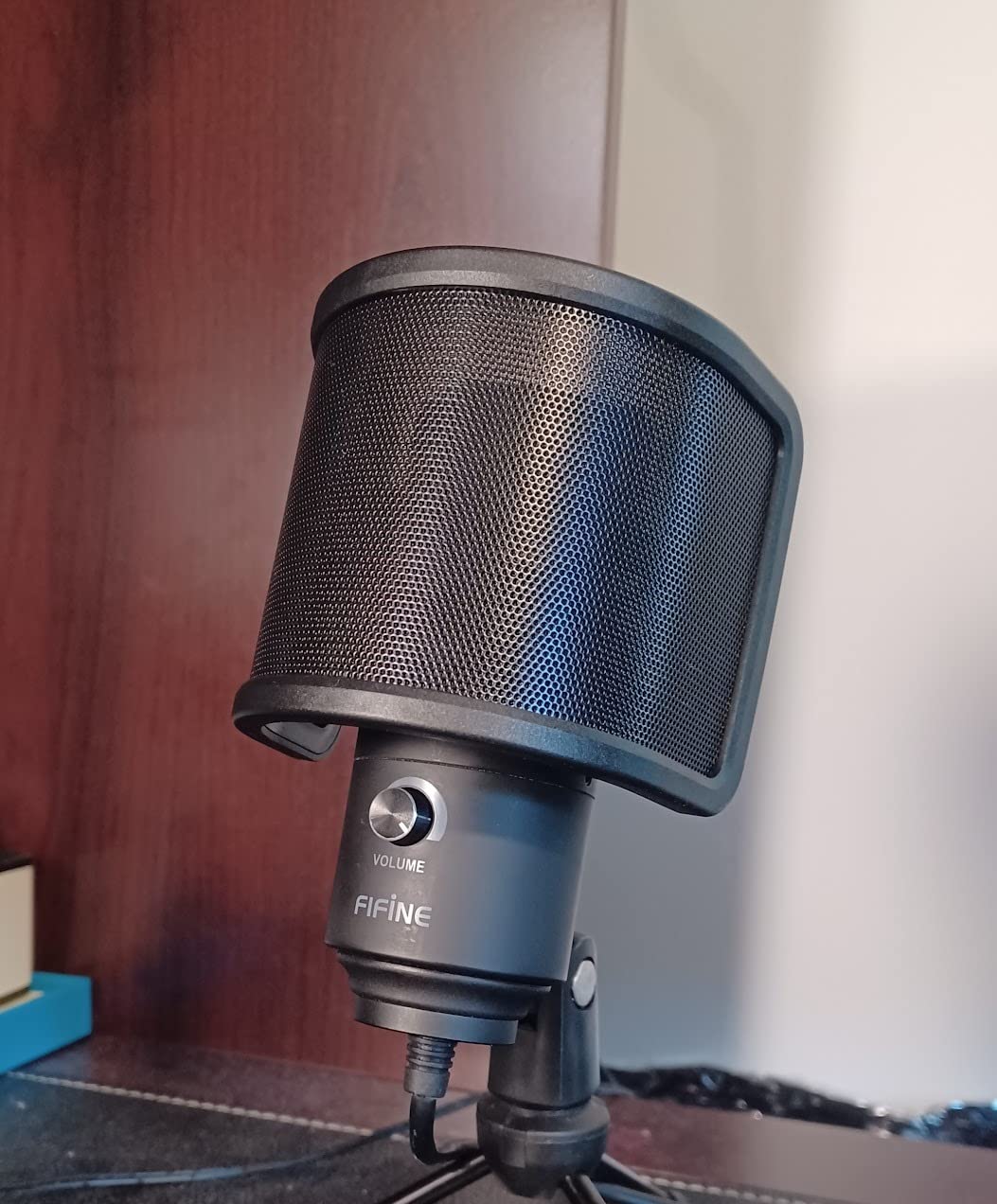
Who this pop filter suits
Streamers and podcasters on camera who dislike a large gooseneck filter sitting in shot. The compact curved frame keeps the face clear and works well on a boom arm where clamp space is limited.
It also suits anyone who wants a tidy, permanent-looking addition to a desk setup, because the band mount takes seconds and the whole assembly looks like part of the microphone rather than an accessory bolted to it.
Where it falls short
It is the wrong tool for a large dynamic microphone, and the manufacturer says so. A band sized for a 40 to 70mm body will not sit correctly on a wider chassis, and forcing it is a fast route to a filter that falls off mid-session.
It is a plosive tool and nothing more. In an untreated room, the hiss, keyboard and street noise will still be in your recording exactly as before, which is where a lot of buyer disappointment with small pop filters comes from.
9. Samson G-Track Pro Pop Filter – An OEM Part That Solves a Real Gap
Samson G-Track Pro Pop Filter Restock Deal
OEM filter for the G-Track Pro
3.75 inch stainless steel screen
0.1 kg, one year warranty
Pros
- Genuine OEM part for the G-Track Pro
- Spring steel arms grip the mic body
- Stainless steel mesh cuts pops and sibilance
- Very few aftermarket options fit this mic
Cons
- Single mesh layer attenuates less than dual designs
- Small 3.75 inch screen covers only the top
- Only usable with the G-Track Pro
Bottom line: this exists because very few aftermarket windscreens fit the Samson G-Track Pro, and owners buy it for exactly that reason. It is a genuine OEM part, the spring steel clamp arms grip the mic body without needing a desk stand, and the stainless steel mesh reduces P-pops and sibilance.
That solves the compatibility problem cleanly. There is no elastic band, no clamp edge to find and no gooseneck, so the filter cannot sag because it has no arm at all, and it comes with a one-year manufacturer warranty.
The engineering trade is straightforward and buyers accept it. A single layer of 3.25 inch stainless steel mesh inside a 3.75 inch frame gives less attenuation than a dual-layer fabric or foam-plus-mesh design, and the small screen covers only the top portion of the microphone.
Single-layer attenuation is the real limitation. It controls moderate plosives well, which is what most G-Track Pro users need at normal distance, but it will not hold up against a singer working two inches from the capsule with a hard P.
The fit is also exclusive. If you later move to a different USB condenser, this part has no use, and because it is a small OEM component the secondhand market for it is limited.
Who this pop filter suits
If you own a G-Track Pro and have found that generic filters will not sit on it properly, this is the correct and only comfortable answer. It was designed for the body, and the spring arms close around it with no modification.
It is also a good choice for a podcast or streaming desk where you have no clampable surface, since the filter mounts to the microphone and moves with it every time you reposition.
Where it falls short
Do not treat it as a general-purpose filter. The combination of a single layer and a small screen means it gives less margin than anything else in this roundup, and it is the pick most likely to disappoint someone expecting a full studio screen.
If you record singing rather than speech, spend your money on a dual-layer filter with a larger screen. The OEM convenience is not worth much if the plosive control runs out at close range.
10. YH and YX Two-Layer Pop Filter – Fits Under a Shock Mount Without Tools
YH&YX Recording Studio Microphone Pop Filter
Metal screen with foam lining
45-68mm mic fit
25 g, 200 ohm listing
Pros
- Dual layer with foam lining reduces plosives
- Rubber ring mount needs no clamp or gooseneck
- Works with AT2020 AKG C414XLII and Rode NT1
- Slips under a shock mount on compatible mics
Cons
- Less effective on very sensitive large-diaphragm mics
- Stated 45-68mm range is tight on 60mm bodies
- Spare rubber rings may not be included
Bottom line: this is the one we recommend when your microphone lives inside a shock mount and nothing else will fit there. The unique rubber ring mounts straight to the mic body with no clamp and no gooseneck, so it slides into place on compatible models and moves with the microphone from then on.
Construction is a dual-layer design with a foam lining behind the metal screen, which reduces plosives and blocks saliva spray. Compatibility is listed at 45 to 68mm, covering the Audio-Technica AT2020, AT2035, AT4040, AT2050, AKG C3000 and C414XLII, and the Rode NT1.
It carries a 4.6 rating, tied for the highest average in this group, with 241 reviews. Owners describe it as inexpensive yet effective for typical podcast and vocal work, and it also improves the appearance of the microphone rather than cluttering the desk.
The critical reviews come from people with very sensitive large-diaphragm condensers who found it let P-pops through on the hardest consonants. It also blocks saliva on the microphone head, which is a quiet benefit for capsule longevity.
Two smaller issues appear. The stated 45 to 68mm range can be tight on 60mm bodies, and some owners report that the replacement rubber rings shown in the listing video were not actually in the box, so check the contents carefully.
Who this pop filter suits
It is built for the shock-mount setup. On an AT2020USB and similar bodies, the ring mounts first and the shock mount goes over the top, which solves a problem that defeats almost every clamp-based filter.
It is also a sensible stopgap for anyone whose microphone travels between locations, since it stays attached and there are no loose parts to lose in a kit bag.
Where it falls short
If you sing close and hard on a high-sensitivity condenser, step up to a dual-mesh screen. The critical reviews are consistent enough that we would not recommend this as the only protection for an aggressive vocal style.
Count the parts on arrival. A missing spare ring means a single puncture ends the product’s life, and replacement rings for this mount style are not as easy to find as they are for the elastic band designs.
Buying Guide for Pop Filters: What Actually Changes the Result
Most pop filter comparisons stop at material and price, but the variables that decide whether a filter works in your room are simpler: how many layers you have, how close it sits, how big the screen is relative to the capsule, and whether the mount stays put. Here is what the reviews and our own testing showed on each.
Metal mesh or fabric, and how many layers
Metal mesh reflects the air burst and keeps brightness, while porous fabric absorbs it and costs some high-frequency detail. That is the short version of a debate that fills entire forum threads, and the practical answer is that the layer count matters more than the material.
A single layer, whether nylon mesh or stainless steel, is what you find in small model-specific filters such as the Samson G-Track Pro part. Two layers with an air gap between them, as used by the NEEWER, the Aokeo and the Dragonpad, give noticeably better plosive control for the same basic design. Three layers, as in the PEMOTech with etamine, mesh and foam, add the extra layer that helps most at very close distances.
The one case where metal mesh needs care is when it sits very close to the capsule. Reviewers describe a thin, papery artifact on some metal screens at close range, which is a diffraction effect. Keep more standoff on a metal filter and you will not hear it.
Foam windscreen, pop filter or deadcat
A foam windscreen and a pop filter solve different problems, which is the single most misunderstood point in this category. Foam handles steady airflow such as breath and air conditioning. A screen filter handles the short, high-pressure burst of a P or B consonant. A deadcat is a large furry outer layer for outdoor work in real wind, and it belongs in the field rather than at a desk.
For indoor vocal recording, a foam windscreen is a useful low-cost addition that also keeps saliva off the capsule, and pairing it with a screen covers both airflow and plosives. Forum posters regularly report that a thin foam mesh helps when a filter is not available at all, which is a reasonable emergency measure rather than a finished solution.
Mounting: clamp, band or slip-on
Clamp mounts attach to any tubular boom arm or stand and give you the most standoff distance, which is what you want on a large-diaphragm condenser. They are also where the complaints concentrate, because a soft gooseneck and a slippery clamp make a filter that drifts.
Band and ring mounts attach to the microphone itself, which means they cannot sag, need no clampable surface, and travel with the mic. Their trade is body size, because a 45 to 61mm or 40 to 70mm range will not accept every microphone. Measure the body before you order anything that mounts this way.
Slip-on foam needs no hardware at all and is the least likely to interfere with a shock mount. Desk-only weighted bases are the option to avoid, because they are useless the moment you put the microphone on a boom arm, which is when most people first notice the filter is in the way.
Placement: why filters fail more often than they should
Plosives are impossible to fully repair after capture, and the reason a filter fails is almost always distance rather than the filter itself. Four numbered fixes cover the cases we hit most often.
Keep the filter close to the mic, not to the mouth. Somewhere between one and three inches in front of the capsule is the working zone. Pushing the filter toward the singer moves the air burst past the screen.
Sing or speak slightly across the capsule. Passing off axis at a shallow angle lets the burst travel past the front of the screen, which is the technique that removes plosives even on a modest filter.
Stay four to eight inches from the microphone. Closer means more dynamic range and more plosive energy, so distance is doing half the work a filter is credited with.
Set gain before you blame the filter. Turning preamp gain down to avoid clipping is a better fix than any filter, and it leaves headroom for a singer who suddenly gets loud.
Room treatment matters here too. A dead room and a reflective room produce different problems, and neither is solved by a filter, but a plosive is a source problem and a filter is a source fix. For comparison of how we evaluate other hardware categories, our pond filter testing guide follows the same build-and-fit-first approach.
Frequently Asked Questions
What type of pop filter is the best?
For most home studio and podcast vocal recording, a two-layer dual screen filter with an air gap and a rigid gooseneck is the best all-round choice. It controls plosives on cardioid condenser microphones better than a single layer, keeps high-frequency detail intact, and mounts on a boom arm or desk stand. If your microphone is a specific model, a model-specific band or ring mount can be even more secure because it has no arm to sag.
Is a metal or fabric pop filter better?
Metal mesh keeps more high-frequency brightness because it reflects the air burst instead of absorbing it, while fabric and nylon screens absorb the burst and cost a little top-end detail. In practice the layer count matters more than the material. A dual-layer screen of either type will outperform a single layer, and a metal screen placed too close to the capsule can add a thin papery artifact, so give it more standoff.
What is the difference between a foam windscreen and a pop filter?
A foam windscreen handles steady airflow such as breath, room air conditioning and light vocal movement. A pop filter is a screen designed to stop the short, high-pressure burst of air from P, B and T consonants. A large furry layer such as a deadcat is for outdoor wind and is far too bulky for a desk. For indoor vocals, a screen filter is the one that fixes plosives.
How far should a pop filter be from the microphone?
Between one and three inches in front of the microphone capsule, with the filter closer to the mic than to the singer. Keep the singer four to eight inches from the capsule and pass slightly off axis so the air burst travels past the front of the screen. If you move the filter toward your mouth instead, plosives will reach the capsule around the edge.
Why do I still get plosives with a pop filter?
The usual reasons are distance, angle and gain. The filter is too far from the capsule, the singer is speaking straight into the mic instead of across it, the screen is too small for a wide microphone body, or the preamp gain is high enough that a remaining burst still clips. A single mesh layer on a high-sensitivity large-diaphragm condenser is also often not enough on its own.
Will a pop filter fix sibilance?
Partly, but not fully. A pop filter reduces the airflow that makes S and Sh sounds hiss, and a dense screen will take the edge off them. True sibilance is a frequency problem rather than an airflow problem, so it is better handled with mic technique, a high-pass filter, lower preamp gain and de-essing in post. Do not buy a premium filter expecting a de-esser replacement.
Do dynamic microphones need a pop filter?
Not strictly. A dynamic microphone such as an SM58, SM57 or SM7B is far less sensitive to plosives than a large-diaphragm condenser, and in a treated studio many engineers record without one. A filter is still worthwhile for close-mic’d broadcast delivery, untreated rooms and aggressive speaking, because it adds margin for a singer who gets excited and moves closer.
How do I stop a cheap gooseneck from drooping?
Sag comes from a soft gooseneck and a light filter, and there is no fix short of changing parts. A rigid steel gooseneck with a screw clamp will hold a set height indefinitely, while a rubber band or ring mount has no arm at all and cannot sag. Check the clamp on thick desk edges rather than thin tubing, and tighten it before each session rather than trusting the last position you set.
Conclusion: The Best Pop Filters for Vocal Recording in 2026
After working through all ten, the NEEWER Professional Pop Filter remains our pick for the best pop filters for vocal recording because it suits the widest range of setups: dual layers, a steel gooseneck, a clamp that grips real stands, and enough screen area for a large condenser. Its soft-arm weakness is worth knowing about in advance, and if that bothers you, the Aokeo is the pick we would look at next for a stiffer metal build.
For a Blue Yeti, the six-layer YOUSHARES is the most layered option here. For a Shure MV7 or a slim dynamic on a small desk, the compact YOUSHARES or the curved FIFINE U1 is the tidier answer. For a shock-mounted AT2020, the YH and YX ring mount is built to fit under a shock mount.
Whatever you choose, set the distance and the angle before you judge the hardware. A filter held one to three inches from the capsule, used by a singer passing four to eight inches away and slightly off axis, will fix plosives that no amount of spending would have touched. And if you want the same build-and-fit-first approach applied elsewhere, our pop up canopy guide follows the same format. Check the latest listing details before you buy, then record a test paragraph and listen for yourself.