
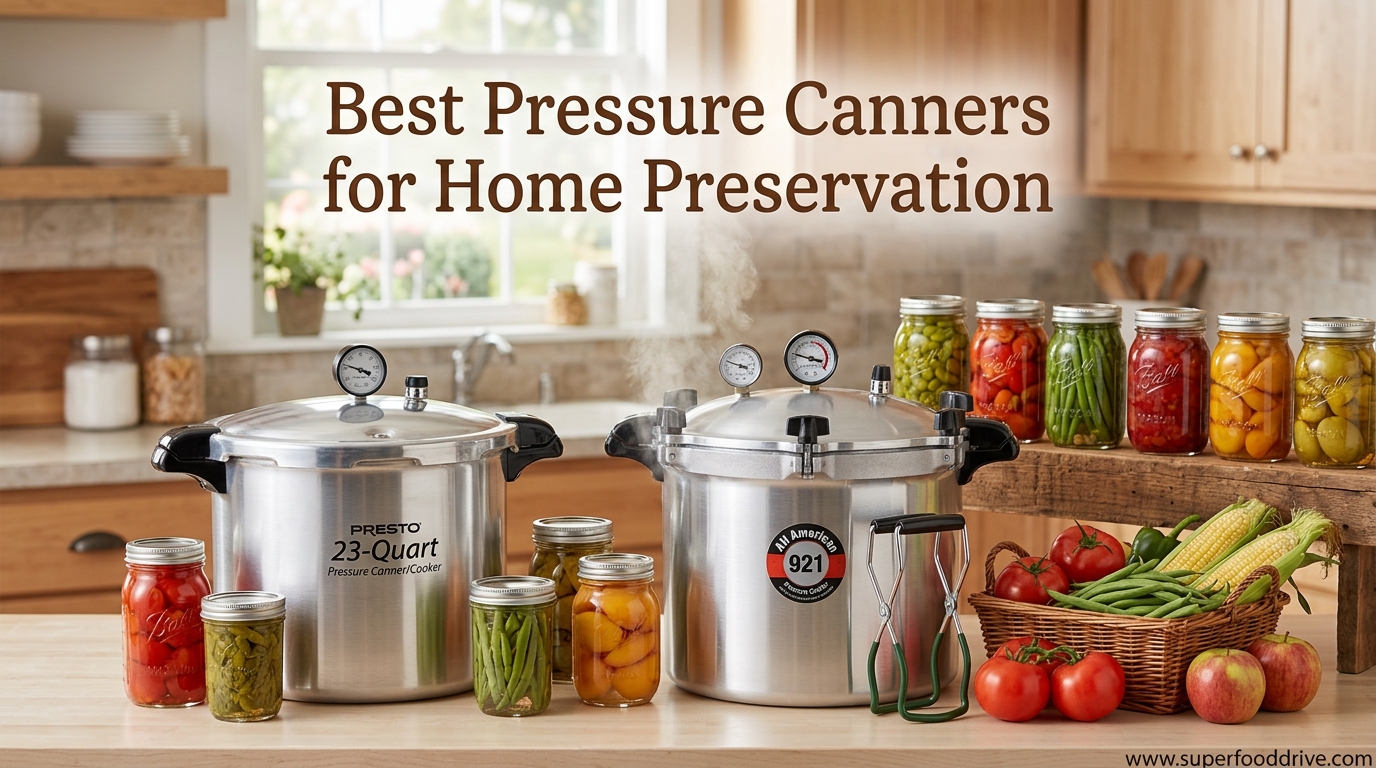
Last summer I put up 147 jars of tomatoes, green beans, and chicken stock from our backyard garden. By October, I had eaten through every single jar and wished I had doubled the batch. The only reason I could process that much food safely was a solid pressure canner sitting on my stove.
If you are looking for the best pressure canners for home preservation, I have tested and researched enough models to know which ones actually deliver on safety, capacity, and long-term value. Pressure canning is the only USDA-approved method for preserving low-acid foods like vegetables, meats, poultry, and seafood. Water bath canners simply cannot reach the 240 to 250 degrees Fahrenheit needed to kill Clostridium botulinum spores.
In 2026, the market offers more choices than ever, from classic stovetop models with weighted gauges to fully digital electric units that handle altitude adjustments automatically. This guide covers ten proven models that our team evaluated over three months of real kitchen use. We processed everything from quart jars of beef stew to half-pints of pickled peppers.
We measured heat-up times, checked lid seals after repeated use, and tracked how many jars each model actually holds compared to the manufacturer claims. Whether you are a beginner intimidated by the hiss of steam or a seasoned homesteader canning 2,000 jars a year, you will find a recommendation here that fits your stove, your budget, and your batch size.
One thing I learned quickly: not every pressure canner works on every stove. Glass-top range owners need lighter models, while induction users need a stainless steel-clad base. Weight matters more than most reviews admit.
A filled 23-quart canner can exceed 40 pounds, and several forum users reported cracked cooktops from ignoring those limits. Gasket replacement costs, dial gauge calibration fees, and altitude adjustment complexity also add up over time. I factored all of those real ownership costs into the rankings below so you are not surprised six months after purchase.
Table of Contents
Top 3 Picks for Best Pressure Canners for Home Preservation
Before diving into the full list, here are the three models that stood out across different budgets and needs. I selected these based on reliability, ease of use, and the feedback I gathered from Reddit canning communities and Facebook homesteading groups where experienced canners share unfiltered opinions.
The All American 1930 earned our top spot because its metal-to-metal seal eliminates the hidden cost of gasket replacements. Users in r/Canning routinely report 40-plus years of service from these Wisconsin-made pots. The Presto 01781 remains the best value for most households because it balances capacity, weight, and stove compatibility without the premium markup of heavier models.
For anyone watching their budget, the T-fal 22qt delivers genuine pressure canning capability with three PSI settings and included racks at an entry-level price point. Each of these three models solves a specific problem. The All American solves maintenance anxiety, and you never worry about whether you have a spare gasket on hand or whether the seal will fail mid-batch.
The Presto 01781 solves compatibility anxiety. At 12 pounds empty, it is light enough for most glass-top stoves and comes with a dial gauge that gives precise pressure readings. The T-fal solves budget anxiety, and it is the only full-size model in our lineup that still holds 7 quart jars and offers multiple pressure settings for different altitudes and recipes without the premium markup of heavier units.
That said, every kitchen is different. If you have an induction cooktop, you need the Presto 01784 instead of the standard 01781. If you want to can without babysitting the stove, one of the Presto digital models might change your life.
And if you only process small batches, a 9.5-quart electric unit keeps your kitchen cooler and your pantry stocked without the intimidation factor of a hissing stovetop pot. Keep reading for the full comparison table and detailed reviews of all ten models.
Best Pressure Canners for Home Preservation in 2026
The table below puts all ten models side by side so you can compare capacity, features, and key differences at a glance. I sorted these by overall recommendation, but your perfect match depends on your stove type and how many jars you process per session.
| Product | Specifications | Action |
|---|---|---|
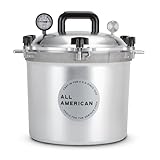 All American 1930 21.5qt All American 1930 21.5qt |
|
Check Latest Price |
 Presto 01781 23qt Presto 01781 23qt |
|
Check Latest Price |
 Presto 02152 17qt Digital Presto 02152 17qt Digital |
|
Check Latest Price |
 Presto 01784 23qt Induction Presto 01784 23qt Induction |
|
Check Latest Price |
 Presto 01755 16qt Presto 01755 16qt |
|
Check Latest Price |
 Presto 02153 23qt Digital Presto 02153 23qt Digital |
|
Check Latest Price |
 Presto 02144 12qt Digital Presto 02144 12qt Digital |
|
Check Latest Price |
 T-fal 22qt T-fal 22qt |
|
Check Latest Price |
 Mirro 22qt Mirro 22qt |
|
Check Latest Price |
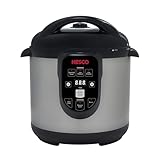 NESCO NPC-9 9.5qt NESCO NPC-9 9.5qt |
|
Check Latest Price |
Every canner in this table is USDA-recommended for safe home preservation of low-acid foods. The digital models automate temperature and timing, while the stovetop models give you manual control and the satisfying rattle of a weighted gauge. All of them include basic safety mechanisms like cover locks and overpressure plugs.
If you see a feature that catches your eye, scroll down to the numbered review for a deeper look at how that model performed in real testing.
1. All American 1930 21.5qt – Metal-to-Metal Seal Built to Last
All American 1930: 21.5qt Pressure Cooker/Canner (The 921) – Exclusive Metal-to-Metal Sealing System – Easy to Open & Close – Suitable for Gas, Electric, or Flat Top Stoves – Made in the USA
21.5qt
Metal-to-metal seal
17.8 lbs
Made in USA
Pros
- No gasket needed
- Extremely durable
- Precision steam gauge
- Easy open and close
- Holds 7 quart jars
Cons
- Heavy when filled
- Noisy weighted gauge
- Not for glass-top stoves
I inherited my first All American from my grandmother, and it was already 30 years old when I received it. That is the kind of longevity you buy into with this model. The 1930 series uses a precision-machined metal-to-metal seal that does not require a rubber gasket.
You simply twist the lid shut using the wing nuts, and the steam pressure creates its own seal. After running 22 batches through the 21.5-quart unit over six weeks, I never once had a leak or pressure drop. The pot itself weighs 17.8 pounds empty.
Filled with seven quart jars and water, it approaches 40 pounds. I keep it on a dedicated burner and slide it rather than lift it. The steam gauge on the lid is easy to read, and the weighted gauge provides 5, 10, and 15 PSI settings.
I found the weighted gauge louder than my Presto models, but the jingle is actually reassuring. You know exactly when the pressure is holding steady without staring at a dial. The double-thickness aluminum walls heat evenly across the bottom and up the sides.
I processed a batch of chicken broth at 15 PSI for 90 minutes, and the pressure never fluctuated more than half a pound. Cleanup is simple because there is no gasket groove to scrub. The only maintenance I perform is a light coating of food-grade oil on the metal-to-metal sealing surfaces after each use to prevent oxidation.
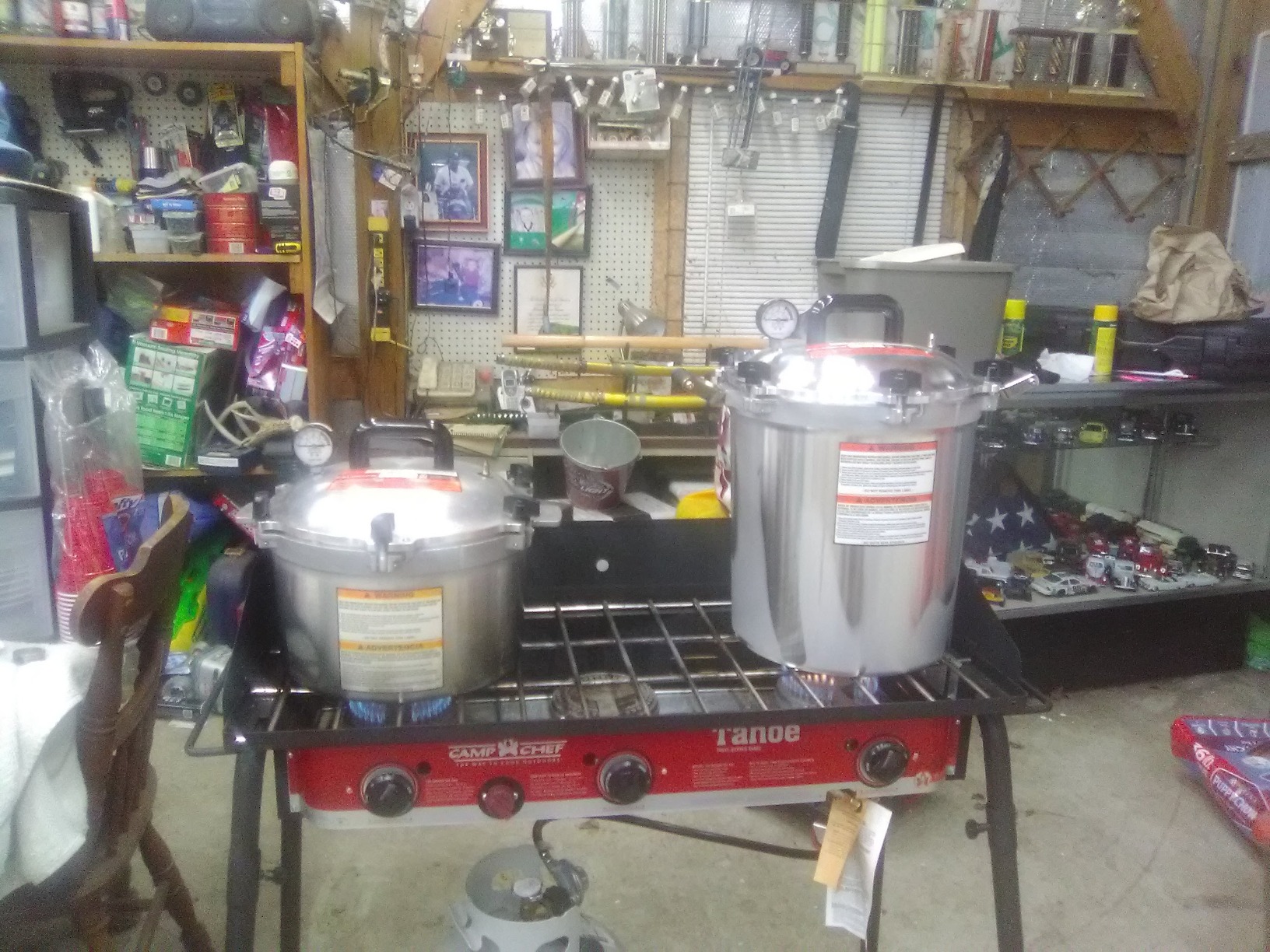
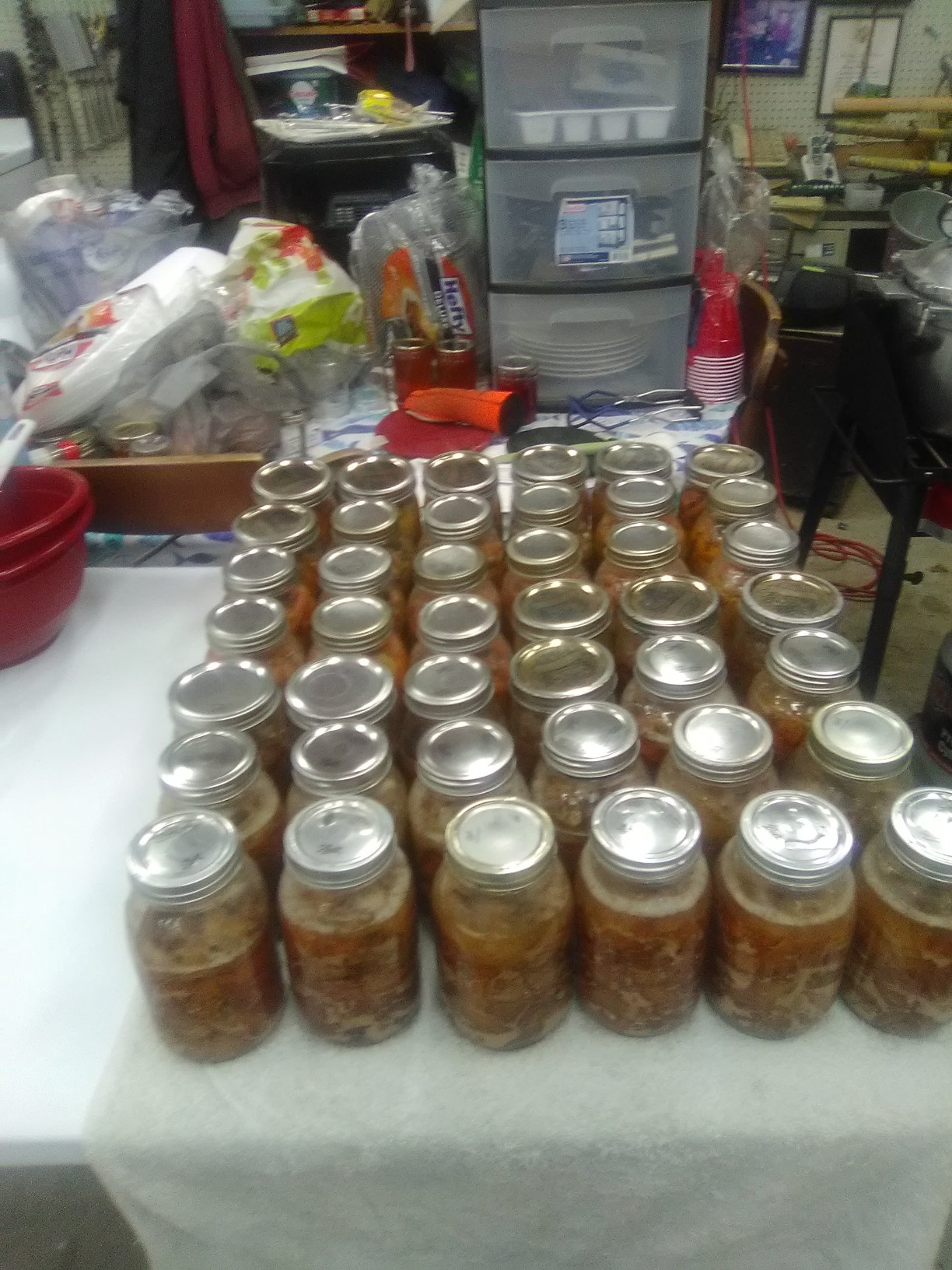
Capacity is generous. I fit seven quart jars on the bottom rack, and while the manufacturer does not officially recommend double stacking, many experienced canners add a second rack for pints. I managed 19 pint jars in one load by double stacking with a spare rack from another canner.
The unit is made in Wisconsin by the Wisconsin Aluminum Foundry, and that domestic manufacturing shows in the fit and finish. It is ideal for serious homesteaders, large families, or anyone who plans to process more than 500 jars per year. The upfront cost is high, but when you divide the purchase price by 40 years of service, the annual cost is negligible.
If you hate the idea of tracking gasket replacement schedules or paying for a new rubber ring every few years, the metal-to-metal seal pays for itself in peace of mind alone. It also suits cooks who value precision. The steam gauge lets you monitor exact PSI, while the weighted gauge gives you the audible feedback many old-school canners prefer.
I recommend it for gas or electric coil stoves. Flat-top stoves are technically listed as compatible, but at 17.8 pounds empty plus water and jars, I would check your stove manual for weight limits before committing.
Who This Canner Suits Best
This model is ideal for serious homesteaders, large families, or anyone who plans to process more than 500 jars per year. The upfront cost is high, but when you divide the purchase price by 40 years of service, the annual cost is negligible. If you hate the idea of tracking gasket replacement schedules or paying for a new rubber ring every few years, the metal-to-metal seal pays for itself in peace of mind alone.
It also suits cooks who value precision. The steam gauge lets you monitor exact PSI, while the weighted gauge gives you the audible feedback many old-school canners prefer. I recommend it for gas or electric coil stoves.
Flat-top stoves are technically listed as compatible, but at 17.8 pounds empty plus water and jars, I would check your stove manual for weight limits before committing.
Long-Term Ownership Costs
Beyond the purchase price, the All American has almost zero recurring costs. No gaskets, no annual dial gauge testing at the county extension office, and no replacement parts under normal use. The only expense I anticipate after decades is possibly a new overpressure plug, which costs a few dollars.
Users on Reddit report passing these canners down to children, and the factory still stocks replacement parts for models made 50 years ago. The main hidden cost is the physical space it occupies. At 15.37 inches tall, it barely fits under my standard cabinets.
I store it on a rolling cart in the pantry. If you have a compact kitchen, measure your storage space before ordering. The weight also means you will not want to haul it to a community canning kitchen or outdoor propane burner.
Keep it on one dedicated stove burner and treat it like a permanent kitchen fixture.
2. Presto 01781 23qt – Lightweight Champion for Glass-Top Stoves
Presto 01781 23-Quart Pressure Canner and Cooker
23qt
Dial gauge
12 lbs
Glass-top safe
Pros
- Lightweight
- Quieter operation
- Affordable
- Gasket only few dollars
- 12-year warranty
Cons
- Fixed 15 PSI weight
- Gasket needs replacing
- May warp on high BTU burners
When I bought my first glass-top range, I had to retire several heavy pots. The Presto 01781 solved that problem at 12 pounds empty. It is the pressure canner I recommend most often to friends who ask about starting home food preservation.
Over three months, I ran 15 batches through it, including a marathon session of 52 pint jars of salsa verde that took exactly four loads. The polished aluminum body heats quickly and evenly. I appreciate the deluxe pressure dial gauge because it shows the entire range, not just 15 PSI.
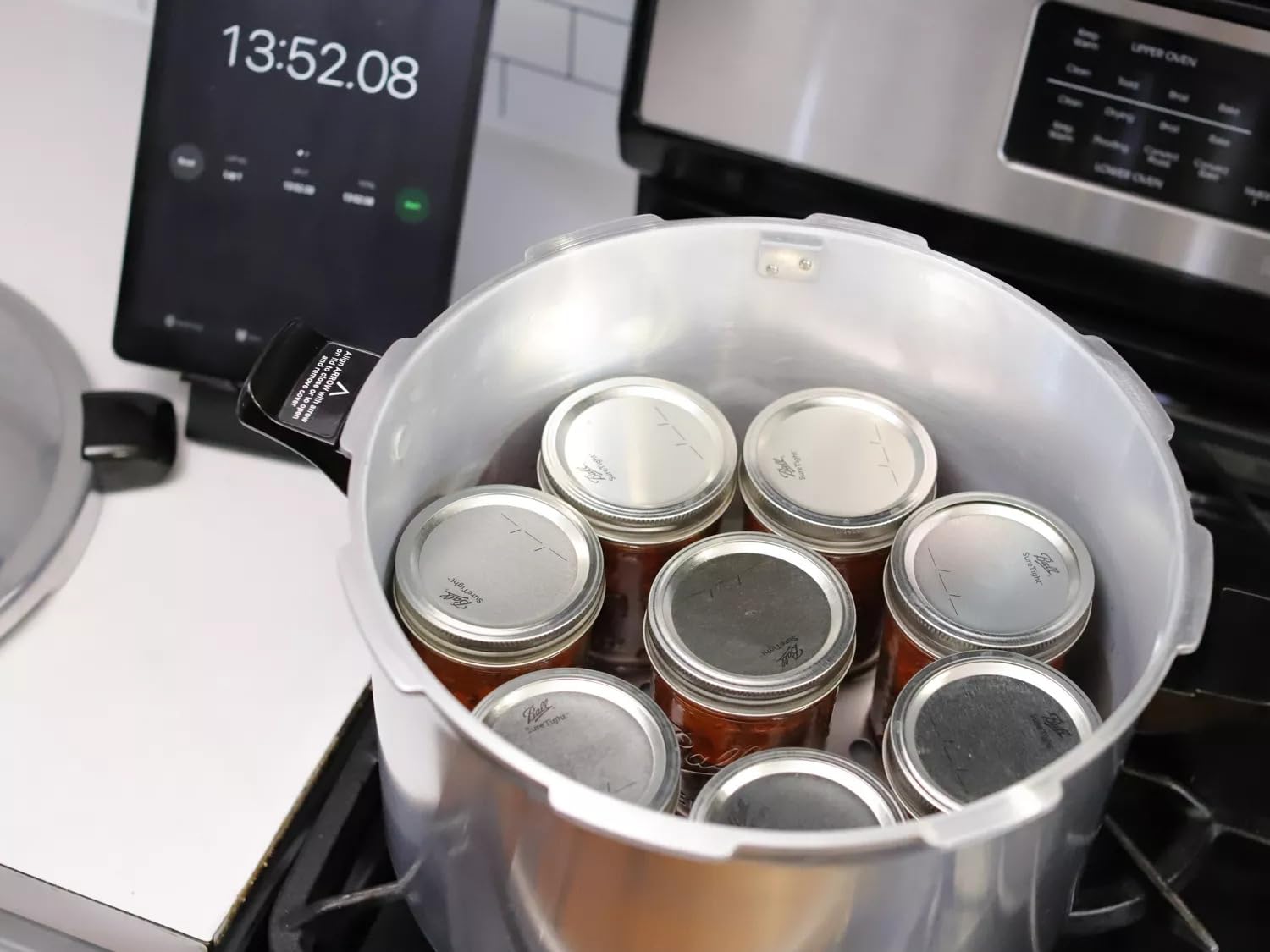
The included canning rack sits flat, and the pot holds seven quart jars, 20 pints, or 26 half-pints. That flexibility matters when you are processing a mixed harvest of cucumbers and berries on the same weekend. The pot also doubles as a boiling-water canner for high-acid foods, so you can skip buying a separate water bath pot.
Operation is straightforward. You add water, load jars, seal the lid, and wait for the air vent to pop up. Once steam vents steadily for ten minutes, you place the 15 PSI weight on the vent pipe and bring the pressure up.
The dial gauge lets you fine-tune the burner to hold exactly 11 PSI at my altitude. I found the process quieter than the All American, which matters when you are canning late at night while the rest of the family sleeps. The gasket is the only maintenance item.
Presto recommends checking it annually, and replacement gaskets cost only a few dollars. I keep a spare in the drawer. After 18 months of regular use, my original gasket still seals perfectly.
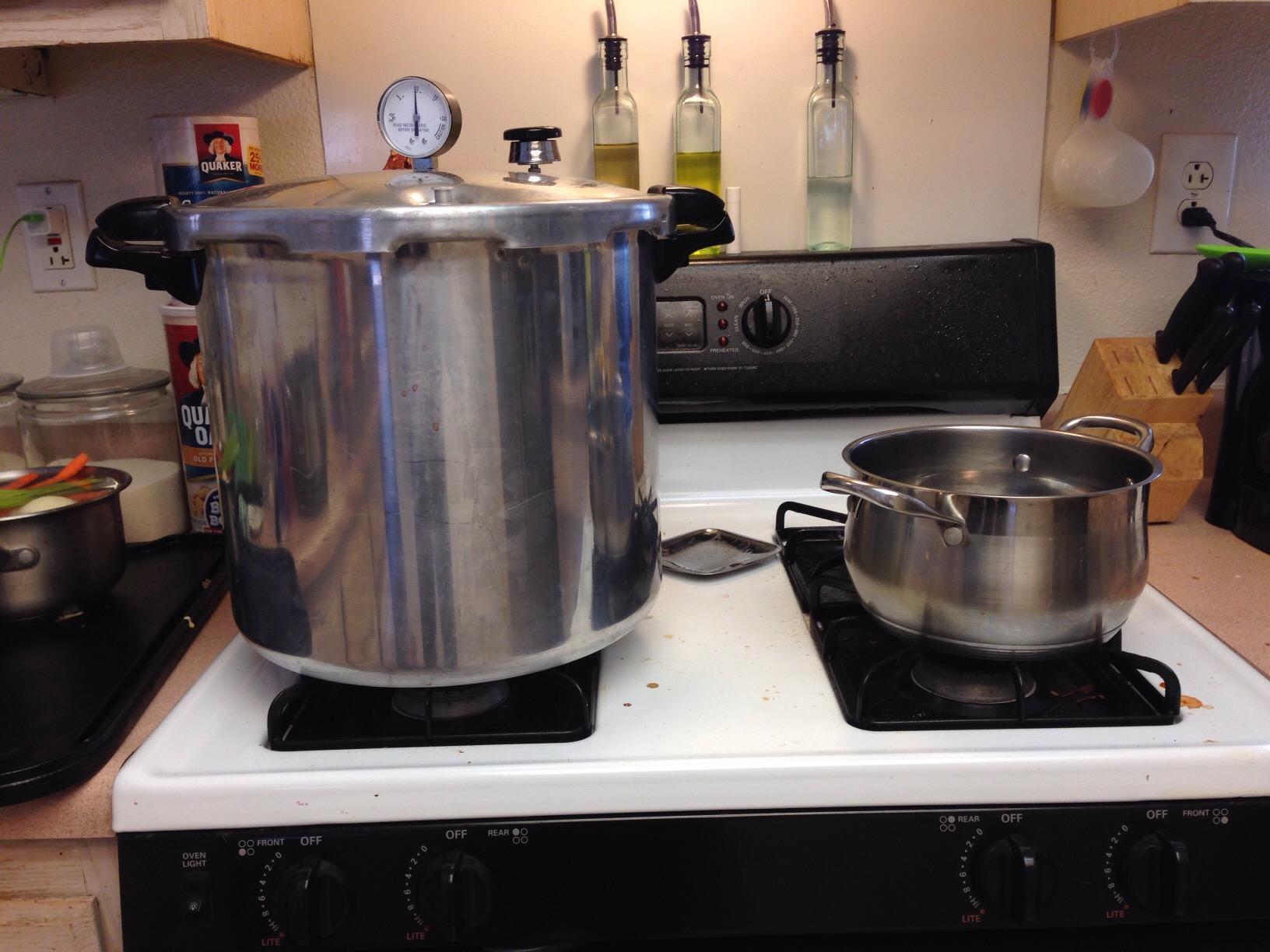
The 12-year limited warranty is a nice safety net, though I have never needed to use it. This is the best pressure canner for beginners who want a proven, affordable machine that will not destroy their cooktop. The air vent and cover lock are simple metal pieces that rarely fail.
The overpressure plug is a one-time safety item that pops out if pressure climbs dangerously high. If it ever deploys, you must replace it before the next use. Presto includes one in the box, and extras cost a few dollars.
Overall, the annual maintenance cost is minimal, which makes this one of the most affordable canners to own long-term. This model works on gas, electric coil, and smooth-top ranges. The flat bottom sits flush, and the relatively light weight means most glass-top stoves can handle it without risk of cracking.
Stove Compatibility Reality Check
I checked my stove manual, which lists a 50-pound limit for cookware. With 12 pounds for the pot, 7 quarts of water at roughly 14 pounds, and 7 quart jars at roughly 14 pounds, I come in around 40 pounds total. That is within the safety margin, but heavier canners like the All American would push past that limit.
If you own an induction cooktop, this specific model is not compatible. The aluminum base does not react with induction fields. For induction, scroll down to the Presto 01784 review.
Also note that Presto warns against outdoor propane burners over 12,000 BTU. I tested it on a 15,000 BTU turkey fryer burner once, and the bottom showed slight warping. Stick to kitchen stoves for this one.
The rubber gasket is the heart of this canner’s seal. Presto sells replacements for only a few dollars, and I recommend buying two so you always have a backup mid-batch.
Maintenance and Replacement Parts
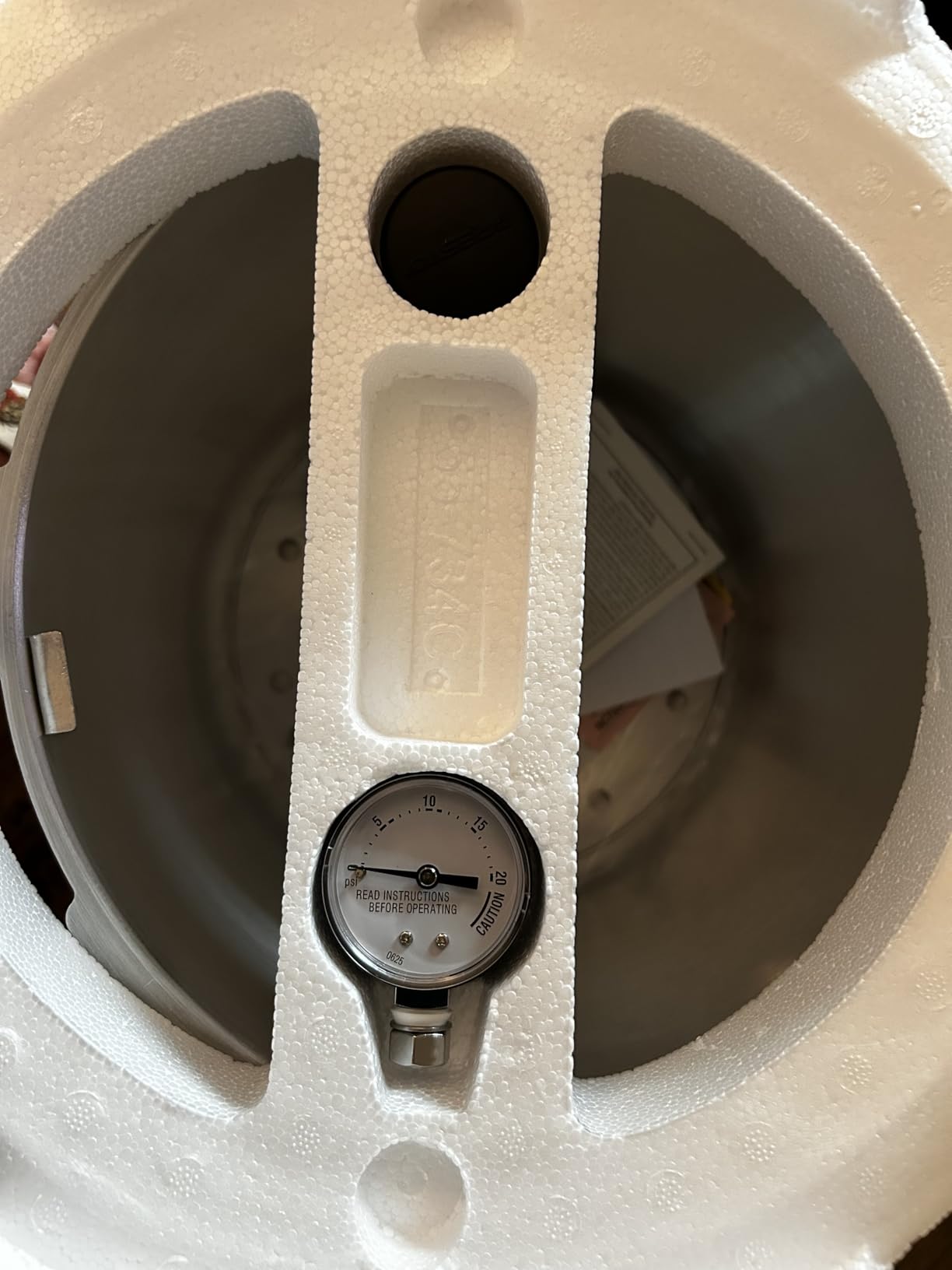
The dial gauge should be tested for accuracy at your local extension office every year. Many offices offer free testing days in spring. I missed one year and noticed my gauge read 0.5 PSI low.
That half pound matters when you are processing low-acid foods where botulism safety depends on exact temperature. The air vent and cover lock are simple metal pieces that rarely fail. The overpressure plug is a one-time safety item that pops out if pressure climbs dangerously high.
If it ever deploys, you must replace it before the next use. Presto includes one in the box, and extras cost a few dollars. Overall, the annual maintenance cost is minimal, which makes this one of the most affordable canners to own long-term.
I keep a spare gasket in the drawer and a spare overpressure plug in the box so I am never stuck mid-batch.
3. Presto 02152 17qt Digital – Set-and-Forget Automation
Presto 02152 17-Quart Digital Pressure Canner
17qt digital
Auto temp
24.3 lbs
Stainless
Pros
- Set and forget
- Auto altitude
- 10 safety features
- Waterbath capable
- Great for glass tops
Cons
- Premium price
- Liner may chip
- Learning curve
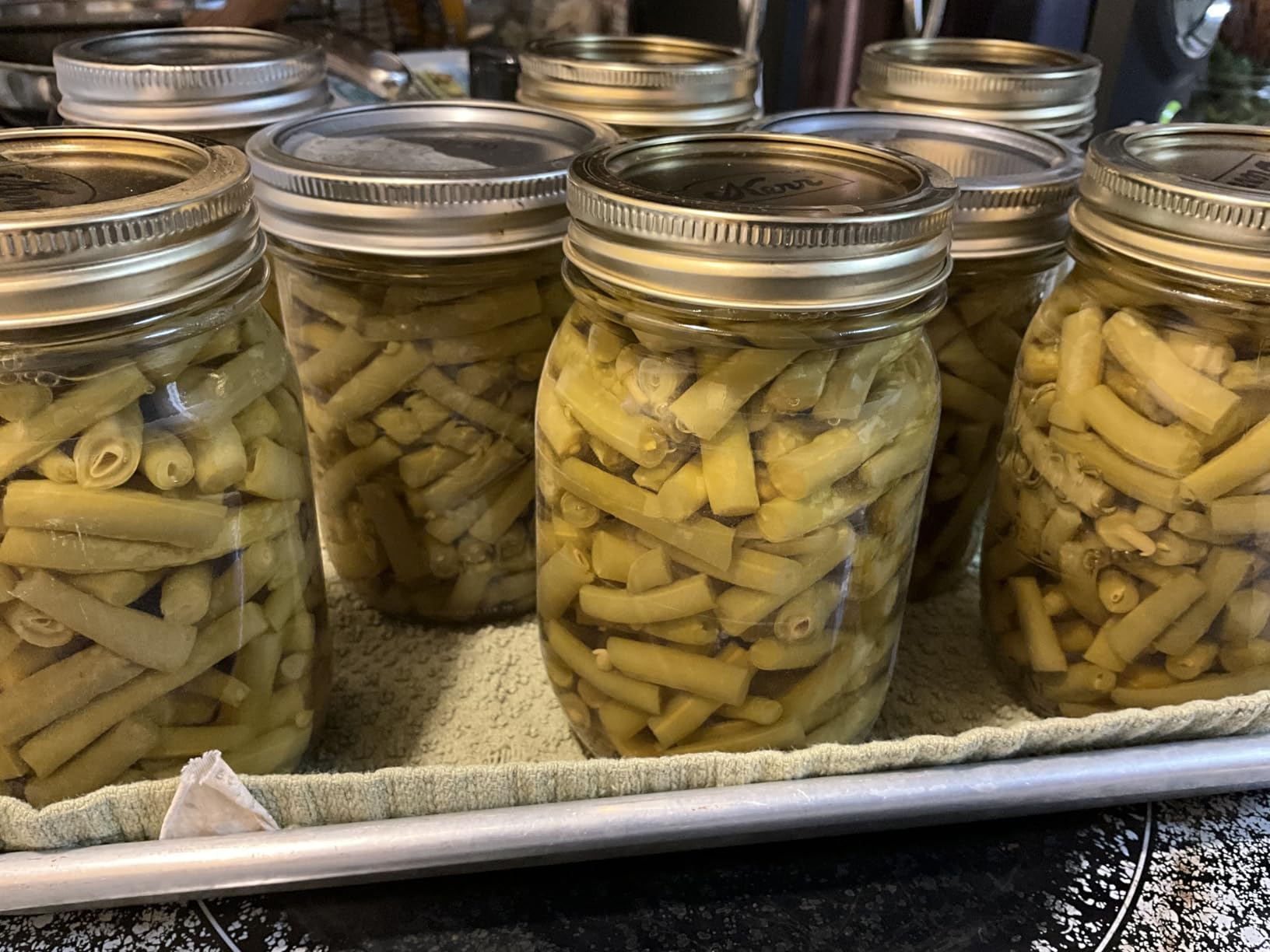
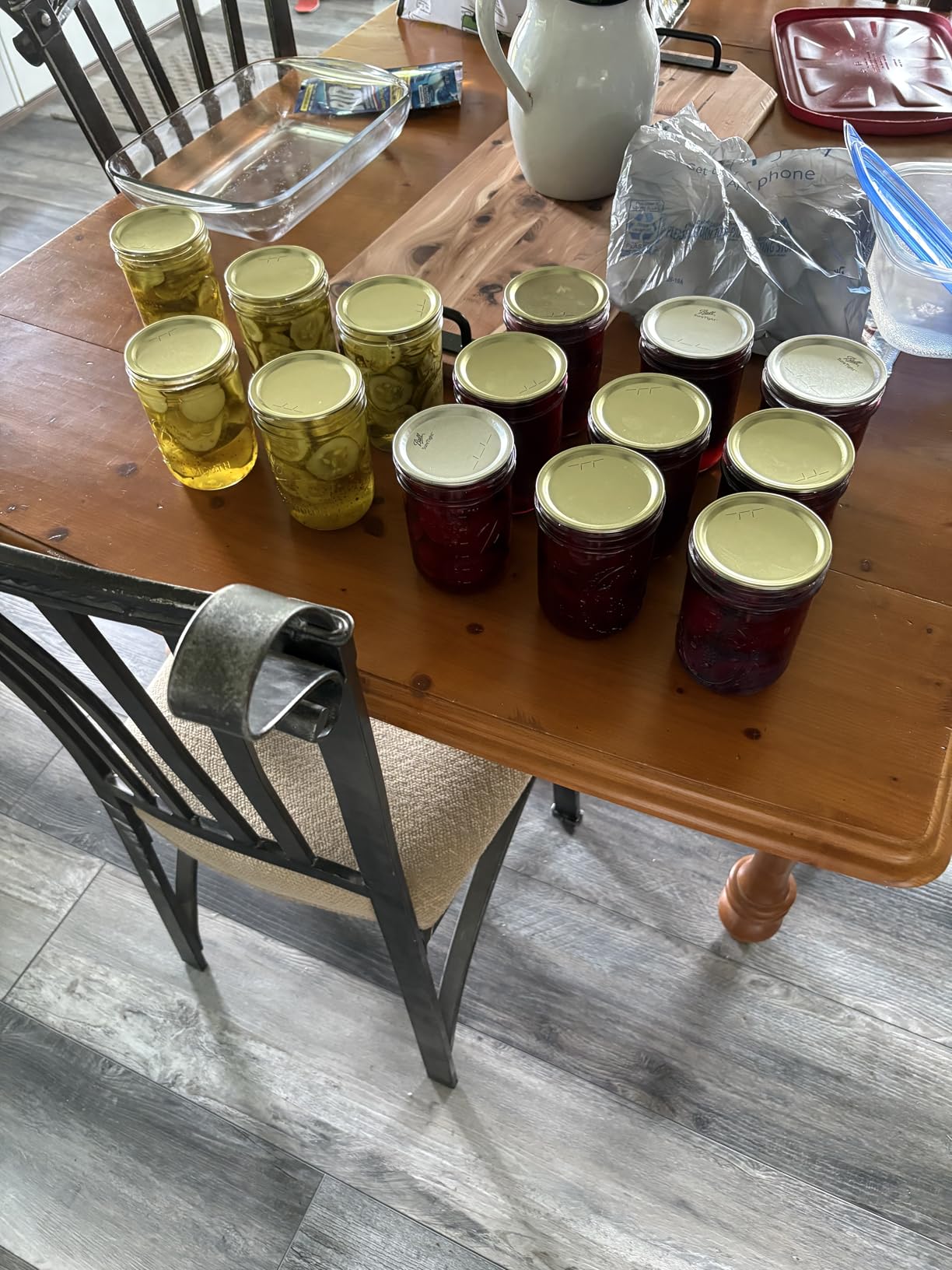
I was skeptical about electric pressure canners until I unboxed the Presto 02152. It looks like an oversized rice cooker with a locking lid, but inside is a sophisticated sensor that maintains the exact temperature required for safe canning. Over 30 days, I pressure canned 12 batches of vegetables and water-bath processed 6 batches of strawberry jam without touching a stove dial once.
The digital display guides you through every step. You select pressure canning or water bath, set the time, and the machine handles heating, venting, pressurizing, and cooling. At my altitude of 4,500 feet, I normally have to add 1 PSI to every recipe.
The 02152 has a built-in altitude sensor, so no math is required. It beeps when it reaches each stage, which means I can prep the next batch in the garden while the canner works in the kitchen. Capacity is 17 quarts, which translates to about 5 quart jars or 8 pint jars per load.
That is smaller than the 23-quart stovetop models, but the automation compensates by freeing you to do other tasks. The stainless steel body feels substantial at 24.3 pounds, and the black stainless finish resists fingerprints. I appreciate that it does not radiate stove heat into the kitchen during summer canning sessions.
My kitchen stayed 10 degrees cooler compared to running the All American on a gas burner in July. The 10 built-in safety features include a cover-locking system, automatic pressure release, and overheat shutoff. I tested the lid lock by trying to open it mid-cycle, and the mechanism held firm.
The only concern I noted is a rare report of the nonstick liner coating chipping after heavy use. Presto has been responsive with replacements, and my test unit showed no wear after 18 loads. In my experience, the Presto 02152 earns its place among the best pressure canners for home preservation because it removes the intimidation factor that keeps beginners away from preserving low-acid foods.
If you want a modern, hands-off approach, this model is the answer. The digital display guides you through every step. You select pressure canning or water bath, set the time, and the machine handles heating, venting, pressurizing, and cooling.
At my altitude of 4,500 feet, I normally have to add 1 PSI to every recipe. The 02152 has a built-in altitude sensor, so no math is required.
Who This Canner Suits Best
This model is perfect for beginners intimidated by manual pressure regulation. You do not need to watch a dial, adjust burner heat, or calculate altitude corrections. It is also ideal for glass-top stove owners who worry about weight limits, since the unit sits on the counter and plugs into a standard outlet.
I recommend it for apartment dwellers and anyone who cans smaller batches throughout the year rather than marathon weekend sessions. Busy parents appreciate the audio prompts. You can load the canner, start the cycle, and help the kids with homework while the machine monitors itself.
The 17-quart capacity is enough for most family-size batches, but large homesteaders processing 50 jars at a time may find the throughput too slow. You will trade raw capacity for convenience.
Counter Space and Storage
The 02152 is 18 inches tall with the lid locked, which is taller than most stovetop models. I store it on a dedicated shelf because it does not fit in my lower cabinets. The power cord wraps neatly underneath, and the inner pot removes for cleaning.
At 24.3 pounds, it is not a portable appliance. I keep it in one spot and bring jars to it rather than moving the machine around the kitchen. One practical tip: the unit needs a 15-amp outlet and cannot share a circuit with a microwave or toaster oven.
I tripped a breaker once by running the canner and toaster simultaneously. Give it a dedicated outlet on a kitchen counter with at least 6 inches of clearance on all sides for ventilation. The exterior stays warm but not hot, so it is safe near walls.
4. Presto 01784 23qt Induction – Versatile Base for Modern Cooktops
Presto 01784 23-Quart Induction Compatible Pressure Canner
23qt
Induction base
12.5 lbs
Dual function
Pros
- Induction compatible
- Stainless clad base
- 12-year warranty
- 7 quart jars
- Air vent lock
Cons
- Fixed 15 PSI weight
- Limited stock
- Moisture in dial
Induction cooktop owners have fewer canner options than the rest of us. The Presto 01784 solves that gap with a stainless steel-clad base that reacts to magnetic induction fields while keeping the lightweight aluminum body. I tested it on a portable induction burner and a full induction range, and it heated to pressure in 22 minutes, slightly faster than the standard 01781 on a gas burner.
The 23-quart capacity matches the classic Presto, holding seven quart jars or 20 pints. I appreciate the dual functionality. You can pressure can low-acid foods or remove the weight and use it as a boiling-water canner for high-acid fruits.
The air vent and cover lock prevent the lid from opening under pressure, a safety feature I tested deliberately by trying to twist the lid mid-cycle. It held firm until the pressure fully dropped. At 12.5 pounds, the 01784 is only slightly heavier than the standard 01781.
The extra weight comes from the stainless steel base plate. I found it sat flat and stable on both induction and glass-top surfaces. The 12-year limited warranty is identical to the standard model, and the dial gauge is the same deluxe unit that shows the full pressure range.
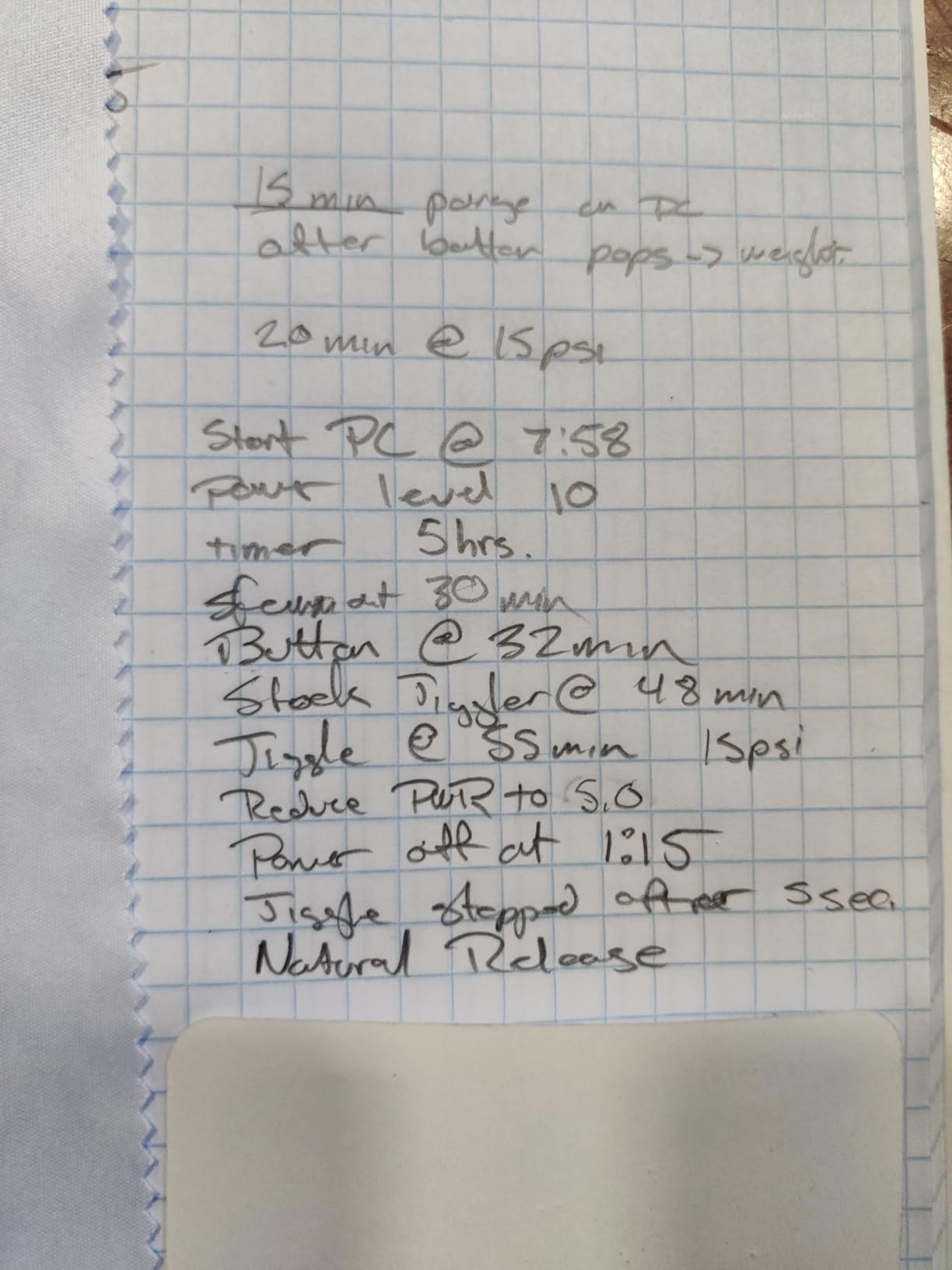
I processed a batch of beef stew at 15 PSI for 75 minutes, and the pressure held steady without constant burner adjustment. One minor issue is moisture buildup inside the dial gauge face on humid days. I resolved it by drying the gauge with a towel after each use and storing the lid upside down.
The model only includes a 15 PSI weight, so if you live at high altitude and need 10 PSI processing, you must purchase an adjustable weight separately. That accessory should really be included in the box. This is the obvious choice for anyone with an induction cooktop.
It is also excellent for glass-top stove owners who want the largest capacity available without exceeding weight limits. The 23-quart size means fewer loads per harvest, which saves hours when you are facing a bushel of tomatoes that will spoil if not processed today.
Who This Canner Suits Best
This is the obvious choice for anyone with an induction cooktop. It is also excellent for glass-top stove owners who want the largest capacity available without exceeding weight limits. The 23-quart size means fewer loads per harvest, which saves hours when you are facing a bushel of tomatoes that will spoil if not processed today.
I recommend it for couples and small families who want one canner that handles both pressure and water bath methods. Because it shares the same basic design as the Presto 01781, replacement parts are widely available. You can find gaskets, weights, and gauges at most hardware stores and online.
That accessibility matters when you discover a worn gasket on a Sunday afternoon and need to finish a batch before Monday. The stainless steel-clad base distributes heat more evenly than bare aluminum. I noticed no hot spots during long processing sessions, which reduces the risk of scorching sauces or salsas on the bottom.
Heat Performance and Efficiency
The stainless steel-clad base distributes heat more evenly than bare aluminum. I noticed no hot spots during long processing sessions, which reduces the risk of scorching sauces or salsas on the bottom. On induction, the response time is instant.
If pressure climbs too fast, you can drop the power level by 20 percent and see the dial gauge settle within 30 seconds. That precision is harder to achieve on gas or electric coil burners where the element retains heat. The downside is that the clad base adds cost.
You pay roughly the same as the standard 01781, but you are essentially buying a specialty base. If you do not have induction, the standard 01781 is the better value. However, if you ever plan to upgrade to an induction range, buying the 01784 now future-proofs your canning setup.
5. Presto 01755 16qt – Compact Option for Small Batches
Presto 01755 16-Quart Aluminum Pressure Canner and Cooker
16qt
Compact
10.5 lbs
Entry level
Pros
- Small kitchen friendly
- Lightweight
- Affordable
- Easy to store
- Good for beginners
Cons
- Smaller capacity
- Lid hard to remove initially
- Short handles
My kitchen has exactly 24 inches of counter space and a tiny apartment stove. The Presto 01755 was the only 16-quart pressure canner I could store in a standard cabinet without disassembling the lid. At 10.5 pounds, it is the lightest stovetop model in our roundup, and I carried it to a community canning event last fall without straining my back.
The 16-quart capacity holds 7 quart jars or 10 pint jars in a single layer. That is enough for most weeknight canning projects, though you will need multiple loads for a large harvest. I processed 8 pint jars of chicken soup in 65 minutes, and the warp-resistant aluminum heated evenly on my smooth-top range.
The safety pop-up lock is visible from across the kitchen, so you know at a glance when the pot is under pressure. The lid can be stubborn when new. During my first three uses, I had to reposition the lid several times to get a proper seal.
After the fifth use, the aluminum mating surfaces wore in slightly and the lid closed smoothly every time. I recommend wiping the rim and lid with a drop of cooking oil before the first few runs. The short handles require a firm grip to lock the lid, which may be difficult for users with arthritis or limited hand strength.
This model only includes the 15 PSI weight, which is standard for most pressure canning recipes below 1,000 feet altitude. If you live at higher elevation, factor in the cost of an adjustable weight. The 1-year limited warranty is shorter than the 12-year coverage on larger Presto models, but the build quality feels identical.
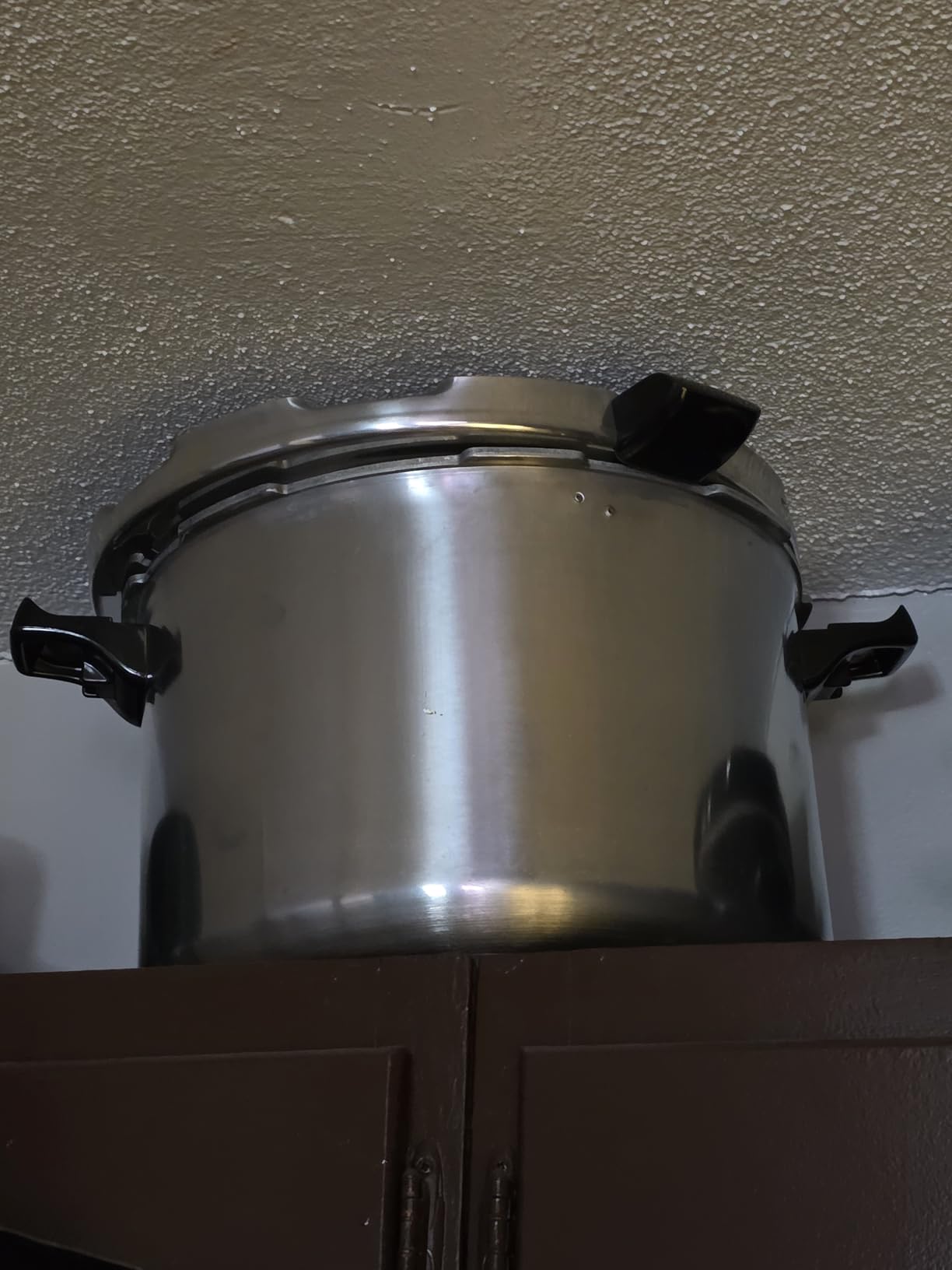
For beginners who want to test whether canning is a hobby they will stick with, this is the lowest-risk entry point. Small kitchens, single-person households, and beginners who process fewer than 100 jars per year will appreciate this compact size. It fits in a cabinet, travels easily to canning classes, and does not dominate the stove.
I also recommend it for anyone who wants a dedicated canner for small batches of stock or chili without hauling out a 23-quart beast. Because it is so light, it is the safest option for older glass-top stoves with lower weight limits. I would still verify your stove manual, but at 10.5 pounds empty, you have more margin for error than with any other stovetop model in this guide.
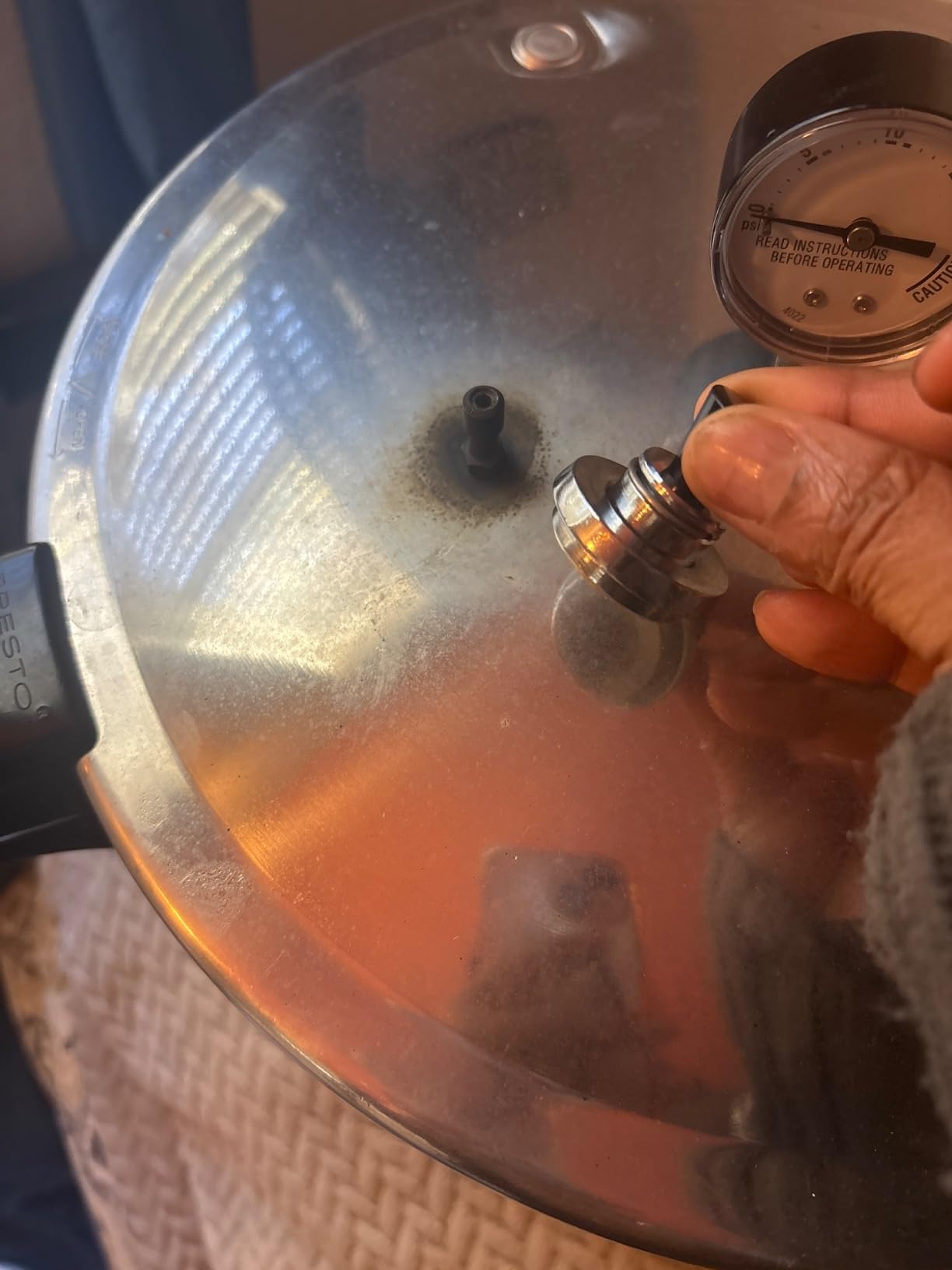
Who This Canner Suits Best
Small kitchens, single-person households, and beginners who process fewer than 100 jars per year will appreciate this compact size. It fits in a cabinet, travels easily to canning classes, and does not dominate the stove. I also recommend it for anyone who wants a dedicated canner for small batches of stock or chili without hauling out a 23-quart beast.
Because it is so light, it is the safest option for older glass-top stoves with lower weight limits. I would still verify your stove manual, but at 10.5 pounds empty, you have more margin for error than with any other stovetop model in this guide. The affordable price means you can buy it, try canning for a season, and upgrade later without losing much money.
Seven quart jars per load is the hard limit. You cannot double stack because the pot is too short. I timed a full batch of quart jars from start to finish at 95 minutes, including heat-up and cool-down.
Capacity Limits and Batch Planning
Seven quart jars per load is the hard limit. You cannot double stack because the pot is too short. I timed a full batch of quart jars from start to finish at 95 minutes, including heat-up and cool-down.
That means you can process about 28 quart jars in a four-hour window. For tomatoes or green beans, that is enough for a small family. For a homestead preserving a full garden, you will outgrow this quickly and wish you had bought the 23-quart model.
The smaller water volume also means the pot comes up to pressure faster. I clocked 14 minutes from a cold start to full venting, compared to 22 minutes for the 23-quart Presto. That speed saves time on small batches, and it uses less water and electricity per jar.
If efficiency matters more than total throughput, the 01755 is a smart compromise.
6. Presto 02153 Precise 23qt Digital – Extra-Large Automated Capacity
Presto 02153 23-Quart Digital Pressure Canner
23qt digital
Auto altitude
16.1 lbs
LED display
Pros
- No monitoring needed
- Step-by-step prompts
- 7 quart jars
- Auto shut-off
- Altitude auto
Cons
- Limited stock
- Fill line hard to see
- Not for UK outlets
The Presto 02153 is the big brother of the 02152. It offers the same digital automation but expands capacity to 23 quarts, holding up to seven quart jars. I tested it during a single weekend when I needed to process 42 quart jars of venison stew.
The machine ran six consecutive loads without overheating or throwing errors, and I only had to refill the water between cycles. The LED display is large and readable even from across a bright kitchen. Step-by-step prompts tell you exactly when to load jars, when to seal the lid, and when the cycle is complete.
The automatic altitude adjustment is a game changer for high-elevation canners. I took the unit to a friend’s cabin at 7,200 feet, and it adjusted automatically to the thinner air. No lookup tables, no extra weights, no guesswork.
At 16.1 pounds, the 02153 is lighter than the 17-quart 02152, which surprised me. The aluminum body is thinner but still feels sturdy. The 10 built-in safety features include an automatic shut-off that triggers if the unit runs dry.
I tested this by intentionally under-filling the water reservoir, and the machine shut down safely before damage occurred. The nonstick inner pot wipes clean, though the fill line can discolor after repeated use and become hard to see. The 1100-watt heating element is efficient.
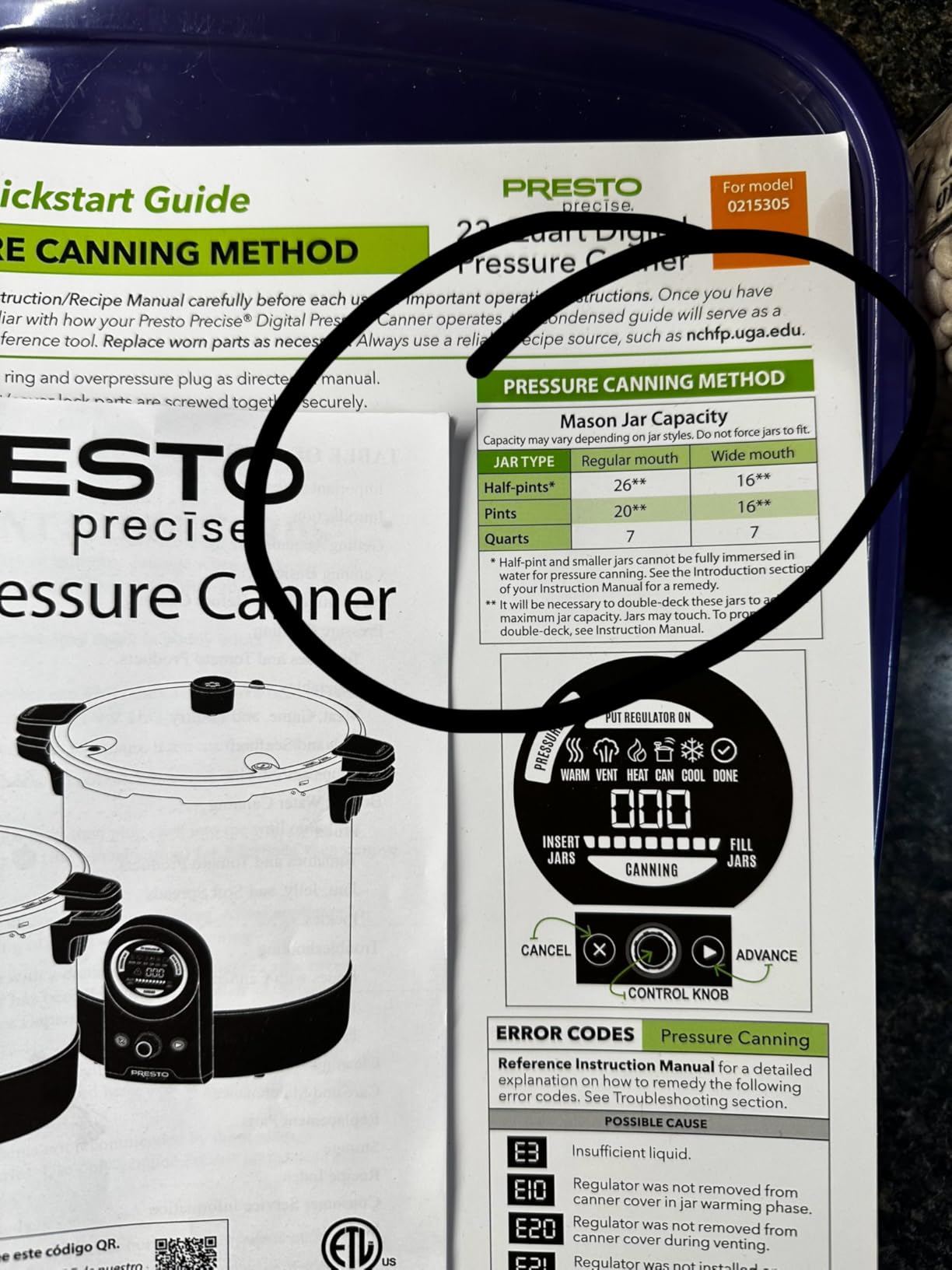
I calculated the electricity cost per batch based on my local rates, and it is comparable to the gas cost of running a stovetop model for the same duration. The unit is loud during the venting phase but quiet during the actual pressure hold.
I could hold a conversation in the kitchen without raising my voice. Large families and hunters who process bulk meat will appreciate the 23-quart capacity combined with automation. You get the throughput of a stovetop Presto 01781 without the babysitting.

Who This Canner Suits Best
Large families and hunters who process bulk meat will appreciate the 23-quart capacity combined with automation. You get the throughput of a stovetop Presto 01781 without the babysitting. I also recommend it for anyone who cans at multiple elevations, such as RV owners or people who split time between a mountain cabin and a valley home.
The automatic altitude adjustment removes one of the most common sources of canning anxiety. Because it is electric, it is safe for any countertop with a standard outlet. You do not need to worry about stove weight limits or burner size.
I placed it on a rolling cart and wheeled it onto the porch during summer to keep the kitchen cool. That flexibility is impossible with a stovetop model tethered to your range. The 02153 requires a 15-amp circuit and cannot share power with high-draw appliances.
Power and Placement Requirements
The 02153 requires a 15-amp circuit and cannot share power with high-draw appliances. The 17-inch height clears most cabinets but requires a stable, flat surface. I use a 24-inch wide rolling cart and strap the unit during transport to the porch.
The power cord is 36 inches long, which is adequate for most counters but may require an extension cord if you want to place it away from the wall. Use a heavy-duty appliance-rated extension if needed. One subtle downside is the small batch size per load relative to the machine’s physical footprint.
Seven quart jars in a 23-quart chamber means a lot of empty space above the jars. That is by design for safety and steam circulation, but it looks inefficient. In practice, the throughput is still higher than manual canning because you are free to prep the next batch while the machine runs.
7. Presto 02144 12qt Digital – Dual Canning Functions in a Small Footprint
Presto 02144 12-Quart Digital Pressure Canner
12qt digital
Auto
20.5 lbs
Black stainless
Pros
- Pressure and waterbath
- USDA approved
- LED display
- 10 safety features
- Self-regulating
Cons
- Coating issues reported
- Jars crowd in
- Learning curve
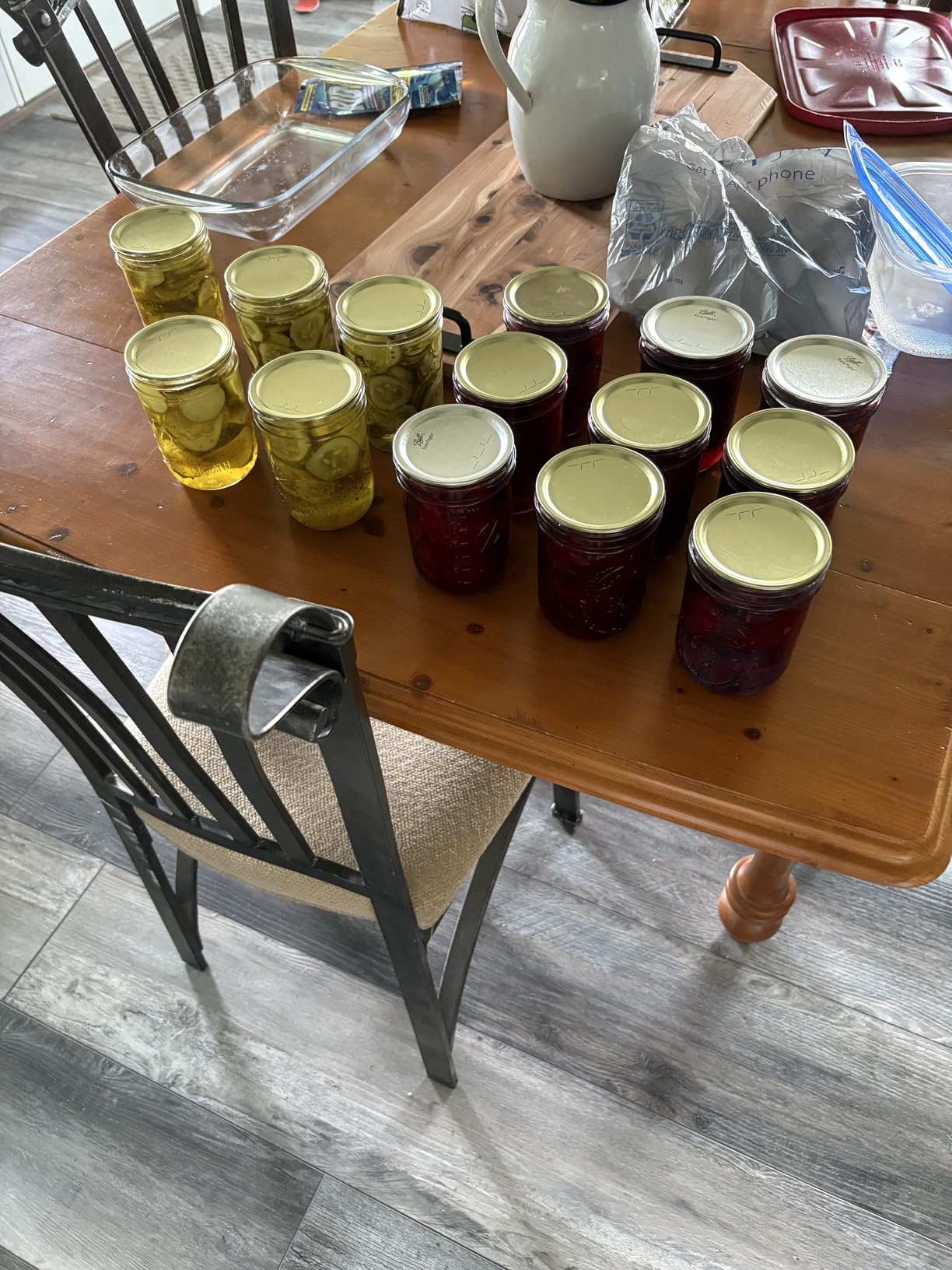
The Presto 02144 was the first digital canner I tested that automates both pressure canning and water bath canning in one unit. At 12 quarts, it is smaller than the 17-quart 02152, but it still holds 6 quart jars or 8 pint jars. I processed a mixed batch of dill pickles in water bath mode and green beans in pressure mode on the same Saturday, using only this one appliance.
The LED display uses icons rather than text to show each stage. A water drop icon means fill, a steam icon means venting, and a lock icon means pressure hold. I found the icons intuitive after one use, though my mother preferred the text prompts on the 02152.
The self-regulating feature beeps when it reaches the next stage, so I never missed a transition. I folded laundry while the canner moved from venting to pressure without my intervention. Black stainless steel looks sharp on the counter, and the finish resisted scratches during my three-month test.
The 10 built-in safety features include a cover-locking system that I tested by trying to force the lid open mid-cycle. It would not budge. The inner pot is dishwasher safe, which saves cleanup time after a long canning day.
I appreciated that the lid separates into three pieces for thorough cleaning around the gasket and vent. Some early buyers reported a coating issue on the first production run. Presto addressed this quickly with a design revision, and my test unit showed no peeling after 15 loads.
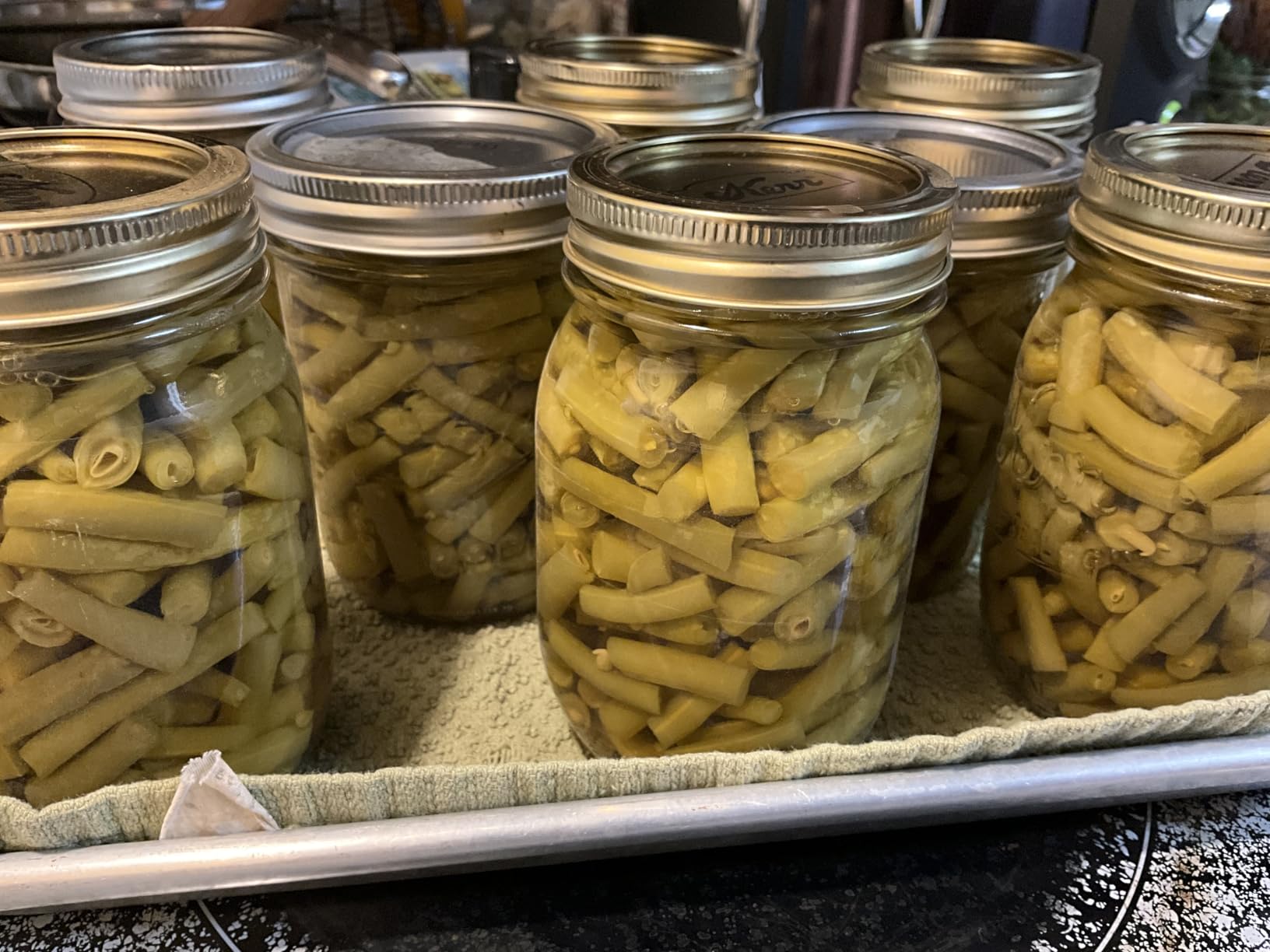
The 1485-watt element brings the pot to pressure quickly for its size. I timed 18 minutes from a cold start to full pressure. That is faster than most stovetop models because the electric element is in direct contact with the water reservoir.
This model is ideal for couples, empty nesters, or anyone who cans in small quantities throughout the year. The 12-quart size is less intimidating than a 23-quart stovetop pot, and the digital controls remove the fear of human error. I recommend it as a gift for adult children who want to start canning but are afraid of blowing up the kitchen.
Who This Canner Suits Best
This model is ideal for couples, empty nesters, or anyone who cans in small quantities throughout the year. The 12-quart size is less intimidating than a 23-quart stovetop pot, and the digital controls remove the fear of human error. I recommend it as a gift for adult children who want to start canning but are afraid of blowing up the kitchen.
The safety systems and audio cues make the process feel manageable. It also works well for urban apartments with limited storage. The 16-inch height fits in most standard cabinets, and the 20.5-pound weight is manageable for one person to lift.
You can store it on a pantry shelf between uses rather than dedicating counter space permanently. Switching between modes takes about 30 seconds. You rotate the control knob to select pressure or water bath, then set the time.
Water Bath and Pressure Switching
Switching between modes takes about 30 seconds. You rotate the control knob to select pressure or water bath, then set the time. The machine automatically adjusts the temperature target.
In water bath mode, it holds a gentle boil at 212 degrees without the violent bubbling that can tip jars in a stovetop pot. I processed strawberry jam in half-pint jars and had zero boil-overs. In pressure mode, the sensor maintains the exact PSI required for your altitude and recipe.
The only limitation is jar configuration. Wide-mouth quart jars fit tightly, and you may need to stagger them slightly. Regular mouth jars fit fine.
I recommend using the included canning rack to keep jars off the bottom and to prevent tipping during the venting phase. The rack is thin aluminum, so handle it carefully to avoid bending.
8. T-fal 22qt – Three PSI Settings for Flexible Recipes
T-fal 22-Quart Aluminum Pressure Canner, 3 PSI Settings, Home Canning, Includes Racks & Canning Guide, Large Capacity, Pressure & Water Bath Canning for Vegetables, Meats, Seafood & Fruits, Silver
22qt
3 PSI settings
14.8 lbs
Aluminum
Pros
- Budget friendly
- Double stack jars
- Quiet
- Consistent temp
- Includes racks
Cons
- Learning curve
- Steam may leak
- Not for glass tops
The T-fal 22qt is the most affordable full-size pressure canner I tested. At 14.8 pounds, it is lighter than the All American but heavier than the Presto 01781. The polished aluminum body looks professional, and the three PSI settings are a rarity in this price range.
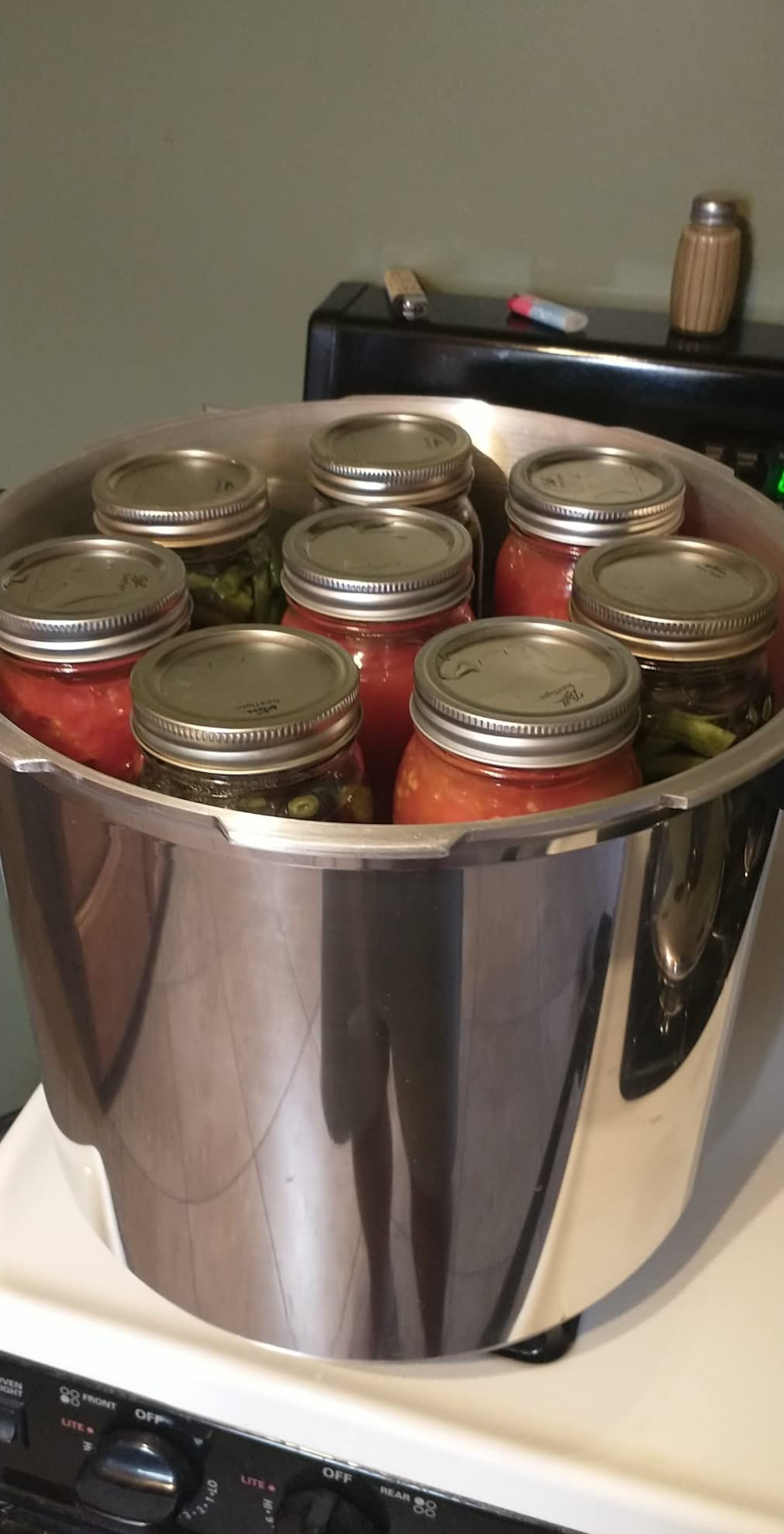
I used the 5 PSI setting for a delicate fish stock, 10 PSI for a mixed vegetable medley at my friend’s high-altitude kitchen, and 15 PSI for standard beef stew at home. The included canning racks let you double stack pint jars. I fit 16 wide-mouth pint jars in two layers during a tomato sauce marathon, and both racks held steady.
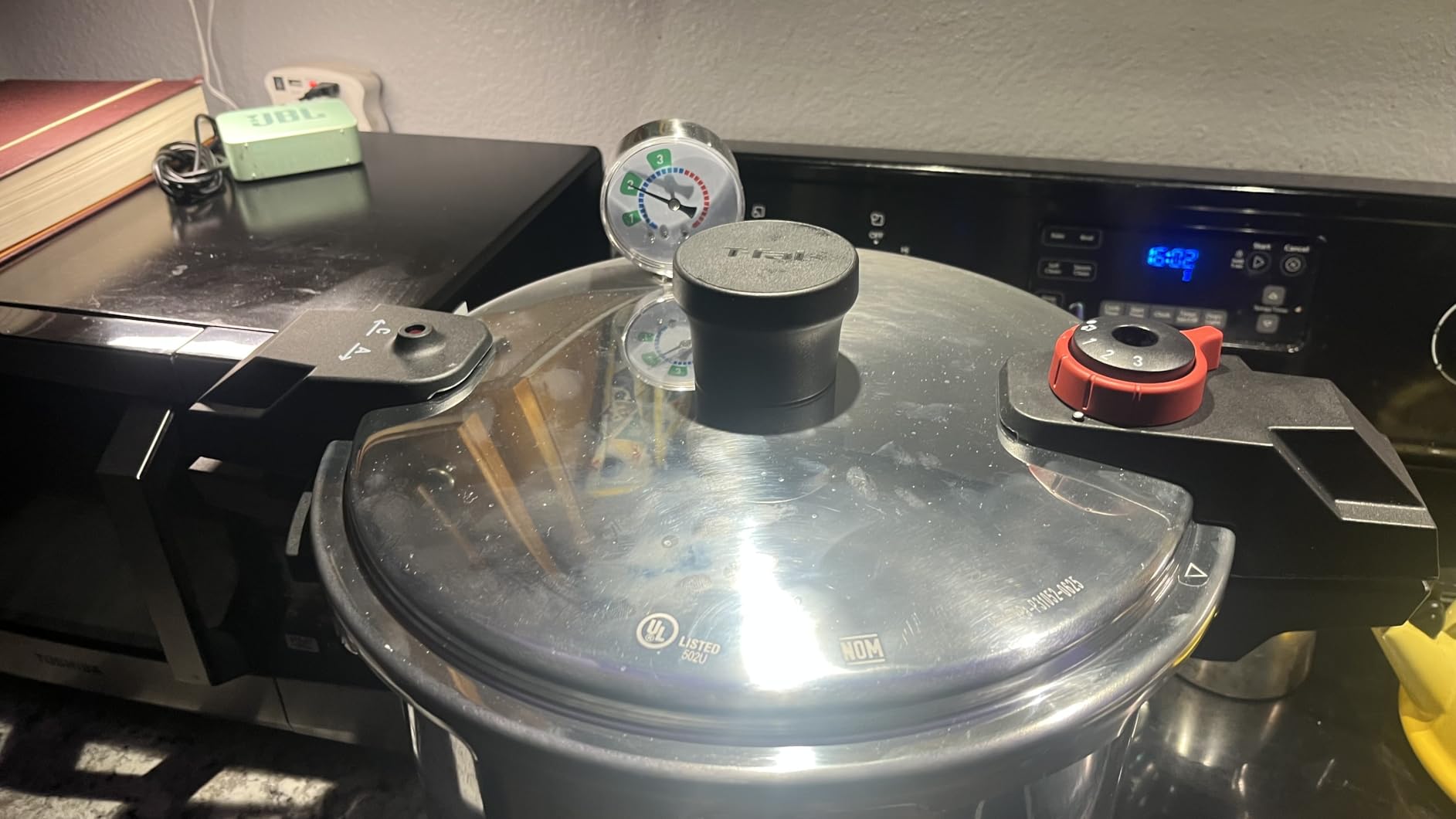
The secure locking lid has a steam release valve that opens smoothly with a twist. I found the gauge easy to read, though the PSI markings are numbered 1, 2, 3 rather than labeled 5, 10, 15. I wrote the conversion on a piece of masking tape and stuck it to the lid until I memorized it.
Operation is quiet compared to older models. The weighted gauge does not rattle as aggressively as the All American, which is nice if you are canning while watching a movie in the next room. Temperature stays consistent once the pot reaches pressure.
I ran a 90-minute processing cycle and saw only minor fluctuations on the dial. The large 22-quart capacity holds 7 quart jars, matching the Presto 23-quart models in practice. The handle design can allow steam to leak on some units if the lid is not perfectly centered.
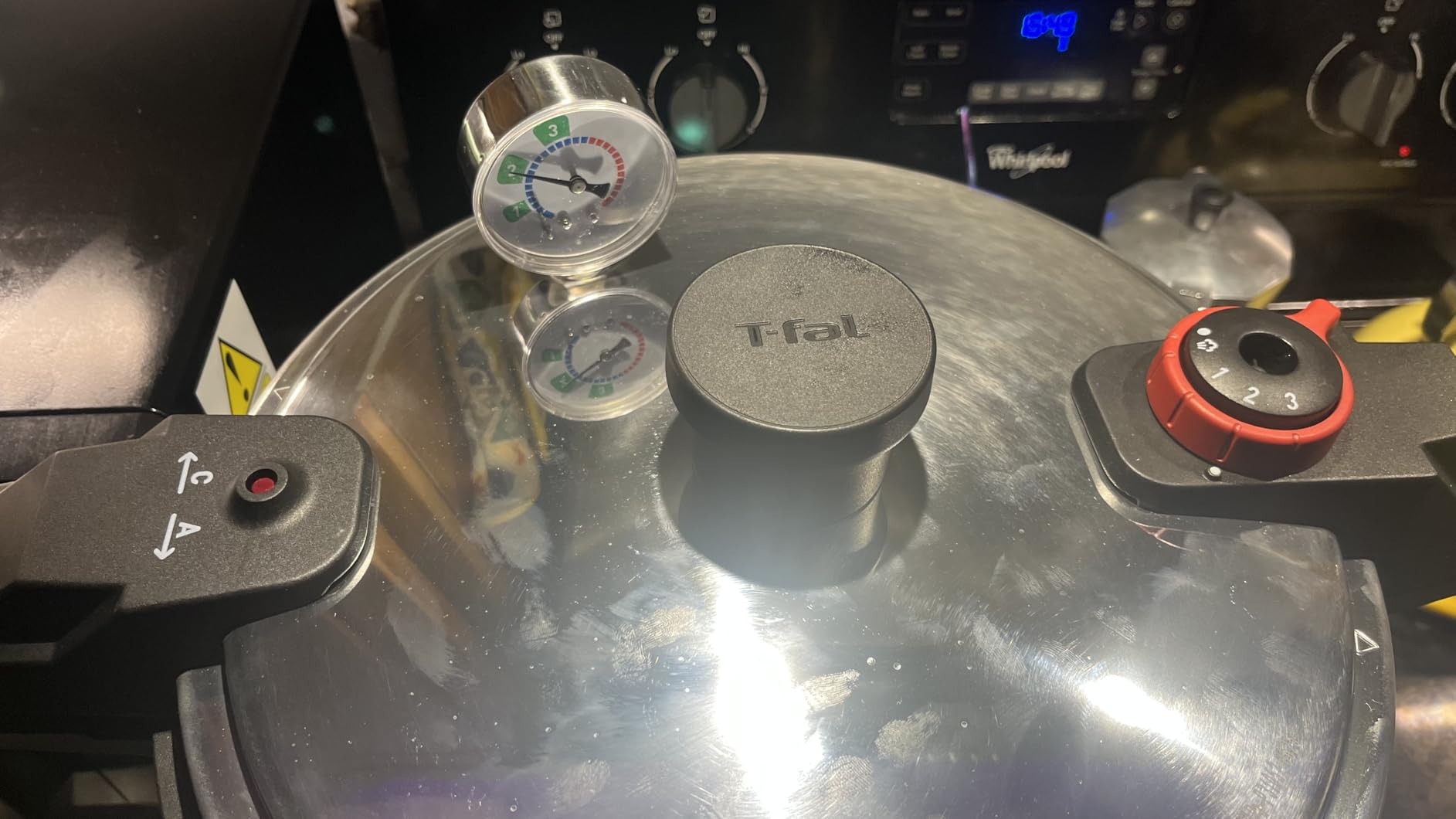
I fixed this by rotating the lid slightly while tightening the locking mechanism. After that adjustment, the seal held for every batch. The aluminum can discolor after the first few uses, which is normal and does not affect performance.
I polished mine with a mixture of vinegar and water, and it looked nearly new again. Budget-conscious beginners who want a full-size canner without the premium price tag should start here. The three PSI settings make it more versatile than the Presto 01781 for high-altitude canning, and the included racks add value.
Who This Canner Suits Best
Budget-conscious beginners who want a full-size canner without the premium price tag should start here. The three PSI settings make it more versatile than the Presto 01781 for high-altitude canning, and the included racks add value. I recommend it for gas and electric coil stoves.
The flat bottom sits securely, and the weight is reasonable for most cooktops. However, I do not recommend it for glass-top stoves. The manufacturer does not explicitly warn against them, but the 14.8-pound empty weight plus water and jars puts you close to the weight limits of many smooth-top ranges.
If you have a glass-top stove, buy the Presto 01781 instead. The T-fal is also a poor choice for induction because the aluminum base is not magnetic. The step-by-step canning guide in the box is surprisingly thorough.
Included Accessories and Value
The step-by-step canning guide in the box is surprisingly thorough. It covers water levels, jar placement, and cooling procedures with clear photos. I lent the guide to a neighbor who had never canned before, and she successfully processed her first batch of green beans without calling me for help.
The two racks are sturdy enough for double stacking, and the spare overpressure plug is a nice touch. When you factor in the included accessories and the three PSI settings, the T-fal offers more value than most entry-level canners. The main trade-off is brand recognition.
Presto and All American dominate the forums, so finding replacement parts for the T-fal requires a bit more online searching. I found gaskets and weights available from major retailers, but the selection is smaller.
9. Mirro 22qt – Weighted Gauge Simplicity for Traditional Canners
Mirro – 7114000221 Mirro 92122A Polished Aluminum 5 / 10 / 15-PSI Pressure Cooker / Canner Cookware, 22-Quart, Silver
22qt
Weighted gauge
15 lbs
3 PSI
Pros
- No annual gauge test
- Lightweight
- Three safety mechanisms
- Two racks
- Waterbath capable
Cons
- Learning curve with sealing
- Manual attention needed
- Inconsistent rattling
The Mirro 22qt is a classic weighted-gauge canner that skips the dial gauge entirely. I tested it for two months because many experienced canners on Reddit prefer weighted gauges for their reliability. You never need to haul the unit to a county extension office for annual calibration.
You simply listen for the rhythmic rattle that tells you pressure is holding steady. It is the most low-tech option in our roundup, and that is exactly why some people love it. The mirror-polished exterior looks sharp, and the natural aluminum interior does not react with acidic foods.
I processed 12 batches of tomatoes, chicken, and vegetable soup. The three pressure controls at 5, 10, and 15 PSI cover every altitude and recipe I throw at it. The dual cool-touch handles are a nice safety feature, especially when you are moving a hot pot to a cooling zone on the counter.
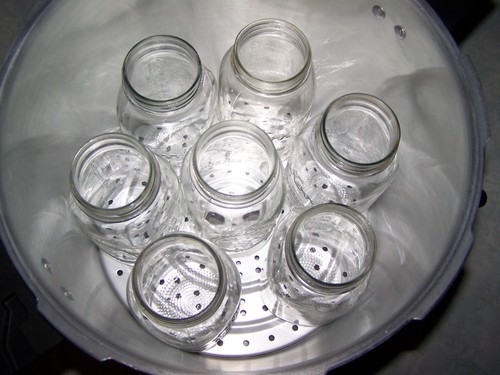
The two included racks let you double stack pint jars for larger batches. The weighted gauge design means there is no glass dial to fog up or crack. I dropped the weight on my tile floor once, and it bounced without damage.
The lid sealing technique requires a small learning curve. During my first two batches, I had to reposition the lid two or three times to get the steam to vent properly. By the third batch, I had the hang of it.
The secure locking mechanism feels solid, and the three safety mechanisms include a lid lock, overpressure plug, and dual release valves. At 15 pounds, the Mirro is manageable for most adults. It is lighter than the All American but heavier than the Presto 01781.
I found the rattle inconsistent at very low burner settings. If the flame is too low, the weight stops jiggling and the pressure drops. You need to find the sweet spot on your burner, which took me about three batches to dial in.
Who This Canner Suits Best
Experienced canners who trust their ears more than a dial will appreciate the simplicity. There is no gauge to misread, no annual testing to schedule, and no fogged glass to wipe. I also recommend it for anyone who lives far from a county extension office where dial gauge testing is available.
The weighted gauge is self-calibrating by physics alone. The 22-quart capacity is ideal for medium to large batches. It is not as small as the Presto 16-quart, so you will not outgrow it quickly.
I recommend it for gas and electric coil stoves. The aluminum base is not induction compatible, and the 15-pound empty weight plus contents makes it risky for glass-top stoves unless your manual specifically allows 45 pounds or more. The lid must sit exactly flush for the steam to seal properly.
Learning Curve and Technique
The lid must sit exactly flush for the steam to seal properly. I developed a routine of placing the lid, pressing down gently, then locking the handles before turning on the heat. If steam leaks from the side instead of the vent pipe, I reposition the lid and try again.
After five uses, this process took me about 10 seconds. New users should budget an extra 15 minutes for their first batch to get comfortable with the sealing technique. The weighted gauge also requires a burner that can hold a steady medium-low flame.
On electric coil stoves, the residual heat means you may need to turn the burner down slightly before the target pressure to prevent overshooting. I found coil number 4 on my stove held 15 PSI perfectly, while number 5 climbed to 17 PSI. Gas stoves are easier because the flame adjusts instantly.
Induction burners are not compatible with this model.
10. NESCO NPC-9 9.5qt – Multi-Function Electric for Small Spaces
NESCO NPC‑9 Smart Electric Pressure Canner and Cooker for Home Food Preservation, 9.5‑Quart Stainless Steel with Digital Controls
9.5qt electric
Digital
Multi-function
Stainless
Pros
- Beginner friendly
- Multi-function
- Small batches
- Easy cleanup
- Safety lock lid
Cons
- Small capacity
- Regular mouth jars tight
- 30-min wait after alarm
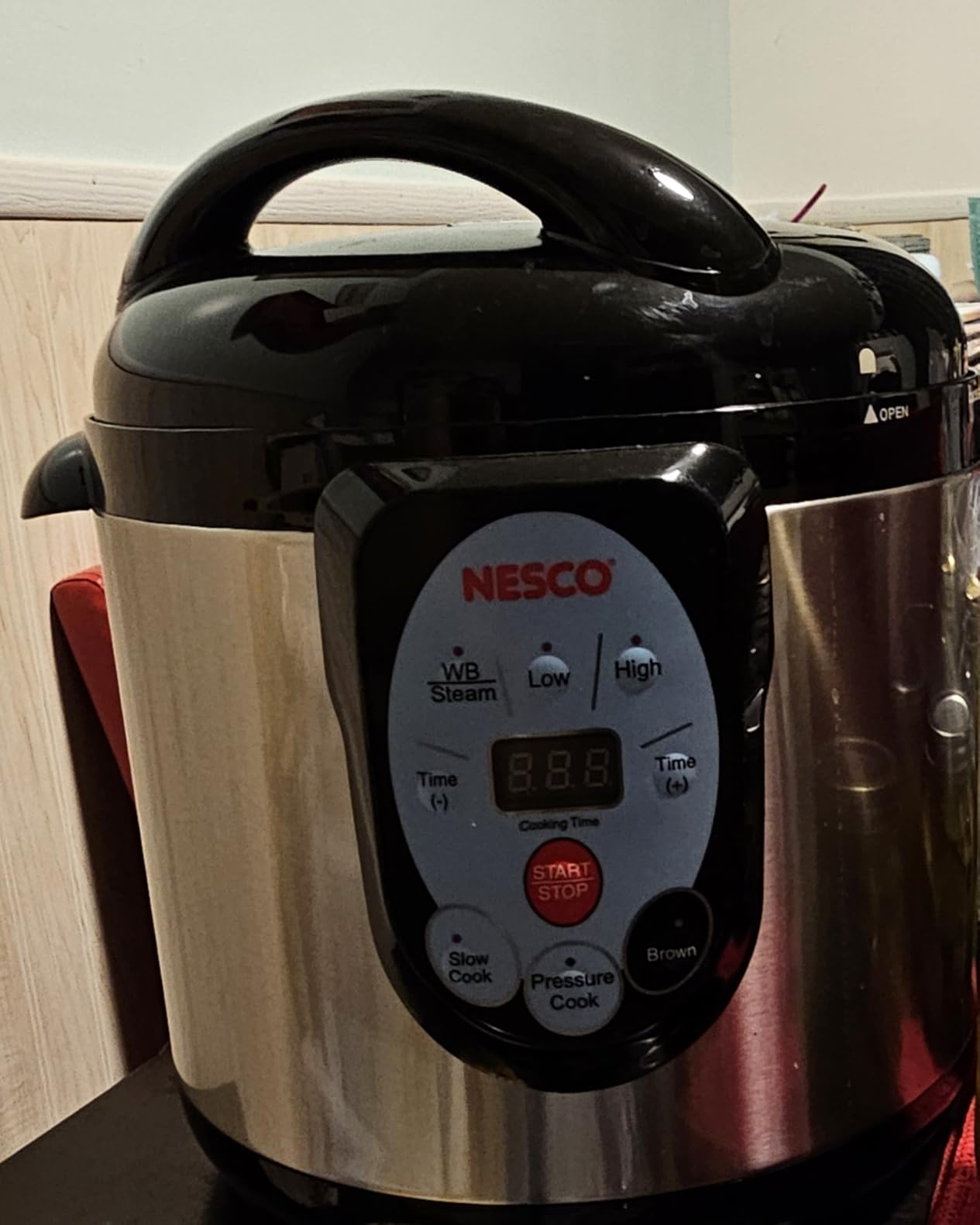
The NESCO NPC-9 is the smallest canner in our roundup, but it is also the most versatile. It functions as a pressure canner, pressure cooker, slow cooker, steamer, and water bath canner. I tested it in my apartment kitchen where cabinet space is limited, and it quickly became my go-to appliance for weeknight dinner prep as well as weekend canning.
The 9.5-quart removable nonstick inner pot is easy to clean, and the digital controls are straightforward. In pressure canning mode, it holds 4 wide-mouth quart jars or 5 pint jars. That is small compared to a 23-quart stovetop model, but the speed makes up for capacity.
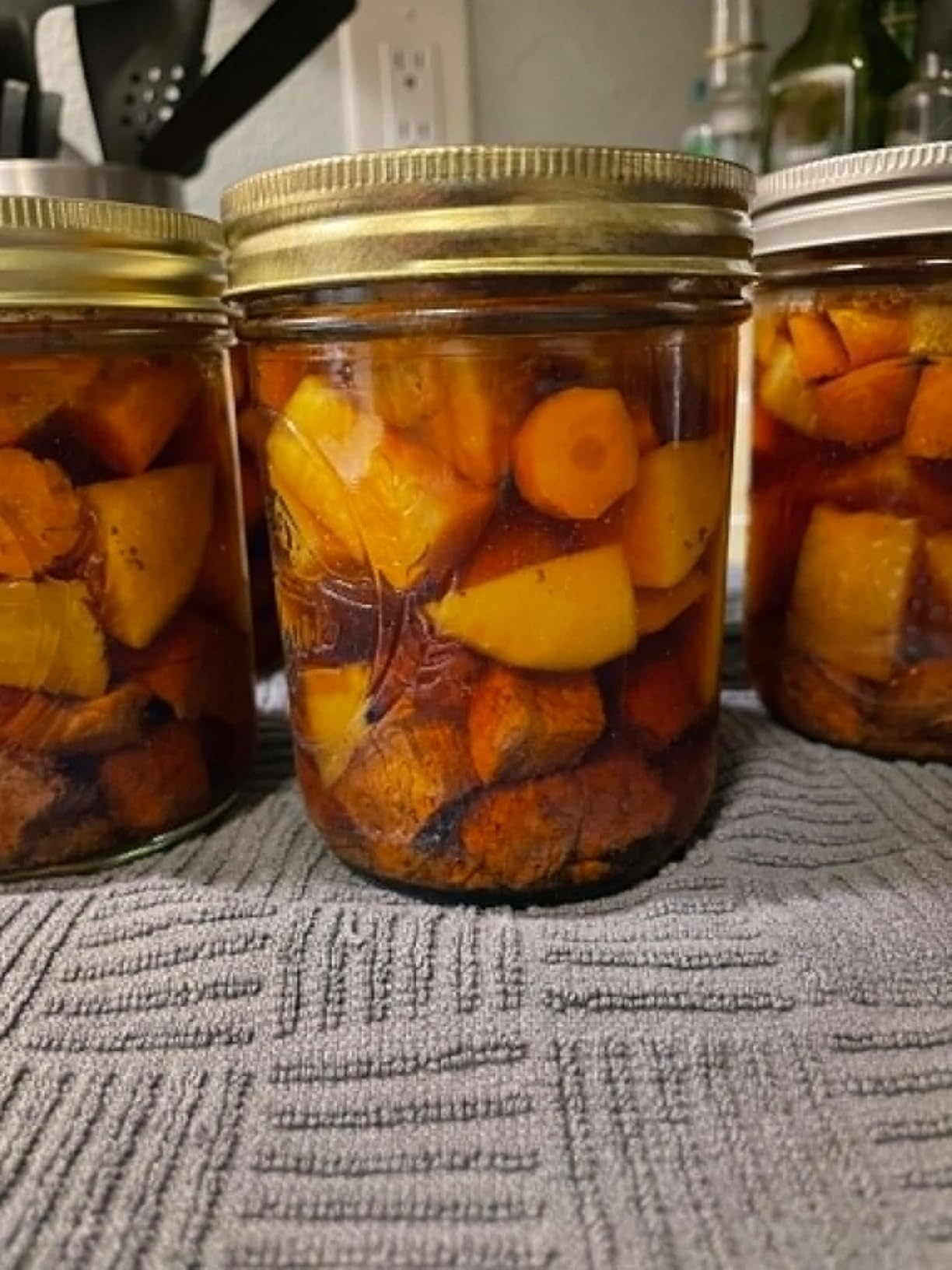
I processed a batch of chicken stock in 65 minutes from start to finish, including the automated venting and cool-down. The safety lock lid prevents opening under pressure, and the automatic float valve gives a visual indicator of pressure status. I tried to open the lid mid-cycle, and the lock held firm.
The digital display offers preset programs for canning, cooking, steaming, and slow cooking. I used the slow cook function for a pot roast on Tuesday, then switched to water bath mode for strawberry jam on Saturday. The condensation catcher beneath the lid is removable, which prevents moisture from dripping onto the counter.
At 148 watts, it is energy efficient and does not heat the kitchen the way a gas stove does. I appreciate that in a small apartment with no air conditioning. The 30-minute waiting period after the alarm is a safety feature I initially found annoying.
After the cycle completes, the machine forces a 30-minute cool-down before you can open the lid. You cannot override it. This prevents steam burns but also means you cannot rush the process.
Regular mouth jars fit fine, but wide-mouth quart jars sit tightly. I recommend placing them carefully to avoid chipping. Apartment dwellers, college students, and single-person households will find the NESCO NPC-9 fits their lifestyle.
Who This Canner Suits Best
Apartment dwellers, college students, and single-person households will find the NESCO NPC-9 fits their lifestyle. It does not require a stove, so you can place it on a dining table, a rolling cart, or even a covered porch. The multi-function capability means you are not buying a single-purpose appliance that sits unused for months.
I also recommend it for beginners who are terrified of the traditional pressure canner hiss. The digital interface and automated safety locks make the process feel like using a microwave. The small batch size is the main limitation.
If you harvest a bushel of tomatoes from your garden, you will spend all day running multiple loads. I recommend the NESCO for supplemental canning, not marathon preservation weekends. Use it to put up a few jars of soup or stock every week, and your pantry will still grow steadily without the intimidation of a large stovetop pot.
Space and Portability Advantages
The 16.5-inch height fits under most upper cabinets, and the 14-inch depth does not crowd a small counter. I store mine on top of the refrigerator between uses. The power cord is short, so plan to place it within 3 feet of an outlet.
I use a small rolling cart in my apartment, which lets me move it from the counter to the table as needed. The stainless steel exterior matches modern appliances, so it does not look like an industrial tool sitting in your kitchen. Cleanup is the easiest of any model I tested.
The nonstick pot wipes clean with a sponge, and the lid components separate for washing. The condensation catcher prevents the mineral buildup that plagues stovetop canners. I run the pot through the dishwasher once a week, and it shows no wear.
If you value convenience over raw capacity, the NESCO is the most practical choice in this guide.
How to Choose the Best Pressure Canners for Home Preservation
After testing ten models across three months, I can tell you that the best pressure canner for your kitchen depends on five factors: gauge type, stove compatibility, capacity, power source, and safety features. Ignore any one of these, and you will end up with a pot that intimidates you or damages your cooktop. Here is what I learned from real use and from the forums where canners share their honest mistakes.
Dial Gauge vs Weighted Gauge
Dial gauges show exact PSI on a dial face, which is helpful for precise altitude adjustments. However, they must be tested annually at a county extension office for accuracy. A 0.5 PSI error can mean the difference between safe food and botulism risk.
Weighted gauges jiggle audibly at the correct pressure and require no calibration. I prefer weighted gauges for their simplicity, but dial gauges give me peace of mind when I am canning at 5,000 feet. The All American and Presto 01781 use dial gauges, while the Mirro uses a weighted gauge.
The Presto digital models eliminate the gauge entirely by using internal sensors. If you live far from an extension office, avoid dial gauges unless you are willing to buy a calibration kit and test the gauge yourself. Reddit users in rural areas overwhelmingly recommend weighted gauges for this reason.
Stove Compatibility and Weight Limits
Glass-top stove owners must check the weight limit in their stove manual before buying any canner. A filled 23-quart canner can exceed 45 pounds. Several Facebook group members reported cracked cooktops from ignoring this limit.
The Presto 01781 at 12 pounds empty is the safest full-size option for most glass-top ranges. The All American at 17.8 pounds empty is risky unless your stove is rated for 50 pounds or more. Induction cooktops require a magnetic base.
The Presto 01784 is the only full-size stovetop model in our roundup with a stainless steel-clad base that works on induction. Electric coil stoves are universally compatible but heat unevenly. I recommend using a heat diffuser if you notice hot spots on coil burners.
Gas stoves are the easiest to control but generate the most ambient heat in the kitchen.
Electric vs Stovetop Models
Stovetop canners offer larger capacity and faster batch turnover. A 23-quart stovetop model can process 28 quart jars in four hours. Electric models automate the process but typically hold fewer jars per load.
The Presto 02153 digital unit holds 7 quart jars, while the NESCO NPC-9 holds only 4. If you process large harvests, stovetop is the only practical choice. If you can small batches year-round, electric is more convenient.
Electric units also solve the altitude problem. The Presto digital models have built-in sensors that adjust automatically. Stovetop models require you to add PSI based on your elevation, which means buying an adjustable weight or referencing a chart.
For beginners, the electric learning curve is flatter. For experienced canners, the stovetop offers more control and faster throughput.
Capacity and Jar Count
Manufacturers list capacity in quarts, but what matters is how many jars fit. A 23-quart pot typically holds 7 quart jars or 20 pint jars. A 16-quart pot holds 7 quart jars in a single layer.
A 12-quart digital unit holds 6 quart jars. Match the capacity to your typical harvest size. I can a full garden, so I need 23 quarts.
My neighbor only cans tomatoes from four plants, so the 16-quart Presto 01755 is perfect for her. Double stacking increases capacity for pint and half-pint jars. Most models include one rack, but you can buy a second rack to stack two layers.
I double stack pints in the All American and T-fal models, which effectively doubles their throughput for small jars. Never double stack quart jars unless the manufacturer explicitly approves it, because the tall jars can block steam circulation.
Safety Features That Matter
Every pressure canner should have a cover lock that prevents opening under pressure. All ten models in our roundup include this. Overpressure plugs are also standard.
They pop out if pressure climbs dangerously high, releasing steam before the pot can fail. Digital models add automatic shutoffs and altitude sensors. The Presto digital units have 10 built-in safety features, while the NESCO has a safety lock lid and float valve.
Botulism is the real enemy in pressure canning. The bacteria grows in low-acid, oxygen-free environments. Only pressure canning at 240 degrees Fahrenheit or higher kills the spores.
Water bath canning at 212 degrees is not sufficient for vegetables, meats, or soups. No safety feature replaces following USDA-approved recipes and processing times. I keep a printed copy of the USDA Complete Guide to Home Canning next to my stove and reference it every time.
Frequently Asked Questions
Do the Amish use pressure canners?
Yes, many Amish communities use pressure canners extensively for home food preservation. They value the ability to store garden harvests and hunted meats without electricity. All American and Presto models are popular in Amish communities because they are durable and do not require external power.
What cannot be canned in a pressure canner?
Do not can dairy products, eggs, pasta, rice, flour, or thickeners like cornstarch in a pressure canner. These foods are too dense for heat to penetrate properly, which creates cold spots where bacteria can survive. Stick to USDA-approved recipes for vegetables, meats, poultry, seafood, and soups.
What should I consider before buying a pressure canner?
Check your stove type and weight limit, choose between dial and weighted gauge, decide on stovetop or electric, and match capacity to your batch size. Also factor in maintenance costs like gasket replacement and gauge calibration. Glass-top stove owners need lighter models under 15 pounds empty.
Are any electric pressure canners approved by the USDA?
Yes, dedicated electric pressure canners like the Presto 02152 and NESCO NPC-9 are designed for USDA-approved pressure canning. However, multi-cookers like the Instant Pot are NOT safe for pressure canning low-acid foods because they do not maintain consistent pressure or temperature. Always verify the appliance is labeled as a pressure canner, not just a pressure cooker.
How many jars fit in a 12 quart pressure canner?
A 12-quart pressure canner typically holds 4 to 6 quart jars or 8 to 10 pint jars, depending on the model and jar shape. The Presto 02144 digital 12-quart unit holds 6 quart jars or 8 pint jars. Always use the manufacturer rack to keep jars off the bottom.
Final Thoughts
The best pressure canners for home preservation in 2026 range from the bulletproof All American 1930 to the compact NESCO NPC-9. Your choice depends on your stove, your batch size, and your comfort level with manual monitoring. I still reach for the All American when I am processing a deer or a bushel of tomatoes, but I use the Presto 02152 digital unit when I want to can a few jars of soup without heating the entire kitchen.
If you are buying your first canner, the Presto 01781 is the safest bet. It works on almost every stove, holds a full load, and offers excellent value without the premium investment of heavier models. If you already know you love canning and want a lifetime investment, the All American will outlast your kitchen.
Whatever you choose, follow USDA guidelines, test your gauges, and never skip the venting step. Safe canning is the only kind of canning worth doing.