
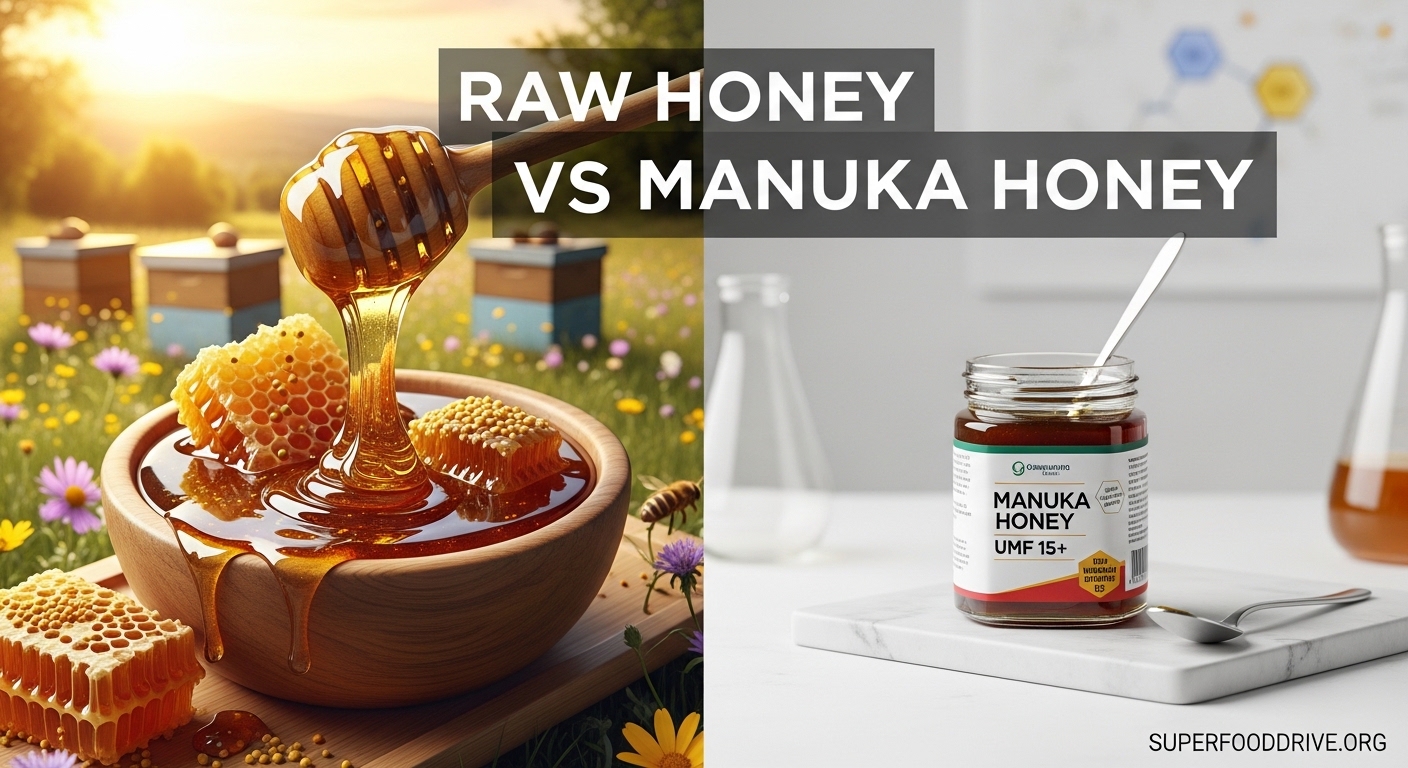
Raw Honey vs Manuka Honey is one of the most common questions people ask when shopping for quality honey. While both offer health benefits, they differ significantly in origin, antibacterial strength, and ideal use cases. Raw honey is unpasteurized honey from various floral sources worldwide, while Manuka honey is a specific type produced from the nectar of New Zealand’s Manuka tree. Understanding these differences will help you choose the right honey for your needs.
In this guide, I will break down everything you need to know about Raw Honey vs Manuka Honey. I will explain what makes each unique, compare their health benefits, and help you decide which one fits your lifestyle and budget.
Table of Contents
Quick Overview: Raw Honey vs Manuka Honey
Before diving deeper, here is a side-by-side comparison of the key differences between these two types of honey.
| Feature | Raw Honey | Manuka Honey |
|---|---|---|
| Origin | Global – various floral sources | New Zealand & Australia only |
| Floral Source | Multiple flowers (polyfloral) | Leptospermum scoparium (Manuka tree) |
| Processing | Unpasteurized, unfiltered | Raw, minimal processing |
| Key Compound | Hydrogen peroxide | Methylglyoxal (MGO) |
| Antibacterial Strength | Moderate (varies by source) | High to very high (measured) |
| Grading System | None standardized | UMF or MGO rating |
| Price Range | $8-$25 per 500g | $40-$200+ per 500g |
| Best For | Daily wellness, cooking | Medicinal use, wound care |
What Is Raw Honey?
Raw honey is honey that has not been pasteurized or heavily filtered. This means it retains all the natural enzymes, pollen, propolis, and antioxidants that processed honey loses during heat treatment.
When bees collect nectar from flowers and transform it into honey inside the hive, they add enzymes that make honey naturally antibacterial and shelf-stable. Raw honey keeps all these beneficial compounds intact.
How Raw Honey Is Produced
Beekeepers harvest raw honey by extracting it from the honeycomb and straining it to remove large wax particles. The key difference from regular honey is temperature. Raw honey is never heated above hive temperature (about 95 degrees Fahrenheit). This preserves the enzymes and delicate compounds.
The color and flavor of raw honey vary dramatically depending on which flowers the bees visited. Clover honey tastes light and sweet, while buckwheat honey is dark and robust. Wildflower honey contains a blend of nectars, giving it complex flavor notes.
Nutritional Profile of Raw Honey
Raw honey contains approximately 80% sugars (fructose and glucose), 18% water, and 2% other compounds. That 2% includes enzymes like diastase and invertase, trace minerals including iron and zinc, B vitamins, and amino acids.
The pollen content in raw honey may help with seasonal allergies for some people. When you consume local raw honey, you are also consuming small amounts of local pollen, which could potentially build tolerance over time.
What Is Manuka Honey?
Manuka honey is a special type of monofloral honey produced when bees collect nectar exclusively from the flowers of the Leptospermum scoparium tree, commonly known as the Manuka or tea tree. This tree grows wild in New Zealand and parts of Australia.
What makes Manuka honey truly unique is its exceptionally high methylglyoxal (MGO) content. This compound gives Manuka honey its powerful and stable antibacterial properties that go far beyond what regular raw honey can offer.
The Science Behind Manuka’s Power
Manuka honey contains three key bioactive compounds that work together. Methylglyoxal (MGO) is the star compound responsible for the strong antibacterial effects. Leptosperin is a marker compound found only in Manuka nectar, proving authenticity. Dihydroxyacetone (DHA) in the nectar converts to MGO over time as the honey matures.
Unlike the hydrogen peroxide in regular honey, which breaks down when exposed to heat, light, or body enzymes, MGO remains stable. This means Manuka honey maintains its antibacterial potency even when diluted or exposed to adverse conditions.
UMF and MGO Grading Explained
Manuka honey uses two main grading systems to measure potency. The UMF (Unique Manuka Factor) rating system measures multiple compounds including MGO, leptosperin, and non-peroxide activity. Ratings range from UMF 5+ to UMF 20+.
The MGO rating system measures only methylglyoxal content in milligrams per kilogram. Common ratings include MGO 83+, MGO 263+, MGO 400+, MGO 550+, and MGO 850+. Higher numbers indicate stronger antibacterial properties.
Here is a simple conversion guide. UMF 5+ equals approximately MGO 83+. UMF 10+ equals MGO 263+. UMF 15+ equals MGO 514+. UMF 20+ equals MGO 829+.
Key Differences Between Raw Honey and Manuka Honey
Understanding Raw Honey vs Manuka Honey means looking at several critical factors that set them apart. Here is what you need to know.
Origin and Floral Source
Raw honey can come from anywhere in the world. Bees visit multiple flower types, creating polyfloral honey with varying properties. Manuka honey comes exclusively from New Zealand and Australia, produced from a single tree species. This monofloral origin means every jar of authentic Manuka has consistent bioactive properties.
Antibacterial Mechanism
Raw honey fights bacteria primarily through hydrogen peroxide produced by glucose oxidase enzymes. This is effective but unstable. The hydrogen peroxide breaks down when exposed to heat, light, or dilution. Manuka honey uses methylglyoxal as its primary antibacterial weapon. MGO remains stable and effective even when the honey is diluted, heated, or exposed to body enzymes.
Testing and Certification
Raw honey has no standardized testing or certification system. Quality varies significantly between producers and regions. Manuka honey undergoes rigorous laboratory testing for MGO, UMF, and authenticity markers. Look for UMF or MGO certification on the label to ensure you are getting genuine Manuka with verified potency.
Availability and Authenticity Concerns
Raw honey is widely available from local beekeepers, farmers markets, and grocery stores. The main concern is ensuring it is truly raw and unheated. Manuka honey faces more serious authenticity issues. The high price has led to widespread counterfeiting. Always buy from reputable brands with verified testing and New Zealand origin certification.
Health Benefits Comparison
Both raw honey and Manuka honey offer health benefits, but their strengths differ. Here is a breakdown of what each can do for you.
Raw Honey Benefits
Raw honey supports immune health through antioxidants and enzymes. The antioxidants help fight free radicals in the body. The enzymes aid digestion by supporting gut health. Raw honey also contains prebiotics that feed beneficial gut bacteria.
For sore throats and coughs, raw honey provides soothing relief. Studies show it can be as effective as over-the-counter cough medicines for children over one year old. The thick texture coats the throat while the antibacterial properties help fight infection.
Some people use raw honey for seasonal allergy relief. The theory suggests that consuming local raw honey exposes you to small amounts of local pollen, potentially building tolerance. While scientific evidence is limited, many people report positive results.
Manuka Honey Benefits
Manuka honey takes antibacterial benefits to another level. Research supports its use for wound healing, including burns, ulcers, and surgical wounds. Medical-grade Manuka honey is used in hospitals for treating antibiotic-resistant infections like MRSA.
For digestive health, Manuka honey shows promise for conditions like SIBO (small intestinal bacterial overgrowth), acid reflux, and stomach ulcers. The antibacterial properties target harmful bacteria while supporting beneficial gut flora.
Skin care is another popular use. Manuka honey can help with acne, eczema, and minor skin infections when applied topically. The antibacterial and anti-inflammatory properties reduce redness and fight bacteria on the skin.
Which Is Healthier?
The answer depends on your needs. For daily wellness, general immune support, and cooking, raw honey provides excellent value. For specific health concerns requiring strong antibacterial action, wound care, or digestive issues, Manuka honey offers superior medicinal benefits.
Taste, Texture, and Price Comparison
Beyond health benefits, practical factors like taste and cost matter when choosing between Raw Honey vs Manuka Honey.
Flavor Profiles
Raw honey offers incredible variety. Clover honey is light and floral. Buckwheat is dark and molasses-like. Wildflower blends offer complex, changing flavors throughout the season. This variety makes raw honey exciting for culinary use.
Manuka honey has a distinctive earthy, slightly bitter, and medicinal taste. It is less sweet than most raw honey varieties. Some people love the complex flavor, while others find it too strong. The higher the MGO rating, the more intense and medicinal the flavor becomes.
Texture Differences
Raw honey crystallizes naturally over time as glucose separates from water. This is normal and does not mean the honey has spoiled. Gentle warming returns it to liquid form. Different floral sources crystallize at different rates.
Manuka honey is typically thicker and creamier than many raw honey varieties. High-grade Manuka often has a thick, almost paste-like consistency that spreads easily on toast or skin.
Price Considerations
Raw honey is affordable for daily use. Quality local raw honey typically costs $8 to $25 for a 500g jar. This makes it practical for cooking, sweetening drinks, and daily consumption.
Manuka honey commands premium prices. Entry-level Manuka (MGO 83+) starts around $40 for 500g. High-grade medicinal Manuka (MGO 850+) can cost $150 to $200 or more. This price reflects limited supply, testing costs, and verified potency.
When to Use Raw Honey vs Manuka Honey
Based on my research and forum discussions with regular users, here is a practical guide for choosing between Raw Honey vs Manuka Honey.
Use Raw Honey For
Daily tea and coffee sweetening. Baking and cooking where honey flavor enhances recipes. General immune support during cold and flu season. Soothing sore throats and coughs. Everyday wellness routines. Budget-conscious health choices.
Raw honey is your go-to for culinary applications. Its varied flavors complement different dishes, and the affordable price means you can use it generously.
Use Manuka Honey For
Active infections requiring antibacterial support. Wound care and minor burns. Digestive issues like SIBO or stomach ulcers. Skin conditions including acne and eczema. Sore throats that need extra medicinal support. Post-surgical wound healing.
Think of Manuka honey as a natural medicine cabinet staple rather than an everyday sweetener. The high price means you will want to reserve it for situations where its superior antibacterial properties make a real difference.
Safety and Storage Considerations
Both raw honey and Manuka honey require proper storage to maintain their benefits.
Store honey in a cool, dark place in an airtight container. Avoid refrigeration, which accelerates crystallization. Keep honey away from heat sources that could degrade enzymes and active compounds.
Never give honey to children under one year old due to the risk of infant botulism. People with diabetes should monitor honey consumption due to its high sugar content. Those with bee pollen allergies should introduce honey slowly.
To verify authentic Manuka honey, look for UMF or MGO certification on the label. Check that the product is from New Zealand. Be suspicious of prices that seem too good to be true. Genuine Manuka cannot be produced cheaply.
Frequently Asked Questions
What is healthier, Manuka honey or raw honey?
Both offer health benefits, but Manuka honey has superior antibacterial properties due to its high methylglyoxal (MGO) content. Raw honey is excellent for daily wellness, immune support, and cooking at a more affordable price. Manuka is better for medicinal purposes, wound care, and fighting specific infections. The healthiest choice depends on your specific needs and budget.
Is Manuka honey ok with SIBO?
Manuka honey may actually help with SIBO (small intestinal bacterial overgrowth) due to its antibacterial properties. Research suggests it can help balance gut bacteria by targeting harmful bacteria while supporting beneficial flora. However, those with SIBO should consult their healthcare provider before adding honey to their diet, as individual responses vary.
Can Manuka honey cure MRSA?
Medical-grade Manuka honey has shown effectiveness against MRSA (methicillin-resistant Staphylococcus aureus) in clinical studies and hospital settings. Hospitals use Manuka honey dressings for wound care in MRSA patients. While it is not a cure on its own, Manuka honey can be an effective complementary treatment for MRSA-infected wounds when used under medical supervision.
Does Manuka honey lower cortisol?
There is limited direct evidence that Manuka honey lowers cortisol levels specifically. However, its anti-inflammatory properties may help reduce stress-related inflammation in the body. Some studies suggest honey in general may support better sleep quality when consumed before bed, which could indirectly affect cortisol levels. More research is needed for definitive conclusions.
Is Manuka honey worth the extra cost?
Manuka honey is worth the premium price if you need its specific medicinal benefits for wound healing, digestive issues, or fighting resistant infections. For daily sweetening and general wellness, raw honey offers better value. Many users keep both on hand – raw honey for everyday use and Manuka for specific health needs.
Can I use raw honey instead of Manuka honey for skincare?
Raw honey can be used for basic skincare like moisturizing and gentle cleansing. However, Manuka honey is superior for treating acne, eczema, and skin infections due to its stronger antibacterial properties. For serious skin conditions, Manuka is worth the investment. For general skin maintenance, raw honey works well at a lower cost.
What MGO level should I choose?
For daily wellness and general immune support, MGO 83+ to MGO 263+ is sufficient. For digestive health and moderate medicinal use, choose MGO 400+ to MGO 550+. For serious wound care, infections, or medical-grade needs, select MGO 850+ or higher. Higher MGO means stronger antibacterial properties but also higher cost and more medicinal taste.
Conclusion
Raw Honey vs Manuka Honey is not a contest with one clear winner. Both offer genuine health benefits at different price points and potency levels. Raw honey provides excellent daily wellness support, immune benefits, and culinary versatility at an affordable price. Manuka honey delivers superior antibacterial properties that make it worth the investment for medicinal use, wound care, and specific health conditions.
The smart approach is keeping both in your pantry. Use raw honey for your morning tea, baking, and daily wellness routine. Reserve Manuka honey for when you need its powerful antibacterial action for sore throats, skin issues, or digestive concerns. Understanding the difference ensures you get the right honey for the right purpose.