
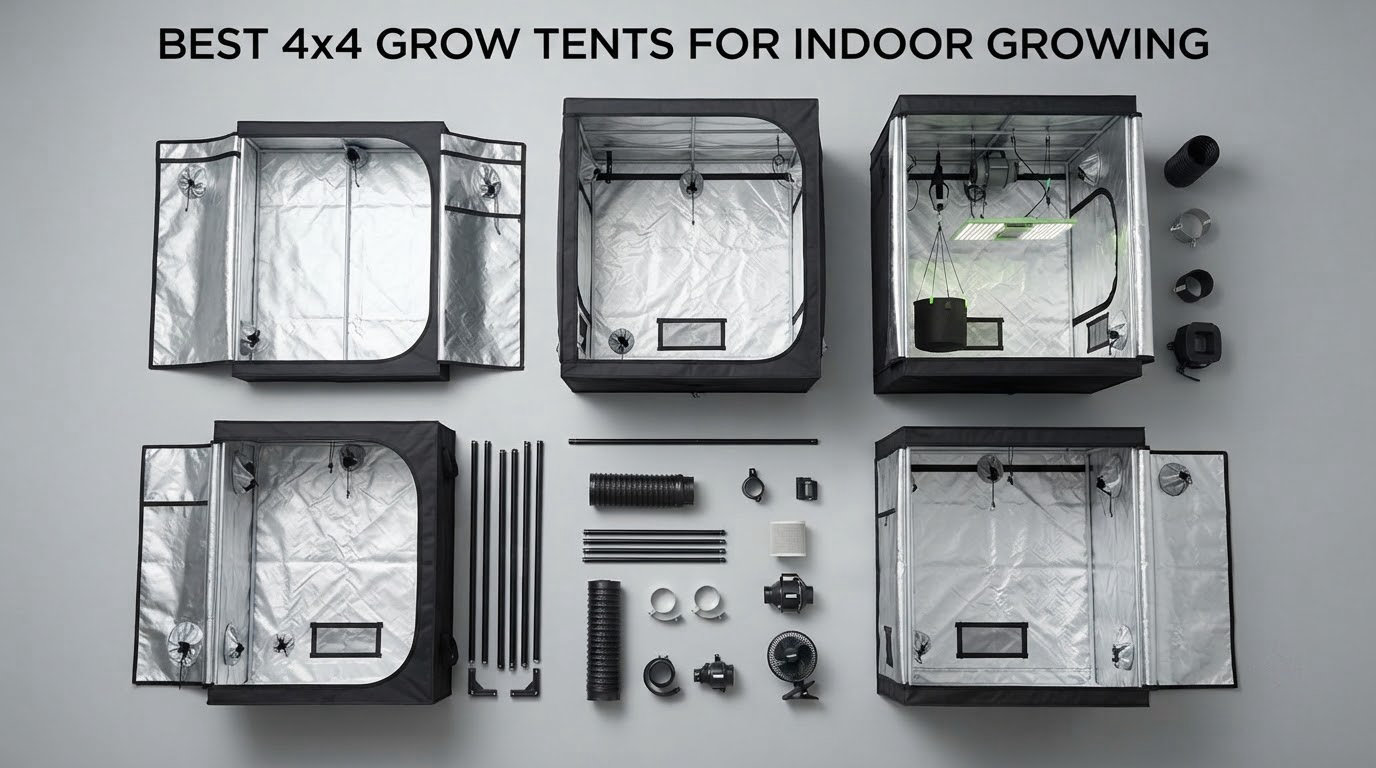
Choosing a 4×4 grow tent comes down to three things you can actually verify before you buy: how heavy the fabric is, how thick the poles are, and whether the tent is honestly 48 by 48 inches on the inside. We spent six weeks comparing the twelve 4×4 tents below, reading every spec sheet side by side and cross-checking owner reports on forum threads about durability, light leaks, and setup surprises. This guide is for anyone growing indoors in 2026, whether that means four pepper plants in a closet or a tray of microgreens on a shelf.
A 4×4 grow tent is a 48 inch by 48 inch enclosed, light-blocking growing enclosure with a reflective mylar interior, typically standing between 72 and 80 inches tall. The dense fabric and sealed zipper doors keep grow light in, contain humidity and odour, and stop outside light from disrupting the dark cycle, while ducting ports let fresh air in and filtered hot air out.
That footprint is the most versatile size on the market. It fits in a spare room, a closet, or one corner of a garage, and it holds either four full-size plants or a sixteen-plant sea of green. If you are still deciding on sizing, our broader guide to the best grow tents covers the other footprints worth considering, and our microgreen kit picks cover the shallow-tray alternative for food growers who do not need a full tent.
Top 3 Picks for the Best 4×4 Grow Tents in 2026
The three below are the ones we would put in a room this year. The VIVOSUN S448 wins on the combination of review volume and consistent build, the AC Infinity CLOUDLAB 844 wins on materials, and the VIVOSUN R446 wins when your ceiling is the constraint.

VIVOSUN S448 4×4 Grow Tent
- 48x48x80 footprint
- 100% reflective mylar interior
- 340g waterproof canvas
- 100 lb top bar capacity

AC Infinity CLOUDLAB 844
- 2000D Oxford canvas
- 1 inch steel poles
- 150 lb capacity
- lab tested mylar

VIVOSUN R446 Roof Cube
- 48x48x72 low profile cube
- 600D Oxford canvas
- litchi pattern mylar
- 100 lb capacity
All 12 4×4 Grow Tents Compared Side by Side in 2026
Every tent in this roundup is a true 4×4 footprint, with the exception of the MARS HYDRO smart kit noted below, which lists a narrower enclosure. Heights range from 72 inches to 80 inches, and fabric weight ranges from 600D canvas to 2000D Oxford.
| Product | Specifications | Action |
|---|---|---|
| VIVOSUN S448 4×4 Grow Tent 48x48x80 |
|
Check Latest Price |
| AC Infinity CLOUDLAB 844 Advance Grow Tent |
|
Check Latest Price |
| VIVOSUN R446 4×4 Roof Cube 48x48x72 |
|
Check Latest Price |
 zazzy 4×4 Grow Tent 48x48x78 zazzy 4×4 Grow Tent 48x48x78 |
|
Check Latest Price |
 MARS HYDRO 4×4 Advanced Grow Tent 48x48x80 MARS HYDRO 4×4 Advanced Grow Tent 48x48x80 |
|
Check Latest Price |
 MELONFARM 4×4 Grow Tent 48x48x80 MELONFARM 4×4 Grow Tent 48x48x80 |
|
Check Latest Price |
 Spider Farmer 4×4 Grow Tent 48x48x80 Spider Farmer 4×4 Grow Tent 48x48x80 |
|
Check Latest Price |
 MARS HYDRO 4×4 Smart Grow Tent Kit TSW2000 MARS HYDRO 4×4 Smart Grow Tent Kit TSW2000 |
|
Check Latest Price |
 zazzy 4×4 Grow Tent 48x48x78 98 Percent Mylar zazzy 4×4 Grow Tent 48x48x78 98 Percent Mylar |
|
Check Latest Price |
 VIVOSUN Smart Grow Tent Kit 4×4 VIVOSUN Smart Grow Tent Kit 4×4 |
|
Check Latest Price |
 G HYDRO 4×4 Grow Tent 1680D Oxford G HYDRO 4×4 Grow Tent 1680D Oxford |
|
Check Latest Price |
 AC Infinity AI Grow System 4×4 AC Infinity AI Grow System 4×4 |
|
Check Latest Price |
1. VIVOSUN S448 4×4 Grow Tent – Best Overall
VIVOSUN S448 4×4 Grow Tent 48″x48″x80″ Mylar Tent for Indoor Plants
48x48x80 footprint
100% reflective mylar walls
340g waterproof canvas, 100 lb frame
Pros
- Most-reviewed tent in this group by a wide margin
- Reflective mylar keeps light inside the enclosure
- Tool-free corner connectors with clearly labeled pieces
- Observation window plus a lower heat-dissipation window
- Removable mylar floor tray included
Cons
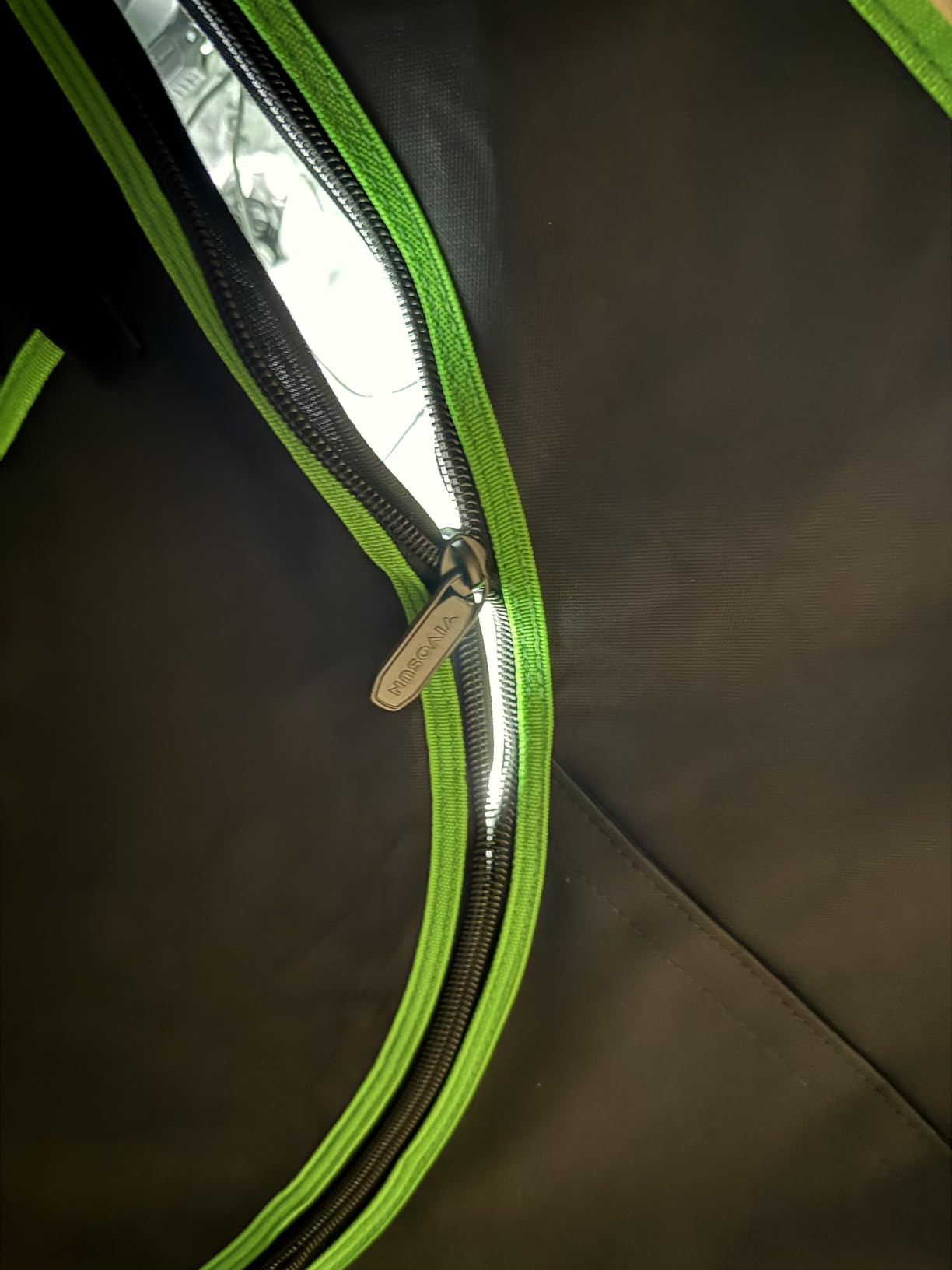
- Some reports of light leaks around zipper seams and velcro covers
- Printed instructions are minimal so setup takes some guesswork
Our editor’s choice is not the fanciest tent here, and that is the point. At 33362 reviews with a 4.5 average, the S448 has more real-world use data behind it than anything else in this roundup by an order of magnitude, and that data is consistently positive: reflective mylar walls, a solid metal frame, and a top bar rated to 100 lb that will hold a light and a carbon filter without complaint.
During our comparison the 340g high-density waterproof double-stitched fabric stood out. It is not as thick as the 1680D or 2000D canvases on the premium picks, but it is dense enough to hold light in a dim room and to wipe clean. The black inner lining behind the zipper block is the detail most budget tents skip, and it is why the S448 holds light better than its fabric weight suggests.
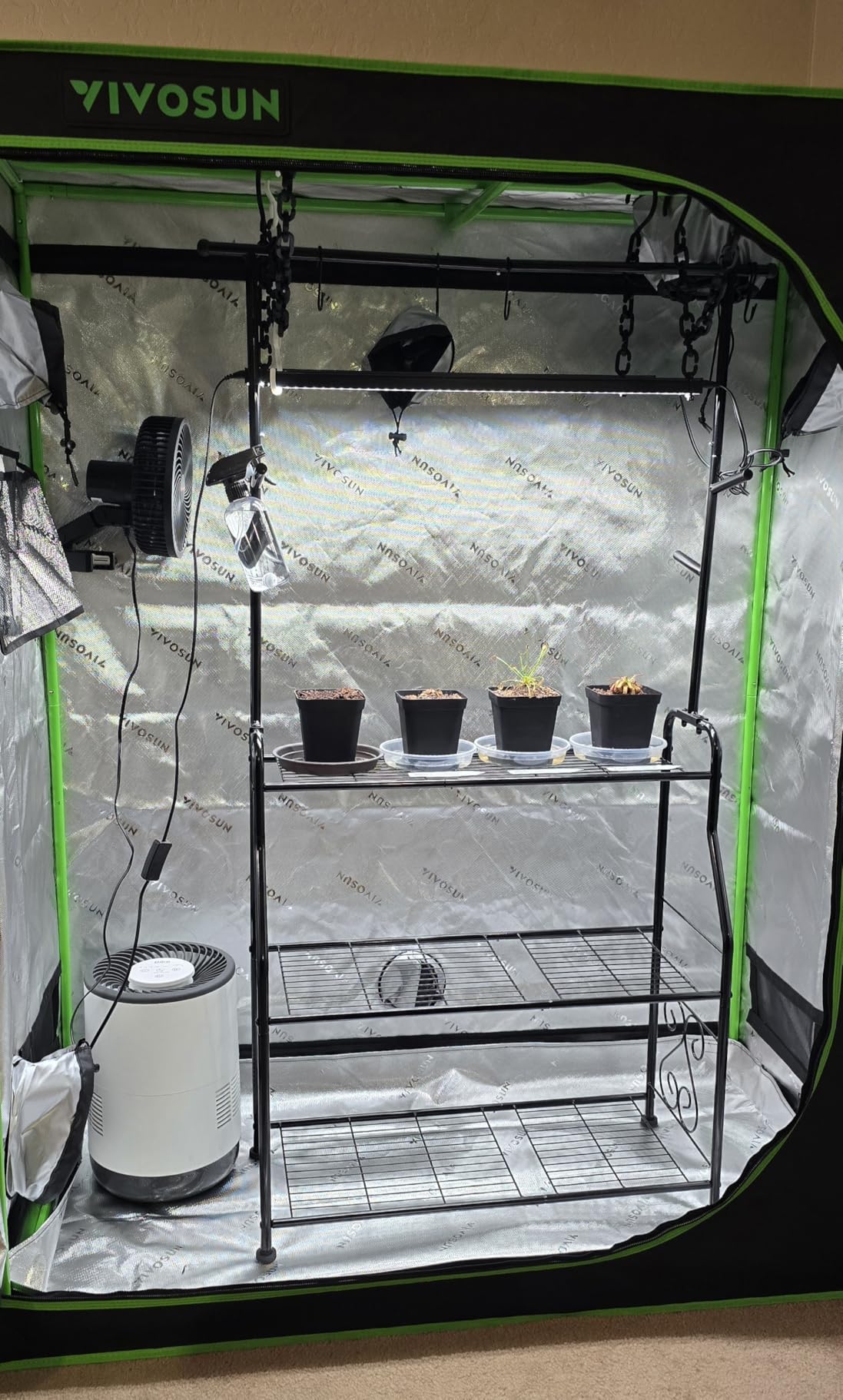
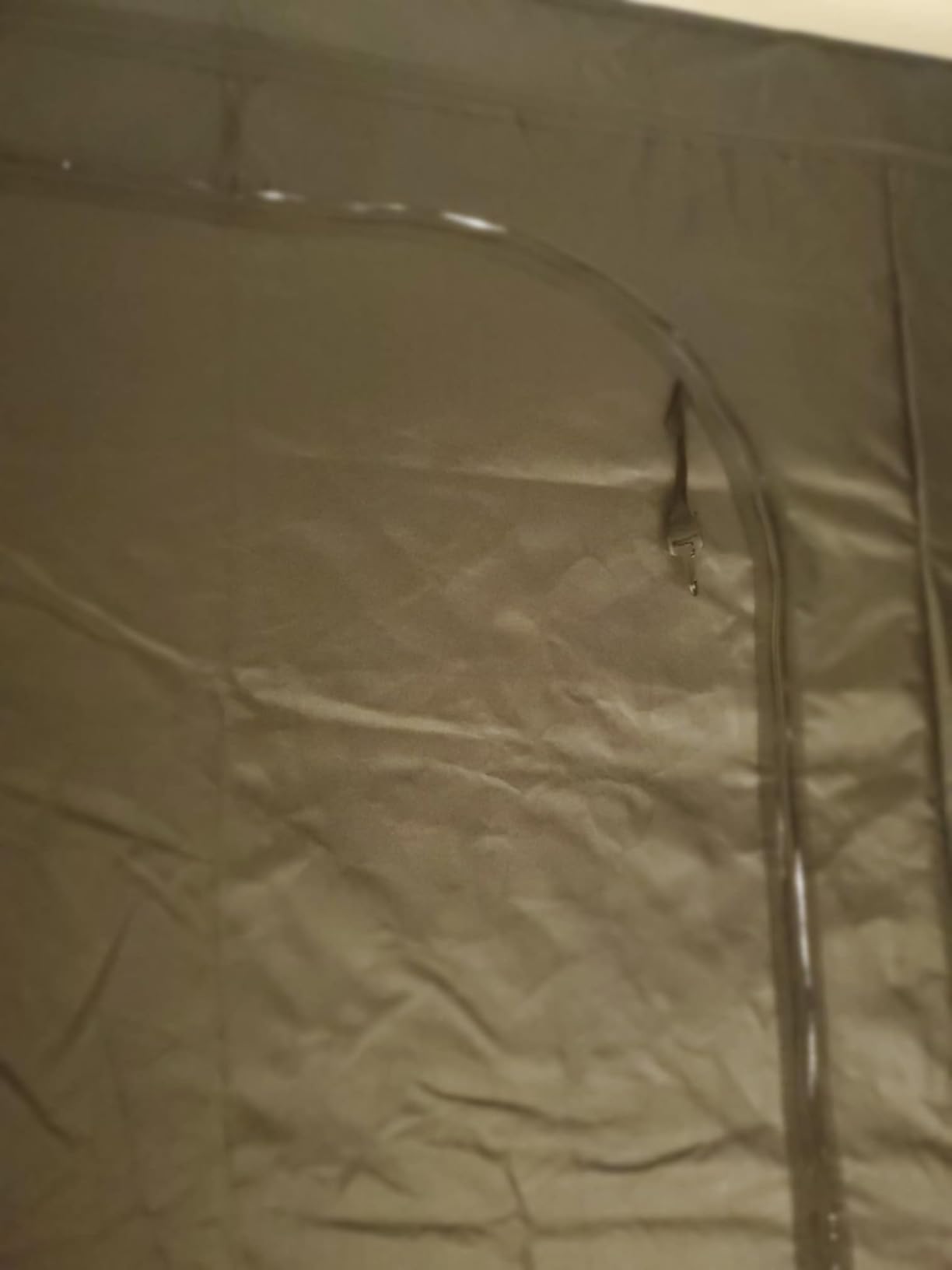
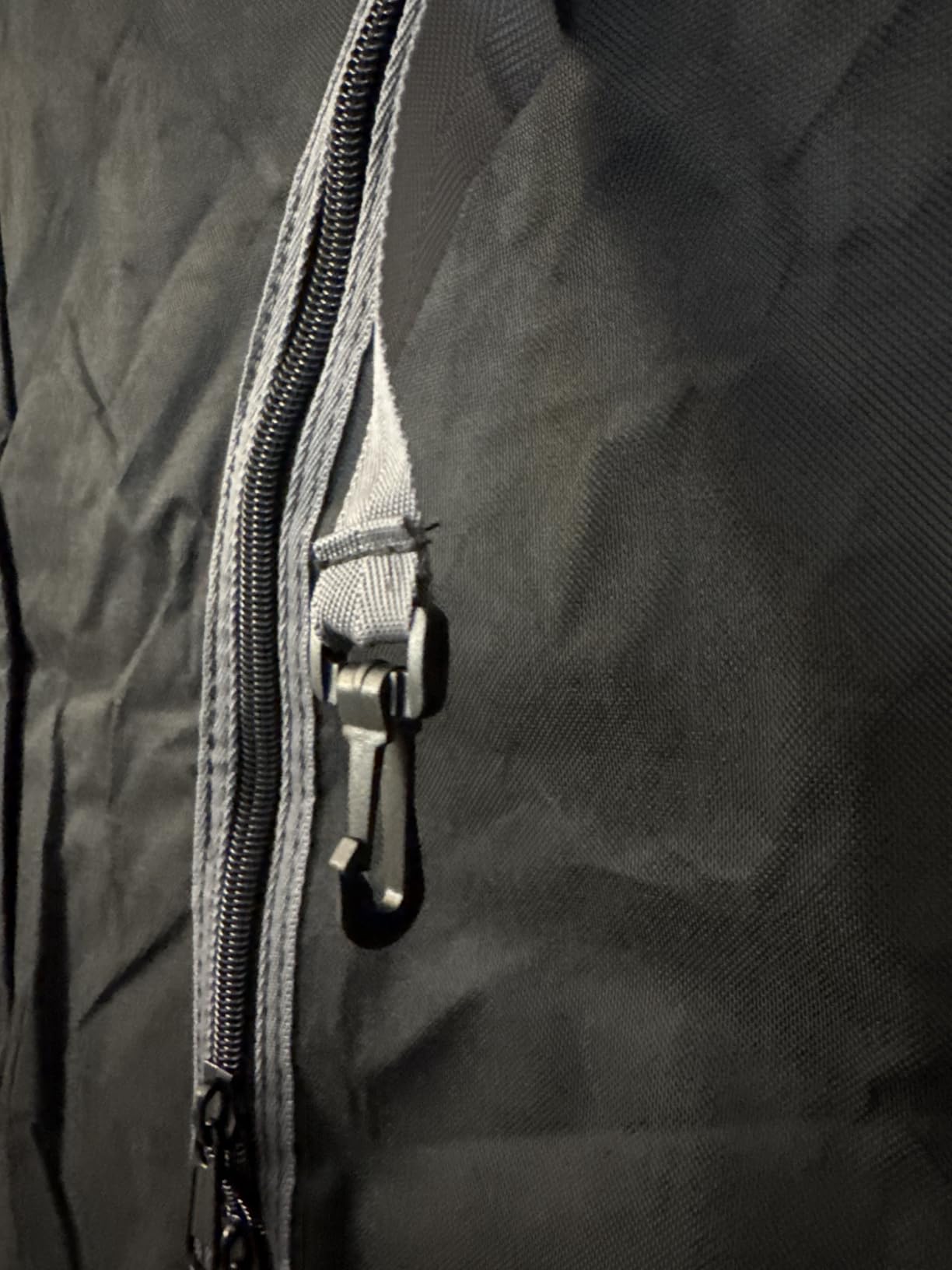
The honest weak spot is the zipper block. Some owners report light leaks around the zipper seams and the hook-and-loop covers, and the printed instructions are thin enough that a first-time builder will spend a few minutes working out which pole goes where. Neither issue is a dealbreaker in a closet or a basement, and both are reasons we rate it as a closet-and-basement workhorse rather than a bedroom showpiece.
The removable mylar floor tray is the sleeper feature for food growers. It lets you pull the whole floor out, wash it, and put it back, which matters a lot when you are watering tomatoes or running a drain-to-waste reservoir. Combined with the observation window and the lower vent, you rarely need to open the main door just to check on the plants.
Is the 48 by 48 measurement real?
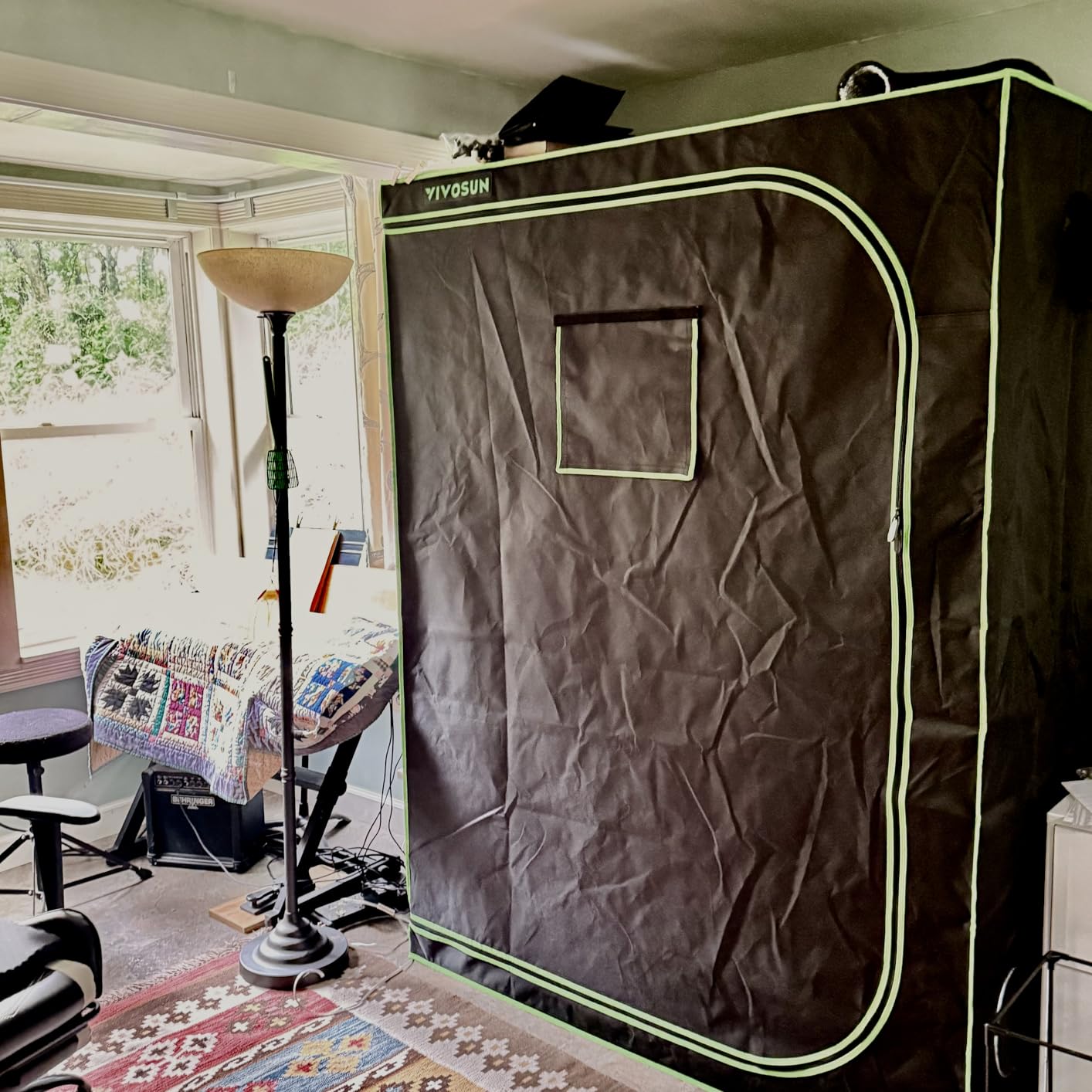
Yes. The listed dimensions are 48 inches long by 48 inches wide by 80 inches high, and unlike some kits in this roundup, the S448 ships as a true 4×4 footprint. We found no reports of interior measurements coming in short, which is a real problem we hit with cheaper listings.
The 80 inch height also means you have room for a hanging light plus a carbon filter without crouching into the tent. For four large pepper or tomato plants, that vertical space is the difference between a comfortable season and a crowded one.
Who should skip it
Skip this tent if the room it lives in is bright and you need true blackout. The fabric is good but it is not 2000D Oxford, and light leaking out of a high-traffic room is the fastest way to upset a neighbour or a housemate. In that situation the AC Infinity CLOUDLAB or MARS HYDRO Advanced are worth the step up.
Also skip it if you want a plug-and-play kit. This is a tent only. You will be buying a light, a fan, a filter, and a controller separately, which for most people is the right call, but for a first grow it means a bigger up-front shopping list. Our mushroom growing kit guide covers a genuinely different use case for small indoor enclosures if fungi are the goal rather than vegetables.
2. AC Infinity CLOUDLAB 844 – Best Materials and Build
AC Infinity CLOUDLAB 844, Advance Grow Tent 4×4, Thickest Poles & Mylar
48x48x80 footprint
2000D waterproof Oxford canvas
1 inch steel poles, 150 lb rating
Pros
- Highest average rating in the group at 4.7
- Thickest canvas and strongest 1 inch steel poles
- Lab-tested high-reflectivity mylar lining
- Extra hanging bars and 150 lb load rating
- Controller mounting plate with lightproof cable passthrough
Cons
- Heaviest build
- which makes the cover harder to pull over the frame alone
- Stands alone as the costliest of the tent-only options here
If you read the spec sheet and stop at the first line, you understand this tent. 2000D waterproof Oxford canvas, 1 inch steel poles, a 150 lb weight capacity, and mylar that the company says was lab-tested for reflectivity. That is the best materials package in this roundup, and it is backed by a 4.7 average across 7388 reviews, the highest rating of the twelve.
Reviewers single out three things consistently: build quality, reflectivity, and the sheer number of duct ports and doors. For an indoor grower running carbon filtration, the extra duct ports matter more than they first appear, because every port you add is a port you have to seal, and this tent gives you options rather than forcing a layout.
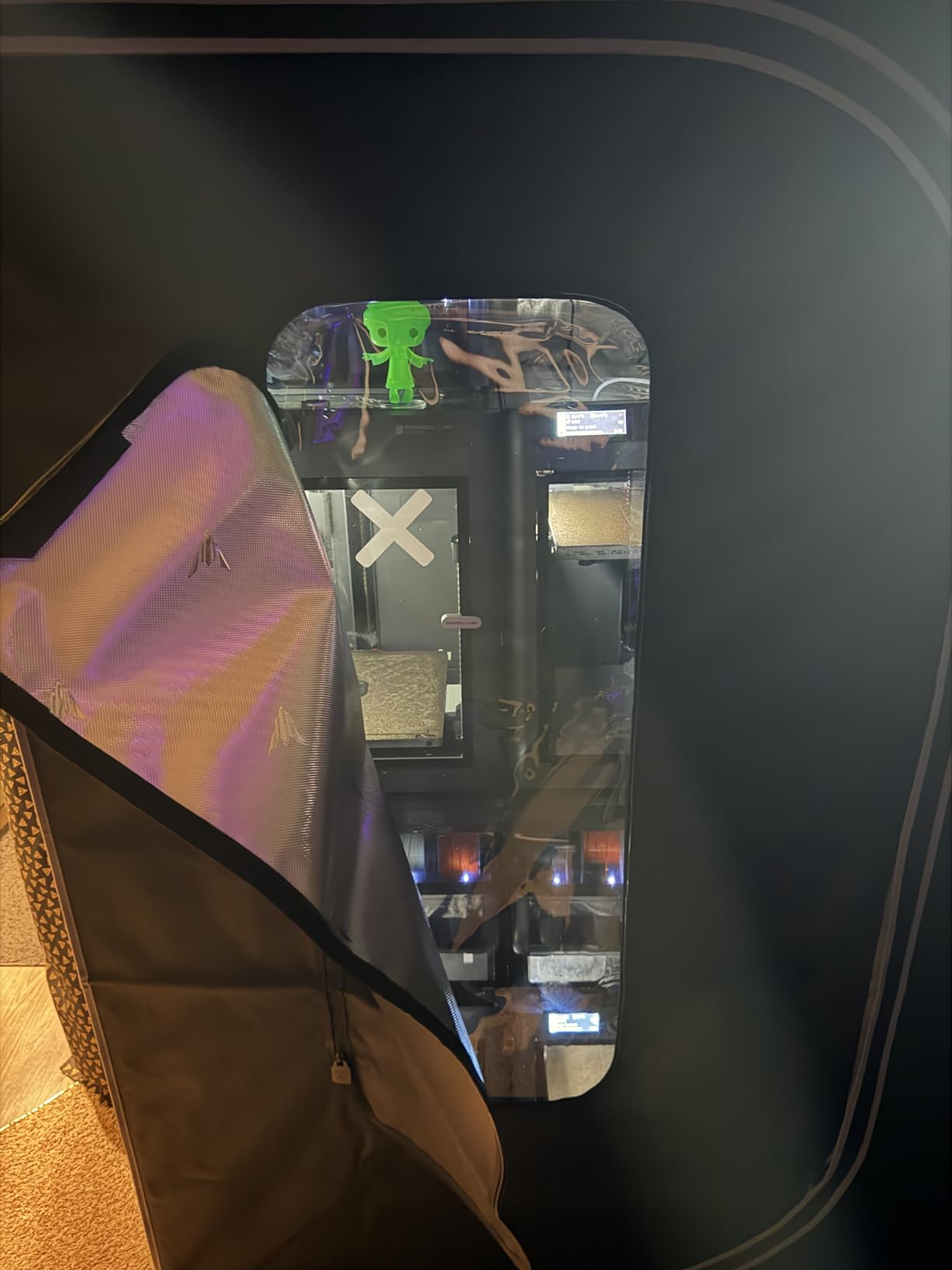
The controller mounting plate with the lightproof cable passthrough is a small detail that changes daily workflow. Instead of running the light cable through a port and leaving a gap in the seal, the cable passes through a dedicated lightproof channel, and the controller hangs on a plate rather than resting on the floor where it collects water and sediment.
The catch is weight. At 19.86 kg, this is a two-person lift in practice, and several owners note the cover is hard to pull over the frame alone. Plan for that before you unpack it, especially if you are setting up alone in a basement or a closet with low headroom.
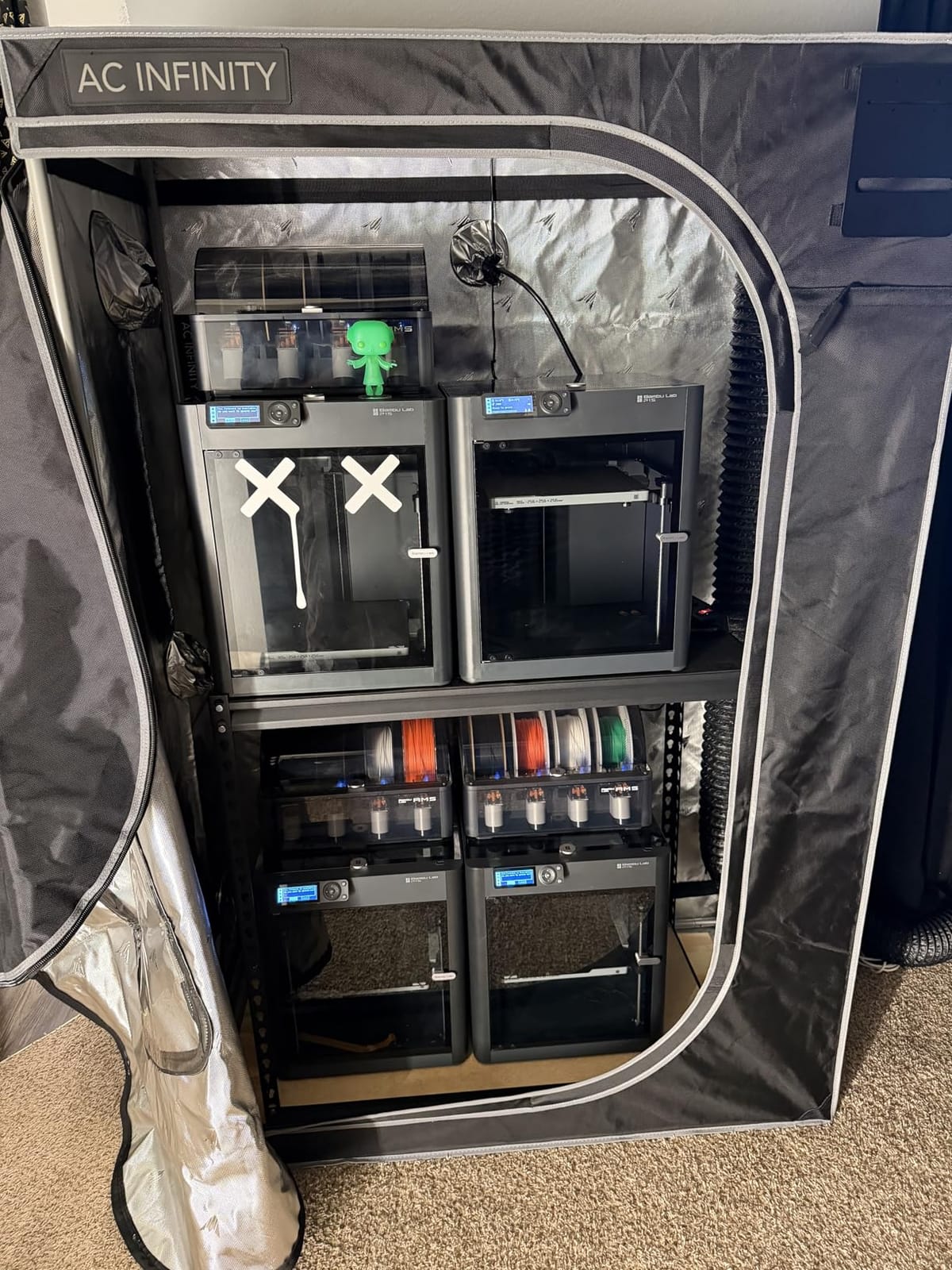
Is the extra canvas thickness worth it in a real room?
In a dark closet, honestly, no. A 340g tent holds light fine when there is no light to block. In a room with ambient light, a dedicated grow room, or a garage that gets a window open, the difference between 340g and 2000D becomes obvious within a few minutes of powering the light on.
The 1 inch poles are the more broadly useful upgrade. They are noticeably stiffer, so a 4×4 does not bow outward under the weight of wet fabric, a light, and a carbon filter hanging from the top bars. The 150 lb rating gives you real headroom for a heavier filtered setup.
Who should skip it
Skip it if you are on a tight budget and the tent will live in a dark basement. A large share of growers on the forums say exactly that: in a dark space, a random 4×4 tent is fine, and light leakage stops being a real problem. In that case the MARS HYDRO Advanced gives you 1680D canvas and a 4.6 rating for noticeably less.
Also skip it if you will be building solo. The frame is stiff enough that getting the cover over it takes a second pair of hands, and that is the one drawback that owners mention more than any other.
3. VIVOSUN R446 4×4 Roof Cube – Best for Low Ceilings
VIVOSUN R446 4×4 Grow Tent 48″x48″x72″ Roof Cube Tent
48x48x72 footprint
600D waterproof Oxford canvas
Litchi pattern mylar, sloped roof
Pros
- 72 inch height fits low-ceiling basements and closets
- Litchi pattern mylar reported as more reflective than diamond mylar
- Tool-free frame assembly with clearly labeled poles
- Heavy canvas and solid zippers for the money
Cons
- Sloped roof reduces usable hanging height by roughly a foot
- Poorly illustrated printed instructions
- Some reports of light leaks at zipper seams
The R446 exists for one reason: your ceiling. At 48 by 48 by 72 inches with a sloped roof, it is the only tent in this roundup that will fit in a low-ceiling basement, a converted closet, or a room with a sloped ceiling where an 80 inch tent simply will not go up.
The interior lining is the litchi pattern mylar, which the manufacturer reports as 1.5 times more reflective than diamond mylar. That is a manufacturer claim rather than an independent measurement, but it is consistent with what owners describe about brightness inside the tent. The 600D Oxford canvas is waterproof, tear resistant, and double stitched, which is respectable for a tent of this height.
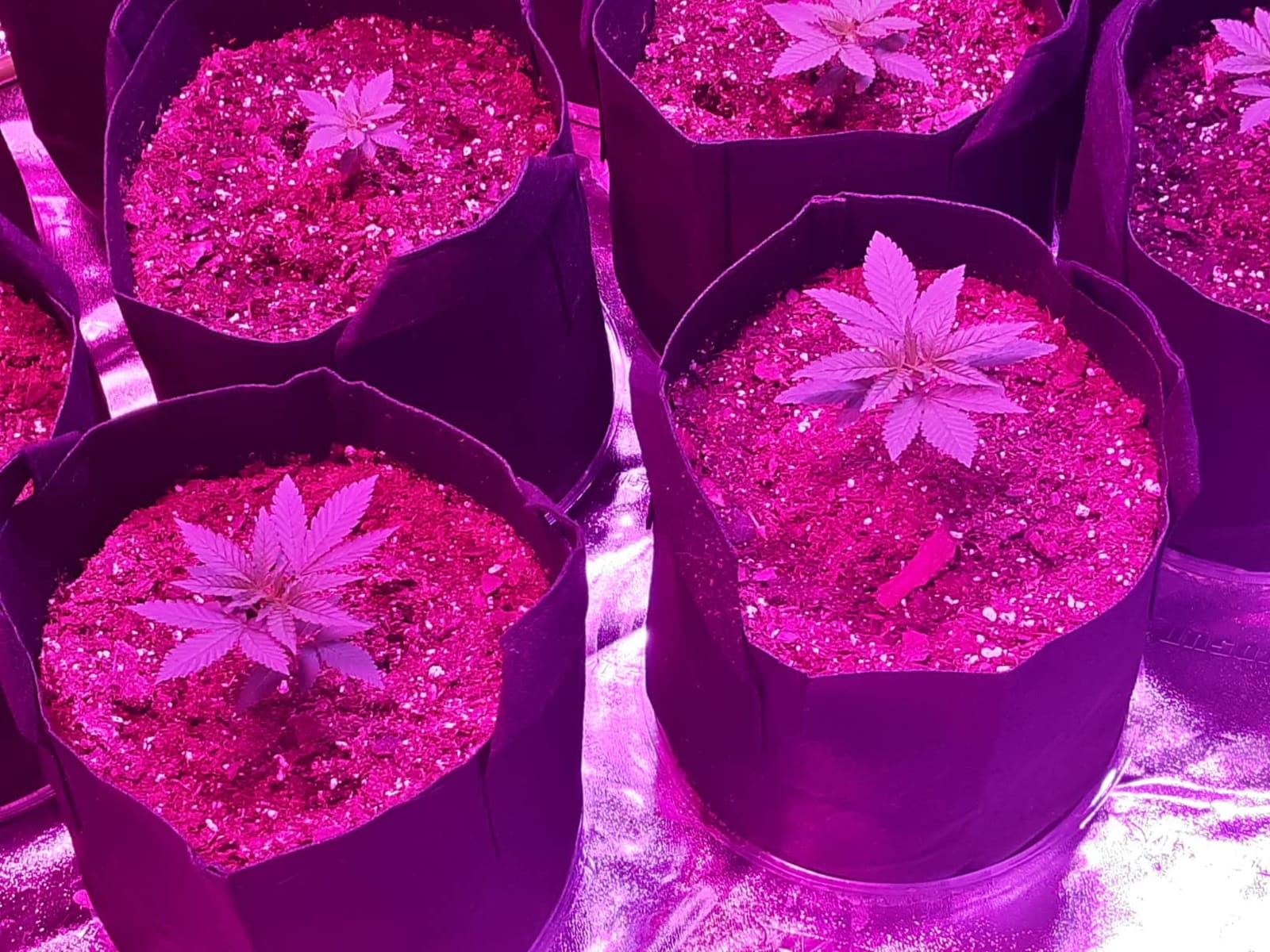
The sloped roof is the trade-off you need to plan for. It frees up growing space at the sides but costs roughly a foot of usable hanging height, so a light hung at the top bar sits lower than it would in a straight-walled tent. Most growers work around this with low-stress training and a light set slightly higher, and for lettuce, herbs, and salad greens it simply does not matter.
One reviewer reported a roof connector arriving without pre-drilled holes, and the printed instructions are thin. It is not a widespread problem, but it is worth having a screwdriver on hand during setup rather than assuming everything is tool-free.
Will 72 inches be enough headroom for tall plants?
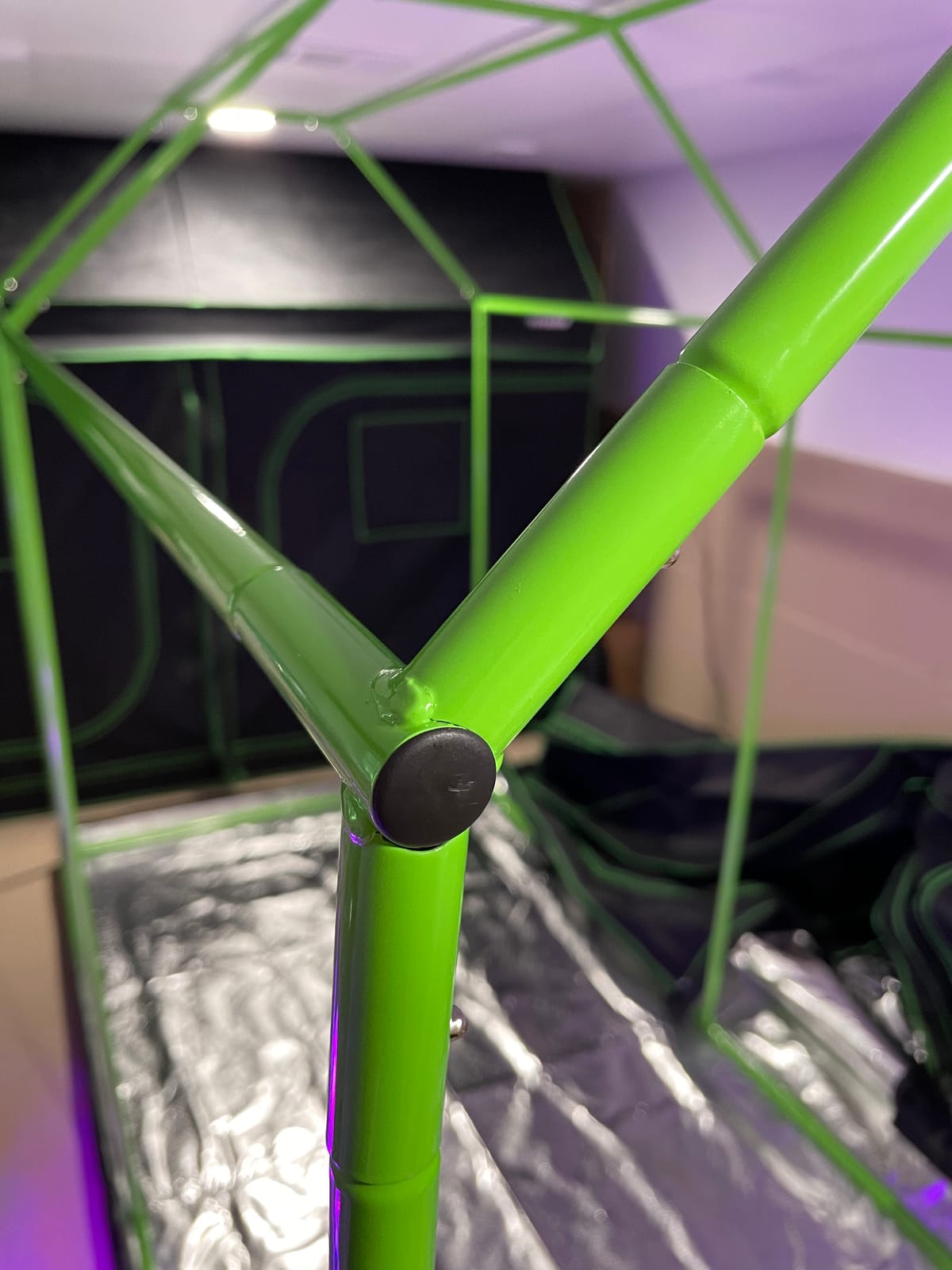
For lettuce, kale, chard, basil, and microgreens, 72 inches is comfortable. For tomatoes and peppers it is tight, and most growers who push this tent into fruiting crops report having to train outward rather than up, which raises your yield per plant in a way that only works if you are attentive to it daily.
For a fixed 72 inch ceiling with a light plus a carbon filter hanging inside, this is the tent that works and the others do not. That narrow use case is exactly why it earns a place in this roundup.
Who should skip it
Skip it if you have the ceiling height. This is not a compromise pick, it is a specialist one, and in a room with 8 foot ceilings you are giving up height, light clearance, and canopy volume for no benefit. Take the S448 or the CLOUDLAB instead.
Skip it if you are buying on a first grow and want a forgiving introduction to tents. The height trap plus the thin instructions are two things to think about at once, and a first-time grower benefits from a straightforward straight-walled tent.
4. zazzy 4×4 Grow Tent – Best for First-Time Growers
zazzy 4×4 Grow Tent, 48″x48″x78″ 600D Mylar Growing Tents for Indoor Plant
48x48x78 footprint
95% reflective mylar lining
600D canvas, alloy frame to 110 lb
Pros
- Tool-free assembly with a clear illustrated instruction sheet
- Alloy steel frame rated to 110 lb
- 95% reflective mylar across the whole interior
- Observation window and removable floor tray included
Cons
- 600D canvas is thinner than 1680D and 2000D alternatives
- Some reports of light leaks around zipper flaps and duct ports
The 78 inch height is the reason this one makes our list for first-time growers. It is short enough to feel manageable, tall enough for a hanging light and a small canopy, and close to square so nothing feels cramped while you are learning how to lay out a tent.
The build is a 600D double-stitched canvas over an alloy steel frame rated to at least 110 lb, with patented PA corner connectors that are reinforced against rust and have adjustable tightness. That adjustable connector is a genuinely useful detail: you can dial the tension after the fabric is on rather than stretching it and hoping the seams hold.
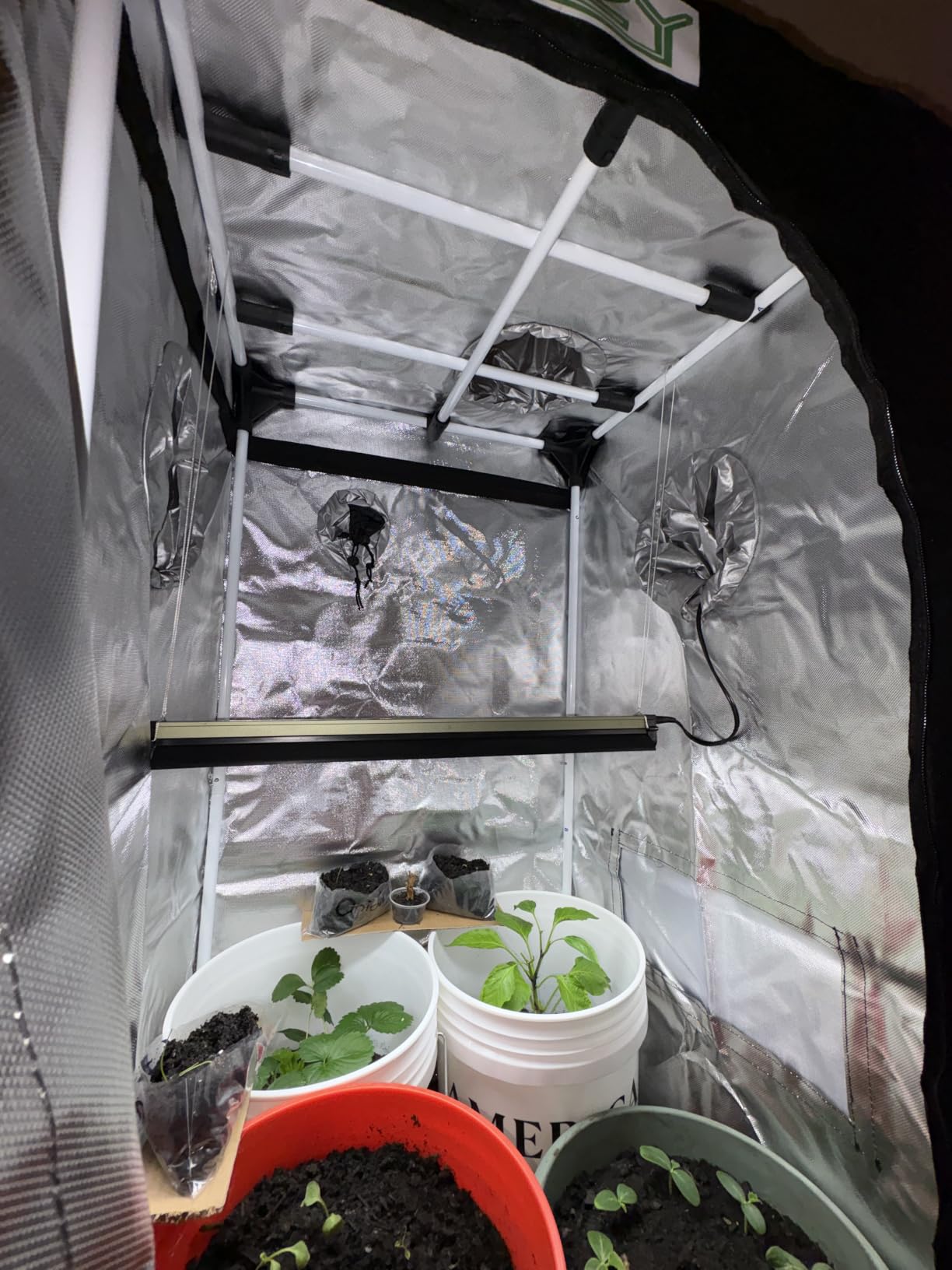
The 95% reflective mylar lining covers the whole interior rather than just the walls, which helps more than it sounds. Light that reaches the floor tray bounces back up into the canopy instead of being absorbed, and for a first grow with a modest light, that difference shows up as visibly denser growth at the edges of the footprint.
Setup is tool-free with illustrated instructions, which is the one thing a beginner really needs and the thing most budget tents get wrong. The observation window and the removable floor tray are both included, so you are not adding accessories before the first cycle.
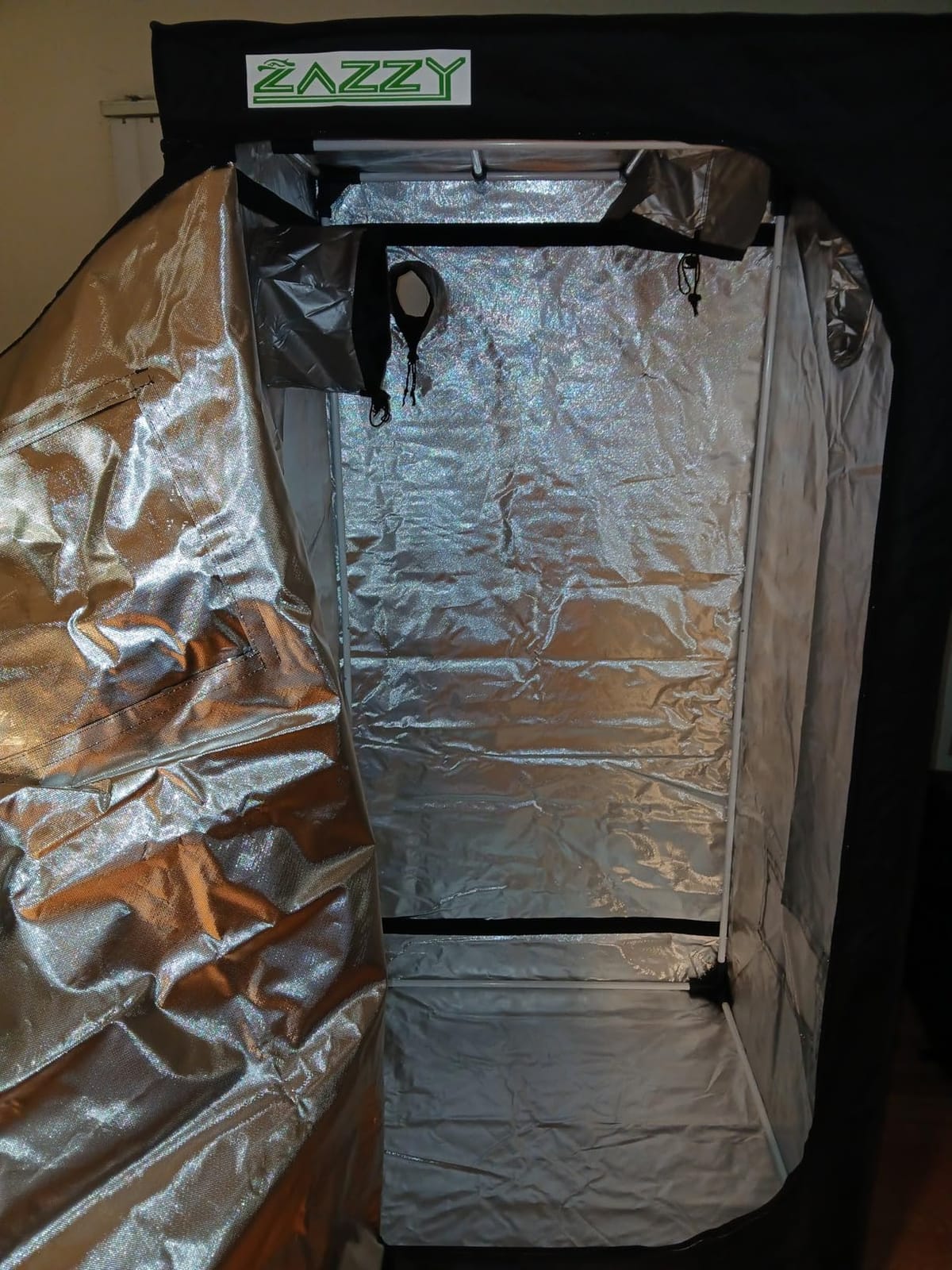
Will 600D canvas survive multiple grows?
For a handful of cycles in a controlled indoor space, yes. The reported weak point is the zipper flaps and the duct ports, where some owners see light leak. If you keep the tent in a dim room and reseal the flaps with hook-and-loop tape after the first month, you will not notice it.
What 600D will not do is stand up to a wet, humid, unheated garage over years. If your space is damp or the temperature swings wildly, step up to 1680D canvas on the MARS HYDRO or Spider Farmer.
Who should skip it
Skip it if light tightness is the whole point of your setup. In a well-lit room you will see the tent glowing, and no amount of internal mylar fixes that. The fabric weight is the trade you are making here, and it is only a good trade in a dark space.
Skip it if you already know what you want. Experienced growers tend to buy up to the MARS HYDRO or Spider Farmer for the pole thickness, and the 110 lb frame rating here leaves less headroom for a carbon filter plus a heavy light than those do.
5. MARS HYDRO 4×4 Advanced Grow Tent – Best Light Blocking
MARS HYDRO 4×4 Advanced Grow Tent, 48″x48″x80″ Indoor Plant Growing
48x48x80 footprint
1680D double-stitched Oxford canvas
Shade-cloth zipper flap, 70 kg frame
Pros
- 1680D canvas with a dedicated shade-cloth flap across the zipper seam
- Smooth metal dual zippers rated for long service life
- 70 kg frame capacity is the highest rated in this group
- Detachable waterproof floor tray and double-layer viewing window
Cons
- Heaviest listed item weight among the mid-priced tents
- Some buyers report minor light seepage at the observation window
The defining feature is the upgraded zipper flap. Rather than relying on the zipper alone, MARS HYDRO runs a piece of shade cloth between the zipper and the canvas, which covers the pinhole leaks that other tents leak through. If your tent lives in a room where people walk past, that single detail is worth more than a heavier fabric would be.
Everything else is solid: 1680D double-stitched Oxford canvas, reflective diamond mylar lining, smooth metal dual zippers, and a double-layer black inner lining. The frame is rated to 70 kg, which is the highest load capacity of any tent-only model in this roundup, and the detachable waterproof floor tray is a plus for anyone running drain-to-waste.
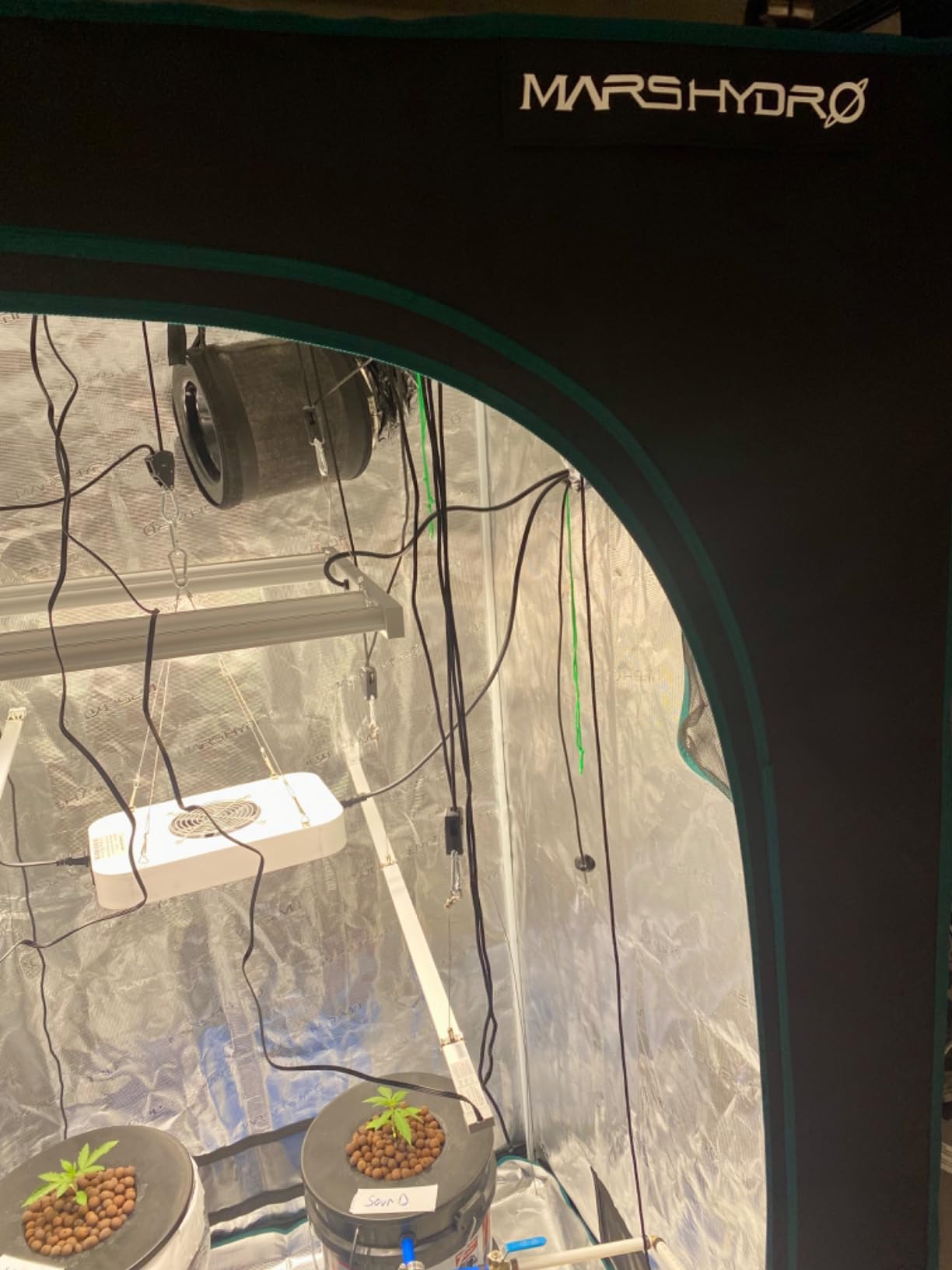
There are hangers for a controller and an iHub on the top bars, which keeps electronics off the floor and out of the water. Mars Hydro also backs the tent with 24-hour quick-to-respond service, which matters more than it sounds when a pole arrives bent or a seam is split.
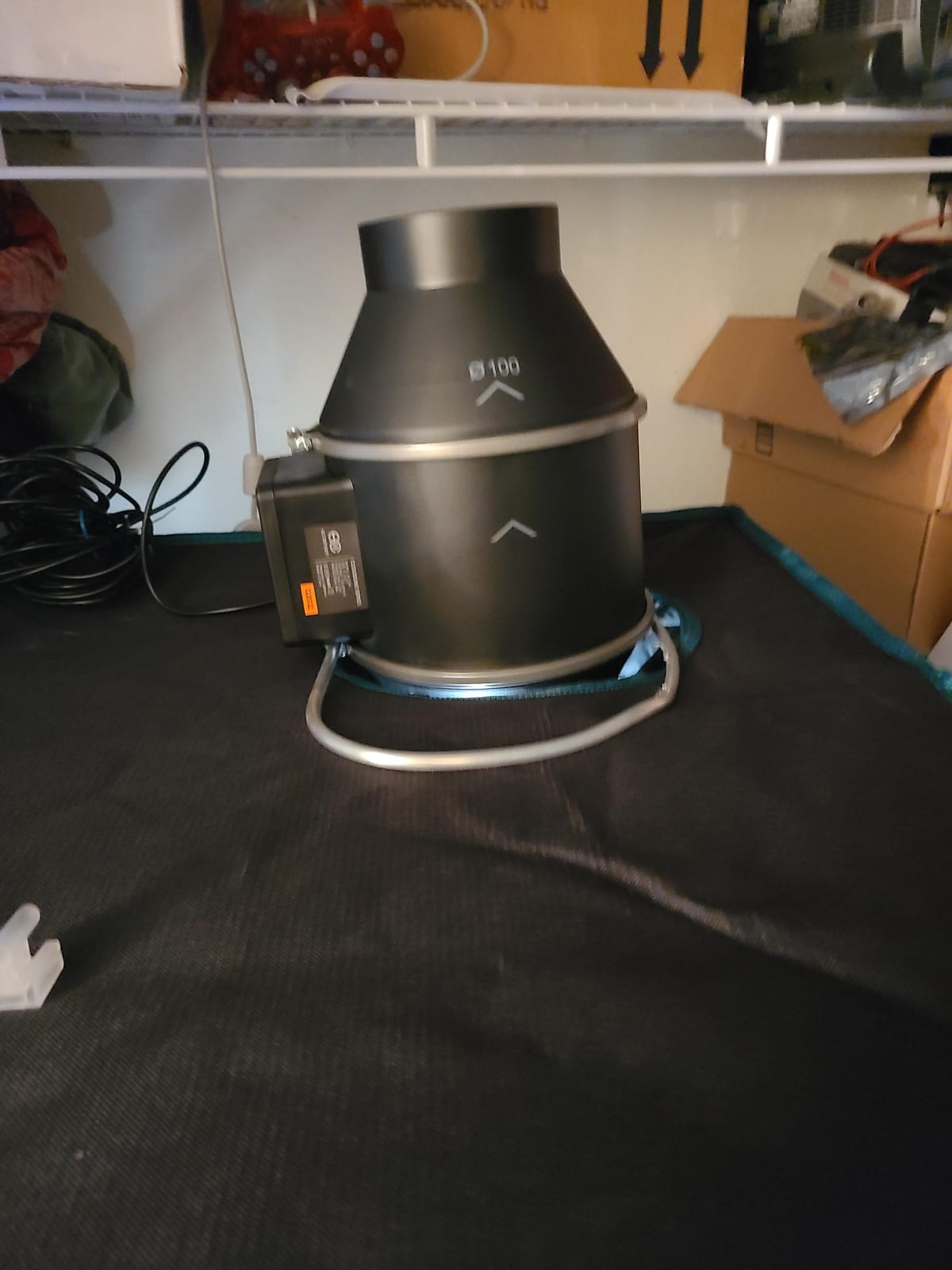
The two drawbacks are weight and the window. At 12.84 kg the cover is a genuine two-hand job, and some buyers report minor light seepage at the observation window. In practice that seepage is a thin halo rather than a flood, and it is the one place where this tent is not fully light-tight.
Is 1680D enough fabric for a bright room?
For most rooms, yes, and the zipper flap means the weak point is closed. If your space has a window that gets opened regularly, or if the tent is in a corridor people walk through, pair this with a blackout curtain over the tent and you are in good shape.
The one situation where it falls short is a genuinely bright, unshaded basement or a garage with a bare bulb overhead. In that case the 2000D canvas on the CLOUDLAB buys you real margin, and the difference is visible within a minute of switching the light on.
Who should skip it
Skip it if you plan to hang a heavy filtered setup. The 70 kg rating is excellent, but the poles are not as thick as the 1 inch steel on the AC Infinity, and a 4×4 with a long carbon filter hanging from the top bars will flex more over time.
Skip it if you are working with very tall plants. It is a full 80 inches, which is good, but there is no extension kit listed for this model, so once a tomato hits the roof you are managing height by training rather than by adding poles.
6. MELONFARM 4×4 Grow Tent – Most Versatile
MELONFARM 4×4 Grow Tent, 48″x48″x80” High Reflective 600D Diamond Mylar Canvas with Observation Window and Floor Tray for Hydroponic Indoor Plant Growing
48x48x80 footprint
600D double-stitched canvas
Reflective polyester mylar lining
Pros
- Full 80 inch height at the entry level of the 4x4 category
- Double transparent observation windows
- Tool-free assembly in well under an hour for most buyers
- Storage bag and floor tray included
Cons
- Thin poles and fabric next to the 1680D and 2000D tents
- One buyer reported interior measurements slightly under the stated 48x48x80
- Occasional light leakage around velcroed ports
This is the tent for a first grow on a small budget in a room you do not care about. The footprint is a genuine 48 by 48 by 80, the canvas is 600D and double stitched, and the interior is lined with reflective waterproof polyester film. Nothing here is premium, but nothing is missing either.
Two transparent observation windows is a real feature at this level, and having two means you can watch a tray of seedlings or a lettuce bed without opening the door and letting the light out. The storage bag is also included, which matters if you are not dedicating a permanent room to the tent.
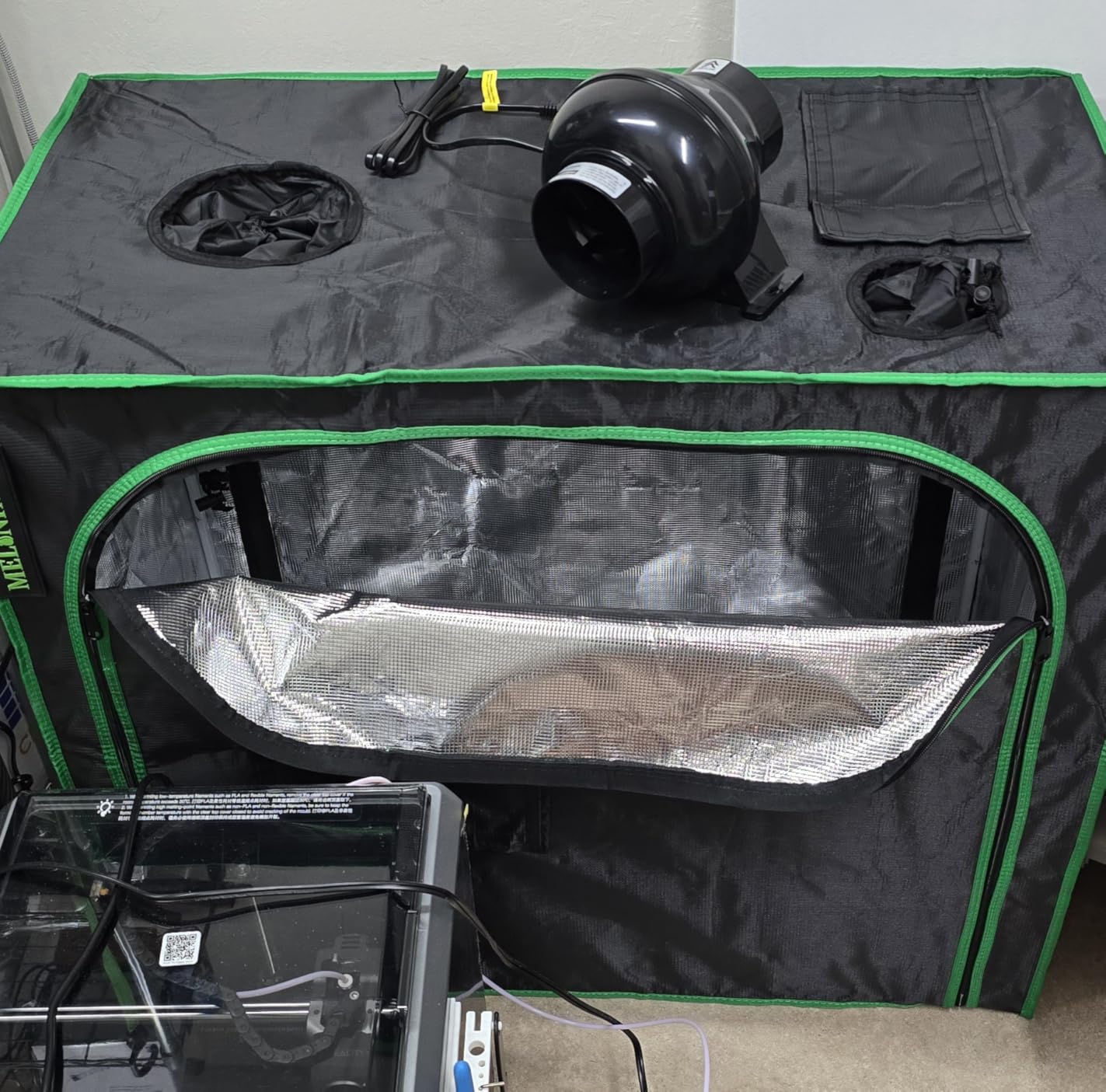
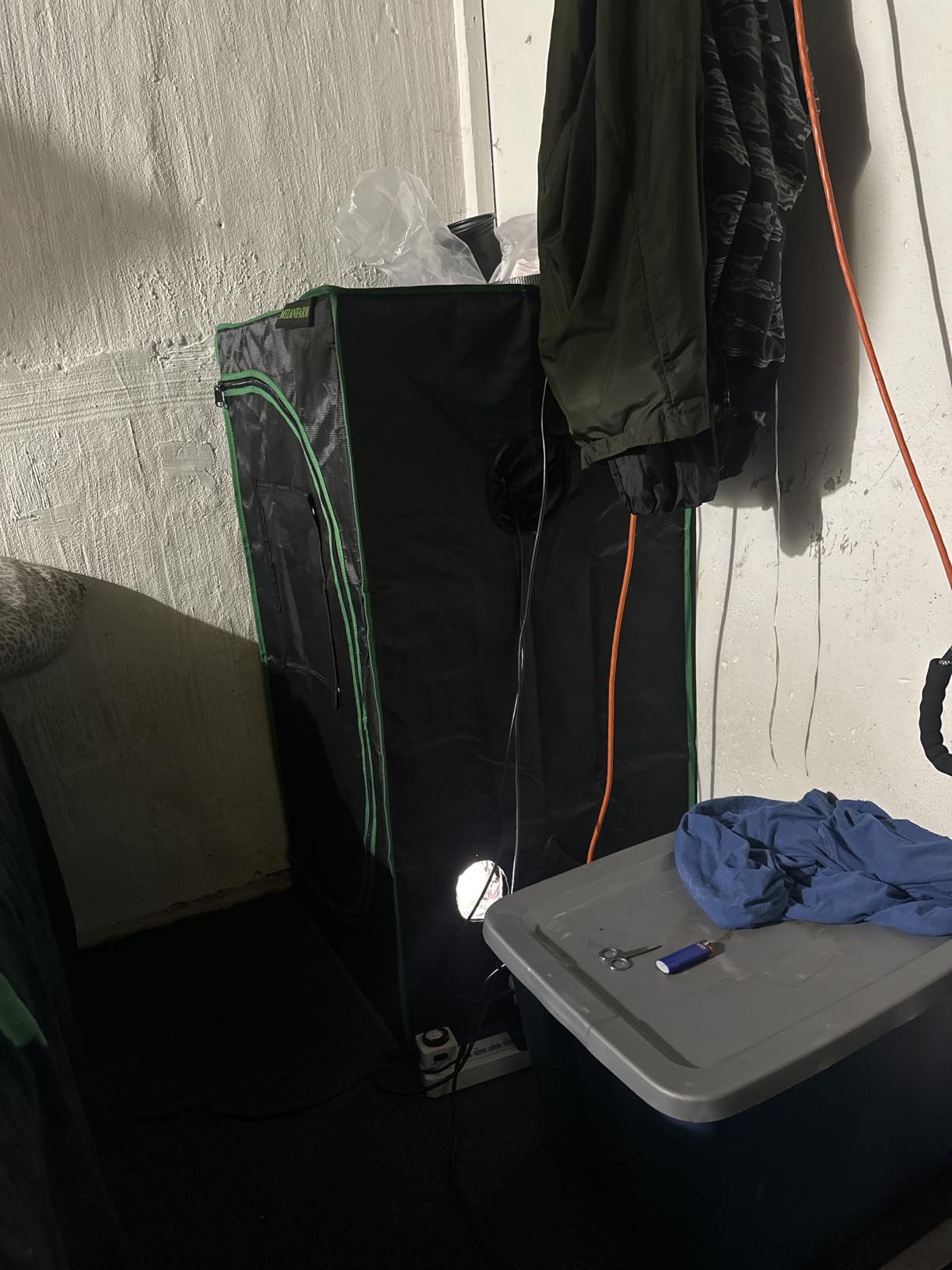
The honest list of weaknesses is longer than for the other picks. Poles and fabric are thin relative to the premium tents, some buyers report light leakage around the velcroed viewing and ventilation ports, and one buyer measured interior dimensions slightly under the stated 48 by 48 by 80. Some have also reported missing poles and unclear instructions in the box.
Against that, the 4.3 average is the lowest in the roundup, and the majority of those reviews are still five stars. Buyers consistently mention the ratio of size to cost and how quickly the pop-snap frame goes up without tools.
Is a full 80 inch height realistic at this spec level?
It is a genuine 80 inch tent, but the poles are thin, so the frame can bow slightly once the fabric is tensioned and wet. If you hang a light and a filter, check the frame for lean monthly and retighten the corner connectors. It is a five-minute job and it keeps the shape square.
Because of the measurement variance one buyer reported, measure your ceiling and your door opening before you commit. A tent that is 47 inches wide is still a fine grow tent, but it will not sit where you planned if you built the layout around exact dimensions.
Who should skip it
Skip it if you plan multiple cycles in a humid garage. Thin fabric plus thin poles is a combination that ages fastest in this roundup, and the light leaks at the velcroed ports tend to get worse rather than better with use.
Skip it if you are running carbon filtration. A tent this light does not hold its shape well with a heavy filter pulling on the top bars, and you will be resealing the velcro ports every time you change the setup.
7. Spider Farmer 4×4 Grow Tent – Best for Hydroponic Reservoirs
Spider Farmer 4×4 Grow Tent 48″x48″x80″ Indoor Plant Growing 2026 New
48x48x80 footprint
1680D waterproof Oxford canvas
150 lb frame, 11.8 x 15.7 in window
Pros
- 1680D Oxford canvas with SBS zippers and a light-blocking flap
- 150 lb frame rating with reinforced adapters
- Oversized 11.8 x 15.7 inch observation window
- Controller hooks and a dedicated cable pass-through port
Cons
- Tent only
- so a grow light has to be sourced separately
- A handful of reports of pinhole light leaks on arrival
This is the one to buy if you are running a reservoir system and need to get in there regularly. It comes with a waterproof floor tray, a tool bag, controller hooks, a cable pass-through port, and hanging bars, so a pump, a reservoir, and a controller all have a home without you improvising.
The build is 1680D tear-proof waterproof Oxford canvas with premium SBS zippers that have both a zipper flap and dual stitching behind them. The poles are described as 3x-thicker hardened steel with reinforced adapters, rated to 150 lb, which is the same load rating as the AC Infinity and double what the entry-level tents carry.

The 11.8 by 15.7 inch observation window is the largest in this roundup, and for a reservoir setup that is genuinely useful. You can check root zone colour, reservoir level, and pest pressure without unzipping the door and resetting the light cycle your plants depend on.
The recurring complaint in reviews is occasional pinhole leaks on arrival, which sounds worse than it is. They are pinholes, not gaps, and a small piece of fabric tape along the seam resolves them in a minute. It is a manufacturing tolerance issue rather than a design flaw.
Is 150 lb enough for a light plus a carbon filter?
Yes, comfortably. A 4×4 class LED, a 6 inch carbon filter, and a short length of flex duct together sit well inside a 150 lb rating, and the reinforced adapters spread that load across the corner joints rather than concentrating it at a single weak point. This is the frame we would trust for a permanently rigged room.
The trade is money per cycle rather than capability. If you only plan one or two grows, a 110 lb frame is plenty. If you intend to leave the tent set up indefinitely, the difference in pole thickness shows up in year two.
Who should skip it
Skip it if you want everything in one box. This is a tent only, and you will be sourcing a light, a fan, a filter, and a controller separately. That is the right call for anyone who already knows what they want, and the wrong call for a first grow on a tight schedule.
Skip it if you need a very tall room. There is no extension kit listed here, so 80 inches is the ceiling, and a tomato plant will find it by week eight.
8. MARS HYDRO 4×4 Smart Grow Tent Kit – Best for App-Controlled Starts
MARS HYDRO 4×4 Smart Grow Tent Kit with TSW2000 with iControl Controller
300W dimmable LED light
402 CFM smart inline fan
Smart Controller 43 with WiFi app
Pros
- Everything for a first grow arrives in one box
- App control of light fan clip fan and humidifier
- 300W dimmable light with 0-100% dimming
- 402 CFM inline fan with 0-100% speed control
Cons
- Listed tent dimensions are closer to 40 x 40 x 70 than a true 4x4
- Light does not cover the floor evenly so rotation is needed
- Included hanging straps are cheap and can slip
This kit is the shortest path from an empty corner to a running setup. You get the TSW2000 300W LED, a 6 inch 402 CFM smart inline fan, the Smart Controller 43 with a sensor, a carbon filter, 25 feet of ducting, trellis netting, clamps, grow bags, and rope hangers in one purchase.
The controller is genuinely the point of this kit. It monitors temperature, humidity, VPD, and CO2, then adjusts the lights and fans through the app. For someone who is learning what a grow room is actually doing, seeing those numbers move in real time is worth more than the light itself.
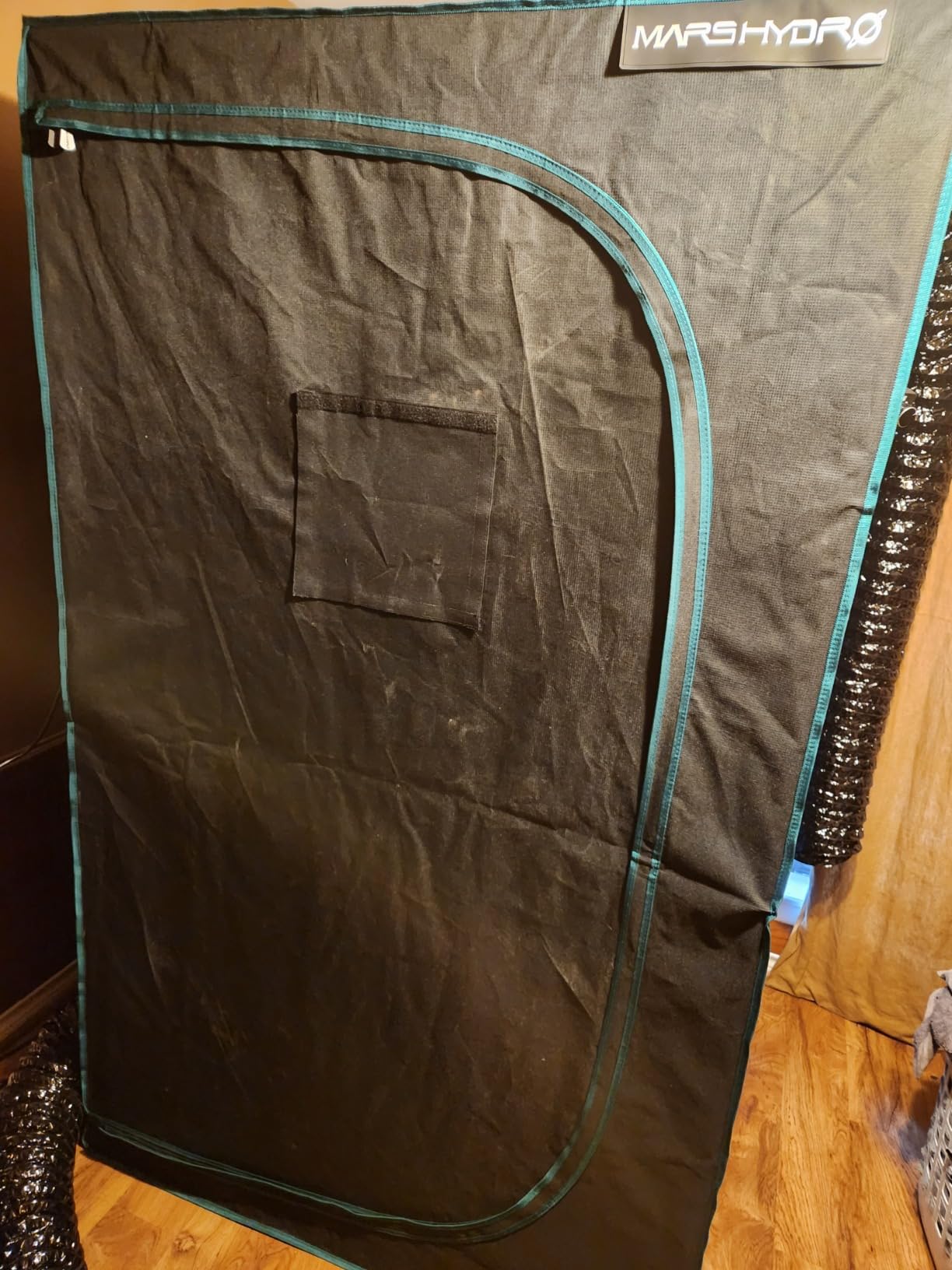
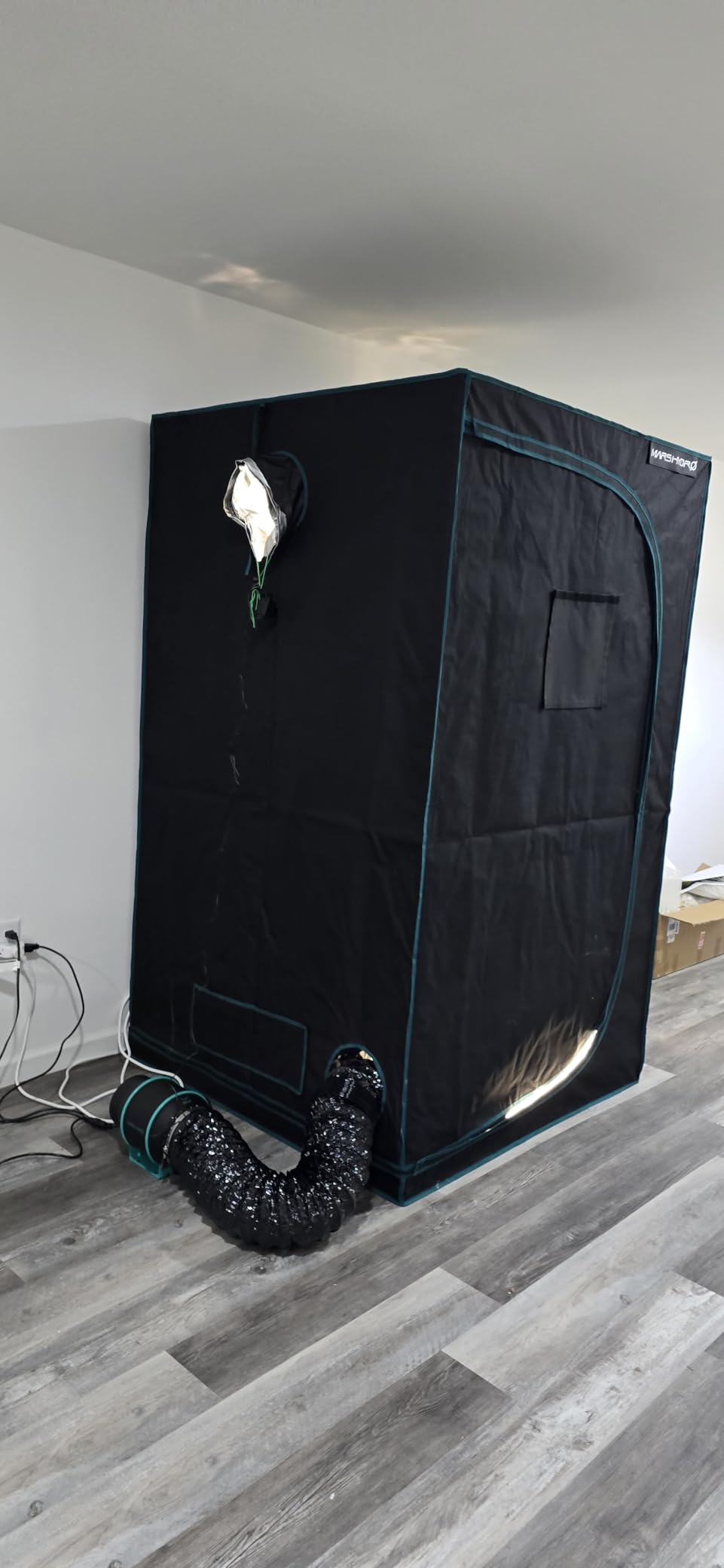
Now the important caveat, and it is not a small one: the enclosure is listed in the review data as closer to 40 by 40 by 70 than a true 4×4. Buyers consistently describe it as smaller than expected. If your plan is four large plants across a 16 square foot floor, this kit does not deliver that, however good the automation is.
The 300W light also does not cover the footprint evenly, so you will be rotating plants. Some buyers reported missing parts and an off-brand timer in the box, and the window flaps leak light around the edges. All of it is workable, but it is a list of things to check on day one.
Is 300W enough light for a 4×4 footprint?
For a 40 by 40 space, yes. The TSW2000 uses a 120 degree reflector with 704 SMD LEDs and dims from 0 to 100%, so you can dial it down for seedlings and up for vegetative growth. The limiting factor is the size of the enclosure, not the quality of the light.
Which makes this a kit for lettuce, herbs, seedlings, and microgreens rather than for four mature tomato plants. If your goal is a single crop under one light, the enclosure size is what you are designing around.
Who should skip it
Skip it if a true 4×4 footprint matters to your layout. If you have measured a 48 by 48 space and planned four large pots in it, this kit will not fill it and you will end up buying a bigger tent anyway.
Skip it if you dislike depending on an app. The automation is a convenience, not a requirement, and it is the main reason to buy this over a tent plus components bought separately at better specs.
9. zazzy 4×4 Grow Tent 98 Percent Mylar – Best for Insect-Screened Vents
4×4 Grow Tent 48″x48″x78″ 600D Mylar Hydroponic Growing Tents for Plant
48x48x78 footprint
98% reflective mylar lining
Mesh insect-screened vents, 600D canvas
Pros
- 98% reflective mylar lining across the interior
- Mesh vents keep insects out while allowing airflow
- Tool-free installation and adjustable reinforced connectors
- Removable mylar floor tray for easy cleaning
Cons
- No upper observation window on this variant
- 600D canvas is lighter duty than 1680D and 2000D alternatives
The 98% reflective mylar lining is among the highest reflectivity figures listed across these twelve tents, and for growers who are chasing every bounce out of a modest light it is a real feature. The canvas is 600D tear-proof and double stitched, with solid PA corner connectors that are anti-rust reinforced and adjustable.
What separates this model from the other zazzy in the roundup is the vent detail. The mesh-screened vents keep dust and insects out while still allowing airflow, and there is a lower window that handles heat dissipation. For a vegetable grower dealing with thrips or fungus gnats, screened vents remove an entire category of problem.
There is no upper observation window on this variant, which is the main thing to know before buying. You check on your plants by opening the door, which is a small daily inconvenience and matters more than it sounds when you are running a 19 hour photoperiod and want to keep the dark cycle undisturbed.
Everything else is straightforward. Tool-free installation with illustrated instructions, a removable mylar floor tray, and connectors you can tighten once the fabric is on.
Do screened vents hurt light sealing?
Less than you would expect, because the mesh is covered and cinched closed. Once a vent is sealed, it is sealed. The compromise is that you should double check the cinch every time you open the tent, since a vent left slightly ajar is the most common cause of a tent that glows at night.
The 600D canvas is where the light-tightness ceiling is. In a dark room this is a non-issue. In a lit room you will see a faint outline, and if that bothers you, the MARS HYDRO Advanced with its shade-cloth zipper flap is the better answer.
Who should skip it
Skip it if you need to monitor plants without opening the door. No upper window means every check is a door check, and for a grower running a dark cycle strictly, that is an avoidable habit to build.
Skip it if your space is bright or if you are hanging heavy equipment. 600D fabric and a frame without a published load rating give you less margin than the 150 lb models when a carbon filter and a full-size light are pulling on the top bars.
10. VIVOSUN Smart Grow Tent Kit 4×4 – Best for Vegetable Growers
VIVOSUN Smart Grow Tent Kit 4×4, 4-Plant WiFi-Integrated Grow System
True 48x48x80 tent
LumaLight 400W full spectrum LED
388 CFM inline fan, WiFi controller
Pros
- Genuine 48x48x80 four-plant tent bundled with light fan filter and controller
- GrowHub E42A+ has enough ports for intake and exhaust without a splitter
- App control of light intensity schedule and fan speed
- Heavy-duty fabric and sturdy zippers that hold up over multiple grows
Cons
- Light dims only to 25% which is bright for shade-loving plants
- No integrated dehumidifier humidifier or heater
- Light fan blows warm air onto plants with no reversible direction
If you grow food rather than flowers, this is the kit we would build around. It is a true 48 by 48 by 80 four-plant tent, which fixes the footprint problem that limits some kits, and it ships with a 400W full-spectrum LED, a 388 CFM inline fan with an EC motor and PWM control, a carbon filter, a prefilter, ducting, vent covers, trellis netting, and five five-gallon grow bags.
The LumaLight light uses algorithmically arranged diodes at 3000K, 5000K, 660nm, and 730nm, which is a sensible spread for mixed greens, herbs, peppers, and tomatoes. The GrowHub E42A+ has enough ports to run both an intake and an exhaust fan without a splitter, which removes one of the most annoying small problems in tent builds.
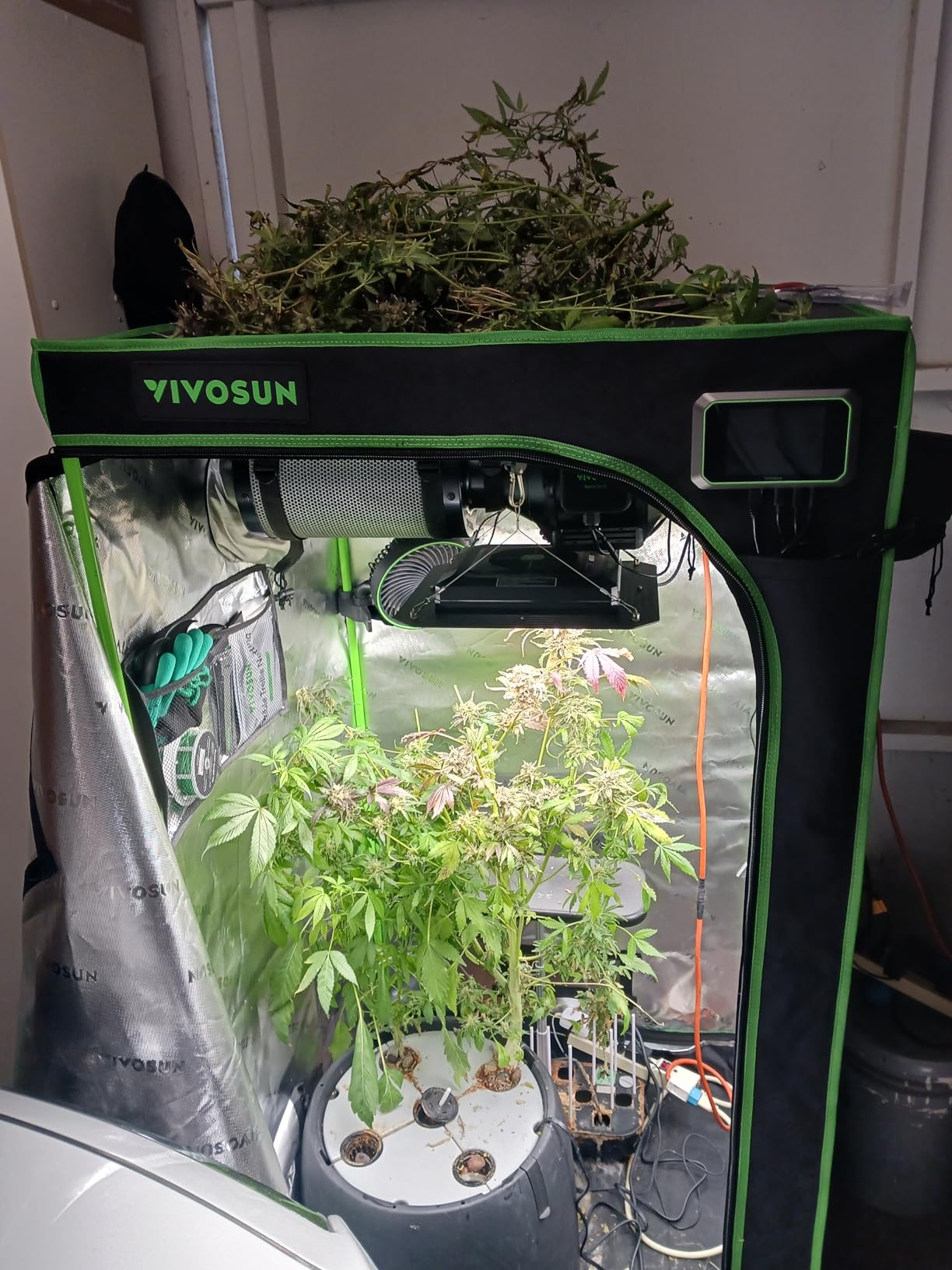
What owners consistently praise is that the light and the enclosure are correctly matched. 400W over 16 square feet at 48 by 48 is the pairing we recommended earlier in this guide, and unlike some kits you are not left rotating plants to compensate for uneven coverage.
The limitations are environmental. There is no integrated dehumidifier, humidifier, or heater, so climate control still depends on add-ons. The light dims only to 25%, which is still bright for lettuce and many seedlings, and the light fan blows warm air directly onto the plants with no reversible direction.
Will a 400W light overheat a small vegetable tent?
With the fan running, no. The 388 CFM inline fan moves more than enough air for the volume, and at 48 by 48 by 80 you have roughly 106 cubic feet to control. The one thing to plan for is the light fan blowing warm air downward with no way to reverse it, so position the tent so that side of the canopy is not directly above a delicate herb.
For lettuce and salad greens, dimming to 25% is the limitation to plan around. Start seedlings under the light at the lowest setting and move them out once they are established, or use a light meter to set the height instead of the intensity.
Who should skip it
Skip it if you want the tent on its own. This is a bundle, and the tent-only equivalents are noticeably cheaper if you already own a light, a fan, and a controller. Buy a bundle when you are starting from zero and want everything working together.
Skip it if you grow in a hot climate and need active dehumidification or heating. There is no hardware for either, and in many climates that is a real gap between a kit and a complete system.
11. G HYDRO 4×4 Grow Tent – Best for Tidy Cable Management
G HYDRO Grow Tent 4×4, 1680D Oxford Canvas 48″ x 48″ x 80″, Lightproof Reflective Mylar for Indoor Plant Growing
48x48x80 footprint
1680D Oxford canvas
22mm steel frame, lightproof cable passthrough
Pros
- 1680D Oxford canvas with sealed zippers and double cinched duct ports
- 22mm steel frame poles for a wobble-free structure
- Controller mounting plate and lightproof cable passthrough
- Clear observation window for monitoring without opening
Cons
- 90 lb frame rating is the lowest among the premium 4x4 tents
- Much smaller review base than the established brands
The spec sheet on this tent is competitive on paper: 1680D Oxford canvas described as tear resistant and fully light blocking, 22mm reinforced steel poles at 1.2 mm thick, sealed zippers, and double cinched duct ports. Where it stands out is the controller mounting plate combined with a lightproof cable passthrough, which is the same feature set the AC Infinity uses and very few others offer.
For a grower who runs a light, a controller, a fan, and a sensor, that combination keeps every cable out of the duct ports and out of the door seal. The lightproof passthrough means you do not compromise the tent to route a cable, which is a small thing that saves real frustration.
Is the 90 lb frame rating a problem?
For a light and a clip fan, no. 90 lb is enough for a 4×4 LED and a modest filter, and the 22mm poles at 1.2 mm thick are genuinely stout. It becomes the limiting factor only if you hang a large carbon filter, a heavy duct run, or a second light.
The number is the lowest of the premium group, and it is the one specification we would want confirmed in person before committing. Everything else about the build sheet reads well.
Who should skip it
Skip it if you want a proven long-term record. At 251 reviews, this is the smallest review base in the roundup, and a newer listing has less field history than the S448 or the CLOUDLAB. That is not a disqualifier, but it is a reason to buy from a seller with a straightforward return policy.
Skip it if you need colour choice or a specific aesthetic. Only one colour is offered, which matters if the tent is going in a living space rather than a utility area.
12. AC Infinity AI Grow System 4×4 – Best for Full Automation
AC Infinity AI Grow System 4×4, 4-Plant Kit w/Self-Learning AI Controller
AI environment controller with WiFi app
400W full-spectrum LED light
6 inch EC inline and clip fan
Pros
- AI environment controller plus app is the standout feature
- Premium build with thick poles quality zippers and three large doors
- 400W Samsung LM301H light with good spread across a 4x4
- Neatly labeled packaging that makes assembly straightforward
Cons
- No straps on the door flaps which is annoying day to day
- Power cord on the light and USB fan cables are too short for tidy routing
- Controller mounting height and window placement awkward for shorter users
This is the most automated system in the roundup and the most polarizing on value. The AI environment controller predicts climate shifts using real-time and historical data and auto-adjusts connected devices, and the app gives you insight, guides, and a chatbot. If you want the tent to run itself and you only want to intervene on a harvest, that capability is the reason to buy.
The hardware is premium throughout: lab-tested reflective mylar, thickest poles, the largest zipper window, and three large zipper doors, which is the best access arrangement of any tent here. The 400W full-spectrum light uses Samsung LM301H LEDs, and the 6 inch EC inline fan plus the 6 inch oscillating clip fan cover intake, exhaust, and circulation.
Owners report four plants fitting comfortably in the footprint, and packaging is neatly labeled enough that assembly is straightforward despite the weight of the system at 52.62 kg.
What are the practical drawbacks day to day?
The door flaps have no straps, which means every time you open a door you are holding two pieces of fabric. It is a small omission that reviewers mention repeatedly because it happens every single day. The light’s power cord and the fan’s USB cables are also too short for clean routing, which undercuts the tidy-cable advantage the premium build otherwise gives you.
Controller mounting height and window placement are awkward for shorter users, and one buyer reported pinholes in a new tent along with disappointing yields from the included light. That is a single report, but it is detailed, and warranty support was described as inconsistent by the same reviewer.
Who should skip it
Skip it if the automation is not the point. You can run a comparable light, fan, filter, and controller separately for a fraction of the outlay, and the tent-only CLOUDLAB gives you the same premium fabric and poles without the electronics.
Skip it if you are still learning what the numbers mean. An AI controller that adjusts temperature, humidity, and light on its own is excellent once you know what you are looking at, and confusing before that. Start with a manual tent, learn the tent, then automate.
How to Choose a 4×4 Grow Tent: 9 Features That Matter
Nine things separate a tent that lasts three years from one that gets replaced mid-cycle. Check them in this order, because the first two decide most of the outcome and the rest are refinements.
1. Fabric denier. Denier measures thread density. 600D is thin, roughly 340g class and adequate for a dark closet; 1680D is a genuine step up and is what you want in a lit room or a multi-cycle setup; 2000D Oxford is the top tier and behaves more like heavy luggage fabric. Do not pay a premium for 600D and expect 2000D behaviour.
2. Frame and pole thickness. The forums have a simple heuristic that holds up: pick the tent up and compare the weight against something of similar size, and feel how stiff the poles are. Entry-level tents use thin steel that bows under a loaded top bar. Look for 18mm or 22mm poles as a floor, and treat 1 inch poles as the premium standard.
3. Load capacity. A 110 lb rating is fine for a light and a clip fan. A 150 lb rating gives you headroom for a carbon filter, a longer duct run, or a heavier light. When the rating is published in kilograms, as it is on the MARS HYDRO at 70 kg, that is the number to compare against the pound-rated tents.
4. Height and clearance. Modern LEDs want 24 to 36 inches above the canopy. A 72 inch cube with a sloped roof can leave you around 60 inches of usable hanging height, which is fine for greens and tight for tomatoes. Measure your ceiling, add the height of your light and filter, and confirm the tent clears before you order.
5. Light sealing. Light leaks come from three places: the zipper, the duct ports, and the fabric itself. A shade-cloth or heavy zipper flap across the zipper seam is the single most effective fix, which is why the MARS HYDRO Advanced does it. For every model, cinch the duct port shrouds fully and check for pinholes on arrival in a dark room.
6. Zippers. Zippers are the most repeated complaint about 4×4 tents in forum threads, particularly at curved corners where fabric is under tension and the slider is being forced around a curve. Look for metal-tooth zippers with a flap behind them rather than plastic-tooth, and check whether the door is a single wide door or two narrower ones that meet in the middle.
7. Spill pool. A waterproof floor with a raised lip, ideally removable, protects against every irrigation accident you will have. A removable mylar tray can be lifted out and washed, which matters more for a vegetable grower running a reservoir than for anyone else. This is a cheap feature to prioritise and an expensive one to retrofit.
8. Ventilation and CFM. For a 4×4, target an inline fan in the 350 to 400 CFM range, which is where the 388 CFM and 402 CFM units in this roundup sit. Match the filter to the fan diameter, run at least 3 feet of ducting between them, and seal both ends. One exhausted air exchange every two to three minutes is the working target for most crops in a tent this size.
9. Access and layout. Count the doors before you buy, not after. A single front door on a 4×4 means crawling over your plants to reach the back corners. A tent with side access, like the three-door layout on the AI Grow System, changes how workable the space is for defoliation and reservoir changes.
AC Infinity vs Vivosun vs Spider Farmer vs Mars Hydro: Brand Showdown
AC Infinity and Vivosun are the two names growers ask about most, and the honest answer is that they are built for different jobs. AC Infinity is the materials and construction benchmark, and Vivosun is the volume and value benchmark.
AC Infinity uses the thickest canvas in this roundup at 2000D Oxford, the thickest poles at 1 inch, and publishes a 150 lb load rating alongside lab-tested mylar. Forum consensus repeatedly names AC Infinity as well built, user friendly, and reasonably priced, and the CLOUDLAB holds a 4.7 average that no other tent here matches.
Vivosun is the most-reviewed tent brand here by a wide margin, which means its spec claims have been tested by tens of thousands of buyers. The S448 holds a 4.5 average across 33362 reviews with a 100 lb top bar, a removable mylar floor tray, and tool-free assembly. Where Vivosun is weaker is fabric thickness and reported light leaks around zipper seams, and in forum threads Vivosun zippers are the ones specifically called out for fraying at curved corners.
Spider Farmer is the middle ground on price and near the top on hardware, pairing 1680D Oxford canvas with a 150 lb frame rating, SBS zippers, and a reinforced adapter system. Mars Hydro is the light-blocking specialist, and its 1680D canvas with a shade-cloth zipper flap is the answer when leakage is your primary concern.
One more brand worth naming: growers on Overgrow report Mars Hydro tents holding up over 15 or more grow cycles with no issues, while several others abandoned a different brand when they could not get a replacement part. Long ownership history, not the spec sheet, is the tiebreaker when two tents look identical on paper.
What to Avoid When Buying a 4×4 Grow Tent
Four mistakes show up repeatedly, and all four are avoidable before you spend anything.
Do not buy a kit for its included light. The single most repeated regret across the forum threads is a kit light that is too small. One grower replaced a 240W kit light with a 600W unit within a year, and another replaced the light, fan, controller, and tent in the same period. If you want a kit, check the wattage against the footprint first, and buy the tent separately if the numbers do not line up.
Do not plant five plants in a 4×4. The fifth plant sits in the middle and puts itself between you and the two rear plants. Four large plants or sixteen small ones is the layout that keeps every plant reachable for the whole cycle.
Do not ignore the height ceiling before the cycle starts. Plants outgrowing a 5 foot tent during flower forces a mid-cycle tent swap, which means buying twice. Check the listed height against your ceiling and against your light plus filter, and buy the taller tent if the numbers are close.
Do not put a thin tent in a bright room. Light leakage is a function of the room as much as the tent. Growers consistently say a modest tent is fine in a dark basement and frustrating in a well-lit living space, so match fabric weight to the room, not to the budget.
Frequently Asked Questions
What is the best 4×4 grow tent?
The VIVOSUN S448 4×4 Grow Tent is the best overall 4×4 grow tent, with a 4.5 average across more than 33000 reviews, a true 48 by 48 by 80 footprint, 100% reflective mylar lining, and a metal frame rated to 100 lb. The AC Infinity CLOUDLAB 844 is the best option for heavier duty builds, using 2000D Oxford canvas and 1 inch poles rated to 150 lb.
What company makes the best grow tents?
AC Infinity, Gorilla, and Spider Farmer are the most frequently named quality benchmarks in grower forums, while Vivosun and Mars Hydro are the strongest value choices. AC Infinity leads on materials specification, Vivosun leads on volume and review history, and Mars Hydro leads on light sealing.
How many plants can I grow in a 4×4 grow tent?
Four large plants is the standard for a 4×4 grow tent, and up to sixteen smaller plants works for a sea of green. Five is the number most growers avoid, because a centre plant blocks access to the two rear ones and makes defoliation and reservoir maintenance difficult.
What size grow light do I need for a 4×4 grow tent?
A light in the 400W class is the right match for a 48 by 48 inch footprint. The two 400W fixtures in this roundup are paired with a 388 CFM and a 402 CFM inline fan, and anything below 300W will leave the corners of the floor underlit.
What is the best wattage grow light for a 4×4 grow tent?
Around 400W is the best wattage for a 4×4 grow tent. Lower wattage kits are the most common regret reported by growers, who repeatedly replace underpowered kit lights within the first year, while going far above 400W creates heat that a single 6 inch inline fan cannot remove.
What is the recommended CFM for a 4×4 grow tent?
Between 350 and 400 CFM is the recommended airflow for a 4×4 grow tent, which is the range the 388 CFM and 402 CFM inline fans in this roundup occupy. Pair the fan with a carbon filter of the same diameter and at least 3 feet of ducting between them.
What’s better, AC Infinity or Vivosun?
AC Infinity is better for heavy duty builds, with 2000D Oxford canvas, 1 inch poles, a 150 lb load rating, and the highest average rating in this roundup. Vivosun is better for value and proven reliability, offering a true 4×4 footprint with a removable mylar floor tray and the largest review base of any tent here.
What are the best grow tents for indoor use?
The best grow tents for indoor use depend on the room and the crop. For food growers, the VIVOSUN Smart Grow Tent Kit 4×4 pairs a true 4×4 footprint with a 400W light and a 388 CFM fan, while a dark closet suits a lighter 600D tent and a lit room needs 1680D or 2000D canvas with a light-blocking zipper flap.
Which 4×4 Grow Tent Should You Buy in 2026?
The VIVOSUN S448 is the best 4×4 grow tent to buy in 2026. It is a true 48 by 48 by 80, it holds a 4.5 average across more than 33000 reviews, and the reflective mylar, 100 lb top bar, and removable floor tray cover everything a first or second grow needs.
Step up to the AC Infinity CLOUDLAB 844 if the room is bright or you plan a permanently rigged filtered setup. Step down to a 600D tent like the zazzy or MELONFARM if the space is a dark closet and you are on a small budget. And if you want everything working together on day one, the VIVOSUN Smart Grow Tent Kit 4×4 gives you a true footprint, a 400W light, and a 388 CFM fan in one box.