
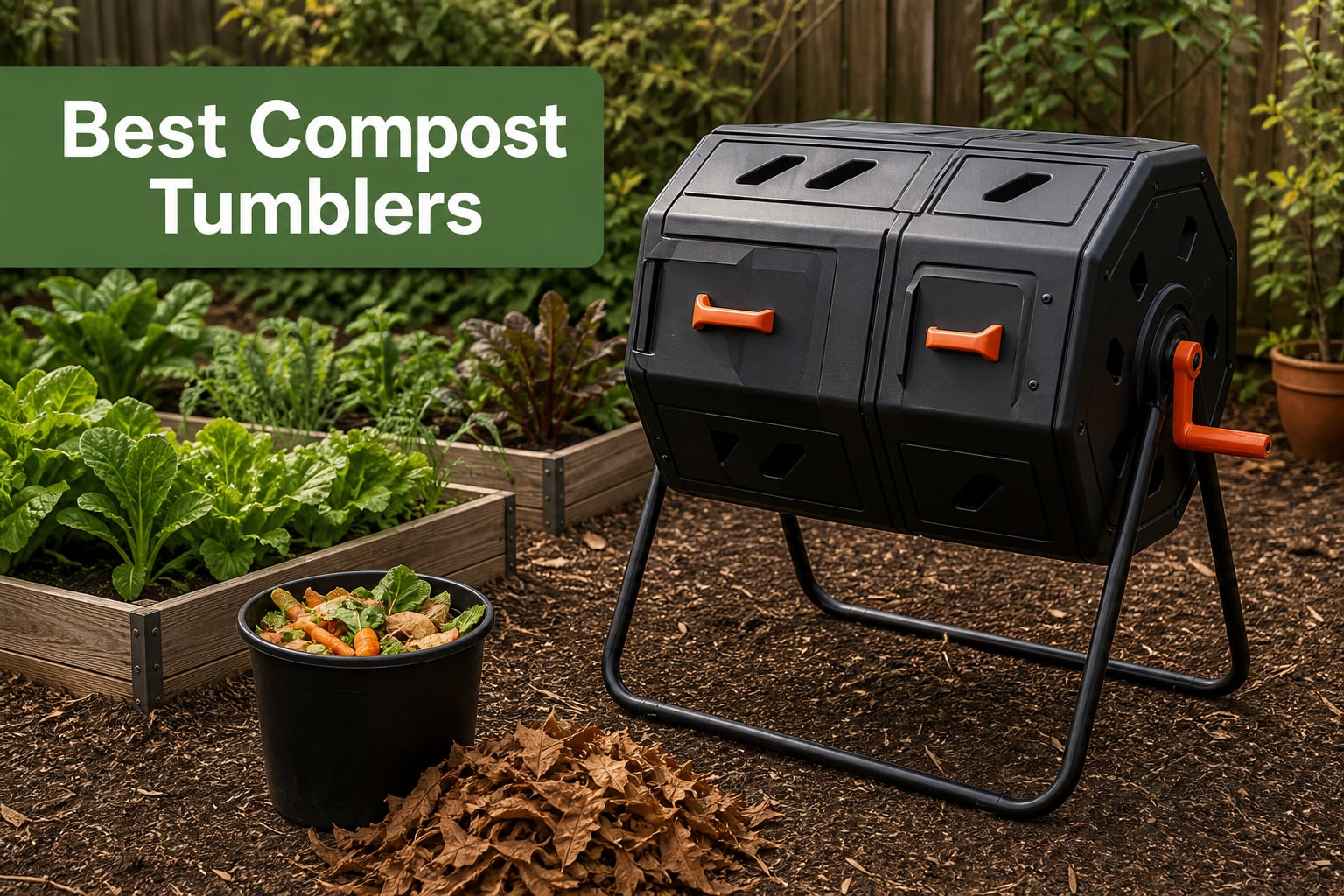
The best compost tumblers make backyard composting less like a weekly chore and more like a repeatable kitchen-scrap routine. A rotating compost bin gives you a contained place to mix greens and browns, add oxygen, and keep material away from many common pests.
They are not magic barrels. A compost tumbler still needs a sensible carbon-to-nitrogen mix, enough moisture without sogginess, and regular turning; overload it with dense grass clippings or wet food scraps and even a well-made model can stall.
For this 2026 guide, I compared the six available models by stated capacity, chamber layout, materials, access design, weight or load data where supplied, ratings, review volume, and the recurring positives and problems in their product data. Every pick here is a dual-chamber outdoor composter, which matters if you want one batch finishing while you begin filling the other.
My short answer is that a tumbler works best for a household that produces a steady, moderate stream of kitchen waste and chopped garden material. It is less suited to processing a season’s worth of branches, leaves, or lawn clippings in one go; an open garden compost bin is usually better for that bulk material.
Forum discussions line up with that distinction: gardeners repeatedly say tumblers shine with kitchen scraps but feel small when used as a yard-waste bin. They also put turning effort, large loading doors, and long-term outdoor durability ahead of flashy claims, so those are the details I focus on below.
The top 3 compost tumblers give three clear starting points in 2026
The Cozurra is my editor’s-choice starting point because it combines a stated 45-gallon capacity, two 22.5-gallon chambers, snap-together assembly, and a 4.6 rating, though its review base is small. The VEVOR is the sturdier-on-paper alternative with a stated 110-pound load capacity, while the Goplus makes sense when secure access and interior stirring blades rank higher than maximum volume.
These categories are not claims that one barrel can compost every kind of waste better than another. They are practical matches drawn from the available specifications and customer-review summaries, and your available space plus weekly scrap volume should make the final call.


These six compost tumblers cover compact to larger backyard batches in October 2026
All six picks use separate chambers, so the basic workflow is the same: feed one side until it is nearly full, let it work while you fill the second, then empty the finished material and repeat. The important differences are capacity, barrel shape, access details, frame construction, and how much stated support each model has from its review history.
| Product | Specifications | Action |
|---|---|---|
| Cozurra 45 Gallon Dual Chamber |
|
View Product Details |
 Hourleey 43 Gallon Dual Chamber Hourleey 43 Gallon Dual Chamber |
|
View Product Details |
| VEVOR 43-Gallon Dual Chamber |
|
View Product Details |
 THE GROW’ING 43 Gallon Tumbler THE GROW’ING 43 Gallon Tumbler |
|
View Product Details |
| Goplus 37.5 Gallon Tumbler |
|
View Product Details |
 EAST OAK 37 Gallon Tumbler EAST OAK 37 Gallon Tumbler |
|
View Product Details |
The Cozurra 45 Gallon tumbler is the easiest all-round starting point
Cozurra 45 Gallon Large Compost Tumbler Outdoor, Dual Chamber Compost Bin
45 gal
Two 22.5 gal chambers
PP
360 degree turning
Pros
- Dual chambers
- Snap-together assembly
- 45-gallon capacity
- Weather-resistant material
Cons
- Only 16 reviews
- Long-term reliability is less proven
The Cozurra offers the largest stated capacity in this six-model group: 45 gallons split into two 22.5-gallon chambers. That makes it a sensible fit for a household that wants continuous composting but does not have room for a stationary pile.
I would put its snap-together assembly near the top of the decision list for a first tumbler. Assembly frustration is one of the most consistent user pain points in this category, and the product data specifically identifies easy snap-together setup as a strength.
The barrel is polypropylene, and the listing describes a 360-degree tumbling action. With a dual chamber design, the useful habit is to keep one side active with kitchen scraps, brown materials, and small garden trimmings while the opposite side rests.
The rating is 4.6, the highest in this group, but it comes from only 16 reviews. That is encouraging rather than conclusive, so I would treat the score as a positive early signal and inspect the frame, panels, and connections during setup rather than assuming years of trouble-free outdoor use.
The Cozurra capacity suits a moderate, steady household stream
Forty-five gallons sounds roomy, yet each chamber is only 22.5 gallons. A family that adds a little material several times each week can work within that rhythm, but a single large cleanout of leaves or grass will crowd it quickly.
Chop bulky material before loading and save woody stems for a separate yard-waste bin. That leaves air pockets in the active chamber, which gives the tumbling action something useful to mix instead of making a packed, wet mass.
The Cozurra assembly appeal needs a realistic review-count caveat
The easy-assembly claim is especially appealing to beginners because fiddly hardware can turn an otherwise simple purchase into an afternoon project. The dimensions are 29.5 by 26 by 37.5 inches, so choose its final spot before filling it; moving a loaded tumbler is a different task from positioning an empty one.
The available review base is limited, which is the model’s main unknown. If you want the most established review history, the Hourleey, VEVOR, THE GROW’ING, Goplus, and EAST OAK entries each have far more reviews in the supplied data.
The Hourleey 43 Gallon tumbler is the most established high-volume option
Hourleey Compost Bin Outdoor, 43 Gallon Dual Chamber Tumbling Composting Bin with Sliding Doors, Tumbler Rotating Batch Composter Bin for Garden Kitchen Yard
43 gal
Dual chamber
Metal frame
Sliding doors
Pros
- 627 reviews
- Continuous dual-bin workflow
- Metal frame
- Sliding-door access
Cons
- Some durability concerns
- 21.7 lb empty weight
The Hourleey pairs a 43-gallon dual chamber barrel with a plastic body and metal frame. Its 627 reviews give it the broadest customer base in this group, which is useful when a buyer wants more than a small handful of early impressions.
Its product data calls out sliding-door access, a practical detail that affects daily use more than a product photo suggests. Small doors can make it awkward to add browns, remove finished compost, or break up a clump, so a door design is worth checking before choosing any compost bin tumbler.
At 27.6 by 25.8 by 36 inches, the Hourleey has a fairly contained footprint for its stated capacity. It weighs 21.7 pounds empty, which is not a problem once placed but does mean that a level, permanent location is a better plan than frequent repositioning.
The customer summary is positive about dual-bin operation and ease of use, while some users report durability concerns after extended outdoor exposure. That mixed picture is more useful than a blanket recommendation: it is a strong choice for review depth, but the frame and plastic panels deserve periodic checks in a harsh climate.
The Hourleey review base makes it easier to judge recurring feedback
A 4.3 rating from 627 reviews offers a larger pool of experience than the newer, lightly reviewed choices here. It does not remove the need to manage moisture or balance materials, but it gives more context for the reported advantages of sliding doors and dual chambers.
Most households should begin by feeding one chamber, not both. Leaving the other side alone gives a batch time to decompose and avoids the common mistake of repeatedly adding fresh scraps to material that is supposed to finish.
The Hourleey outdoor placement calls for basic weather management
Reports of durability concerns are a reason to put the barrel on a firm, level surface and keep it from sitting in standing water. If heavy rain is common, check through the doors after storms and add dry shredded leaves, torn cardboard, or another brown material if the contents look wet and dense.
Users in composting forums repeatedly flag rainwater and soggy contents as tumbler problems. That is a material-management issue as much as a model issue, and no stated 43-gallon capacity can compensate for an overloaded wet chamber.
The VEVOR 43-Gallon tumbler is the strongest pick for stated load capacity
VEVOR Compost Bin, 43-Gal Dual Chamber Composting Tumbler, Large Tumbling Rotating Composter with 2 Sliding Doors and Steel Frame, BPA Free Composter Bin Tumbler for Garden, Kitchen, Yard, Outdoor
43 gal
110 lb load
Octagonal barrel
BPA-free PP
Pros
- 110-pound load capacity
- UV-resistant material
- Octagonal mixing shape
- Two sliding doors
Cons
- Assembly can be difficult
- Lower sales rank
The VEVOR is a 43-gallon dual chamber tumbler with an unusually clear stated load capacity of 110 pounds. For a gardener who wants a concrete load figure before adding dense food scraps and damp browns, that information makes this model easier to assess than barrels that give capacity alone.
It uses polypropylene with metal components, and the product data describes the plastic as BPA-free and UV-resistant. Its octagonal barrel is another functional difference: corners and internal surfaces can help the contents shift during rotation instead of simply sliding as one packed layer.
The model has two sliding doors and measures 29 by 24.6 by 37.6 inches. It is close in overall footprint to the Cozurra and Hourleey, so capacity should not be the only measurement; think about clearance around the doors and room to turn the barrel.
Review highlights describe effective tumbling and a secure design that blocks pests, but some users report assembly difficulty. I would set aside time to sort the parts, avoid fully tightening hardware until the frame is aligned, and build it where it will live rather than trying to carry a partially assembled unit across the yard.
The VEVOR load figure helps set a sensible filling limit
A 110-pound stated load capacity does not mean a chamber should be compressed until it cannot turn. Composting needs air, and a barrel that is too full may become hard to rotate and slow to decompose even when its structure can support the weight.
Use the figure as a structural reference, then stop adding material while the chamber still has room for movement. Mix food scraps with dry browns as you add them, because it is easier to prevent a wet core than to correct one after it forms.
The VEVOR octagonal design favors mixed material over large yard debris
The octagonal shape is intended to aid mixing, and that is most useful with a varied blend of chopped scraps, leaves, and small trimmings. Long branches, thick corn stalks, and large matted grass layers can still jam the motion or reduce airflow in any rotating composter.
The supplied data cites a four-to-six-week composting timeline. Treat that as a favorable-condition benchmark rather than a calendar promise, because temperature, material size, moisture, turning frequency, and the green-to-brown balance all change the pace.
The GROW’ING 43 Gallon tumbler is the compact choice for solo setup
THE Growing 43 Gal Outdoor Compost Bin Tumbler for Backyard Garden, Black
43 gal
Twin 21.5 gal chambers
Heat-absorbing PP
Hexagonal
Pros
- Pre-embedded nuts
- Heat-absorbing chambers
- Compact footprint
- Locking pins
Cons
- Chambers can feel small
- Hexagonal body may be harder to clean
THE GROW’ING packs 43 gallons into twin 21.5-gallon rotating sections and has a compact stated footprint of 25 by 26 by 33 inches. Those measurements make it one of the more practical options when the composting area is a patio edge, narrow side yard, or a small garden rather than a large open plot.
The standout setup detail is its pre-embedded nuts, which the product data identifies as helping with one-person assembly. That addresses a real category weakness: many dual chamber composters use numerous panels and fasteners, so less hardware alignment can make the initial setup less frustrating.
Its black polypropylene chambers are described as heat-absorbing, with cross-ventilation and dual locking pins for loaded-barrel stability. Dark plastic can help a chamber absorb warmth, but compost heat still comes from the microbial activity of a balanced mix, not color alone.
Customer summaries praise the simple setup and dual-chamber arrangement, while some users say the chambers feel smaller than expected. That is a useful reminder that a 43-gallon total is divided into two working batches, and a gardener with high weekly output may prefer a bigger stationary bin for overflow.
The GROW’ING footprint fits a small-space composting routine
At 33 inches tall, this is a lower profile than the 36- to 37.6-inch models in this group. The compact dimensions are useful only if you still leave space to open the doors, turn the barrel, and hold a container for finished compost.
Place it where you can carry kitchen waste without making the task a detour. A tumbler receives more consistent use when it is near the route from house to garden, though it should sit on level ground with drainage rather than against a wall where water collects.
The GROW’ING chamber size rewards batch discipline
The two 21.5-gallon chambers can support continuous composting when you keep one side in its finishing phase. If both sides receive fresh scraps every day, neither gets the quiet finishing period that makes a dual chamber composter useful.
Use a small covered pail for scraps if the active side is full, then add the stored material with a brown layer when space opens. This slower, layered approach is more effective than forcing fresh, wet waste into a chamber that needs air.
The Goplus 37.5 Gallon tumbler is the practical pick for secure doors
Goplus Compost Tumbler, 37.5 Gallon Large Outdoor Compost Bin w/Dual Chambers, 2 Lockable Doors, Efficient 360° Rotating Batch Composter for Garden Yard Farm Waste, Easy Assembly, BPA-Free (Black)
37.5 gal
Dual chambers
Lockable doors
Interior stirring blades
Pros
- Lockable doors
- Interior blades
- Easy buckle assembly
- BPA-free PP
Cons
- Smaller 37.5-gallon capacity
- Fewer reviews than leaders
The Goplus has a smaller stated capacity of 37.5 gallons, but it brings two details many households will value: two lockable doors and interior stirring blades. It is a solid match for someone whose compost needs are moderate and who wants the barrel contents less accessible to animals.
Its BPA-free polypropylene barrel sits on a metal frame and measures 28 by 25 by 36 inches. The listing also identifies easy buckle assembly, which is a welcome feature when you want a straightforward build but still want the ongoing convenience of separate chambers.
The interior blades are designed to help mix material during 360-degree rotation. I see them as assistance rather than a substitute for preparation: shredding browns and cutting up larger food waste gives those blades loose material to move through.
Review data gives the Goplus a 4.3 rating from 302 reviews, and the summary is positive about doors and assembly. Its main tradeoff is capacity; it has roughly five to seven fewer total gallons than the 43- and 45-gallon options, which can matter when garden trimmings arrive quickly.
The Goplus lockable doors matter most where animals investigate bins
Lockable access points are a meaningful feature when raccoons, rodents, or other animals regularly explore a yard. A closed tumbler is generally more pest resistant than an open pile, but keeping the doors locked and wiping spilled scraps around the openings still matters.
Do not read a locking system as permission to add meat, dairy, oily foods, or large amounts of cooked food. Those materials can create odor and pest pressure, and they do not fit a simple backyard tumbler routine.
The Goplus smaller capacity works best with frequent harvesting
Thirty-seven and a half gallons can be plenty for a small household that adds scraps steadily and lets one chamber finish. It becomes limiting if you expect it to accept all autumn leaves, a large garden cleanup, or waste from several households.
The listed variants include larger capacities, but this review concerns the 37.5-gallon black model identified by the supplied product data. Choose by the actual barrel size you will receive rather than assuming every variant shares the same capacity or footprint.
The EAST OAK 37 Gallon tumbler is the lightest option for pest-aware gardens
East Oak Dual Chamber Outdoor Compost Tumbler, 2 × 18.5 Gallon Compost Bin, Rotating Composter with Aeration and Locking System for Garden, Kitchen, Yard
37 gal
Two 18.5 gal chambers
Locking system
10 lb
Pros
- 10-pound empty weight
- Locking system
- Aeration holes
- Stable rectangular shape
Cons
- 4.2 rating
- Smaller chambers
- Rectangular turning feel
The EAST OAK combines two 18.5-gallon chambers for a 37-gallon total, plus a locking system and aeration holes. It is the lightest model in the supplied data at 10 pounds, which can simplify initial placement for someone setting up a compact backyard composting station.
The barrel uses polypropylene with powder-coated steel, measures 25.6 by 23.6 by 30.3 inches, and has a rectangular shape intended to promote stability. Its lower height can be helpful for loading, although its shape may feel different to rotate than the cylindrical or octagonal designs above.
The product summary notes that the black design absorbs heat and that the locking system deters animals. The 4.2 rating from 590 reviews is slightly lower than the other models here, so I would choose it for its particular security, stability, and weight priorities rather than rating alone.
Users value the animal deterrence and the secure form, while the lower individual chamber capacity is the obvious tradeoff. Two 18.5-gallon sections ask for deliberate batch management, particularly if your household cooks often or produces many vegetable scraps.
The EAST OAK aeration details support the basics of active compost
Aeration holes help avoid pressure buildup and can support airflow, but holes do not fix a chamber loaded with compacted wet material. Turn the barrel regularly and add carbon-rich browns whenever you add a wet green material such as fruit and vegetable scraps.
The goal is a damp, loose mixture rather than a dripping one. If the material clumps and smells sour, pause the scraps, mix in shredded dry material, and turn again after the added browns have distributed through the chamber.
The EAST OAK small chambers suit controlled inputs, not a cleanup dump
Each chamber holds 18.5 gallons, the smallest individual batch size in this comparison. That can make the fill-and-finish rhythm easy to manage for one or two people, but it provides little margin for a weekend of heavy yard work.
Use a separate leaf pile or stationary compost area for large seasonal material, then reserve the tumbler for a prepared blend. This division gives you the contained, pest-aware advantages of a tumbler without asking a 37-gallon system to do the work of a much larger bin.
Choose a compost tumbler by workflow, capacity, and material mix
The right outdoor composter is the one that matches what you can feed, turn, and empty week after week. Start with your scrap volume and space, then look at the chamber system, access opening, materials, frame, and stated capacity rather than treating the rating as the full story.
A dual chamber tumbler is better for a continuous household routine
A dual chamber composter separates the process into two batches. You add new material to one chamber while the other rests and decomposes, then switch after the first batch is ready to empty.
That makes dual chambers the better choice for most households producing kitchen waste every week. A single chamber can hold more in one batch, but it is harder to keep adding scraps without resetting the decomposition process for older material.
Every product in this guide uses two chambers, ranging from two 18.5-gallon sections in the EAST OAK to two 22.5-gallon sections in the Cozurra. The total capacity is useful for comparison, but the per-chamber number tells you how much one active batch can actually hold.
A 37- to 45-gallon tumbler fits steady scraps, not unlimited yard waste
For one or two people, 37 gallons can work well when inputs are mostly fruit and vegetable scraps, coffee grounds, eggshells, and a reliable supply of dry browns. A larger household may find 43 or 45 gallons more comfortable, especially if garden trimmings join the mix.
Those sizes still have limits. A tumbler is a contained kitchen waste composter and batch processor, not a place to force a whole lawn’s clippings or unchopped branches.
Plan for a companion system if you maintain a large yard. Store dry leaves nearby for browns, use a separate pile for bulky debris, and let the tumbler handle the material that benefits most from contained turning and pest resistance.
Turn the barrel when material needs air, not just because a schedule says so
A useful baseline is turning a composting tumbler every few days or after adding a meaningful new layer of scraps and browns. Rotation mixes the chamber and introduces oxygen, which supports aerobic decomposition and reduces the chance of a dense, sour-smelling center.
Do not expect daily spinning to repair a poor mix. If the contents are soaked or packed tight, add shredded dry leaves, cardboard, or another carbon-rich brown first, then rotate enough to distribute it.
Turning should also be physically manageable. This is why access panels, barrel shape, load capacity, and a stable frame matter: a tumbler that is difficult to turn is less likely to receive the regular mixing its contents need.
A balanced green-and-brown mix prevents most tumbler failures
Greens are moist, nitrogen-rich inputs such as fruit scraps, vegetable scraps, coffee grounds, and fresh plant cuttings. Browns are drier, carbon-rich materials such as dry leaves, shredded paper, torn cardboard, and small untreated wood chips.
Each addition of wet kitchen scraps should be accompanied by a visible brown layer. This reduces excess moisture, separates food material, and helps the mixture keep air spaces as the barrel rotates.
The most common forum complaint is a tumbler that becomes wet and soggy. That is usually a balance problem, sometimes made worse by rain, and it is far easier to prevent with stored dry browns than to solve after the barrel has become a heavy, compacted mass.
Keep meat, dairy, grease, and bulky debris out of a simple tumbler
For a straightforward backyard system, put fruit and vegetable scraps, coffee grounds, eggshells, dry leaves, paper, cardboard, and small non-diseased plant trimmings in the barrel. Cut larger pieces down first so they break down and mix more readily.
Leave out meat, fish, dairy, fats, oils, pet waste, diseased plants, and weed seeds. These materials can create odor, attract pests, or create a composting problem that a small rotating chamber is poorly equipped to manage.
Avoid adding thick mats of grass clippings or large branches in one load. Grass can compact into a wet layer, while branches take up capacity and interfere with the rotating action.
Manage rain and cold weather by watching the material, not the calendar
Heavy rain can add water through access points or ventilation areas, and user discussions identify this as a frequent tumbler annoyance. After sustained rain, check the material through the door and add browns if it looks glossy, heavy, or matted.
Black, heat-absorbing chambers may pick up warmth, as noted for THE GROW’ING and EAST OAK models, but composting slows when the weather turns cold. Keep a winter batch balanced and aerated, then expect the process to take longer rather than assuming a fixed finish date.
In warm conditions with a balanced mix, the VEVOR product data cites four to six weeks. Treat that as an indication of possible speed under favorable conditions; finished compost is ready when it looks dark and crumbly and the original materials are no longer recognizable.
Build on level ground and inspect loaded parts during the first weeks
Dual-chamber tumblers need a level surface so the barrel turns predictably and the frame is not twisted under a wet load. Position it before filling, with clearance for opening doors and for holding a bucket or cart under the access point.
Assembly can be fiddly on some models, and the VEVOR customer data specifically mentions setup difficulty. Lay out the parts, follow the supplied sequence, align the frame before final tightening, and inspect fasteners after the first few loaded turns.
Weather exposure matters over time, especially where plastic meets a steel axle or where a frame stays damp. Periodic checks are a modest task that can catch a loose fitting or stressed panel before a heavy, active batch makes the problem harder to address.
FAQs
Do compost tumblers actually work?
Yes. A compost tumbler can speed decomposition because turning mixes materials and adds oxygen, while its enclosed form offers more pest protection than an open pile. It works when the chamber contains a loose balance of wet green material and dry browns; a barrel full of wet scraps or bulky debris will still compost slowly.
Why is my compost tumbler not working?
Most stalled tumblers are too wet, too dry, too tightly packed, or missing enough nitrogen-rich greens and carbon-rich browns. Add shredded dry leaves or cardboard to soggy contents, add a small amount of water to dusty dry material, break up clumps, and turn the barrel to restore airflow.
What not to put in a compost tumbler?
Avoid meat, fish, dairy, fats, oils, pet waste, diseased plants, weed seeds, large branches, and thick mats of grass clippings. These can cause odors, attract pests, crowd a small chamber, or disrupt the airflow that tumbler compost needs.
Can compost be too wet in tumblers?
Yes. Excess moisture pushes air out of the mix, making it heavy, compacted, and slow to break down. Add dry browns such as shredded leaves, paper, or cardboard, then turn the barrel so that material spreads through the wet areas.
How often should you turn a compost tumbler?
Turn it every few days or after adding a meaningful layer of new material. The better rule is to turn often enough to mix the chamber and keep air moving, while correcting moisture and balance problems instead of relying on rotation alone.
The Cozurra is the best compost tumbler for an easy dual-chamber start
For the best compost tumblers in 2026, I would start with the Cozurra if you want the highest stated total capacity in this group, two equal chambers, and a setup designed around snap-together assembly. Its small review base is the reason to choose it thoughtfully rather than blindly.
Choose the Hourleey for the largest review pool, the VEVOR for its stated 110-pound load capacity and octagonal design, THE GROW’ING for compact solo setup, the Goplus for lockable doors and stirring blades, or EAST OAK for its lightweight, locking, aerated format. Whichever you select, keep dry browns close by, fill one chamber at a time, and give the mix room to move.