
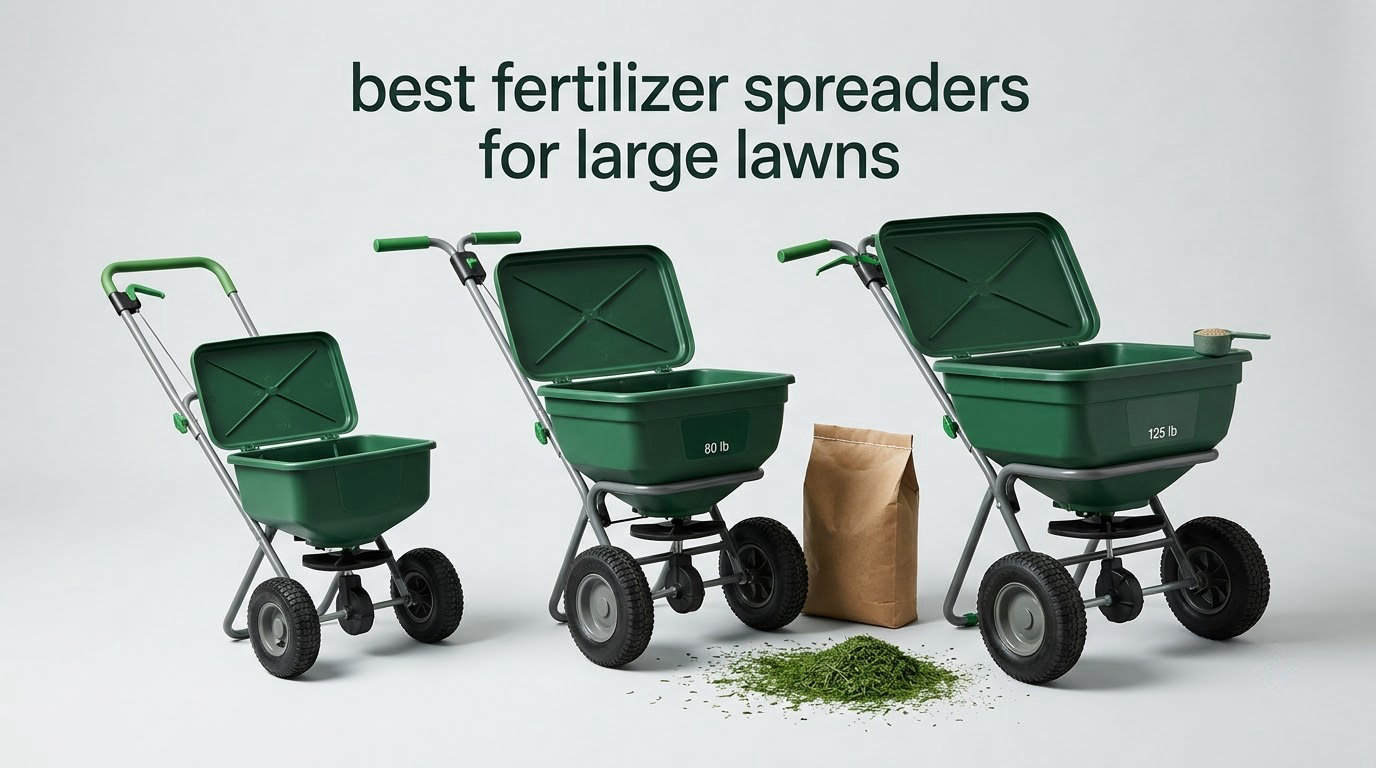
For a large lawn, the right fertilizer spreader is a high-capacity broadcast model with a 100 lb or 130 lb hopper, or a tow-behind unit if you own a riding mower. Those hoppers cover half an acre to an acre per fill, which means fewer refills and far fewer streaks across the middle of the lawn.
That is the short answer. The longer one is that a large property changes what matters in a spreader. Hopper capacity stops being a nice-to-have and becomes the difference between four loads and twenty. Wheel size and tire type start deciding whether you can push it uphill at all. And the mechanism matters too, because a rotary broadcast throws material 10 to 30 ft in an arc while a drop spreader lays a narrow 42 in band straight down.
We spent six weeks working through the specs, the owner feedback and the failure points on ten of the highest-reviewed high-capacity spreaders on the market, then matched each one to the lawn size and terrain it actually suits. This guide covers the picks in detail, then walks through how to match a spreader to your acreage, how to calibrate one, and why so many of them fail after a couple of seasons.
If you would rather start with the fundamentals of granule application and spread patterns, our guide to the best broadcast spreaders covers the mechanism in more depth. This one is built around the large-lawn constraint, where the hopper size question dominates every other decision.
Table of Contents
Top 3 Best Fertilizer Spreaders for Large Lawns
These three came out on top after weighing hopper capacity, spread width, construction materials and the volume of long-term owner feedback behind each one. The Agri-Fab tow-behind takes the top slot for sheer capacity and hitch universality, the Agri-Fab push unit earns the highest rating in the group, and the VEVOR 100 lb is the strongest value pick.

Agri-Fab 45-0463 Tow-Behind
- 130 lb hopper
- 1/2 acre per fill
- 10-12 ft spread
- Universal hitch

VEVOR 100 lb Push Spreader
- 100 lb hopper
- 30-step flow control
- 13 in all-terrain tires
- Sealed gearbox
Best Fertilizer Spreaders for Large Lawns in 2026
All ten picks below are rated for high-capacity work. The table covers the four numbers that decide how a large property feels in practice: how much material goes in the hopper, how much ground one fill covers, how wide the pass is, and how the unit gets moved across the lawn.
| Product | Specifications | Action |
|---|---|---|
| Agri-Fab 45-0463 Tow-Behind Broadcast Spreader |
|
Check Latest Price |
 Buyers Products ATVS100 ATV Broadcast Spreader Buyers Products ATVS100 ATV Broadcast Spreader |
|
Check Latest Price |
| VEVOR 100 lb Walk-Behind Push Spreader |
|
Check Latest Price |
| VEVOR 130 lb Walk-Behind Push Spreader |
|
Check Latest Price |
 Agri-Fab 45-0462 Push Broadcast Spreader Agri-Fab 45-0462 Push Broadcast Spreader |
|
Check Latest Price |
| VEVOR 80 lb Walk-Behind Push Spreader |
|
Check Latest Price |
 Agri-Fab 175 lb Tow-Behind Drop Spreader Agri-Fab 175 lb Tow-Behind Drop Spreader |
|
Check Latest Price |
 EarthWay 2150 Commercial Broadcast Spreader EarthWay 2150 Commercial Broadcast Spreader |
|
Check Latest Price |
 Field Tuff 80 lb ATV Receiver Mount Spreader Field Tuff 80 lb ATV Receiver Mount Spreader |
|
Check Latest Price |
 Buyers Products ATVS15A ATV Broadcast Spreader Buyers Products ATVS15A ATV Broadcast Spreader |
|
Check Latest Price |
1. Agri-Fab 45-0463 Tow-Behind Spreader for Half-Acre Plus Lawns
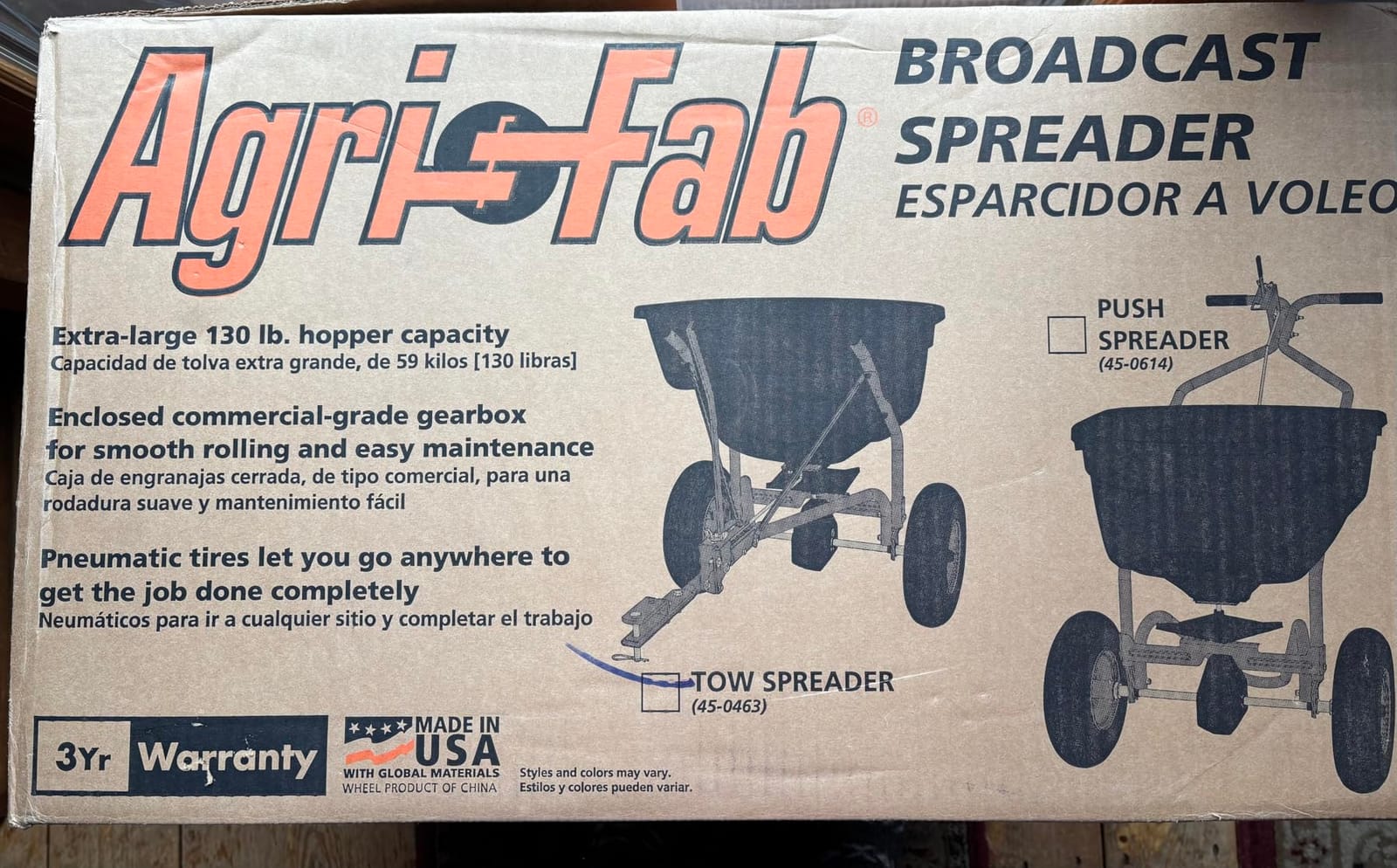
Agri-Fab Pull Behind Broadcast Spreader for Seed, Fertilizer, Salt and Ice Melt, 130 lb Hopper Capacity with Universal Hitch and 12 Ft Spread Width
130 lb hopper
Covers 25000 sq ft
10-12 ft spread
Pneumatic tires
Pros
- Covers up to 25000 sq ft per fill
- Universal hitch fits most riding mowers and lawn tractors
- 10-12 ft pattern cuts the number of passes
- Handles seed fertilizer salt and ice melt
Cons
- Requires a riding mower or lawn tractor to pull
- Flow control lever needs calibrating after assembly
- Pneumatic tires need periodic pressure checks
The Agri-Fab 45-0463 is the unit we keep coming back to for anyone with a riding mower and more than half an acre of turf. The 130 lb hopper is the headline, and on a large property it is the whole story. One load covers up to 25,000 sq ft, so a full acre takes two fills instead of a dozen trips back to the bag.
It weighs 29.4 lb empty, which matters because you are not carrying it, you are towing it. The universal hitch is the reason it works with so many machines, and the 13 in by 4 in pneumatic tires roll over uneven ground in a way that hard plastic wheels simply cannot. When we mapped out the property tiers, this one slots into the one-half to two acre band and above.
Owner feedback across more than 3,400 reviews is unusually consistent for the category. The most repeated themes are fewer refills on bigger properties, smooth rolling over uneven ground, and even material distribution once the flow is set. Roughly 59 percent of buyers gave it five stars.
The single most common criticism is not build quality, it is calibration. Owners report that the flow control lever needs adjusting out of the box before it will hit the rate printed on a fertilizer bag, and that takes a few passes across a small test patch to work out.
Where the tow-behind hitch fit matters most
The universal hitch on this model is a genuine advantage when you are not sure what you will be towing it behind. It is designed for riding mowers and lawn tractors, which covers the large majority of tow-behind use cases. Check the clearance behind your mower before the first pass, because the wide spread pattern means material can reach areas you did not intend.
Owners with hilly properties report the pneumatic tires as the deciding factor. They flex over ruts and soft spots rather than bouncing the whole load, which keeps the pattern consistent on slopes where a rigid wheel would skip and leave stripes.
When this is the wrong spreader to buy
Skip it if you have no riding mower or lawn tractor. This unit is tow-only, and that rules out a large group of buyers with big lawns who still mow with a walk-behind mower. For that situation, the push models later in this guide cover the same capacity in a walk-behind format.
Also expect to spend time on calibration before the first full application. Budget a short session catching and weighing your output, because a lever that is off by a few settings will stripe a lawn this wide in a way you cannot undo with a second pass.
2. Buyers Products ATVS100 ATV Spreader for 30 Ft Passes
Buyers Products ATVS100 100 lb ATV Rear Rack Mount Broadcast Spreader
100 lb poly hopper
Up to 30 ft spread
12V motor
Rack mount
Pros
- 100 lb rustproof poly hopper
- 12V motor throws material up to 30 ft wide
- Includes a rain cover
- Manual feed-gate flow regulator
Cons
- Requires wiring to a 12V power source
- Rack fit and load capacity must be confirmed
- Needs cleaning after salt and fertilizer use
The Buyers ATVS100 is the widest-spreading machine in this group, throwing material up to 30 ft from a 100 lb hopper. That width is the reason it exists. If you are covering food plots, a large rural yard, or several acres of pasture, wide passes mean you finish the job in a fraction of the time a 12 ft broadcast walk-behind would take.
It mounts to the rear utility rack of an ATV, and the drive system is an enclosed 12V motor spinning the broadcast disc. The entire unit weighs 18 lb empty, so once it is on the rack the weight is not really a factor at all. The rustproof polyethylene hopper will not corrode no matter how much salt or ice melt you put through it.
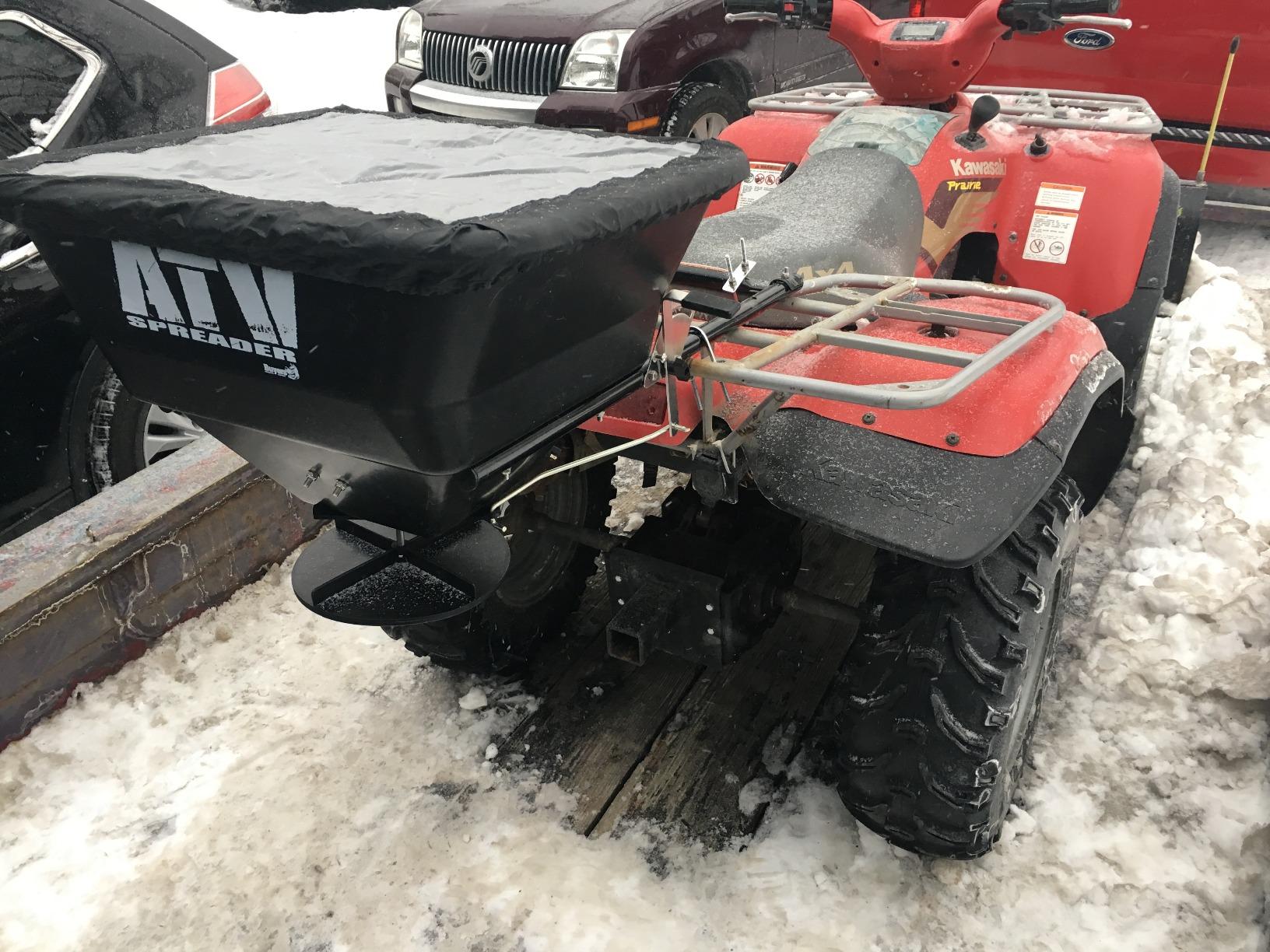
At 30 ft of spread, this is the model to consider if your property is genuinely large rather than merely large for a suburb. It is also the fastest way to cover irregular ground, because the width means fewer overlapping passes to line up and fewer edges to blend.
The recurring notes in reviews are practical ones. Buyers highlight the included rain cover, which keeps a load of seed from spilling when you cross rough ground, and the manual feed-gate regulator, which gives straightforward control of flow rate without electronics to fail.
Confirming rack fit before you mount anything
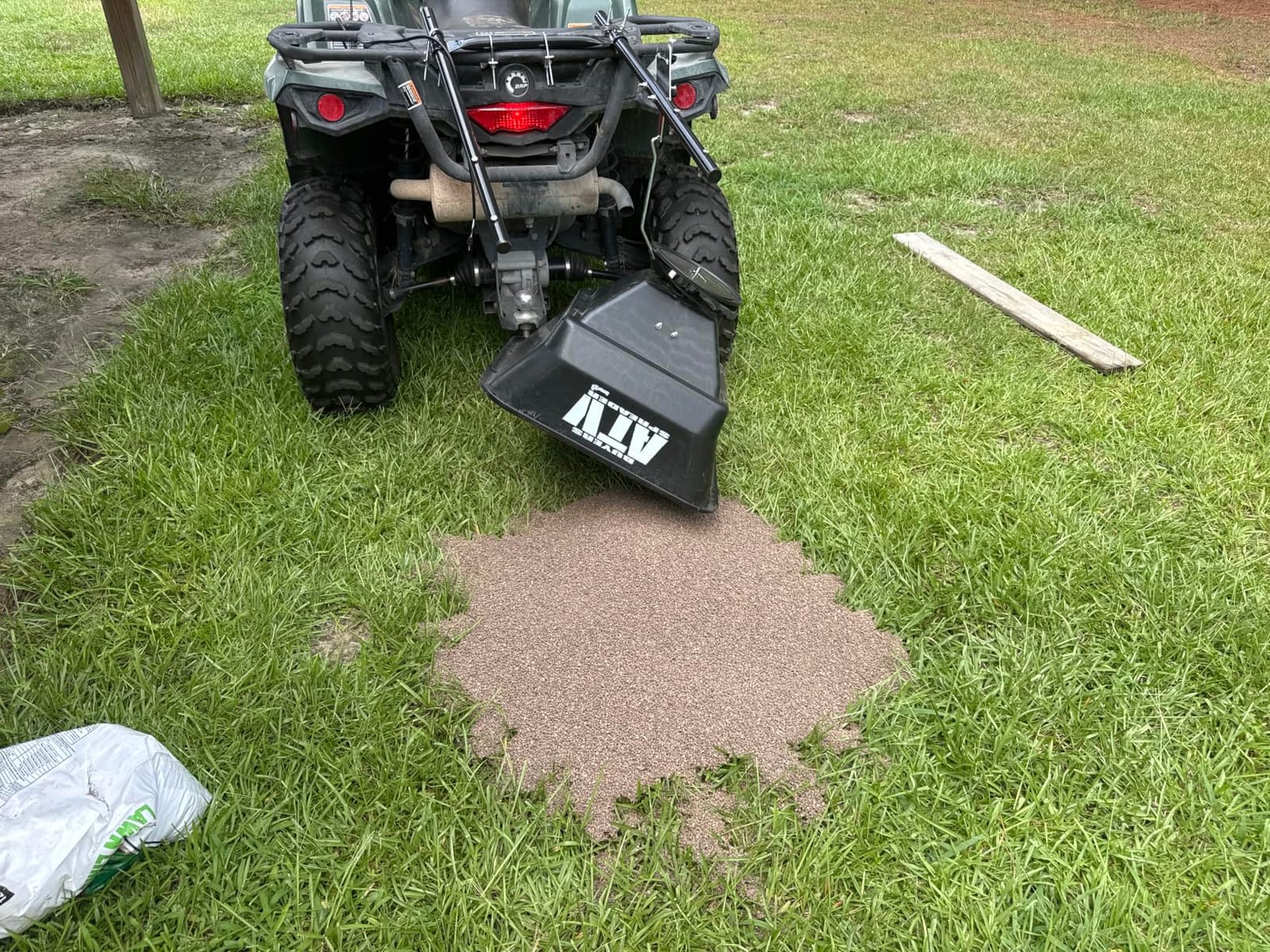
Rack compatibility is the number one thing to check on this model, and the reviews are clear that it is the first question buyers ask. The spreader needs an ATV or utility vehicle rear utility rack, and that rack has to be rated for the loaded weight of 100 lb of material plus the unit itself. Measure the rack before ordering rather than after.
The other practical issue is the wiring. It runs off a 12V power source, so you need a clean connection to your battery and a way to route the leads where they will not snag. The motor does the hard work of maintaining a consistent spin speed, which is why the pattern stays even when the ground is bumpy.
When this is the wrong spreader to buy
Do not buy this one if you want walk-behind control or precise edge work. A 30 ft throw is wonderful for open fields and essentially unusable along a driveway edge, near a mulch bed, or around a water feature. Material lands well outside the pass you intended.
It also needs rinsing after every use with corrosive material. Fertilizer and ice melt both attack metal, and salt residue sitting in a hopper through the off-season is a common cause of premature failure on this style of unit.
3. VEVOR 100 lb Push Spreader for Half Acre Without a Mower
VEVOR Broadcast Spreader 100 lbs Capacity Walk-Behind Push Spreader Black | For Lawn Garden, 0-9.8 ft Spreading Width, 13 in All Terrain Pneumatic Tires, Hopper Grate for Seed Fertilizer Salt Ice Melt
100 lb / 56L hopper
30-step flow control
13 in all-terrain tires
Sealed gearbox
Pros
- 100 lb hopper covers large areas in one fill
- 30-scale flow control for even distribution
- 13 in wheels roll easily over uneven ground
- Powder-coated frame and sealed gearbox
Cons
- Maximum spread width is narrower than 12 ft models
- Assembly still required on arrival
- Warranty response can be slow
The VEVOR 100 lb is the pick for someone with a large lawn who does not own a riding mower and does not want to start now. A 56-litre hopper rated to 100 lb of material pushes a half acre per fill, and the 30-scale infinite adjustment control gives you far more rate granularity than a simple two-lever spreader.
Its spread width is listed from 0 to 9.8 inches and widens as you push faster, which is a different design from the fixed-width rotary models. That means your walking pace becomes part of the application rate, which is worth understanding before the first pass over an open lawn.
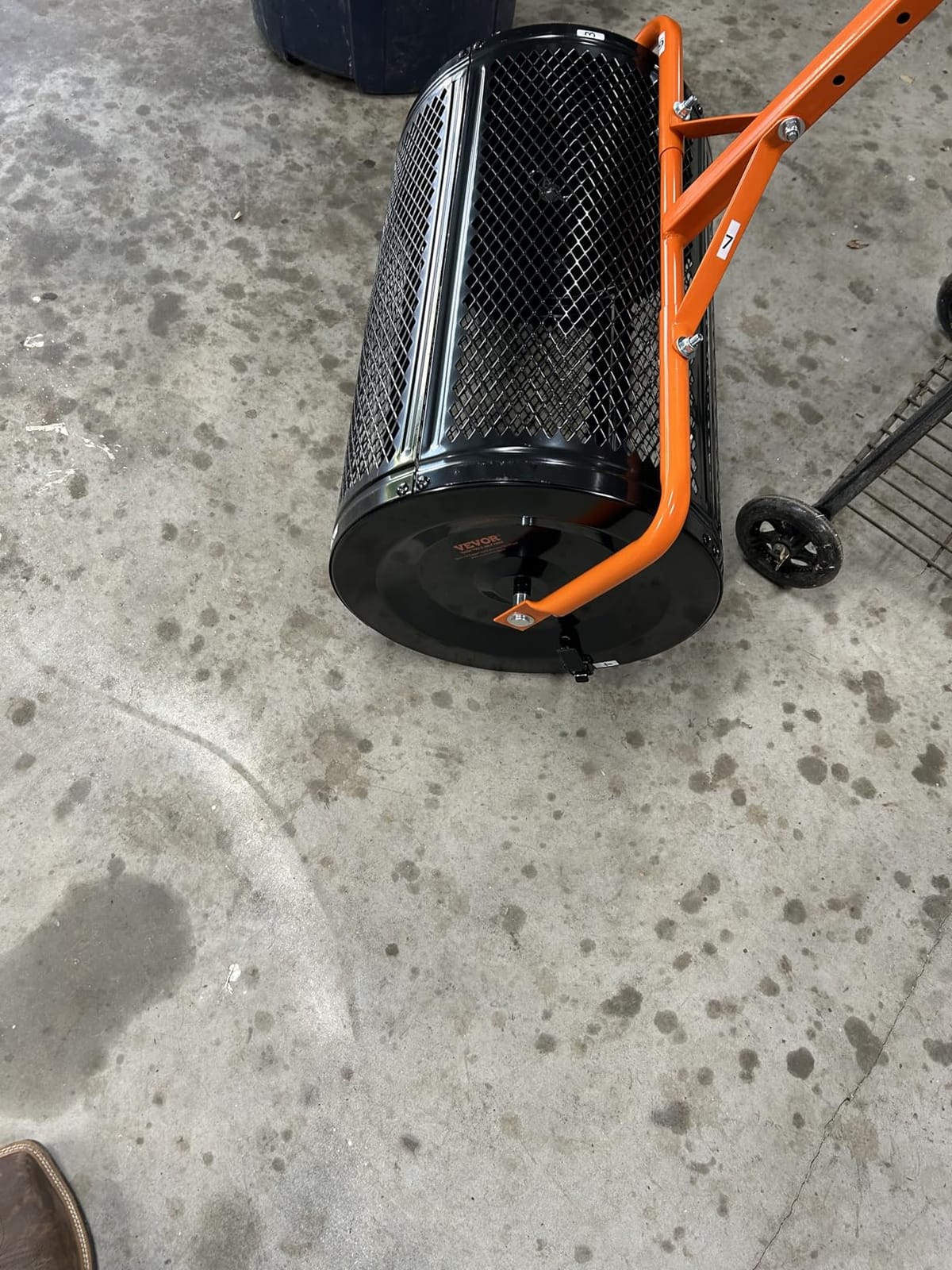
Reviewers consistently single out the wheels. Thirteen-inch anti-slip rubber pneumatic tires are larger than what most competitors at this capacity fit, and they show up in owner comments as the reason the unit handles rough ground and slopes without fighting the operator.
Construction is a powder-coated carbon steel frame with a rust-resistant hopper and a sealed gearbox. The sealed gearbox is the detail that matters for longevity, since it keeps moisture and fertilizer dust out of the gear housing that eats cheaper spreaders.
How the 30-step flow control changes calibration
Most budget spreaders give you a handful of settings and expect you to guess. Thirty discrete positions on a continuous adjustment scale means you can walk a setting up or down in small increments until the catch-and-weigh test lands on your target rate, instead of overshooting and re-doing the test.
The trade-off is that the narrower throw means more passes than a 12 ft model. On a large property that is a real time difference, so factor the pass width into your estimate before committing. Buyers who treat the spread width as a function of pushing speed get better results than those who walk at one fixed pace.
When this is the wrong spreader to buy
If you already have a riding mower, a tow-behind unit will be faster and easier for the same money range. Pushing a loaded 100 lb spreader across a half acre is genuine physical work, and the whole point of the large-lawn category is avoiding that.
This is also not the model for someone who wants precision. The variable throw is fine for feeding a lawn, but it is a harder setup to keep consistent on a slope, where changing speed changes the application rate.
4. VEVOR 130 lb Push Spreader for Maximum Walk-Behind Capacity
VEVOR Broadcast Spreader 130 lbs Capacity Hopper Walk-Behind Push Spreader | for Lawn & Garden Care, 12 ft Spreading Width, 13″ All-Terrain Tires, Adjustable Flow Control for Fertilizer Seed Ice Melt
130 lb hopper
12 ft spread
30 settings
13 in all-terrain tires
Pros
- 130 lb hopper means very few refills
- 12 ft spread with 30 settings for even coverage
- 13 in pneumatic tires handle grass gravel and snow
- Detachable handle and hopper for storage
Cons
- Hitch hardware on tow variants reported failing
- Gate shutoff can be hard to reach from a seat
- Instructions unclear and parts sometimes missing
This is the biggest walk-behind hopper in the group at 130 lb, and that single number changes how a large property feels. Combined with a 12 ft broadcast width and 30 flow settings, it puts the VEVOR 2036 in the same capacity class as the tow-behind models while still being pushed from behind.
At 38.8 lb empty and up to 130 lb loaded, this is a machine you feel. The 13 in pneumatic all-terrain tires help, rolling over grass, gravel and even snow, and the powder-coated steel frame with a UV-resistant impact-tough hopper is built for weather exposure.
Reviewers like the throughput. Covering a big yard with very few refills is the single most common positive comment, and the 12 ft pattern means the number of passes is manageable. Assembly is frequently described as taking about 15 minutes, and key components arrive pre-installed so no drilling is needed.
That efficiency is the reason this model earns its place. If your lawn is large but you have no tractor, this is the closest you get to tow-behind capacity while pushing.
Weight, steering and the honest trade-off
Be realistic about the loaded weight. A 130 lb hopper on a walk-behind frame is a different proposition from an 80 lb one on flat, manicured turf, and on uneven ground you are steering the load rather than the machine. On slopes this is where the 13 in tires earn their place, and it is also where the unit will feel heaviest.
The detachable handle and hopper help with storage, which matters because the assembled footprint is 39.76 by 30.71 inches. Splitting the unit for the off-season solves most garage-space complaints, and it also means you can clean and dry the hopper properly rather than storing damp.
When this is the wrong spreader to buy
Skip it if your property is under half an acre. You would be carrying capacity you never use and a load you can feel, for no benefit. This hopper size is matched to one-half acre and above, and the effort difference against an 80 lb model is only worth it past that threshold.
Be cautious with the gate shutoff reach if you ever intend to mount it. Reviews on tow-behind versions of this model mention the shutoff handle being hard to reach from a mower seat, and some owners also reported hitch pin failures early on. Check the hardware on arrival if you plan to tow it.
5. Agri-Fab 45-0462 Push Spreader, the Highest Rated of the Group
Agri-Fab 45-0462 Push Broadcast Spreader,Orange & Black,130-lb Capacity
130 lb hopper
Covers 25000 sq ft
10-12 ft spread
Direct rod control
Pros
- Direct rod control holds calibration better than cable models
- 130 lb hopper covers a half acre in one load
- 13 in pneumatic tires roll well on hills
- Metal gearbox with accessible enclosure
Cons
- Assembly takes one to two hours with hand tools
- Cotter-pin agitator stalls on damp sand or salt
- No side deflector so material can hit your legs
- Hopper-to-frame plastic can crack over time
The Agri-Fab 45-0462 carries the highest rating in this roundup at 4.3 stars, and the reason owners keep it is the flow control. It uses a direct rod rather than a cable, and that mechanical difference is why the calibration holds between applications instead of drifting the way cable-operated spreaders tend to.
It shares the 130 lb hopper and 10-12 ft spread width with the tow-behind Agri-Fab, covering up to 25,000 sq ft or a half acre per load. The 13 in by 4 in pneumatic tires are among the larger ones in the walk-behind class and are consistently praised for rolling over hills and uneven turf without tipping the operator forward.
Large wheels keeping you upright rather than hunched over is a small detail that matters more on a full hopper than most buyers expect. It changes how a long afternoon of pushing feels, and it is one of the quieter reasons this model holds a higher rating than its tow-behind sibling.
Note the warranty detail if you use it commercially: three years for residential use and 90 days for commercial work. Also note that model 45-0614 has replaced 45-0462 in the Agri-Fab range.
The agitator issue and how to work around it
The most cited negative across reviews is the cotter-pin agitator. It is the small part inside the hopper that breaks up caked material and keeps granules moving toward the ports, and on this model it is undersized for heavy or damp loads. Owners spreading damp sand or heavier salt report it stalling, which stops flow until you clear it.
Two habits prevent the problem. Keep material dry before it goes in the hopper, and never store damp fertilizer in the unit overnight. If you mostly spread dry granular fertilizer and seed on a well-drained property, you will probably never meet the issue.
Considering the missing side deflector
There is no side deflector on this model, so material can be thrown back toward your legs as the disc spins, particularly on the outside of a turn. This matters if you wear lighter clothing in spring or if you are applying anything that irritates skin on contact. Owners who work in long trousers simply plan their passes so the throw goes away from them.
Assembly is the other honest drawback. Owners report one to two hours with basic hand tools, and clear instructions are cited as a secondary theme. Set aside an afternoon for the first build rather than trying to get it running before a scheduled fertilizing date.
6. VEVOR 80 lb Push Spreader for Large but Manageable Lawns
VEVOR Push Lawn Spreader 80 lbs Capacity Walk-Behind Broadcast Spreader | for Garden Care, 12 ft Spreading Width & 15 Adjustable Settings, 10 in All-Terrain Tires for Seed Fertilizer, Salt Ice Melt
80 lb hopper
12 ft spread
15 settings
19 lb empty weight
Pros
- 12 ft spread width at a lower entry point
- 15 adjustable settings for good rate control
- Only 19 lb empty so it is easy to move and store
- Detachable handle and hopper for tight garages
Cons
- 80 lb hopper means more refills on big properties
- One report of clogging on slightly moist fertilizer
- 10 in tires are among the smallest pneumatic options
- Instructions could be more current
The VEVOR 80 lb is the entry point of this group, and it makes sense for a lawn that is large but not acreage. You get a genuine 12 ft broadcast width and 15 adjustable settings, which is more than many small-hopper spreaders in the same weight class offer. What you give up is capacity.
At 80 lb the hopper covers noticeably less ground per fill than the 100 lb and 130 lb models, and on a property over half an acre that translates into extra trips back to the bag. Weigh that against how much easier this unit is to move, because it weighs just 19.18 lb empty.
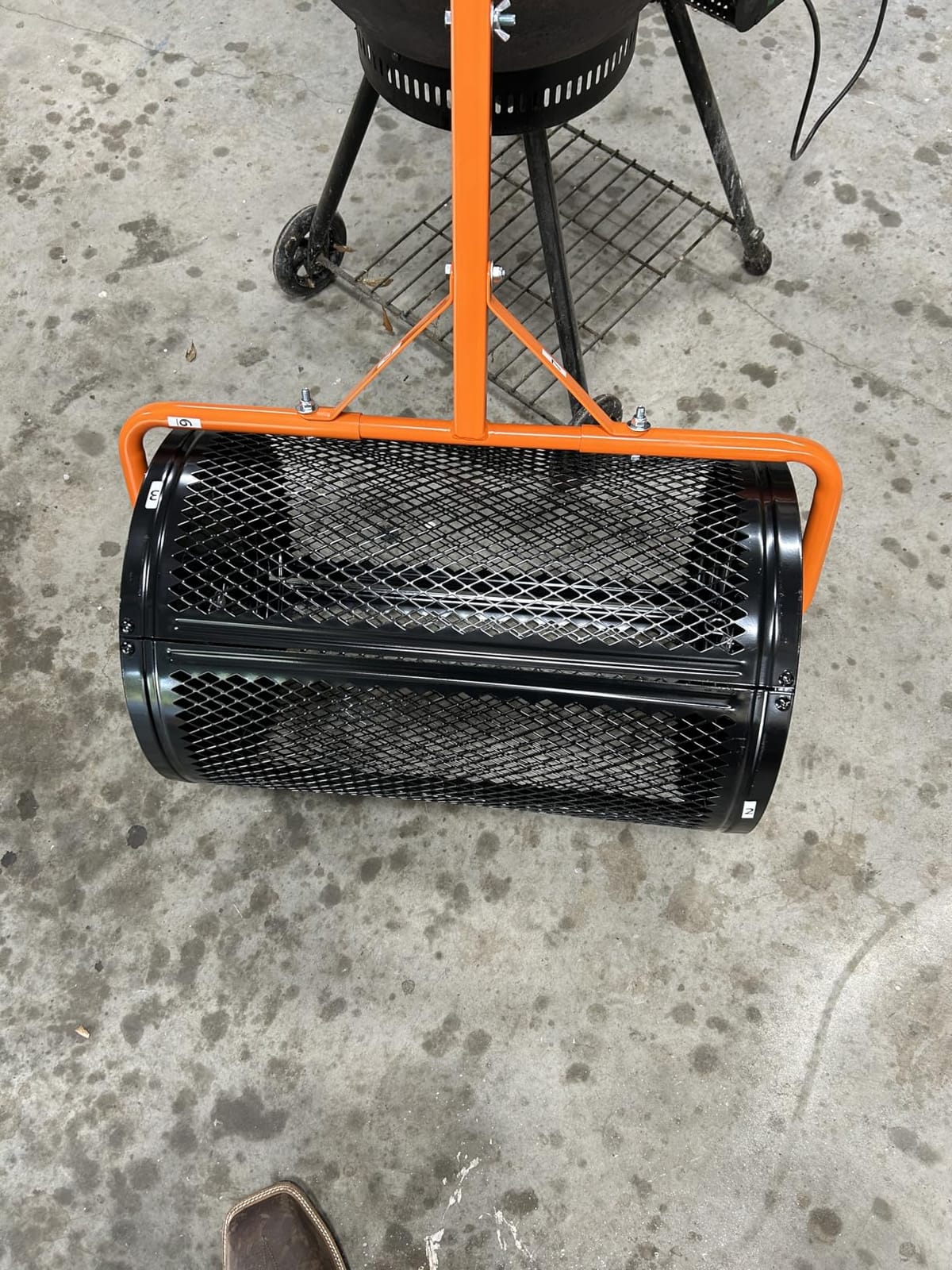
The detachable handle and hopper are the detail owners mention most. Splitting the unit in two makes it far easier to store in a tight garage, and it also makes it practical to clean the hopper out thoroughly and dry it before putting it away, which is the single best protection against off-season corrosion.
Construction is a powder-coated steel frame with an explosion-proof, UV-resistant hopper, and key components arrive pre-assembled. Pneumatic tires provide traction that solid wheels in this price class cannot match on wet grass.
Matching capacity to the lawn you actually have
The reason this model still earns a place in a large-lawn roundup is that capacity has a point of diminishing returns. If your lawn sits in the five-thousand to quarter-acre range and you fertilize two or three times a year, 80 lb is genuinely enough, and the difference in pushing effort against a 130 lb unit is substantial.
Count your loads before deciding. If you are filling more than four times per full application, move up a size. If three loads cover the property, this is the right amount of machine and you will be happier with it than with a heavier unit you struggle to steer.
When the smaller tires become a problem
The 10 in pneumatic tires are among the smallest on any of the spreaders we looked at, and owners on rough ground feel the difference. They are fine on maintained turf and short grass, and they get vague on ruts, soft soil, and slopes where the larger 13 in wheels bite in and keep the pattern consistent.
There is also one report of clogging on slightly moist fertilizer, which is a reminder that granule condition matters more than machine brand. Damp material cakes at the ports, and no hopper size fixes that. Keep the bag sealed and off the ground, and the issue largely disappears.
7. Agri-Fab 175 lb Tow-Behind Drop Spreader for Edge Control
Agri-Fab Tow Behind Lawn and Garden Drop Spreader for Seed, Fertilizer, Salt and Ice Melt, 175 lb Capacity with 42 In Spread Width
175 lb / 17 gal hopper
42 in drop width
Covers up to 1 acre
One wheel
Pros
- Largest hopper here at 175 lb and 17 gallons
- 42 in controlled drop width is precise at edges
- Drop design is forgiving on slopes
- Alloy steel frame with rustproof poly hopper
Cons
- Tow-behind only so a tractor is required
- 42 in width means many more passes
- Heaviest unit at 50.5 lb
- 50 in width is awkward to store
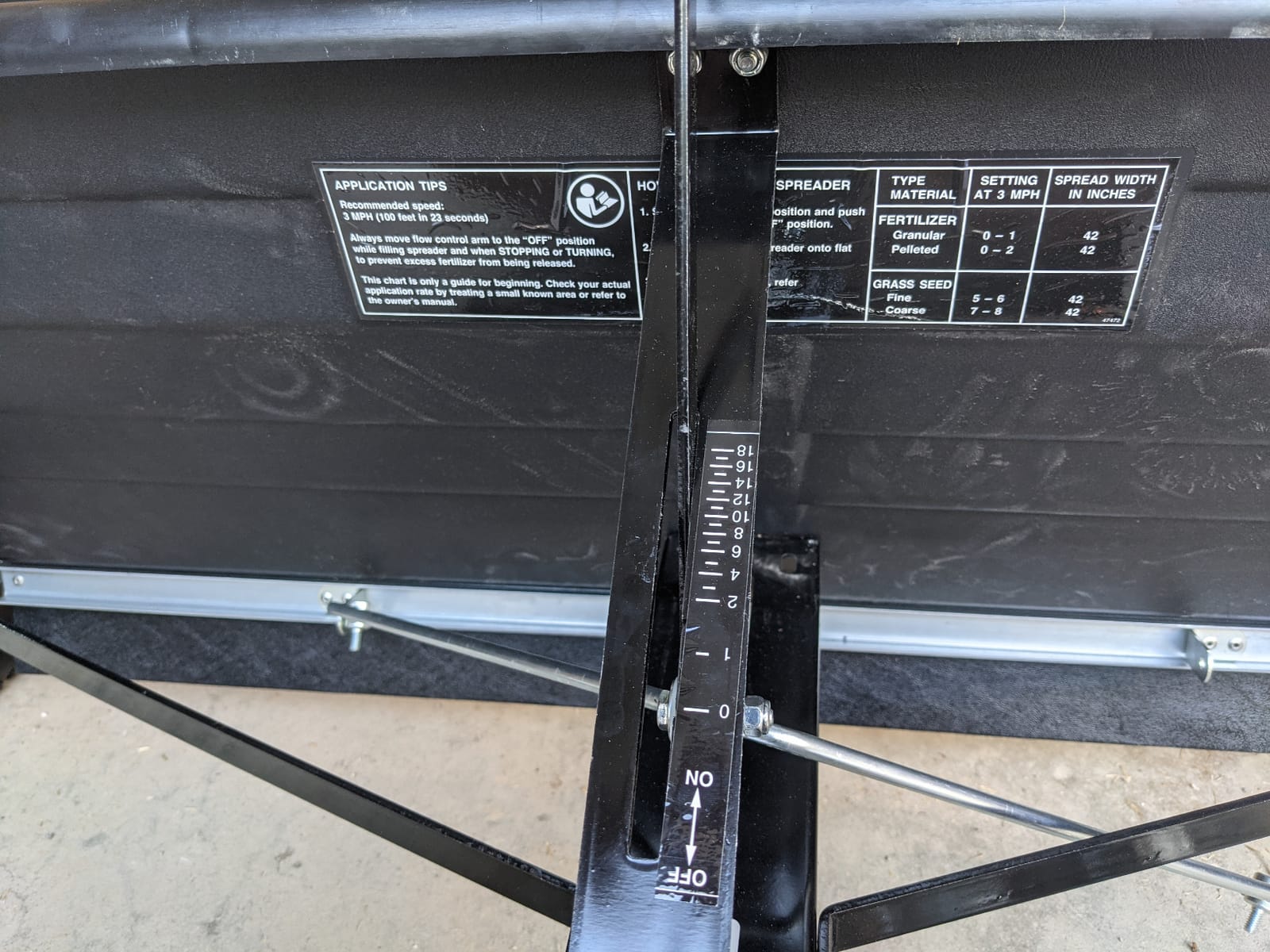
This is the drop spreader in the group, and it works on a completely different principle from everything above. Instead of a spinning disc flinging granules in an arc, a drop spreader lets material fall straight down through calibrated ports into a narrow band. The Agri-Fab 45-0288 puts that band down in a controlled 42 in width.
That precision is why drop spreaders exist. Material lands where you point it and nowhere else, which is exactly what you need along a driveway, beside a mulch bed, or on a slope where broadcast throw would run off into the bed or the water feature.
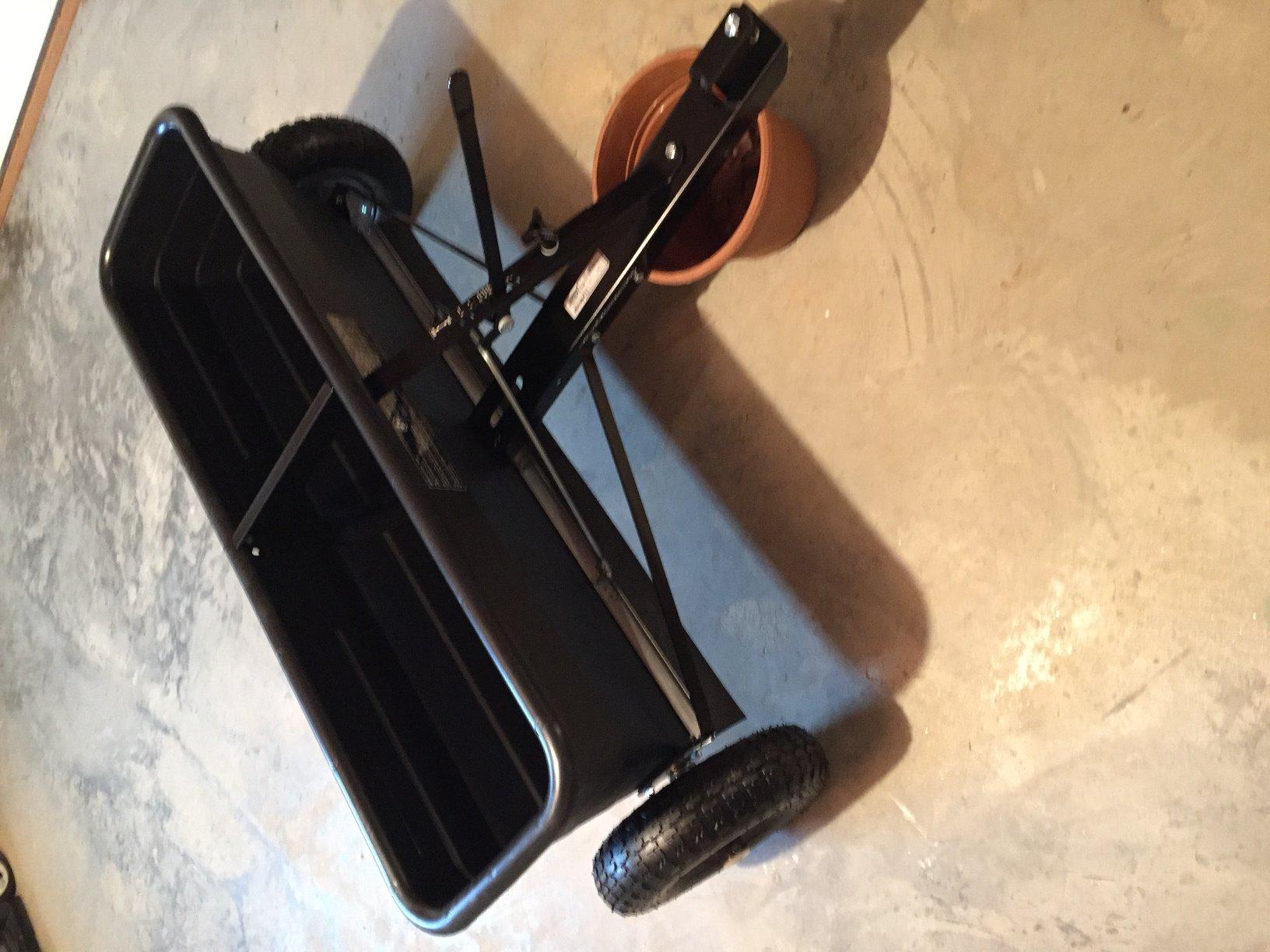
The 17-gallon hopper holds up to 175 lb, which is the largest capacity in this roundup, and covers roughly 40,000 sq ft or up to an acre per fill. The alloy steel frame and rustproof poly hopper are built for permanent outdoor service, and the adjustable on/off control lets you stop the flow precisely at the end of a pass.
Owners also note that the gravity feed is more forgiving on sloped ground than a rotary broadcast, because the material is not being thrown outward from a spinning disc. On uneven acreage that is a meaningful advantage.
What a 42 in drop width costs you in time
Precision has a price, and for a drop spreader the price is passes. A 42 in band against a 12 ft broadcast means covering the same lawn takes roughly three times as many passes. On a full acre with a tow-behind rig that is still a reasonable afternoon, but it is a real difference in how you plan the job.
The approach experienced users take is a hybrid. Broadcast the open field with a rotary spreader, then come back with the drop spreader for edges, trails, and anything close to mulch beds or a water feature. That gets you both the speed of broadcast coverage and the control of drop application without trying to make one machine do both jobs.
When a drop spreader is the wrong tool
Do not buy this as your only spreader for a large lawn. The time cost over an acre or more is significant, and the reason is simple: a narrow band cannot cover a large open field efficiently. If your property is mostly open turf with a short perimeter, a broadcast model serves you far better.
Storage is worth factoring in too. At 50.5 lb empty and 50 inches wide, this is the most awkward unit here to keep in a residential garage. If you are tight on space, measure first.
8. EarthWay 2150 Commercial Spreader for Damp Conditions
EarthWay 2150 Commercial 50 LB Broadcast Fertilizer Spreader. Heavy-Duty Walk-Behind Push Garden Seeder with Adjustable Drop Rate and Driving Handle. Large 13 inch Pneumatic Stud Tires
50 lb hopper
13 in stud tires
Enclosed gearbox
3-hole drop system
Pros
- Fully enclosed gearbox keeps working in damp conditions
- Slide-in grate breaks up caked fertilizer
- 13 in stud tires glide over uneven ground
- Handle adjusts to multiple lengths
Cons
- Written instructions are poorly laid out
- Calibration takes practice without printed rate charts
- Commercial throw is hard to control on small lawns
- Side-spread lever and hopper cover sold separately
The EarthWay 2150 is the odd one out in this roundup at only 50 lb, and we included it on purpose. It is a commercial-grade machine, and what makes it last is the fully enclosed gearbox rated for damp conditions, which is the component that ends the life of most consumer spreaders.
Long-term owners describe it as a machine that outlasts cheaper consumer units, with even distribution, solid handling on hills, and a 3-hole drop system with side-spread control that produces a feathered edge instead of a hard line where passes meet.
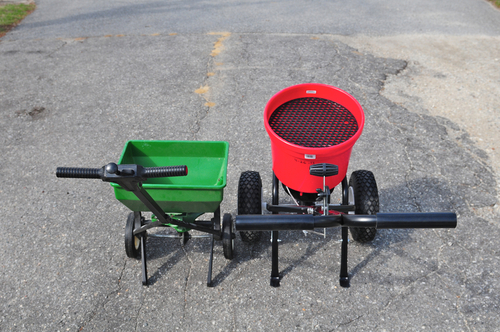
The slide-in hopper grate is the other piece of that longevity story. It sits above the ports and breaks up caked fertilizer before it can reach them, which is the direct answer to the clogging complaints that show up on almost every other model here. The 13 in high-flotation pneumatic stud tires on rustproof poly rims glide over uneven ground and push uphill without fighting.
The adjustable-length handle is a genuine comfort feature. Multiple length settings let a taller operator walk upright rather than stooped, and with 25 lb empty weight this is a machine you can work all day with.
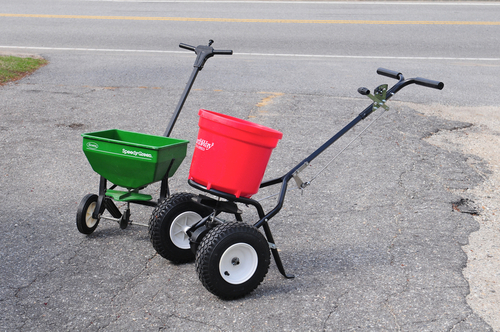
Why the gearbox enclosure outlasts everything else
Corrosion inside the gear housing is the leading cause of failure in this category. Fertilizer dust is hygroscopic, meaning it pulls moisture out of the air, and combined with any water that gets past the shaft seals you end up with a gearbox that seizes. A fully enclosed housing keeps that material out entirely, which is why this unit keeps working in conditions that ruin open-gearbox spreaders.
That said, a smaller hopper works against you on a genuinely large lawn. Fifty pounds means more refills, and the commercial-width throw is awkward to control on a small or irregular property. This machine earns its place when reliability over a decade matters more than speed this season.
Working around the assembly documentation
The dominant complaint is the written instructions. Owners report one to two and a half hours of assembly and strongly recommend skipping the paper manual in favor of a video walkthrough. That is a solvable problem, but plan for it. It is the most common reason owners rate a machine lower than it performs.
One more thing to know: fertilizer manufacturers typically do not print EarthWay spreader settings, so calibration takes practice to dial in. Budget a few test passes with a catch pan and a scale, and mark the setting on the frame once you find it. Also note the side-spread control lever and hopper cover are separate purchases.
9. Field Tuff 80 lb ATV Spreader for Utility Tractors
Field Tuff 12V 80 Pound Capacity Grass Seed Fertilizer Spreader with Hitch Mount Receiver and Rain Protector for ATV, UTV, or Utility Tractor
80 lb capacity
6 ft spread
Fits 1.25 in or 2 in receiver
12V motor
Pros
- Covers a large volume quickly
- Fits both 1.25 in and 2 in receivers
- Includes a rain cover
- Seat-reachable flow controls
Cons
- Gate cable stretches so the valve will not close fully
- Power leads are short for front-mounted batteries
- Motor failures after a few seasons
- Difficult assembly with small diagrams
The Field Tuff 80 lb takes a different approach to the ATV category by mounting to a receiver hitch rather than a utility rack. It fits both 1.25 inch and 2 inch receivers, which covers ATVs, UTVs and utility tractors, and that broader compatibility is the main reason to consider it over a rack-mounted unit.
It holds up to 80 lb, or about 8 gallons of seed or fertilizer, driven by a 12V DC motor rated at 570 RPM. The broadcast width is 6 ft, narrower than the 30 ft ATV units, which makes it a better fit for defined areas like food plots, paths, and a pasture section than for a huge open field.
What owners consistently like is the throughput and the control placement. The flow controls are reachable from the operator seat while driving, so you can open and close the gate without stopping, and at 20 lb empty the unit adds very little weight to a receiver-mounted setup.
Several owners report covering several acres per season with it, and the included rain cover keeps seed from spilling when you cross uneven ground.
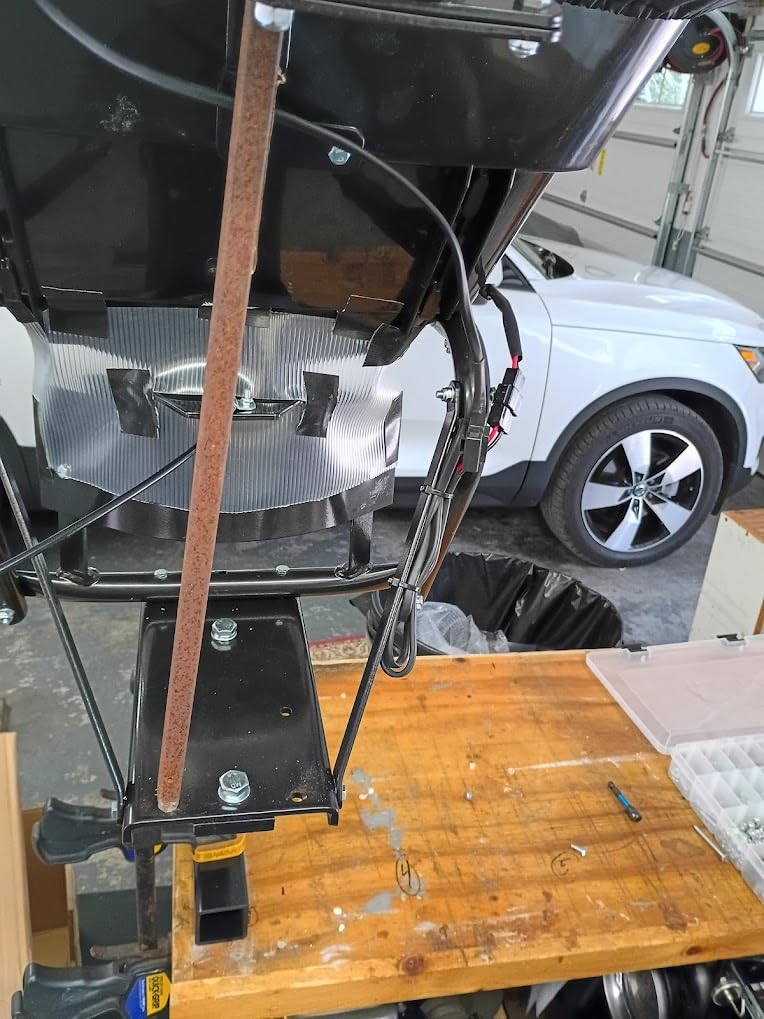
Checking the power connection before you buy
The wiring is the practical constraint. The power leads are short enough for a rear-mounted battery but not for front-mounted ATV batteries without splicing, and that is a recurring theme in reviews. Measure the run from your power source to the mounting position before ordering so you know whether you need an extension.
Receiver fit is the other check. Confirm your hitch class matches, and confirm the receiver is rated for the loaded weight, because 80 lb of material plus the unit approaches 100 lb on a tongue that may not be built for it.
Long-term durability is the open question
Two components drive the complaints in long-term reviews. The gate cable stretches over time until the valve no longer closes fully, and the 12V motor itself can fail after a few seasons of use. Both are repairable, but neither is a sealed design, which is where the EarthWay and the Agri-Fab units have an advantage.
Assembly is also cited as difficult and time-consuming, with small, hard-to-read diagrams. If you are comfortable with wiring and a socket wrench, this is fine. If not, expect to spend an hour on the instructions alone.
10. Buyers Products ATVS15A ATV Spreader for Food Plots and Pasture
Buyers Products ATVS15A ATV 12V Broadcast Spreader 15 Gallon Hopper
15 gallon poly hopper
5-30 ft adjustable spread
12V motor
Utility rack mount
Pros
- Spread width adjusts from 5 to 30 ft
- Heavy poly hopper with built-in funnel will not rust
- Handles full 50 lb fertilizer bags
- Mounts and removes from a standard utility rack in minutes
Cons
- Gate control is the most common complaint and needs modification
- No agitator so damp material can stall
- Loose rain cover can blow off at speed
- Bracket can tilt forward under load without a brace
The Buyers ATVS15A is the most adjustable of the ATV-mounted options here, with a spread width that runs from 5 to 30 ft. That range lets you cover a wide path in one pass or narrow down to a tight band along an edge, which is unusual for a machine in this class and useful on mixed terrain.
The 15-gallon poly hopper weighs 39 lb empty, heavier than the other rack-mounted units here, and that mass is tied to a built-in funnel designed to keep material moving. The hopper is rustproof by construction, and it handles full 50 lb fertilizer bags without complaint.
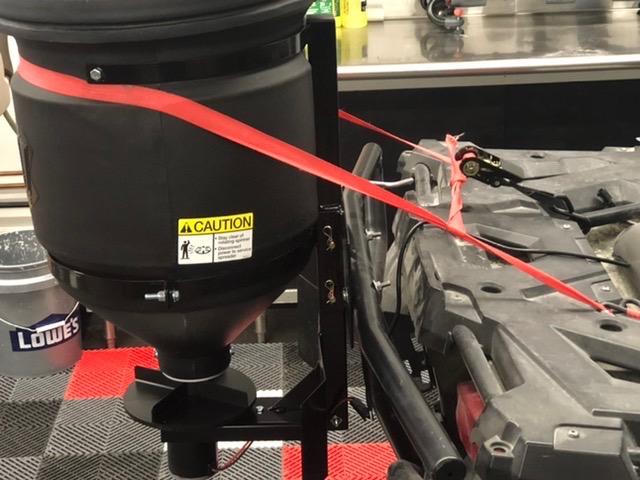
Owners treat this as a workhorse. Reviews mention seeding two acres of pasture with it, and the mounting and removal from a standard ATV utility rack takes minutes rather than a project, which matters if you are switching between spreading and hauling through the season.
The 12V electric motor provides consistent broadcast performance across the adjustable width, which is the part that keeps a variable-width machine from becoming frustrating in practice.
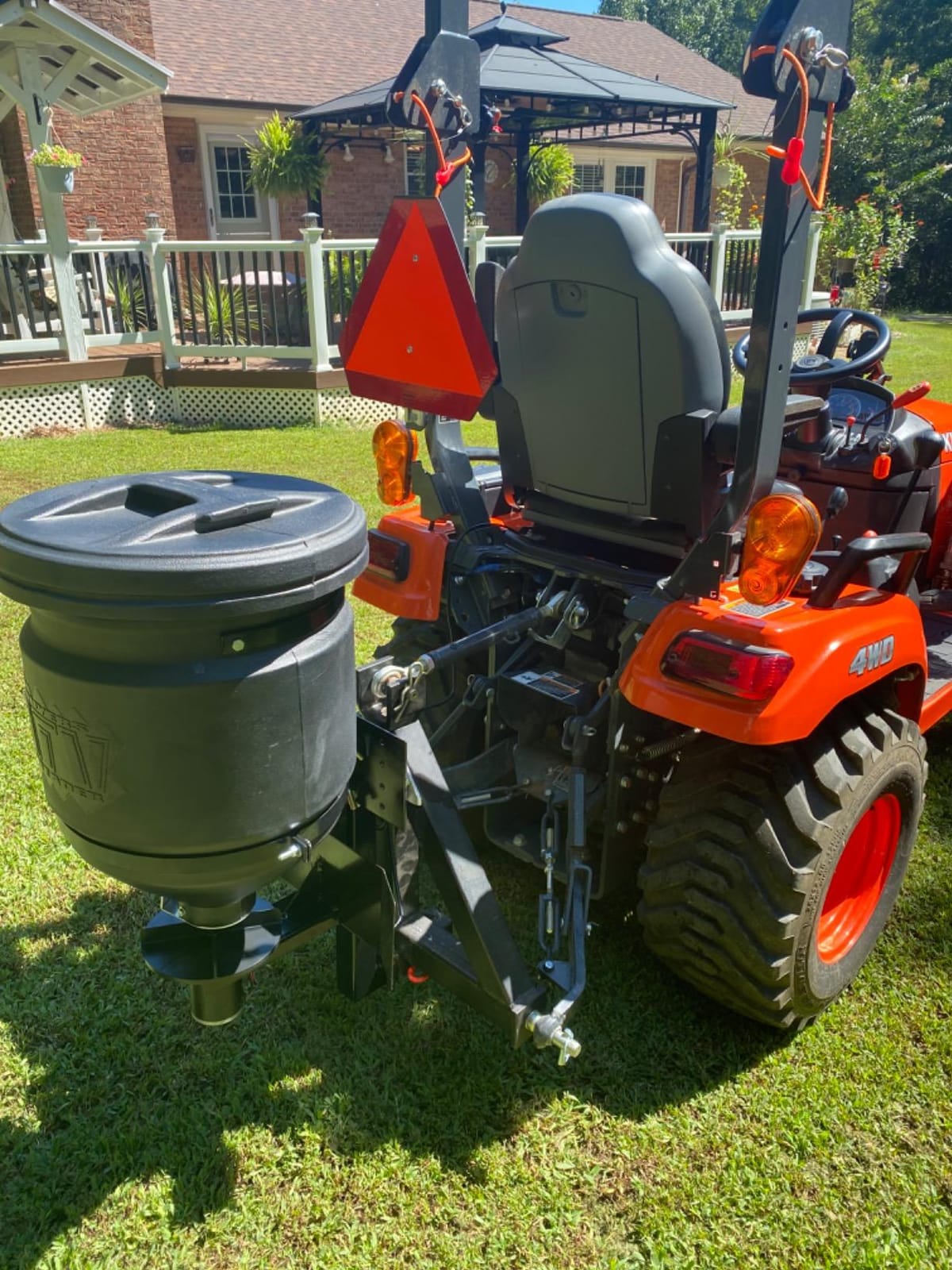
Fixing the gate before the first large pass
Almost every detailed review touches the gate mechanism, and several buyers adjusted or fabricated a fix to make it work reliably. This is the component to inspect first after assembly, before you trust it with a full hopper on a large property. A gate that does not close cleanly wastes product and stripes the lawn.
The missing agitator is the second issue worth planning around. With no agitator in the hopper, damp or clumped material can stall the flow and sit in the bottom. Keep fertilizer dry and sealed, and empty the hopper at the end of each session rather than leaving a partial load overnight.
Knowing who should skip this one
The bracket can tilt forward under a full load without an added brace, and the included rain cover fits loosely enough to blow off at speed. Both are fixable, but if you are not comfortable adding a brace or a bungee, choose a rack-mounted unit with a tighter fit.
It is also the wrong choice for a walk-behind operator. This unit requires an ATV or UTV with a utility rack, and nothing about the design works from behind a mower. Customer service responsiveness is also described as inconsistent, so test the unit early in the season rather than the week before you need it.
How to Choose a Fertilizer Spreader for a Large Lawn
Most spreader buying mistakes come down to three questions asked in the wrong order: how much do I want to spend, what brand looks good, and then how big is my lawn. Flip the order. Measure the lawn, work out how you move across it, look at the terrain, and only then decide on a machine.
Match hopper capacity to lawn size. Here is the tier breakdown we use, and it lines up with what we saw across the ten products above. Under 5,000 sq ft needs very little and most consumer spreaders handle it. Between 5,000 sq ft and a half acre, an 80 lb hopper is the sweet spot. Between a half acre and two acres, you want 100 to 130 lb or a tow-behind. Past two acres, tow-behind or ATV mounting is worth the trade because refills and pushing effort become the limiting factor rather than the spread itself.
Decide how the unit moves before anything else. If you own a riding mower or lawn tractor, a tow-behind spreader with a universal hitch removes the physical work entirely. If you ride an ATV, UTV or utility tractor, a rack-mount or receiver-mount 12V spreader puts you in the seat and lets you cover acreage at speed. If you mow with a walk-behind, a 100 or 130 lb push spreader is your ceiling, and you should buy the largest hopper you can comfortably steer.
Check the terrain and the tire specification. This is where a lot of large-lawn buyers go wrong. Pneumatic tires of 13 in or larger flex over ruts and soft spots and keep the spread pattern consistent on slopes. Smaller 10 in pneumatic tires work on maintained turf and get vague on rough ground. Solid plastic wheels are noticeably worse, and a pattern that varies with the ground produces visible striping no matter how well calibrated the unit is.
Understand broadcast versus drop. A broadcast spreader uses a rotating impeller to throw granules in an arc, giving wide coverage of open turf. A drop spreader uses gravity ports to lay a narrow controlled band, giving precision at edges. For a large lawn, broadcast does the field and drop does the perimeter, and experienced users on lawn forums describe exactly that hybrid as their standard workflow. If you own a riding mower, a 42 in tow-behind drop spreader is a natural companion to a broadcast unit rather than a replacement for it.
Look at the mechanism that actually breaks. In our experience reading long-term owner reports, the weak points are consistent across brands. Plastic gears inside an open gearbox corrode and seize. A small or missing hopper agitator stalls on damp material. A cable-operated gate stretches until it will not close. An open metal hopper rusts from residual fertilizer if it is stored damp. A sealed gearbox, a direct rod gate control, and a slide-in grate are all signs of a machine built for years rather than seasons.
Read the warranty in full, including the commercial clause. Three years for home use and 90 days for commercial use is a common structure, and it tells you how the manufacturer expects the machine to be used. If you are maintaining multiple large sites, a five-year commercial warranty is worth paying up for.
How to calibrate a broadcast spreader in five steps
Calibration is where most lawn damage happens, and it is also the step most owners skip. Fertilizer burn, dark green stripes, and bare patches all trace back to an application rate that was never verified. The process is simple and takes about 15 minutes.
Start with a small catch pan or a piece of flat cardboard about 4 feet square, weighed before you start. Run the spreader over the pan at your normal walking pace with the rate dial set to the manufacturer recommendation for your material. Weigh the catch again and subtract the original weight to get the actual amount applied.
Compare that figure to the label rate. Divide your target pounds per thousand square feet by the catch weight and you get a multiplier, then move the dial up or down proportionally. Repeat once. When the catch weight matches, write the setting on the frame with a paint pen so you never have to guess again.
Test each new material separately, because granule size and density change the flow. A starter fertilizer, a slow-release granule, and a top-dress compost layer will not run at the same setting even on the same spreader. Owners on professional forums are candid that striping usually comes from technique rather than the machine: start and stop points, overlap width, and walking speed all shift the rate.
Finally, always close the gate at the end of a pass and take two steps before turning. Most dark stripes and wasted product happen in the turn, not in the run.
Building a seasonal calendar around a large property
A large lawn rarely needs one big fertilizing day. Spreading everything at once concentrates work, product and risk into a single afternoon. Breaking it into a few passes across the year is easier on the machine, easier on the lawn, and much easier on you.
Overseeding in early autumn is the heaviest single job on most large properties because seed is lighter and more expensive per pound than fertilizer. This is where a wide broadcast throw pays for itself fastest, and where a 130 lb hopper avoids an afternoon of refilling.
Ice melt in winter is the other demanding season, and it is where the tow-behind models earn their keep. A 175 lb hopper of rock salt covers more ground per load than anything else you will run all year, and the drop-behind control matters more than usual when you are working near a driveway you need to keep clear.
Between seasons, treat the spreader itself as equipment that needs attention. A clean, dry, gated-down machine in October survives to the next spring without a single repair, while one that is rinsed, dried, and stored with the gate open usually does.
Preventing clogs, streaks and off-season damage
Keep material dry. Damp fertilizer cakes at the ports, and a gate that stalls mid-lawn means a stripe you cannot fix without starting over. Store bags sealed and off the ground, and empty the hopper at the end of every session.
Rinse after salt and ice melt. Both are corrosive, and residue left in a hopper over the winter attacks metal fasteners and bearings. Do it every time, not once a year.
Wash and fully dry before storage. A clean, dry hopper stored open in a shed will outlast the same hopper stored damp and sealed. The detachable hoppers on the two VEVOR push models make this genuinely easy, and it is a reason to favor them if you store in a humid climate.
Check tire pressure periodically on pneumatic models. Low pressure causes the spreader to drag, and dragging changes the disc speed, which changes the rate without you touching the dial.
Check hitch hardware on tow-behind units at the start of each season. This is a small ten-minute task, and it is the difference between a spreader that lasts and one that ends up in a ditch.
Calculating pounds needed per fill
Coverage math takes thirty seconds and prevents the most common complaint about a large spreader, which is refilling too often. Multiply your lawn area by the label rate in pounds per thousand square feet, then divide by 1,000. That gives you total pounds needed. Compare that to the hopper capacity and you immediately know how many loads to expect.
On a half acre, or 25,000 sq ft, at a typical starter rate that comes to roughly 125 lb of material, which means a 130 lb hopper covers it in one fill. A 50 lb commercial spreader needs three. On two acres you would need roughly 250 lb, so no single fill covers it and a 175 lb drop hopper gets you to two loads. Working the numbers before you buy is the fastest way to see whether the capacity you are paying for actually fits.
Frequently Asked Questions
Which is better, a broadcast or drop spreader?
A broadcast spreader is better for covering large open areas of lawn quickly, because a rotating impeller throws granules 10 to 30 ft in an arc. A drop spreader is better along edges, near mulch beds, beside driveways and on slopes, because gravity ports lay a narrow controlled band. For a large lawn, experienced users typically broadcast the open field and use a drop spreader for the perimeter.
What size hopper spreader do I need for 2 acres?
For 2 acres, a 130 lb to 175 lb hopper is the practical range. Two acres is 87,000 sq ft, and at typical fertilizer rates that works out to several hundred pounds of material per application. A 130 lb push or tow-behind hopper needs multiple fills, and a tow-behind drop spreader with a 175 lb hopper gets you down to fewer loads. If you mow with a riding mower, a tow-behind is the clear choice.
Are drop spreaders better than broadcast spreaders?
No. Each is better at a different job. Broadcast spreaders cover open turf faster and more evenly at distance, which makes them the right tool for the majority of a large lawn. Drop spreaders place material exactly where you aim it, which makes them better for edges, slopes, water features and seeded beds. The most efficient approach on a large property is to use both.
What are the disadvantages of using a drop spreader?
The main disadvantage is time. A 42 in drop width takes roughly three times as many passes as a 12 ft broadcast width to cover the same area. Drop spreaders also cannot handle windy conditions well, they leave visible tramlines on large open areas, and some models are awkward to store. They are a precision tool, not a coverage tool.
Is a fertilizer spreader worth it?
For anyone with more than about 5,000 sq ft who fertilizes or seeds more than twice a year, yes. Hand-spreading wastes product, misses patches, and causes uneven dosing that can burn the lawn. A spreader with a large hopper and a calibrated rate delivers the same measured amount to every square inch, which cuts waste, cost and runoff into storm drains.
Why does my fertilizer spreader keep clogging?
The usual cause is damp or caked material bridging at the ports. Keep fertilizer dry and sealed, and empty the hopper at the end of every session rather than leaving a partial load overnight. A spreader with a slide-in hopper grate, such as the EarthWay 2150, breaks up caked material before it reaches the ports. Agitator-equipped models also help with heavier materials like damp sand or salt.
Conclusion: The Best Fertilizer Spreaders for Large Lawns in 2026
If you own a riding mower, the Agri-Fab 45-0463 tow-behind is the pick: 130 lb hopper, a half acre per fill, 10-12 ft spread, and a universal hitch with more than 3,400 reviews behind it. If you want the highest-rated walk-behind in the group, the Agri-Fab 45-0462 uses direct rod control that holds its calibration better than cable-operated designs.
If you ride an ATV or utility tractor instead, a 12V-mounted spreader changes the math entirely. The Buyers ATVS100 covers ground fastest with a 30 ft throw, and the Buyers ATVS15A offers the widest adjustment range for mixed terrain. Walking a large lawn with no tractor? The VEVOR 100 lb is the value balance, and the VEVOR 130 lb is the maximum capacity you can push.
Whichever route you take, calibrate before the first full pass, keep material dry, and rinse the hopper after salt. Those three habits do more for the life of the machine than any spec on the box. If you want the mechanism itself covered in more detail, our broadcast spreader guide goes deeper on how the impeller, ports and rate settings interact.