
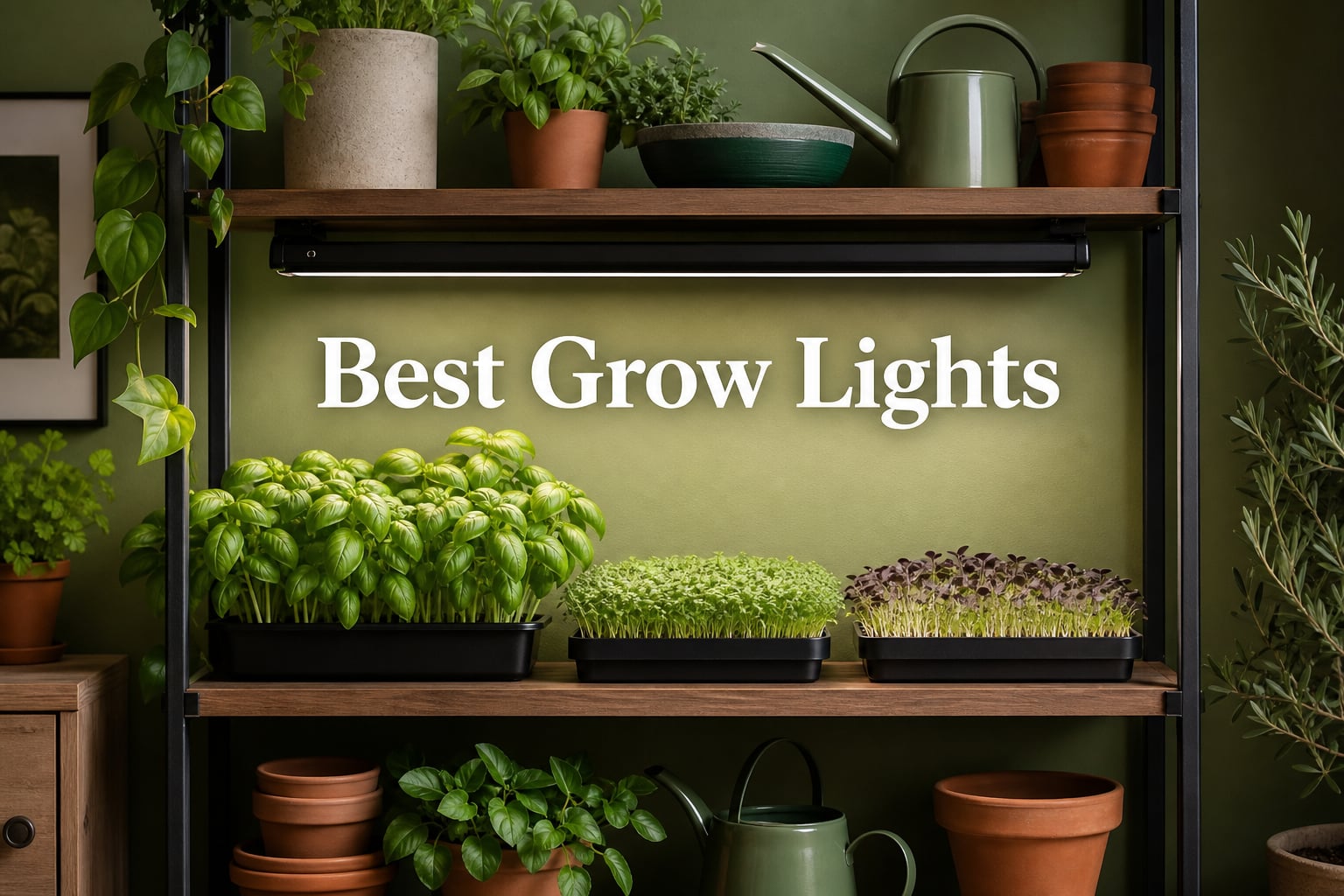
Finding the best grow lights starts with a simple question: are you brightening a few houseplants, filling a plant shelf, or raising seedlings and food crops in a dedicated space? Those jobs call for very different fixtures, and a bright-looking lamp alone does not tell us how evenly it covers the leaves.
For this guide, I compared nine verified LED fixtures by their stated wattage, spectrum, mounting style, control options, plant-stage claims, ratings, and review volume. The short answer is that the VIPARSPECTRA XS1500 Pro is the strongest fit for a controlled small grow area, the VIPARSPECTRA P700 makes sense for a 2 x 2 vegetative space, and Barrina T5 strips are a practical match for tight shelves.
Full-spectrum LED grow lights are the common thread here because they provide broad, sunlight-like output while drawing less power than older conventional options. Still, I would match the lamp to the space before looking at extras: a narrow strip works well over trays, while a hanging board belongs over a defined canopy.
One limitation matters before we begin: no product listing in this set supplies a verified PPFD map at a stated hanging height. I treat manufacturer coverage claims as starting points, then explain how to watch the plants and adjust height, duration, and dimming rather than pretending one setting suits every leaf.
The top 3 grow-light picks cover small tents, seedlings, and shelves in October 2026
Choose the XS1500 Pro for a more controlled full-cycle setup, the P700 for seedlings and vegetative growth in a stated 2 x 2 area, or the compact Barrina T5 pack when shelf placement and separate fixture control matter most.
The best grow lights in 2026
This overview puts every reviewed fixture in one place. It is a faster way to separate compact panels and strips from the more concentrated hanging lights before reading the details.
| Product | Specifications | Action |
|---|---|---|
 VIPARSPECTRA P700 VIPARSPECTRA P700 |
|
Check Latest Price |
 Barrina 4FT 6-Pack Barrina 4FT 6-Pack |
|
Check Latest Price |
 Barrina T5 1FT 4-Pack Barrina T5 1FT 4-Pack |
|
Check Latest Price |
 SDOVUERC 6 Bars SDOVUERC 6 Bars |
|
Check Latest Price |
 FREELICHT 4FT 2-Pack FREELICHT 4FT 2-Pack |
|
Check Latest Price |
 VIPARSPECTRA XS1500 Pro VIPARSPECTRA XS1500 Pro |
|
Check Latest Price |
 Sunco 2FT 4-Pack Sunco 2FT 4-Pack |
|
Check Latest Price |
 FECiDA Panel 4-Pack FECiDA Panel 4-Pack |
|
Check Latest Price |
 Vego Garden 2-Pack Vego Garden 2-Pack |
|
Check Latest Price |
1. VIPARSPECTRA P700 is the compact pick for seedlings and vegetative plants
70 Watt Grow Light, Dimmable Plant Light, LED Grow Lights for Indoor Plants
70W
11000 lumens
4-level dimmer
Pros
- Full spectrum
- 4-level dimmer
- Fanless aluminum cooling
- 3-year limited warranty
Cons
- Not smart compatible
- Corded power required
I would start with the P700 when the goal is a contained indoor garden rather than a long shelf. VIPARSPECTRA states that this 70-watt hanging LED is designed for a 2 x 2 foot vegetative area, which gives a useful planning boundary for herbs, young vegetables, and seedling trays.
Its 4.7 rating comes from more than 5k reviews, the largest review base among the hanging boards in this group. That does not replace measuring the light at leaf level, but it gives this compact model a deeper pool of customer feedback than many alternatives here.
The diode mix combines 660 nm red with 3000K and 5000K white LEDs, and the fixture has 216 light sources. I like that the built-in four-level dimmer lets a grower lower output for recently germinated plants instead of solving excessive intensity only by moving the fixture farther away.
The fanless aluminum heat-sink design avoids fan noise, while the listed 2.43-pound weight and hanging mount suit a rack or tent with a secure overhead point. It is not a smart-home device, so scheduling calls for a separate outlet timer if daily automation is wanted.
The P700 fits a 2 x 2 vegetative area
Use this shape where the canopy is roughly square and you can suspend the lamp above it. The brand describes it for seedling and vegetative growth, so it is a more natural fit for leaf-focused herbs and starts than a scattered collection of plants across a long room.
I would begin conservatively with its dimmer, then increase only when new growth remains compact and evenly colored. This approach addresses a frequent community concern: leaf bleaching from treating every plant like a high-light crop.
The P700 needs a timer and a secure hanging point
The package includes two stainless-steel hooks, but the actual mounting surface still needs to carry the 2.43-pound fixture safely. Keep cords out of watering paths and confirm the lamp is level before placing seedlings underneath.
Because there is no timer or smart control listed, a simple mechanical or digital outlet timer is the practical companion. It keeps the daily light period consistent without relying on memory.
2. Barrina 4FT 6-Pack is the broad-coverage pick for racks and greenhouse shelves
Barrina Plant Grow Lights, 4FT 5000K Full Spectrum Daylight White, 6 Packs
6 x 42W
5000K full spectrum
4-foot strips
Pros
- Six-fixture coverage
- V-shaped reflectors
- Linkable design
- 2-year warranty
Cons
- Assembly required
- Not water resistant
- Not smart compatible
I see the Barrina 4-foot six-pack as a coverage tool, not a single-plant spotlight. Six 42-watt fixtures can spread light down a rack, across propagation trays, or over a greenhouse bench where one central hanging board would leave the ends dim.
Its 4.7 rating from more than 1k reviews supports its place among the better-established strip systems. Grower conversations often praise Barrina-style track lights for shelf coverage, and this specific kit backs that approach with six bars, mounting clips, tape, and connecting cables.
The listed 5000K daylight-white full-spectrum output is intended for seeding, growth, and bloom. Barrina says the V-shaped reflector raises efficiency by 17 to 20 percent, and the aluminum housing is intended to move heat away from the LEDs.
Each fixture is listed at 2,100 lumens, while the entire six-fixture system consumes 252 watts. That makes placement and runtime especially relevant: cover the growing surface evenly, rather than directing all six strips at a small cluster of low-light houseplants.
The six-bar kit fits long shelves and many small plants
Choose it when uniform side-to-side coverage matters more than a single strong center point. I would space the bars across the shelf width and judge the outer plants as carefully as the plants directly below a fixture.
The system can link up to six lights in a series, which helps keep a rack orderly. Plan the cable route before using the included clips, tape, and cable ties.
The six-bar kit needs a dry, measured installation
The listing says assembly is required and the fixtures are not water resistant. A greenhouse or plant room can be humid, so I would keep connections away from spray, drips, and reservoir filling.
It also lacks smart-home compatibility, and the supplied controls are push-button based. An external timer can give an entire shelf a reliable daily cycle.
3. Barrina T5 1FT 4-Pack is the compact shelf pick with separate switches
Barrina T5 Grow Lights for Indoor Plants, 5000K Full Spectrum, 1FT, 4 Packs
20W total
5000K full spectrum
4 one-foot strips
Pros
- Separate fixture switches
- Linkable up to 16
- Low total draw
- 2-year warranty
Cons
- Assembly required
- Surface limits
- Not smart compatible
For a small propagation shelf or narrow cabinet, the Barrina T5 one-foot four-pack is one of the easiest shapes to place. The four fixtures together draw 20 watts and include 96 LEDs, making them a much different proposition from the P700 or XS1500 Pro boards.
This is the best grow light format in this guide for someone who wants to light individual shelf levels without a large hanging fixture. Its 4.6 rating is supported by nearly 7k reviews, and each fixture has its own on-off switch.
The 5000K white full-spectrum design aims to replace daylight for seedlings through flowering plants. Barrina states that the four-light set can link up to 16 lights in a series, so the system can grow with a shelf setup rather than forcing every planter under one lamp.
Installation hardware includes tape, clips, cable ties, power cords, and connecting cords. I would regard tape as a convenience aid, not a substitute for clips when the surface is dusty, greasy, rough, or uncured plaster; the listing specifically warns against those surfaces.
The T5 four-pack fits compact shelves and seed trays
Use the short bars where plants sit close to a shelf ceiling and a wide light footprint is not needed. Separately controlling each bar helps when one tray needs a longer day than another.
Because the output is distributed, this setup is better for an even row of starts than for a tall, light-hungry specimen plant. Taller plants can quickly outgrow the usable distance beneath a fixed shelf light.
The T5 four-pack needs dependable mounting surfaces
The non-magnetic strips need a clean, appropriate surface or the included clips. I would position every cord and connector before loading the shelf with pots, since retrofitting a crowded propagation station is frustrating.
No timer is listed, and this model is not smart compatible. Adding one outlet timer makes the separate physical switches far less of a daily task.
4. SDOVUERC 6 Bars is the timed shelf-light pick for flexible mounting
SDOVUERC 16” 6 Bars Grow Light Strips for Indoor Shelves Plants Growing.
36W
3600 lumens
6/12/18-hour timer
Pros
- Built-in daily timer
- Five dimming levels
- Three mounting methods
- Long power cord
Cons
- One-year warranty
- 12V adapter required
- Not smart compatible
SDOVUERC’s six-bar system is a useful middle ground between one-foot strips and a full rack kit. The six 16-inch bars draw 36 watts, produce a listed 3,600 lumens, and arrive with screws, double-sided tape, and lashing tape for different shelf or wall layouts.
Its defining feature is the built-in cyclic timer with 6-, 12-, and 18-hour choices. I prefer a lamp with this kind of control for busy homes because a consistent schedule matters more to plants than occasional very long sessions followed by forgotten days.
The LEDs include warm white, cool white, and 660 nm red, with a stated 380 to 800 nm output range. There are also five dimming levels, so a new seedling tray can begin at lower output while stronger herbs can receive more light as they settle in.
At 4.6 stars from 583 reviews, it has a smaller feedback base than the Barrina strips but still offers useful control features. The 95-inch power cord is another practical detail for a shelf that is not directly beside an outlet.
The SDOVUERC bars fit shelves that need a built-in schedule
Pick this design when an outlet timer would be awkward or when one shelf needs an independent routine. The six bars can be distributed across more than one level if the available light per plant remains adequate.
I would choose the 12-hour setting as a moderate starting routine for many foliage plants, then adjust duration and dimming from plant response. The 18-hour setting is not automatically better for every houseplant.
The SDOVUERC bars need dry adapter placement
The setup requires a 12-volt DC adapter, so the adapter and its connection should stay dry and accessible. Do not bury it behind wet pots, trays, or a reservoir where a leak could go unnoticed.
The one-year warranty is shorter than the two-, three-, and five-year coverage listed on several other choices. That is a fair trade-off to weigh against the timer and flexible installation options.
5. FREELICHT 4FT 2-Pack is the simple hanging pick for a long bench
FREELICHT 2Pack 4FT Grow Light for Indoor Plants, 40W=250W, Full Spectrum
40W
3500K spectrum
two 4-foot fixtures
Pros
- Long fixture format
- Linkable up to four
- Hanging or mounting options
- 2-year warranty
Cons
- Smaller review base
- Assembly may be needed
- Not smart compatible
The FREELICHT two-pack puts two long fixtures over a linear growing surface. With 40 watts of listed power, 168 LEDs, and a 3500K red-white spectrum, it is a straightforward option for a bench of herbs, flowers, or seedling trays.
I would look at this one when a four-foot span needs light but six separate strips feel like overkill. The fixtures measure 45.67 inches long and can be hung or mounted, allowing a more open setup than a shelf with a low fixed ceiling.
The maker describes the spectrum as sunlight-like for growth from seedlings through flowering, and says up to four lights can connect using the included on-off power cords. That expandability is helpful when a growing area develops in stages.
The 4.6 rating is based on 393 reviews, so it has less customer feedback than the larger Barrina kits. I would put more emphasis on its clearly stated long-form factor and two-year warranty than on assuming it suits every plant density.
The FREELICHT pair fits long, open growing surfaces
Two 4-foot bars make sense above a bench, windowside setup, or a long row of trays where even lengthwise coverage is the main goal. Hanging height can be changed as seedlings become taller, which is an advantage over fixed under-shelf lighting.
For a small group of sun-loving culinary herbs, position plants across the usable length rather than bunching them under the center. A sparse, evenly spaced layout makes it easier to spot shaded edges.
The FREELICHT pair needs coverage checks at both ends
Long fixtures do not automatically produce equal intensity across a wide bench. I would rotate plants if edge growth lags and move the fixtures only after checking that the center is not already too bright.
The listing does not include smart control. A separate timer and a test run before adding plants will show whether one outlet can handle the linked configuration cleanly.
6. VIPARSPECTRA XS1500 Pro is the controlled full-cycle pick for a small tent
LED Grow Lights for Seed Starting Vegetables Bloom 150 Watt Full Spectrum
150W
3000K 5000K red IR
daisy chain up to 20
Pros
- Uniformity-focused lenses
- Full-cycle spectrum
- Daisy-chain dimming
- 3-year limited warranty
Cons
- Not smart compatible
- No Prime eligibility listed
The VIPARSPECTRA XS1500 Pro is the most purpose-built option here for a compact controlled growing area. It draws 150 watts and is described for a 3 x 3 foot vegetative area or a 2 x 2 foot flowering area, so it is a substantial step up from shelf bars.
I selected it as the editorial choice because its stated features speak directly to the issues that matter with a dense canopy: dimming, edge-to-edge uniformity, heat handling, and room to scale. Its 4.7 rating comes from 931 reviews.
Its spectrum includes 3000K and 5000K white LEDs, 660 nm red, and 730 nm infrared. The optical-lens design is intended to concentrate light with less loss and support more uniform PPFD at the corners, while the aluminum heat sink is part of its cooling design.
The fixture can daisy-chain up to 20 XS1500 Pro lights for unified dimming. That is more capability than most home growers need, but it becomes relevant for a dedicated tent, greenhouse area, or a carefully organized indoor food-growing project.
The XS1500 Pro fits a measured small grow tent
Use it where you can control hanging height, airflow, plant spacing, and daily duration. The listed area distinctions matter: vegetative coverage is broader than flowering coverage, so crop stage changes the practical footprint.
I would treat the dimmer as the first adjustment, then raise or lower the fixture in small steps. A high-output board can make plants look fine at the center while stressing the upper leaves if it is placed too close.
The XS1500 Pro needs more planning than a plug-in strip
At 150 watts, this is a fixture to plan around rather than attach casually beneath a light shelf. Confirm the hanging hardware, air movement, and electrical layout before planting a full canopy.
It is plug-and-play but not listed as smart-home compatible. A timer remains the simple way to give seedlings, leafy greens, and fruiting crops a stable schedule.
7. Sunco 2FT 4-Pack is the long-warranty pick for linked fixtures
Sunco 4 Pack 2FT LED Grow Light, Full Spectrum, 20W
80W total
full spectrum
four 2-foot fixtures
Pros
- Five-year warranty
- Linkable fixtures
- 50
- 000-hour stated life
- Mount or suspend
Cons
- Not dimmable
- Not smart compatible
- Smaller review base
Sunco’s kit supplies four 2-foot full-spectrum fixtures and lists 80 watts of total light-source wattage. I would put it on a short rack or a moderate-width indoor garden where two-foot modules make spacing easier than four-foot bars.
The five-year warranty is the standout data point. It is longer than every other stated warranty in this group, while the maker also gives the fixture a 50,000-hour lifespan claim and says the kit can link up to four fixtures.
These fixtures can mount directly or suspend from the ceiling, and mounting hardware plus a five-foot plug-in cord are included. That flexibility lets a grower preserve headroom for taller plants or mount lights closely above low trays.
The 4.6 rating comes from 167 reviews, which is a fairly small sample compared with the major Barrina and VIPARSPECTRA listings. I would view the warranty as a meaningful confidence factor while still matching the 2-foot dimensions to the actual shelf footprint.
The Sunco four-pack fits modular racks and flexible mounting
Select it when a two-foot light length matches the shelf or bench better than a one- or four-foot option. Linking up to four fixtures helps create one coordinated line instead of several unrelated lamps.
The full-spectrum claim covers seeding, vegetative growth, cloning, and flowering, but crop needs still vary. Leafy greens and seedlings can be set up differently from a mature fruiting plant even under the same fixture.
The Sunco four-pack does not offer dimming
Without a dimmer, hanging height and runtime become the main ways to moderate light. I would first set the fixture farther away and shorten the daily duration if leaves show bleaching or upward curling.
It is also not smart compatible. The included inline switch is convenient for manual use, while a plug-in timer handles repeatable daily operation.
8. FECiDA Panel 4-Pack is the under-cabinet pick with the widest timer choices
FECiDA High Output Flat Panel Grow Lights for Indoor Plants & Shelves
40W
4 to 20-hour timer
four linkable panels
Pros
- Five timer modes
- Series or parallel linking
- Full spectrum
- External driver
Cons
- One-year warranty
- Not smart compatible
- Smaller review base
FECiDA’s four-panel system is made for an under-cabinet or shelf arrangement. The kit lists 40 watts total, 1,200 lumens, and 192 LEDs per panel, so it is focused on distributing light across multiple small plant zones rather than lighting a tall tent.
I find the timer choices unusually flexible: 4, 8, 12, 16, and 20 hours. A 4-hour setting can supplement a bright window, while 12 hours is a reasonable starting point for many indoor plant lights in a dim room.
The panels connect by series or parallel using one home socket, and the external-driver design is intended to support longevity. This is a neat fit for a kitchen herb shelf where cable management and repeatable schedules may matter as much as raw output.
Its 4.5 rating from 258 reviews is positive but lower in both rating and review volume than the leading choices. The product also has a 12-month warranty, so I would choose it for its particular timer and panel layout, not merely for a general-purpose grow room.
The FECiDA panels fit cabinets and small herb stations
Install the panels across the underside of a shelf to limit shadows on a row of basil, greens, or starter plants. The link options make it possible to tailor the layout to a cabinet width rather than leaving unused bright spots.
I would begin with the shortest useful schedule for plants that already receive window light. Supplemental light should fill the day, not turn a shaded plant into a twenty-hour experiment without watching its response.
The FECiDA panels need a realistic timer setting
More runtime is not a substitute for distance or intensity. If a plant stretches, improve the light position or coverage before simply extending a 20-hour cycle.
All four panels need orderly cord routing, particularly under cabinets used for food preparation or watering. Keep the external driver dry and leave access to the timer controls.
9. Vego Garden 2-Pack is the tailored-mode pick for home and office displays
Vego Garden Grow Lights for Indoor Plants, Full Spectrum LED Grow Light with Customized 5 Modes for Seed Starting, Leafy, Herbs, Fruits & Microgreens, 2 Packs
2 panels
5 plant modes
full spectrum
Pros
- Five customized modes
- Full spectrum
- Sleek format
- Wall-mount compatible
Cons
- Limited technical specs
- Low review volume
- Not smart compatible
Vego Garden’s two-pack takes a more plant-category-focused approach. It offers five customized modes for seed starting, leafy plants, herbs, fruits, and microgreens, which may feel more approachable than choosing intensity from a bare dimmer.
I would consider this format for a visible home office, kitchen, or indoor garden where fixture appearance matters alongside plant care. The two cream-white fixtures are listed as 14.7 inches long, 3.6 inches wide, and 1.1 inches high, with wall-mount compatibility.
Full-spectrum output is the central plant feature, but the listing provides fewer technical details than the higher-ranked board and strip systems. It does not state wattage, voltage, lumens, PPFD, or a defined coverage area, which limits precision when planning a dense crop.
The 4.5 rating is based on 33 reviews, the lowest review volume in this guide. I would regard its dedicated modes and sleek presentation as its main appeal, while giving more weight to plant observation because the numerical specifications are limited.
The Vego Garden pair fits curated herb and microgreen displays
Its named modes give a clear starting point for someone growing a small, mixed assortment. The herb and microgreen settings are especially relevant for an indoor food station where the crop changes often.
Wall-mount compatibility can keep a counter or desk clear, but the mount location should still let you adjust the distance as plants gain height. Decorative placement cannot come ahead of leaf-level light.
The Vego Garden pair needs closer plant monitoring
Without published power, intensity, or coverage figures in the product data, I would not assume the settings equal a particular PPFD. Start with a modest distance, look for even growth, and change one variable at a time.
The lower review count and limited technical details make it less suitable for a grower who wants tightly specified tent planning. It makes more sense for a small, design-conscious setup with a willingness to observe and adjust.
The right grow light depends on intensity, coverage, timing, and plant response
I use four questions to narrow the list: how much growing surface needs light, how far can the fixture sit above leaves, what stage are the plants in, and who will keep the schedule consistent? The answers matter more than choosing the fixture with the biggest wattage number.
PPFD is the leaf-level light measurement that matters most
PPFD means photosynthetic photon flux density: the number of photosynthesis-useful photons reaching one square meter each second. It is normally written as micromoles per square meter per second, or µmol/m²/s, and it is more useful for plants than room brightness in lumens.
Lumens describe how bright light looks to human eyes. A grow lamp can look intensely bright yet spread that light too widely, while a focused board can deliver more plant-usable intensity to a small canopy.
No reviewed listing provides a complete verified PPFD map, so I would not invent target readings for these models. If you own a meter, measure at canopy level and compare center, edges, and corners; if not, use new growth and leaf condition as your practical feedback.
Full spectrum is the simplest choice for mixed indoor plants
Full spectrum usually combines white light with wavelengths such as red, creating a more sunlight-like output for human viewing and plant growth. Every reviewed light is described as full spectrum or as a white-and-red plant spectrum.
Older blurple lights emphasize blue and red and can work for plant growth, but their colored appearance makes it harder to inspect leaf color and they are less pleasant in a living space. For houseplants, herbs, seedlings, and mixed shelves, I would generally start with full-spectrum LED plant lights.
Runtime should match plant type rather than stay on all day
Most indoor foliage plants, herbs, and seedlings do well with a predictable light-and-dark rhythm. Start with about 10 to 12 hours of supplemental light for many houseplants and herbs, then adjust for available daylight, crop type, and fixture intensity.
Seedlings and leafy greens often work well with a consistent 12- to 16-hour routine when natural light is limited.
Houseplants near a bright window may need only several supplemental hours, not a full artificial day.
Fruit-producing crops may need more total light than foliage plants, so coverage and intensity need attention along with longer duration.
Plants also need a dark period. I would avoid running a grow lamp continuously, because a timer-led routine is easier to repeat and gives you a clearer picture of what changed when plant health shifts.
Hanging height should change gradually with intensity and growth
There is no universal distance because fixture power, beam spread, dimming, and plant tolerance differ. Start farther away with a high-output board, especially over seedlings, and move closer in small increments only if plants stretch or growth is weak.
Bleached patches, pale upper leaves, dry edges, and upward curling can indicate too much light or heat. Long gaps between leaves, leaning toward the lamp, and slow, pale new growth can signal too little light, though watering and nutrition can create similar symptoms.
Community discussions repeatedly raise coverage and hanging height as trouble spots. I would change one thing at a time: first dimmer level or height, then duration, while leaving the rest of the care routine steady for a few days.
Coverage should be planned from the plant canopy outward
Measure the shelf, tray, or tent before selecting a fixture. A 2 x 2 board such as the P700 suits a defined square canopy, while Barrina strips, Sunco modules, and panel systems make more sense when plants are arranged in a long row.
Do not judge coverage by the bright circle on the floor. Place plants at their final leaf height and check whether the edge plants receive meaningfully less light than those under the center.
For indoor food growing, give herbs and leafy greens their own evenly lit section rather than mixing them behind tall houseplants. A compact shelf configuration is often easier to manage than trying to light a deep room from one corner.
Energy use can be estimated from wattage and daily hours
Use this simple calculation: watts ÷ 1,000 × hours per day = kilowatt-hours per day. For example, a 70-watt P700 used for 12 hours consumes 0.84 kilowatt-hours per day; multiply that by your local electricity rate to find the daily operating cost.
The same math makes system size visible. A 252-watt six-bar rack used for 12 hours consumes 3.024 kilowatt-hours in a day, while a 20-watt Barrina T5 four-pack used for 12 hours consumes 0.24 kilowatt-hours.
LEDs are efficient, but more fixtures and longer schedules still add energy use. I would buy the coverage needed for the actual plants, then use timers and dimmers to avoid wasting light on empty shelf space.
Setup safety begins with dry connections and airflow
Keep adapters, plugs, and power strips away from watering zones, and make drip loops in cords so water cannot run toward an outlet. The Barrina 4-foot kit is specifically listed as not water resistant, but dry electrical placement is sensible for every indoor grow lamp.
Allow the fixtures to release heat and do not sandwich drivers beneath pots or fabric. A fanless fixture may be quiet, yet it still needs open air around its heat sink.
Before trusting a timer, watch one complete on-off cycle. I also label linked cords on a multi-shelf garden, because that makes it much easier to identify the fixture responsible if a level goes dark.
FAQs
What is the best grow light for indoor houseplants?
The best fit depends on the space. A compact strip or panel system suits a shelf of houseplants, while a dimmable hanging board such as the VIPARSPECTRA P700 suits a defined small canopy. Choose a full-spectrum LED, match its footprint to the plants, and use a timer.
Which houseplants do well under grow lights?
Many houseplants can grow under a correctly placed full-spectrum LED, including pothos, philodendron, hoya, peperomia, succulents, orchids, African violets, and herbs. Light-demanding plants generally need a stronger or closer fixture than tolerant foliage plants. Watch new growth and leaf color, then adjust gradually.
What are the drawbacks of using grow lights for indoor plants?
Grow lights need space, mounting or shelf planning, safe cord management, and a repeatable schedule. Light that is too intense or too close can bleach leaves, while weak coverage can leave edge plants stretched. Fixtures also use electricity and can add heat, so choose the right size instead of over-lighting a small area.
Do grow lights run up your electric bill?
They use electricity, and the effect depends on wattage and hours of use. Divide watts by 1,000 and multiply by daily hours to find daily kilowatt-hours, then multiply by your electricity rate. A 70-watt lamp run for 12 hours uses 0.84 kilowatt-hours per day.
How many hours a day should you have your grow lights on?
Start with about 10 to 12 hours for many houseplants and herbs, then adjust for daylight and plant type. Seedlings and leafy greens often use 12 to 16 hours when natural light is limited. Give plants a daily dark period instead of leaving the lamp on continuously.
Is 10,000 lumens too bright for seedlings?
Lumens alone cannot answer that because they measure light for human vision, not the intensity reaching the seedling leaves. Fixture distance, beam spread, runtime, and dimming all matter. Start a strong fixture farther away or dimmed, then watch for bleaching, curling, stretching, and healthy compact new growth.
The best grow lights are the ones that fit your plants and space
For a controlled 2 x 2 or 3 x 3 growing area, I would begin with the VIPARSPECTRA XS1500 Pro; for seedlings and vegetative plants in a 2 x 2 footprint, the P700 is the simpler choice. For shelves, choose the Barrina T5, SDOVUERC bars, FECiDA panels, or longer Barrina, FREELICHT, and Sunco fixtures by the shape you need to cover.
The best grow lights in 2026 are not defined by one headline number. Measure the canopy, give plants a consistent day and night, start conservatively, and let healthy new growth guide each adjustment.
2 thoughts on “9 Best Grow Lights (October 2026) Honest Reviews”