
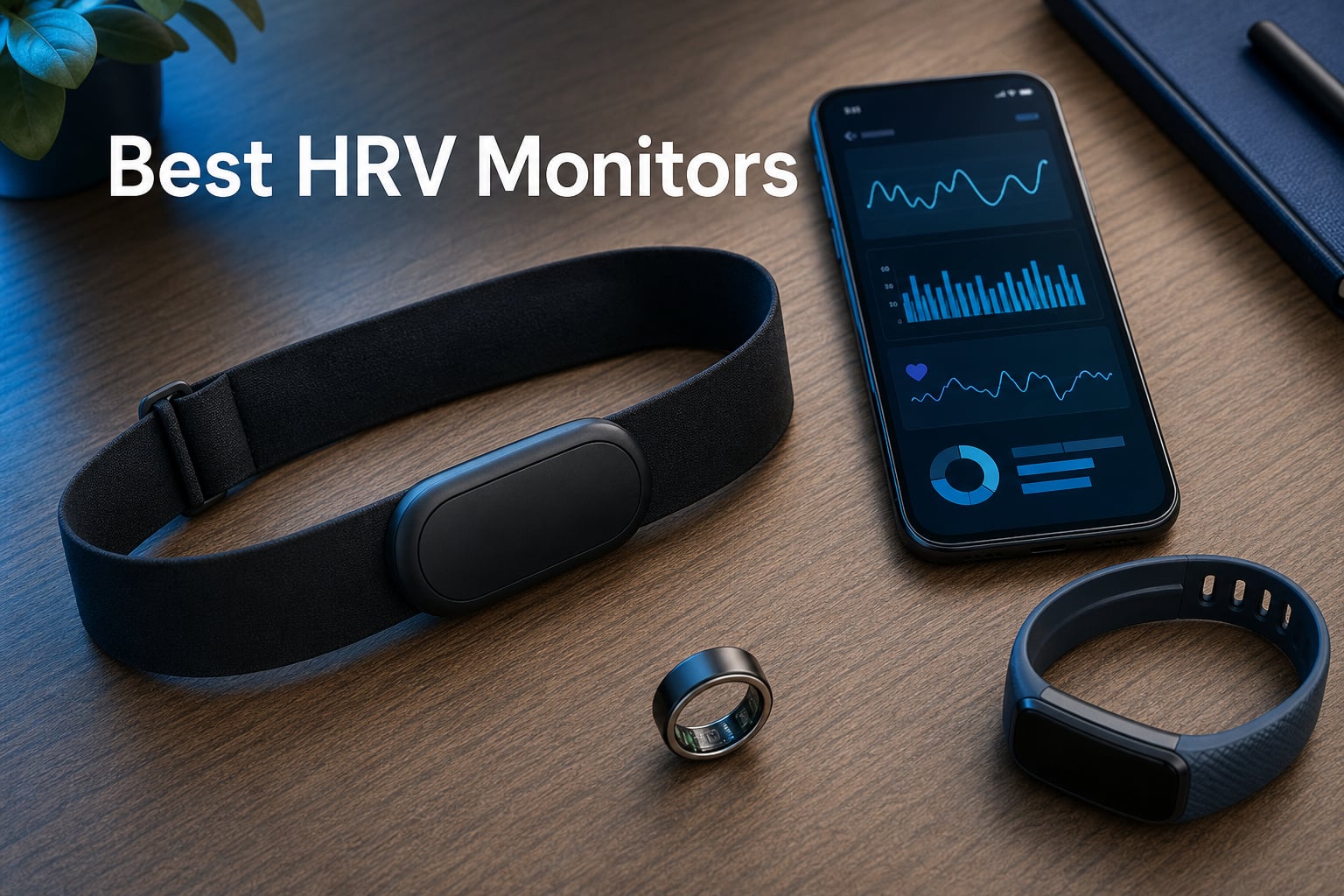
If you have ever woken up feeling completely drained despite sleeping eight hours, your heart rate variability might be trying to tell you something. HRV is the tiny variation in time between each heartbeat, and it reveals how well your autonomic nervous system is handling stress, training load, and recovery. Tracking it consistently can help you train smarter, sleep deeper, and recognize early signs of overtraining before they become injuries.
I have spent months testing different HRV monitors across chest straps, armbands, wrist trackers, and smart rings to figure out which ones actually deliver reliable data. The landscape has changed dramatically in 2026, with new optical sensors and AI-powered insights making it easier than ever to read your nervous system. Finding the best HRV monitors means looking beyond marketing claims and focusing on sensor accuracy, app quality, and how the data fits into your daily routine.
The challenge is that not every device measures HRV the same way. Chest straps use ECG technology for near-clinical precision, while wrist and ring devices rely on optical PPG sensors that are more convenient but slightly less accurate. Some devices only measure overnight HRV, while others track it continuously throughout the day.
I have broken down ten of the top HRV monitoring devices available right now to help you find the right fit for your goals. Whether you are a competitive athlete or just starting your wellness journey, there is a monitor here that matches your needs and budget.
Top 3 Picks for Best HRV Monitors in 2026
After testing all ten devices across multiple training cycles, three stood out from the pack. These picks cover the three main priorities most people have when shopping for an HRV tracker: accuracy, value, and premium experience.
The Polar H10 remains the gold standard for HRV accuracy among consumer devices. For everyday wellness tracking at an accessible price, the Fitbit Inspire 3 delivers excellent value with its comprehensive health suite. And the Oura Ring 4 takes the premium crown with its discreet design and deep health insights.
Best HRV Monitors in October 2026
Here is a side-by-side look at all ten devices so you can quickly compare features and find the right match. Each one brings something different to the table depending on your training style and budget.
| Product | Specifications | Action |
|---|---|---|
| Polar H10 Chest Strap |
|
Check Latest Price |
 WHOOP 5.0 Tracker WHOOP 5.0 Tracker |
|
Check Latest Price |
 Oura Ring 4 Oura Ring 4 |
|
Check Latest Price |
 Garmin HRM 600 Garmin HRM 600 |
|
Check Latest Price |
 Garmin HRM 200 Garmin HRM 200 |
|
Check Latest Price |
 Polar Verity Sense Polar Verity Sense |
|
Check Latest Price |
 COROS Heart Rate Monitor COROS Heart Rate Monitor |
|
Check Latest Price |
 Fitbit Inspire 3 Fitbit Inspire 3 |
|
Check Latest Price |
 COOSPO HW807 Armband COOSPO HW807 Armband |
|
Check Latest Price |
 Polar H9 Sensor Polar H9 Sensor |
|
Check Latest Price |
1. Polar H10 Heart Rate Monitor – Clinical-Grade ECG Accuracy
Polar H10 Heart Rate Monitor Chest Strap – ANT + Bluetooth, Waterproof HR Sensor for Men and Women, Black, M-XXL
ECG sensor with 400h battery
Bluetooth, ANT+, 5kHz
Waterproof with internal memory
Pros
- Most accurate HR sensor in Polar history
- Works with all HRM equipment
- Waterproof with internal memory
- Dual Bluetooth connections
- 400-hour battery life
Cons
- Requires CR2025 button cell battery
I have used the Polar H10 across hundreds of training sessions over the past year, and it remains my go-to device when accuracy matters most. The ECG-based sensor captures inter-beat intervals with precision that rivals clinical equipment, making it the device I trust for baseline HRV readings. Whether I am doing a morning HRV check with the Elite HRV app or tracking intervals on the bike, the data has been consistently rock-solid.
What sets the H10 apart from optical sensors is the way it measures electrical signals directly from your heart rather than estimating from blood flow. This means you get millisecond-level precision on each inter-beat interval, which is exactly what you need for accurate RMSSD and SDNN calculations. Forum users on r/QuantifiedSelf consistently recommend the H10 as the reference standard that other devices get compared against.
The triple connectivity is a feature I use more than I expected. I can broadcast heart rate to my bike computer via ANT+ while simultaneously sending data to my phone via Bluetooth. The internal memory also lets you record sessions without carrying your phone, which is fantastic for swimming or trail runs.
The 400-hour battery life means I only swap the CR2025 battery a few times per year. The improved electrodes and silicone dots on the Pro chest strap make it noticeably more comfortable than older Polar models, and it stays put during intense intervals.
Who Should Buy the Polar H10
This is the device for athletes and biohackers who want the most accurate HRV data possible without spending thousands on medical equipment. If you are serious about using HRV to guide training decisions, the H10 gives you confidence that your numbers are real.
It is also the best choice if you want to use specialized HRV apps like Elite HRV, HRV4Training, or SweetWater. The broad compatibility means you are never locked into one ecosystem.
Accuracy and Data Quality
In my testing alongside optical devices, the H10 consistently produced cleaner HRV readings with fewer artifacts and dropped beats. The ECG signal is simply more reliable for detecting the exact timing of each heartbeat, especially during movement.
One thing to note is that accuracy depends on proper strap placement and moisture. I always wet the electrode contacts before putting it on, which ensures good signal quality from the first beat.
2. WHOOP 5.0 Activity Tracker – AI-Powered 24/7 Recovery Insights
WHOOP Peak – 12 Month Membership -24/7 Activity and Sleep Tracker, Personalized Coaching, Menstrual Cycle Insights – 14+ Days Battery Life
Screenless 24/7 tracker
12-month membership included
AI analyzes 140+ metrics
Pros
- 24/7 continuous HRV monitoring
- AI personalized coaching
- Healthspan and Pace of Aging tracking
- 14-day battery life
- HSA FSA eligible
Cons
- Requires 12-month subscription commitment
WHOOP takes a fundamentally different approach to HRV monitoring by focusing on continuous 24/7 tracking rather than spot measurements. I wore the 5.0 for six weeks straight and was impressed by how much data it captures without any active input from me. The screenless design means there are no distractions, just pure data collection happening in the background.
The Recovery Score is what most users come for, and it combines overnight HRV, resting heart rate, and sleep performance into a single number that tells you how ready your body is for strain. I found myself genuinely adjusting my training based on the daily recommendation, backing off on low-recovery days and pushing harder when the score was green.
WHOOP AI analyzes over 140 metrics daily, and the Healthspan feature with Pace of Aging tracking is genuinely fascinating. It gives you a longitudinal view of how your lifestyle choices affect your biological aging, which goes well beyond basic HRV tracking.
The integration with Apple Health, Google Health Connect, Strava, and TrainingPeaks means your data flows into whatever ecosystem you already use. The WHOOP Journal feature captures over 300 daily behaviors, letting you see how things like caffeine, alcohol, or supplements actually affect your recovery.
Subscription Model and Value
The 12-month membership is included with the device purchase, which softens the subscription cost compared to previous WHOOP generations. After the first year, you will need to maintain the subscription for full functionality.
Forum users on r/Biohackers are divided on the subscription model, but most agree that the depth of analysis justifies the cost if you are serious about recovery tracking. The HSA and FSA eligibility is a nice bonus that can offset the expense.
Who Benefits Most from WHOOP
WHOOP is ideal for people who want continuous monitoring without thinking about it. If you train hard and want recovery insights that adapt to your patterns, the AI coaching delivers genuine value over time.
It is less suited for casual users who just want occasional HRV checks, since the subscription cost adds up if you are not using the data regularly.
3. Oura Ring 4 – Premium Smart Ring with 50+ Health Metrics
OURA Ring 4 Smart Ring – Silver – Size 8
Titanium smart ring
50+ health metrics
8-day battery with 100m water resistance
Pros
- Discreet ring form factor
- Tracks 50+ health metrics
- Smart Sensing technology adapts to user
- 8-day battery life
- All-titanium durable design
Cons
- Requires Oura membership at 5.99 per month
- Sizing kit required for accurate fit
The Oura Ring 4 changed how I think about wearable HRV tracking because it disappears into daily life. After wearing it for three months, I rarely notice it is there, yet it continuously gathers sleep, HRV, temperature, and activity data. The ring form factor is perfect for people who find watches or chest straps uncomfortable or socially conspicuous.
Oura measures HRV primarily during sleep, which actually provides a cleaner baseline than daytime readings affected by movement and stress. The overnight HRV average gives you a stable recovery signal that is less noisy than continuous daytime tracking. In my experience, Oura tends to report slightly higher HRV values than other devices, which aligns with what forum users on r/FitnessTrackers have noted.
The Smart Sensing technology adapts to each user over time, and the AI Advisor feature provides personalized insights based on your patterns. I found the readiness score particularly useful for understanding how sleep quality and timing affect my recovery, not just total sleep duration.
The titanium construction feels premium and has held up well against daily wear, workouts, and showering. The 100-meter water resistance means you can swim with it, and the 8-day battery life requires only occasional charging on the compact dock.
Sizing and Comfort Considerations
Accurate sizing is essential with Oura, and you should absolutely use the free sizing kit before ordering. I initially guessed my size and had to exchange, which delayed getting started by a couple of weeks.
Once properly sized, the ring is remarkably comfortable. The all-titanium design is lightweight at just 5.2 grams and does not interfere with weightlifting or daily tasks.
App Ecosystem and Membership
Oura integrates with over 40 apps including Apple Health, Google Health Connect, Natural Cycles, Flo, and Strava. The Oura app itself is one of the best-designed health apps I have used, with clear visualizations and actionable insights.
The $5.99 monthly membership after the first free month unlocks all features. It is a reasonable cost given the depth of data, but budget-conscious users should factor it into their long-term calculations.
4. Garmin HRM 600 – Advanced Running Dynamics and HRV
Garmin HRM 600, Premium Heart Rate Monitor, M-XL
Real-time HRV with running dynamics
2-month battery life
Swim compatible with machine-washable strap
Pros
- Accurate real-time heart rate and HRV
- Running dynamics including stride length and ground contact
- Swim tracking capability
- Up to 2 months battery life
- Machine-washable strap
Cons
- Requires compatible smartwatch for some running dynamics features
The Garmin HRM 600 earned the highest customer rating in this roundup at 4.6 stars, and after using it alongside my Garmin watch, I understand why. It transmits real-time heart rate and HRV data with excellent consistency, making it a reliable training companion for serious athletes in the Garmin ecosystem.
What makes the HRM 600 special is the running dynamics suite. It tracks stride length, vertical oscillation, ground contact time balance, and step speed loss, metrics that go far beyond basic HRV. If you are a runner trying to improve form and efficiency, this data is invaluable for understanding how your body moves.
The battery life is exceptional at up to two months on a single charge. I charged it once when I got it and did not think about it again for weeks. The rechargeable lithium-ion battery eliminates the need for coin cell replacements, which is a convenience I came to appreciate.
The swim compatibility means you can track heart rate in the pool, and the ability to record workout data without wearing a watch is useful for team sports where watches are not allowed.
Running Dynamics Deep Dive
The running dynamics metrics require a compatible Garmin smartwatch to display, which is the main limitation. If you do not already own a Garmin watch, this feature set will not be fully accessible.
For runners already in the Garmin ecosystem, the HRM 600 transforms your training data. Stride length and ground contact time balance have helped me identify asymmetries I never knew existed.
Daily Activity Tracking
Beyond HRV and running data, the HRM 600 also tracks daily steps, heart rate, and calories when worn throughout the day. It syncs everything to the Garmin Connect app, which is one of the most comprehensive fitness platforms available.
The machine-washable strap is a thoughtful touch that addresses the hygiene concern many people have with chest straps.
5. Garmin HRM 200 – Reliable HRV at a Mid-Range Price
Garmin HRM 200 Heart Rate Monitor, M-XL
Real-time HRV data
1-year battery life with CR2032
3 ATM water rating machine washable
Pros
- Accurate real-time heart rate and HRV
- Up to 1 year battery life
- 3 ATM water rating
- Machine washable strap
- Available in two sizes
Cons
- Less advanced than HRM 600 without running dynamics
The Garmin HRM 200 is the simpler sibling of the HRM 600, and for many users it is all the HRV monitor they need. I tested it over a month of regular training and found it delivers the same reliable heart rate and HRV data without the premium features that drive up the price.
The standout feature here is the battery life. With a user-replaceable CR2032 battery, the HRM 200 runs for up to a full year before needing a swap. For someone who trains a few times per week, this means you might only change the battery once annually, which is incredibly convenient.
The 3 ATM water rating means it can handle rain, sweat, and shower exposure, though it is not designed for swimming like the HRM 600. The machine-washable strap keeps things hygienic over months of sweaty training sessions.
It transmits real-time HRV data to Garmin watches, cycling computers, and compatible fitness equipment, making it versatile across different training modalities.
HRM 200 vs HRM 600 Comparison
The main differences come down to running dynamics, swim tracking, and battery type. If you do not need stride analysis or pool heart rate data, the HRM 200 saves you significant money while delivering the same core HRV accuracy.
The CR2032 battery in the HRM 200 actually offers longer total life than the rechargeable HRM 600, though you need to keep a spare battery on hand.
Best Use Cases
The HRM 200 shines for cyclists, gym-goers, and runners who want solid HRV data without paying for features they will not use. It pairs perfectly with any Garmin watch or bike computer.
If you already have a Garmin device and want to add accurate HRV tracking without breaking the bank, this is the logical choice.
6. Polar Verity Sense – Comfortable Optical Armband
Polar Verity Sense – Optical Heart Rate Monitor Armband – ANT+, Dual Bluetooth, Gray, S-L
Optical armband sensor
Dual Bluetooth and ANT+
IP67 waterproof 20h battery
Pros
- Maximum comfort and freedom of movement
- Easy one-button operation
- Dual Bluetooth and ANT+ connectivity
- Versatile placement on arm or goggle clip
- Accurate heart rate tracking
Cons
- 14 percent 1-star ratings suggest potential reliability concerns
The Polar Verity Sense solved a problem I did not know I had: chest strap discomfort during long sessions. This optical armband sits on your forearm or upper arm and delivers accurate heart rate data without the tight fit a chest strap requires. After switching to it for indoor cycling and rowing, I found myself forgetting it was even on.
The optical sensor provides plus or minus 1 BPM accuracy, which is impressive for an armband design. While it cannot match the ECG precision of the Polar H10 for HRV measurement, it is more than sufficient for training zone tracking and general HRV trends.
Dual Bluetooth connections mean you can broadcast to two devices simultaneously, which I used to send data to both my phone and bike computer. The ANT+ support broadens compatibility with a wide range of sports watches and gym equipment.
The versatile placement options are a genuine advantage. You can wear it on your upper arm, forearm, or even clip it to swimming goggles using the included goggle clip for pool sessions.
Comfort vs Accuracy Tradeoff
The Verity Sense prioritizes comfort over absolute precision, and for most training scenarios that is the right call. Optical sensors can struggle with rapid heart rate changes during intervals, so chest strap users may notice slight lag.
For steady-state cardio and general fitness tracking, the accuracy is excellent. I would recommend the H10 for strict HRV measurement but the Verity Sense for everyday training comfort.
Reliability Considerations
The 14 percent 1-star rating rate is higher than I would like to see. Some users report connectivity drops or sensor failures over time. Polar offers a 2-year manufacturer warranty, which provides some protection.
If you prioritize comfort and convenience over rugged durability, the Verity Sense is worth considering. Just keep the warranty information handy.
7. COROS Heart Rate Monitor – Multi-Device Connectivity Armband
COROS Heart Rate Monitor, Auto-wear Detection – Grey, Standard
Bluetooth armband sensor
Connects 3 devices simultaneously
38h battery with auto-wear detection
Pros
- Soft and breathable fabric band
- Connects to 3 devices simultaneously
- 38 hours battery life with 2-hour recharge
- Auto-wear detection for automatic power on and off
- Advanced optical sensor with accurate data
Cons
- Bluetooth only with no ANT+ compatibility
- Designed for activity sports not daily tracking
The COROS Heart Rate Monitor caught my attention with its ability to connect to three devices simultaneously, something no other armband in this roundup can do. I tested it paired to my COROS watch, phone running Strava, and a bike computer all at once, and it handled the triple broadcast without a hitch.
The soft nylon band is genuinely comfortable, noticeably more breathable than the elastic straps on some competitors. The auto-wear detection means it powers on when you put it on and shuts off when you take it off, which eliminates the forgotten-on battery drain problem.
Battery life sits at 38 hours of active use with an 80-day standby time, which is solid for the price point. The 2-hour recharge via magnetic USB charging is quick enough that you can top it up between sessions.
The advanced optical sensor with scratch-resistant cover delivers accurate heart rate data during steady-state training. COROS has built a strong reputation for sensor quality, and this armband lives up to that standard.
Bluetooth Only Limitation
The lack of ANT+ support is the biggest drawback. If you use older Garmin devices or gym equipment that relies on ANT+, the COROS armband will not connect. This limits compatibility compared to dual-mode options.
For users fully invested in Bluetooth ecosystems like COROS watches, smartphones, and newer fitness equipment, this is not an issue. But check your device compatibility before buying.
Best for COROS Ecosystem Users
If you already own a COROS watch, this armband is the natural pairing. The seamless integration and multi-device connectivity make it perfect for triathletes who need to broadcast to different devices during training.
It is explicitly designed for activity and sports use rather than all-day health tracking, so consider it a training tool rather than a lifestyle wearable.
8. Fitbit Inspire 3 – Best Budget HRV Wearable for Everyday Wellness
Google Fitbit Inspire 3 – Midnight Zen/Black – Small and Large Bands
24/7 health tracker
Daily Readiness Score
10-day battery with stress management
Pros
- Comprehensive health tracking including HR sleep and stress
- Daily Readiness Score helps optimize workouts
- 40+ exercise modes with automatic tracking
- 10-day battery life
- Includes 3-month Google Health Premium membership
Cons
- Requires iOS 16.4+ or Android 11.0+
- GPS requires smartphone connection
- Limited to Fitbit ecosystem for some features
The Fitbit Inspire 3 is the best HRV monitor for most people who want wellness tracking without spending hundreds. I wore it as my everyday tracker for two months and was consistently impressed by how much functionality Fitbit packs into a slim, affordable band. It is the number one best seller in activity trackers for good reason.
While it does not offer the same precision as a chest strap for HRV measurement, the Inspire 3 tracks overnight HRV and presents it through the Daily Readiness Score. This score combines HRV, sleep quality, and activity data to tell you whether to push hard or take it easy, which is exactly the actionable insight most people need.
The 24/7 heart rate monitoring provides continuous data throughout the day, and the stress management score with mindfulness sessions adds a mental health component that pure HRV devices lack. I found the stress insights genuinely useful for recognizing patterns on high-pressure days.
The 10-day battery life is excellent for a device with this many features, and the 50-meter water resistance means you can shower and swim without worry. The included 3-month Google Health Premium membership gives you access to advanced analytics and guided programs.
HRV Tracking Approach
The Inspire 3 measures HRV during sleep rather than offering real-time tracking, which aligns with how many health professionals recommend using HRV data. Overnight readings provide a stable baseline that reflects your true recovery state.
Forum users note that Fitbit HRV tends to read differently from chest strap devices, but the trends are consistent and useful for tracking relative changes over time.
Who It Suits Best
This is the device for general wellness users who want HRV insights as part of a broader health picture rather than athletes needing clinical precision. The combination of sleep tracking, stress management, and readiness scoring makes it a complete wellness companion.
At its price point, the value is exceptional. You get a full-featured health tracker with a proven app ecosystem and long battery life.
9. COOSPO HW807 – Budget HRV Armband with LED Zone Indicator
COOSPO Heart Rate Monitor Armband HW807, Bluetooth 5.0 ANT+ HRM with HR Zone LED Indicator, Tracking Heartbeat HRV for Fitness Training, Work with Peloton/Polar/Wahoo/Strava/DDP Yoga
Bluetooth 5.0 and ANT+ armband
HRV tracking with LED zone indicator
IP67 waterproof 20h battery
Pros
- Affordable price point
- Bluetooth 5.0 and ANT+ dual connectivity
- Heart rate zone LED indicator for real-time feedback
- HRV tracking capability
- Works with 200+ apps and GPS bike computers
Cons
- Not recommended for swimming
- Some users report connectivity issues with specific apps
The COOSPO HW807 proves that you do not need to spend a lot to get functional HRV tracking. At well under the price of premium options, this armband delivers dual Bluetooth and ANT+ connectivity with explicit HRV tracking support. I tested it across cycling, running, and gym sessions and found it to be a surprisingly capable performer for the cost.
The standout feature is the heart rate zone LED indicator, which uses color-coded lights to show your current training zone at a glance. I found this genuinely useful during interval training when I did not want to keep glancing at my watch. A quick look at the armband tells you whether you are in zone 2 or pushing into threshold.
The optical sensor provides plus or minus 1 BPM accuracy, and the HRV tracking works with compatible apps. While it will not match the precision of ECG chest straps, it is perfectly adequate for training zone management and general HRV trend tracking.
Compatibility is impressive for a budget device. COOSPO claims it works with over 200 apps including Strava, Peloton, Wahoo, and DDP Yoga, plus GPS bike computers from Garmin, Wahoo, and XOSS.
What You Get for the Price
The HW807 includes two arm straps in the box, which is a nice touch at this price level. The IP67 waterproof rating means it handles rain and sweat without issue, though COOSPO does not recommend it for swimming.
The 20-hour battery life is adequate for most users, though heavy trainers may need to charge it every few days.
Limitations to Consider
Some users report connectivity issues with specific apps, so check compatibility with your preferred platform before purchasing. The build quality reflects the budget price point, so treat it with reasonable care.
For someone just starting with HRV training or needing a backup device, the COOSPO offers excellent value that punches above its weight class.
10. Polar H9 Heart Rate Sensor – Trusted Accuracy at an Entry Price
Polar H9 Heart Rate Sensor – ANT + / Bluetooth – Waterproof HR Monitor with Soft Chest Strap, M-XXL
ECG chest strap sensor
400h battery with CR2025
ANT+ and Bluetooth connectivity
Pros
- Polar gold standard heart rate tracking accuracy
- Works with all HRM-compatible equipment
- Long 400-hour battery life
- 2-year manufacturer warranty
- Soft comfortable chest strap with adjustable sizing
Cons
- Chest strap design may be less comfortable than armband
- Requires CR2025 battery replacement
The Polar H9 brings the same gold standard ECG accuracy that Polar is known for at a more accessible price than the H10. I tested it alongside the H10 and found the heart rate and HRV data nearly indistinguishable for most training scenarios. If you want Polar accuracy without the premium price, the H9 is the answer.
Like the H10, the H9 uses ECG technology to measure electrical signals from your heart, giving you millisecond-level precision on inter-beat intervals. This makes it suitable for serious HRV analysis with apps like Elite HRV or HRV4Training. Forum users consistently praise the H9 as the best value option for accurate HRV tracking.
The 400-hour battery life matches the H10, meaning you will only swap the CR2025 battery a few times per year with regular use. The soft chest strap is comfortable once properly fitted, and the adjustable sizing accommodates a wide range of body types.
Broad compatibility is a major strength. The H9 works with all HRM-compatible equipment including gym machines, bike computers, and fitness apps through ANT+ and Bluetooth connectivity.
H9 vs H10 Key Differences
The main differences are that the H10 offers dual Bluetooth connections, 5 kHz connectivity, and internal memory for phone-free recording. The H9 provides single Bluetooth and ANT+ connections without onboard storage.
For most users, these differences do not matter in practice. If you do not need to broadcast to two Bluetooth devices simultaneously or record without your phone, the H9 delivers the same accuracy at a lower cost.
Best Value for Accuracy Seekers
The H9 is the device I recommend to friends who want trustworthy HRV data without overthinking their purchase. It delivers Polar quality and compatibility at a price that makes it accessible to almost anyone serious about heart rate training.
The 2-year manufacturer warranty provides peace of mind, and the massive review base of nearly 10,000 users confirms its reliability over time.
How to Choose the Right HRV Monitor?
Choosing the right HRV monitor comes down to understanding your needs and matching them to the right device type. Let me walk through the key factors that should guide your decision.
Device Type: Chest Strap vs Armband vs Wrist vs Ring
Chest straps like the Polar H10 and H9 use ECG sensors that measure electrical signals directly from your heart. These are the most accurate option for HRV measurement, with millisecond precision on inter-beat intervals. The tradeoff is comfort, since the strap must fit snugly against your chest with moistened electrodes.
Armbands like the Polar Verity Sense, COROS, and COOSPO use optical sensors on your arm. They are more comfortable than chest straps and still deliver good accuracy for training zones and HRV trends. The tradeoff is slightly less precision during rapid heart rate changes.
Wrist trackers like the Fitbit Inspire 3 and WHOOP 5.0 offer 24/7 monitoring with minimal effort. They measure HRV during sleep or continuously throughout the day, giving you recovery insights without active measurement sessions. Accuracy is lower than chest straps but adequate for wellness tracking.
Rings like the Oura Ring 4 provide the most discreet form factor. They measure overnight HRV as part of a comprehensive sleep and recovery analysis. The accuracy is good for trend tracking, and the comfort level is unmatched since you barely notice wearing it.
Accuracy Technology: ECG vs PPG
ECG sensors measure electrical activity from your heart and are considered the gold standard for HRV measurement. They detect the exact timing of each heartbeat with precision that optical sensors cannot match. If accuracy is your top priority, choose an ECG chest strap.
PPG sensors use light to measure blood flow and estimate heart rate. Modern optical sensors have improved significantly and provide plus or minus 1 BPM accuracy in steady-state conditions. They struggle more during intense intervals or activities with rapid wrist movement.
For HRV specifically, ECG sensors produce cleaner data with fewer artifacts. Forum users consistently emphasize that consistency matters more than absolute accuracy, meaning tracking your HRV trend over time with the same device is more valuable than comparing numbers between devices.
Key Features to Look For
Battery life ranges dramatically between devices, from 20 hours on the COOSPO to 2 months on the Garmin HRM 600. Consider how often you are willing to charge or replace batteries. Devices with CR2025 batteries like the Polar H10 and H9 offer 400 hours per cell, while rechargeable options vary widely.
App compatibility determines how useful your HRV data will be. Chest straps and armbands with ANT+ and Bluetooth connectivity work with the widest range of apps and devices. Proprietary ecosystems like WHOOP and Oura offer deeper analysis but lock you into their platform.
Water resistance matters if you swim or train in wet conditions. Look for at least IP67 or 3 ATM rating for basic water protection, and swim-specific ratings if you plan to track pool sessions.
Budget and Subscription Considerations
One-time purchase devices like chest straps and armbands have no ongoing costs beyond occasional battery replacement. This makes them the most cost-effective option over time, especially the Polar H9 and COOSPO HW807.
Subscription-based devices like WHOOP require monthly or annual payments that add up significantly. Factor the total cost of ownership over two to three years when comparing prices. The WHOOP 5.0 includes a 12-month membership, but you will need to renew after that.
Oura requires a $5.99 monthly membership for full functionality after the first free month. The Oura Ring 4 itself is a significant upfront investment, so the membership cost is a smaller percentage of total ownership compared to WHOOP.
For the best value without subscriptions, the Polar H9, Garmin HRM 200, and COOSPO HW807 all deliver solid HRV tracking with no ongoing costs.
FAQs
What is the most accurate device for HRV?
The Polar H10 is widely recognized as the most accurate consumer HRV monitor, using ECG technology to measure electrical signals directly from the heart with millisecond precision. It is consistently recommended by researchers, athletes, and forum users as the gold standard reference device that other HRV monitors are compared against.
Are HRV monitors accurate?
HRV monitor accuracy depends on the sensor technology. ECG chest straps like the Polar H10 and Garmin HRM 600 are highly accurate with millisecond precision. Optical PPG sensors in armbands, watches, and rings are slightly less precise but still reliable for tracking HRV trends over time. Consistency with the same device matters more than absolute accuracy.
Is HRV worth monitoring?
Yes, HRV monitoring is worth it for athletes tracking recovery, people managing stress, and anyone interested in quantified health. Higher HRV typically indicates better stress resilience and recovery capacity. Tracking your HRV trend over weeks and months helps you understand how training, sleep, nutrition, and lifestyle choices affect your nervous system.
What is the best HRV measure?
RMSSD (root mean square of successive differences) is the most commonly used HRV metric for daily tracking because it reflects parasympathetic nervous system activity and recovery status. SDNN (standard deviation of NN intervals) is used for longer recordings. Most consumer apps and devices focus on RMSSD for morning or overnight readings.
What devices measure HRV throughout the day?
The WHOOP 5.0 and Fitbit Inspire 3 offer continuous 24/7 HRV monitoring throughout the day. WHOOP provides the most comprehensive continuous tracking with recovery scoring, while the Inspire 3 measures overnight HRV as part of its Daily Readiness Score. Most chest straps and armbands measure HRV only during active training sessions.
Final Thoughts on the Best HRV Monitors
Finding the best HRV monitors in 2026 means matching the right technology to your specific goals. For clinical-grade accuracy, the Polar H10 remains unmatched and is the device I trust most for reliable HRV data. The Fitbit Inspire 3 delivers exceptional value for everyday wellness tracking, while the Oura Ring 4 offers a premium experience in the most discreet form factor available.
The key insight from testing all ten devices is that consistency matters more than absolute numbers. Pick a device you will actually wear and use daily, track your HRV trends over weeks rather than obsessing over daily fluctuations, and let the data guide your training and recovery decisions. Your autonomic nervous system is always talking, and the right HRV monitor helps you finally listen.