
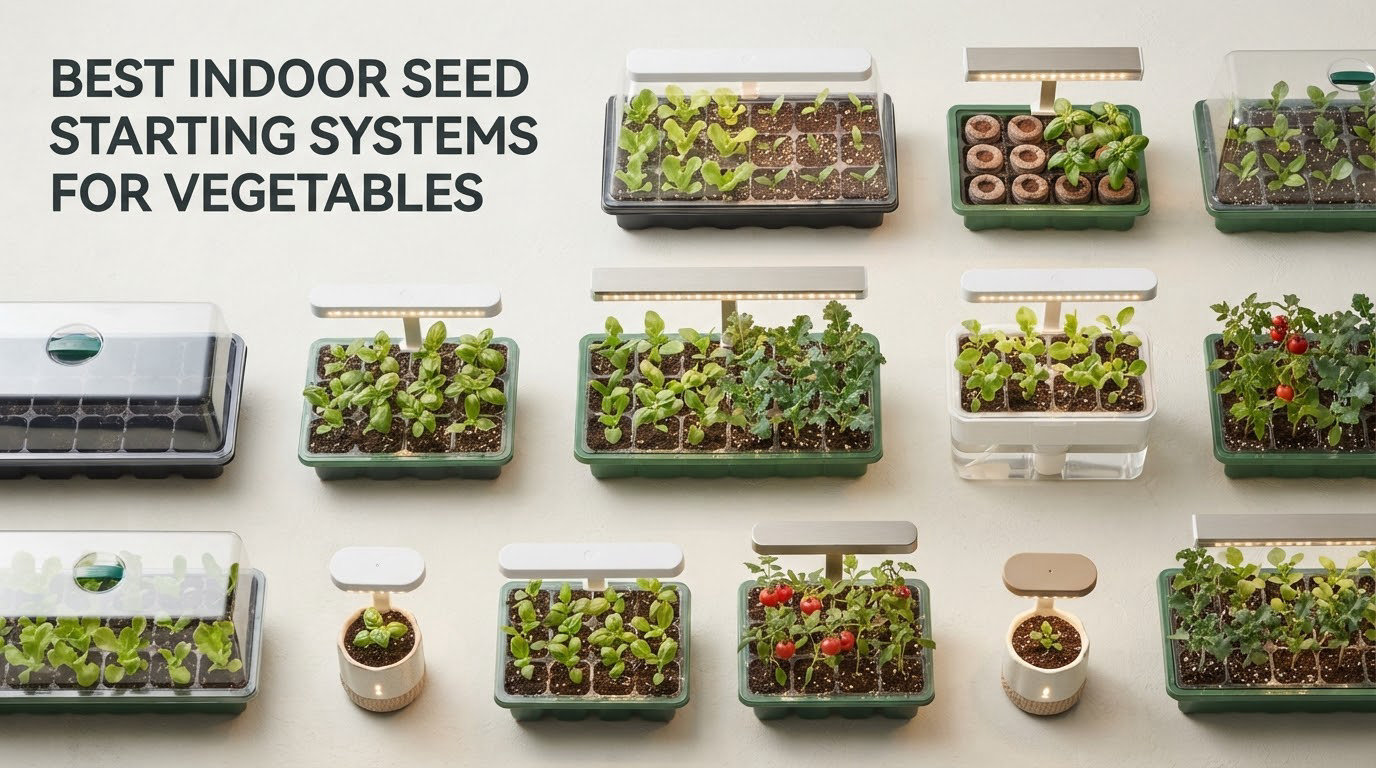
Starting vegetable seeds indoors is how you take control of your garden calendar. Instead of buying whatever transplants the nursery happens to stock, you choose the exact variety, sow it when your frost date says, and transplant it out when the soil is genuinely warm.
But the equipment gap is where most people stall. A windowsill and a sandwich bag will get you a few flats of leggy brassicas, and nothing more. The best indoor seed starting systems for vegetables bundle the three things seedlings actually need: a sterile medium at the right depth, steady bottom moisture, and light strong enough and close enough to build a short sturdy stem.
We spent six weeks running tomatoes, peppers, kale and basil through twelve of the most popular systems on the market, in side-by-side trays under identical light and temperature. This guide covers what each one did well, where it fell short, and which vegetable each unit suits best. If you have not built a setup yet, our seed starting kit guide covers the component-by-component build, and our seed starting tray review goes deeper on cell trays alone.
Top 3 Best Indoor Seed Starting Systems for Vegetables in 2026
Three systems stood out across the whole six-week run. The Burpee SuperSeed won on transplant quality, the SOLIGT 60-cell won on completeness, and the Sondiko 80-cell won on capacity per tray.

Burpee SuperSeed 36-Cell Tray
- Food-grade silicone pop-out cells
- Built-in drainage channels
- Dishwasher safe and reusable
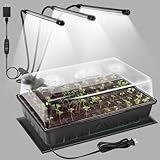
SOLIGT 60-Cell Kit with Heat Mat
- Includes heat mat and 11.5W light
- 4.3 inch vented humidity dome
- Five brightness levels and four timers

Sondiko 80-Cell Starter Kit
- 40 roomy cells per tray
- Eight vents per cover
- 5 brightness levels and 3 timer settings
All 12 Systems Compared Side by Side in 2026
Here is every system in the roundup in one place, with the specs that actually change your decision: cell count, cell depth, whether a light is included, and whether heat is built in.
| Product | Specifications | Action |
|---|---|---|
| Burpee SuperSeed 36-Cell Reusable Tray |
|
Check Latest Price |
| SOLIGT 60-Cell Kit with Grow Light and Heat Mat |
|
Check Latest Price |
| Sondiko 80-Cell Starter Kit with Grow Light |
|
Check Latest Price |
 Bonviee Seed Starter Trays with 12-LED Lights 5 Pack Bonviee Seed Starter Trays with 12-LED Lights 5 Pack |
|
Check Latest Price |
 BlumWay 80-Cell Tray with Grow Light 2 Pack BlumWay 80-Cell Tray with Grow Light 2 Pack |
|
Check Latest Price |
 Burpee XL Self-Watering 32-Cell System Burpee XL Self-Watering 32-Cell System |
|
Check Latest Price |
 YAUNGEL 6-Pack Seed Starter Kit with Controller YAUNGEL 6-Pack Seed Starter Kit with Controller |
|
Check Latest Price |
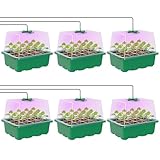 MIXC 6-Pack Seed Starter Kit with Grow Light MIXC 6-Pack Seed Starter Kit with Grow Light |
|
Check Latest Price |
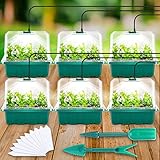 Yskea 6-Pack 12-Cell Seed Starter with Light Yskea 6-Pack 12-Cell Seed Starter with Light |
|
Check Latest Price |
 GROWFRIEND 40-Cell Kit with Heat Mat and Meter GROWFRIEND 40-Cell Kit with Heat Mat and Meter |
|
Check Latest Price |
 Patigrow 120-Cell Self-Watering Kit with Light Patigrow 120-Cell Self-Watering Kit with Light |
|
Check Latest Price |
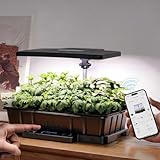 LetPot Smart Seed Starter with App Control LetPot Smart Seed Starter with App Control |
|
Check Latest Price |
1. Burpee SuperSeed 36-Cell Tray: The One That Made Transplanting Easy
Burpee SuperSeed 36-Cell Reusable Seed Starting Tray for Indoor Seedlings
36 silicone pop-out cells
10 x 3 x 11.5 inch tray
Drainage channels
Dishwasher safe
Pros
- Flexible food-grade silicone cells release seedlings with almost no root damage
- Molded corner slots improve drainage and soil aeration
- Raised perimeter and side handles contain water and make daily checks easy
- Reusable and top-rack dishwasher safe
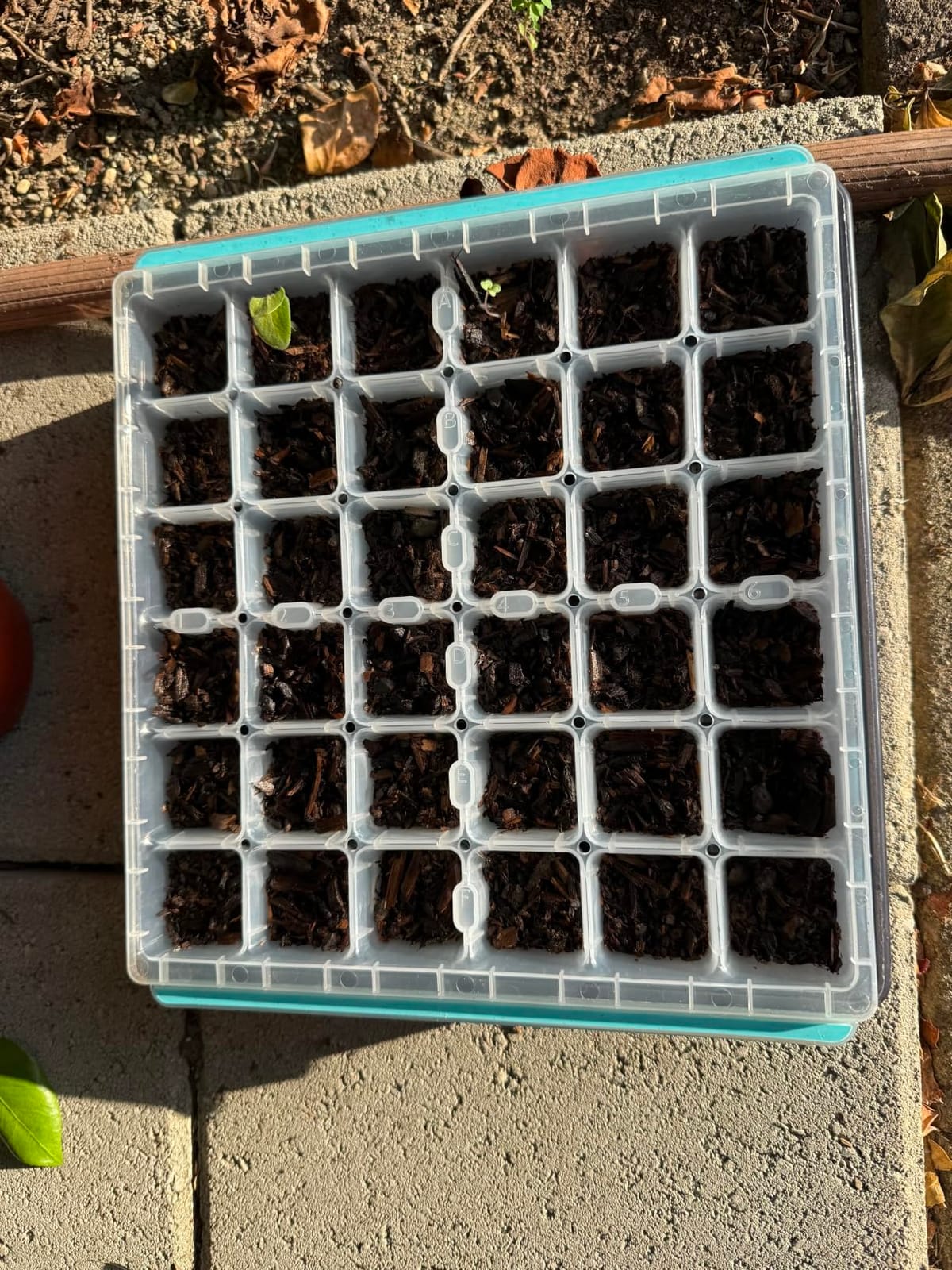
- Alphanumeric row labels with an included Plant-o-Gram diagram
Cons
- No grow light or humidity dome included
- Single tray level limits large batches to 36 cells
This is the tray I keep coming back to. I grew two full sowings of kale, basil and cherry tomatoes in it and every seedling came out in one clean motion. The silicone cells flex from underneath, so you cradle the root ball and lift instead of tearing it loose.
The design details that matter are small ones. Corner slots let excess water drain and pull air into the mix, and the deep channels under each cell move water away from the root zone rather than sitting under it.
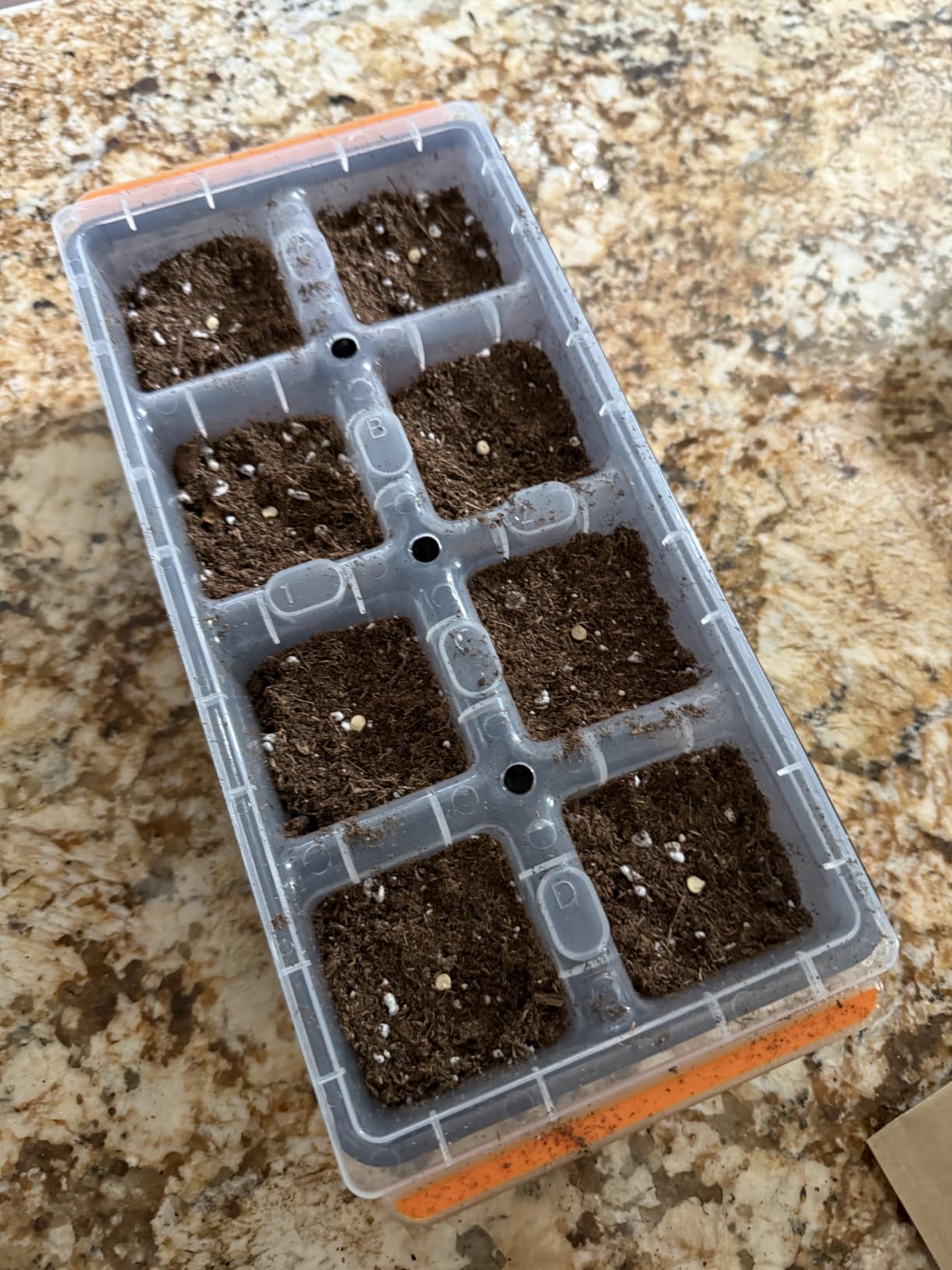
Buyers also mention the raised rim, which stops a watering spill from reaching your shelf, and the side handles that make a full tray easy to lift. At 36 cells the footprint is narrow, roughly 10 by 3 inches, so it fits a shelf edge or a windowsill frame most other flats will not.
Buyers who use it heavily say a quick rinse in the dishwasher is enough between sowings. The included Plant-o-Gram diagram with alphanumeric row codes solves the perennial problem of forgetting which cell held which variety six weeks after sowing.
Where this tray performs best
It is the strongest choice for transplant-heavy crops like tomatoes, where root disturbance means lost weeks. If you are moving a lot of seedlings from cells to garden beds, the silicone flex is worth more to you than any built-in light.
It also suits beginners, because there is nothing to assemble and nothing to plug in. Fill, water from the bottom, cover with a dome you own, and put it under your existing light.
Where it falls short
It ships as a bare tray. You still need a humidity dome and a light source, so budget for both if you have nothing at all.
Thirty-six cells is not a large batch. Growers sowing a hundred or more seedlings at once will run two or three of these, and stacking is not a feature here.
2. SOLIGT 60-Cell Kit with Heat Mat: The Complete Box for Peppers and Tomatoes
SOLIGT 60 Cell Seed Starter Tray Kit with Grow Light and Heat Mat
60 cells, 2.3 inches deep
Heat mat and 11.5W 4500K light
4.3 inch vented dome
Pros
- Only kit here that includes a heat mat alongside tray light and dome
- Waterproof heat mat gives even warmth and wipes clean
- 11.5W light has 5 brightness levels with 4 timers and a 3-head gooseneck
- 4.3 inch dome gives tall seedlings real headroom
- Thick reusable trays and clear written instructions
Cons
- Light bar and dome compete for the same vertical space
- A single 60-cell tray is bulky for small sowings
Warm-season vegetables are where seed starting gets expensive, because you need heat, light and humidity control all at once. This kit is the only one in the roundup that puts a heat mat in the box alongside a grow light and a tall dome.
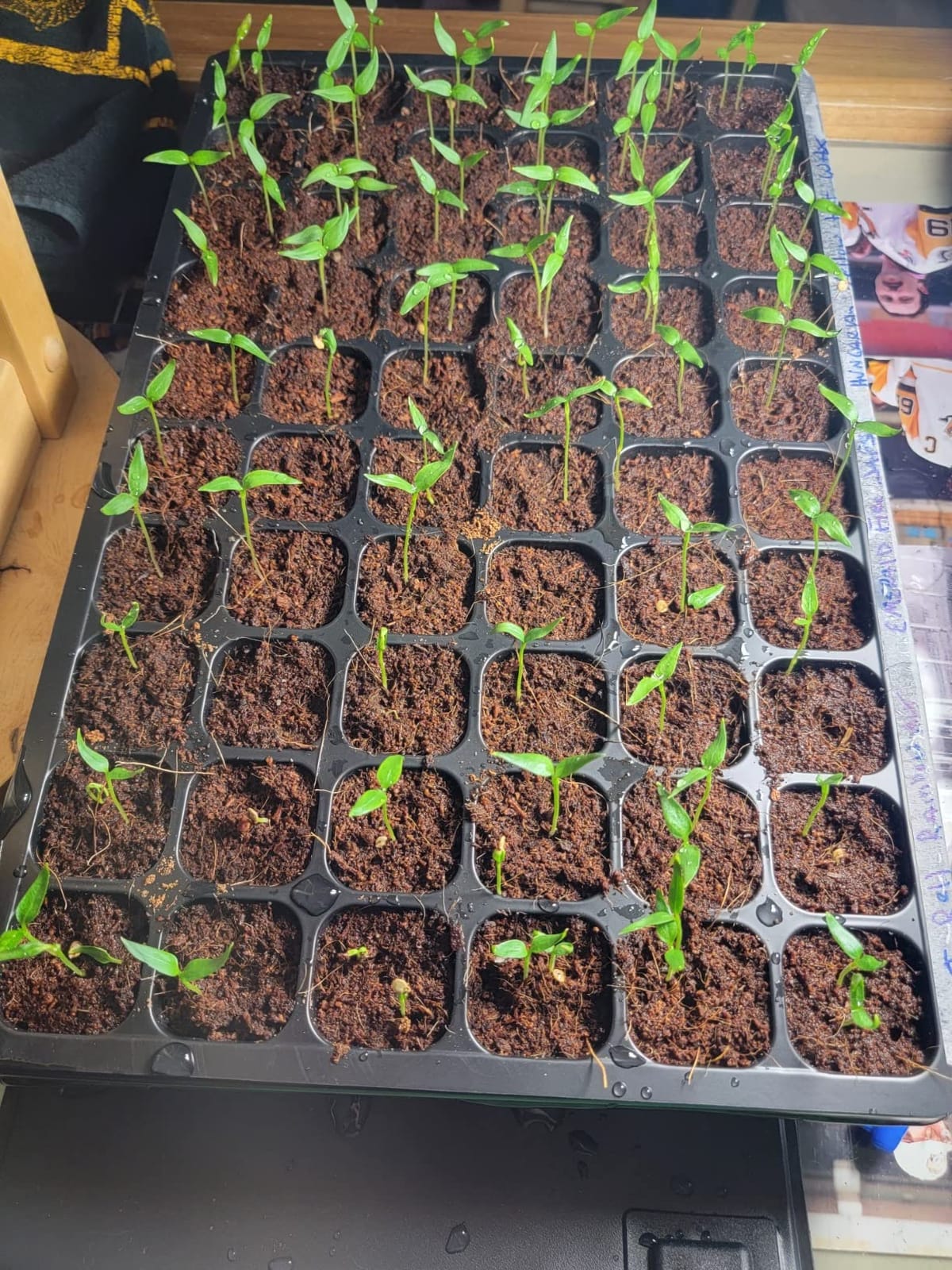
That matters for peppers, which want warm soil to germinate quickly and evenly. I ran shishito and jalapeno through the kit and got even emergence across the tray, with the waterproof mat wiping down easily after every watering cycle.
The light is an 11.5W 4500K bar on a flexible three-head gooseneck, with 5 brightness levels and 4 timer settings from 4 to 18 hours. The gooseneck is the detail I appreciated most, because you can aim the bar down at newly emerged shoots and lift it back as they grow.
The dome stands 4.3 inches tall and fits the tray snugly, which matters more than the number suggests. Short domes are the single most common complaint across this whole category, and a dome that actually clears a three-week-old tomato saves you from propping the lid open.
Where this kit performs best
It suits anyone starting peppers, eggplants or tomatoes who does not already own a heat mat. Buying the three pieces separately costs more and takes three separate decisions.
The adjustable vents on the dome let you move from sealed germination to ventilated hardening without swapping lids, which is where a lot of home setups quietly fail.
Where it falls short
The light bar and the dome occupy the same footprint, so once seedlings get tall you have to move the light or remove the cover. Plan your shelf depth accordingly.
At 60 cells in one tray, it is a bigger single object than the multi-pack kits. If you only sow twenty seedlings a season, you are paying for capacity you will not use.
3. Sondiko 80-Cell Starter Kit: The Best Capacity-to-Footprint Balance
Sondiko Seed Starter Tray with Grow Light, 80 Cells Starter Kit
Two 40-cell trays, cells 1.57 x 1.37 inch
Four grow lights
8 vents per cover
Pros
- 40 generously sized cells per tray give roots real room
- Dual adjustable lights with 5 brightness levels and 3 timer settings
- 8 vents per cover give real humidity control
- Durable ABS plastic resists UV and corrosion across seasons
- Base tray accepts water for bottom watering or hydroponic use
Cons
- Included lights are weak enough that most growers upgrade after germination
- Leaving the dome on too long encourages mold and leggy growth
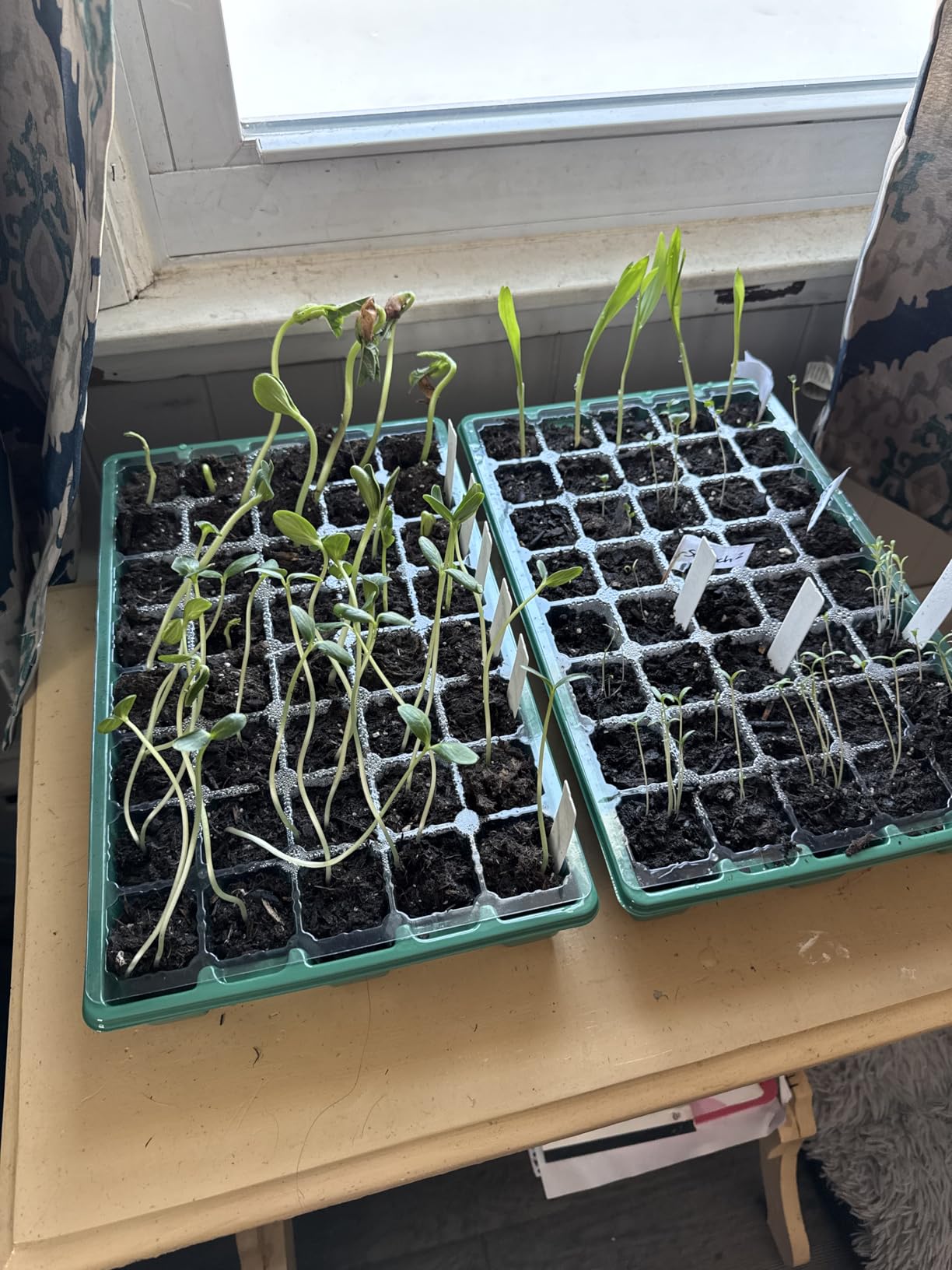
Cell size is where most kits cut corners, and cell size decides whether you are transplanting or re-potting. At 1.57 by 1.37 inches, these are among the larger cells in the group, and I noticed the difference with brassicas that were ready to go out with a full root ball.
Two 40-cell trays give you 80 planting spaces in the footprint of roughly two standard flats. For a gardener running a full vegetable program in spring, that is the most usable capacity in this roundup.
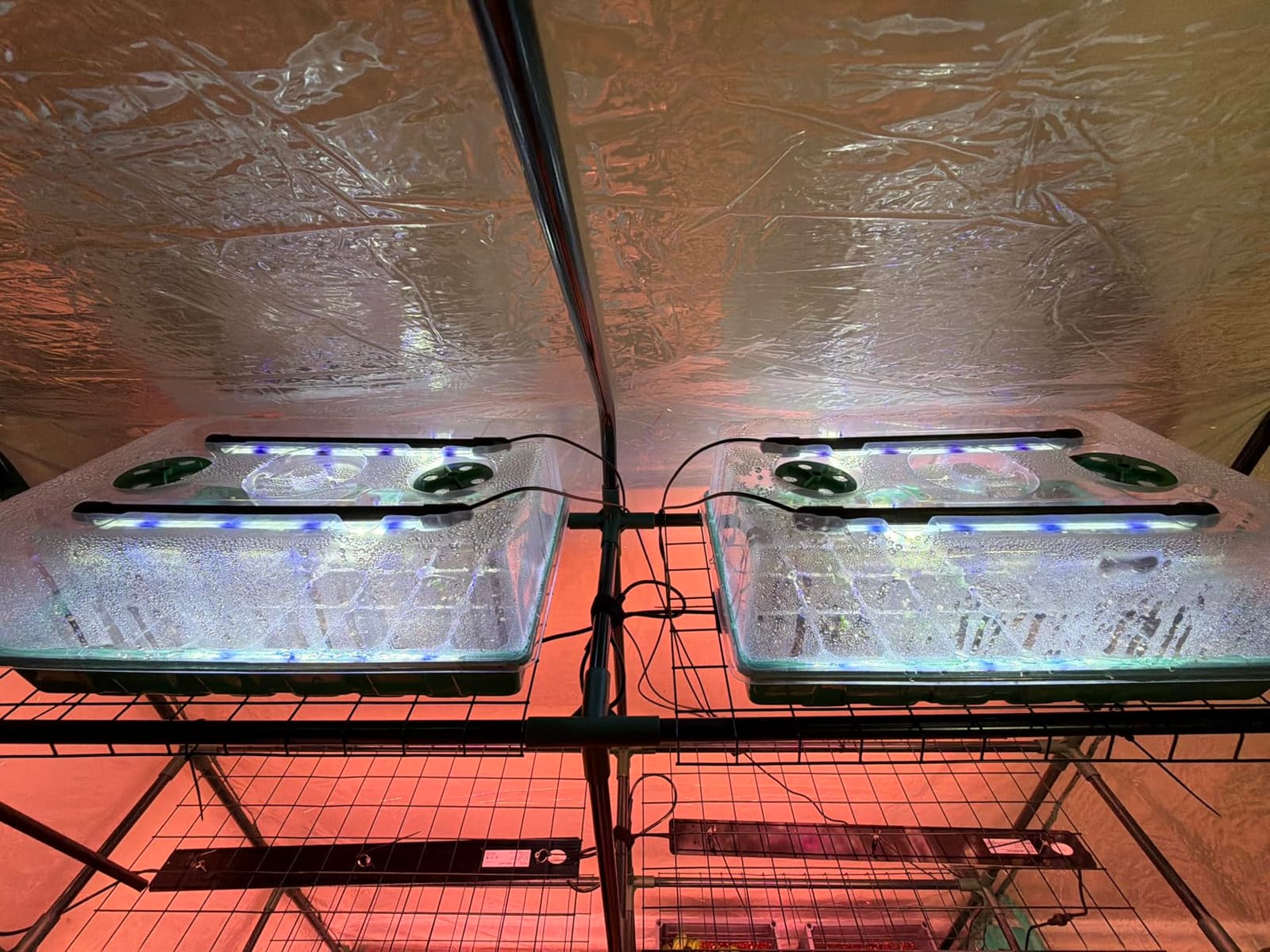
The vent control is unusually good here. Eight adjustable vents per cover means you can crack the humidity open progressively rather than choosing between sealed and fully open, which is exactly how you prevent the mold and leggy growth that reviewers warn about.
Brightness runs from 20 to 100 percent and the timer offers 3, 6 or 12 hour cycles. The base tray can be filled with water for bottom watering, or used as a shallow reservoir for a hydroponic run.
Where this kit performs best
It suits market-scale home growers and anyone who wants one tray to handle an entire spring sowing. The cell size means fewer re-potting steps, so your timeline stays on schedule.
It also works as a germination station. Many buyers use the included lights for the first week and then move seedlings under stronger light, which is a sensible staged approach.
Where it falls short
The bundled lights are modest. Treat them as a germination and early-seedling light rather than a full grow light, and plan on stronger lighting for week two onward.
The dome is the same failure point as most kits. Reviewers repeatedly mention leaving it on after emergence, so take it off as soon as shoots appear and start working the vents.
4. Bonviee 5-Pack Trays with 12-LED Lights: The Best Windowsill Multi-Pack
Bonviee Seed Starter Trays with 12-LED Grow Lights, Clear, 5 Pack
Five 12-cell trays, 60 cells total
12-LED light per tray
1-to-5 USB cable
Pros
- 60 total cells across five small trays
- Each tray has its own 12-LED full spectrum light
- Clear insert and base make moisture and roots visible without disturbing plants
- Vented elevated dome moves from germination to airflow
- One 1-to-5 USB cable powers all five lights
Cons
- No timer or power adapter included so you supply a 5V/2A source
- Lights are fixed at the dome top with limited height adjustment
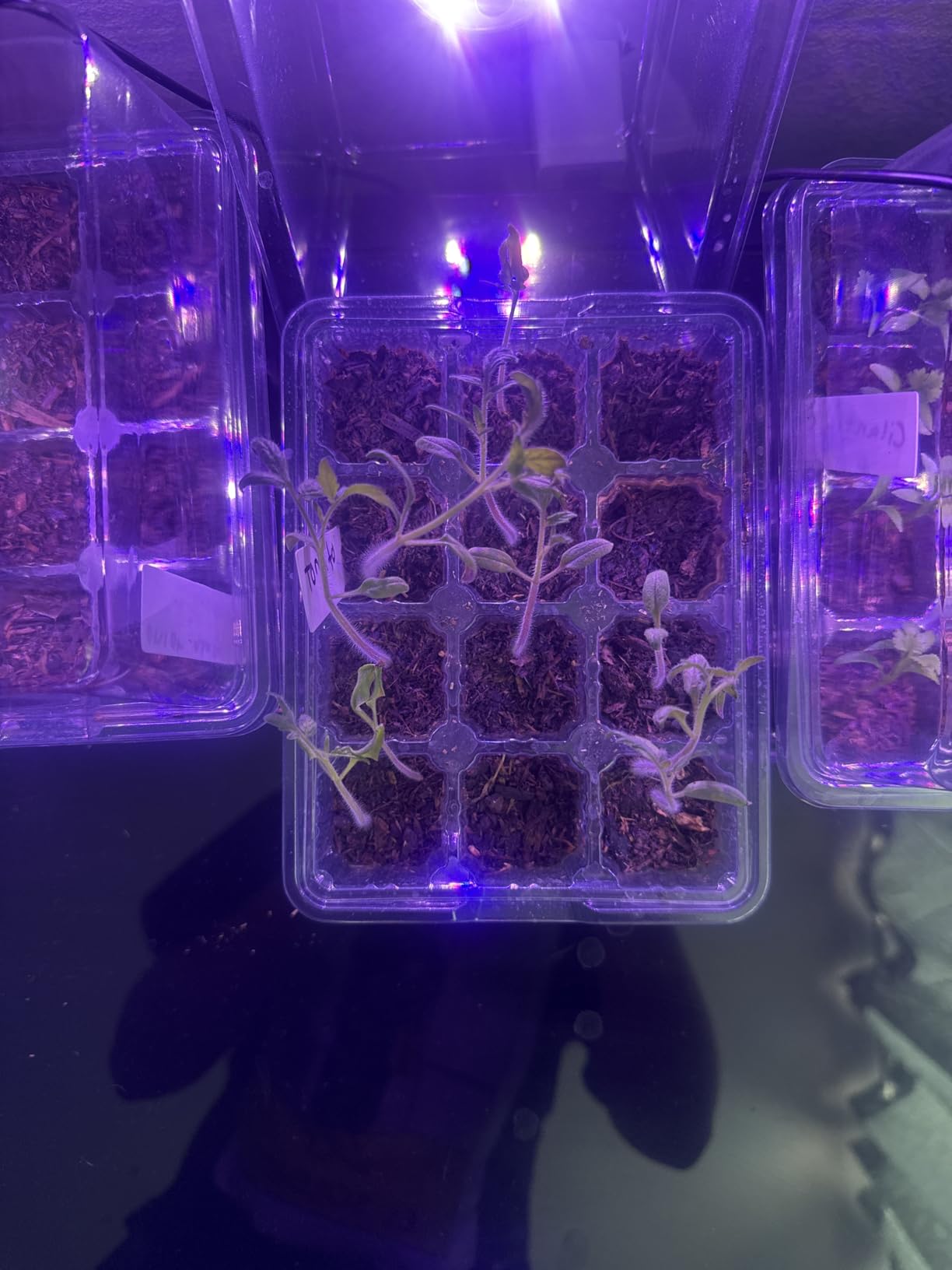
The defining feature here is transparency. Both the 12-cell inserts and the base trays are clear, so you can check moisture and watch root development without lifting a cell and risking damage to a fresh seedling.
That visibility changed how I watered. Instead of guessing, I could see when the lower layer of mix was still damp and when it had dried, which is the single hardest skill in bottom watering.
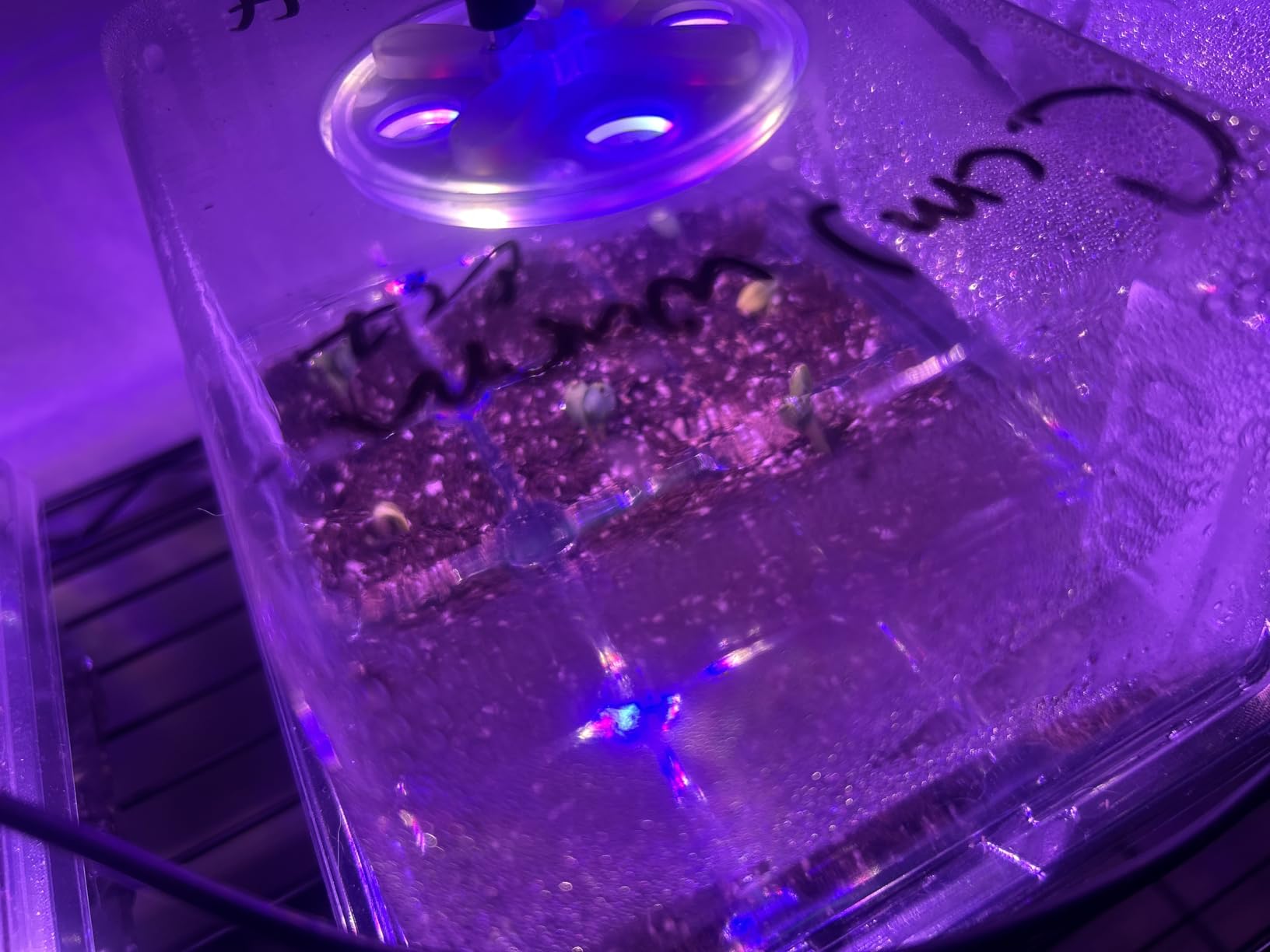
Five separate 12-cell trays means you can spread a small sowing across five windowsills or shelves instead of crowding one surface. Each tray gets its own 12-LED full spectrum light bar mounted on a vented clear cover, and one 1-to-5 USB cable runs all five.
The elevated dome with a ventilation insert keeps humidity high through germination, then lets you open airflow without removing the light. Drainage holes in each cell support bottom watering and let the trays sit on a compatible heat mat.
Where this kit performs best
It suits apartment growers and anyone with several small sunny spots rather than one long shelf. Dividing a sowing across five locations also lets you match each tray to a different crop.
Clear walls are a genuine advantage for slower seeds like parsley or cilantro, where uneven germination is common and you want to see what is happening below the surface.
Where it falls short
There is no timer and no power adapter in the box. You need a 5V 2A source and an external timer or smart plug to automate the light cycle.
The light is fixed at the top of each dome, so you cannot raise it as seedlings stretch. Treat these as supplemental light rather than a primary source for leggy-prone crops.
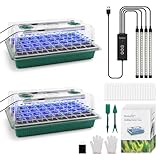
5. BlumWay 80-Cell Tray with Grow Light: Best Even Light Coverage
BlumWay Seed Starter Tray with Grow Light, Humidity Dome, 2 Pack 80 Cells
Two 40-cell trays with four light strips
80 LED beads
9cm dome, 1.96 inch cells
Pros
- Four full spectrum strips spread light evenly across the whole tray
- 1.96 inch deep cells and 0.31 inch drainage holes support strong roots
- 9cm dome gives seedlings room to stretch before transplanting
- 3 lighting modes with 3 timer settings and 5 brightness levels
- Thickened anti-UV ABS plastic that survives many seasons
Cons
- Deep cell design makes the 2-pack bulkier than single-tray kits
- Timer tops out at 12 hours rather than offering longer photoperiod options
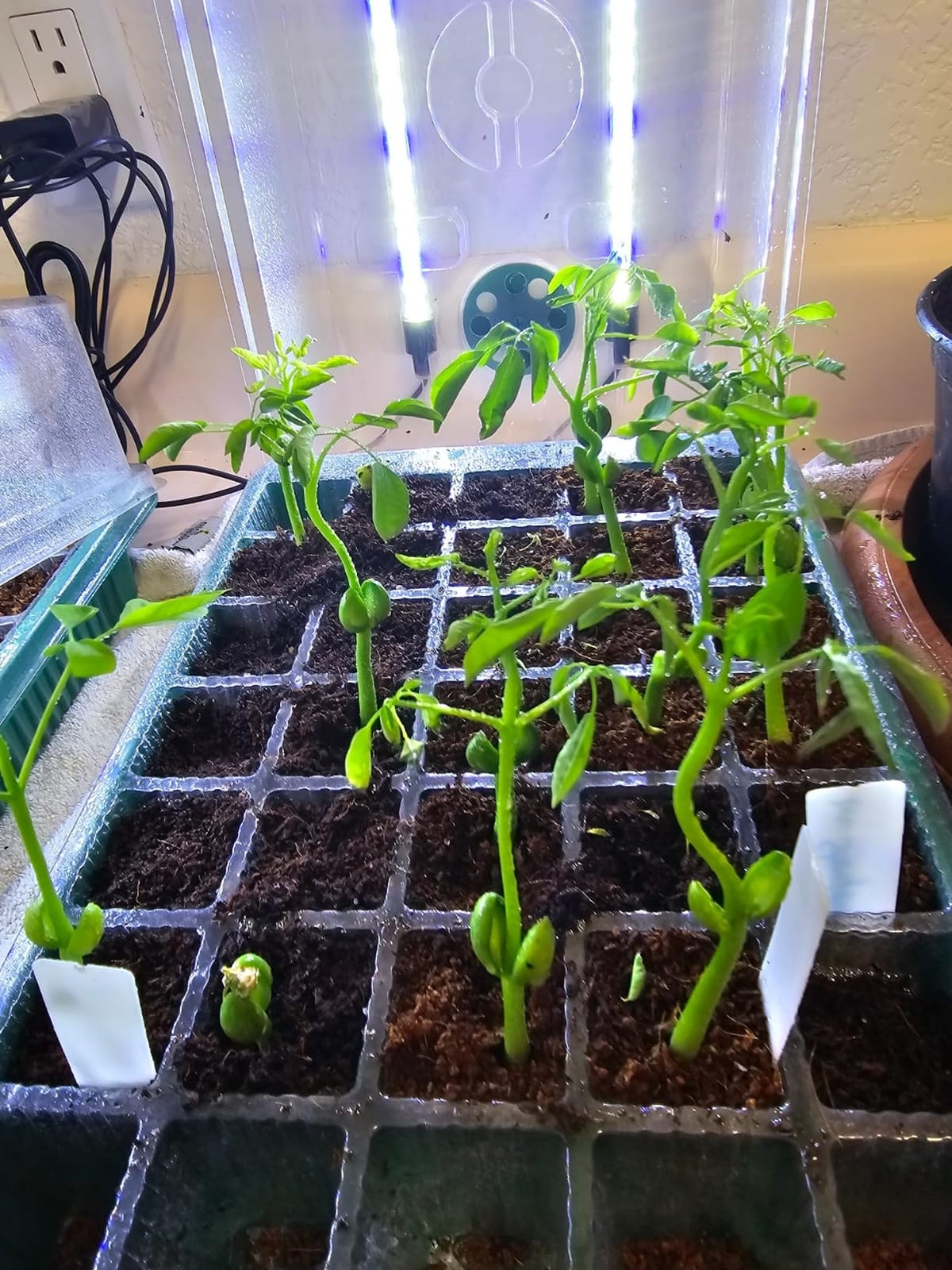
Light uniformity is the problem this kit solves. Four full spectrum strips with 40 LED beads each spread coverage across the entire tray rather than concentrating it in the center, and the even canopy is visible when you look at a dense brassica flat.
Uneven light produces uneven seedlings. The outer cells of a tray under a single centered bar stretch while the middle cells stay compact, and you end up potting on two very different growth stages.
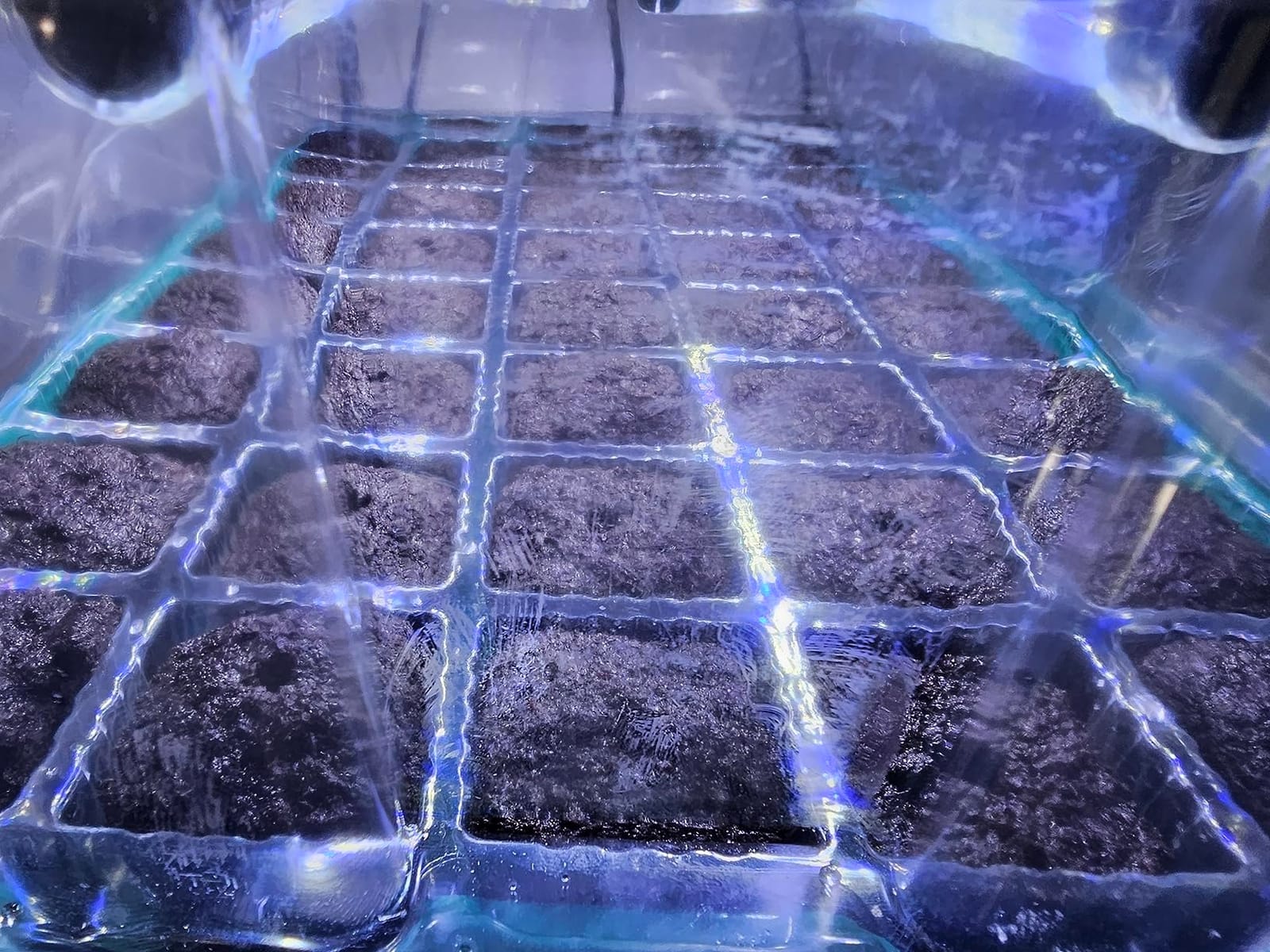
The cells are 1.96 inches deep, deeper than most trays in this group, with 0.31 inch drainage holes. Deeper cells give roots more vertical run before they circle, which is the closest thing these plastic systems get to air pruning.
Control runs through 3 lighting modes, 3 timer settings at 3, 6 or 12 hours, and 5 brightness levels, with a color-coded indicator on the timer so you can read the setting at a glance.
Where this kit performs best
It suits growers who fill a tray densely and want uniform seedlings across the whole surface. Even coverage matters most for brassicas, which are typically sown thick.
USB and included plug options mean it fits a seed shelf with no wall outlet nearby, or a countertop setup with one.
Where it falls short
The deep cells and two-tray pack make this physically bulky. If your seed shelf is limited, the footprint is the first thing you will notice.
The timer maxes out at a 12-hour photoperiod. If your setup needs a longer day to hit a target light integral, you will need a separate timer.
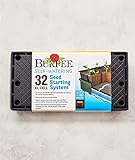
6. Burpee XL Self-Watering 32-Cell System: Best for Deep-Rooted Crops
Burpee XL Self-Watering Growing System Indoor Seed Starting 10″ W x 20″ L x 5″ H, 1 Kit (32 Cells)
32 XL cells, 2 inches deep
Self-watering mat included
32 coir pellets
Pros
- Self-watering mat keeps cells evenly moist and curbs overwatering
- 32 extra-large cells suit tomatoes peppers and eggplants
- Complete kit with trays stands coir pellets dome markers and diagrams
- Coir pellets hold enough moisture to bridge short absences
- Deep sturdy plastic built for multiple seasons
Cons
- Included dome is only about 2 inches tall and too short for tall crops
- Seedlings are hard to extract and the mix tends to crumble at transplant
- Filled trays are heavy and the dome slips off easily
Cell depth is the headline number here. At 2.25 by 2.25 inches and 2 inches deep, these are among the largest cells in the group, and tomatoes and peppers both reward the extra root run with sturdier transplants.
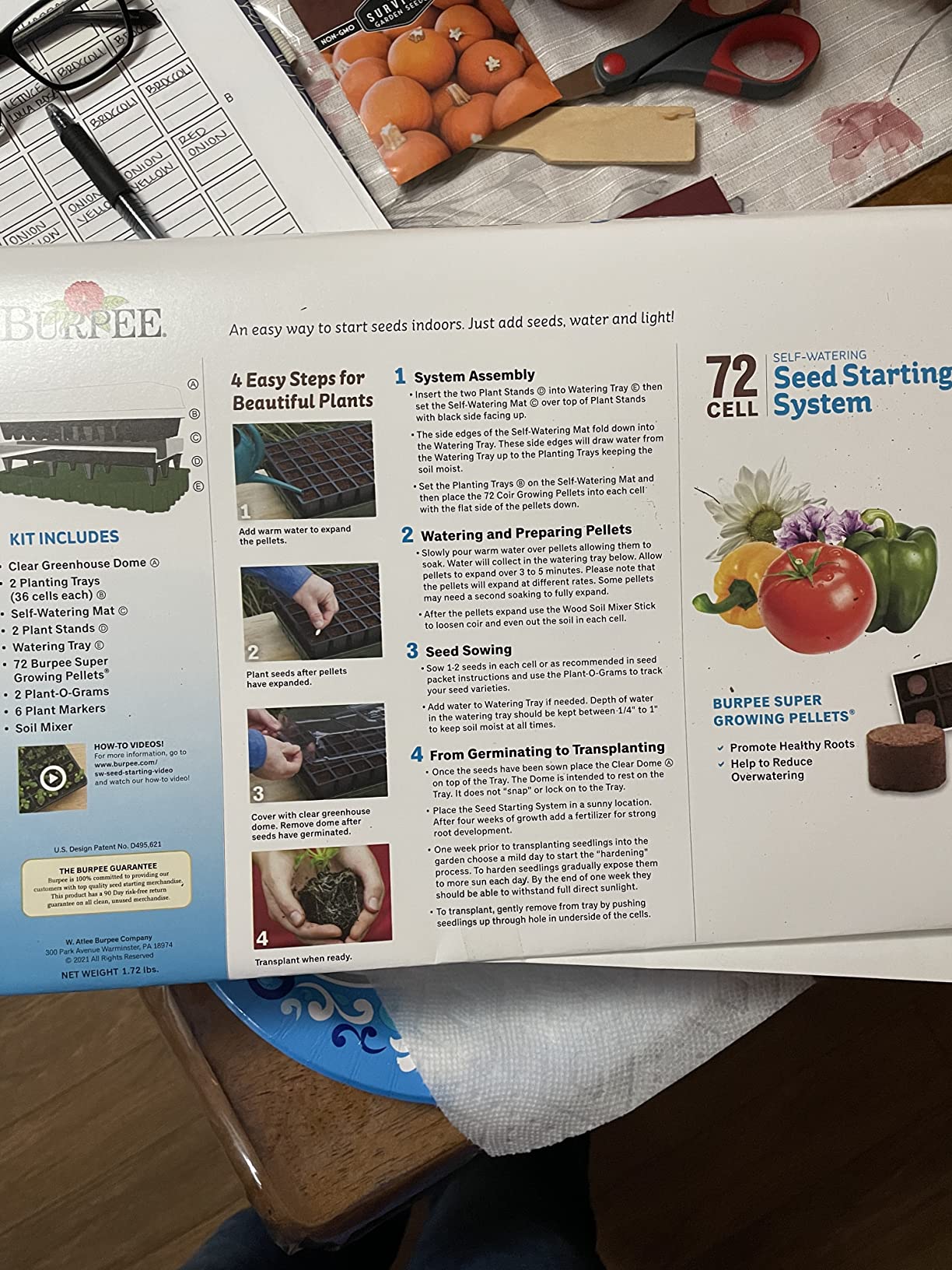
The self-watering mat wicks moisture up from the water tray into each cell through capillary action. During a six-week run that meant I topped the reservoir up roughly every third day rather than daily, and the coir pellets never fully dried out.
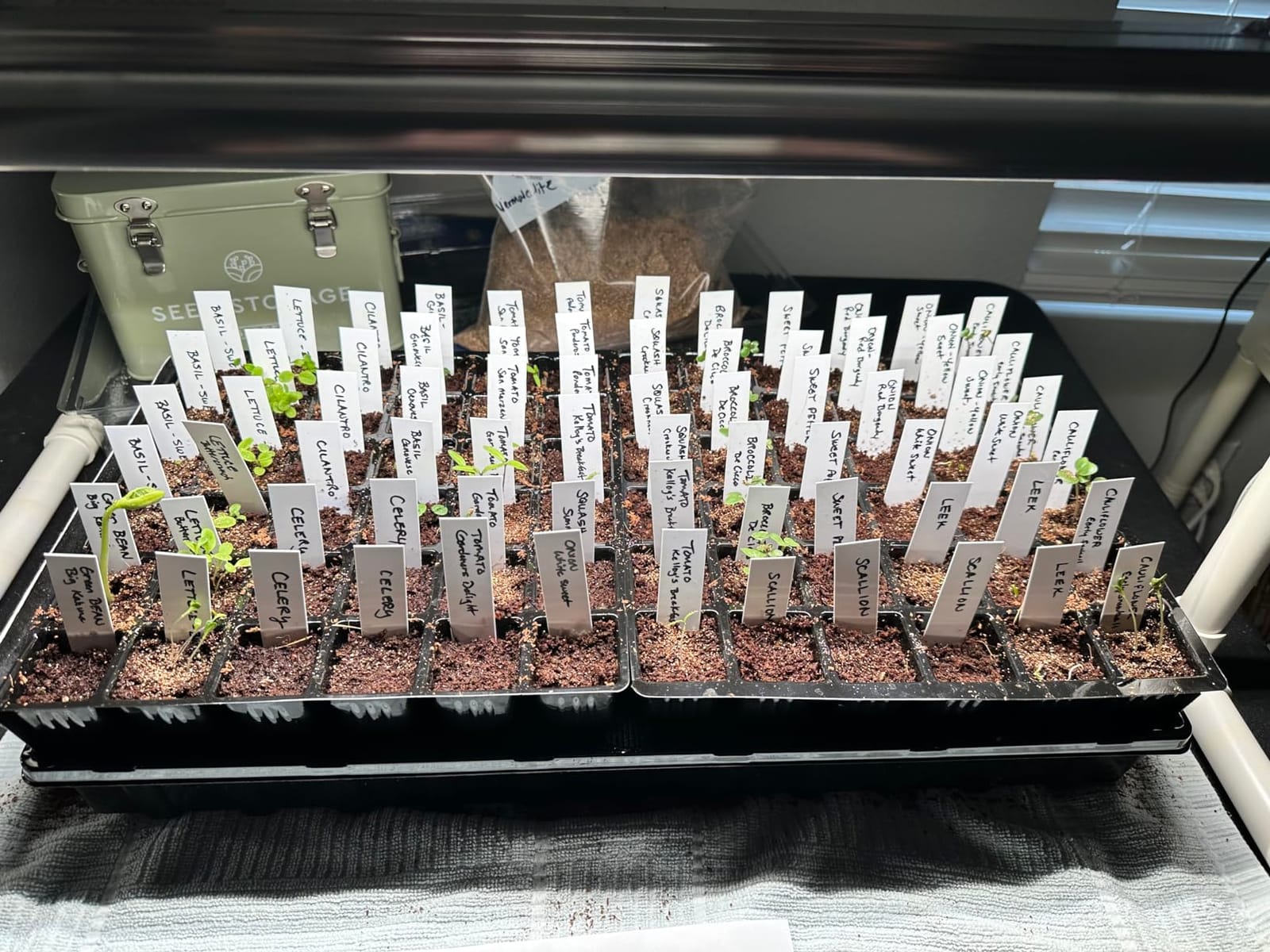
Everything is in the box: two 16-cell trays, plant stands, a self-watering mat, a water tray, 32 coir pellets, a dome cover, two Plant-o-Gram diagrams and six markers. For a first season, the pellet-and-tray combination means you can sow the same day it arrives.
Burpee recommends pairing this kit with a heat mat for faster germination, which fits well with warm-season crops that need bottom heat anyway.
Where this kit performs best
It suits tomatoes, peppers and eggplants, the crops where cell size and consistent moisture matter most. If you take a holiday in the middle of a sowing, the reservoir buys you several days.
It also suits anyone who prefers a fully stocked first box over assembling trays, medium and domes separately.
Where it falls short
The dome is the real limitation. At roughly 2 inches of clearance, it cannot cover a tomato past the cotyledon stage, so you will be removing and propping it almost immediately.
Extraction is harder than with silicone cells, and the coir mix tends to crumble as you pull. Reviewers also report the filled tray is heavy and awkward to move.
7. YAUNGEL 6-Pack Seed Starter Kit: Best for Vertical Shelf Space
YAUNGEL Seed Starter Tray with Grow Light, 6 Pack Seed Starter Kit with Timing Controller Adjustable Brightness, Thicken Seedling Starter Trays with Humidity Domes Heightened Lids, Gift Box
Six kits with 16 LEDs each
Controller with 4 timer settings
50 to 100 percent humidity
Pros
- Six units give strong parallel starting capacity
- 16 full spectrum LEDs per tray across six trays
- Intelligent controller automates 4 8 12 or 18 hour cycles
- Raised dome gives extra headroom with humidity adjustable 50 to 100 percent
- 20 plant labels included
- Arrives in a gift box
Cons
- Power adapter not included
- Shared controller means each tray cannot be programmed separately
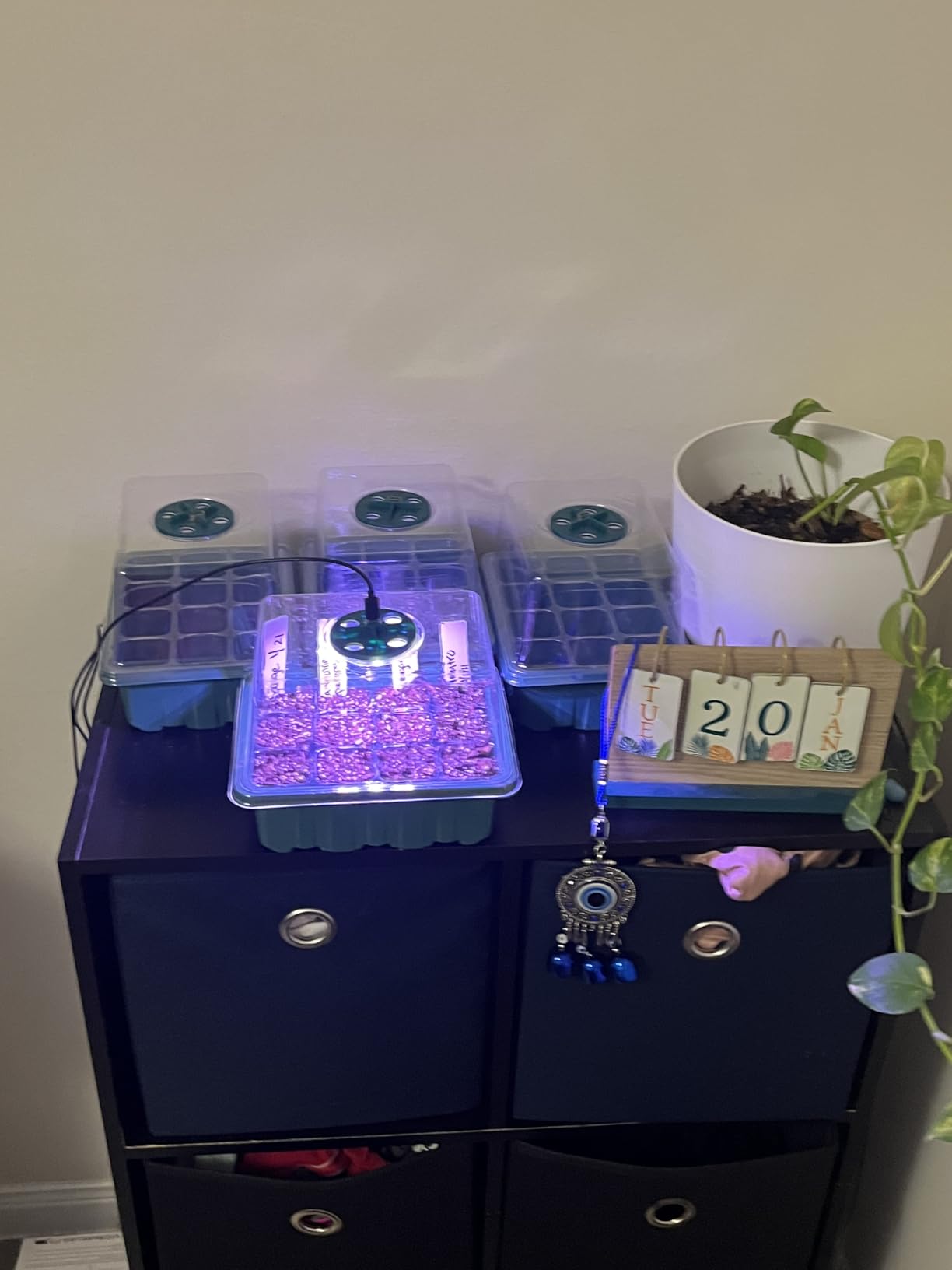
Six small trays stack across a narrow shelf better than one large flat, and that is the whole argument for this kit. Each unit measures roughly 5.6 by 5.5 inches, so you can fill an entire tier with plantings and keep each variety on its own timer-free schedule.
The 18-hour timer setting is a genuine advantage. Most kits in this roundup top out at 12 hours, but many vegetables do better with a longer photoperiod once they are past germination.
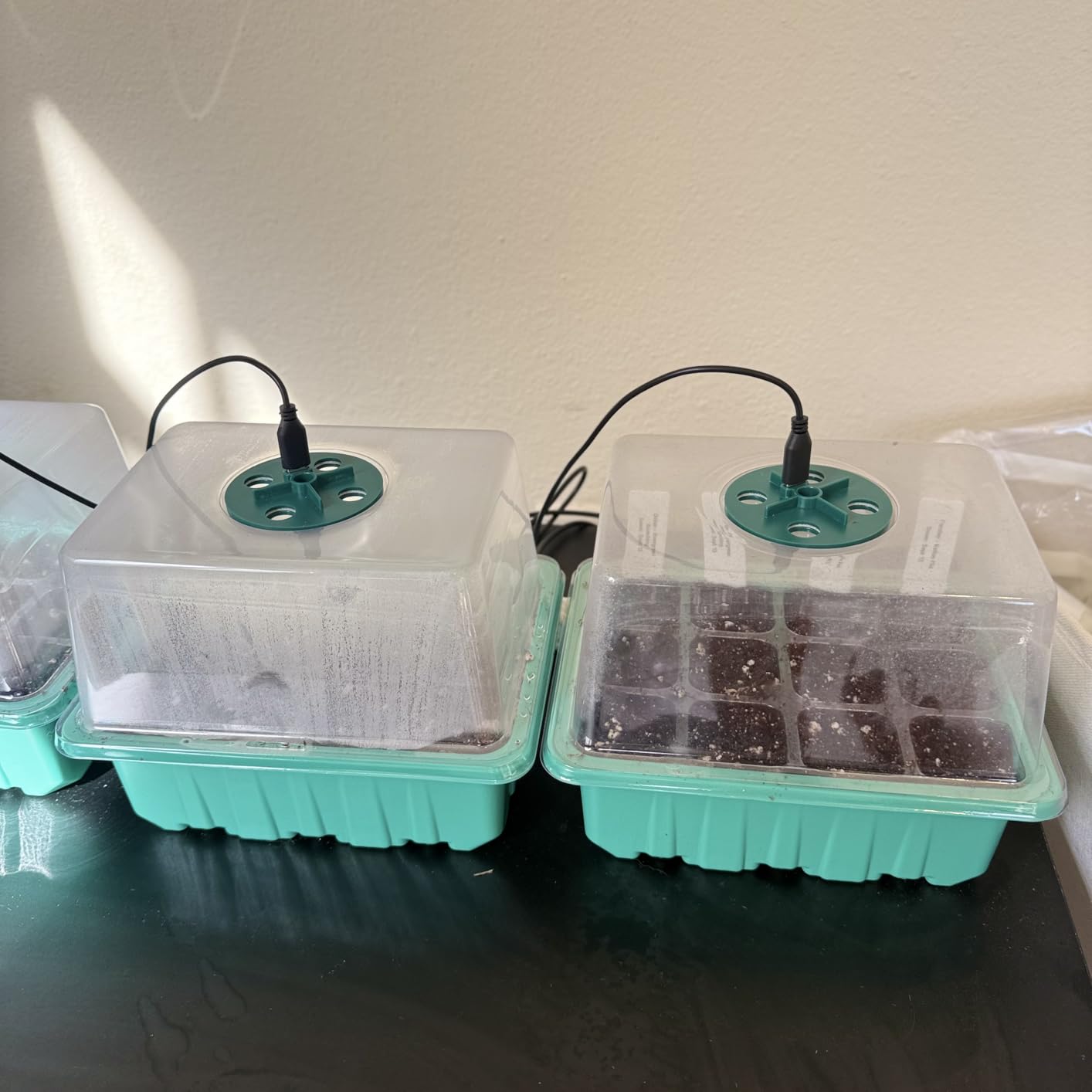
The shared intelligent controller handles brightness and timing for all six trays at once, so you set the cycle once in the morning instead of touching six switches. The raised dome also adjusts humidity from 50 to 100 percent through a rotating window.
Sixteen LEDs per tray run full spectrum, and 20 plant labels come in the box, which is enough to sort a mixed spring sowing without hunting for stakes.
Where this kit performs best
It suits small-space growers who have shelf height to use and floor area they do not. Vertical stacking is the natural way to run six units on one tier.
It is also a good first kit for someone who wants variety rather than volume, since each tray can hold a different crop at a different growth stage.
Where it falls short
One controller drives all six lights, so you cannot run a herb tray on a short day and a tomato tray on a long one. That flexibility matters later in the season.
As with several kits here, the power plug is not included, so plan for a separate adapter or a powered USB hub.
8. MIXC 6-Pack Seed Starter Kit: The Sturdiest Plastic in the Roundup
MIXC 6 Pack Seed Starter Kit with Grow Light, Vented Humidity Dome, Green
Six 12-cell packs, 72 cells
1.5 x 1.5 x 2 inch cells
Side grip stackable bases
Pros
- Thicker reusable plastic than most trays in this price tier
- Elevated adjustable humidity domes give seedlings extra room
- Clear trays let you watch water levels and root development
- Side grips on the base make transplanting less destructive
- Units stack neatly for storage between seasons
Cons
- Dome is short for fast-growing tomatoes that reach the lid
- Lights and wiring run hot during use
- Lids rest on the base rather than securing
Buyers consistently describe this as the sturdiest tray they have used at this level, and after a full season of handling I agree. The plastic is noticeably thicker than the lightweight polypropylene used by several cheaper kits, and nothing flexed or cracked when I lifted a saturated tray.
Six packs of 12 give 72 cells in total, with 1.5 by 1.5 by 2 inch cells and bottom drainage holes. That is a reasonable cell size for herbs, brassicas and lettuces.
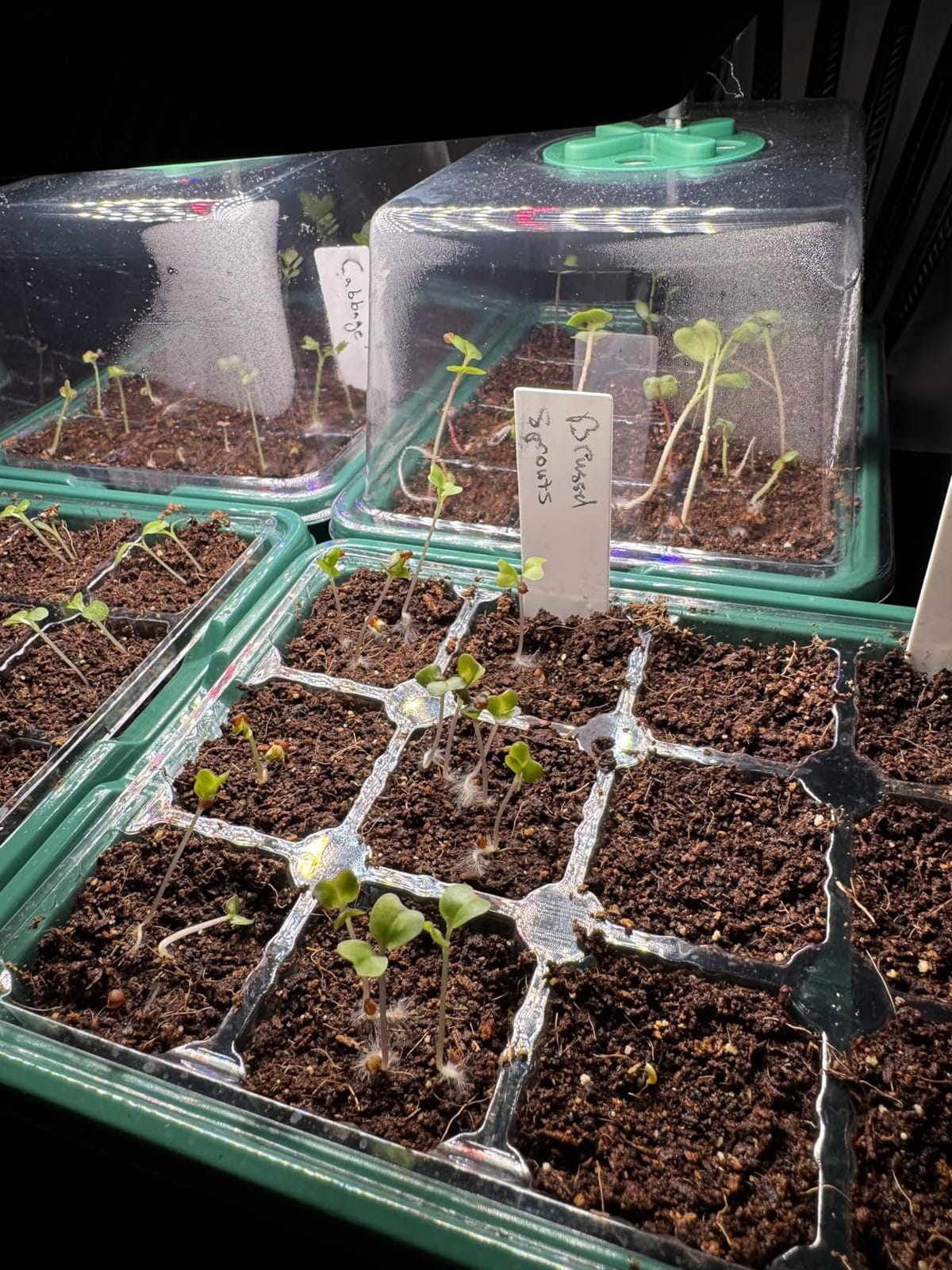
The side grips on the base tray are the detail I used most. You squeeze both ends and lift the inner clear tray out for transplanting, rather than trying to pinch a seedling and pull.
Clear walls again help with watering decisions, and the perforated humidity discs give per-tray control so you can keep a slow-germinating tray covered while a fast one gets air.
Where this kit performs best
It suits growers who want trays that survive a decade of storage and repeated washing. The stacking design means they disappear onto a shelf when the season ends.
For mixed sowings of herbs and salad greens, the per-tray humidity control and clear viewing make it easy to run each crop at its own pace.
Where it falls short
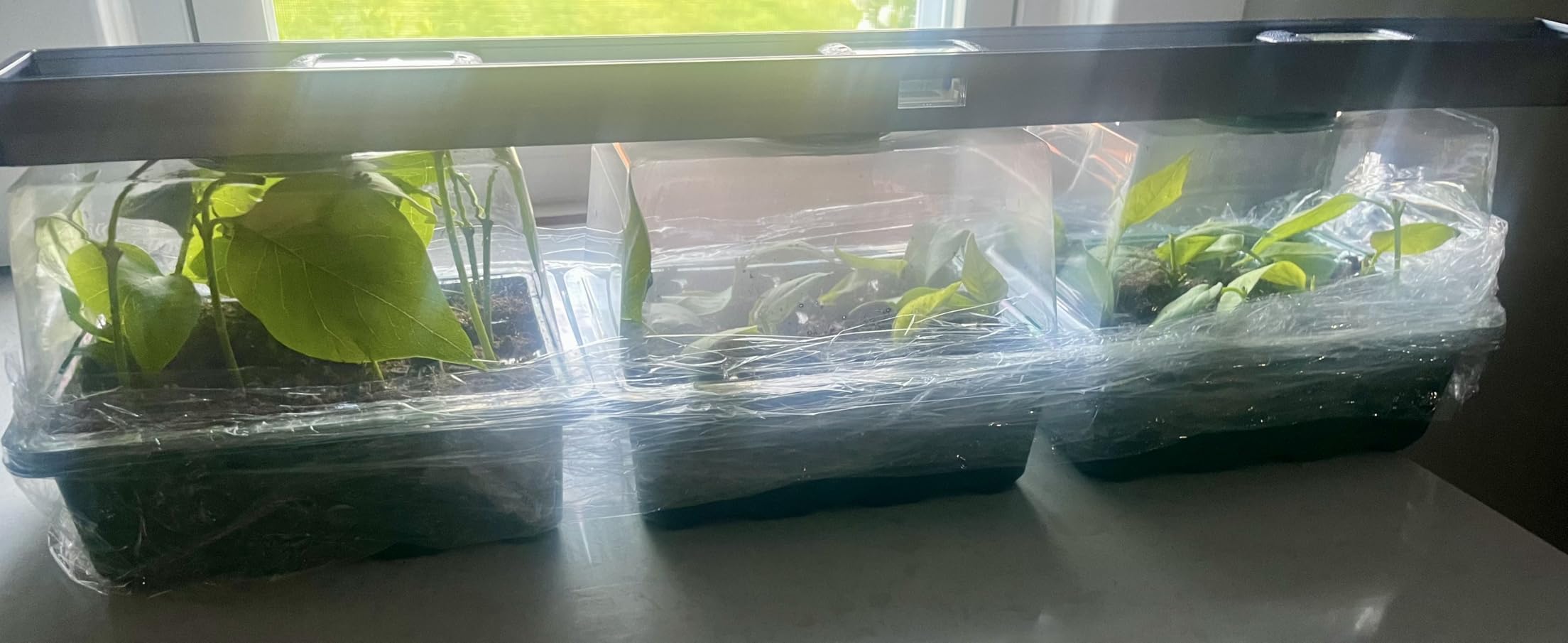
The dome is short for tall crops. Tomatoes reach the lid quickly, and because it rests rather than clips, it has to be propped open.
Reviewers note the lights and wiring run warm during use, so give the unit airflow and do not stack powered trays directly on each other.
9. Yskea 6-Pack 12-Cell Seed Starter: The Budget Pick for First-Time Growers
Yskea Seed Starter Tray with Light, 6PCS Seed Starter Kit with Grow Light, Seedling Starter Trays with Humidity Domes, Covers Height 3.9″, Indoor Gardening Plant Germination Trays (12 Cells per Tray)
Six 12-cell packs, 72 cells
3.9 inch dome height
Vents for 50 to 100 percent humidity
Pros
- Lowest entry cost of the light-equipped kits in this roundup
- 72 planting spaces across six trays
- Adjustable circular vents dial humidity from 50 to 100 percent
- Full spectrum grow light included for each tray
- Non-toxic reusable polypropylene
Cons
- Small 12-cell footprint means more frequent filling and watering
- Light strips have no brightness or height adjustment as seedlings grow
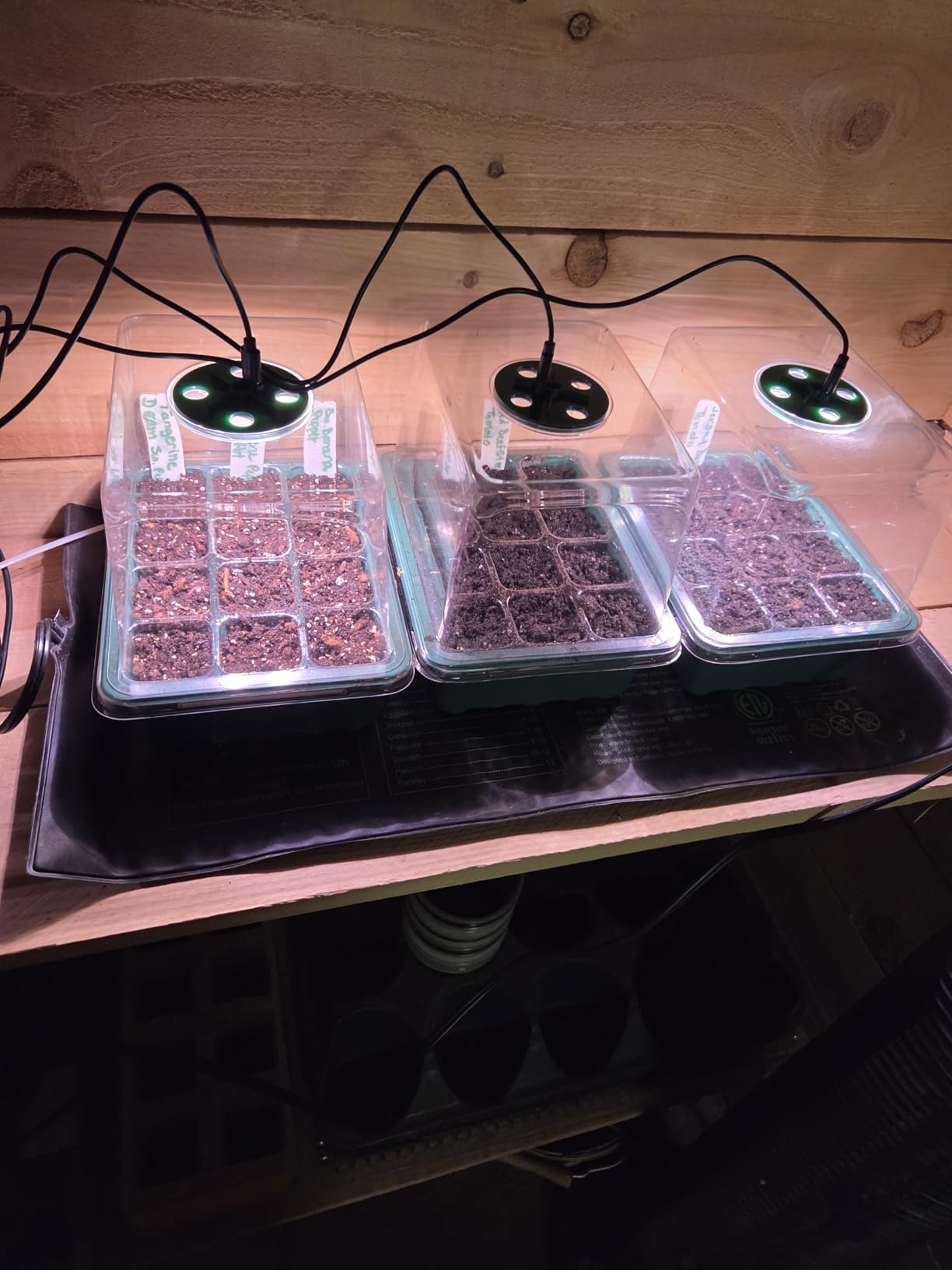
This is the kit to buy if seed starting has to be cheap and you are not sure you will stick with it. Six packs of 12-cell trays, six humidity domes and six grow lights cover a full spring sowing at the lowest entry point in this group.
The 3.9 inch dome is taller than several competing kits, which is a real advantage for brassicas that grow upright quickly after emergence.
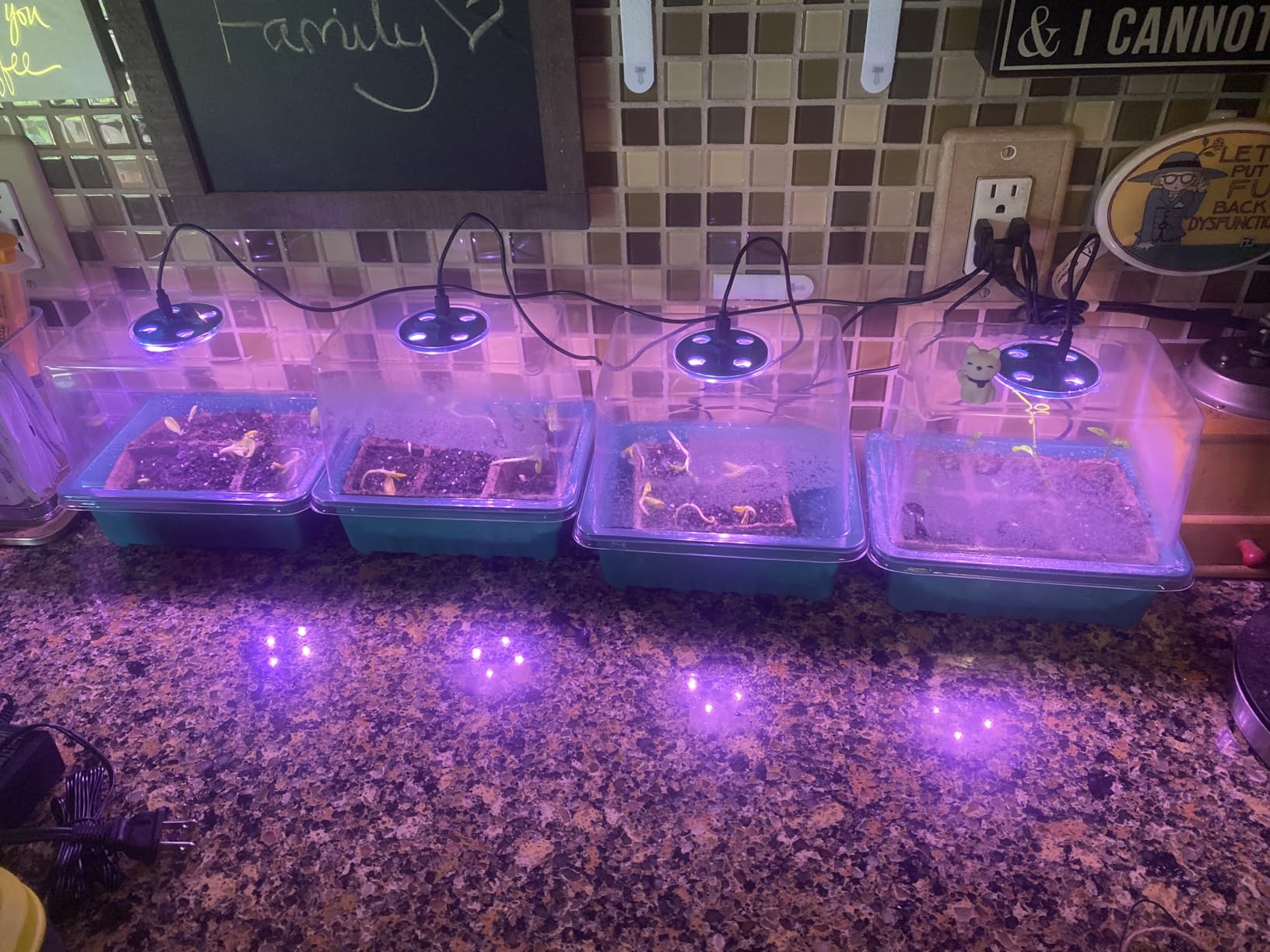
Circular vents in each transparent dome let you move humidity between 50 and 100 percent, so you can crack them open without removing the cover. That is how you walk seedlings back from the germination stage toward normal room air.
The trays are polypropylene, described as non-toxic and reusable over the long term. In practice, rinsing and reusing them across seasons is straightforward.
Where this kit performs best
It suits a first season, a school or community group project, or anyone who wants a complete setup spread across several rooms. Six separate trays can each sit under a different window.
For lettuce, kale, cilantro and other quick crops, the 12-cell format is convenient because you can sow small batches and repeat them.
Where it falls short
Twelve cells is a small footprint, so you will be filling and watering trays more often than with a single 40 or 60-cell flat.
The light strips are simple, with no brightness control and no way to raise them. Plan to move seedlings under stronger light once true leaves appear.
10. GROWFRIEND 40-Cell Kit with Heat Mat: The Most Complete Box
GROWFRIEND Seed Starter Kit with Grow Lights & Heat Mat – 40-Cell Seed Starter Tray, Humidity Dome, Soil Moisture Meter & Sticky Gnat Traps – Indoor Greenhouse & Plant Propagation Station
40-cell tray with dual LED bars
10 x 20 inch heat mat
Soil meter and gnat traps
Pros
- Widest bundle in the roundup with tray lights mat dome meter and gnat traps
- Adjustable brightness on the dual LED bars for herbs or microgreens
- 10 x 20 inch waterproof heat mat wipes clean easily
- Clear dome with vents for airflow and mold control
- Thick plastic tray resists bending across seasons
Cons
- Lowest average rating of the kits reviewed
- Heat mat and lights add bulk and take countertop space
Nothing else in this roundup ships with this much in one box. You get a 40-cell tray, a base tray, dual LED bars, a waterproof heat mat, a humidity dome, a three-in-one soil meter, sticky gnat traps and an eBook.
The soil meter is the sleeper item. Beginners overwater constantly because they cannot see moisture below the surface, and a meter that reads the root zone takes most of the guesswork out of the first few weeks.
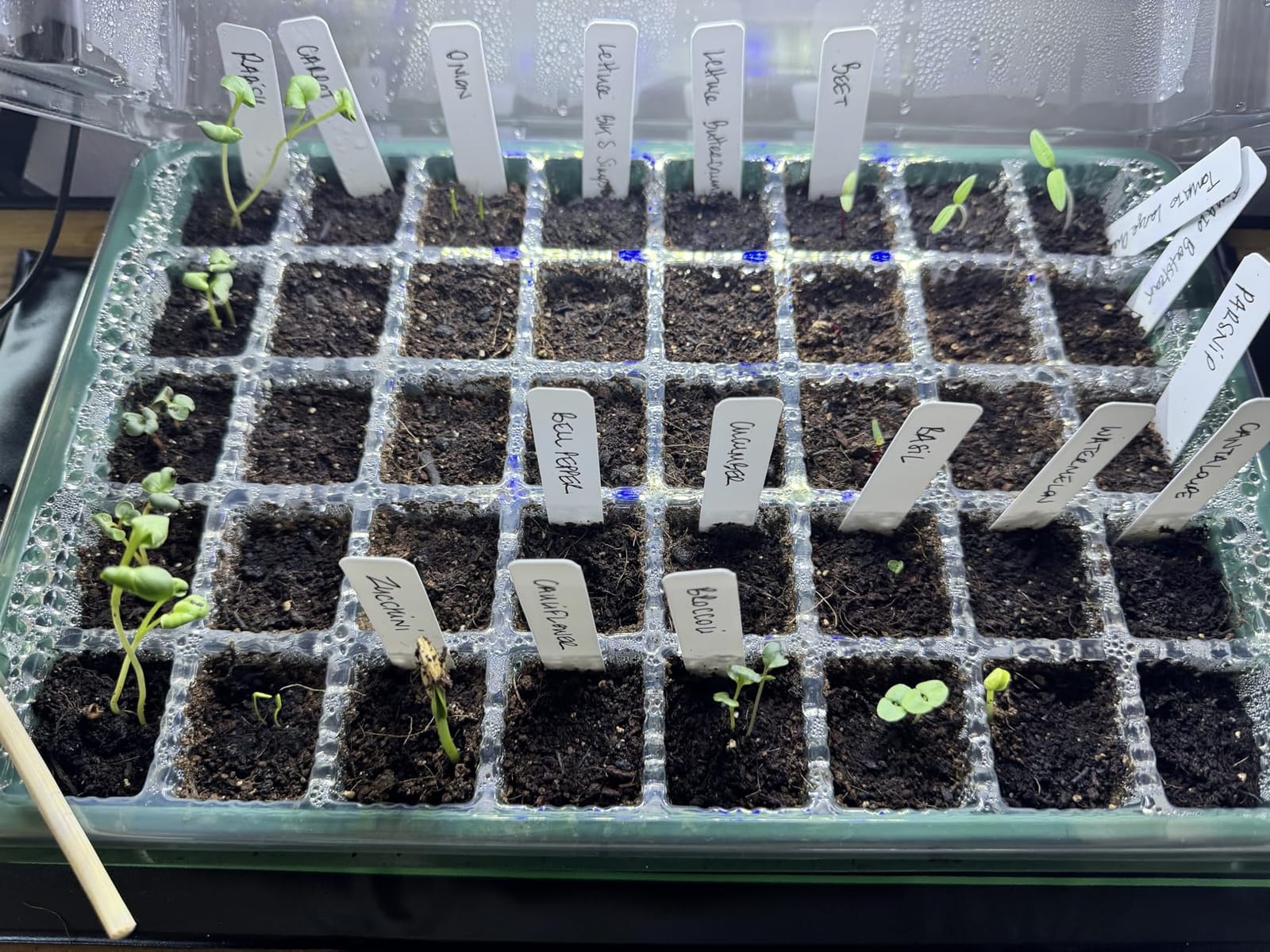
The heat mat is 10 by 20 inches and waterproof, so you can wipe it down instead of protecting it from splashes. The dual LED bars carry 16 white and 4 blue LEDs each, with adjustable brightness for moving between microgreens, herbs and flowers.
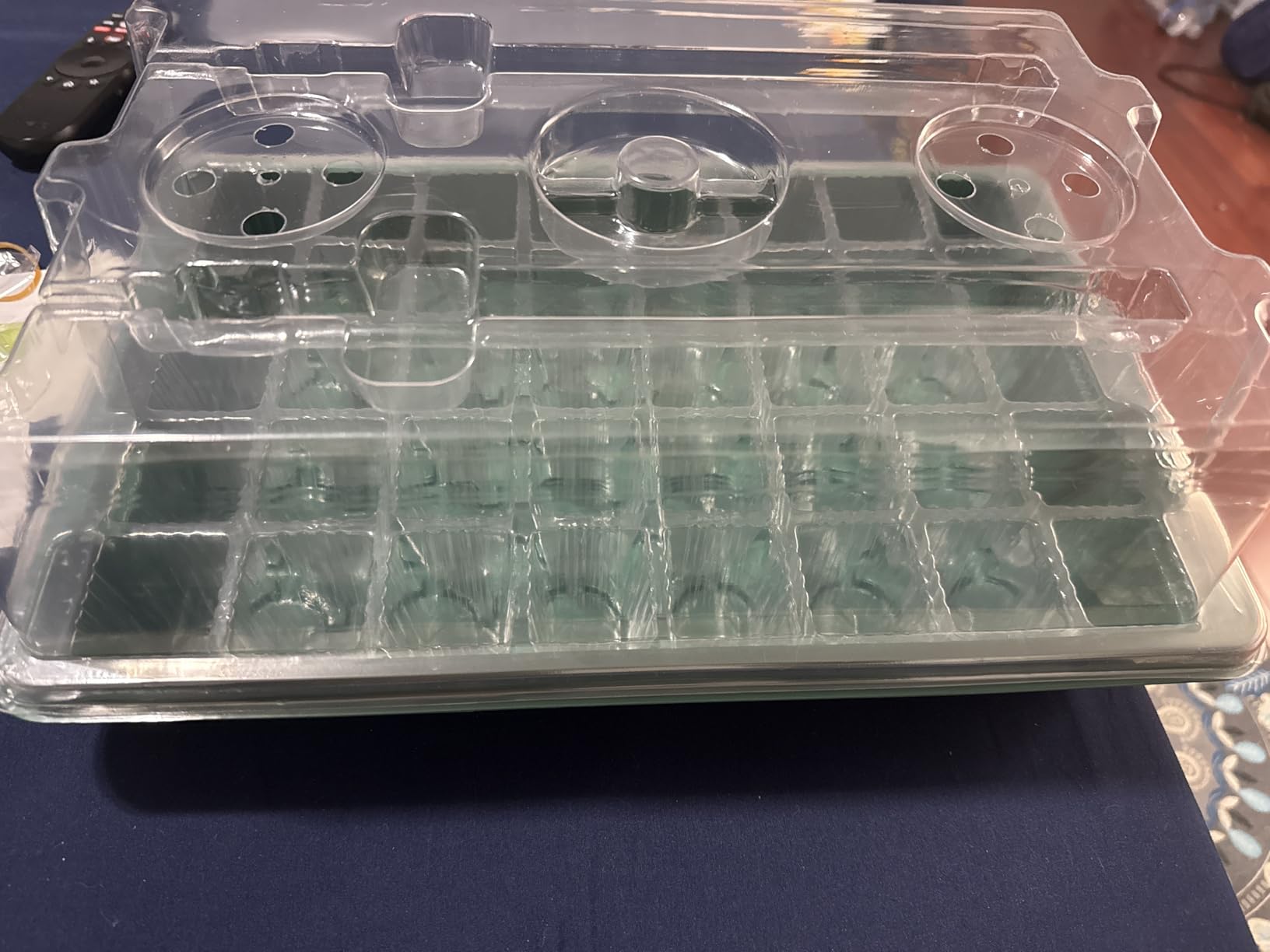
Overall build is thick and resists cracking, and the clear dome has vents to manage airflow. The kit is genuinely well engineered, which is reflected in the number of people buying it as a gift.
Where this kit performs best
It suits a first-time grower who wants a single purchase instead of assembling tray, mat, light, dome and meter separately. It also fits growers running microgreens, which benefit from the adjustable light.
The gnat traps are a genuine help later in the cycle, when fungus gnats appear in consistently moist media.
Where it falls short
Its average rating is the lowest in this group, and a double-digit share of ratings are one star. Expect more mixed feedback on durability of the electronics over time.
Everything together takes real countertop space for only 40 cells, and the heat mat and lights both need somewhere safe to sit.
11. Patigrow 120-Cell Self-Watering Kit: Best for High Volume
Patigrow 120-Cell Self-Watering Seed Starter Tray with Grow Light, Seed Starter Kit with 4.07” Humidity Dome, Indoor Seedling Starter Tray, Seed Starting Trays for Plant Germination, Seeds Growing
120 cells across two 60-cell trays
Capillary mats and stands
56 LED beads per tray
Pros
- Largest cell count of the light-equipped kits at 120 cells
- Self-watering capillary system reduces overwatering and watering frequency
- 56 LED beads per tray with adjustable brightness and timer
- Two adjustable vents per tray plus enlarged drainage holes
- Support stands raise the tray with 20 labels and tools included
Cons
- Reservoir refill is awkward once the tray is full of plants
- Some units report poor wicking contact so cells dry despite water in the reservoir
- LED bars are too dim for strong seedlings on their own
- Bottom drainage holes too small to push seedlings through at transplant
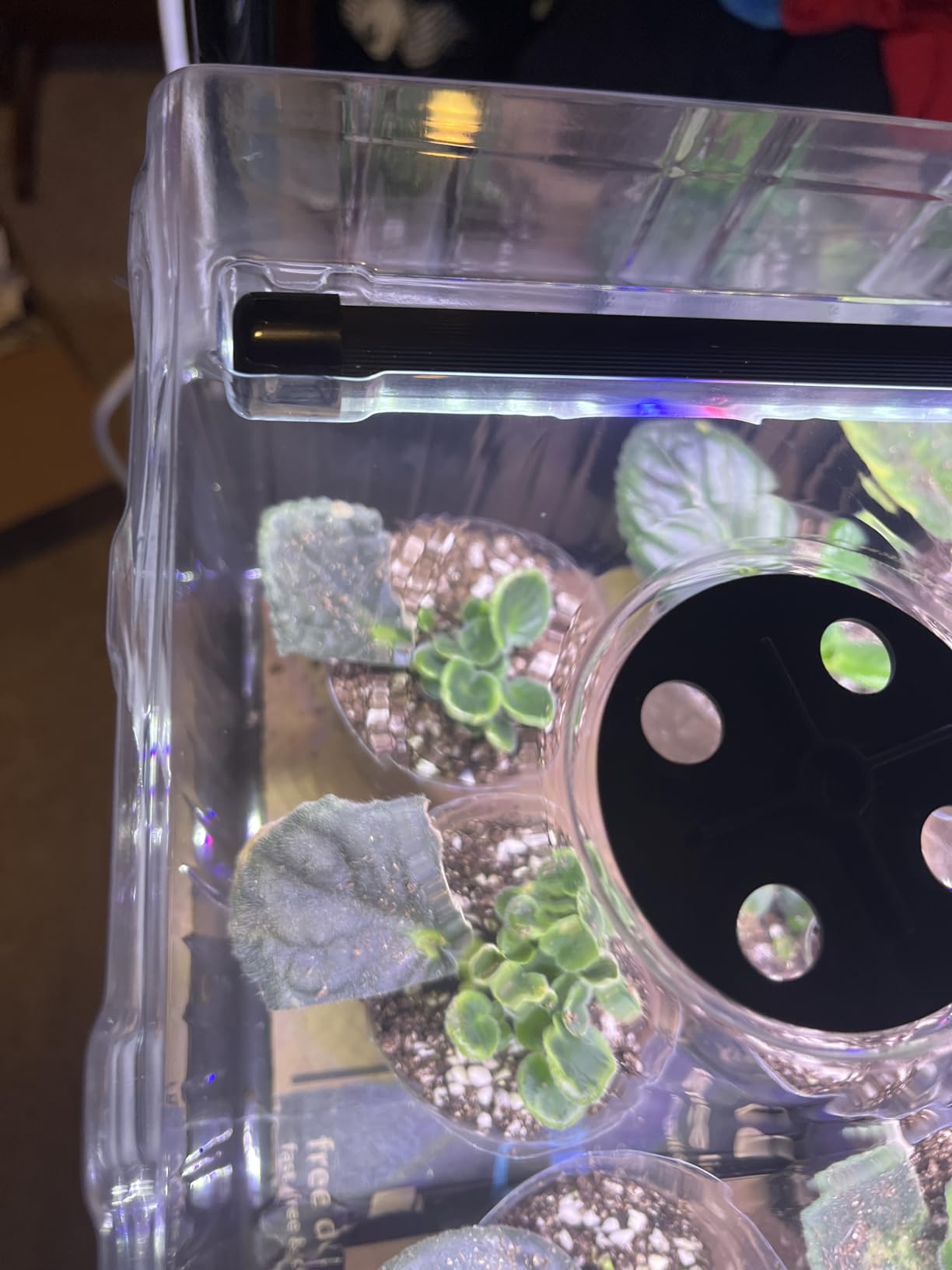
Capacity is the reason to look at this kit. Two 60-cell trays give 120 planting spaces, and unlike the 120-cell trays sold as thin single-use plastic, these are 1.5mm BPA-free PET with stands, capillary mats and lights.
The self-watering design is genuinely hands-off during the middle of a cycle. Capillary mats wick from the base reservoir into the cells, which means the top layer dries while the roots still have water below.
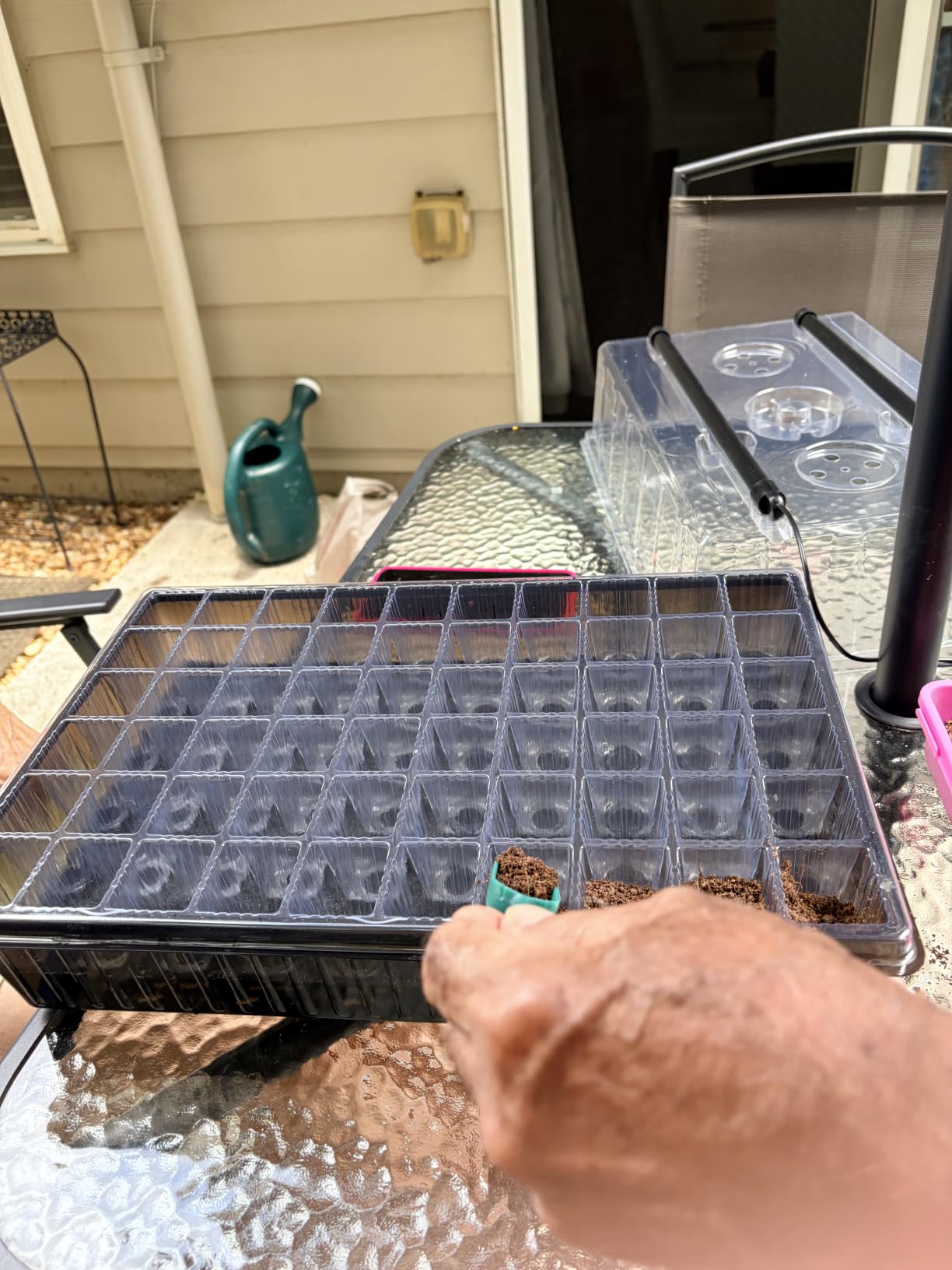
Lighting is four LED strips with 56 high-efficiency beads per tray, plus brightness and timer control. Support stands lift the tray so light reaches lower leaves as plants fill out, and 20 plant labels come included.
Two adjustable vents per tray give reasonable humidity control, and the enlarged drainage holes help excess water leave the root zone.
Where this kit performs best
It suits growers sowing large batches, sharing seedlings, or running succession plantings where you want a second wave started while the first is still under light.
The support stands are a genuine advantage for dense plantings, since they let light reach into the canopy instead of only across the top.
Where it falls short
Refilling the reservoir is awkward once the tray is full, and there is no side fill spout. Some buyers also report wicking felt that does not contact the medium well, so cells can dry out despite a full reservoir.
The LED bars are too dim to carry seedlings alone past week two, and the small bottom drainage holes make it hard to push seedlings out at transplant time.
12. LetPot Smart Seed Starter with App Control: Best Fully Integrated System
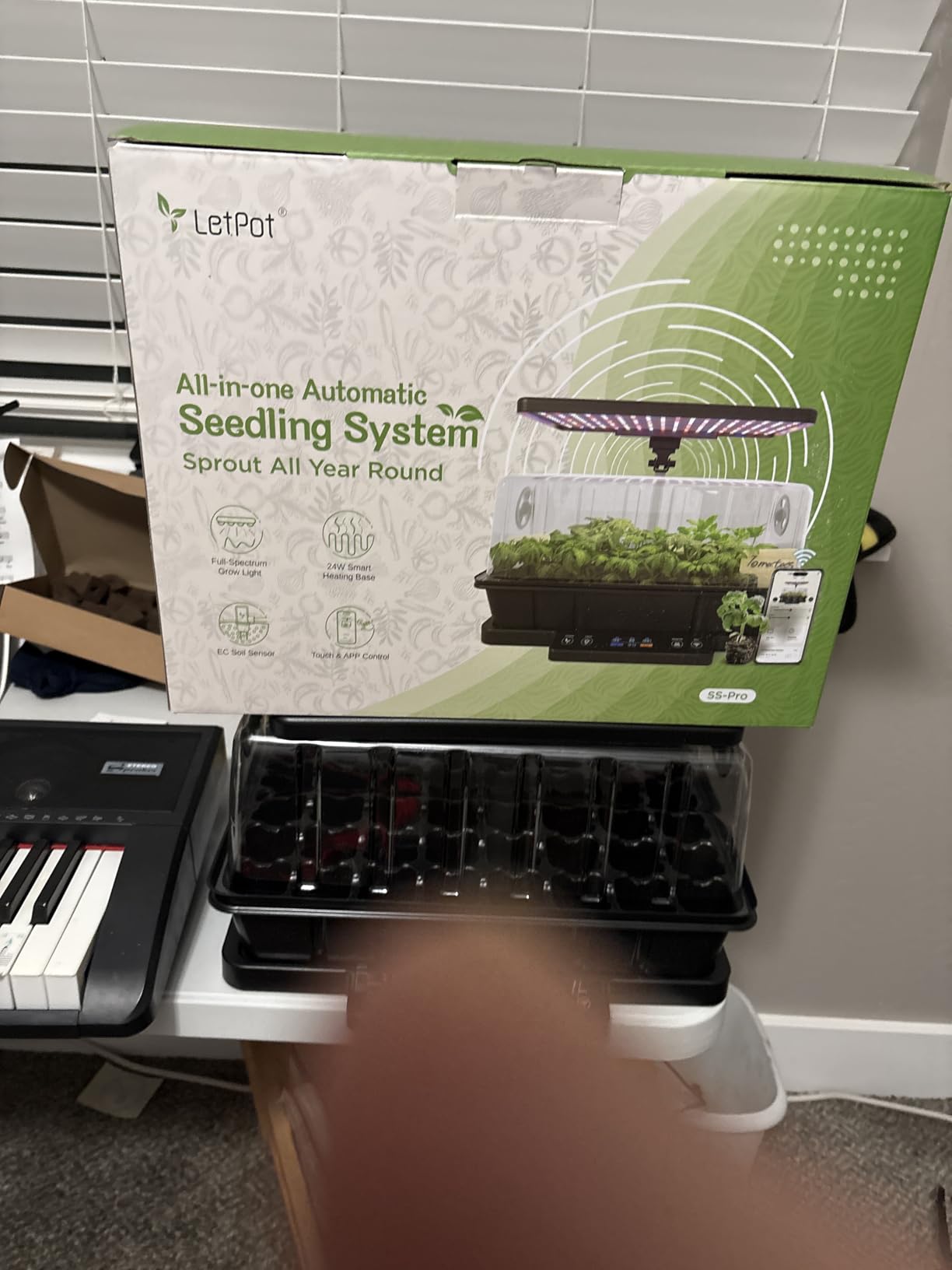
LetPot Smart Seed Starter with Humidity Dome, Germination Kit with Waterproof Seedling Mat, 24W Full Spectrum LED Grow Light, Smart Heating Base, EC Soil Sensor & App Control for Indoor Seed Starting
40 cells in one unit
24W full spectrum LED
24W heating base with soil EC sensor
Pros
- Only fully integrated system with light heating sensors dome and app in one unit
- 24W full spectrum panel gives uniform coverage across all 40 cells
- Real-time soil EC and temperature readings on the display and in the app
- Extra-tall dome with vents and a condensation-capture edge
- Grow sponges transplant without disturbing roots
Cons
- Smallest cell count of the light-and-heat systems at 40 cells
- Heaviest build and smallest review base in the roundup
- App setup adds complexity for growers who just want a tray
This is the newest system here and the only one that treats seed starting as a monitored process rather than a set of separate accessories. Light, heat, sensors and humidity control all live in one enclosure you plug in once.
The 24W full spectrum panel is the strongest light in the group and rotates 180 degrees while adjusting in height, so you can set the canopy distance properly as seedlings grow. That is the single most common cause of leggy growth, and this panel addresses it directly.
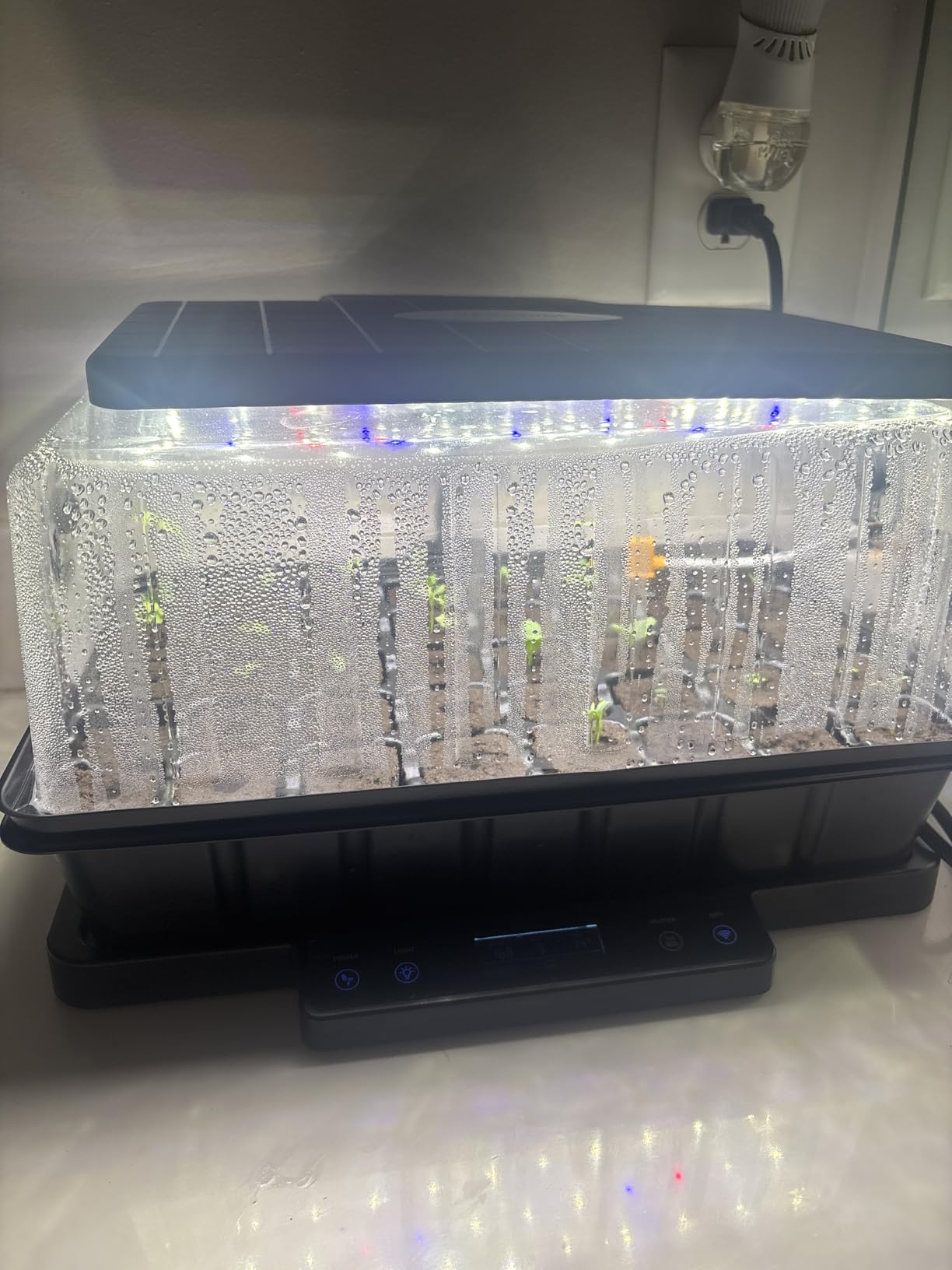
The 24W heating base runs a smart day and night cycle, and the built-in sensors report soil EC and temperature on the touch display and in the app. Watching the temperature trace caught a heat mat overheating problem in my own setup that I would otherwise have missed.
The dome is extra tall with adjustable vents, and its condensation-capture edge returns water to the tray rather than dripping it onto seedlings. The included grow sponges transplant cleanly without disturbing roots.
Where this system performs best
It suits growers who want measurable data rather than guesswork, and anyone starting a crop where a temperature miss means a failed sowing. Peppers are the classic case.
It also fits a single-shelf setup, since everything is designed to work together in one footprint instead of as a stack of mismatched parts.
Where it falls short
Forty cells is the smallest capacity here, and at 5.73 pounds it is the heaviest, so you are not moving a full tray up and down a staircase.
Its review base is far smaller than the established kits, so long-term durability reports are thin. App setup also adds a layer of complexity if you only want a tray.
How to Choose an Indoor Seed Starting System
Most buyers pick on capacity or price and regret it. The four variables that actually change your results are cell size and depth, light strength and adjustability, humidity control, and how you water.
Cell size and depth. Small cells dry out fast and root-bound seedlings stall when transplanted. Anything at 1.5 inches square or larger gives brassicas and herbs room, and tomatoes and peppers want closer to 2 inches square and 2 inches deep. Deeper cells also resist circling roots.
Light. Every kit here has a light, and most are adequate for germination but not for week three onward. The useful features are brightness adjustment and the ability to raise the light as shoots stretch. If a kit offers neither, treat it as a germination station and plan separate lighting.
Humidity control. Vents matter more than dome height for most crops. A dome with several adjustable vents lets you move gradually from sealed germination to normal room air, which is how you avoid both mold and leggy seedlings. Light specs are easier to judge in micromoles per square meter per second, though most consumer kits do not publish that number.
Watering. Bottom watering into a base tray is the least damaging method, and a self-watering capillary mat is the version that survives a few days away. Top watering with a mister works only if you keep the mix consistently, not saturated.
Heat. Warm-season crops germinate faster and more evenly on a heat mat. A mat without a thermostat can overshoot on a warm shelf, so add a controller with a temperature probe if you go that route.
Media. A sterile soilless mix, whether peat-based or coir-based, is the safest starting point because it avoids the pathogens behind damping off. For peat-free options, buffered coconut coir and recycled paper products such as PittMoss perform comparably, with coir needing buffering to hold a stable pH.
Space. Measure the shelf, not the floor. A tray with a dome and a light bar needs vertical clearance for the light to be raised, and that is the dimension people underestimate. Our kit breakdown covers the footprint question in more detail.
Which Vegetables to Start Indoors (and Which to Skip)
Tomatoes and peppers belong indoors. Both need a long head start, warm soil and strong light, which makes the SOLIGT kit with its included heat mat the natural match. Peppers are slower and more temperature-sensitive, so a mat with a controller helps.
Brassicas such as kale, cabbage, broccoli and cauliflower germinate fast and tolerate cool indoor conditions. The even-lighting kits like BlumWay suit them best, because they are usually sown thick across a full tray.
Leafy greens, lettuce, kale and mizuna are the easiest indoor crops and reward succession sowing. Any multi-pack with small cells works, since you will discard extras.
Herbs such as basil, cilantro, dill and parsley suit indoor starting, and the clear-walled trays help with the slow, uneven germination these seeds often show.
Root vegetables should be direct sown. Carrots, radishes, beets, turnips and parsnips form taproots that fork or deform when transplanted. Peas, beans and corn also germinate poorly indoors because of their large seeds and fast root growth, so sow them outside.
Common Seed Starting Problems and How to Fix Them
Damping off. Seedlings collapse at the soil line when fungal pathogens like pythium and rhizoctonia attack. Use a sterile medium, avoid overwatering, remove the dome once shoots appear, and run a fan for air circulation.
Leggy seedlings. Stretched stems almost always mean insufficient light or a light held too far away. Move the light closer so it sits just above the canopy, raise the intensity, and extend the photoperiod toward 16 hours.
Poor germination. Old seed, soil that is too cold, or sowing too deep are the usual causes. Check your seed viability with a damp paper towel test, add bottom heat for warm crops, and cover seeds no deeper than twice their own height.
Mold on the surface. Surface mold appears when humidity stays high with no airflow. Open the vents, remove the dome, and increase air movement across the tray.
Seedlings outgrowing their cells. When roots fill the cell and leaves crowd, seedlings stall. That is a cell size problem, not a care problem, and it is the argument for buying fewer cells with more depth next time.
Transplant shock. Hardening off over 7 to 14 days, increasing outdoor exposure by an hour or two daily and withholding water slightly less often, prepares plants for sun, wind and a different water supply.
Frequently Asked Questions
What is the best way to start vegetable seeds indoors?
Use a 72-cell tray with a humidity dome filled with sterile soilless seed starting mix, under a full spectrum LED grow light for 14 to 16 hours daily. Keep soil at 70 to 80 F, adding a heat mat for peppers and tomatoes. Water from the bottom, sow 2 to 3 seeds per cell, thin after germination, and start a dilute fertilizer around the four week mark.
What vegetable seeds should not be started indoors?
Root vegetables should be direct sown, including carrots, radishes, beets, turnips and parsnips, because their taproots fork when disturbed by transplanting. Peas, beans and corn also germinate poorly indoors because of their large seeds and rapid root growth, so sow them straight into the garden instead.
What is the best material to start seeds in indoors?
A sterile soilless seed starting mix is the safest choice, usually peat moss or coconut coir blended with perlite. It is lightweight, holds moisture and stays free of the pathogens that cause damping off. For peat-free options, buffered coconut coir and recycled paper products such as PittMoss perform comparably with comparable germination rates.
What are common mistakes when starting seeds indoors?
The most common mistakes are insufficient light causing leggy seedlings, overwatering that leads to damping off, sowing too deep, leaving the humidity dome on after germination, and skipping airflow. Seeds also fail when they are too old, when soil temperature is wrong, or when the mix is too heavy to drain. Bottom watering solves most watering problems.
Do I need a heat mat for seed starting?
A heat mat helps most with warm season crops such as peppers, tomatoes and eggplants, which germinate faster and more evenly in soil held near 75 F. Brassicas, lettuce and most herbs germinate well at room temperature, so a mat is optional for them. Pair any mat with a thermostat controller and a temperature probe, since an unregulated mat can overheat a warm shelf.
The Best Indoor Seed Starting Systems for Vegetables: Final Verdict
The Burpee SuperSeed 36-Cell Tray takes our overall recommendation. Its silicone cells released seedlings with almost no root damage, its drainage design kept water out of the root zone, and it has the largest review base of any system here at more than 6,000 ratings. For a first tray, nothing else made transplanting this clean.
Match the rest to your crop. Peppers and tomatoes belong on the SOLIGT kit with its included heat mat. A full spring sowing fits the Sondiko 80-cell kit, and dense brassica trays look best under the BlumWay’s four light strips. Small windowsills suit the Bonviee or Yskea multi-packs, and the LetPot smart system is the choice if you want sensor data instead of guesswork.
Whichever you pick, the setup matters more than the box. Give seedlings light close enough to touch the leaves, water from the bottom, and take the dome off the moment you see emergence. Then check your local last frost date and work backwards, because a good indoor seed starting system in 2026 is only half the calendar.