
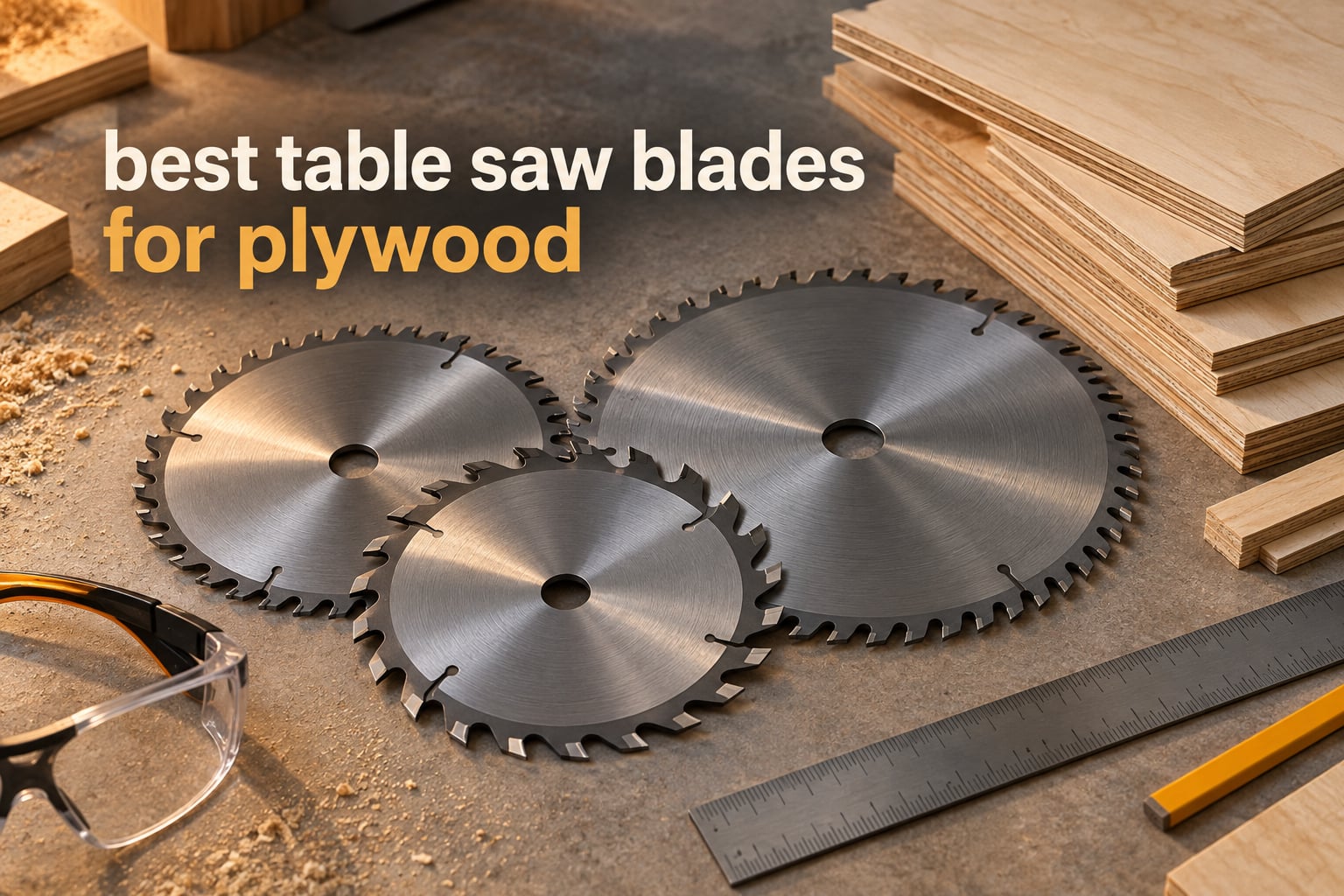
The best table saw blades for plywood are 10-inch blades with 60 to 80 teeth and a high alternate top bevel grind. That combination takes many small bites through the face veneer instead of levering it out in chips, which is what causes most of the fuzzy edges people blame on their saw.
Every blade on this list is a real, current 10-inch model with a 5/8 inch arbor, and I have sorted them by the job you actually need to do: fine veneered panel work, rough CDX breakdown, thin-kerf jobsite saws, or a one-blade shop that also rips. If you are still shopping for the saw itself, our table saw buying guide covers the machines these blades live in.
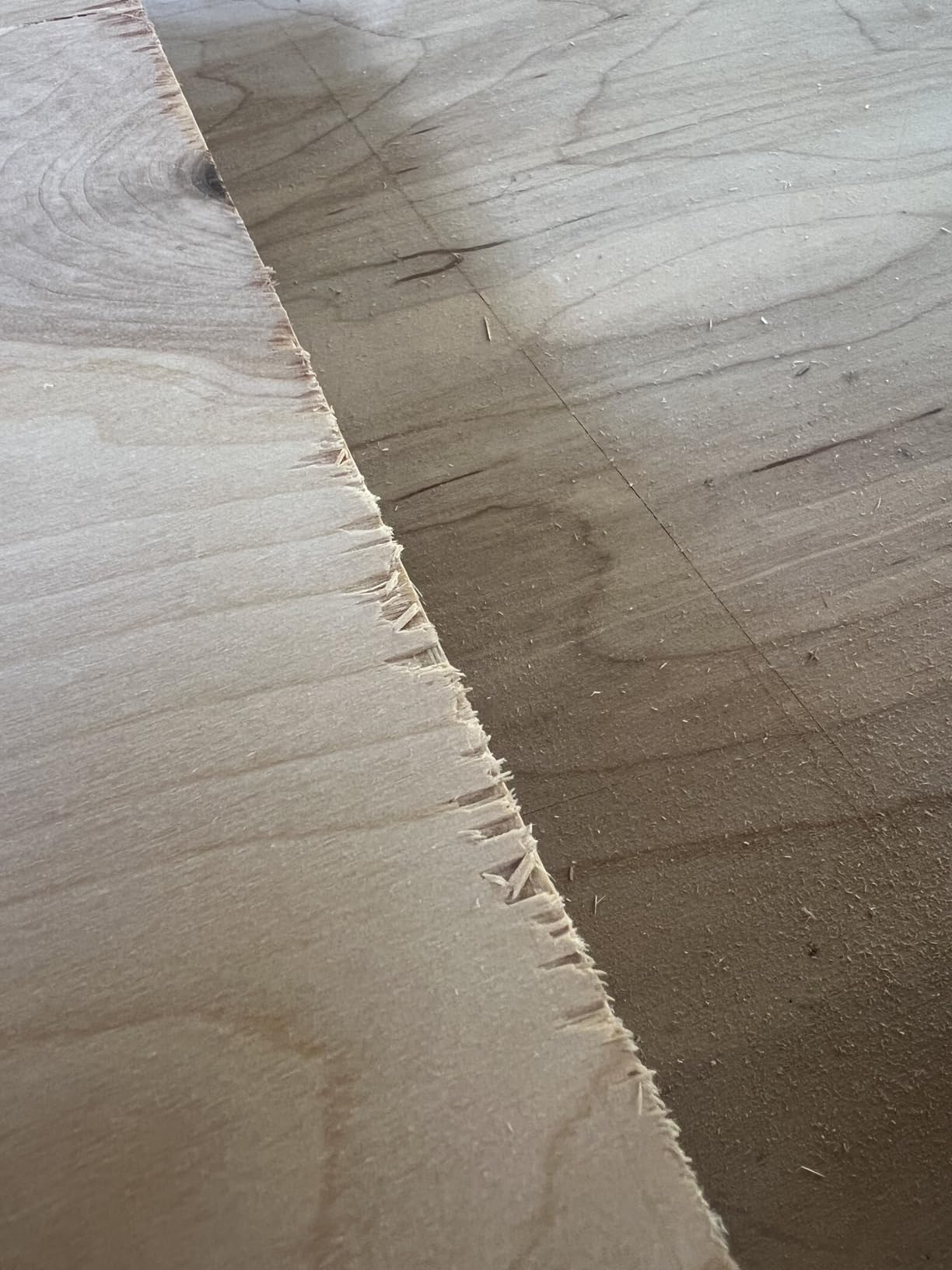
The blade that ships with a new table saw is a compromise. It rips softwood, crosscuts hardwood and dulls quickly on engineered panels, and on birch or maple ply it leaves a defect that has to be sanded or filled before finish will stick. Swapping in a dedicated plywood blade turns a two-step repair into one pass, which is why this is the first upgrade most cabinet and kitchen casework builders make.
Two details drive everything below. First, grind beats tooth count: a 30 degree or steeper bevel shears veneer fibers cleanly, so a 70-tooth blade with a shallow bevel can tear out where an 80-tooth steep-ATB blade does not. Second, kerf has to match your saw. A 0.126 inch full-kerf blade is fine on most cabinet saws and punishing on a 15 amp jobsite saw, while a 0.098 inch thin-kerf blade cuts faster and wastes less sheet material but can deflect more on a heavy plate.
I updated this roundup in September 2026, and every rating and review count below is copied straight from the live listing, not rounded up for effect.
Top 3 Picks for Best Table Saw Blades for Plywood in 2026
Freud LU80R010
- 80 teeth
- Hi-ATB grind
- 2 degree hook
- 0.126 inch full kerf
- anti-vibration slots

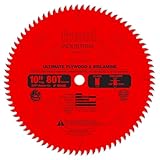
The Freud LU80R010 takes the top slot because it is the most-corroborated answer to the plywood question anywhere in the owner community. Multiple owners on the FineWoodworking blade thread describe it as near flawless on veneered panel stock, and its 80-tooth Hi-ATB geometry is the closest match to what a Freud technical representative described as the right way to cut thin modern veneer.
The Forrest Woodworker II takes the highest rating in the group and the most owner reports, and the only reason it is not first is that 40 teeth is a compromise count for a blade that also rips. The Diablo D1050X wins on value: owners compare it to roughly 90 percent of a Woodworker II for a fraction of the outlay, and its 0.098 inch kerf saves real material on every full sheet you break down.
Quick Overview: All 10 Blades Side by Side in 2026
Two things stand out when you read across the spec sheet. Every plywood-capable blade here carries a 5/8 inch arbor, so fit is rarely the problem, and tooth counts cluster in the 50 to 80 range with 80 the finish end of the scale. The real differentiators are grind, hook angle and plate thickness, and those are what the individual entries below break down.
1. Freud LU80R010: Best Overall Blade for Plywood
Freud LU80R010: 10″ Ultimate Plywood & Melamine Blade
80 teeth
Hi-ATB grind
0.126 in kerf
2 degree hook
5/8 in arbor
Pros
- Splinter-free cuts on veneered plywood and melamine
- Very quiet vibration-free operation
- Laser-cut anti-vibration slots
- Perma-Shield non-stick coating
Cons
- High ATB peak leaves a ridged kerf
- Not built for solid wood ripping
This is the blade I keep in the saw for anything that matters. The Freud LU80R010 is an 80-tooth Hi-ATB blade with a 2 degree hook, a 0.126 inch kerf and a 0.087 inch plate on a 5/8 inch arbor. Every one of those numbers points the same direction, toward a blade built to shear face veneer rather than tear it.
Owner reports are unusually consistent. On the FineWoodworking blade thread, multiple owners independently describe near flawless results on veneered plywood, and the same model comes up as the reference answer whenever someone asks about tearout. One owner running a Freud Fusion alongside it calls the results the smoothest they have seen in veneered panels. Current buyer reviews describe splinter-free chip-free cuts in birch ply, MDF and prefinished melamine, and quiet vibration-free running.
The 2 degree hook is the detail that separates it from most of the field. That is as close to zero rake as a production blade gets, and it is why the exit side stays clean instead of lifting at the end of the cut. Owners also point out that the laser-cut anti-vibration slots and the Perma-Shield coating combine to make it noticeably quiet and resistant to pitch build-up over long panel runs.
The honest tradeoff is the kerf profile. Alternate top bevel teeth meet in a peak at the bottom of the cut, so this blade will not produce a flat-bottomed groove, spline slot or non-through dado. It is a full through-cut blade for sheet goods and it does not want to rip thick solid wood either, since 80 fine teeth need more feed than a rip blade offers.
Why it wins for fine veneered panel work
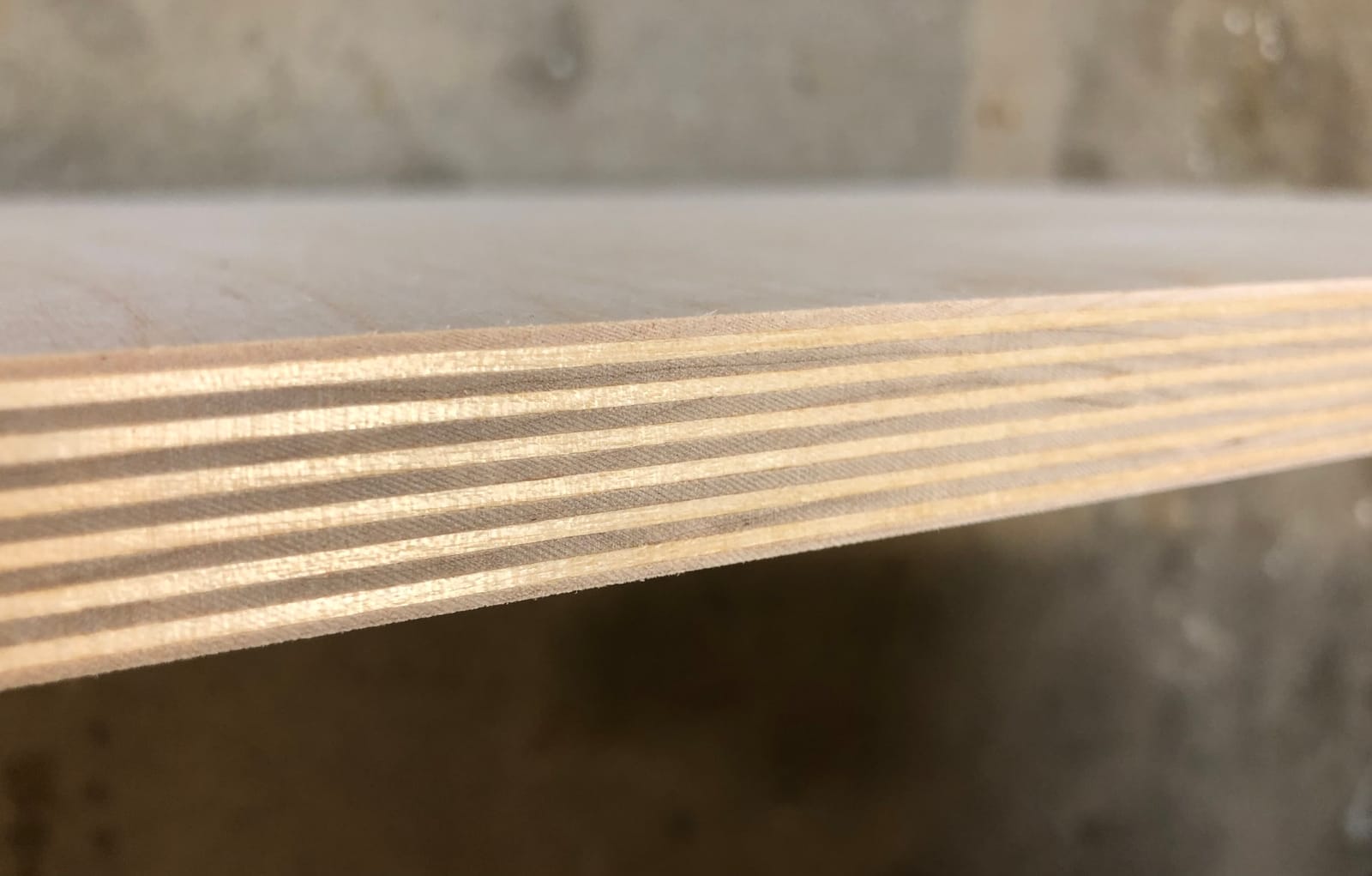
On birch and maple ply, a softwood face veneer over a hard core, the 80-tooth Hi-ATB geometry with a 2 degree hook leaves both faces of the cut clean enough to take finish without sanding. Add the anti-vibration slots and the plate stays flat through a full 4 by 8 sheet, which is what keeps the edge straight from the first cut to the last.
The Perma-Shield coating matters more than it sounds. Plywood glue lines are sticky and abrasive, and a coated plate releases that film instead of letting it bake onto the carbide. Owners who maintain their blades describe the edge lasting across hundreds of feet of panel cutting before it needs attention.
Where it will frustrate you
If your work includes ripping thick hardwood, stop here. A Freud technical explanation on the FineWoodworking thread makes the point that Hi-ATB teeth wear faster than standard ATB, and a veteran poster quantified it: for hundreds of linear feet an ATB blade is the better value, for thousands a triple chip blade lasts best. An 80-tooth Hi-ATB blade is built for panel goods, not for hours of solid lumber ripping.
Watch out for nails as the teeth are easy to damage, is the most repeated caveat about this blade in owner reports. On rough construction material, sweep for fasteners first or use a different blade.
2. Freud LU79R010: Best Thin-Kerf Blade for Lower-Powered Saws

Freud Thin Kerf Ultimate Plywood & Melamine Saw Blade with Premium Tico Hi-Density Carbide Crosscutting Blend for Maximum Performance – 10″ Diameter, 80 Teeth – LU79R010
80 teeth
Hi-ATB geometry
Thin kerf
5/8 in arbor
Perma-Shield
Pros
- Chip-free edges in veneered ply melamine and laminate
- Holds edge over hundreds of feet
- Resharpenable to near-new performance
- Runs quiet with no burn marks
Cons
- Bottom face can chip with some saw plates
- Leaves a ridge in the bottom of grooves
Same 80-tooth Hi-ATB philosophy as the blade above, different kerf. The Freud LU79R010 keeps the tooth count and grind and drops the kerf to thin, which is the whole point. On a 15 amp jobsite saw or a contractor table saw, a 0.126 inch full-kerf blade bogs the motor and generates heat, and thin kerf removes that load without giving up the shearing geometry.
Owners rate it as the best of their collection for plywood and melamine, and the praise is specific rather than generic: sharp carbide out of the box, quiet running, no burn marks, and an edge that holds over hundreds of feet. Several reviewers note that it is resharpenable, returning to near-new performance, which is a large part of the long-run value.
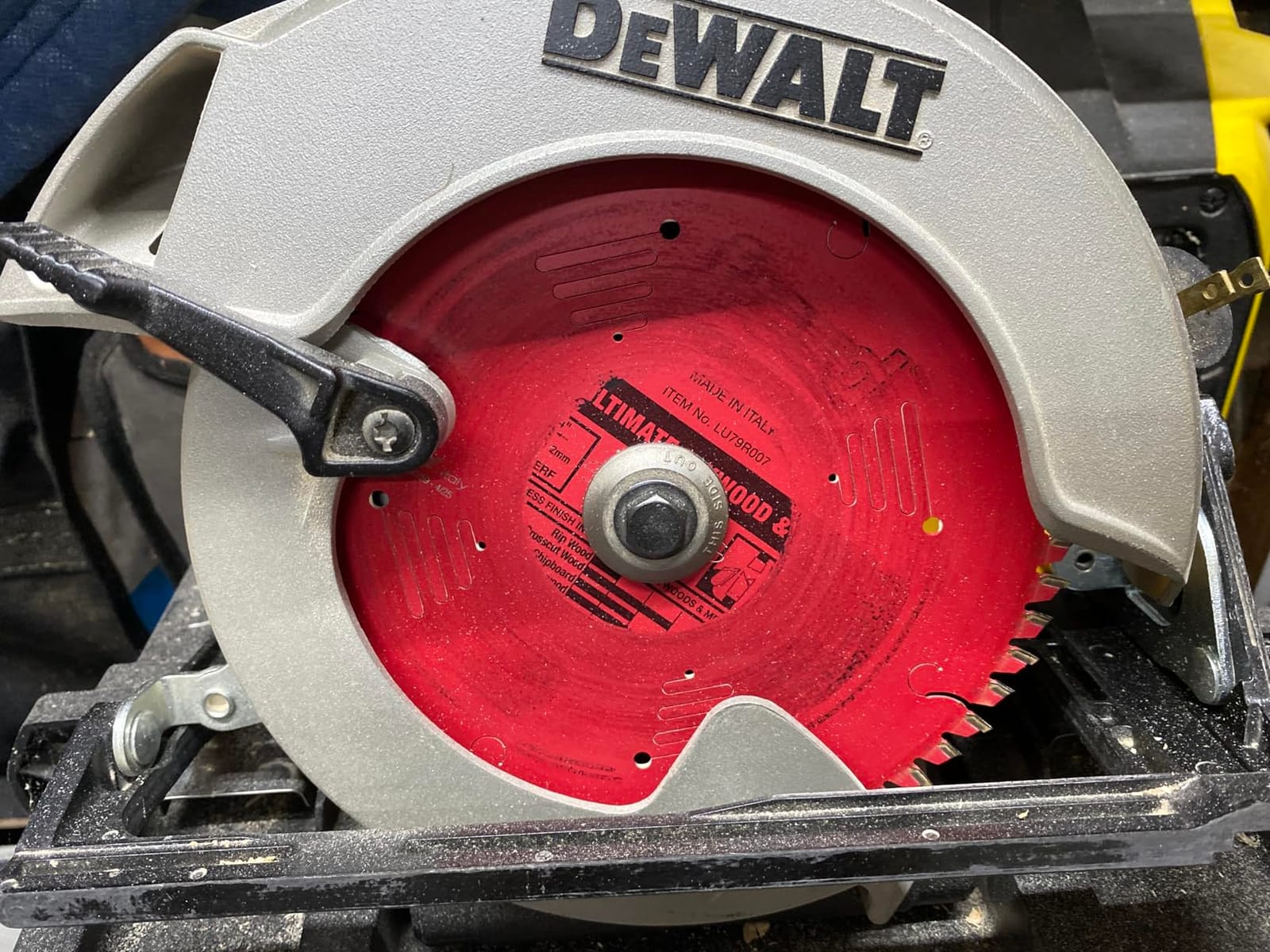
The same 2-degree-geometry logic applies here in practical terms. Because each tooth takes a small bite and the kerf is narrower, the blade tends to track straight through a full sheet and resist the pull that plagues general-purpose blades on large panels. The anti-vibration laser-cut slots extend blade life by damping plate movement, and the coating prevents pitch and resin build-up on glue lines.
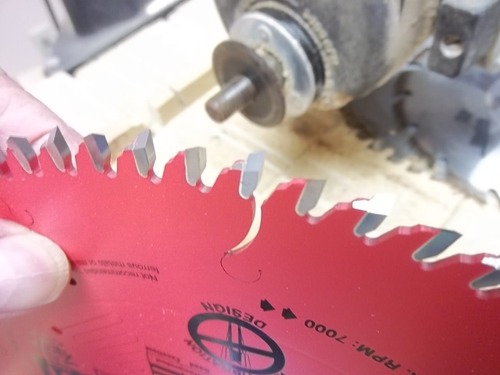
There is a real reason owners name the same two limitations. Some report chip-out on the bottom face depending on the zero-clearance setup of their saw plate, and the alternating tooth pattern leaves a ridge in the bottom of any groove rather than a flat kerf. If your saw has never been fitted with a proper zero-clearance insert, this blade will show you that fact on the very first sheet.
When this is the right blade
Pick this one if your saw is corded, portable or modest in power, or if you are working with expensive sheet material and want less waste per cut. A narrower kerf also returns a little more usable panel from every full sheet, which compounds quickly if you cut a lot of 4 by 8 material.
It also solves a specific frustration. Reddit users running high-atb blades alongside thin-kerf blades report no deflection difference on plywood, so the common worry that thin kerf wanders in sheet goods is often overstated for a quality blade of this weight.
Where it falls short
On a large cabinet saw with plenty of torque, a full-kerf blade of equal quality will usually hold a truer edge through heavy stock because the plate is stiffer. If you rip solid wood regularly rather than panel goods, the 80-tooth count is still working against you and the thin kerf will not rescue it.
And the bottom-face chipping reports are a saw setup issue as much as a blade issue. A fitted zero-clearance insert removes most of it.
3. Forrest Woodworker II 40T: Top Rated All-Rounder for Plywood
Forrest WW10407125 Woodworker II 10-Inch 40 Tooth ATB .125 Kerf Saw Blade with 5/8-Inch Arbor
40 teeth
30 degree ATB
0.125 in kerf
5/8 in arbor
2.2 lb
Pros
- Regarded as a gold-standard combination blade
- Cuts birch ply and hardwoods with no tearout
- Forrest resharpens and rebalances for life
Cons
- Full 0.125 inch kerf wastes sheet material
- Peaked ATB kerf will not cut flat-bottom dados
- Needs more saw power in thick hardwood
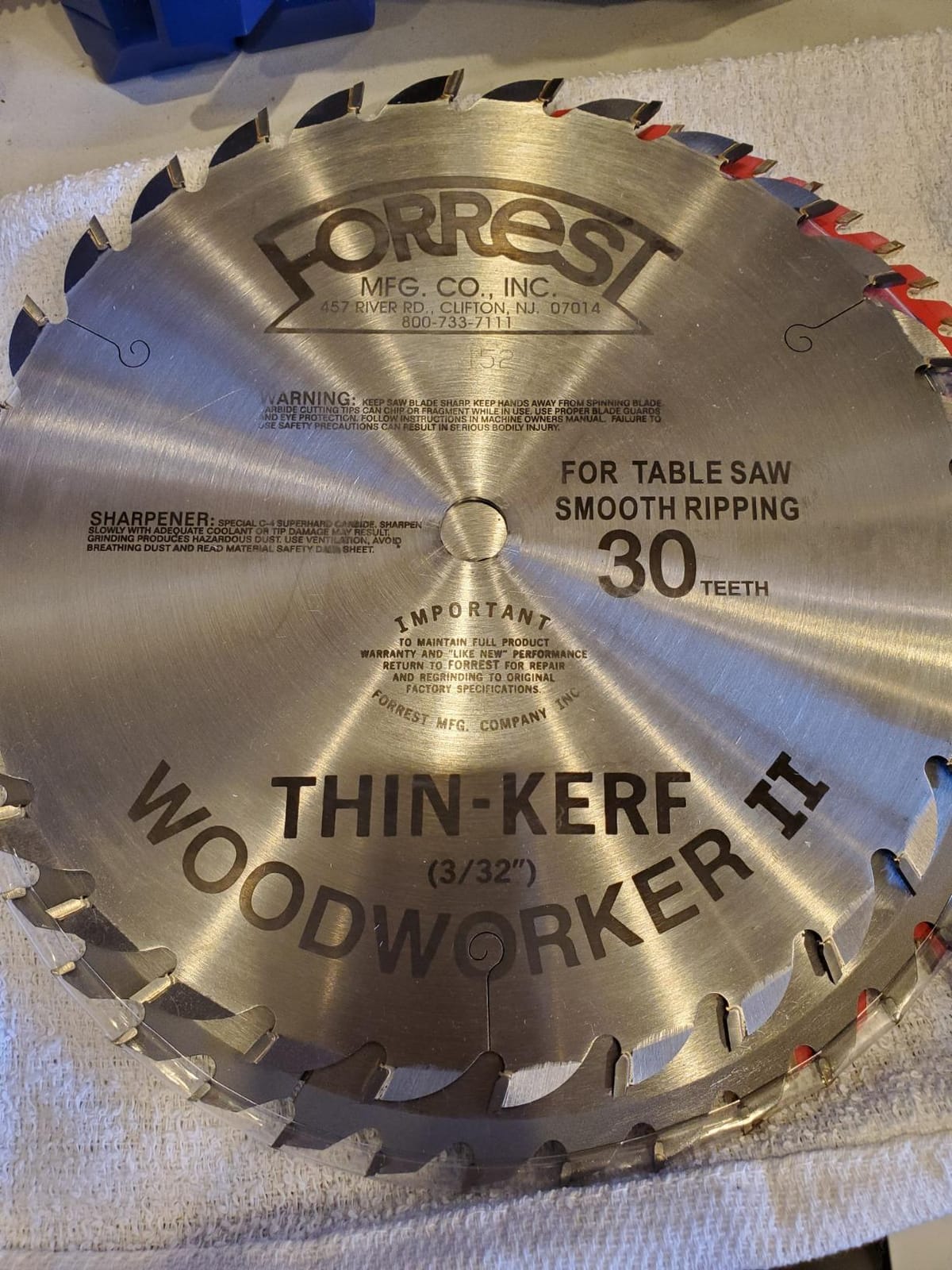
This is the blade most shops already own, and at 4.8 stars across 837 reviews it also carries the most owner history of any blade in this roundup. The Forrest Woodworker II is a 40-tooth, 30 degree ATB blade with a 0.125 inch kerf, and it does a competent job on plywood while also ripping and crosscutting solid wood properly.
That combination is the whole argument for it. On the r/woodworking blade upgrade thread, owners recommend the Woodworker II 40T as the single blade to buy when you want one tool for everything, and long-term owners treat it as a lifetime purchase because Forrest resharpens and rebalances it to factory specification for a modest fixed fee. That service is the real product, and it spreads the original cost over a decade or more.
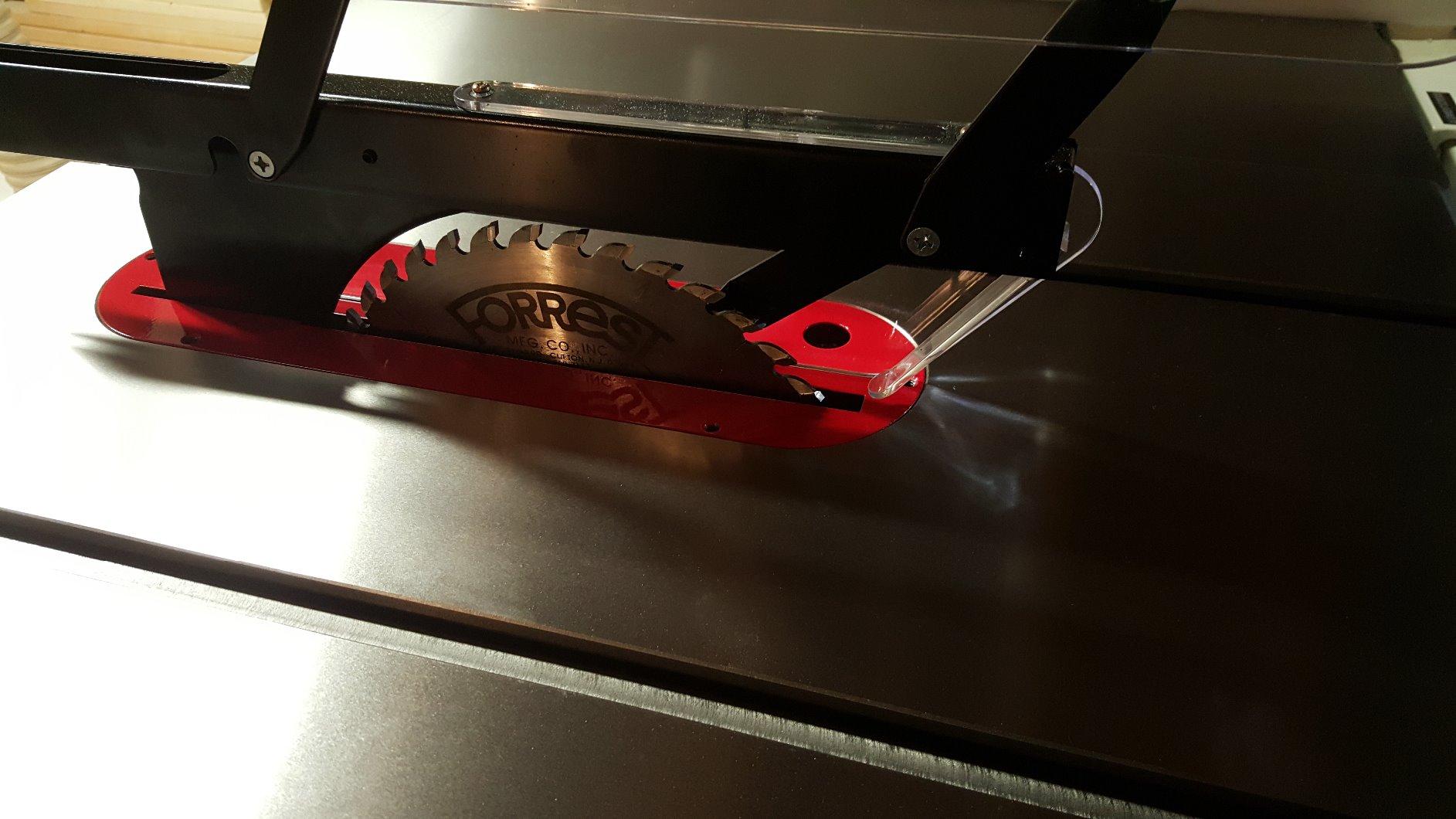
Cut quality on panel goods is genuinely good, not compromised. Reviewers report glass-like, tear-out-free cuts on birch ply and mahogany ply alongside maple, pine and oak, running quietly and feeding easily under modest saw power. The 30 degree alternate top bevel is a step steeper than the 10 degree bevel on most general-purpose blades, which is why the plywood results hold up.
Be honest about the tooth count though. Forty teeth is fewer than the 60 to 80 this article recommends for sheet goods, so you are getting there through grind rather than count. On very fine veneered birch with a prefinished face you will find a little more cleanup than an 80-tooth Hi-ATB blade leaves, and on melamine the difference is visible.
Why owners keep it for years
The free-for-life resharpen and rebalance service is the reason nobody in the community replaces this blade. It also reduces blade deflection, which is one of those cuts bottom splintering on the exit side. Owners consistently describe it as easy to push, which matters when you are breaking down sheet after sheet.
It is also the safest pick for a beginner. A 40-tooth combination blade will rip a board, crosscut a panel and handle dado work without you having to think hard about which direction the teeth need to face.
Where it falls short
The 0.125 inch kerf is the biggest cost. It removes more material per cut than a thin-kerf alternative, which on a full sheet of expensive birch ply adds up quickly. The peaked ATB kerf also means it will not cut spline slots or dados that need a flat bottom, and it wants more saw power in thick hardwood than thinner-kerf blades.
If your work is mostly cabinet casework and finish panel, the 80-tooth Hi-ATB picks on this list are a better fit. If your work is mixed, this blade is still hard to argue with.
4. Diablo D1050X: Best Value Blade for Plywood

Diablo Combination Saw Blade – 10″ Dia., 50-Teeth, 5/8″ Arbor, .098″ Kerf
50 teeth
0.098 in thin kerf
5/8 in arbor
6000 max RPM
16 oz
Pros
- Sharp and quiet out of the box
- Thin kerf saves sheet material and effort
- Clean hardwood cuts
- Strong value against premium combinations
Cons
- Not ideal for thick solid lumber
- Burn marks and vibration if feed rate is uneven
The Diablo D1050X is the value benchmark in 10-inch combination blades, with 4.8 stars across 2853 reviews. It is a 50-tooth blade with a 0.098 inch kerf, a 5/8 inch arbor and a 6000 max RPM rating, and it costs a fraction of what a premium combination blade does. Owners compare the cut quality to roughly 90 percent of a Woodworker II.
It is the pick for most first-time buyers, and for anyone who cuts plywood occasionally rather than daily. The thin kerf is the quiet hero here: less material removed, less heat, and noticeably less effort pushing through a full sheet, which is exactly what a 15 amp saw needs.
The Perma-Shield non-stick coating protects against heat, gumming and corrosion, and tri-metal shock-resistant brazing adds impact durability that matters more than the spec sheet suggests. Builders report it is sharp out of the box and noticeably quieter than a stock or budget blade, and they note it cuts hardwood cleanly with little finish sanding.
Be clear about what 50 teeth means. It sits between a general-purpose blade and a dedicated plywood blade, so the cut on birch ply is good rather than showpiece. It will not deliver the mirror finish of an 80-tooth Hi-ATB blade, but on a carcass, a shelf or a shop panel the extra sanding is minimal.
Who gets the most out of it
Hobbyists, DIYers and site carpenters cutting a handful of sheets a year. At this level of use the blade is going to stay sharp for years, and the thin kerf returns a little more usable material from every cut. Contractors who rotate blades between tasks like this one belongs in the rotation.
It also makes sense as a companion blade. Pair it with a steep 80-tooth blade for panel work and you cover rip, crosscut and finish without buying anything exotic.
Where it falls short
The reviews are direct about the limit. This is not the blade for thick solid lumber, which benefits from a heavier plate, and vibration or burn marks appear if the cut is not fed at a steady rate. That last point is a technique issue as much as a blade issue, so push consistently rather than leaning into the cut.
If your panels are fine veneered birch or prefinished melamine where a visible defect matters, step up a tier. The extra teeth are what buy you the finish.
5. Diablo D1080N: Best Triple-Chip-Grind Blade for Tough Cutoffs

Diablo Saw Blade – 10″ Diameter, 80 TCG Teeth, 5/8″ Arbor
80 TCG teeth
0.094 in kerf
5 degree hook
0.071 in plate
1.5 lb
Pros
- Clean burr-free cuts in aluminum ABS and melamine
- Handles thin aluminum without melting or chatter
- Laser-cut stabilizer vents cut noise
- Fine sanding-free finish on sheet goods
Cons
- Can melt acrylic slightly at the edge
- Not for forced cuts in solid aluminum bar
- Woodworking is not its design focus
This blade is in the list for durability, not for cabinet finish. The Diablo D1080N is an 80-tooth triple chip grind blade with a 0.094 inch kerf, a 5 degree hook and a 0.071 inch plate, and it is built by the same manufacturer as the D1050X with a completely different tooth design. TCG puts three teeth on each chip, so the carbide points are broad and blocky instead of needle-like.
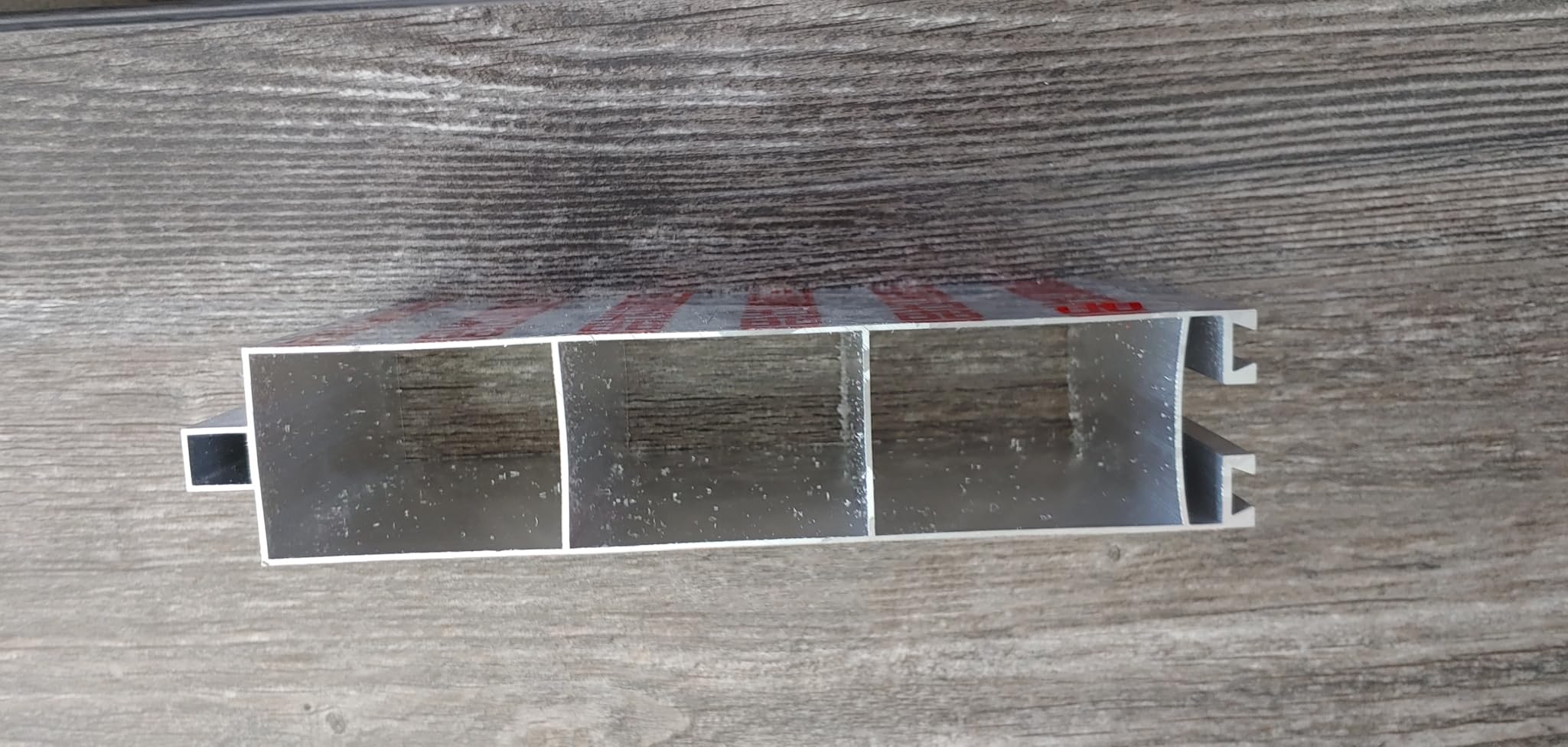
That geometry is why it survives things that destroy a Hi-ATB blade. Owners use it mainly for aluminum extrusions, ABS, acrylic and laminate flooring, and they report it handles thin aluminum cleanly without melting or chatter. A laser-cut stabilizer vent traps noise and reduces vibration, and TiCo super-density micro-grain carbide extends cutting life.
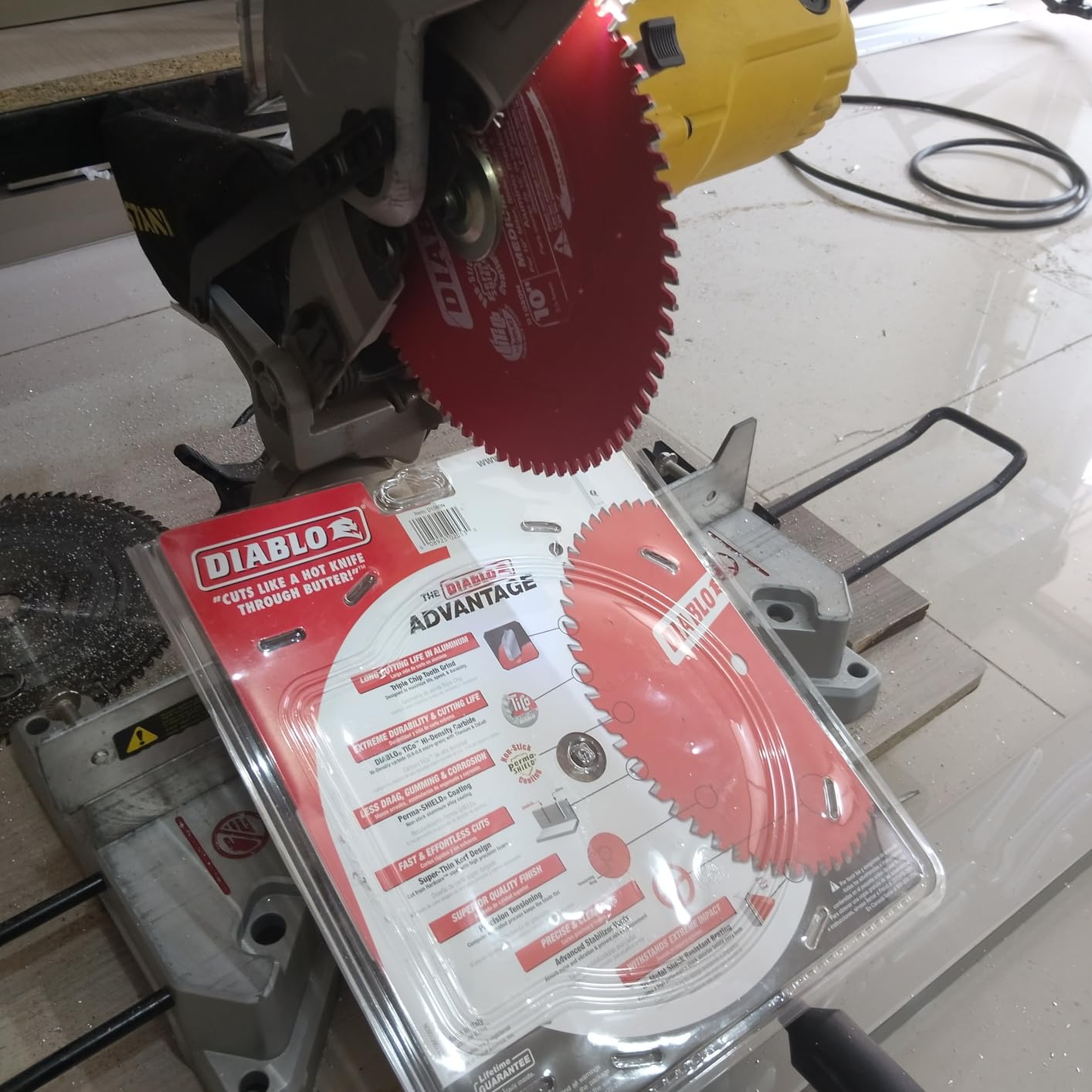
On plywood it is a legitimately good crosscut blade for stack cutting and repeated cutoffs. The 80-tooth count and 5 degree hook give a fine, mostly sanding-free finish on sheet goods, and reviews specifically praise clean burr-free results in melamine and plywood crosscuts. The 0.071 inch plate is thin, so this is a blade that wants a steady hand rather than thick material.
Where the triple chip design shows up on wood is the kerf. Each trapezoidal point leaves a small ridge at the top of the cut, so the exit face is fractionally fuzzier than a Hi-ATB blade of the same tooth count. On visible cabinet faces you can see it. On cutoffs, carcasses and stacked panel work you will not care.
When to reach for it
Buy it if you cut more than one material on the same saw. A shop doing cabinetry and some aluminum or plastic trim wants one blade that handles both, and the reviews confirm clean burr-free results in melamine, ABS, plastics and plywood crosscuts. It is also a smart second blade for anyone who occasionally breaks down CDX, since TCG points shrug off stray fasteners far better than needle points.
It cuts thin aluminum without melting, which no woodworking blade can claim.
Where it falls short
Owners note it can still melt acrylic slightly at the edge, and it can chip or fail if forced aggressively through solid aluminum bar stock. It is also not a woodworking-focused blade, so if plywood is nine-tenths of your cutting, the steep ATB picks above will produce a better visible face.
Treat it as the durable workhorse of this list rather than the finish blade.
6. Bosch DCB1080: Best Stiff-Plate Blade for Melamine Panels

BOSCH DCB1080 10 in. 80 Tooth Edge Circular Saw Blade for Extra-Fine Finish for Melamine and Finished Plywood
80 teeth
ATB geometry
Thinner kerf
Speed Coat
1.8 lb
Pros
- Minimal chip-out on melamine and finished plywood
- Extra-hard steel body resists deflection
- Clean cuts on hardwoods and cabinet panels
- Thin kerf reduces waste
Cons
- Some owners report chipping on thin veneer faces
- 10 degree ATB angle can pull the workpiece
The Bosch DCB1080 is the stiff-plate option in this roundup. It is an 80-tooth ATB blade with a thinner kerf, a Speed Coat anti-friction finish and an extra-hard steel body, weighing 1.8 pounds. Plate stiffness is what it is really selling: on a full sheet cut, a rigid plate tracks straight and resists the wandering that produces wavy edges and burn marks.
Buyers like it as an affordable melamine and finished-plywood blade, describing smooth, low-chip cuts and a stiff, non-deflecting plate. The Brute carbide C3/C4 micro-grain formulation is specified for impact damage resistance, and the thinner kerf means faster cutting and less material waste per pass.
Its ATB tooth geometry is aimed at fast crosscutting, cutoff and trim work in wood and plywood, and that is where it performs. The Speed Coat finish is designed to cut faster without burning or melting the panel face, which matters on prefinished melamine where a burn mark cannot be sanded out without going through the surface.
Be aware of the tradeoffs. Reviewers report that a minority see chipping on thin veneer faces, so the extra-fine finish is not always achieved on the most delicate birch ply. The 10 degree bevel is a shallower grind than the 30 to 40 degree Hi-ATB picks here, and owners note it can pull the workpiece toward the blade, which means good support and controlled feed matter more with this blade.
Who should buy it
Anyone cutting a lot of prefinished melamine or two-sided cabinet panels on a saw that is not brand new. The stiff plate and anti-friction finish are aimed squarely at panel work, and the 80-tooth count is in the right band for the job. It is also a good first dedicated panel blade for someone moving up from a factory blade.
If your panels are fine veneered birch rather than prefinished, pair it with better support rather than a different blade.
Where it falls short
The 10 degree ATB angle is the honest weakness. It drags at the exit side, and that is where bottom tearout comes from on plywood. A blade with a 2 to 5 degree hook like the Freud LU80R010 or CMT 255.080.10 will hold a cleaner underside on the same sheet.
At 4.6 stars with 108 reviews it also has the thinnest owner record in this list, so treat the enthusiasm as recent rather than battle-tested.
7. CMT 221.060.10: Best for Laminate and Chipboard Cutoffs

CMT Orange Tools 221.060.10 – Laminated&Chipboard Circular Saw Blade HW D=10 B=5/8 Z60 K=0.126 P=0.087 a=10
60 teeth
0.126 in kerf
0.087 in plate
10 degree angle
5/8 in bore
Pros
- Made in Italy with laser-cut dampening slots
- Suited to laminate chipboard melamine OSB and plywood
- Industrial chrome carbide with mirror finish
- PTFE coating resists build-up
Cons
- Crosscut only
- not a rip and cross combination blade
- Thicker kerf removes more material per pass
The CMT 221.060.10 is a purpose-built sheet goods blade rather than a generalist. It is a 60-tooth blade with a 0.126 inch kerf, a 0.087 inch plate and a 10 degree cutting angle, specified for chipboard, laminate, melamine, OSB, plywood and softwoods. CMT builds it in Italy with a laser-cut premium steel plate body carrying heat expansion and sound dampening slots.
That 60-tooth count lands squarely in the band this article recommends for plywood, and owners value the build quality and quiet, stable cutting of sheet goods in table, radial arm, miter and panel saws. A tensioning ring with tri-metal brazing and industrial chrome carbide with precision mirror finish sharpening round out a well-made tool.
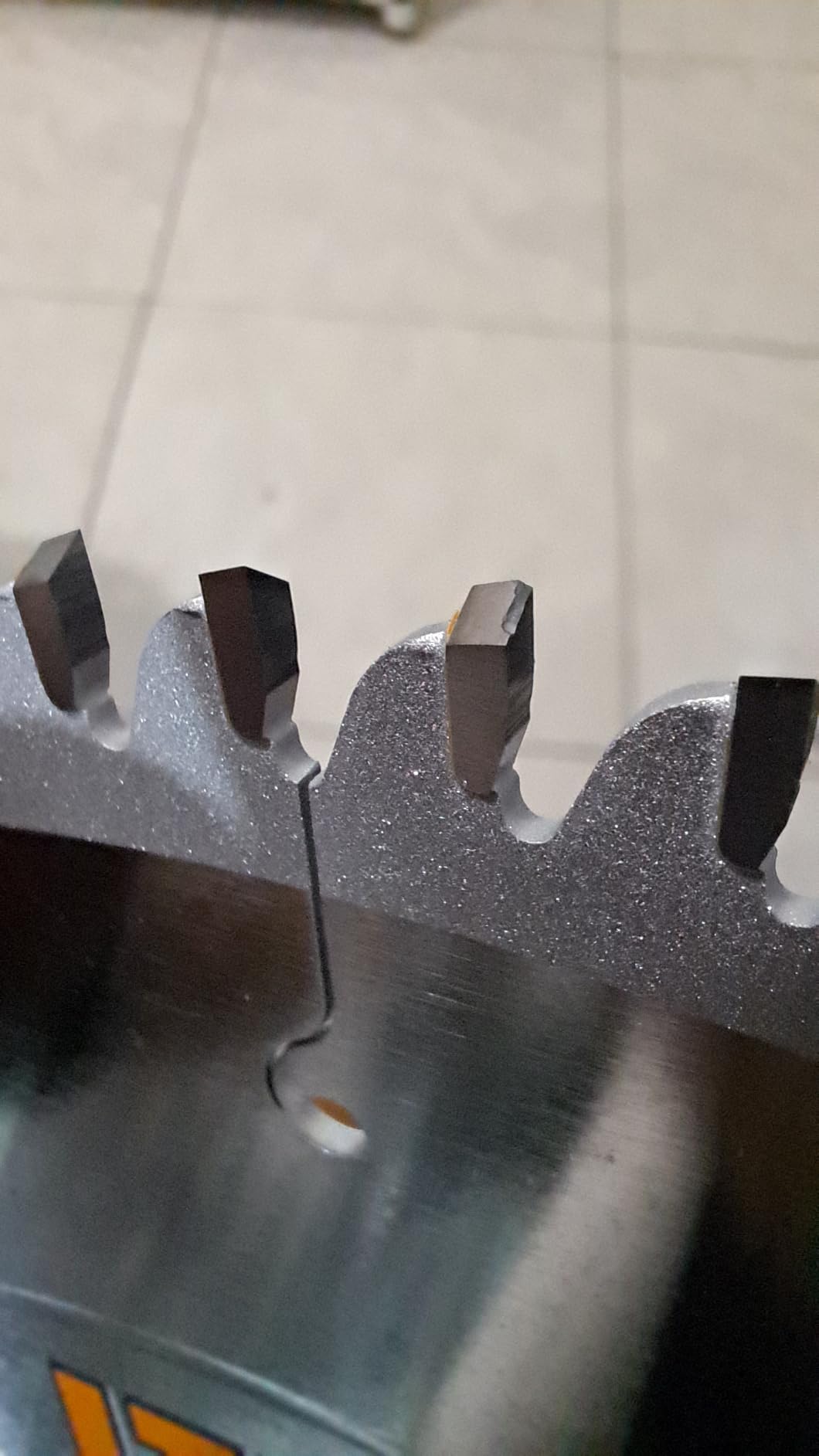
The non-stick PTFE coating resists resin and glue build-up, which on plywood is not a minor feature. Glue lines are the abrasive part of the cut, and a coated plate releases that film instead of baking it onto the carbide edge.
The limitation is straightforward: this is a crosscut blade, not a combination blade. If you need ripping capability, CMT itself points you to a combination model. The 0.126 inch kerf also removes more material per pass than thin-kerf alternatives, which on a stack of expensive panels is a running cost.
Who it suits
Shoppers who work primarily with laminated and chipboard products, especially if their saw is not a table saw. The blade is compatible with miter saws, radial arm saws, stationary table saws and vertical panel saws, which makes it the most versatile mounting option in this roundup.
For anyone breaking down OSB or chipboard, a 60-tooth crosscut at a 10 degree angle is a sensible, quiet, stable choice.
Where it falls short
Crosscut only is the deal-breaker for many table saw owners. A 40-tooth combination blade gives up a little plywood finish quality and gains the ability to rip. If you rip anything at all, weigh that before choosing this.
And the full kerf is heavier to push than a thin-kerf blade, so pair it with a saw that has the power.
8. CMT 255.080.10: Best Low-Hook Fine Crosscut Blade

CMT Orange Tools 255.080.10 – Ultra Fine Finishing Saw Blade D=10 B=5/8 ß=Hi-ATB 30 K=0.110 P=0.071 a=5
80 teeth
Hi-ATB 30 grind
5 degree hook
0.110 in kerf
0.071 in plate
Pros
- Thin kerf and thin plate reduce drag and deflection
- Low 5 degree hook and 80 teeth give a very fine low-chip finish
- Good value for cabinet-grade and finished plywood
Cons
- Fine-kerf high-tooth geometry is tuned for crosscuts not ripping
Take the Freud LU80R010 specification and hand it to a different manufacturer and you get this. The CMT 255.080.10 is an 80-tooth blade with a Hi-ATB 30 degree grind, a 5 degree hook angle, a 0.110 inch kerf and a 0.071 inch plate. The geometry is the right geometry; the execution and the plate weight are the differences.
Owners use this ultra-fine finishing blade for clean crosscuts in veneer plywood, melamine and laminate, and they consistently single out two things: the thin kerf and the low hook angle make it easy to push, and edge chipping is minimal. A 5 degree hook is low enough to reduce exit-side drag without going so low that the blade struggles to cut.
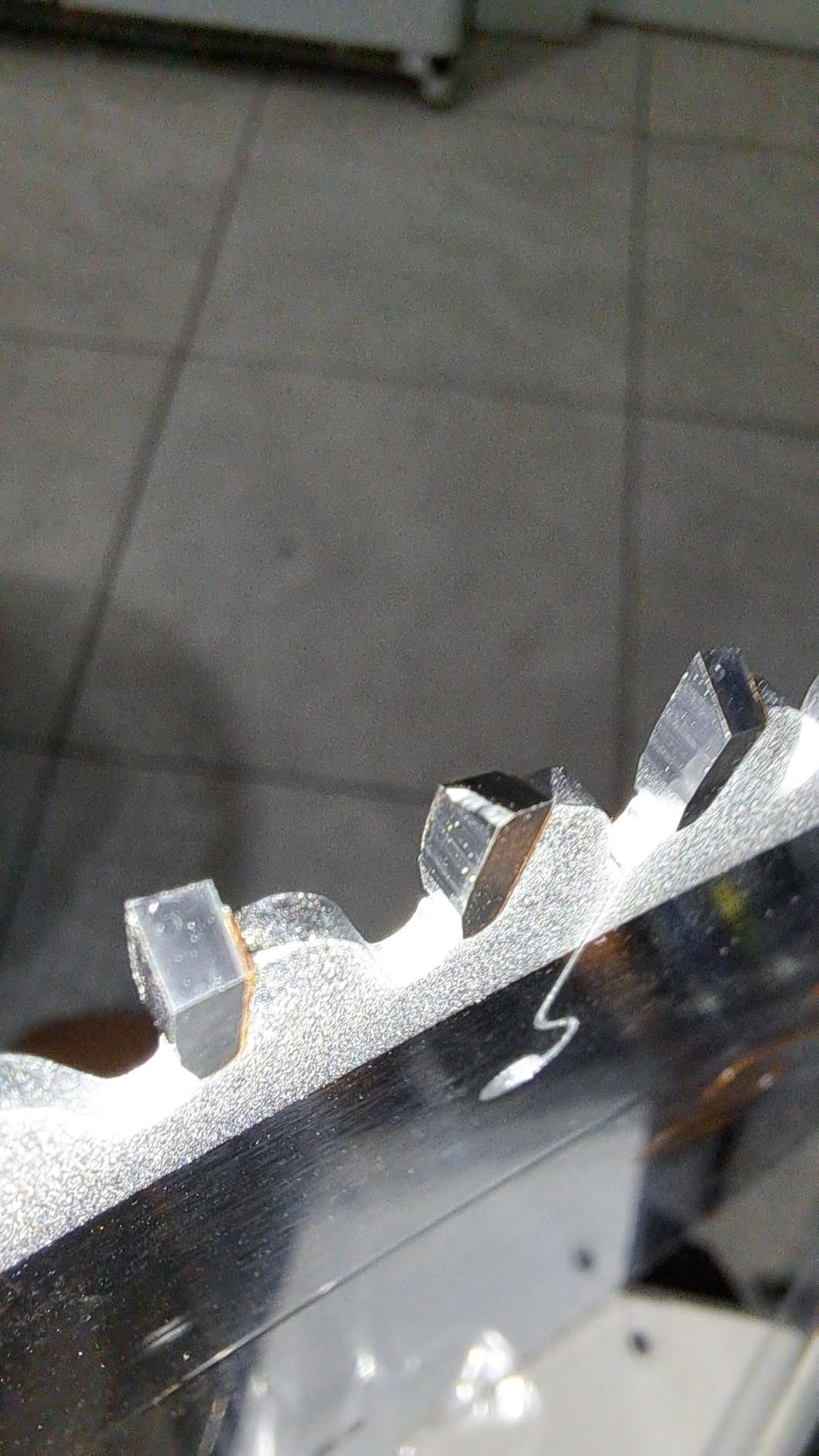
At 0.110 inch kerf and 0.071 inch plate, it is the lightest combination of drag and stiffness in this list. That thin plate reduces deflection in a full sheet cut, and the reduced drag means less heat and less burn risk on a prefinished face. It is a good value for cabinet-grade and finished-plywood crosscutting, and at 4.7 stars across 328 reviews the owner record is solid if not enormous.
The honest comparison is with the blade at the top of this list. The Freud has a 0.126 inch kerf and a 0.087 inch plate, so it is a stiffer, heavier tool that holds a line through heavy, thick material better. The CMT is easier to push and gives up some of that stiffness.
Why a low hook angle matters here
Exit-side splintering starts when the tooth drags forward as it finishes the cut. A 5 degree hook is low enough to keep the tooth from levering the bottom veneer up, and the 80-tooth Hi-ATB grind means each bite is small enough that the veneer is scored rather than peeled. That combination is why the finish on the underside is close to clean on birch ply.
It is also why this blade suits a less powerful saw than the full-kerf picks. Reduced drag means reduced motor load on every pass.
Where it falls short
Fine-kerf, high-tooth geometry is tuned for finish crosscuts rather than heavy ripping, and reviewers are consistent about that. Push it through thick solid lumber and you will get heat and burn before you get a cut.
The 0.071 inch plate is also the thinnest in the roundup alongside the triple chip blade, so if your saw has any vibration at full blade height, a stiffer plate is the better bet.
9. Amana 610800C: Best Trim Blade for Finished Plywood

Amana Tool 610800C Carbide Tipped Prestige Trim 10 Inch D x 80T ATB, 10 Deg, 5/8 Bore Circular Saw Blade
80 teeth
ATB grind
10 degree hook
5/8 in bore
10 inch diameter
Pros
- Clean low-splinter edge on finished surfaces
- Standard 5/8 inch bore fits common saws
- Accurate trim and crosscut on finished and solid wood
- Consistent 4.7 star rating from owners
Cons
- 10 degree hook angle is aggressive and pulls the workpiece
- Heavier plate needs an adequately powered saw
The Amana 610800C Prestige Trim blade is built for sizing finished panels rather than for crosscutting rough stock. It is an 80-tooth carbide blade with an ATB grind, a 10 degree hook angle and a standard 5/8 inch bore on a 10 inch diameter plate. The tooth count is right for plywood; the grind is the compromise.
Buyers rate it as a solid, accurate trim and crosscut blade with clean edges on finished and solid wood, holding a consistent 4.7 star rating. The PrestiTrim geometry is designed to leave a clean, low-splinter edge on finished surfaces, which is the whole point on a cabinet panel that will be seen.
It fits common table saw and miter saw arbors without any adapter, which removes the most common purchase mistake in this category. Many buyers do not know their saw arbor size and end up with a blade that will not mount, so a standard 5/8 inch bore is a genuinely useful default.
What you give up is hook angle discipline. At 10 degrees, this blade leans forward more than the low-hook picks above, and owners note it can pull the work slightly, so support and feed control matter more. On a sled with a well-fitted throat plate the pull is manageable; freehand on a small saw it is not.
What it does well
Trim work on finished plywood and solid wood, where the edge will be visible and the panel is supported properly. The 80-tooth count handles crosscut finish duty, and the 10 inch diameter and 5/8 inch bore are the two most common table saw configurations there is.
It is a sensible choice for a shop that cuts a lot of plywood trim and edging to length rather than breaking down full panels.
Where it falls short
The heavier plate requires an adequately powered saw to push through thick material, which rules it out for a 15 amp jobsite saw doing full sheets. And the 10 degree hook pulls the workpiece, so it is not a forgiving blade for someone still learning feed control.
If the bottom face of the panel will be visible, choose a low-hook blade instead. This one prioritizes speed and versatility over the cleanest underside.
10. Freud LU83R010: Best One-Blade Setup for Plywood and Ripping

Freud LU83R010 Industrial 10-in 50T Thin Kerf Combination Saw Blade
50 teeth
ATB grind
Thin kerf
5/8 in arbor
16 oz
Pros
- Rip and crosscut in one blade
- Very quiet with effective dust collection
- Cuts half inch plywood with zero splintering
- Approaches an 80 tooth finish blade
Cons
- Some units measure slightly under nominal 10 inch
- Some owners report more motor resistance than expected
If you want one blade that does everything, this is the one to buy. The Freud LU83R010 is a 50-tooth ATB blade with a thin kerf, a 5/8 inch arbor, a Perma-Shield coating and laser-cut anti-vibration slots. At 4.7 stars across 1256 reviews it has one of the largest owner records in this roundup, and the reviews describe it as an affordable one-blade-does-everything setup.
Owners love it for quiet, clean crosscuts and rips in plywood, OSB and hardwoods with minimal dust. Several report it cuts half inch plywood with zero splintering and leaves edges ready for glue, and they say the cut quality approaches an 80-tooth finish blade at a fraction of the cost.
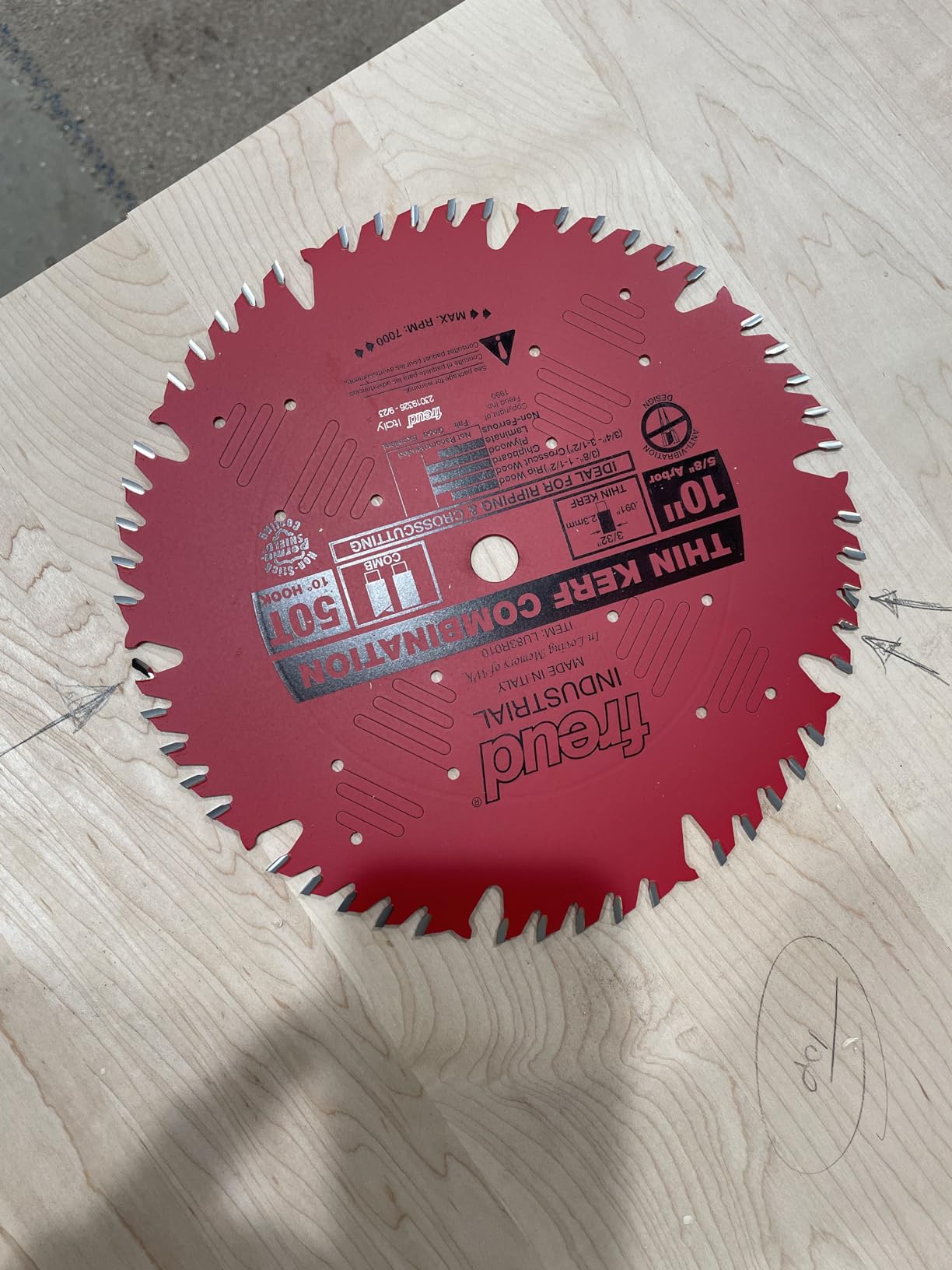
The thin kerf is what makes this combination blade work on a modest saw. It rips and crosscuts wood, chipboard, plywood and laminate, and because it cuts thin it asks less of the motor than the full-kerf alternatives. The coating resists heat and gumming, and the anti-vibration slot design means no stabilizers are needed on this one.
At 50 teeth you are giving up some of the fine finish of an 80-tooth Hi-ATB blade. On a cabinet face that will be sprayed or stained, expect a light sand. On carcass, shelf and shop panels, reviewers say you will not notice the difference.
Why one blade is a real strategy
A dedicated rip blade plus a dedicated plywood blade is the textbook setup, and it is genuinely better than either one alone. But many shops never use the rip blade on anything other than plywood edges, which means the rip blade just sits in a drawer. For those shops, a good 50-tooth thin-kerf combination blade covers 90 percent of the work with zero friction.
The community consensus on NC Woodworker leans the same way. Hi-ATB blades with low or negative hook angle and many teeth, like the LU80R010, are the plywood specialists, and a capable combination blade covers everything else without the mid-project blade change.
Where it falls short
The most reported drawback is slight undersizing. Some units measure a little under nominal 10 inch, which prevents completing a cut on certain sliding compound miter saws. Check the diameter before you rely on it for 10 inch nominal capacity.
A small number of owners also report more motor resistance than expected from a new premium blade. And if your plywood work is fine veneered birch where the finish is the product, a 50-tooth ATB blade is not the last word.
Zero-Clearance Inserts vs Scoring Blades for Plywood Tearout
The blade is only half of plywood tearout. The most common complaint in every woodworking forum we read is bottom-side splintering that no blade change fixed, and the reason is usually the saw, not the blade. A scoring blade is one answer, and a properly fitted zero-clearance insert is usually the better one.
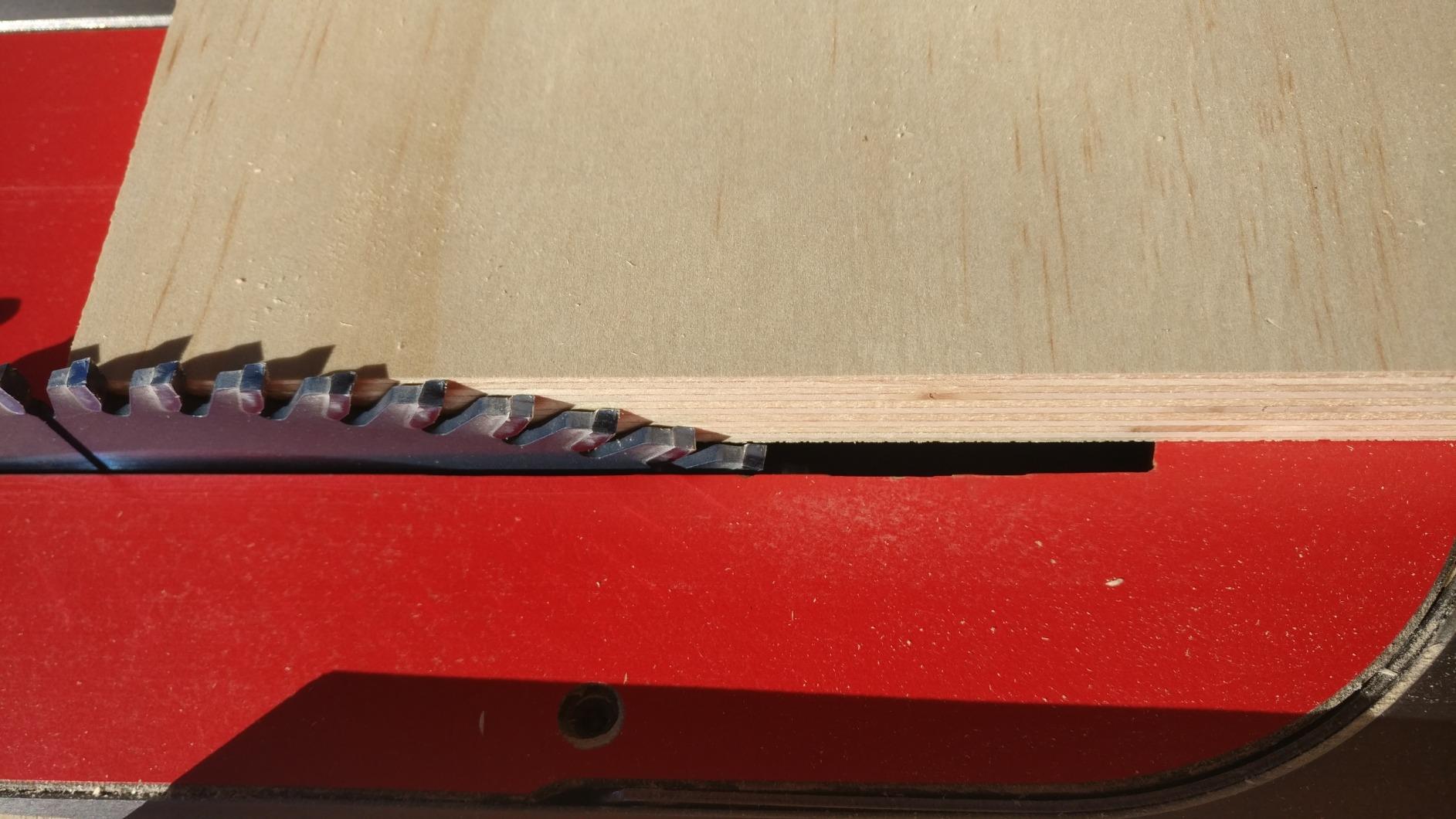
What a zero-clearance insert does. A table saw throat plate is normally wider than the blade kerf, leaving a gap. The workpiece drops slightly into that gap as the cut finishes, and the unsupported veneer at the exit side tears. Cutting the insert down to match your kerf supports the material right up to the blade, which removes most bottom tearout for a few dollars of steel.
What a scoring blade does. A scoring blade is a short splitter ahead of the main blade that cuts the exit-side veneer cleanly before the main teeth arrive. It guarantees a clean underside on prefinished and two-sided panels, but it costs extra, requires matched kerf widths, only works on saws with a scoring provision, and it still leaves the main blade to make the top cut.
Which one you actually need. If your saw has a throat insert you can machine, do that first and test the cut. Most shops that solve tearout this way never buy a splitter. If you cut two-sided prefinished panels where the underside is visible and cannot be sanded, or your saw has no insert at all, a splitter earns its place.
Here is the full tearout fix stack, in the order that actually works. 1. Fit a zero-clearance insert matched to your kerf. 2. Choose a 60 to 80 tooth blade with a 30 degree or steeper bevel. 3. Push the feed at a steady rate, because surging and dwelling both tear veneer. 4. Set blade height so only the teeth project above the workpiece, by a few thousandths more than the deepest point, since a tall blade adds drag. 5. Keep the glue lines clean, because hardened adhesive on the panel face gouges the carbide and dulls the edge fast. A splitter slots in as step six if the first five are not enough.
Ripping needs a different approach entirely. On a rip cut the tearout happens on the top face as the teeth exit the cut, and a high tooth count finish blade is the wrong tool, because many fine teeth will burn the wood rather than cut it. A rip blade with few teeth and a flat top grind, or a high-ATB general purpose blade, is the right choice. Our box blade and dado guide covers the flat-top-grind options if you rip a lot of solid stock.
Buying Guide: How to Choose a Plywood Table Saw Blade
Start with the saw, not the blade. Most disappointing blade purchases are a torque or fit problem rather than a quality problem, and the forum consensus is blunt about it: plenty of buyers do not know their saw horsepower or arbor size and end up with a blade that bogs the motor or will not fit.
Check the arbor first. A 5/8 inch arbor fits most 10-inch table saws. Measure before you order, because an adapter for a 5/8 inch arbor is a quick fix while a mismatched diameter is a returned blade.
Match the kerf to the saw class. Full kerf, around 0.125 to 0.126 inch, is stiff and stable and is the right choice on a cabinet saw with 3 horsepower or more. Thin kerf, around 0.094 to 0.110 inch, saves material and reduces heat and drag, and is the right choice on a jobsite saw or a 15 amp portable. Mismatching a full-kerf blade to a small saw is the most common cause of burnt plywood edges.
Pick the grind, then the count. For plywood crosscutting, a high alternate top bevel at 30 degrees or more is the target. Triple chip grind is the durability option. Flat top grind belongs to rip blades and dado sets, not sheet goods. Once the grind is right, 60 to 80 teeth is the band, with 80 giving the finest finish and 60 being more forgiving and easier to push.
Use hook angle as a quality filter. Anything at 10 degrees or less reduces exit-side drag. A low hook angle is the single cheapest tearout improvement available and it is worth more than a step up in brand.
Look at the plate, not just the teeth. A 0.087 to 0.091 inch plate holds a line through thick material. Below roughly 0.071 inch, expect more deflection on a full sheet, especially if your saw is older.
Factor in serviceability. Resharpenable carbide that a shop will relabel and rebalance is worth far more over five years than a cheaper edge that dulls in a season. Forrest’s lifetime resharpen service is the clearest example in this list, and it is the main reason that blade has a four-decade owner record.
Consider the two-blade system. If your work mixes rip and crosscut, run a 24-tooth rip blade and an 80-tooth Hi-ATB plywood blade. Ripping with the 80-tooth blade burns the wood and dulls the fine points, and crosscutting with the 24-tooth rip blade tears the exit side. One blade cannot be good at both, and switching takes about thirty seconds.
Buy for your actual cut volume. If you cut a few sheets a year, a 40-tooth or 50-tooth combination blade with a fitted zero-clearance insert gets you most of the way. The dedicated 80-tooth Hi-ATB blade pays for itself when you are breaking down panel goods every week.
One more warning for readers outside the US: brand availability frustrates owners constantly, with Freud and CMT blades hard to source in some regions. Forum regulars name Forrest Duraline, Infinity 010-080, Amana and CMT as the common substitutes, and several of those brands appear on this list.
Blade Maintenance: Glue Lines, Resin and Sharpening
A plywood blade dies of glue and resin long before it dies of use. Plywood glue lines are abrasive, and the face veneer carries a factory coating that gums the carbide up. A simple schedule keeps the edge alive.
1. Clean after every session on engineered panels. A blade scrub pad, a drop of dish soap and warm water will lift soft glue film in under a minute. 2. Use a blade cleaner for hardened resin. Kitchen-style cleaners and dedicated saw blade cleaners both work, and several coated blades on this list specify a non-stick coating that slows buildup in the first place. 3. Keep a dedicated wipe for glue face-up cuts. Running a panel with glue squeeze-out on the top face is the fastest way to strip a coating and dull an edge.
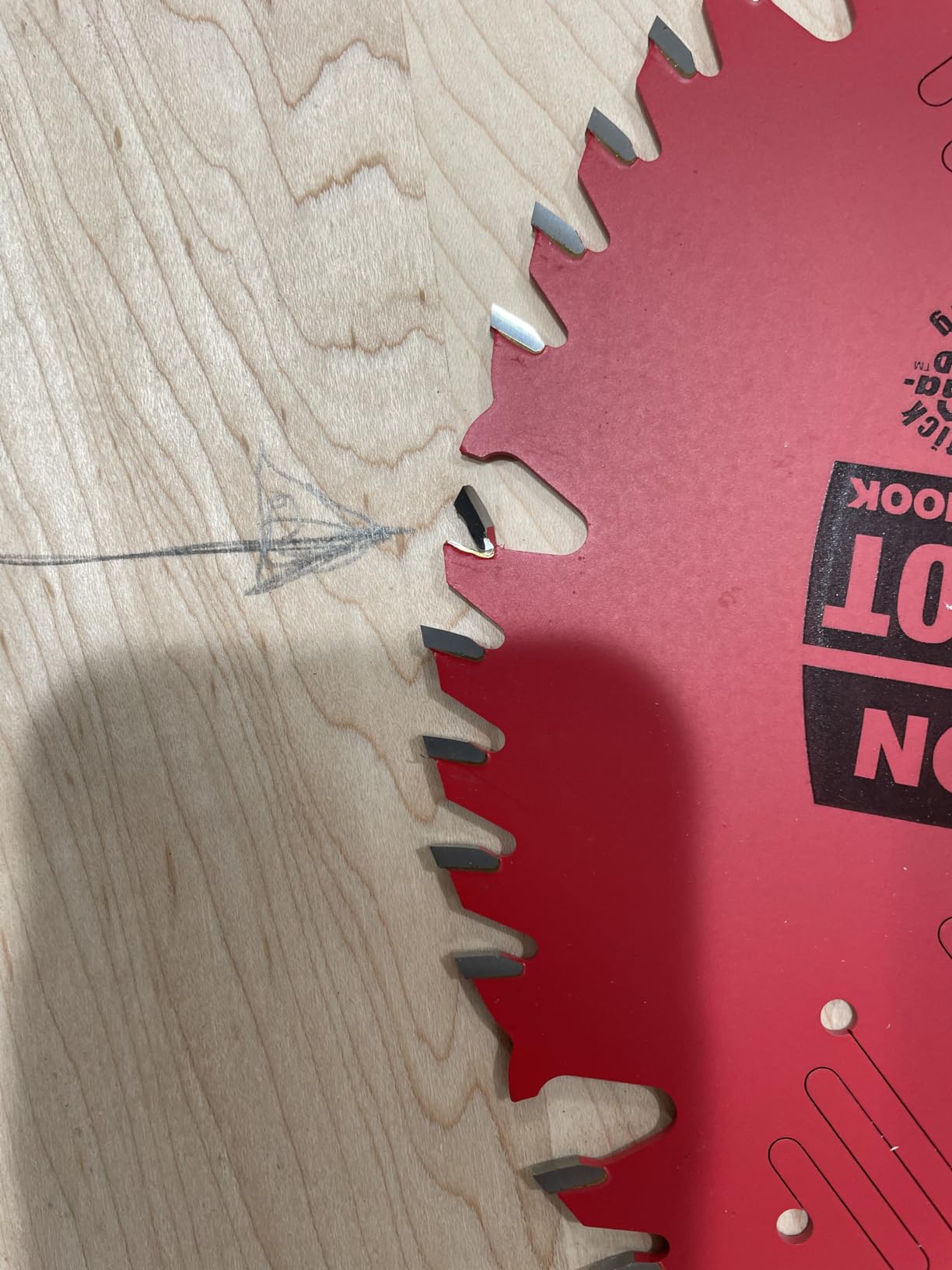
4. Inspect after rough construction work. A 10×10 or 60-tooth panel saw cut through CDX will find nails eventually, and a Hi-ATB needle point chips rather than bends. Run a fingernail along each tip; a tip that catches dramatically is chipped. 5. Address one damaged tooth immediately, not later. A single chipped Hi-ATB point raises cutting resistance across the whole pass and will dull its neighbours. 6. Track cut volume, not calendar time. Owners who log hundreds versus thousands of linear feet of panel cutting make better sharpening decisions than those who count months.
7. Sharpen before the edge fails, not after. A blade that needs grinding at every point has lost too much carbide to save. A dull edge also generates more heat, which accelerates the damage. 8. Use a resharpen service rather than a filing jig for carbide. Single-point sharpening of Hi-ATB teeth requires a fixture and experience, and several manufacturers on this list offer it for a flat fee.
One forum note worth repeating, because it comes up with a Hi-ATB blade specifically: a user running a high-atb blade alongside a thin-kerf blade reports no deflection difference on plywood, so the thin-kerf concern is often overstated. Cut with confidence and control the feed.
Frequently Asked Questions
What type of blade is best for cutting plywood?
A 10-inch blade with 60 to 80 teeth and a high alternate top bevel grind at 30 degrees or steeper. The high tooth count takes many small bites so face veneer is scored rather than peeled, and the steep alternating bevel shears both walls of the kerf. Our top pick is the Freud LU80R010, an 80-tooth Hi-ATB blade with a 2 degree hook.
How many teeth does a saw blade need for plywood?
Between 60 and 80 teeth on a 10-inch blade. Below 50 teeth, each tooth takes too large a bite and levers veneer out of the exit side. Above 100 teeth, the fine points dull almost immediately and burn the panel before earning their keep. 80 teeth gives the finest finish; 60 teeth is more forgiving to push.
Is a 140 tooth blade good for plywood?
No. A 140-tooth blade has so many needle points that each one dulls almost immediately, so it burns plywood, generates heat and slows the cut down well before it holds a usable edge. It also needs far more saw power than a panel cut can justify. For plywood, 60 to 80 teeth is the productive range.
How can I cut plywood without it chipping?
Work through the stack in order: fit a zero-clearance throat insert matched to your kerf, choose a 60 to 80 tooth blade with a 30 degree or steeper bevel, push at a steady feed rate without surging or pausing, set blade height so only the teeth project above the workpiece, and keep glue lines off the top face. Add a scoring blade only if the first five do not solve it.
What is the best table saw blade for ripping plywood?
You want a rip blade rather than a finish blade for plywood edges. Many fine teeth generate heat they cannot dissipate and will burn the wood. A rip blade with few teeth and a flat top grind, or a capable 24-tooth rip blade paired with a separate 80-tooth Hi-ATB plywood blade for crosscuts, is the correct setup. An 80-tooth blade is a crosscut tool.
What is the best 10 inch table saw blade for finish work?
For finish crosscuts in veneer plywood, an 80-tooth blade with a high alternate top bevel and a low hook angle of 5 degrees or less. The Freud LU80R010 runs a 2 degree hook, and the CMT 255.080.10 runs a 5 degree hook with a 0.110 inch kerf and a 0.071 inch plate. Both leave a clean exit side with little or no sanding.
The Best Table Saw Blade for Plywood in 2026
After putting ten 10-inch blades through sheet goods, the Freud LU80R010 is the best table saw blade for plywood in 2026 for anyone who cuts fine veneered panel stock. The 80-tooth Hi-ATB grind with a 2 degree hook is the specification the expert community keeps pointing to, and the owner record of clean, sanding-free cuts on both faces of the sheet is the hardest evidence to argue with.
Buy the Freud LU79R010 instead if your saw is modest in power, and step down to the Diablo D1050X if you cut a few sheets a year rather than every week. Keep the Forrest Woodworker II if you want one blade that also rips, and add a rip blade to any of them before you try ripping plywood edges with a crosscut blade.
Whatever you choose, fit a zero-clearance insert before you blame the blade. Most tearout complaints we read were a saw setup problem wearing a blade’s name, and a set of teeth plus a fitted throat plate fixes more plywood problems than any single upgrade in this list.