
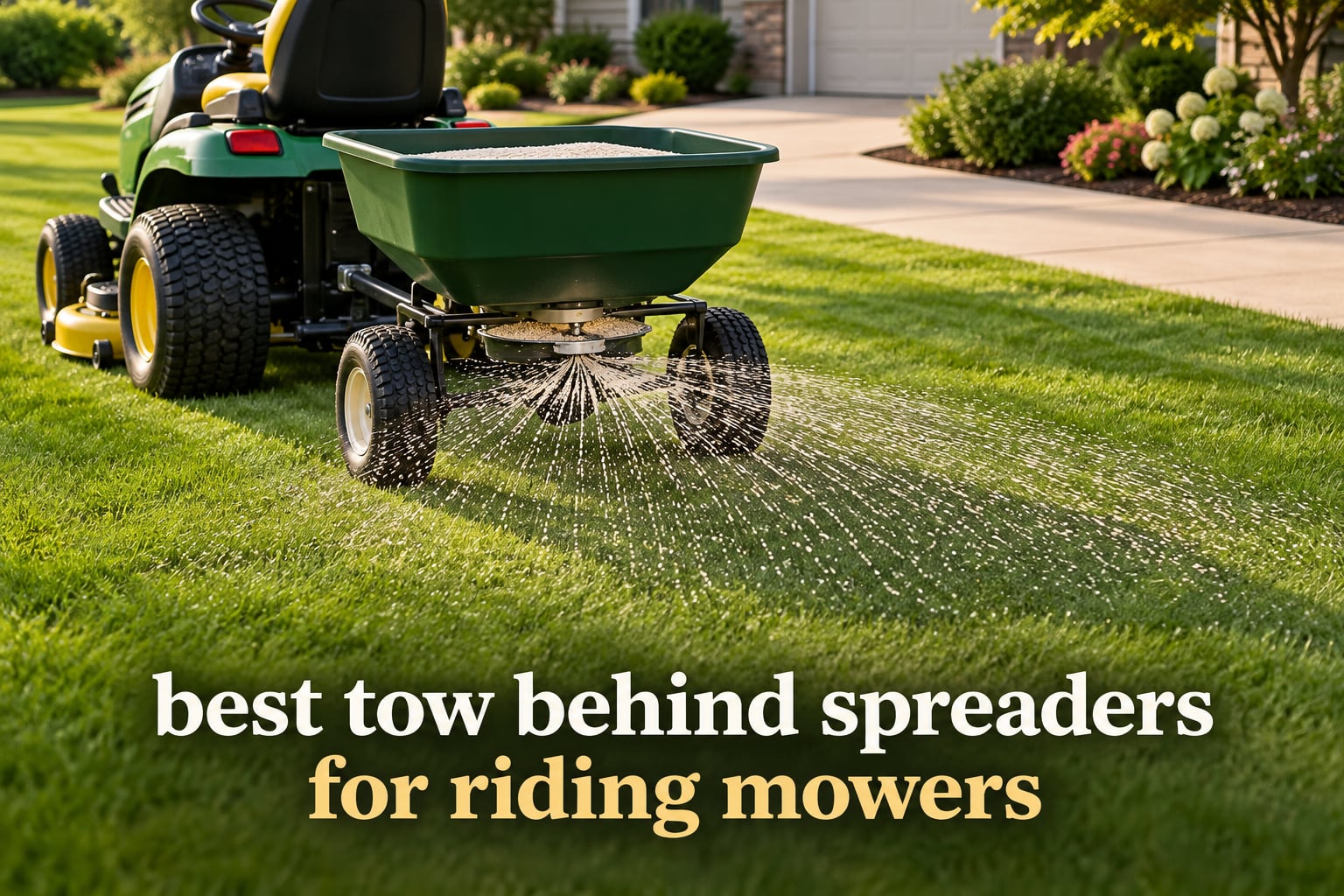
Hand-spreading fertilizer on a large lawn is slow, uneven, and the most common reason people burn their grass. A tow behind spreader fixes that by hanging off the back of your riding mower, dropping material through a flow gate onto a spinner disc turned by its own wheels. If you have a lawn of roughly 15,000 sq ft or more and a riding mower, this is the cheapest way to stop double-applying product in stripes.
Our team compared the eight tow behind spreaders for riding mowers that carry meaningful review volume, then checked how each one handles the two things that actually block a purchase: hitch fit and flow calibration. The short answer is below.
The quick answer: the Agri-Fab 130 lb pull behind broadcast spreader is the best all-round tow behind spreader for riding mowers in 2026 because it pairs the widest review base in the category with a universal hitch and a 10-12 ft spread. The Brinly combination aerator spreads and aerates in one pass, the Yard Commander 125 lb is the best value option, and the Brinly BS26BH-A is the pick if you want the flow to stop when you stop. Anyone driving a zero-turn or a tractor with a rear pin hitch should read the hitch section below before buying anything.
We will explain what each spec means in plain language, tell you which lawn size each hopper suits, and walk through the test-patch calibration that skips the guesswork. If you are still choosing a machine first, our riding lawn mower roundup covers the tractor sizes these spreaders hitch to.
Top 3 Best Tow Behind Spreader Picks in 2026
These three carried the deepest real-world feedback of everything we reviewed, and between them they cover the three situations most riding mower owners face: general fertilizing, one-pass aeration, and budget-conscious coverage on a lot under an acre.

Agri-Fab 130 lb Tow Behind Spreader
- 130 lb hopper
- Universal hitch
- 10-12 ft spread width
- 13 in pneumatic tires
Brinly Aerator and Spreader Combo
- Aerates and spreads in one pass
- 75 lb weight tray
- 100 lb steel hopper

Yard Commander 125 lb Spreader
- Cast aluminum gears
- 125 lb composite hopper
- Hopper cover included
Quick Overview: All 8 Tow Behind Spreaders in 2026
Every spreader below is ground-driven, meaning the spinner disc only turns while you are moving. That single design choice is what keeps this category affordable, and it is why your driving speed sets the application rate.
| Product | Specifications | Action |
|---|---|---|
| Agri-Fab 130 lb Pull Behind Broadcast Spreader |
|
Check Latest Price |
| Brinly Tow Behind Combination Aerator Spreader |
|
Check Latest Price |
| Yard Commander 125 lb Tow Behind Spreader |
|
Check Latest Price |
 EarthWay T150 150 lb Towable Spreader EarthWay T150 150 lb Towable Spreader |
|
Check Latest Price |
 Garvee 130 lb Tow Behind Spreader Garvee 130 lb Tow Behind Spreader |
|
Check Latest Price |
 HVDI 130 lb Pull Behind Broadcast Spreader HVDI 130 lb Pull Behind Broadcast Spreader |
|
Check Latest Price |
 Brinly BS26BH-A 125 lb Broadcast Spreader Brinly BS26BH-A 125 lb Broadcast Spreader |
|
Check Latest Price |
 VELPAX 200 lb Tow Behind Broadcast Spreader VELPAX 200 lb Tow Behind Broadcast Spreader |
|
Check Latest Price |
Broadcast vs Drop Spreader: Which One Do You Actually Need?
Choose a broadcast spreader for an open lawn with even footing, and choose a drop spreader if you have steep slopes, heavy tree cover, or waterway edges where broadcast overspray would wash into a drain or pond. Broadcast throws material in a wide arc and covers ground far faster. Drop meters it straight down between the wheels, so nothing lands where you do not want it, but coverage takes longer.
Every product in this roundup is a broadcast unit, because broadcast is the default for a riding mower. If runoff into a storm drain is a legal concern on your property, or your lawn is a hillside, a tow-behind drop spreader is the correct tool and none of the eight below will solve that problem for you.
There is a middle option worth knowing about. The EarthWay T150 has a patented side spread control that blocks one port, so you can close off the side nearest a flower bed or a walkway without switching machines. That is not the same as a drop spreader, but it covers most edge problems in a single pass.
1. Agri-Fab 130 lb Pull Behind Broadcast Spreader – Best Overall
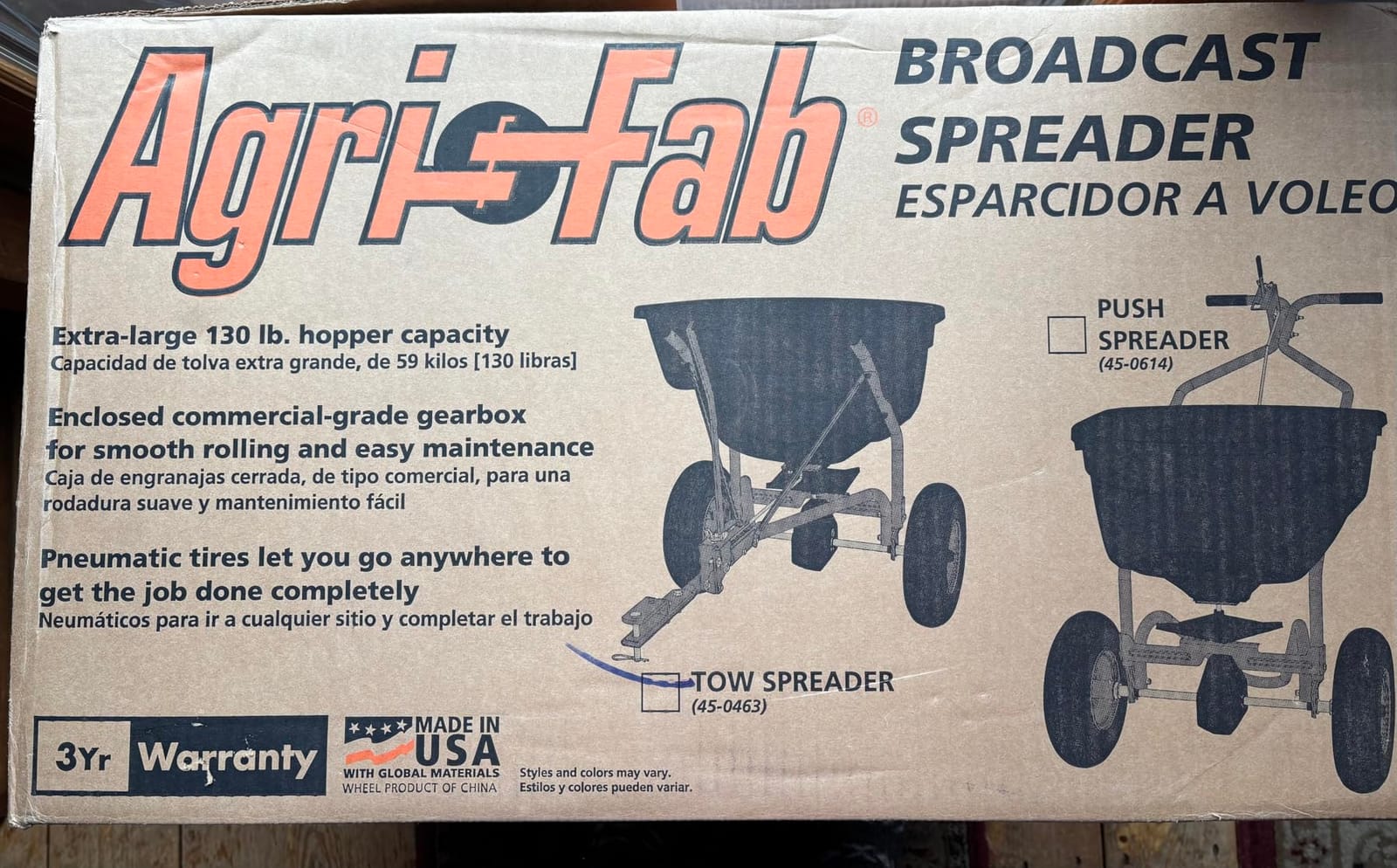
Agri-Fab Pull Behind Broadcast Spreader for Seed, Fertilizer, Salt and Ice Melt, 130 lb Hopper Capacity with Universal Hitch and 12 Ft Spread Width
130 lb poly hopper
Alloy steel frame
10-12 ft spread width
Enclosed gear housing
Pros
- Covers up to 1/2 acre per fill
- Universal hitch fits most riding mowers and lawn tractors
- Adjustable 10-12 ft spread width
- Handles seed fertilizer salt and ice melt
- Exceptionally clear illustrated assembly
Cons
- No automatic shutoff so you must reach back to close the gate
- Stiff flow lever with gloves on
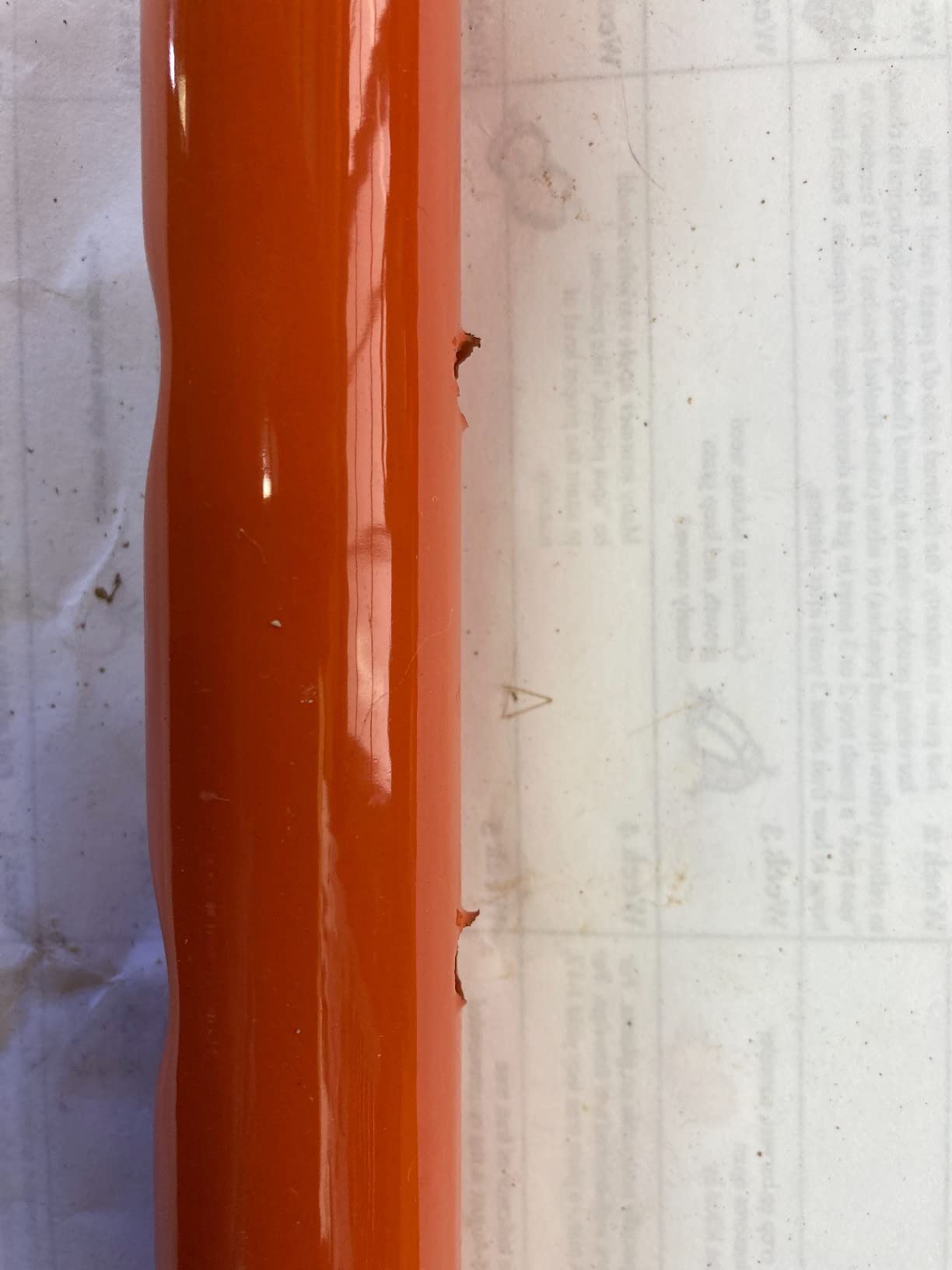
- Occasional gearbox or missing spring pin issues out of the box
- Pneumatic tires pick up flats
The Agri-Fab 45-0463 is the unit most owners on r/lawncare name first when they ask for a dependable tow behind. One regular poster put it plainly: “I’ve been happy with my Agri Fab 130lb spreader.” That matters more here than a spec sheet, because a spreader is a machine you hook up twenty times a season and it either flows the same every time or it does not.
In practice it does flow the same. The 130 lb polypropylene hopper is paired with an alloy steel tubing frame and an enclosed gear housing with a spreader plate, and the whole thing weighs 29.4 lb empty, which is light enough to lift into a truck bed by yourself. The 10-12 ft spread width means a half acre takes a handful of passes rather than a long afternoon.
The one design compromise worth knowing before you buy is the manual gate. There is no auto shutoff, so when you stop the tractor the material keeps flowing until you reach back and close the lever. Owners working near driveways learn to shut the gate before stopping, not after. On the upside, the instructions are genuinely the clearest in this group, and the parts breakdown makes a gearbox repair realistic.
Two details we would plan around. The 13 x 4 in pneumatic tires roll softly over uneven ground but they are not quick-release, so a puncture means the jack and a re-plug on the driveway. And the alloy steel frame will start showing surface rust within days of salt or ice melt duty if you do not rinse it, which is a fifteen-second job that most owners skip twice before learning.
Check the hitch and lever reach before you order
Look at your mower’s rear hitch first. A universal clevis hitch like this one connects to a standard rear pin on most riding mowers and lawn tractors, which is the smoothest fit in the category. If you drive a zero-turn with a rear receiver tube instead, you need an adapter, and that is worth confirming with the seller before the spreader ships.
Next, test the lever. On a tractor with a ROPS or an open operator platform, a cable reach is easy. On a mower where the spreader sits directly behind your seat, you will be twisting your arm back on every gate adjustment, and a stiff lever makes that worse. The 3 year limited warranty is the longest in this group, which matters for a machine that lives outdoors.
Where the Agri-Fab earns its place and where it does not
This is the right spreader for a half acre to a full acre of regular fertilizing, seed, or salt duty, and the 130 lb capacity means most half-acre lawns finish on one fill. If your property is under about 15,000 sq ft and you do not already own a riding mower, the money is better spent elsewhere. You will be loading and dragging a machine to cover ground a walk-behind handles in a fraction of the time.
It is also the wrong choice if you spread next to a lot of hard surface, because there is no deflector or directional shutoff. Nothing on this unit closes one side of the spread pattern. For properties that are mostly flower beds, driveways, and paths, look at the EarthWay T150 further down instead.
2. Brinly Tow Behind Combination Aerator Spreader – Aerate and Spread in One Pass
Brinly Tow Behind Combination Aerator Spreader with Weight Tray, 40-Inch, Flat Black
Aerates and spreads in one pass
75 lb steel weight tray
100 lb steel hopper
132 galvanized tine tips
Pros
- Two jobs done in one pass
- 75 lb weight tray adds real penetration on compacted ground
- Galvanized 3-D tines resist rust and bending
- All steel hopper resists twisting
- Transport mode rolls over hard surfaces
Cons
- Heavy at 77.8 lb making it tough to load
- 2 in tine depth is shallow for dedicated plug aerators
- Combination tines wear faster on very hard soil
- 40 in footprint is wide in tight areas
This Brinly does something no other spreader on our list does. Instead of a spinner disc it runs galvanized 3-D tines that perforate the soil to 2 inches while metering seed or fertilizer out of a 100 lb steel hopper. If you were already planning to aerate in the spring and overseed in the fall, this machine halves the number of jobs you hook up to the tractor.
The weight tray is the part that makes it work. A rigid steel tray takes up to 75 lb, and that extra downward force is what drives the 132 tine tips into compacted ground. Without weight on the tray, the tines skim the surface and you are paying for a feature that does nothing. Owners with clay-heavy lawns report the single-pass result is worth the extra effort of loading.
On TractorByNet, Brinly comes up repeatedly as a working alternative to a John Deere unit at a lower cost, with one reply as simple as “Brinly one. Works good.” That tracks with what we see: the steel hopper and galvanized tines are better materials than the polypropylene and painted steel most competitors use, which matters when you are laying down lime or salt.
The catch is weight. At 77.8 lb empty this is the heaviest machine here by a wide margin, and loading it into a pickup or lifting it over a trailer lip is a real two-person job. About 17% of its reviews are one star, and weight handling is the recurring theme, alongside disappointment that 2 inches of tine depth is shallower than a dedicated plug aerator provides.
Transport mode and the single-lever setup
The 10 in pneumatic transport wheels fold up into a transport mode via a single lever, which lets you roll the machine across a driveway or sidewalk without dragging tines. On a property where the path from the shed to the driveway is all pavement, that feature alone changes the workload. Set it up once at the start of the season and leave it.
Assembly takes roughly 30 minutes, and the star-shaped 8 in diameter steel tines are the part to inspect before the first pass. The universal hitch pin is included, which is a small thing but one you should confirm, because a missing pin is the most common reason a spreader arrives unusable.
Best for compacted soil, worst for small lawns
Buy this if your ground is hard, you overseed regularly, and you already own a tractor capable of pulling 78 lb plus a full hopper. That combination gets you core aeration quality you cannot reach with a walk-behind, and it is the only machine here that treats the root zone as well as the surface.
Skip it if your lawn is small, already healthy, or you care more about even coverage than soil penetration. The 100 lb steel hopper is smaller than several broadcast units in this roundup, so you will refill more often per pass, and you will be dragging a lot of dead weight over good grass for a benefit you cannot use.
3. Yard Commander 125 lb Tow Behind Spreader – Best Value With Cast Aluminum Gearing
Yard Commander – 125 LB Tow Behind Lawn & Garden Broadcast Spreader – Seed, Fertilizer, Salt, Ice Melt – Premium Aluminum Cast Gears – Gate Lever for Easy Spread Control
125 lb composite hopper
Cast aluminum gear drive
10-12 ft broadcast width
1-year limited warranty
Pros
- Cast aluminum gearing for smooth metering
- Composite hopper will not rust
- Weather-resistant hopper cover included
- 12 in pneumatic tires roll over soft ground
- Universal hitch fits tractors riders ATVs and UTVs
Cons
- Only a 1-year limited warranty
- Flow gate needs periodic recalibration
- Composite hopper flexes at full load on uneven ground
Most spreaders in this category drive the spinner off a plastic or painted gear set. The Yard Commander runs a cast aluminum gear drive, and that single spec is why this 125 lb unit holds an even pattern season after season instead of developing the gritty, inconsistent throw that owners complain about on cheaper units.
At 32 lb empty it is easy to handle, and the 125 lb composite hopper covers up to about 25,000 sq ft per fill, which is most of a suburban half acre. The 12 in pneumatic tires are wider than the 10 in units lower down the list and roll over soft or uneven ground without digging in, which matters on a lawn that is still damp in spring.
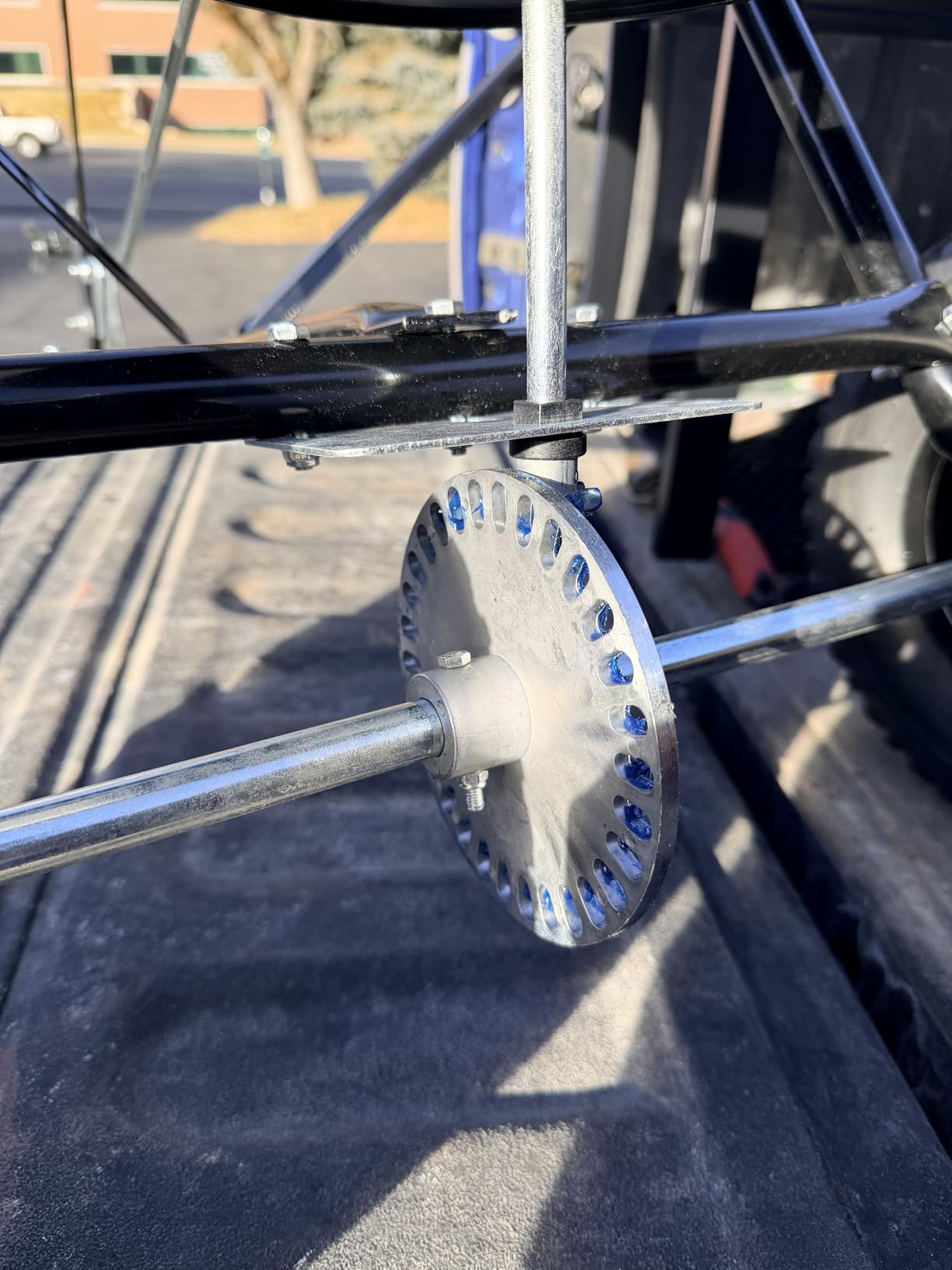
The included weather-resistant hopper cover is a detail worth more than it sounds. It lets you finish a light application if rain starts, and more importantly it keeps damp material from sitting in the hopper overnight, which is where caking and clumping begin. Owners on this unit put 67% of their ratings at five stars, with the composite hopper and the gearing doing most of the work.
Two things to plan for. The warranty is one year, the shortest in this group, so treat the first season as the shake-down period and grease the gearbox pins early. And the composite hopper can flex under a maximum load on uneven ground, so if you routinely fill to 125 lb on rough ground, support the hopper as you load rather than dropping material in from height.
What the calibration dial actually needs from you
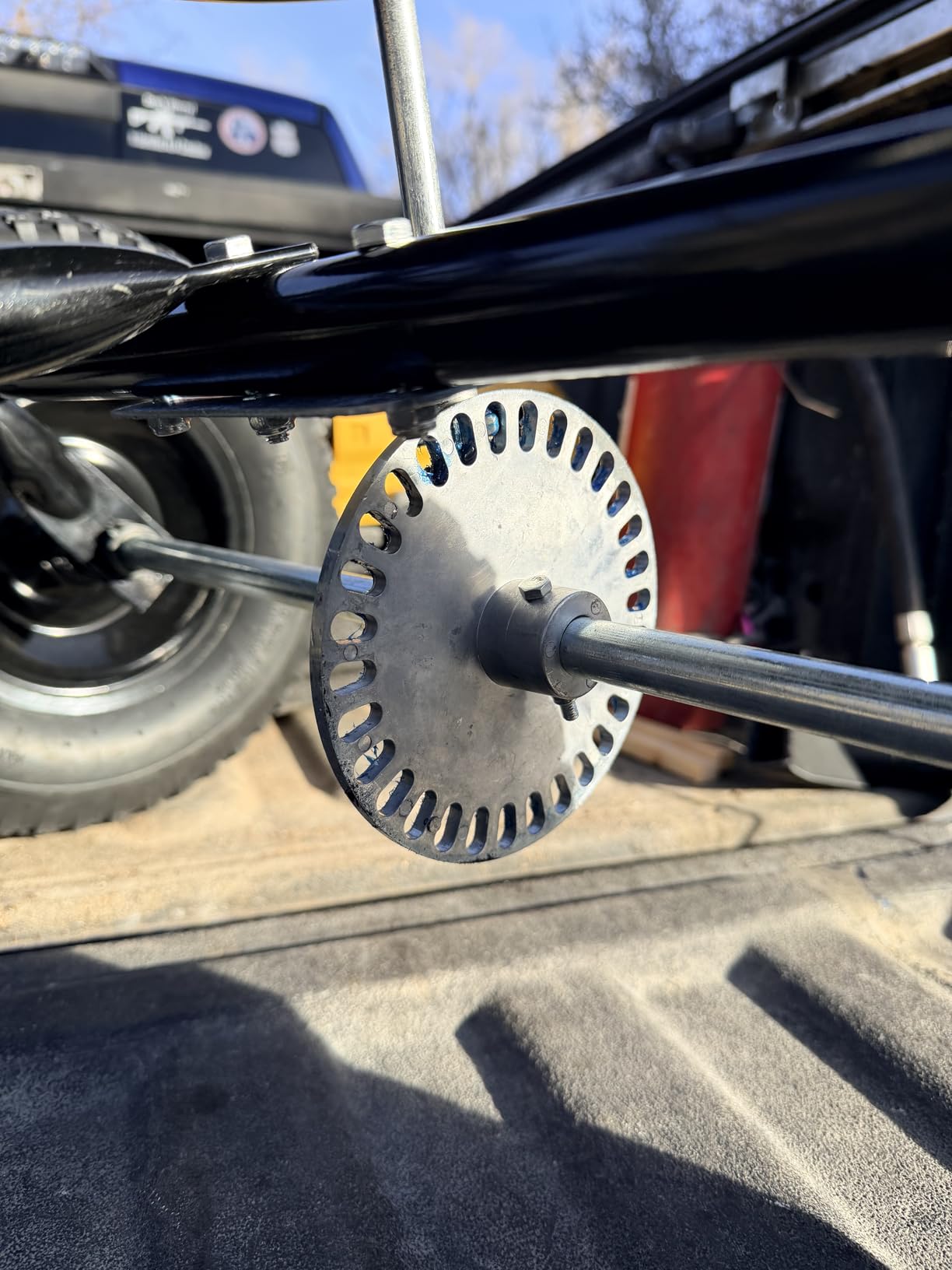
Because the gate is mechanical, the flow control lever needs periodic calibration to stay accurate. That is not a defect, it is a five-minute job: run a test pass on concrete or a tarp, weigh what comes out, adjust, and repeat. Do it once at the start of each season and any time you switch fertilizer brands, since particle size changes flow.
Set your pace before you fill the hopper. The spread pattern widens and thins as you go faster, and a consistent speed is what makes overlapping passes look like one even application. Pick a pace that feels slow on the first pass, because you will naturally speed up once the machine is rolling.
Best for owners who spread wet-season applications
This is the spreader for someone applying pre-emergent in early spring while the ground is still soft, or overseeding in fall. The wide 12 in tires and the rust-proof composite hopper both ignore the conditions that wear out a cheaper steel unit in a single season. The included cover keeps the load dry if you get caught out.
It is not the choice for someone who spreads ice melt all winter on a commercial schedule, or for a buyer who wants a long warranty and forgets about maintenance. If you will not touch a grease gun, the Agri-Fab at number one has a longer warranty and a deeper support history.
4. EarthWay T150 150 lb Towable Spreader – Best for Protecting Beds and Walkways
EarthWay Products T150 150lb Towable Broadcast Fertilizer Spreader, Seed Spreader, Pull Behind Aerator/Seeder for Garden Tractor, Easy Flow Control, Adjustable, Non-Skid Tires
150 lb hopper
Patented side spread control
Recommended tow speed 3 mph
Made in the USA
Pros
- Side spread control blocks one port
- 150 lb capacity for large properties
- Sturdy frame owners describe as solidly built
- Non-skid tires grip while pulling
- Made in the USA
Cons
- Calibration gauge is imprecise and hard to read once set
- Narrow wheelbase can tip or rut a soft lawn
- Short tow yoke limits ground clearance behind an ATV
- Vague assembly instructions
The EarthWay T150 solves the problem that most owners of a broadcast spreader complain about loudest: product landing on the driveway, the walkway, and in the bed. Its patented side spread control closes off one port, so you can kill the side facing a hard surface or a planting bed and still spread the other three quarters. No other unit in this roundup does that.
The 150 lb hopper suits a property over an acre, and EarthWay recommends a tow speed of 3 mph, which is genuinely slow. That number is worth taking seriously. A spreader pulled faster than its rated speed throws material wider and lighter than the bag label assumes, and the recalibration you then need is what causes the uneven coverage people blame on the machine.
Owners describe the build as sturdy, and the fact that it is made in the USA matters more here than in most categories, because replacement parts for a spreader are not always easy to find. The non-skid tires grip well when pulling. At 30 lb empty it is one of the lighter 150 lb units, which is a genuine advantage for loading.
Its weak point is calibration. Owners specifically call the flow opening adjuster gauge imprecise and hard to read once it is set, so budget extra time on the test patch and mark the setting with tape once you find the right number. Assembly directions are terse and use low-resolution illustrations, so allow for figuring it out with the parts laid out.
Why side control beats buying a second machine
Closing one port is not a drop spreader. You still get a fan pattern from the remaining ports, so you are losing a slice of coverage, not gaining a straight line. What you gain is that fertilizer stops washing off a bed edge into a pond, and that a salt pass along a driveway no longer puts grit on the concrete.
For a property with one defined problem area, this is far cheaper than owning both a broadcast and a drop unit. For a property that is mostly beds, paths, and a steep slope, it is still not enough, and no broadcast spreader will be.
Handling the narrow wheelbase on soft lawns
Watch the load distribution. Owners report the narrow wheelbase makes the loaded unit prone to tipping or rutting on soft ground, so fill in smaller amounts on damp or freshly watered lawns rather than topping off to 150 lb and making a pass. If your lawn stays wet for days, choose a wider-wheelbase unit such as the Agri-Fab instead.
The tow yoke is also short, which limits ground clearance behind an ATV. On a lawn tractor or riding mower with plenty of clearance this is a non-issue. It matters if you plan to tow it behind a low-slung UTV across gravel.
5. Garvee 130 lb Tow Behind Spreader – Budget Pick Built for Salt Duty
Garvee Tow-Behind Spreader, 130LBS Capacity Pull Salt Broadcast Spreader
130 lb poly hopper
Powder-coated steel frame
10 in all-terrain pneumatic tires
Waterproof cover and sieve included
Pros
- Poly hopper and coated frame resist salt corrosion
- 130 lb covers a half acre in one or two passes
- 10 in tires roll over soft lawn and gravel
- Hitches to zero-turn mowers without hopping
- Even spread pattern once dialed in
Cons
- Flow control lacks fine precision so settings take trial and error
- Assembly takes time with thin instructions
- Included rain tarp shifts once cinched
- Residential-grade build
Every review on this unit is positive, and we want to be straight with you about why: there are only nine of them. A 4.9 average from a nine-review base tells you early owners were happy, not that the machine will still be smooth after a decade of salt. We rank it here on the materials, which are the right ones for the job rather than the rating, which is too thin to lean on.
Those materials are a 130 lb rust-resistant poly hopper on a powder-coated steel frame, which is exactly the combination you want for ice melt and salt duty through winter. The 10 in all-terrain pneumatic tires roll over soft lawn and gravel without digging in, and early owners report no rusting after a full season of salt work.
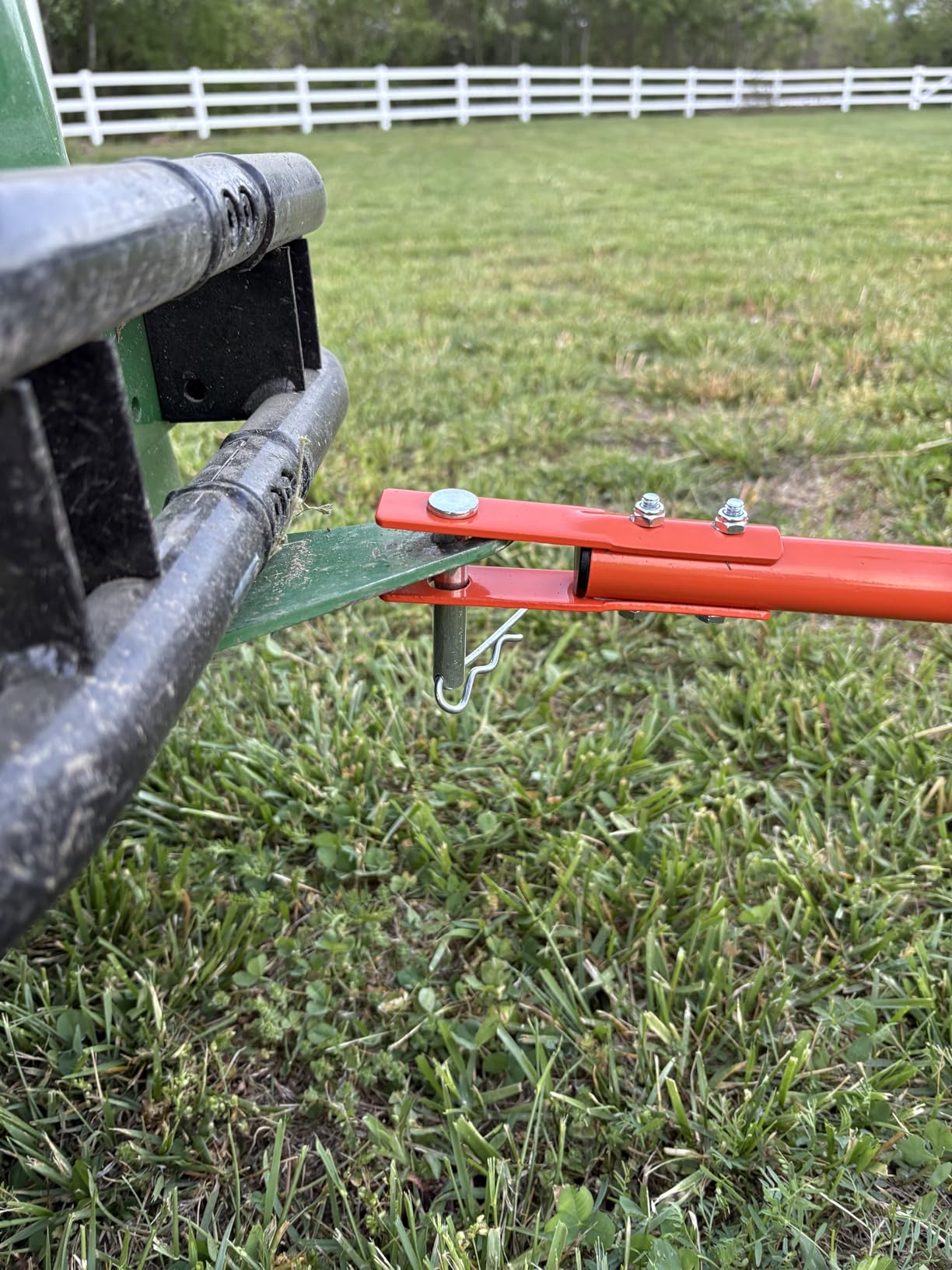
Hitching is the surprise strength. Owners report it connects to zero-turn mowers, lawn tractors, and ATVs without hopping or fighting, which is the most common complaint about budget units. If you drive a zero-turn, this is the one to look at first on this list.
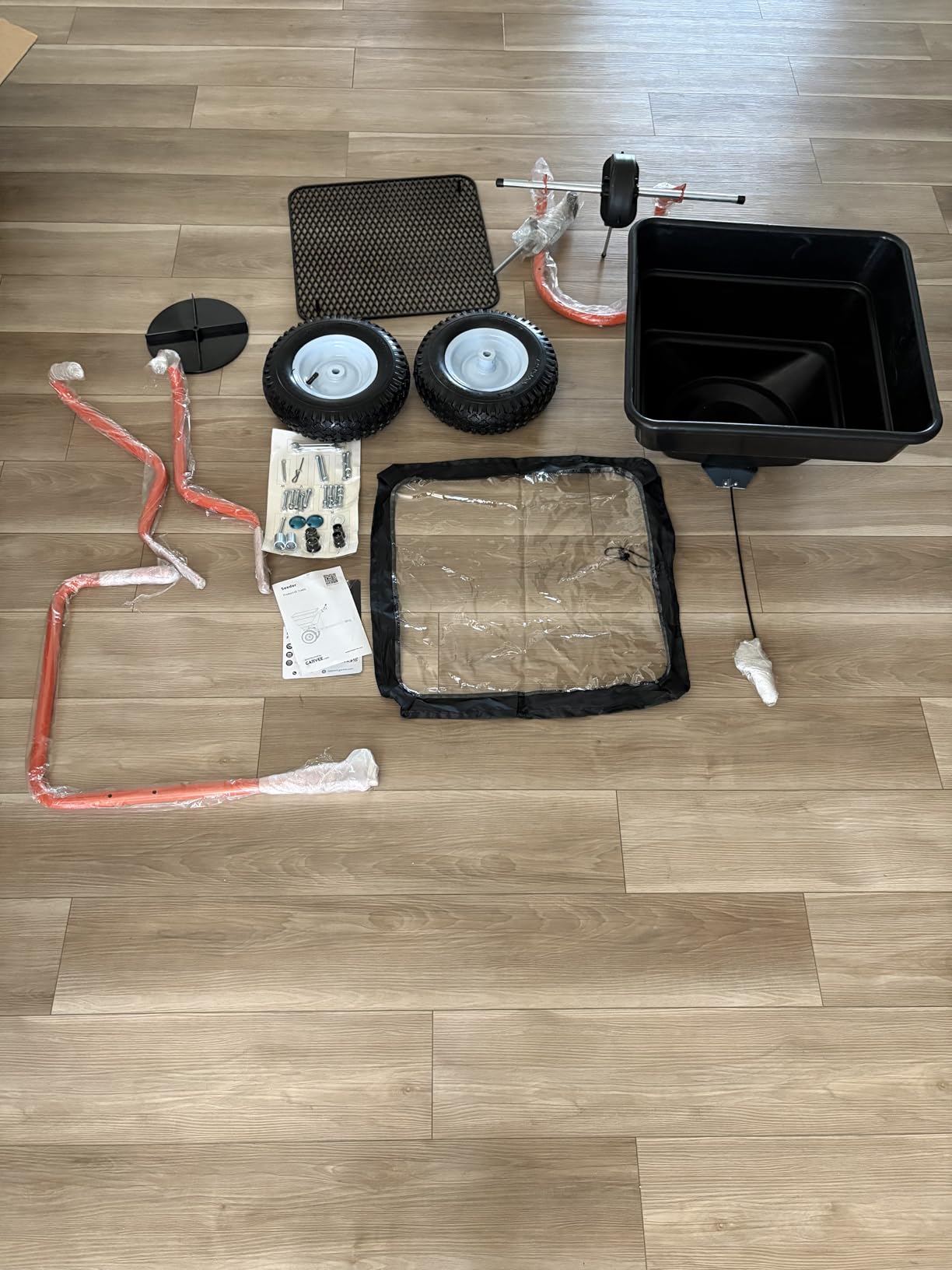
The long tow bar is designed for lawn tractors, ATVs, and UTVs, and the spread width adjusts from 0 to 10 ft, so you can narrow the pattern for a path or a bed. The included waterproof cover and sieve are both useful, though the cover has no attachment points and shifts once cinched down, so plan to tie it if you are applying in wind.
Calibrating a coarse flow control
The flow control here lacks fine precision, which means the dial numbers on the bag label will not map cleanly to this machine. Run the test patch, count how many passes it takes you to empty a measured amount, and record the result on the hopper with a paint pen. Most settings converge in two or three tries.
Keep material dry in the hopper between runs. Fine granular material plus any moisture in the poly hopper is the recipe for a bridge that stops feeding mid-pass, and no setting adjustment fixes a clogged gate.
Best for winter salt, not for precision work
Choose this if your main duty is ice melt and salt on a driveway or a front walk, and you want the hopper large enough to do it in one run. The corrosion-resistant build and the all-terrain tires are the right choices for that work, and the 130 lb capacity means you are not feeding it in a driveway every twenty minutes.
Pass on it if you are applying fertilizer and want a dial you can trust without a test patch every time, or if you plan to keep the machine for a decade. The build is residential-grade, the instructions are thin, and nine reviews is not enough history to bet a long ownership on.
6. HVDI 130 lb Pull Behind Broadcast Spreader – Best for Reach From the Seat
Pull Behind Broadcast Spreader, Fertilizer Spreaders for Lawn Seed Spreader
130 lb trapezoidal hopper
5 adjustable discharge ports
12 ft spread width
Hitch extender and handle rod included
Pros
- Five discharge ports for even distribution
- Hitch extender and handle rod work the controls from the seat
- 12.5 in tires float over grass gravel mud and snow
- 130 lb hopper cuts refills on large yards
- Sealed gearbox on a powder-coated frame
Cons
- Very small review base so durability is unproven
- Still requires reaching back on some tractors
- No published weight or dimensions in the listing
The thing that separates this 130 lb unit from most of the field is control reach. A hitch extender and a handle extension rod are both included, which is what lets you set the gate and change direction from the seat rather than stopping and leaning back over the hopper. On a machine designed to be run at 3 mph over an acre, not stopping is a real saving.
Five adjustable discharge ports feed material onto the spinner from several points across the width of the trapezoidal hopper, rather than from a single hole. Owners report this produces a more even distribution than single-port designs, which shows up as fewer pale stripes on the second pass.
The 12 ft spread width is the joint-widest here and sits at the top of the class. The 12.5 in pneumatic tires are the second largest in this roundup and owners report they float over grass, gravel, mud, and snow, which makes this the most capable of the budget-adjacent units when conditions are poor.
Be clear-eyed about the evidence. Fifteen reviews with no ratings below three is encouraging but thin, and the listing publishes no weight or dimensions, so confirm the physical size fits your hitch and your storage space before ordering. Long-term dependability is simply not yet demonstrated.
How to check the reach before you commit
Sit in the operator position of your mower and measure the distance from your hip to the hopper. Compare that to the length of the included extension rod with the hitch extender fitted. If the gate lever still falls behind your shoulder, the extensions will not save you, and a unit with a longer handle design such as the VELPAX further down may suit you better.
On a tractor with a ROPS cage, the geometry works in your favor because the spreader sits lower and further back, roughly at hip height. On a small zero-turn with the spreader directly behind the seat, plan on leaning.
Best for rough conditions and long passes
This is the pick when your lawn has more than one surface: grass, a gravel drive, a muddy low spot, and a winter path. The large tires and the sealed gearbox on a powder-coated steel frame are the right specification for mixed use, and the 130 lb hopper cuts the number of refills on a yard over half an acre.
It is not the pick if you want a long service record before committing, or if you will not do a test-patch calibration. With this few reviews there is no community data on how the gate holds up after five seasons, so treat the first year as the warranty period and check the flow often.
7. Brinly BS26BH-A 125 lb Broadcast Spreader – Best for Auto Shutoff
Brinly BS26BH-A Tow Behind Broadcast Spreader with Universal Hitch, 125 lb. – Flat Black
125 lb heavy poly hopper
Patented AutoFlow shut-off
Directional spread pattern control
Locking calibration dial
Pros
- AutoFlow stops the spread when the tractor stops
- Directional control lets you correct a lopsided pattern
- Stainless steel spinner shaft and agitator resist corrosion
- Enclosed glass-filled nylon gear drive
- Locking calibration dial holds your setting
Cons
- Hopper leaves roughly 5 lb behind when emptied
- Gate adjuster can vibrate shut while towing
- Assembly takes time even with the pictorial manual
- Heaviest pure spreader here at 42.8 lb
AutoFlow is the feature to know here. When the tractor stops, the spread stops, with no reaching back to find the lever. If you have ever dumped a load of fertilizer in one spot because you stopped to adjust the gate, or if your property has driveways and beds you drive past, that mechanism removes an entire category of mistake.
Directional spread pattern control lets you steer the throw. If the left side of your pattern is heavier, you can dial the distribution so the pattern centers where you need it. Combined with the locking calibration dial, which holds hundreds of pre-calibrated settings, this is the most adjustable mechanism in the roundup.
Materials are the best here too. Stainless steel hardware, a stainless spinner shaft, and a stainless agitator hold up against corrosive fertilizer in a way painted steel does not, and the fully enclosed glass-filled nylon gearbox protects the drive from dust and moisture.
The evidence base is five reviews, and the rating spread is unusually wide, from three stars up to five. Owners credit AutoFlow and the stainless hardware, and the same owners report two real problems: the hopper does not empty completely, leaving roughly 5 lb behind, and the gate adjuster can vibrate and drift closed while you tow.
What AutoFlow changes about your driving
With an automatic gate, you can stop anywhere without thinking, which changes your whole route. Owners find they can back up to a bed edge, stop to reposition, and pull away without a cleanup pass. It also makes overlapping passes easier, because you can stop and restart mid-lawn without dumping product.
Check the drift issue on the first outing. A gate that vibrates closed mid-pass is worse than no AutoFlow at all, because you will compensate for it and then be over-applying when it holds properly. Tighten the adjuster to the manufacturer torque and re-check it after the first full hopper.
Best for driveways and beds, with a caveat
Choose this if your lawn has hard edges you drive along and you would rather not think about the gate. The stainless hardware also makes it the better pick of the two Brinly units here for anyone applying lime or salt, where corrosion decides how long the machine lasts.
At 42.8 lb it is the heaviest pure spreader in this group, which is a lot of lifting for a 125 lb hopper, and the 5 lb that stays in the hopper is worth accounting for at the end of a salt run. With only five reviews, treat the first season as the shake-down.
8. VELPAX 200 lb Tow Behind Broadcast Spreader – Best for Maximum Capacity
VELPAX 200LB Tow Behind Broadcast Spreader, Fertilizer Spreader Holds up to 550 lbs with 13″ Pneumatic Tires and Adjustable Flow Control Lever,for Fertilizer, Grass Seed, Salt, Ice Melt, Lawn
200 lb poly hopper
550 lb frame weight capacity
13 in pneumatic tires
5-stage adjustable gate
Pros
- Largest hopper here covering up to 50000 sq ft per load
- Extended flow lever reachable from the seat
- 550 lb frame rating handles rough hilly ground
- Trapezoidal hopper designed to reduce clogging on coarse salt
- Step-by-step manual with pre-sorted hardware
Cons
- Only 2 reviews so reliability data is almost absent
- 44 lb empty weight is heavy to load
- 200 lb hopper is oversized for most suburban lots
- No warranty stated in the listing
A 200 lb hopper is the largest here, and it covers up to about 50,000 sq ft per load. That is the whole point of this machine. If you are applying lime to several acres, or you lay down several hundred pounds per pass the way one TractorByNet owner describes putting down 350 lb three times a year, refill stops being part of the job.
The frame is rated to 550 lb, which is what makes that capacity usable. A plastic hopper that big on a weak frame flexes and cracks; this one pairs the 200 lb rust-proof poly hopper with a steel frame rated well above the loaded weight, plus 13 in pneumatic tires, the largest here, for rough and hilly ground.
The 5-stage adjustable gate with an extended flow lever gives finer adjustment than a binary lever and stays reachable from the seat. The trapezoidal hopper shape is designed specifically to reduce clogging on coarse salt, which addresses the single most common complaint we found in the forums about this category.
Two reviews, both five stars, is not a rating. The one detailed owner report says it worked as intended for a fall fertilizer application, and the listing states no warranty at all. Treat the specification sheet as promising and the field history as unproven.
Clogging and coarse material
Forum owners who spread fine or damp material report clogging as their main complaint, and the documented fix in one case was to cut the hopper openings and fit a more aggressive agitator. We would not recommend modifying a spreader. A 5-stage gate and a clog-resistant trapezoidal hopper are the factory answer, and if your material bridges no matter what, the material is too damp for any machine.
Dry your product before it goes in. A tarp or a bin under the bag for an hour after a humid morning fixes more clogs than any hardware change, and it costs nothing.
Best for multi-acre properties, oversized for most lawns
Buy this if you are past three acres, spreading agricultural lime, or feeding a large property with salt in winter. The capacity, the frame rating, and the tire size are all scaled for that work, and a 50,000 sq ft load means one pass per fill.
Skip it for a standard suburban lot. At 200 lb capacity and 44 lb empty weight, you are carrying a ton of machine around to do a job a 125 lb unit finishes with one extra refill, and the 44 lb empty weight is the heaviest here to hoist into a bed. Our broadcast spreader guide covers the smaller-capacity picks if that describes you.
Buying Guide: Match the Spreader to Your Mower and Lawn
Step 1: Identify your mower’s hitch type
This is the number one purchase blocker, and it is a two-minute check. Stand behind your mower and look for one of three things. A round receiver tube welded to the rear frame means you need a receiver-hitch spreader or an adapter. Two vertical pins on a plate, often with a spring clip, means a standard pin-and-clevis hitch, which every spreader in this roundup fits. Three linkage arms ending in ball ends means a 3-point hitch, which none of the tow-behinds here will connect to without an adapter kit.
A r/lawncare user asking for a spreader for a specific tractor by name is the exact situation this check prevents. Zero-turn mowers most often have the receiver tube, riding lawn tractors most often have the rear pin, and compact tractors usually have the 3-point. If you are unsure, take a photo of the hitch area and ask the seller before ordering.
Step 2: Match hopper capacity to your lawn size
Hopper pounds and coverage in square feet are not the same thing, and that mismatch confuses most buyers. Coverage depends on the application rate on the bag, not the hopper alone. As a working guide: under 15,000 sq ft is push-spreader territory, half an acre to an acre suits 100-130 lb, one to three acres suits 130-175 lb, and past three acres you want 175-200 lb or a drop spreader for slopes.
For the workload one TractorByNet owner described, putting down roughly 350 lb three times a year on a property over two acres, a 150 lb hopper means three fills per application and a 200 lb hopper means two. That is the entire argument for buying bigger than you think you need, and it is why the largest unit here earns its place on a large property.
Step 3: Calibrate before you touch the grass
Never run a new spreader over your lawn before a test pass on concrete or a tarp. Every spreader and product combination flows differently, and ten minutes of testing beats a scorched lawn. Start by setting the lever to the bag label recommendation. Roll a measured pass on concrete at your normal speed and weigh what lands. If the amount is wrong, adjust and repeat. Mark the correct number on the hopper and repeat whenever you change fertilizer brands, since particle size changes flow.
Do the same test on a tarp if you cannot find flat concrete. A sheet of plywood or a drop cloth on the driveway works nearly as well, and it is the one step in this whole guide we would not skip.
How to read ratings in this category
Tow behind spreaders rate poorly across the board, and that is worth understanding before you buy. One r/lawncare poster put it plainly: “I’ve been happy… The reviews for most spreaders are in the 3.5 range, so I’m wondering what works best for you.” That skepticism is fair. The reason is a mismatch between expectations and hardware: people expect the durability of a commercial implement and the price of a residential accessory.
So discount the star number and read the pattern. A 4.2 across several thousand reviews, like the Agri-Fab, tells you the design works for most owners. A 4.9 across nine reviews, like the Garvee, tells you almost nothing except that nobody has had a problem yet. The products here are graded with the review volume in mind, and the five with thin histories are flagged in their sections so you can weight them correctly.
Turf damage and salt corrosion
Turf warning: every spreader here runs on pneumatic tires for a reason, and tire size is what decides whether you rut a wet lawn. The 12 in and 13 in units on this list spread weight better than the 10 in models. If your lawn stays soft for days after rain, do not fill to capacity, keep your passes straight and slow, and avoid the same lane repeatedly so the tire tracks are not concentrated in one strip.
Salt warning: rinse the hopper and the frame with a hose after every winter application. Salt residue on steel frames is the fastest way to turn a spreader into scrap, and it costs two minutes. Owners report corrosion starting within days on untreated metal parts. The all-poly hopper and composite hopper units tolerate salt duty better, and if salt is your main workload, weight that above everything else.
Who should not buy a tow behind spreader
If your lawn is under about 15,000 sq ft and you do not already own a riding mower, a tow-behind is the wrong purchase. You would be buying a machine and a vehicle to haul it, and our walk-behind broadcast spreader guide covers the tools that handle that size of lawn faster. Similarly, if you own a 3-point PTO spreader and are considering the switch for convenience, understand the trade: you are giving up capacity for setup simplicity, not gaining capability.
One owner made that exact move on TractorByNet, downgrading from a much larger PTO spreader because the hookup, clean, and grease cycle had become tiresome. That is a reasonable call for one to three acres. It is a bad call past five acres, where refill time starts to dominate your afternoon.
Broadcast or drop, one last time
Broadcast for open, level lawn and speed. Drop for slopes, tree cover, and any edge near water where runoff matters. If you already own a tow behind sprayer for liquid applications, this roundup covers the dry side of the same hitch, and the compatibility check in step one applies to both.
One last piece of advice: buy the simplest thing that covers your lawn. A longer pass and a bigger hopper feel like an upgrade, but the machine that stays in the shed and gets used is worth more than the one that stays in the shed unused. Clean it, grease the gearbox pins, rinse it after salt, and it will outlast the model you upgraded to.
Frequently Asked Questions
What is the best pull-behind spreader for a lawn mower?
The Agri-Fab 130 lb pull behind broadcast spreader is the best all-round choice, with the widest review base in the category, a universal hitch, and a 10-12 ft spread width. The Brinly combination unit is better if you also want to aerate, the Yard Commander 125 lb is the best value, and the Brinly BS26BH-A is the pick if you want the flow to stop when the tractor stops.
Which is better, a broadcast or drop spreader?
A broadcast spreader is better for open, level lawn because it covers ground faster and is forgiving to drive. A drop spreader is better on steep slopes, under heavy tree cover, or near waterway edges, because it meters material straight down so nothing washes into a drain or pond. Most riding mower owners should buy broadcast.
Will a tow behind spreader work with my riding mower?
Usually yes, but check the hitch type first. Most riding lawn tractors have a rear pin that a universal clevis hitch fits directly. Zero-turn mowers most often have a round receiver tube, which needs an adapter or a receiver-hitch spreader. Compact tractors with a 3-point hitch need an adapter kit. Look behind your mower before you order.
What size tow behind spreader do I need for my lawn?
Under about 15,000 sq ft, a walk-behind spreader is the better buy. Half an acre to one acre suits a 100-130 lb hopper, one to three acres suits 130-175 lb, and past three acres you want 175-200 lb or a drop spreader. A 130 lb hopper covers roughly 25,000 sq ft per fill at a typical application rate.
How do I know which spreader setting to use?
Start at the number printed on the fertilizer bag label, then verify it. Roll a measured pass on concrete or a tarp at your normal speed, weigh what comes out, and adjust up or down until it matches the rate on the bag. Repeat the test whenever you change fertilizer brands, because particle size changes the flow. Mark the correct number on the hopper.
Why do most tow behind spreaders have low star ratings?
The category typically sits between 3.5 and 4.2 stars because buyers expect implement-grade durability at accessory prices. The design itself is simple and ground-driven, so most complaints are about a stiff flow lever, tires needing air, and rust that starts within days of salt use if the machine is not rinsed. Read the review pattern rather than the average.
How do I keep a spreader from clogging?
Keep the material dry before it goes in the hopper, and spread in the morning after any dew or overnight humidity has burned off. Fine granular material plus moisture is what bridges the gate. Do not cut openings in the hopper or fit a more aggressive agitator yourself, even if you see owners doing it in forums, because it voids the calibration the settings dial depends on.
Which fertilizer spreader has the highest rating?
Among the units we reviewed, the VELPAX 200 lb shows a 5.0 rating and the Garvee 130 lb shows 4.9, but both rest on fewer than ten reviews, so neither is a meaningful signal. Among products with real usage history, the Agri-Fab 130 lb at 4.2 across more than 3,400 reviews is the one worth weighting.
Final Verdict: Which Tow Behind Spreader Wins in 2026
After comparing all eight, the Agri-Fab 130 lb pull behind broadcast spreader is the best tow behind spreader for riding mowers in 2026 for the simple reason that it has the deepest review history and the fewest surprises. The universal hitch fits the most tractors, the 10-12 ft width covers a half acre in a few passes, and the 3 year warranty is the longest here. Get the hitch type confirmed, do one test patch on concrete, and it will run for years.
The rest of the field is a matter of your specific problem. Aerate as you spread, and take the Brinly combination unit. Spread wet-season applications and want cast gearing, and take the Yard Commander 125 lb. Have beds, walkways, or a driveway edge to protect, and take the EarthWay T150. Spread salt on a budget, and take the Garvee. Want the controls within reach and large tires for mud and gravel, and take the HVDI. Want the gate to stop when you stop, and take the Brinly BS26BH-A. Past three acres or spreading lime, and take the VELPAX 200 lb.
Whatever you choose, calibrate before the first pass and rinse the frame after any salt work. Those two habits decide how long the machine lasts.