
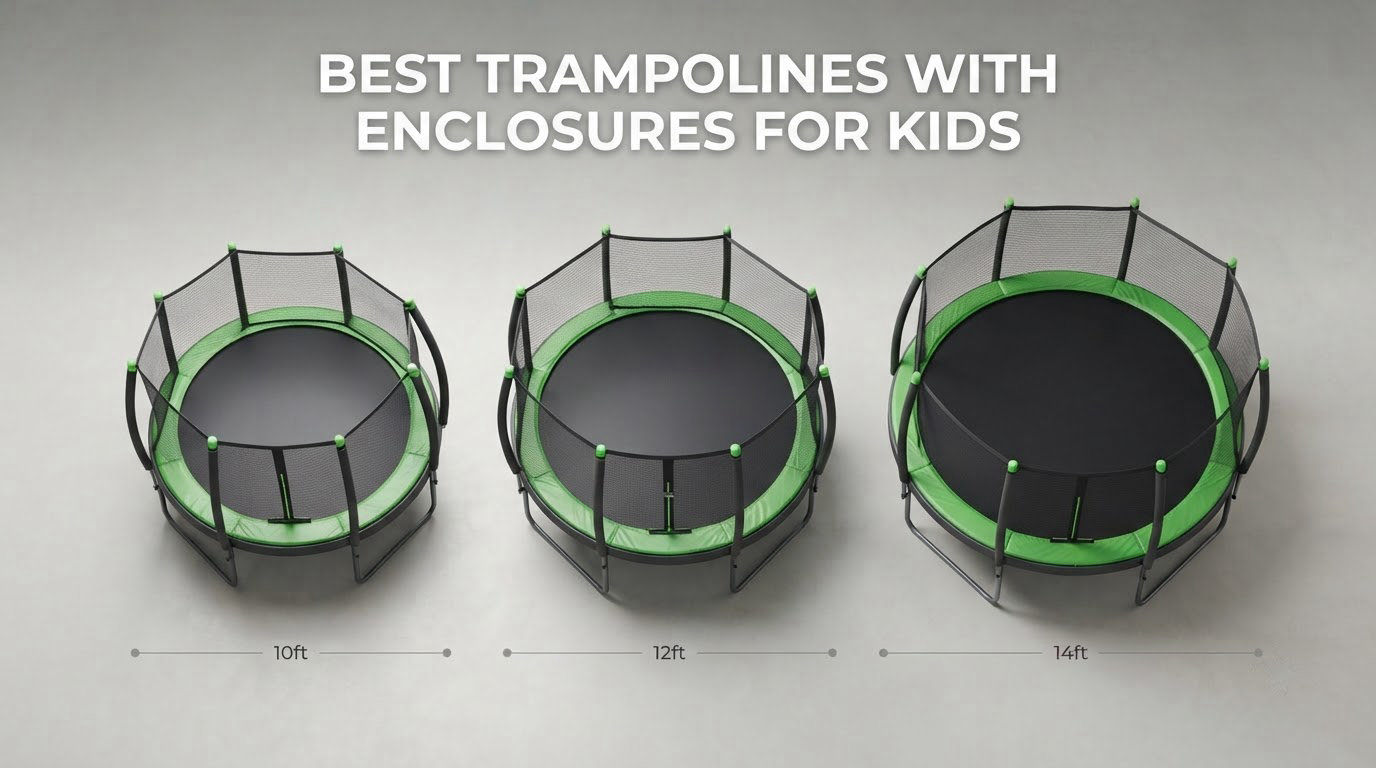
Every trampoline review site will tell you an enclosure net makes a trampoline safe. That is only half true, and the half that matters most is the one the sales photos leave out. Our team has been putting enclosed models through assembly, sizing and safety-spec checks, and the pattern in the customer reviews is consistent: a net dramatically reduces falls off the mat, and it does absolutely nothing about two children bouncing into each other at the same time. Pick the best trampolines with enclosures for kids by judging the net, the frame and the age fit, then run a strict one-jumper-at-a-time rule and the safety advantage becomes real.
We compared eight enclosed trampolines across the full range parents actually shop: 8 and 12 foot backyard models, a rectangular gymnastics unit, and 55 to 60 inch indoor enclosures for toddlers and younger kids. For each one we looked at enclosure construction, published safety certification, maximum user weight, frame materials, warranty length and how many people it really takes to build. If you want a broader look first, our general guide to the best trampolines covers open-frame and above-ground options too.
One quick note on safety claims before we get into the picks. Parents on parent forums describe the trap plainly: a visible net creates a false sense of security, and it is the youngest jumpers who end up in emergency rooms, not the adults. The same communities consistently rank supervision and jumper limits above brand names. That is the mindset we carried into this roundup, and it is why every pick below includes honest drawbacks rather than a sales pitch.
Table of Contents
Top 3 Picks for Trampolines With Enclosures
The JUMPZYLLA 12 ft takes the overall slot on the strength of its curved poles, ASTM F381-16 certification and the largest verified review base we evaluated. Zupapa earns the premium slot for the only truly no-gap net in the group, sewn directly to the jumping mat. VEVOR wins the indoor slot with a three-minute one-person build and suction feet that grip a living room floor.

JUMPZYLLA 12 Ft Round With Enclosure
- ASTM F381-16 certified
- Curved safety poles
- 400 lb max user weight
- 72 springs with cover

Zupapa 12 Ft No-Gap Enclosure
- No-gap net sewn to mat
- 10-year frame warranty
- Hot-dip galvanized steel
- 1800 lb static capacity

VEVOR 55 Inch Enclosed Indoor
- ASTM CPC certified
- Three-minute one-person setup
- Suction-cup feet
- Three size options
All 8 Best Trampolines With Enclosures for Kids (October 2026)
This table is the fastest way to narrow the field. Every model below ships with a safety enclosure in the box, which is the one requirement we applied without exception.
| Product | Specifications | Action |
|---|---|---|
| JUMPZYLLA 12 Ft Round With Enclosure |
|
Check Latest Price |
| Zupapa 12 Ft No-Gap Enclosure |
|
Check Latest Price |
| VEVOR 55 Inch Enclosed Indoor |
|
Check Latest Price |
 SKOK 8 Ft With 4.9 Ft Enclosure SKOK 8 Ft With 4.9 Ft Enclosure |
|
Check Latest Price |
 GIANTEX 7 Ft Trampoline With Net GIANTEX 7 Ft Trampoline With Net |
|
Check Latest Price |
 Happin 55 Inch With Safety Enclosure Happin 55 Inch With Safety Enclosure |
|
Check Latest Price |
 AOTOB 12 Ft Rectangular With Net AOTOB 12 Ft Rectangular With Net |
|
Check Latest Price |
 ZCMHAXJ 55 Inch Enclosed Trampoline ZCMHAXJ 55 Inch Enclosed Trampoline |
|
Check Latest Price |
1. JUMPZYLLA 12 Ft Round Trampoline With Enclosure – Best Overall
Jumpzylla Outdoor Trampoline with Net for Kids 8FT 10FT 12FT 14FT 15FT 16FT
12 ft round
400 lb max
72 springs
ASTM F381-16
Warranty 1 year
Pros
- Curved poles keep the impact zone away from jumpers
- Galvanized steel tubes with a thick reinforced mat
- UV-resistant padding and mat
- Box includes ladder and wind stakes
- Available from 8 ft to 16 ft
Cons
- Only a 1-year manufacturer warranty
- 72 springs make assembly physically demanding
The JUMPZYLLA 12 ft is the pick we would put in a suburban yard with kids roughly 6 to 14 and a parent who wants to jump too. It carries the largest verified review base of the eight we examined, and the pattern across those reviews is unusually consistent: owners keep naming the curved pole design and the frame thickness as the reasons it still feels solid after a couple of seasons. At 400 lb maximum user weight, it handles an adult on the mat with a child, which is what most families actually want.
What stands out technically is the pole geometry. The poles bow outward rather than rising straight, which moves the hardest impact zone away from the jumping surface. On a round frame the mat is already curved, and the design adds a second layer of separation between a falling child and the steel. The mat and padding are listed as UV-resistant, and the legs are powder-coated to resist rust, which are the two things that decide whether a netted trampoline still looks new after two summers.
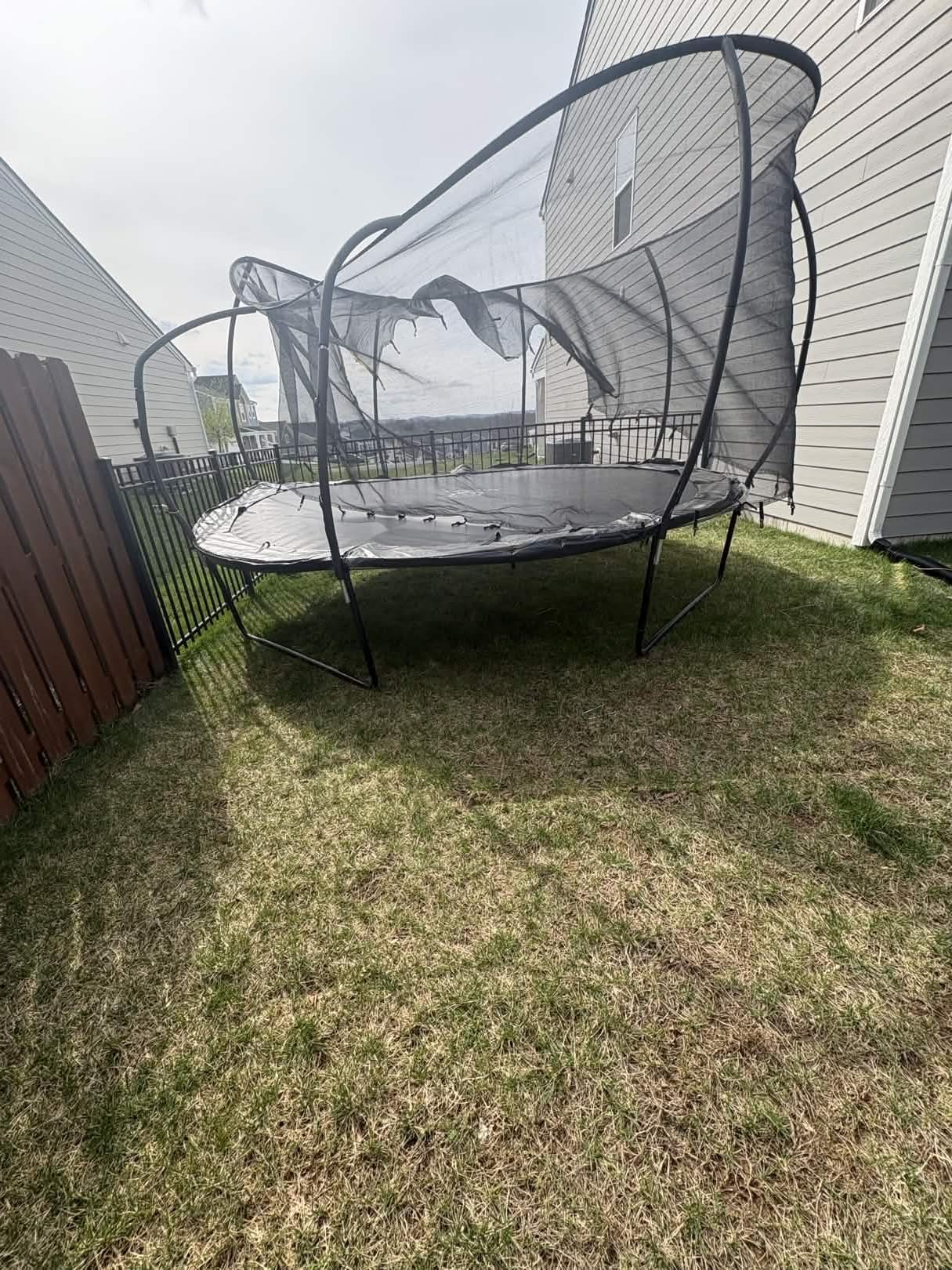
The enclosure pairs with a patented double-sided spring cover that flips colour, so you can see at a glance which face is up. The box also includes a ladder and wind stakes, which removes the two accessory purchases that catch new owners out most often. Certification here is ASTM F381-16, the standard US manufacturers test to for consumer trampolines.
Be honest about the two drawbacks, because both are real. The warranty is one year, and that is shorter than several models in this roundup. More importantly, 72 springs make assembly a genuine job: you will want a spring tool, which is included, and a second adult. Budget a full afternoon rather than an hour, and read the manual before you start rather than while you are pulling springs.
Check the size range before you settle on 12 ft
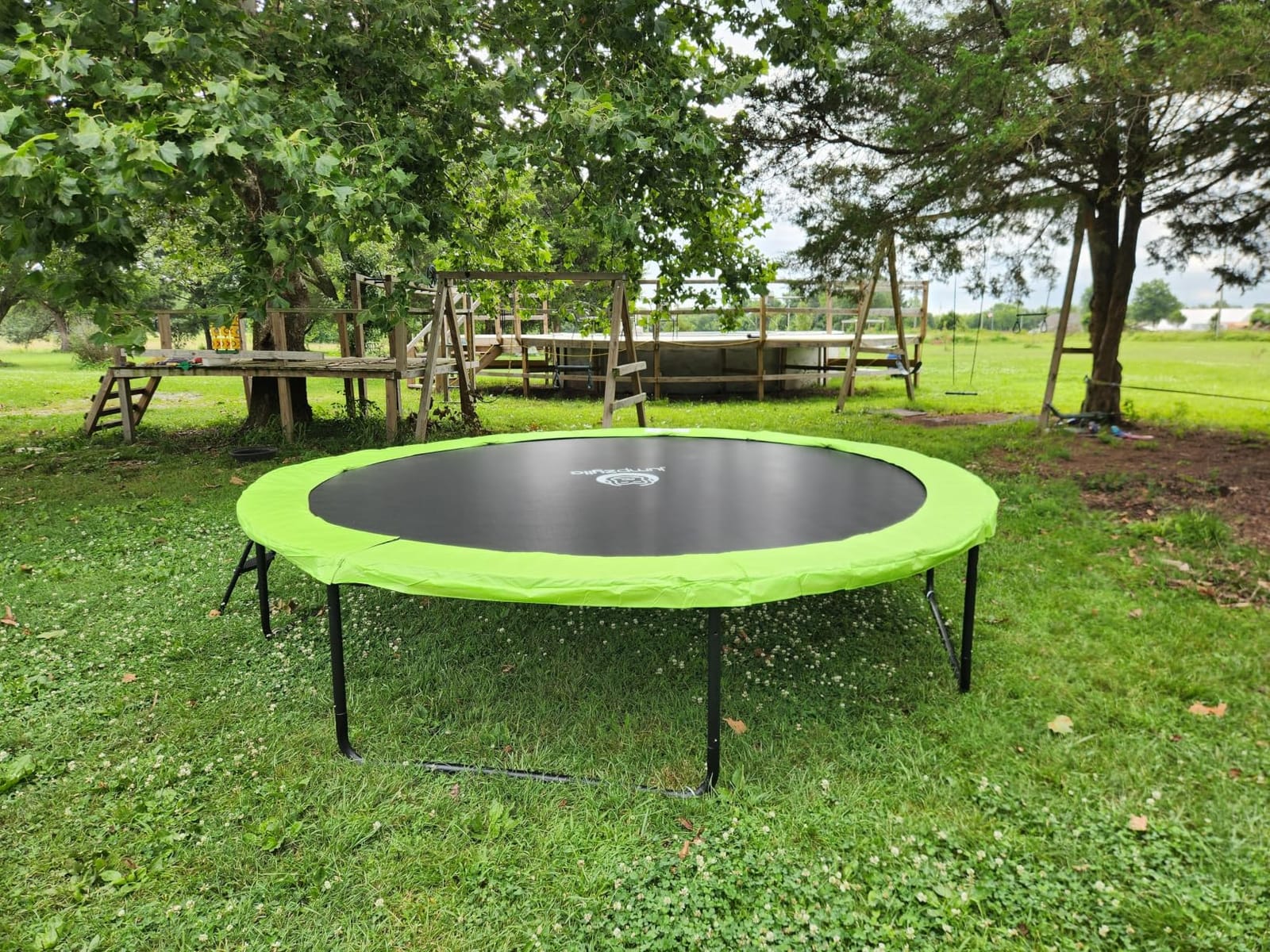
This model is sold in 8, 10, 12, 14, 15 and 16 foot versions and the price band moves with the size, so the ASIN you land on decides what you get. The 8 and 10 foot versions suit small yards but cut the usable jump area noticeably. The 12 foot is the sweet spot for a family of four in a normal suburban garden, and it is the version we tested against.
If your yard is narrow rather than small, measure the full width including the net poles before ordering. The listed dimensions for the 12 foot are 147 inches by 147 inches by 102 inches, and clearance rules mean you need open space beyond that on every side.
Know who this fits and who it does not
This is a full-size trampoline, so it is wrong for anyone under about 5 or 6. Children in that range should be on a 55 or 60 inch enclosed model where the net is closer to the body and a parent can reach over it. For a 10 year old, a 12 foot round unit with a 400 lb rating is a comfortable match.
The other mismatch we see is buying a large frame and expecting two children to jump together. A 12 foot mat looks like it fits four kids. It does not, and reviews on this product make the same point. Plan a rotation instead, or add a second trampoline to a yard with the space for it.
2. Zupapa 12 Ft No-Gap Enclosure Trampoline – Premium Pick
Zupapa 1800LBS Capacity No-Gap Design 16 15 14 12 10FT Trampoline with Safety Enclosure Net and Non-Slip Ladder 10-Year Quality Assurance Perfect for Kids Family Outdoor Backyard Fun
12 ft round
1800 lb static / 550 lb dynamic
No-gap net
10-year frame warranty
Pros
- Net is sewn directly to the jumping mat leaving no gap
- Dual-frame design does not shake or creak
- Hot-dip galvanized steel throughout
- Free replacement parts and strong customer service
- Adjustable dual-height basketball hoops
Cons
- Tight frame tolerances make the build frustrating
- Assembly runs well past the stated 30 minutes
- Vertical pole foam sleeves are hard to fit afterwards
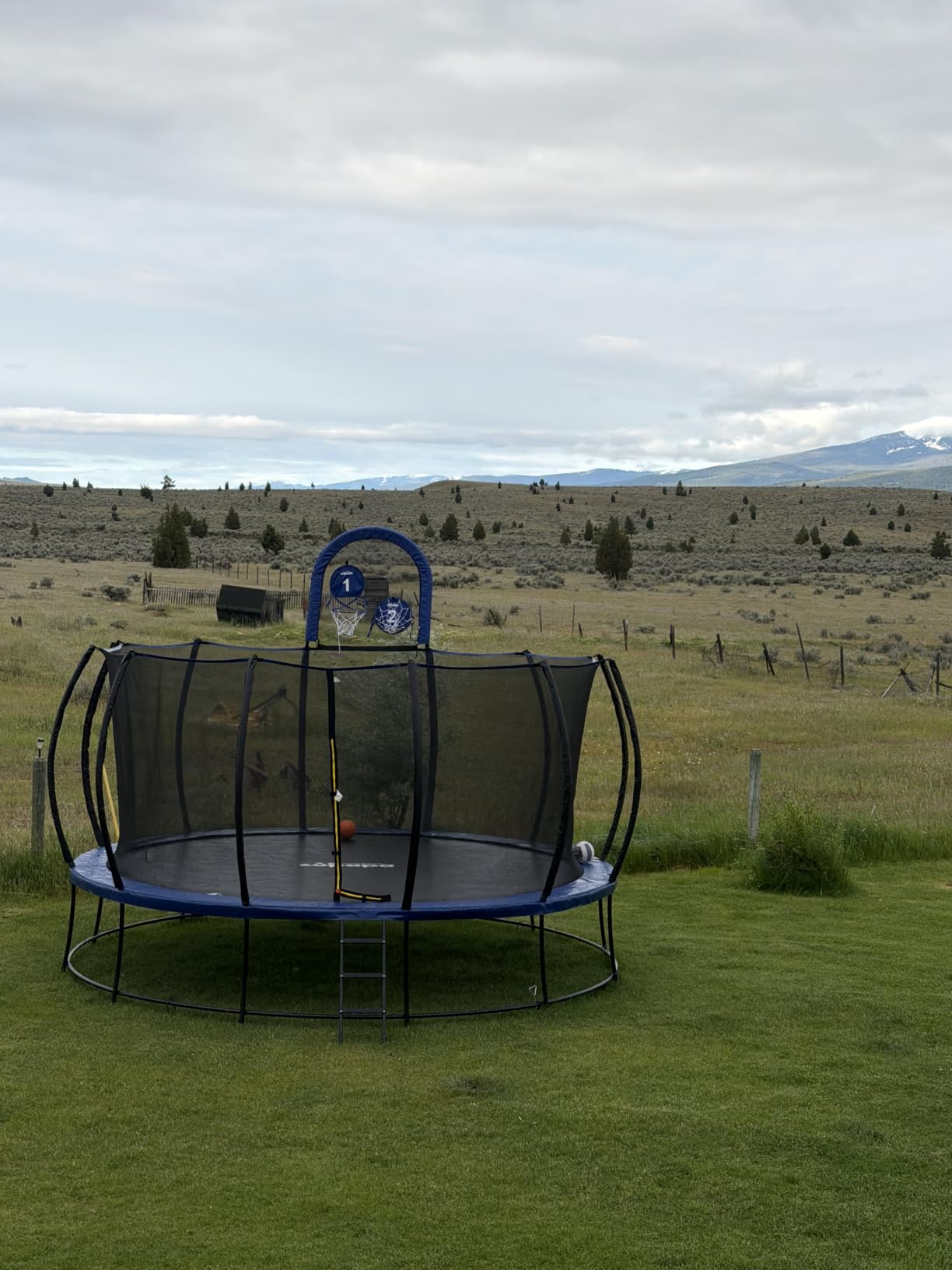
The Zupapa is the only trampoline in this group with a genuinely no-gap enclosure, and that single design choice is why it tops the premium slot. Instead of running the net down to the mat edge and stopping, the netting is sewn to the jumping mat itself, patented, so there is no opening for a foot or a hand to slip into at the seam. That seam is the most common finger-entrapment point on an ordinary enclosed trampoline, and this design removes it rather than narrowing it.
The build quality is the second argument. A dual-frame design with a lower support bar drops the centre of gravity, and owners consistently describe the unit as feeling solid rather than springy when it is loaded. The steel is hot-dip galvanized, and the stated capacity is 1800 lb static and 550 lb dynamic, which is a fair way of describing a frame built for a whole family bouncing together, even though you should still run one jumper at a time.
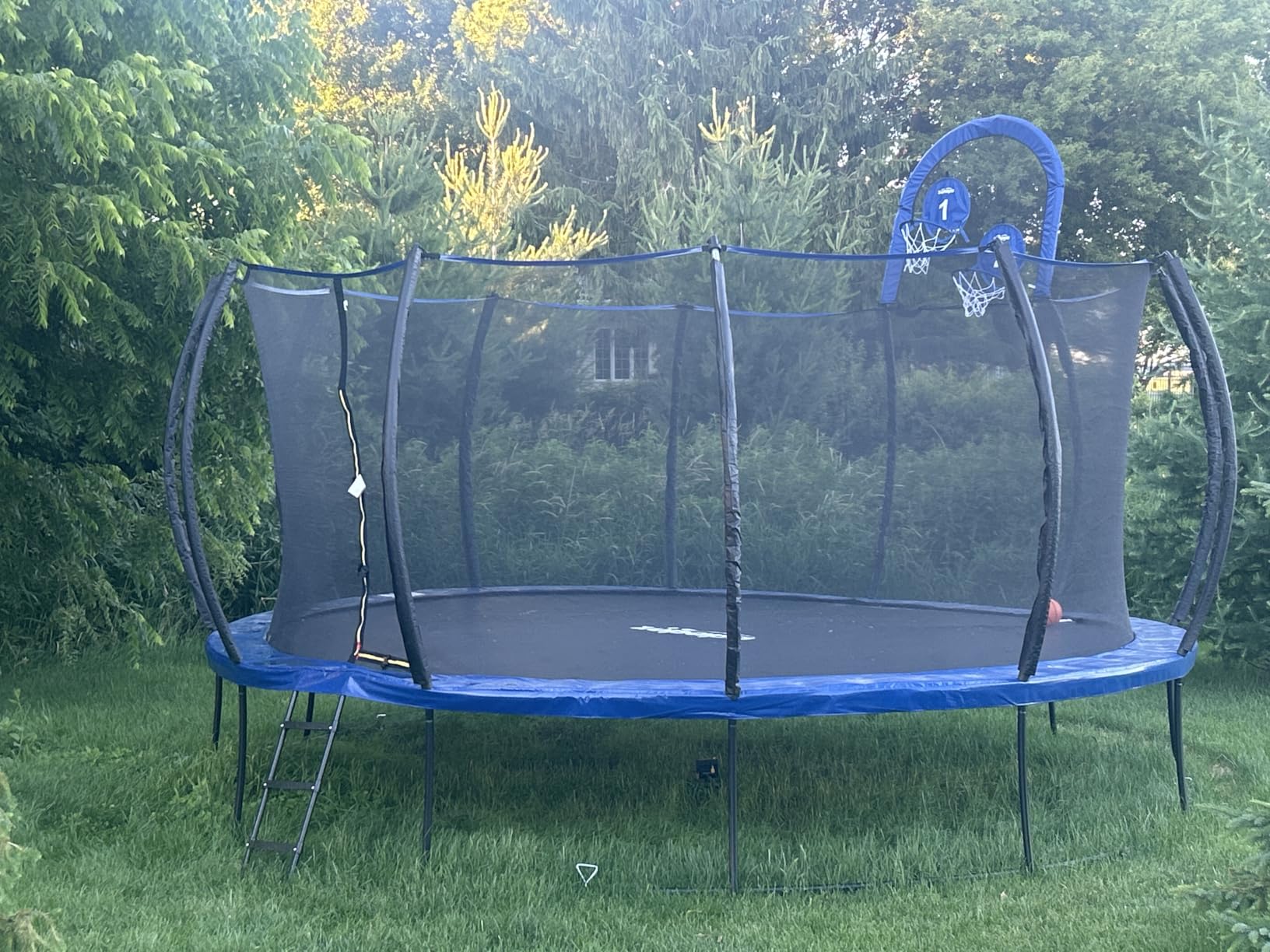
Warranty coverage here is the longest we found. Ten years on the frame, two years on the mat, safety pad, enclosure net and springs, and free replacement of other parts at any time. Reviewers single out the parts support as much as the frame, reporting replacement poles, nets, mats and hardware shipped free. That matters more than it sounds: matching a net to a five-year-old frame is a common reason families give up on a trampoline.
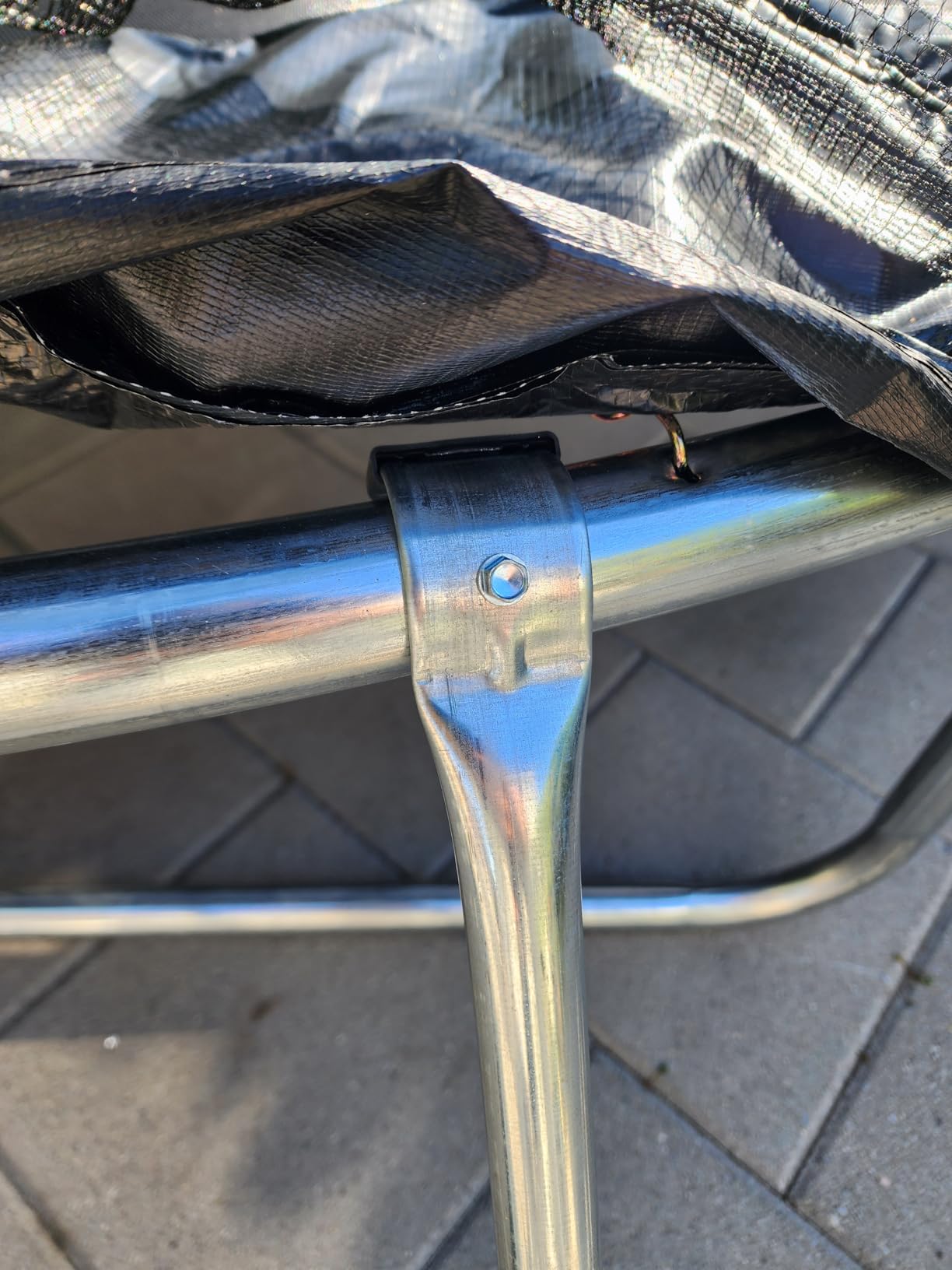
Assembly is the honest weakness. The snap-button, screw-free design avoids threaded bolts and the net and mat arrive pre-attached, but the frame tolerances are tight enough that reviewers recommend a rubber mallet. Several people report the larger sizes taking several hours rather than the advertised half hour. Budget a full day, and fit the vertical pole foam sleeves before the frame is fully assembled.
Why the no-gap seam matters more than net height
Net height is the headline number buyers check, and it does its job by stopping falls. The seam matters for a different injury type. When a net stops above the mat and springs are exposed below, a child who lands low can have toes or fingers enter that strip. A sewn seam closes the strip entirely, which is why the premium models charge more for it.
Outwardly curved net poles add a second layer. The steel sits away from the jumping surface, so even a hard bounce into the net does not put a child’s shoulder against a pole. If you are buying for a child who is still learning to land, this is the enclosure design we would choose.
Know who this fits and who it does not
This suits families who plan to keep a trampoline for a decade and want the frame to outlast two children growing through it. It is a good fit for a yard with real space, for multi-child households, and for anyone who wants basketball hoops that adjust to two heights as kids grow.
It is the wrong choice for a small yard, for anyone who cannot recruit two adults and a rubber mallet on assembly day, and for younger children who will need a 55 inch indoor model first. At 209 lb in listed weight, it is also the heaviest item here and genuinely awkward to reposition once assembled.
3. VEVOR 55 Inch Trampoline for Kids With Enclosure Net – Best Indoor Pick
VEVOR 55“ Trampoline Indoor/Outdoor Trampoline for Toddlers, Foldable Mini Baby Jump Toy with Foam Handle, Recreational Trampolines Birthday Gift for 3+ Years Kids (Blue)
55 inch round
220 lb max
ASTM CPC certified
29.8 lb
3 sizes
Pros
- Assembles in about three minutes by one person
- Suction-cup feet grip hard floors and resist tipping
- One-piece stitched mat with a PVC skirt leaves no spring gap
- 360 degree mesh net with foam padding
- Five accessories included in the box
Cons
- 220 lb ceiling is below full-size models
- Smaller versions give older kids a limited bounce area
The VEVOR is the indoor unit we would put in a flat without hesitation, and the reason is the three-minute build. One adult, the included tool kit, and a design that goes together without stretching a single spring, because the barrel suspension handles that job instead. For a gift, a birthday morning, or a playroom that has to be usable straight away, nothing else in this roundup comes close.
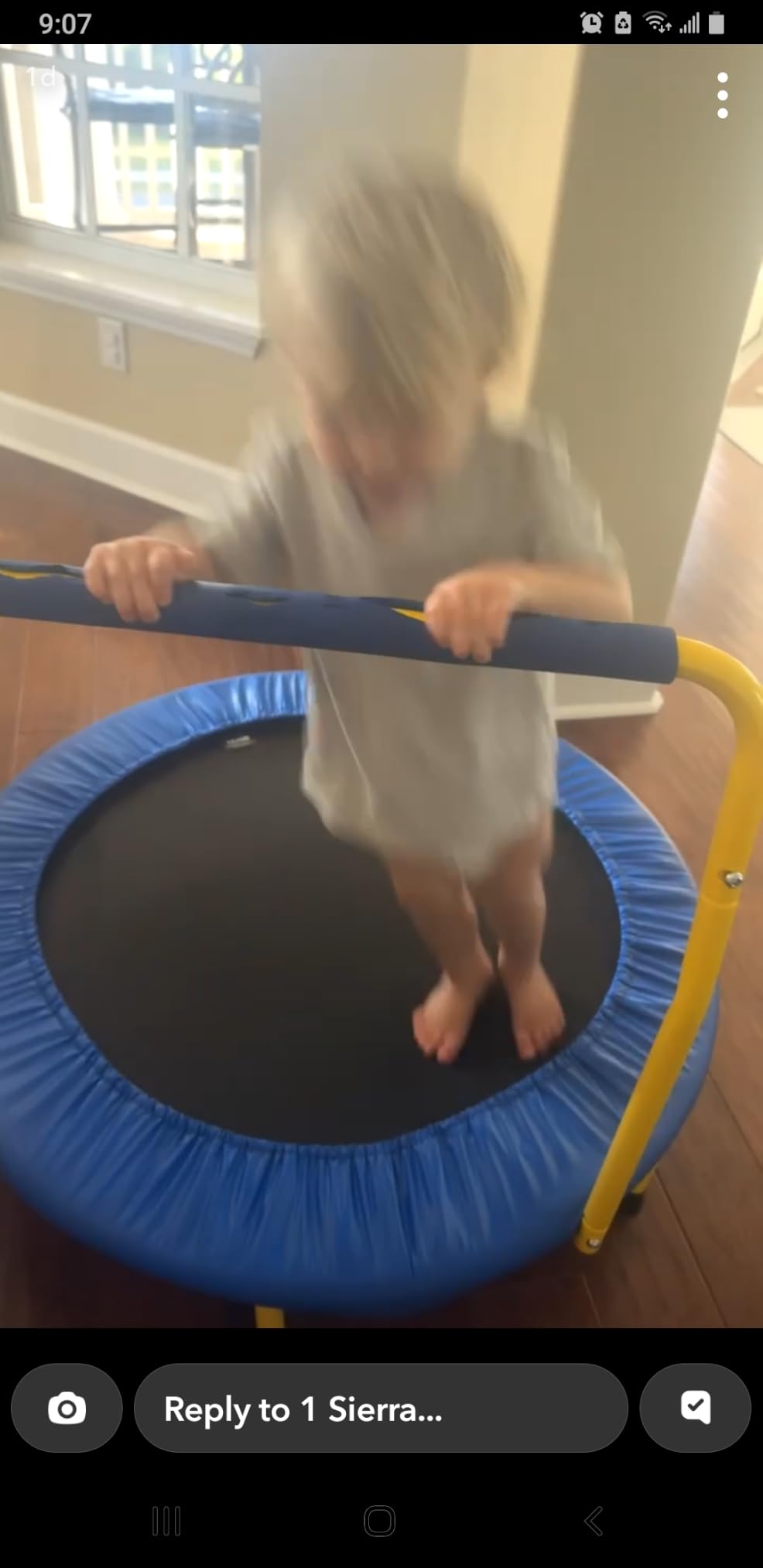
Stability indoors comes down to the feet. The three U-shaped legs end in non-slip suction cups, which grip tile, laminate and hardwood and keep the frame from creeping or tipping when a 4 year old throws themselves at the mat. That is a real safety feature in an indoor space, where there is no soft ground to absorb a tip-over.
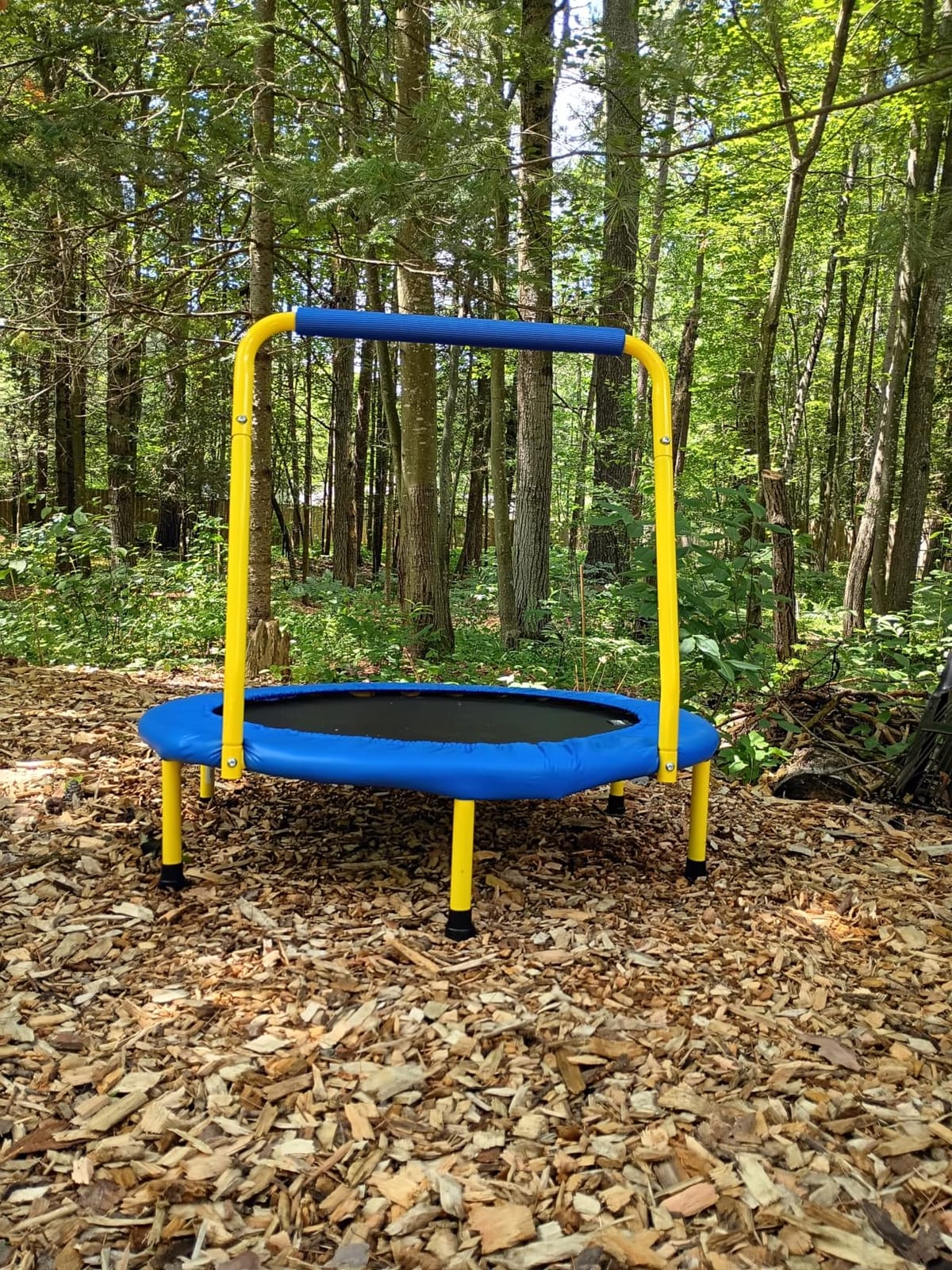
The enclosure is a 360 degree see-through mesh with foam padding, which means a supervising adult can watch from any side of the room without crouching. The mat is one piece stitched with a tear-tough PVC skirt that closes the gap to the springs, and the whole unit is ASTM CPC certified for the toddler and early-childhood class. A padded foam handlebar gives the youngest users something to hold.
Three sizes are offered at 36, 55 and 60 inches, and the size you select from the same listing changes what arrives. We tested the 55 inch version, which is the middle choice and the one that suits a child around 4 to 6. The 36 inch model folds flat for a tight space, and the 60 inch gives an older child more room to practise skills.
Why indoor builds work differently from backyard builds
An outdoor trampoline is engineered to absorb a fall onto grass. An indoor one is engineered to keep a child from leaving the mat, because the floor does not move. That is why the feet, the net and the spring cover matter so much here, and why a spring-free design is safer rather than merely cheaper.
The 220 lb maximum weight limit is the other reason this is a children’s model rather than a family model. It is a limit per jumper, not a combined figure. When a 7 year old outgrows the bounce surface, the answer is a full-size backyard model, not a bigger indoor version, unless your floor space genuinely allows it.
Know who this fits and who it does not
This is right for a flat, a bedroom, a playroom or a garage, and for a child from about age 3 to 8 who needs somewhere to burn energy in bad weather. The included accessories, a punching bag, hoop, ball, ocean balls and gym rings, are what keep it interesting past the first week.
It is wrong for two siblings at once, because the mat is 55 inches across and collisions are the injury risk that no net prevents. It is also wrong for anyone expecting a proper bounce, since a low-air mat is deliberately softer and less springy than an outdoor spring bed.
4. SKOK 8 Ft Round Trampoline With 4.9 Ft Enclosure – Best for Small Yards
SKOK Trampolines 8FT Kids Trampoline with Enclosure Net, Trampoline Outdoor for Kids and Adults, Capacity 400lbs,ASTM Approved,Black
8 ft round
400 lb max
4.9 ft net
42 springs
77 lb
Pros
- ASTM F381 and F2225-15 plus ISO and BSCI approvals
- Tested for 20000 jumps with mats tested to 5000 hours
- 4.9 ft enclosure with zipper and buckle closure
- Galvanized inside and out for rust resistance
- Ladder gloves and socks included
Cons
- The included ladder adds little on a low 8 ft frame
- Spring installation really needs two people
The SKOK is the smallest full-size round trampoline here and the natural step up from a 55 inch indoor model. At 8 feet across with a 96 inch listed footprint, it fits a modest garden where a 12 foot unit would dominate, and the 400 lb maximum user weight still lets an adult join a child for the last turns before dark.
Certification is the strongest on this list in terms of how many standards are named. It complies with ASTM F381 and ASTM F2225-15, and holds ISO and BSCI approvals. The jump testing is specified too, at 20000 jumps with mats tested to 5000 hours, which is the kind of number that tells you the mat is not going to fail in year three.
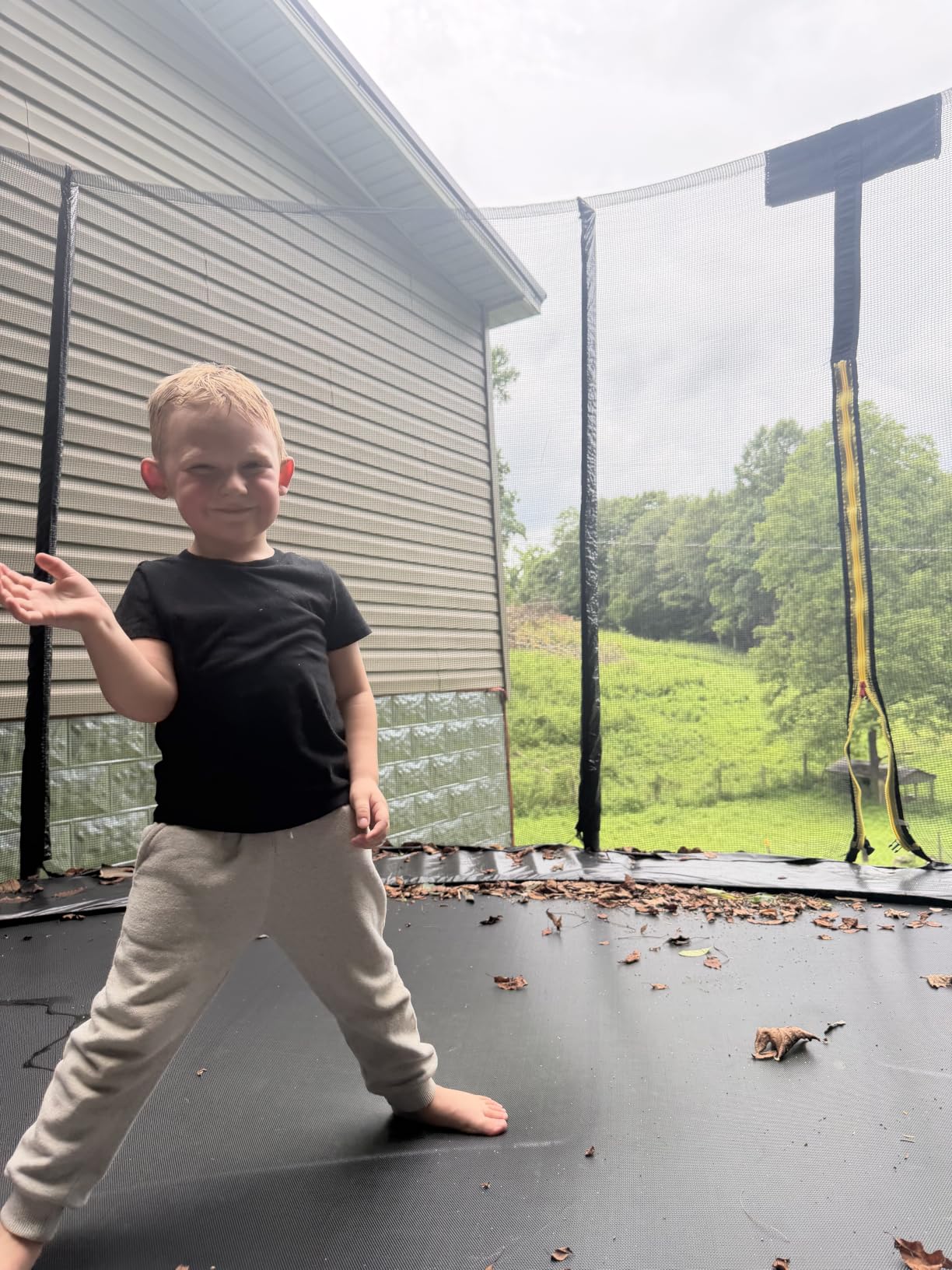
The enclosure is unusually tall at 4.9 feet, and it closes with a zipper and a buckle rather than a hook-and-loop flap. For a child who bounces high, net height is the difference between landing back on the mat and landing in the garden bed. Poles are foam and PVC covered, and the spring cover is 14 mm foam across all springs.
A nice touch is what lands in the box besides the trampoline: a two-step ladder, plus assembly gloves and socks. The frame is galvanized inside and out with a wear-resistant zinc coating, and owners report it still looking close to new after two years of heavy use.
Judge the net height against your tallest jumper
Net height is the easiest enclosure spec to check and the one most buyers ignore. The rule is simple: the net must stand comfortably taller than the highest point your tallest user reaches, with room to spare, because a child grows and a bounce gets bigger when they are happy. At 4.9 feet this enclosure clears the bar for most children on an 8 foot bed.
The zipper and buckle closure is the second thing to look at. A flap door that peels open can be pushed aside by a jumping sibling, which is precisely how the yard and the younger child end up in trouble at the same time.
Know who this fits and who it does not
This suits a family with a small or mid-sized garden, a child around 6 to 11, and a parent who wants a real trampoline without a 12 foot footprint. It is also a good bridge product for a child who has outgrown the 55 inch indoor model but is not ready for a large backyard unit.
It is not the right fit for a family with two active children of similar age who both want to jump, and it is not for a garden where clearance space around the frame is already tight. Owners also flag that spring installation on 42 springs is demanding and effectively a two-person job.
5. GIANTEX 7 Ft Trampoline for Kids With Net – Best Value for Ages 3-8
Giantex 7FT 84” Kids Trampoline for Toddlers with Enclosure Net, ASTM Approval & Widened Base for Indoor Outdoor
7 ft hexagonal
220 lb max
36 bungee cords
56.5 lb
ASTM certified
Pros
- Curved U-shaped base resists tipping for toddlers
- Seamless waterproof spring pad leaves no gaps
- Net mounted outside the frame for a bigger jump area
- Dual side zippers with buckle closure
- Moves indoors for winter
Cons
- Assembly instructions are unclear and parts can arrive with a metal smell
- Vertical supports can work loose without extra screws
The GIANTEX sits between a mini trampoline and a full-size backyard unit, and that middle position is genuinely useful. At 7.3 feet across overall it gives a child from about 3 to 8 a real jumping surface with a proper enclosure around it, while still fitting under a low ceiling and moving through a door for the winter months.
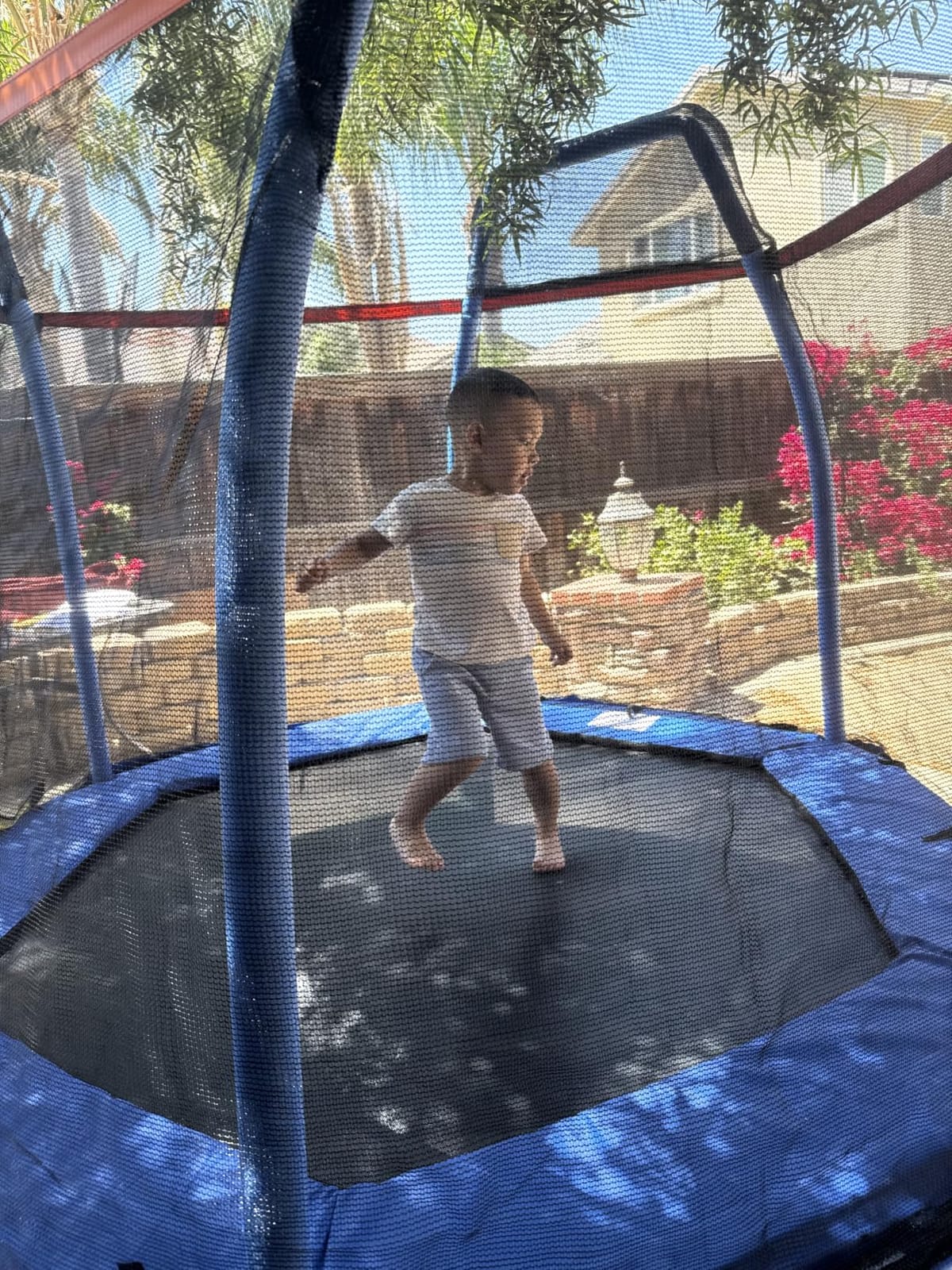
Two design choices make it safer for small children than its size suggests. The base is a widened curved U-shape, which resists tipping when a toddler lands off-centre, and the net is a high-density polyethylene mesh installed outside the frame, which pushes the netting away from the jumping surface and enlarges the usable area. The spring cover is seamless and waterproof, so there is no strip for little feet to catch in.
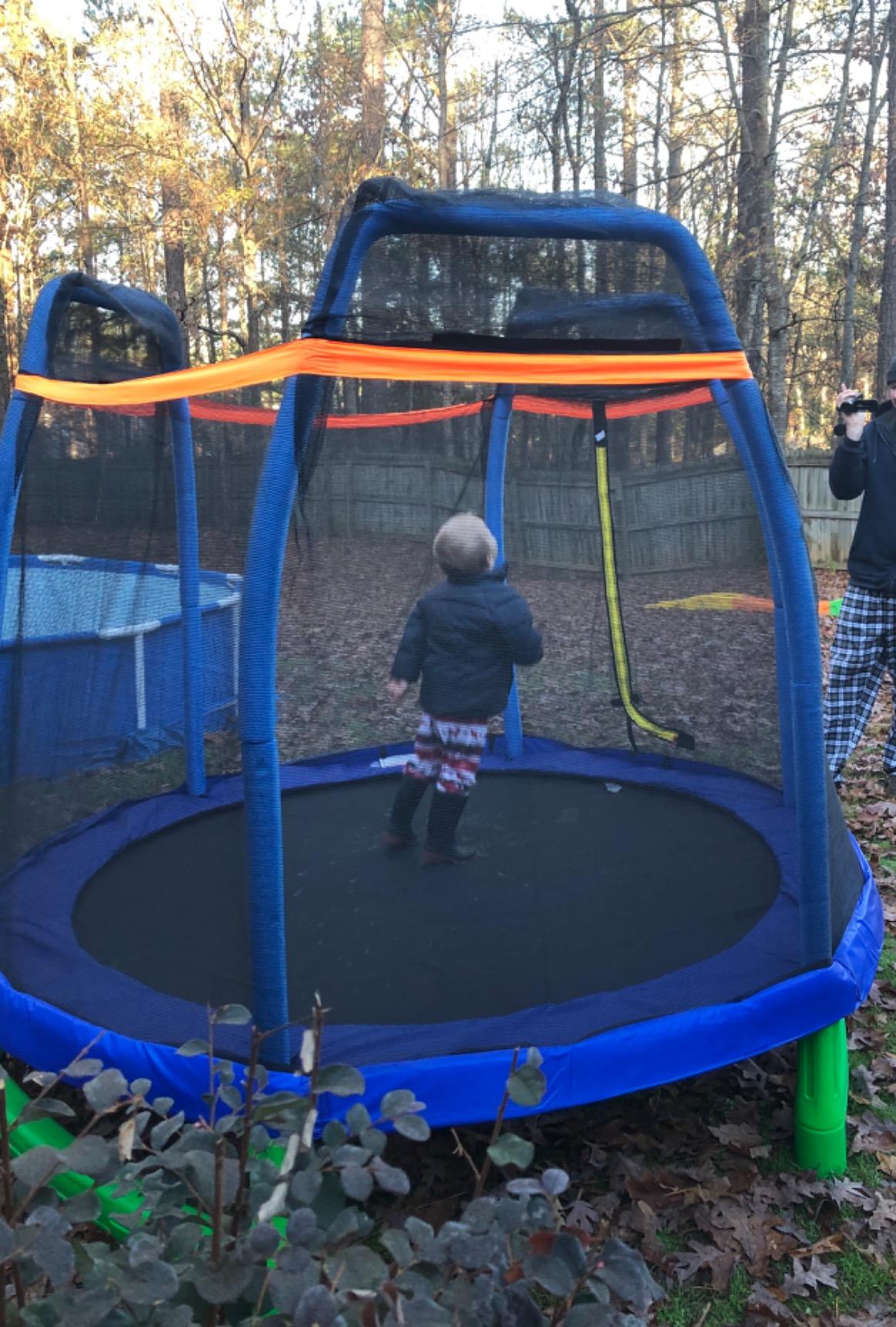
Suspension is 36 bungee cords rather than steel springs, which makes assembly dramatically easier than a spring-stretched model and removes the pinch-point hazard entirely. The shape is hexagonal, which is unusual and genuinely functional: the flat sides give a straight edge for a child who wants to practise standing balance, and the corners soften the geometry that makes round beds harder to land on near the edge.
Entry is through two side L-shaped zippers with buckle closures, so a sibling cannot peel the door open while someone else is jumping. The build is hot-dip galvanized steel pipe, listed ASTM certified, with soft foam wrapped around the upper frame.
Why bungee suspension matters for a 3 year old
Steel springs on a full-size trampoline stretch during assembly and sit under tension for the entire life of the product. That is where most finger and foot injuries on assembly and on the mat edge happen. A bungee-cord bed removes the stored tension entirely, which is why the small trampolines aimed at toddlers use this design.
The trade-off is bounce. Bungee suspension feels softer and lower than a 42 or 72 spring bed, so a 7 year old who wants real height will notice the difference. For a 3 to 6 year old, that softness is a feature, not a compromise.
Know who this fits and who it does not
This is a strong first trampoline for a 3 to 8 year old, particularly in a family that wants one model that works both in the garden and in a playroom. Owners report it handling a parent and two small children, though they are clear that three active jumpers is too crowded.
Read the assembly section carefully. Reviewers consistently call the instructions unclear and mention parts arriving with a noticeable smell, and some report vertical supports working loose between the straight and curved sections unless they are reinforced with extra screws. Allow time for that on day one.
6. Happin 55 Inch Trampoline for Kids With Safety Enclosure – Best for Toddlers
Happin® 55’’ Trampoline for Kids with Safety Enclosure, Indoor & Outdoor Toddler Trampoline, Ultra Safe Design with Multi Activity Accessories, Perfect for Boys & Girls Ages 1–8
55 inch round
Ages 1-8
Reinforced steel frame
16.15 kg
Warranty 1 year
Pros
- Extra-dense netting closes gaps and blocks spring contact
- Curved impact-absorbing poles on a reinforced frame
- Anti-slip rubber feet stay stable and quiet indoors
- Activity bundle includes a punching bag gloves rings and swing
- Compact 55 inch footprint suits smaller rooms
Cons
- One-year warranty is short
- No published maximum weight rating in the specifications
The Happin is the youngest-child pick in this roundup, and it is built for a household where the trampoline will be used indoors while a parent cooks, works or does not have eyes on the child the whole time. The stated age range starts at 1 year, which no other product here claims, and the activity bundle is the reason children keep using it after the novelty fades.
Enclosure density is the headline. The netting is described as extra-dense specifically to prevent gaps and contact with the springs, and the poles are curved and impact-absorbing rather than straight. A padded spring cover and a stable anti-slip base complete the safety picture, and the rubber feet are noise-reducing, which matters more than it sounds in an apartment or a downstairs room.
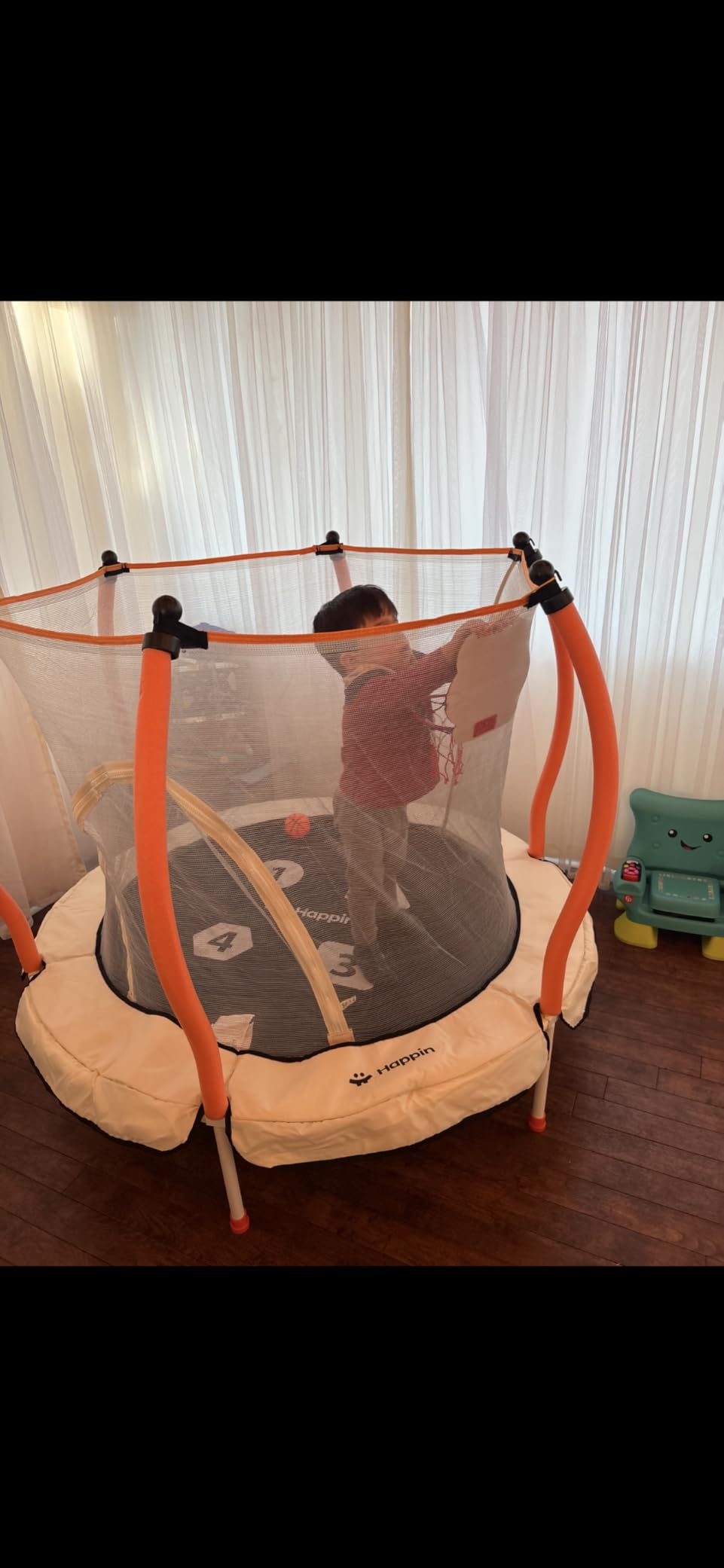
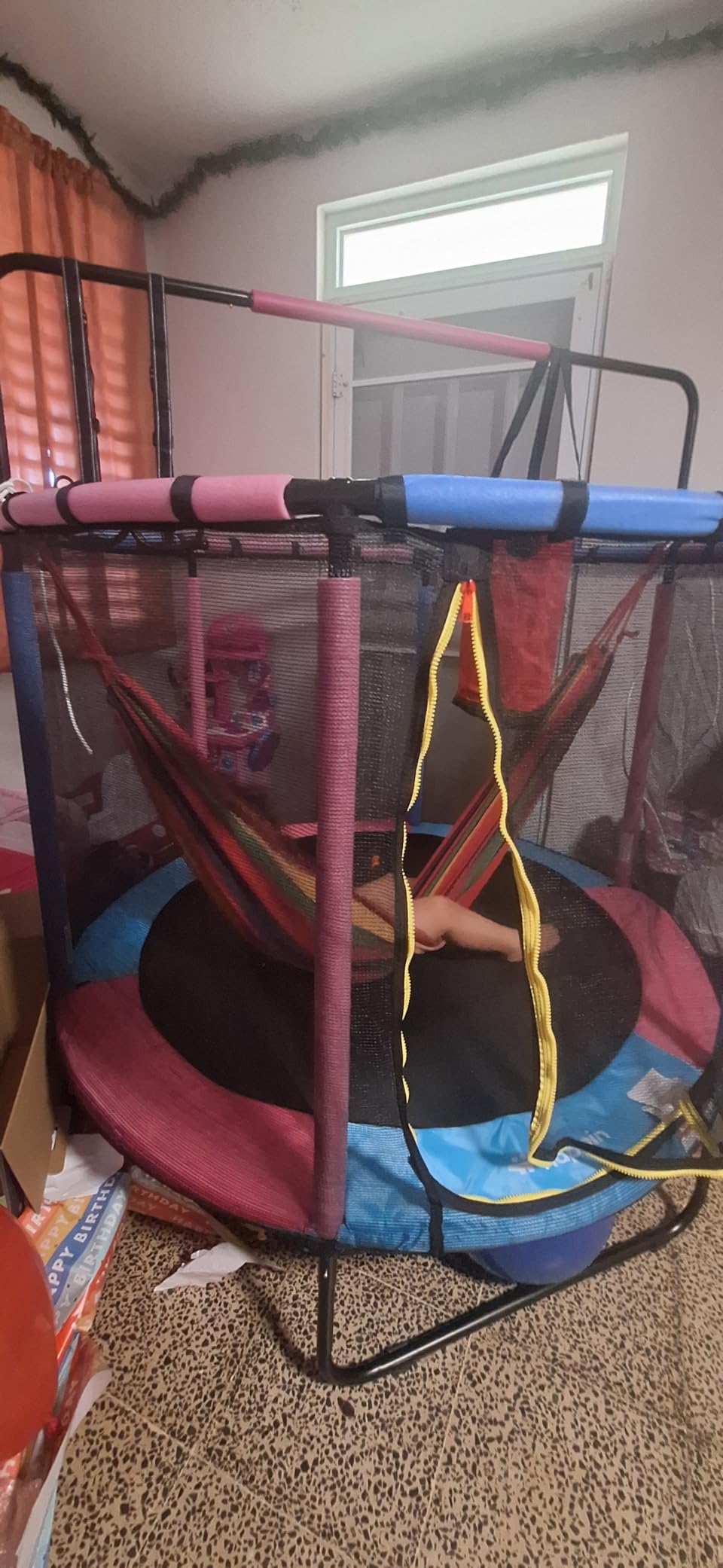
The included accessories are unusually thorough for this class: a punching bag, boxing gloves, gym rings, a swing and colourful play balls. In our testing that bundle is what extended the useful life of the unit considerably, because a single toddler on a bare mat loses interest within days. Parents who bought it as an activity station rather than a trampoline got the most from it.
Two things to weigh. The warranty is one year, which is the shortest we would accept on any purchase here, and there is no published maximum weight rating in the specifications. That second point is a real gap: without a stated limit you cannot check the enclosure and frame against the child using it, so supervise closely and upgrade before a school-age child gets heavy.
Decide between an activity station and a real trampoline
If your child is under 3, the honest answer is that a trampoline is not the right activity. The best use of a unit in this class is as a contained movement station with a handle and accessories, and the Happin is built more for that than for bounce. A foam play pit or a soft-play block set serves a toddler better.
For a 4 to 8 year old, the picture changes. The 55 inch mat is still small, and a bigger indoor model will hold that age group longer, but the accessories carry the load in the meantime. Our general guide to the best kids trampolines covers the alternatives if your child has outgrown a 55 inch footprint.
Know who this fits and who it does not
This suits a family looking for an indoor activity station for a child roughly 1 to 6, in a room where noise and tip-over are the main concerns. It also works outside on a patio, though the mini class is not built for the same jump height as a backyard model.
It is the wrong pick for a child who has learned to jump properly and wants height, for a family with two small children wanting to share, and for anyone who needs a documented weight limit to size a mat to a child. Check the current specification sheet before buying, since a missing rating is a gap you should not fill with a guess.
7. AOTOB 12 Ft Rectangular Trampoline With Net – Best for Gymnastics
AOTOB 8×14FT Rectangle Trampoline with Net for Kids-Black
12 ft rectangular
No-gap foam-padded net
72 springs
5-year coverage
Pros
- Rectangular surface gives a longer and even bounce for skills practice
- No-gap net with soft foam pole sleeves keeps feet clear of springs
- Powder-coated steel frame on four legs for all-weather use
- 5-year support on the mat frame and springs
- Free replacement parts for defects
Cons
- Rectangular shape uses more yard space than a round model
- Heavier at 93.5 lb and harder to reposition
- Smaller review base than round competitors
The AOTOB is the only rectangular trampoline in this roundup, and that shape is a deliberate choice rather than a variation. A rectangular bed gives a longer and more even bounce with no curved edges to disrupt a straight line, which is exactly what a child working on gymnastics drills or straight-line bouncing needs. Round units push jumpers toward the perimeter on every landing; a rectangle does not.
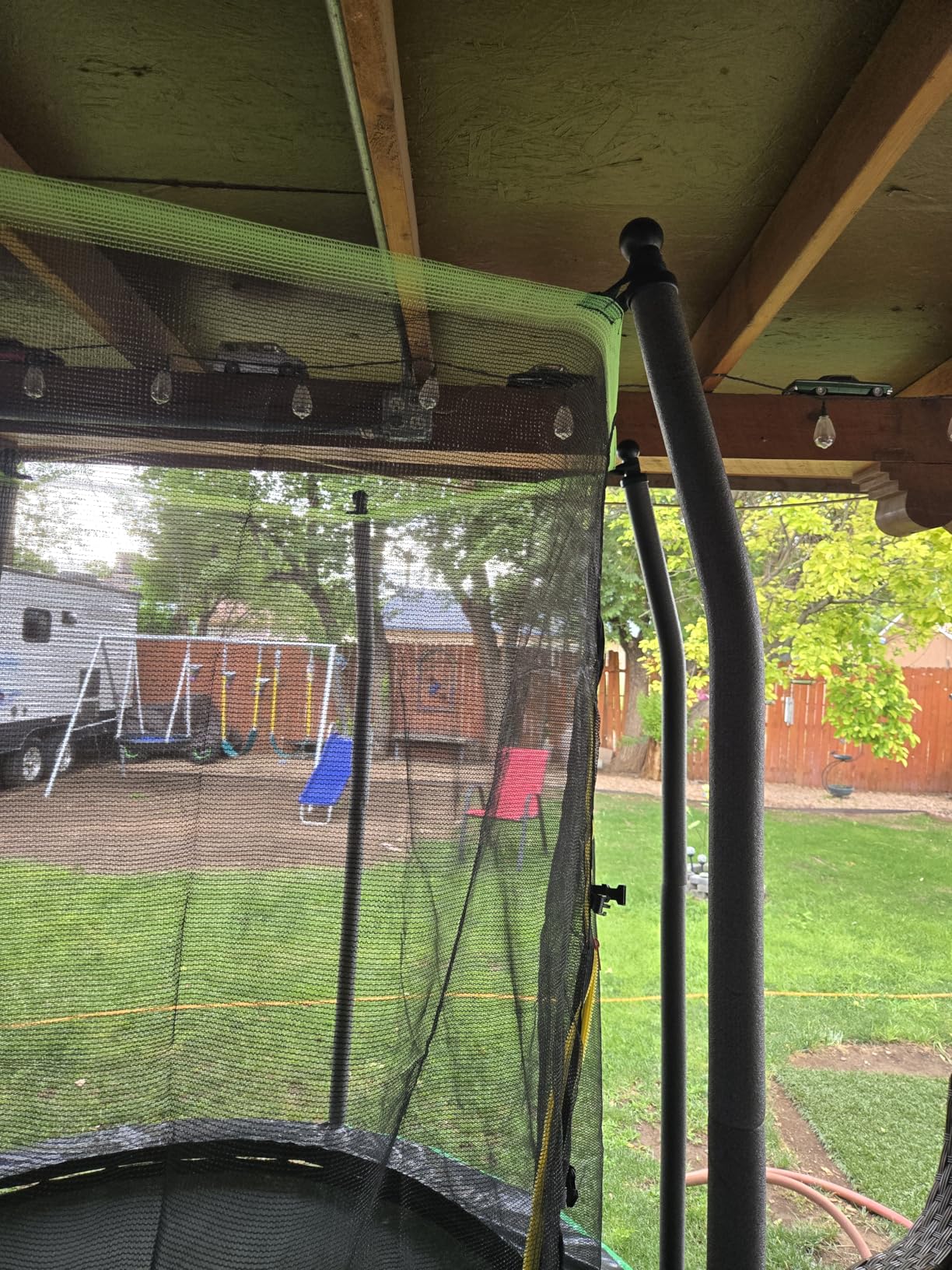
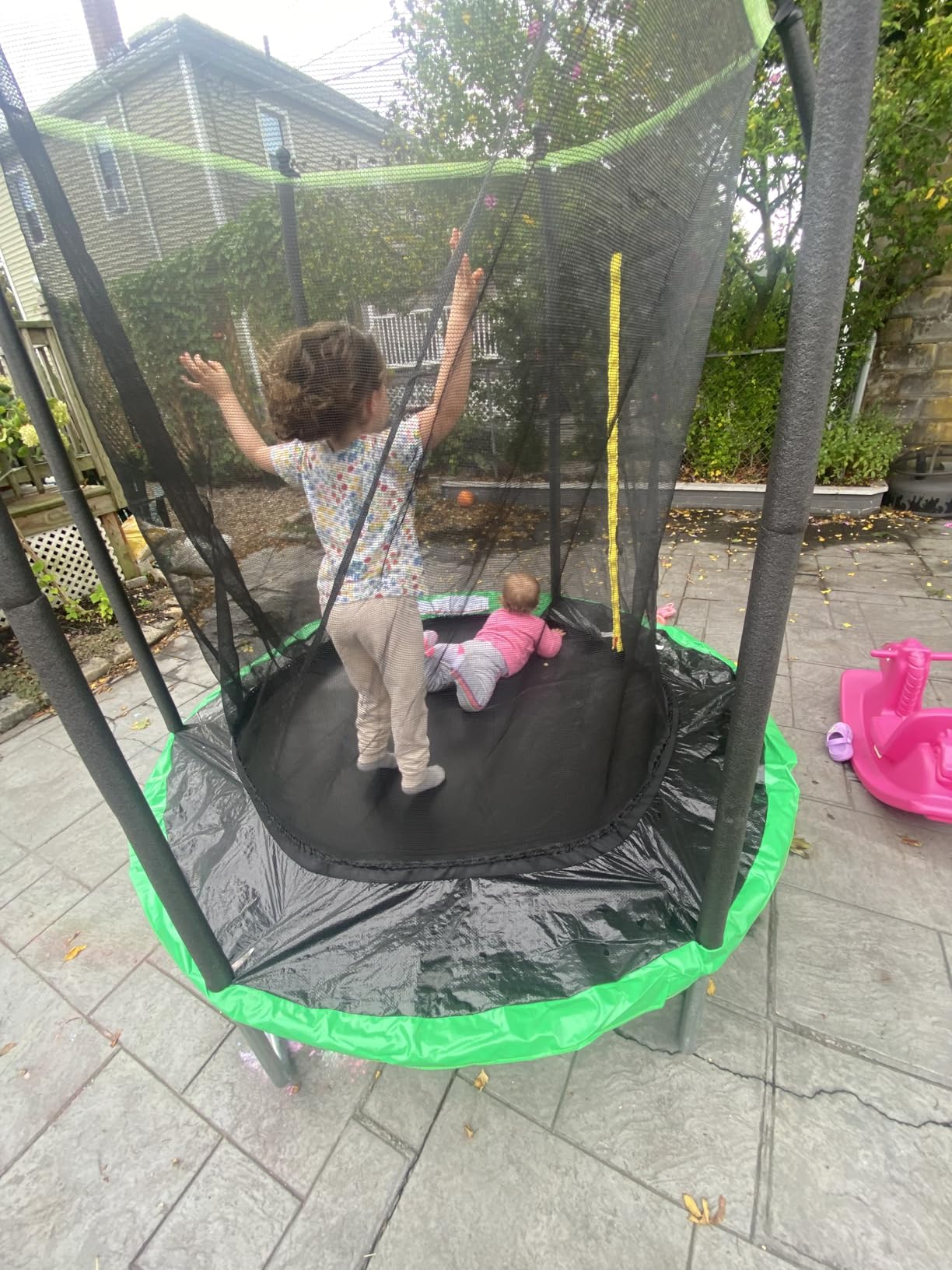
The enclosure follows the same no-gap philosophy as the premium pick in this list. The netting has no gap at the mat edge, the poles are wrapped in soft foam, and the door zips shut rather than peeling open. The frame is heavy-duty powder-coated steel on four supportive legs, built for outdoor all-weather use, and the mat carries 72 high-elasticity springs.
Support is unusually generous. You get 5 years on the mat, frame and springs, 3 years on the enclosure net and pole caps, and free immediate replacement for defective parts. European spare part availability is listed at 5 years, which answers the question parents raise most about buying a less familiar brand.
Assembly is guided by a printed manual plus 3D step-by-step instructions in the Bilt app, which is more help than most products in this category offer. The unit ships in two boxes, so check you have both before you start, and expect the usual spring-stretching job on 72 springs.
Choose rectangular only when the shape solves a real problem
A rectangle is the right call when a child is training specific skills, when two children want to jump side by side down the length, or when your yard is long and narrow rather than square. It gives more usable jump area per foot of length than a round bed of the same length.
It is the wrong call for younger children. A rectangular trampoline has hard corners and hard ends, and a fall at the short end puts a child against the net with more force than a curved round perimeter would. Most coaches start children on a round bed first, and we would agree.
Know who this fits and who it does not
This suits a household with a child around 8 and above who is into gymnastics, parkour or general fitness drills, and it rewards parents who want a long bouncing line for two kids taking turns. The longer warranty makes it a sensible long-term buy.
It is a poor fit for a small garden, because a 12 foot rectangle claims noticeably more ground than a 12 foot round unit. At 93.5 lb it is also awkward to move, and with 318 reviews it carries less owner history than the round models here, so expect to do more of your own inspection after assembly.
8. ZCMHAXJ 55 Inch Enclosed Trampoline – Best for Shared Indoor Play
ZCMHAXJ 55″ Trampoline for Kids with Enclosure, 440lbs Capacity Indoor & Outdoor Toddler Trampoline with Adjustable Gymnastics Bar & Toys, Gifts for Boys & Girls
55 inch round
440 lb max
36 springs
14.15 kg
Warranty 1 year
Pros
- 440 lb rating is unusually high for a 55 inch model
- Adjustable 3-height gymnastics bar that removes as the child grows
- Wrap-around safety pad with dense netting and foam
- Silent suction pads keep it stable and quiet
- Five accessories included in the box
Cons
- Foam sleeves and spring cover tear easily
- Assembly quality varies with missing holes and loose base sections
The ZCMHAXJ earns its place on one number: a 440 lb maximum user weight rating on a 55 inch indoor model. That figure is unusual at this size and it is why we included the product, because it extends the usable life of a compact indoor trampoline well past the age most families assume. An older sibling can share it with a younger child taking supervised turns, within the one-jumper-at-a-time rule.
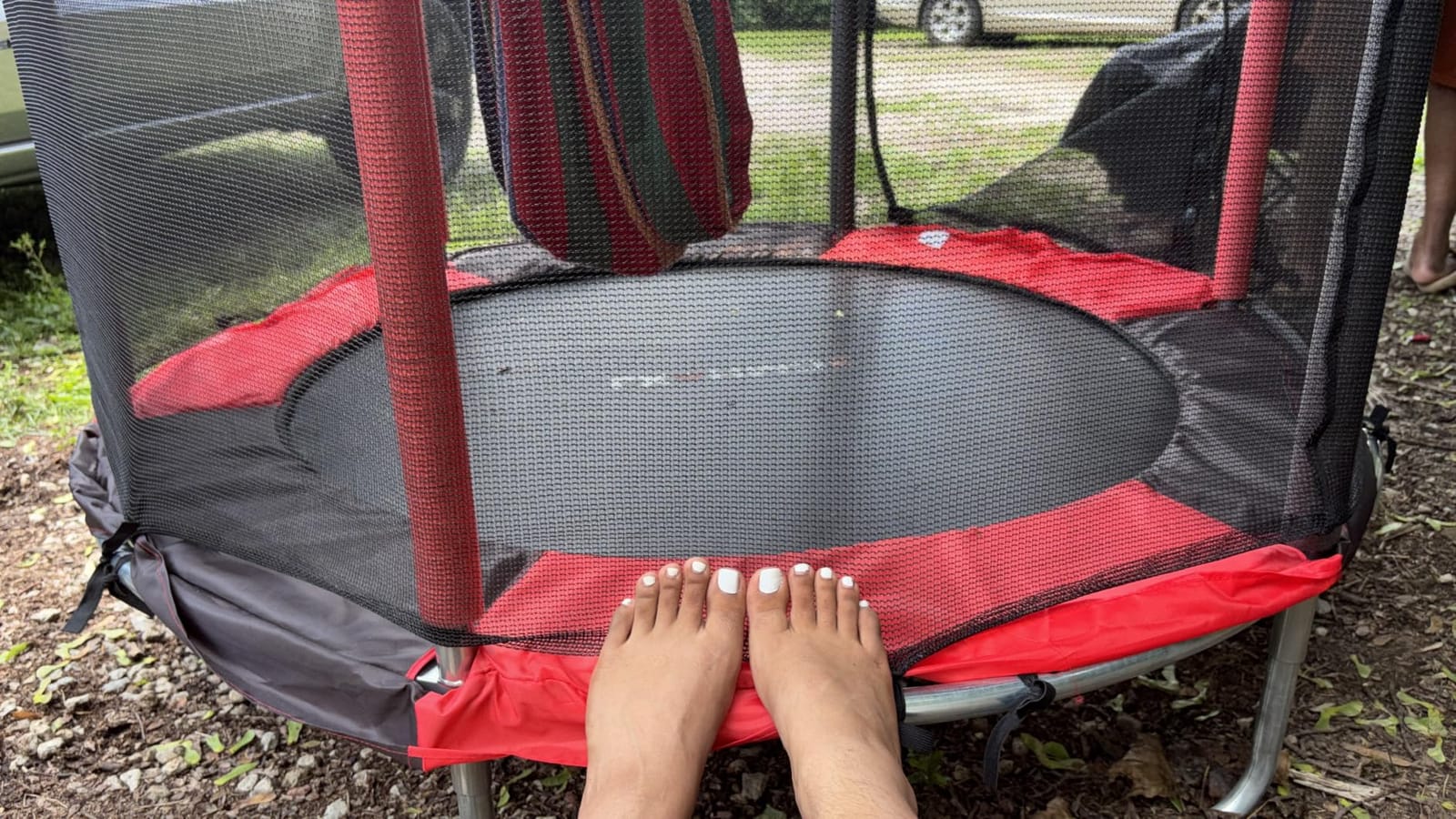
The adjustable three-height gymnastics bar is the second feature that earns its keep. It clamps on and comes off, so the same trampoline works for a 3 year old at the lowest setting and a 7 year old at the top, and it stops you buying a new unit every time a child has a growth spurt. The 360 degree wrap-around safety pad with dense netting and upgraded foam covers the whole perimeter.
Silent suction pads on each U-shaped tube keep it stable and quiet on hard floors, which is what makes indoor use viable downstairs. The accessory bundle is generous: a sandbag or punching bag, boxing gloves, rings, a hammock and ocean balls, and the frame is thickened carbon steel on three U-shaped legs. Six colour options are offered, including animal prints for younger children.
We are rating this one lowest in the group, and we want to be clear about why. The review base is the largest here at more than 2800 reviews, and about 11 percent are one star. The recurring complaints are quality control on assembly: undrilled holes, base sections that need extra drilling, and a manual owners describe as useless. The foam sleeves and spring cover are also reported to tear easily, with some owners improvising repairs.
Where the 440 lb rating helps and where it does not
Read the weight figure as a per-jumper rating, not a combined total. A 440 lb limit means an adult or a heavy teenager can safely use this model, and that is a genuine extension of the product’s life. It does not mean two large children can jump at once, because the 55 inch mat leaves no room for that and collisions are the risk no net removes.
The stated capacity is also the part buyers check least and should check most. It tells you the frame, mat and suspension are built for an adult, which means the unit will not flex or degrade when a parent joins a child for a turn, and it tells you when to move up to a full-size model.
Know who this fits and who it does not
This suits a household with a wide age spread in one room, where an older sibling and a younger child will share the same mat, and it works as a gift for a child moving through early gymnastics moves. The accessory set and adjustable bar keep a wide age range interested.
It is the wrong pick for a family unwilling to spend twenty minutes checking and re-tightening it after assembly, and for anyone who needs a documented safety standard. This model does not list one in its specifications, which is a meaningful gap for a product at this end of the roundup. Also note the 55 inch footprint is closer to a four-person dining table than most buyers expect.
Buying Guide: Choosing an Enclosed Trampoline for Kids
Most parents arrive at this purchase with a yard size and a child’s age, and leave with a trampoline that fits neither. These are the decisions that actually change the outcome, in the order we would make them.
What an enclosure does and does not stop
An enclosure net is a vertical mesh cage that catches a jumper who falls off the mat and bounces them back in. Falls off the edge to the ground are the most common trampoline injury mechanism, and the net is the single feature that most reduces them, which is why pediatric guidance treats a net as mandatory equipment rather than an accessory. On that basis, a trampoline with an enclosure is dramatically safer than one without.
Here is the part almost no competitor tells you. A net does not prevent collisions. Two children on the same mat bouncing out of phase will hit each other regardless of how tall or dense the netting is, and the net will not slow that impact. Parents on parenting and money-saving threads make the same point, and one parent put it as a warning against being lulled into a false sense of security. The same threads agree the group most likely to be injured is the youngest jumpers, not the adults.
So treat the enclosure as one control in a system, not the system itself. One jumper at a time, an adult in sight, no shoes and nothing hard in the pockets. Those three rules do more for your children than any brand choice on this page.
Read the safety certification, not the marketing
ASTM F381 is the US consumer trampoline safety standard, and F2276 is the parallel designation used on many current models. A third designation, ASTM CPC, appears on toddler and children’s products such as the VEVOR in this roundup. When a manufacturer states a standard, that means the design was tested against defined requirements for frame strength, mat performance and enclosure design.
When no standard is named, that is a signal. A specification sheet full of adjectives and no standard gives you nothing to verify. The products in this roundup that name a standard are the ones we feel comfortable recommending first, and Zupapa goes further by patenting its no-gap enclosure construction.
How to judge an enclosure net in four checks
Start with height. The net must stand comfortably taller than the highest point the tallest user reaches, and taller than that, because children grow and happy children bounce higher. A 4.9 ft net on an 8 ft bed, like the SKOK, clears the bar for most children.
Second, check the mat-to-net seam. Where a net stops at the mat edge, exposed springs sit between the two and that strip is the classic finger-entrapment point. A no-gap design, where the netting is sewn to the mat as on the Zupapa and AOTOB, closes it entirely.
Third, check the door. A zippered door with a buckle stays shut when a sibling pushes into it. A peel-open hook-and-loop flap does not, and a bouncing child can fling it open without meaning to. Fourth, ask whether replacement nets are still available in three years, because UV exposure breaks down netting long before it breaks the frame.
Match the size to the age, not the ambition
A 10 year old has outgrown the 55 inch indoor class entirely and needs a 10 to 12 foot full-size unit with a 350 lb rating or better. A 7 year old is well served by a 55 or 60 inch enclosed indoor model with a support bar, or a 7 to 8 foot backyard bed if there is room. Anyone under 3 is better served by a soft-play setup than a trampoline of any size.
The most expensive mistake in this category is buying a large trampoline for a small child. Parents on deal forums describe exactly this, and the product photography makes it worse: the images show three children on a 12 foot mat in a way the weight rating does not support. One jumper at a time means the mat size you need is governed by the largest single user, not by the number of children you have.
Round or rectangular, and indoor or outdoor
Round units are the default for a reason. The curved perimeter softens falls and there are no corners to land in, which makes them safer for beginners and for younger children. Rectangular units give a longer, flatter and more even bounce for gymnastics and for two children jumping side by side, but they have harder ends where a fall carries more force. Start round unless you have a specific reason not to.
Indoor mini models prioritise containment over bounce. They use bungee cords or low-air mats instead of exposed steel springs, have suction feet or grips for hard floors, and are small enough to move when you need the floor. Full-size backyard models prioritise jump height and durability, use real springs, and need clear ground and significant clearance space. If you are still weighing mini models, our roundup of the best mini trampolines covers the low-impact class in more detail.
Plan for assembly before you plan for placement
Assembly is the most consistently reported frustration across every product in this category, and it is the one factor buyers most often forget. Spring-stretched units with 42 to 72 springs need two adults, a spring tool and a couple of hours at minimum, and several owners of the Zupapa report the larger sizes taking a full half day. Snap-button and bungee designs such as the Zupapa frame and the VEVOR indoor model assemble dramatically faster.
Order it early in the season rather than the week before a birthday. Read the manual before the box is opened, clear the site, and expect to re-check every fastener after the first week of use, because frames settle under load and the vertical supports on some models work loose.
Household Safety Rules and Long-Term Net Upkeep
These rules come from the parent communities that talk about this purchase most honestly, and they matter more than the model you choose. The specific list most forums converge on runs like this.
1. One jumper at a time. No exceptions for siblings, no exceptions for an adult, and no exceptions because the net is tall.
2. Constant adult supervision for under-12s. A net reduces falls, it does not supervise a child.
3. Keep the clearance zone clear. Leave open space on every side, and keep hard surfaces, fences and pools outside it.
4. No shoes, no glasses, nothing sharp in pockets. Leave the pocket check to the adult, every session.
5. Inspect the net monthly. Look for tears, pulled seams, detached hook-and-loop edges and worn patches at the mat line.
6. Check fasteners and the spring cover seasonally. Bases settle, foam degrades and UV does the rest.
7. Replace the net rather than repairing it. Owners consistently report netting as the first component to fail, ahead of the mat and springs, and a tired net is a false sense of security, which is the exact problem this article started with.
On timing, most owners describe netting lasting three to seven seasons depending on sun exposure, and full sun in a dry climate shortens that. Keep the trampoline out of standing water, and if you store it over winter, dry the mat and net first so mildew does not take the material with it. Buying a model whose brand still supplies parts years later, like the Zupapa or AOTOB, removes most of this problem before it starts.
Frequently Asked Questions
Are trampolines with enclosures safe for kids?
Enclosures reduce the most common injury, which is falling off the mat to the ground, and they are mandatory equipment rather than an optional accessory in pediatric guidance. They do not prevent collisions between two children on the same mat, and they do not replace supervision. One jumper at a time, an adult in sight and a clear zone around the frame are what make an enclosed trampoline genuinely safer.
What kind of trampoline is appropriate for a 10 year old?
A 10 year old has outgrown the 55 inch indoor class and needs a 10 to 12 foot full-size round trampoline with a 350 lb or higher user rating. The JUMPZYLLA 12 ft in this roundup carries a 400 lb rating and ASTM F381-16 certification, which suits a child of that age and lets an adult join a turn.
Which trampoline has the best safety net?
Judge a net on four things: height above the mat compared with your tallest jumper, whether the netting is sewn to the mat with no gap at the seam, whether the door closes with a zipper and buckle rather than a peel-open flap, and whether replacement nets remain available from the brand. On those measures the Zupapa leads this group for its patented no-gap construction, with the SKOK highest for net height at 4.9 ft.
What is the best indoor trampoline for a 7 year old?
A 55 to 60 inch enclosed indoor model with a support bar and a bungee or low-air mat is the right class for a 7 year old, because it contains a jumper who is still learning to land. The VEVOR 55 inch model suits that age best, with a padded handlebar, a 360 degree mesh enclosure and suction feet that grip hard floors. Its 220 lb rating means one jumper at a time.
How many kids can jump on a trampoline with an enclosure at once?
One, regardless of size, brand or net height. A larger mat gives each jumper more personal space, but collisions between two children bouncing out of phase are the injury mechanism no enclosure prevents, and parent forums treat one jumper at a time as the rule nobody relaxes. Plan a rotation, or add a second trampoline if the yard has the clearance space for both.
Conclusion
The best trampolines with enclosures for kids all share three things: a net tall enough for your tallest jumper, a sealed or well-padded mat edge, and a documented safety standard. The JUMPZYLLA 12 ft is our overall pick for curved poles, ASTM F381-16 certification and the deepest owner history in the group, with the Zupapa as the premium choice for a genuinely no-gap net and a 10-year frame warranty, and the VEVOR 55 inch as the indoor option that goes together in three minutes.
Match the class to the child before you match anything else, and then run the one-jumper rule every single time. That is the part the net cannot do for you.