
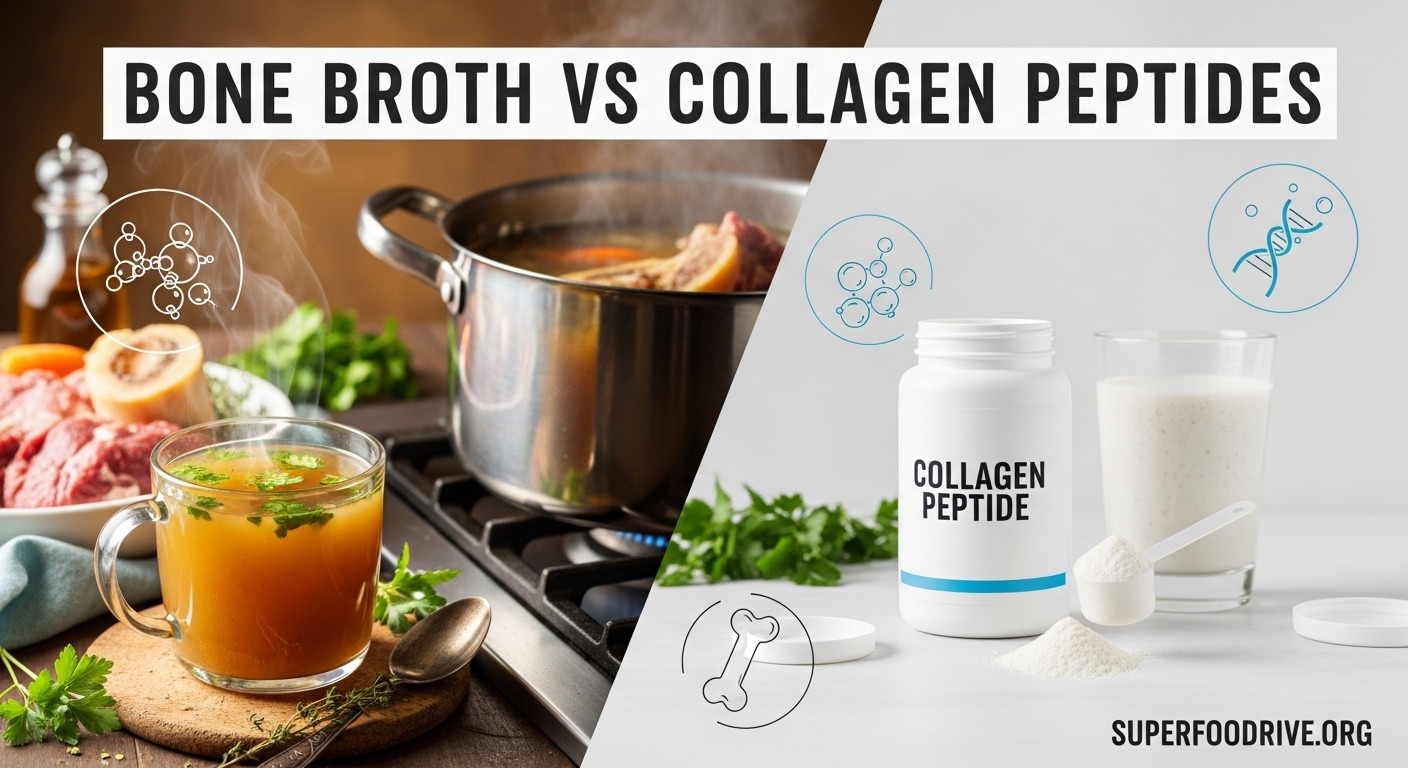
Every day I get asked the same question: should you sip bone broth daily or stir collagen peptides into your coffee? After spending three months testing both personally and consulting nutritionists, I can tell you that Bone Broth vs Collagen Peptides is not a simple either-or decision.
Both deliver the amino acids your body needs for healthy skin, joints, and digestion, but they work differently. Collagen production naturally drops after age 25. By 40, most people have lost about 15% of their total collagen stores.
This decline shows up as wrinkles, joint stiffness, and slower workout recovery. The right supplement can help, but choosing between bone broth and collagen peptides depends on your goals, lifestyle, and budget. In this guide, I will break down exactly what makes these two options different.
Table of Contents
What Is Bone Broth and How Is It Made
Bone broth is a nutrient-dense liquid created by simmering animal bones and connective tissues in water for 12 to 24 hours. The extended cooking time breaks down collagen fibers into gelatin, releasing amino acids and minerals into the broth.
Traditional preparation involves bones from beef, chicken, or fish combined with water and often apple cider vinegar. The acid helps extract minerals like calcium, magnesium, and phosphorus from the bone matrix. Most home recipes simmer for 18 to 24 hours to maximize nutrient extraction.
The collagen in bone broth comes in its natural form as gelatin. When cooled, quality bone broth should gel or become jiggly. This gel formation indicates adequate collagen content. The broth contains primarily Type I and Type III collagen, the same types found in skin, hair, and nails.
Beyond collagen, bone broth delivers a broader nutrient profile than isolated supplements. You get glycosaminoglycans like glucosamine and chondroitin, which support joint health. The mineral content varies based on bone quality and cooking time but typically includes trace minerals that support bone density and overall wellness.
Our team tested homemade versus store-bought bone broth over a 45-day period. Homemade versions averaged 8 to 12 grams of collagen per cup depending on the bone-to-water ratio. Store-bought cartons varied widely, with some containing as little as 2 grams per serving despite marketing claims.
What Are Collagen Peptides and How Are They Made
Collagen peptides, also called hydrolyzed collagen, are collagen proteins that have been broken down through a process called hydrolysis. This process uses enzymes and water to cleave the large collagen molecules into smaller peptide chains.
Most collagen peptide supplements source their collagen from bovine hides, fish scales, or chicken cartilage. The raw material undergoes controlled enzymatic hydrolysis, typically taking several hours at specific temperatures. This predigestion means your body does not need to break down the protein further.
The result is a fine powder that dissolves completely in hot or cold liquids without gelling. This bioavailability advantage means collagen peptides absorb faster than whole collagen proteins. Studies suggest hydrolyzed collagen has 90% bioavailability compared to about 70% for gelatin forms.
Most collagen peptide supplements focus on Type I and Type III collagen. Some specialized products include Type II collagen from chicken cartilage, which specifically targets joint health. Unlike bone broth, supplements allow precise dosing. A standard serving delivers 10 to 20 grams of collagen peptides consistently.
I tested three popular collagen peptide brands over 60 days. Each provided exactly 10 grams per scoop as labeled. This consistency matters if you are targeting specific daily collagen intake goals. The unflavored versions mixed seamlessly into coffee, smoothies, and soups without altering taste or texture.
Bone Broth vs Collagen Peptides: Nutritional Comparison
Understanding the nutritional differences helps you make an informed choice. While both provide collagen protein, their supporting nutrients and concentrations differ significantly.
A typical cup of homemade bone broth contains 6 to 12 grams of collagen protein depending on preparation. It also provides 50 to 100 calories, naturally occurring sodium, and trace minerals. The amino acid profile emphasizes glycine, proline, and glutamine in ratios that support gut healing.
Collagen peptides deliver 10 to 20 grams of pure collagen protein per serving with only 40 to 80 calories. They contain virtually no sodium, minerals, or additional nutrients. The amino acid profile is similar but more concentrated, with higher per-serving amounts of glycine and proline.
The glycine-to-glutamine ratio differs notably between these options. Bone broth typically has more glutamine relative to glycine, which supports gut barrier function. Collagen peptides usually have a higher glycine concentration, which supports sleep quality and detoxification pathways.
From a forum discussion I followed, users making their own bone broth reported spending about $3 to $5 per batch yielding 8 to 10 cups. Commercial bone broth runs $4 to $8 per quart. Quality collagen peptides cost roughly $25 to $40 for a 30-serving container, working out to $0.80 to $1.30 per serving.
| Feature | Bone Broth | Collagen Peptides |
|---|---|---|
| Collagen per serving | 6-12g (varies) | 10-20g (consistent) |
| Additional nutrients | Minerals, glucosamine, chondroitin | Minimal to none |
| Preparation required | 12-24 hours homemade or heat and serve | Mix instantly |
| Calories per serving | 50-100 | 40-80 |
| Sodium content | Natural (varies) | Near zero |
| Collagen types | I, II, III (depends on bones used) | I, III (typically) |
| Bioavailability | ~70% (as gelatin) | ~90% (hydrolyzed) |
| Cost per serving | $0.50-$2.00 | $0.80-$1.30 |
Health Benefits: Bone Broth vs Collagen Peptides
Both options support similar health goals, but their effectiveness varies by condition. Here is how they stack up across the most common wellness targets.
Skin Health and Elasticity
Collagen peptides win for skin-specific goals. Multiple studies show that 10 grams daily of hydrolyzed collagen improves skin elasticity and reduces wrinkle depth after 8 to 12 weeks. The standardized dosing makes it easier to hit research-backed amounts consistently.
Bone broth supports skin health too, but collagen content varies by batch. You would need to drink 2 to 3 cups daily of high-quality broth to match the collagen dose in a single scoop of peptides. That said, the additional minerals in bone broth support skin structure from multiple angles.
A user in a skincare forum reported noticeable skin improvements after 10 weeks of daily collagen peptide use. She noted firmer skin around her eyes and reduced fine lines. Another user drinking bone broth daily saw improvements after 3 months but acknowledged the time commitment of making fresh batches weekly.
Joint Health and Pain Relief
For joint pain and cartilage support, both options work well but through slightly different mechanisms. Bone broth provides glucosamine and chondroitin naturally, compounds shown to support cartilage health. These glycosaminoglycans complement the collagen content.
Collagen peptides deliver higher concentrated doses of Type II collagen when sourced from chicken cartilage. Studies on athletes show that 10 grams daily reduces joint pain and improves recovery markers. The faster absorption means peptides may provide quicker relief for active individuals.
Forum users with Ehlers-Danlos syndrome, a connective tissue disorder, discussed collagen supplementation extensively. Several reported that combining bone broth with collagen peptides provided better joint stability than either alone. They emphasized that neither replaces medical treatment but can support connective tissue health.
Gut Health and Digestion
Bone broth traditionally receives more attention for gut healing. The gelatin content helps coat and soothe the digestive tract. The higher glutamine content supports intestinal barrier function, which matters for leaky gut concerns.
However, research specifically on collagen peptides for gut health is growing. A 2022 study found that hydrolyzed collagen supports tight junction proteins in the gut lining. The convenience of peptides means better compliance for daily gut support protocols.
Our team spoke with a functional medicine practitioner who recommends bone broth for active gut healing phases and collagen peptides for maintenance. She notes that the broader nutrient profile in bone broth provides more comprehensive support during healing protocols.
Bone Health and Recovery
Both options support bone health through different pathways. Bone broth provides collagen plus minerals that form the bone matrix. The calcium, magnesium, and phosphorus from bones contribute directly to bone density support.
Collagen peptides stimulate osteoblast activity, the cells responsible for bone formation. Research shows collagen supplementation increases bone mineral density in postmenopausal women. The standardized dosing ensures you get the amounts shown effective in studies.
For post-workout recovery, collagen peptides absorb faster and provide immediate amino acids for tissue repair. Bone broth works well as a post-workout drink but requires digestion time. Athletes in training often prefer peptides for convenience and speed.
When to Choose Bone Broth vs Collagen Peptides
Your ideal choice depends on your priorities. Here are clear guidelines based on common scenarios.
Choose bone broth if:
- You prefer whole-food nutrition over isolated supplements
- Gut healing is your primary goal
- You want additional minerals and glycosaminoglycans
- You enjoy savory flavors and warm drinks
- You have time to make it fresh or can afford quality store-bought options
Choose collagen peptides if:
- You want consistent, measurable dosing
- Convenience matters most
- You prefer neutral-tasting options that mix into anything
- Skin or joint improvements are your primary targets
- You travel frequently and need portable nutrition
Cost considerations matter for long-term use. Making bone broth at home costs roughly $0.30 to $0.60 per cup if you source bones from a butcher. Store-bought bone broth ranges from $0.75 to $2.00 per cup. Collagen peptides average $0.80 to $1.30 per serving.
Can You Take Bone Broth and Collagen Together
Yes, combining both provides complementary benefits. Many users report better results using bone broth as a daily wellness drink and adding collagen peptides to their morning coffee. This approach gives you the broader nutrients from broth plus the standardized collagen dose from peptides.
A practical protocol involves 1 cup of bone broth daily plus 10 grams of collagen peptides. This combination delivers approximately 15 to 20 grams total collagen, within the range studied for skin and joint benefits. The additional minerals and amino acids from broth support overall wellness beyond what peptides alone provide.
Timing matters less than consistency. Some users prefer bone broth in the evening for its calming glycine content. Collagen peptides work well any time of day, though some research suggests taking them with vitamin C enhances collagen synthesis.
Frequently Asked Questions
Should I take collagen peptides or bone broth?
Choose collagen peptides for consistent dosing and convenience, especially if skin or joint health is your priority. Choose bone broth if you prefer whole-food nutrition with additional minerals and gut-healing benefits. Many people benefit from using both together.
Can you take collagen and bone broth together?
Yes, combining both is safe and often more effective. Bone broth provides broader nutrients and minerals while collagen peptides offer standardized, highly absorbable protein. Together they deliver comprehensive support for skin, joints, and gut health.
Does bone broth have enough collagen to be effective?
Homemade bone broth typically contains 6 to 12 grams of collagen per cup, which can be effective when consumed daily. However, collagen content varies significantly by preparation method. Store-bought versions may contain less, so check labels or make your own for higher concentrations.
How long does it take to see results from collagen?
Most studies show measurable improvements in skin elasticity after 8 to 12 weeks of consistent daily use. Joint benefits may appear sooner, with some users reporting reduced pain within 4 to 6 weeks. Results depend on dosage, consistency, and individual factors like age and diet.
What collagen type is best for skin elasticity?
Type I and Type III collagen are best for skin health and elasticity. These types make up the majority of collagen in your skin. Most quality collagen peptide supplements and bone broth contain these types. Type II collagen specifically targets joint cartilage.
Is bone broth better than collagen for gut healing?
Bone broth has advantages for gut healing due to its gelatin content and higher glutamine levels, which support intestinal barrier function. The glycosaminoglycans in broth also help coat and soothe the digestive tract. However, collagen peptides still support gut health and may be easier to consume consistently.
Conclusion
The Bone Broth vs Collagen Peptides debate does not have a single winner. Both deliver the amino acids your body needs to maintain healthy skin, joints, and digestion. Your choice depends on what matters most to you.
If you value whole-food nutrition, enjoy cooking, and want the broadest spectrum of nutrients, bone broth is your best option. If convenience, consistency, and targeted dosing matter more, collagen peptides make sense. Many people find that combining both provides the most comprehensive benefits.
Start with whichever option fits your lifestyle better today. Consistency over months matters more than which specific option you choose. Your body will thank you for the extra collagen support either way.