
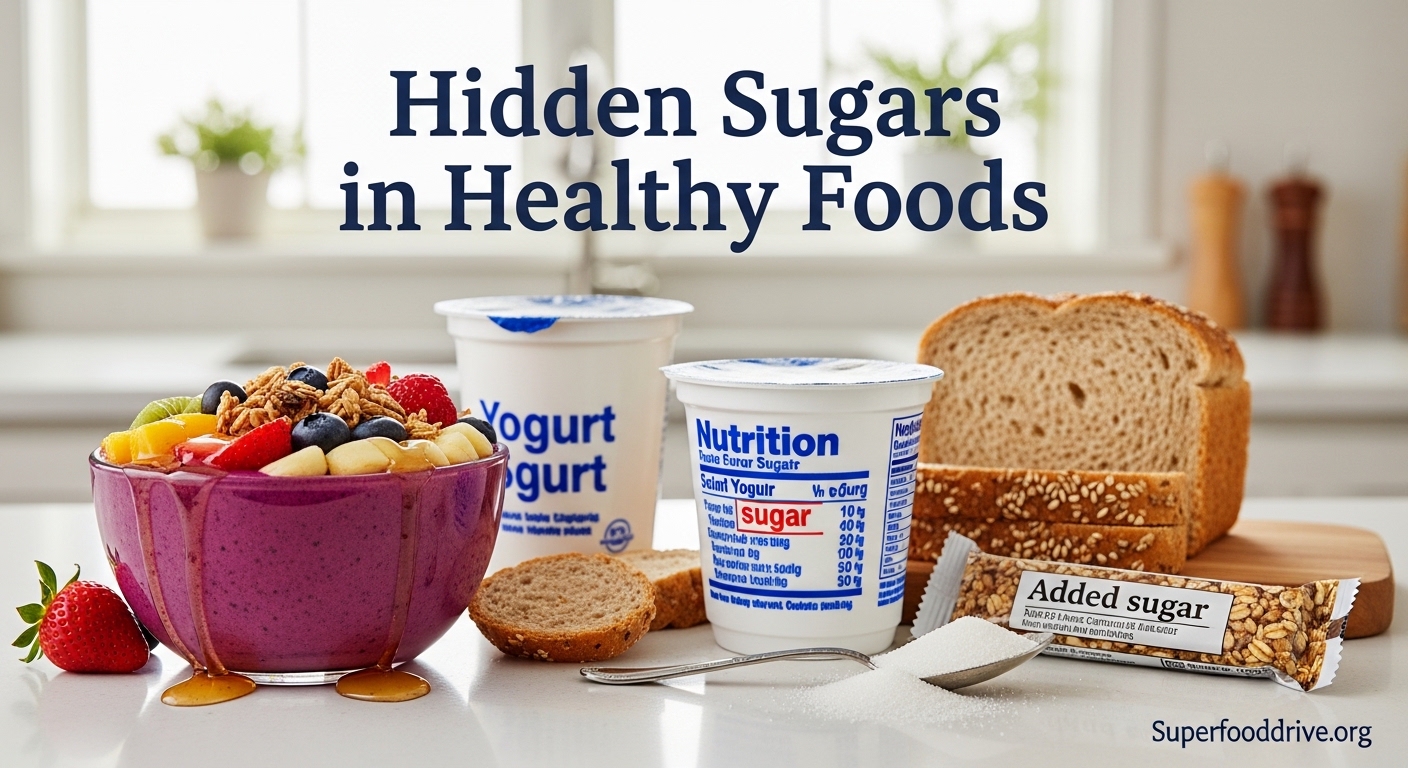
Hidden sugars in healthy foods are one of the biggest obstacles to maintaining a truly nutritious diet. You grab yogurt for breakfast, drizzle dressing on your salad, and snack on granola bars thinking you are making smart choices. The truth is that 74% of packaged foods contain added sugars hiding under names most consumers do not recognize.
I spent weeks tracking every gram of sugar I consumed and discovered I was eating nearly double the recommended limit without touching a single candy bar or soda. The average American consumes about 57 pounds of added sugar annually, often without realizing it. This guide will teach you exactly how to spot these sneaky sweeteners and take control of your health.
Table of Contents
What Are Hidden Sugars?
Hidden sugars are added sugars disguised under various names on ingredient labels. Manufacturers add these during processing to enhance flavor, improve texture, extend shelf life, and even create addiction-like cravings that keep you buying more.
Natural sugars occur naturally in whole foods like fruits (fructose) and dairy (lactose). These come packaged with fiber, protein, and nutrients that slow absorption. Added sugars are introduced during processing and hit your bloodstream faster, causing energy spikes and crashes.
The Food and Drug Administration now requires added sugars to be listed separately on nutrition labels. This change helps identify what nature put in versus what factories added. However, reading the ingredient list remains essential because sugar hides behind 61 different names.
How to Read Nutrition Labels for Hidden Sugars
Reading nutrition labels correctly takes practice, but the skill transforms your grocery shopping experience. Start with these steps every time you pick up a packaged food.
Step 1: Check the serving size. Manufacturers often use unrealistically small servings to make sugar content look lower. That small yogurt might list 12 grams of sugar per serving, but the container holds 2.5 servings.
Step 2: Find “Added Sugars” on the Nutrition Facts panel. Look for the line that specifically says “Includes Xg Added Sugars.” This number is your primary target for reduction. The daily value percentage helps you see how much of your daily limit one serving consumes.
Step 3: Scan the ingredient list for sugar code words. Ingredients appear by weight, so sugar near the top means high content. Watch for multiple sugar types listed separately. A manufacturer might split sugar into “cane sugar,” “honey,” and “corn syrup” so each appears lower on the list.
Step 4: Convert grams to teaspoons. Divide the sugar grams by four to get teaspoons. That yogurt with 24 grams of sugar contains 6 teaspoons, nearly your entire daily limit in one snack.
61+ Names for Sugar on Ingredient Labels
Food manufacturers use an extensive vocabulary to disguise sugar content. Learning these names arms you against deception at the grocery store. Here is the complete list organized by category.
Sugar Names Ending in -ose
Any ingredient ending in “-ose” is a sugar. These are the most common scientific names you will encounter:
Anhydrous dextrose, brown rice syrup solids, corn syrup solids, crystalline fructose, dextrose, fructose, galactose, glucose, high fructose corn syrup, lactose, maltose, sucrose, trehalose, and xylose.
Syrups and Liquid Sweeteners
These pourable sugars often sound healthier than they are:
Agave nectar, agave syrup, barley malt, barley malt syrup, brown rice syrup, carob syrup, coconut nectar, corn syrup, date syrup, golden syrup, high maltose corn syrup, honey, maple syrup, molasses, rice bran syrup, rice syrup, sorghum, sorghum syrup, and tapioca syrup.
Granular and Crystal Sugars
These traditional forms hide behind fancy or foreign names:
Beet sugar, brown sugar, cane crystals, cane juice crystals, cane sugar, caramel, caster sugar, coconut palm sugar, coconut sugar, confectioner’s sugar, corn sweetener, date sugar, demerara sugar, dextran, dextrin, diastatic malt, diatase, ethyl maltol, Florida crystals, glucose solids, golden sugar, grape sugar, icing sugar, invert sugar, maltodextrin, maltol, malt powder, muscovado sugar, panela, panocha, powdered sugar, raw sugar, refiner’s syrup, sorghum sugar, sucrose, sugar, turbinado sugar, white granulated sugar, and yellow sugar.
Other Hidden Sugar Names
These do not fit neat categories but are equally problematic:
Evaporated cane juice, fruit juice concentrate, fruit juice crystals, fruit juice solids, malt extract, malthol, saccharose, and sweet sorghum.
Memorize the -ose rule first, then learn the syrup variations. With 61 names to watch for, a quick scan of any ingredient list becomes second nature.
Top Foods with Hidden Sugars That Seem Healthy
Many foods marketed as healthy contain shocking amounts of added sugar. Here are the worst offenders I discovered during my sugar tracking experiment.
1. Flavored Yogurt
A typical 6-ounce fruit-flavored yogurt contains 19-25 grams of sugar, about 5-6 teaspoons. Plain yogurt has roughly 7 grams of natural lactose. That means flavored varieties add 12-18 grams of hidden sugar.
2. Breakfast Cereals
Even “whole grain” and “high fiber” cereals can pack 12-20 grams of sugar per cup. Granola varieties often reach 13-16 grams in a modest half-cup serving.
3. Pasta Sauce
One cup of commercial pasta sauce contains 10-12 grams of sugar, roughly 3 teaspoons. Tomatoes have natural sugar, but manufacturers add more to balance acidity.
4. Condiments and Salad Dressings
Two tablespoons of ketchup contain 8 grams of sugar. Salad dressings range from 3-6 grams per serving, with fat-free versions often containing the most sugar to compensate for lost flavor.
5. Granola and Protein Bars
A single granola bar often contains 11-15 grams of sugar. Protein bars marketed to fitness enthusiasts can hide 13-20 grams under “chocolate coating” or “fruit filling.”
6. Instant Oatmeal
One packet of flavored instant oatmeal contains 10-14 grams of sugar. Plain rolled oats have zero added sugar and cook nearly as fast.
7. Fruit Juice and Smoothies
An 8-ounce glass of orange juice contains 21 grams of sugar. Bottled smoothies can exceed 30 grams per bottle with no fiber to slow absorption.
8. BBQ Sauce and Marinades
Two tablespoons of barbecue sauce typically contain 12-16 grams of sugar, making it one of the most sugar-dense condiments.
9. Bread and Crackers
Two slices of whole wheat bread can contain 3-6 grams of added sugar. “Honey wheat” varieties often reach 8-10 grams.
10. Dried Fruit
Many dried fruits contain added sugars beyond their natural fructose. Sweetened cranberries can reach 29 grams of sugar per quarter cup.
11. Nut Butters
Flavored peanut butters and nut spreads often add 3-4 grams of sugar per serving. “Honey roasted” varieties add even more.
12. Coffee Creamers
One tablespoon of flavored coffee creamer contains 5 grams of sugar. Heavy users pour in 4-5 tablespoons per cup.
Daily Sugar Limits: How Much Is Too Much?
The American Heart Association provides clear guidelines for daily sugar consumption. Understanding these limits helps you budget your sugar intake throughout the day.
Women should consume no more than 25 grams (6 teaspoons) of added sugar daily. Men should limit intake to 36 grams (9 teaspoons). Children aged 2-18 should stay under 25 grams, with children under 2 consuming zero added sugars.
The World Health Organization suggests keeping added sugars below 10% of total daily calories. For a 2,000 calorie diet, this equals 50 grams or 12.5 teaspoons.
To convert grams to teaspoons, remember that 4 grams of sugar equals approximately 1 teaspoon. That flavored yogurt with 19 grams of added sugar contains nearly 5 teaspoons, consuming your entire daily limit in one snack.
Health Risks of Excess Hidden Sugar
Regular consumption of excess added sugar creates serious health consequences. The risks extend far beyond weight gain.
Heart disease risk increases significantly with high sugar intake. Studies link added sugar consumption to increased cardiovascular disease mortality. People consuming 17-21% of calories from added sugar have a 38% higher risk of dying from heart disease.
Type 2 diabetes develops more readily in people with high added sugar diets. Sugar spikes blood glucose and insulin, eventually leading to insulin resistance. The CDC identifies added sugars as a major contributor to prediabetes and diabetes rates.
Non-alcoholic fatty liver disease results from excess fructose consumption. Unlike glucose, which all cells can use, fructose processes primarily in the liver. Overloading this organ leads to fat accumulation and inflammation.
Weight gain and obesity connect directly to liquid sugars and hidden sweeteners in processed foods. Sugar provides empty calories without satiety signals, making overconsumption easy.
Chronic inflammation triggered by sugar contributes to joint pain, skin conditions, and accelerated aging. Sugar molecules bind to proteins in a process called glycation, damaging collagen and other tissues.
Practical Tips to Reduce Hidden Sugar Intake
Cutting hidden sugars requires strategy, not willpower. These practical tips make the transition manageable.
Shop the perimeter of the grocery store first. Fresh produce, meats, dairy, and bulk grains contain no hidden sugars. Venture into center aisles only for specific whole food items like beans, rice, and nuts.
Choose plain versions of yogurt, oatmeal, and nut butters. Add your own fresh fruit, cinnamon, or vanilla extract for flavor. You control the sweetness level.
Read every label, even on products you trust. Manufacturers frequently reformulate products, often adding more sugar to improve taste or texture.
Cook sauces and dressings at home. A simple vinaigrette takes 30 seconds to make with olive oil, vinegar, mustard, and herbs. Homemade tomato sauce develops natural sweetness from caramelized vegetables.
Replace sweetened beverages with water, sparkling water, or unsweetened tea. Add lemon, lime, or cucumber slices for flavor without sugar.
Gradually reduce sugar in your coffee and tea. Your taste buds adapt over 2-3 weeks, and suddenly the sweetened version tastes too sugary.
Keep a food diary for one week. Track every gram of added sugar. Awareness alone often reduces consumption by 30-40%.
Frequently Asked Questions
What foods have the most hidden sugar?
Foods with the most hidden sugar include flavored yogurt (19-25g per serving), breakfast cereals (12-20g per cup), pasta sauce (10-12g per cup), barbecue sauce (12-16g per 2 tablespoons), granola bars (11-15g each), and bottled smoothies (30g+ per bottle). These foods are often marketed as healthy while containing more sugar than desserts.
How to find hidden sugar in food?
To find hidden sugar, check the Nutrition Facts panel for the Added Sugars line, scan ingredient lists for words ending in -ose (fructose, dextrose, maltose), look for syrups (corn syrup, rice syrup, agave), and watch for terms like evaporated cane juice or fruit juice concentrate. Divide grams by 4 to convert to teaspoons.
What are the rules of a sugar-free diet?
A sugar-free diet eliminates all added sugars, including natural sweeteners like honey and maple syrup. Focus on whole unprocessed foods, read every label, avoid products with sugar in the first 5 ingredients, and limit natural sugars from dried fruit and juice. The American Heart Association recommends under 25g daily for women and 36g for men.
What are all the names for sugar on labels?
Sugar has over 61 names on labels including -ose endings (fructose, glucose, sucrose, maltose, dextrose), syrups (corn, rice, barley malt, agave), and terms like evaporated cane juice, fruit juice concentrate, maltodextrin, caramel, and dextrin. Memorize that any ingredient ending in -ose is a sugar.
Conclusion
Hidden sugars in healthy foods represent one of the biggest challenges to eating well in 2026. The food industry has created 61+ different names for sugar and added it to 74% of packaged products.
Now you understand how to read nutrition labels, identify sugar code words, and spot the worst offending foods. You know the daily limits that protect your health and the serious risks of excess consumption.
Start with one change this week. Switch to plain yogurt, make your own salad dressing, or read labels on your usual breakfast cereal. Small steps compound into significant health improvements. Your body will thank you for every gram of hidden sugar you eliminate.