
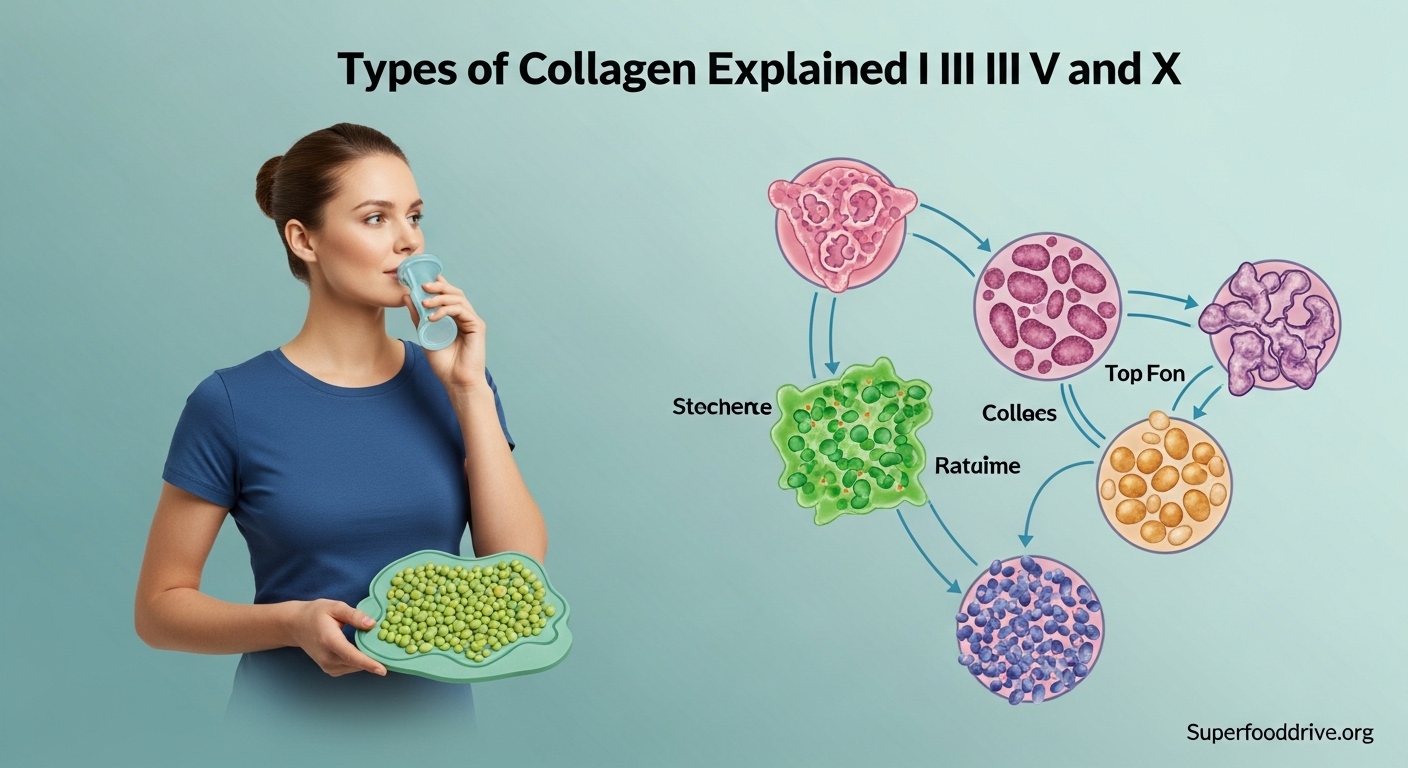
Collagen is the most abundant protein in your body, making up about 30% of your total protein content. Understanding the different types of collagen explained in this guide will help you make informed decisions about your health. Each of the five main types (I, II, III, V, and X) serves unique functions in your body, from supporting your skin and joints to strengthening your bones.
Our team spent weeks analyzing the latest research to bring you accurate, science-backed information about these collagen types. This article covers what each type does, where it is found in your body, and how they work together to keep you healthy. Whether you are researching collagen for skin health, joint support, or overall wellness, you will find the answers you need here.
Table of Contents
What Is Collagen and Why Does It Matter
Collagen is a structural protein that acts as the building block for your skin, muscles, bones, tendons, ligaments, and connective tissues. Think of it as the scaffolding that holds your body together, providing strength, structure, and elasticity where you need it most.
The word collagen comes from the Greek word kolla, meaning glue. This is fitting because collagen literally holds your body together at the cellular level. Without adequate collagen, your tissues would lose their integrity and ability to function properly.
The Triple Helix Structure
Collagen has a unique molecular structure called a triple helix. Three long chains of amino acids twist around each other to form a rope-like structure that is both strong and flexible. This triple helix formation is what gives collagen its remarkable tensile strength.
The primary amino acids in collagen are glycine, proline, and hydroxyproline. Glycine makes up about one-third of the collagen molecule and is the smallest amino acid, allowing the tight packing needed for the triple helix formation. Proline and hydroxyproline help stabilize this structure through hydrogen bonding.
Your body produces collagen through a complex process involving vitamin C, zinc, copper, and manganese. These nutrients act as cofactors in the enzymatic reactions that create and cross-link collagen fibers. Without adequate levels of these nutrients, collagen production suffers.
Why Collagen Production Declines
Your body produces collagen naturally throughout your life, but this production slows down as you age. Most people begin to notice a decline in their 30s, with production dropping by about 1% per year after age 40. By the time you reach 60, your collagen production may have decreased by as much as 50%.
Several factors accelerate this decline beyond normal aging. Sun exposure breaks down collagen fibers through UV radiation damage. Smoking introduces free radicals that degrade collagen and elastin. Poor diet, stress, and lack of sleep all contribute to reduced collagen synthesis.
Types of Collagen Explained: The Five Main Types
Scientists have identified 28 different types of collagen in the human body, but five types account for the vast majority of collagen in your system. Types I, II, III, V, and X each have distinct structures, functions, and locations within your body. Understanding these differences helps you target specific health concerns effectively.
Types I, II, and III are fibrillar collagens, meaning they form long fibers that provide structural support. These are the most common types found in supplements and have been studied extensively. Types V and X serve more specialized roles, with Type V working alongside other collagens and Type X playing a unique role in bone formation.
Type I Collagen: The Foundation of Your Body
Type I collagen makes up approximately 90% of all collagen in your body, making it the most abundant protein by far. This fibril-forming collagen provides structure to your skin, bones, tendons, ligaments, and corneas. Its thick, strong fibers create the tensile strength that keeps your tissues resilient.
Your skin derives much of its firmness and elasticity from Type I collagen, which works alongside elastin to maintain a youthful appearance. In your bones, Type I collagen provides the organic framework upon which minerals like calcium and phosphorus deposit, creating strong, flexible skeletal structures.
Where Type I Collagen Is Found
Type I collagen is densely packed in your dermis, the middle layer of skin that lies beneath the epidermis. This is where wrinkles form when collagen breaks down over time. Your tendons and ligaments are also primarily composed of Type I collagen, allowing them to withstand the tension and stretching required for movement.
Your bones contain significant amounts of Type I collagen, organized in a way that provides both strength and flexibility. Without adequate Type I collagen, bones become brittle and prone to fractures even with normal mineral density.
Sources of Type I Collagen
Most collagen supplements containing Type I come from bovine (cow) or marine (fish) sources. Bovine collagen is extracted from cow hides and bones and contains both Type I and Type III collagen. Marine collagen comes from fish scales and skin and is primarily Type I.
Marine collagen has gained popularity due to its smaller peptide size, which may improve absorption. Some studies suggest marine collagen is absorbed up to 1.5 times more efficiently than bovine collagen. However, both sources provide the amino acids your body needs to support Type I collagen production.
Type II Collagen: Your Joint Protector
Type II collagen is the primary structural component of cartilage, the flexible tissue that cushions your joints. Unlike the thick fibers of Type I, Type II forms thinner fibrils that create a mesh-like network ideal for absorbing shock and enabling smooth joint movement. This type makes up 50% of all protein in cartilage and 85-90% of collagen in your joints.
If you experience joint discomfort or are concerned about maintaining mobility as you age, Type II collagen deserves your attention. It provides the structural framework for articular cartilage, the smooth white tissue that covers the ends of bones where they meet in joints.
How Type II Differs from Type I
The molecular structure of Type II collagen differs significantly from Type I. While both form triple helices, Type II fibrils are much thinner and arranged differently to suit their cushioning function. Type II also contains different ratios of amino acids, with slightly higher levels of hydroxylysine.
Unlike Type I, which is found throughout your body in dense fibrous tissues, Type II is almost exclusively found in cartilage. This specificity makes it crucial for joint health but means you need different strategies to support it compared to skin or bone health.
Type II Collagen and Joint Health
Research has focused heavily on Type II collagen for supporting joint comfort and mobility. Some studies suggest that undenatured Type II collagen may help support the body’s natural inflammatory response in joints. This form of collagen remains in its native triple helix structure rather than being broken down into peptides.
Chicken sternum cartilage is the primary source of Type II collagen in supplements. This source naturally contains the type in its undenatured form. Some research indicates that small doses of undenatured Type II collagen (typically 40mg) may be effective for joint support, much lower than the doses typically used for Types I and III.
Type III Collagen: The Elastic Partner
Type III collagen works closely with Type I and is the second most abundant collagen in your body. It forms reticular fibers that create a supportive mesh in organs and tissues that need to expand and contract. This type is particularly important for skin elasticity, blood vessel walls, and hollow organs like the intestines and uterus.
Your body produces Type III collagen early in life, and it is especially prevalent in fetal tissues. As you age, the ratio of Type III to Type I collagen in your skin decreases, contributing to reduced elasticity and the formation of wrinkles.
Functions of Type III Collagen
Type III collagen provides the structural framework for your blood vessels, helping them withstand the pressure changes of your heartbeat. Without adequate Type III collagen, blood vessels become more fragile and prone to damage. This type also supports the walls of your intestines, contributing to gut health and digestive function.
Your skin contains significant amounts of Type III collagen mixed with Type I. Together, these types create the dermal matrix that gives skin its plump, youthful appearance. Type III contributes more to elasticity while Type I provides the structural strength.
Type III and Wound Healing
Type III collagen plays a critical role in wound healing and tissue repair. When you get a cut or injury, your body first produces Type III collagen to quickly close the wound. Over time, this is gradually replaced by stronger Type I collagen as the tissue matures and strengthens.
This rapid-response function makes Type III essential for recovery from injuries, surgeries, and skin damage. Poor wound healing can sometimes indicate insufficient Type III collagen production or impaired synthesis mechanisms.
Type V Collagen: The Regulator
Type V collagen is a minor fibrillar collagen that plays a regulatory role in collagen fiber formation. It works alongside Type I and III to control the diameter and organization of collagen fibrils. Without Type V collagen, the larger Type I fibrils would not form properly.
This type is found in cell surfaces, hair, and the placenta. It is essential during fetal development and continues to play supporting roles throughout life. Type V helps determine the spacing and arrangement of collagen fibers in various tissues.
Where Type V Collagen Functions
Type V collagen is found in the dermal-epidermal junction, the boundary between your outer and middle skin layers. It helps anchor these layers together and contributes to skin strength and integrity. This location also makes it important for wound healing and skin regeneration.
Your hair contains Type V collagen in the surrounding tissue structures. While keratin is the primary protein in hair strands themselves, Type V collagen supports the follicles and surrounding connective tissue that anchor hair to your scalp.
The placenta contains significant amounts of Type V collagen, reflecting its importance in fetal development. During pregnancy, this collagen type supports the complex tissue interactions required for proper placental function.
Type X Collagen: The Bone Architect
Type X collagen is unique among the five main types because it is a network-forming collagen rather than a fibrillar one. Its primary role is in endochondral ossification, the process by which cartilage is replaced by bone during growth and development. This makes Type X essential for bone formation and growth plate function.
Unlike the other collagen types that provide ongoing structural support, Type X collagen is most active during specific developmental phases. It is produced by hypertrophic chondrocytes in the growth plates of long bones during childhood and adolescence.
The Role of Type X in Bone Formation
Type X collagen creates a structural framework that allows mineralization to occur during bone development. It helps organize the matrix in which calcium and other minerals deposit, transforming soft cartilage into hard bone. Without Type X collagen, normal bone growth would be impossible.
Research has also identified Type X collagen in adult tissues, though in smaller amounts. Some studies suggest it may play roles in bone remodeling and fracture repair, though these functions are less well understood than its developmental roles.
Type X Collagen in Health and Disease
Mutations in the Type X collagen gene can cause Schmid metaphyseal chondrodysplasia, a skeletal disorder affecting bone growth. This rare condition demonstrates how crucial Type X is for proper skeletal development. Understanding this collagen type helps researchers better comprehend bone growth disorders.
Some researchers are investigating whether Type X collagen markers could indicate bone health status or growth potential. However, this remains an area of active research with limited clinical applications at this time.
Collagen Types Comparison
Understanding how the five main collagen types differ helps you appreciate their specialized functions. While they share the basic triple helix structure, their arrangement, location, and specific roles vary significantly. This comparison highlights the key differences between each type.
Type I dominates by volume, making up 90% of your body’s collagen and providing primary structural support. Type II specializes in joint cartilage with its unique mesh-like fibril arrangement. Type III partners with Type I to add elasticity. Type V regulates fiber formation. Type X enables bone mineralization during development.
Quick Reference Guide
Here is a summary of where each collagen type is found and what it does:
Type I: Skin, bones, tendons, ligaments, corneas. Provides tensile strength and structural framework. 90% of body collagen.
Type II: Cartilage, especially in joints. Cushions and supports joint movement. 50% of cartilage protein.
Type III: Skin, blood vessels, intestines, uterus. Adds elasticity and forms reticular fibers. Partners with Type I.
Type V: Cell surfaces, hair follicles, placenta. Regulates fiber diameter and organization. Supports fetal development.
Type X: Growth plates, developing bones. Enables cartilage-to-bone transformation. Essential for skeletal growth.
Collagen Types Working Together
Your body rarely uses just one collagen type in isolation. Types I and III work together constantly in skin, blood vessels, and organs. Type V regulates the assembly of Type I fibers. These combinations create tissues with the specific properties needed for their functions.
Supplements often combine multiple collagen types to provide comprehensive support. Multi-collagen products typically include Types I, II, III, V, and X sourced from various animal tissues. However, the specific ratios and effectiveness of these combinations vary between products.
Collagen and the Aging Process
Collagen loss is one of the primary drivers of visible aging. As production slows and existing collagen breaks down, you may notice wrinkles, sagging skin, joint stiffness, and other signs of aging. Understanding this process helps you take steps to support your collagen levels.
Women experience accelerated collagen loss during menopause due to declining estrogen levels. Studies show women can lose up to 30% of their skin collagen in the first five years after menopause. This explains why many women notice rapid changes in skin appearance during this transition.
Signs of Collagen Decline
Your skin shows collagen decline through wrinkles, fine lines, and reduced elasticity. You may notice your skin feels thinner or bruises more easily. These changes typically begin in your 30s and accelerate with age.
Joint stiffness and discomfort can indicate cartilage collagen breakdown. You might notice reduced flexibility or longer recovery time after exercise. Your nails may become brittle and your hair thinner as these structures lose their collagen support.
Gut issues can sometimes relate to collagen decline, particularly the Type III collagen that supports intestinal walls. Some people experience increased digestive sensitivity or changes in gut function as they age.
Habits That Destroy Collagen
Several lifestyle factors actively damage the collagen in your body. Avoiding these habits helps preserve your existing collagen and supports healthy production. Many of these factors create free radicals or inflammation that break down collagen fibers.
UV radiation from sunlight is one of the biggest culprits. UV rays penetrate the skin and create free radicals that damage collagen fibers directly. This process, called photoaging, accounts for up to 80% of visible facial aging. Wearing sunscreen daily is one of the most effective ways to protect your collagen.
Lifestyle Factors That Harm Collagen
Smoking introduces thousands of chemicals that generate free radicals and impair blood flow to the skin. Smokers typically show signs of accelerated aging, with more wrinkles and poorer skin quality than non-smokers of the same age. Quitting smoking allows your body to begin repairing some of this damage.
Excessive sugar consumption leads to glycation, a process where sugar molecules attach to collagen fibers and make them stiff and brittle. These advanced glycation end products (AGEs) accumulate over time and contribute to skin aging. Reducing refined sugar intake helps minimize this damage.
Chronic stress elevates cortisol levels, which can break down collagen and inhibit new production. Poor sleep also disrupts the repair processes that occur during rest. Managing stress and getting 7-9 hours of quality sleep supports collagen maintenance.
Environmental and Dietary Factors
Air pollution exposes your skin to free radicals and oxidative stress that degrades collagen. Living in urban areas with high pollution levels may accelerate skin aging compared to rural environments. Antioxidant-rich skincare and diet can help counteract some of this damage.
A diet lacking in vitamin C, zinc, copper, or protein impairs your body’s ability to produce collagen. These nutrients are essential cofactors in collagen synthesis. Without adequate protein intake, your body lacks the amino acid building blocks needed for collagen production.
How to Support Collagen Production Naturally
You can take several steps to support your body’s collagen production and protect existing collagen. These strategies combine dietary approaches, lifestyle modifications, and targeted nutrients that provide the raw materials and cofactors needed for synthesis.
Eating adequate protein is essential since collagen is made from amino acids. Include diverse protein sources like meat, fish, eggs, dairy, legumes, and soy in your diet. Bone broth contains collagen directly, though the specific types and amounts vary.
Collagen-Building Nutrients
Vitamin C is absolutely essential for collagen production. Your body cannot make or maintain collagen without it. Citrus fruits, berries, peppers, and leafy greens are excellent sources. Aim for vitamin C-rich foods at every meal.
Zinc, copper, and manganese serve as cofactors in collagen synthesis enzymes. Shellfish, nuts, seeds, whole grains, and leafy vegetables provide these minerals. A varied diet typically supplies adequate amounts, though some people may need supplementation.
Proline and glycine are the primary amino acids in collagen. While your body can make these, providing them through diet reduces the synthetic burden. Egg whites, dairy, cabbage, mushrooms, and meat contain significant amounts of these amino acids.
Lifestyle Strategies for Collagen Health
Protecting your skin from UV damage preserves existing collagen. Use broad-spectrum sunscreen daily, wear protective clothing, and seek shade during peak sun hours. These habits prevent the collagen breakdown that leads to premature aging.
Regular exercise supports collagen health by improving circulation and stimulating production. Weight-bearing exercise is particularly beneficial for bone collagen. Staying active throughout life helps maintain the collagen structures that support movement.
Staying hydrated helps maintain skin plumpness and supports all cellular functions including collagen synthesis. Drinking adequate water and consuming water-rich foods keeps your tissues functioning optimally.
FAQ
What is collagen I, II, III, V, and X?
These are the five main types of collagen in the human body. Type I makes up 90% of body collagen and supports skin, bones, and tendons. Type II is found in joint cartilage for cushioning. Type III provides elasticity to skin and blood vessels. Type V regulates collagen fiber formation. Type X enables bone mineralization during growth. Each type has a unique triple helix structure and specific function.
What habits destroy collagen?
UV sun exposure, smoking, excessive sugar consumption, chronic stress, poor sleep, and air pollution all damage collagen. UV radiation creates free radicals that break down collagen fibers. Smoking reduces blood flow and introduces harmful chemicals. Sugar causes glycation that makes collagen stiff. Managing these factors helps preserve your existing collagen.
What is Type X collagen good for?
Type X collagen is essential for bone formation and growth. It enables endochondral ossification, the process where cartilage transforms into bone during development. Found in growth plates during childhood, Type X creates the framework for mineralization. It helps organize the matrix where calcium deposits, allowing proper skeletal growth and bone strength.
Which collagen type is best for skin?
Type I and Type III collagen are best for skin health. Type I provides the structural strength that keeps skin firm and resilient. Type III adds elasticity and works with Type I to maintain youthful appearance. Together they form the dermal matrix that prevents wrinkles and sagging. Most skin-focused supplements contain these two types.
Which collagen type is best for joints?
Type II collagen is best for joint health as it makes up 85-90% of cartilage collagen. This type forms the mesh-like structure that cushions joints and enables smooth movement. Undenatured Type II collagen, which maintains its native triple helix structure, has been specifically studied for joint support and comfort.
Do collagen types matter when taking supplements?
Yes, collagen types matter because each type targets different tissues. Type I and III support skin, bones, and general structure. Type II specifically benefits joints and cartilage. Some research suggests collagen peptides may signal specific tissues regardless of original type, but choosing type-appropriate supplements aligns with traditional use and specific research.
Conclusion: Understanding Your Collagen Types
Types of collagen explained in this guide show how these five proteins work together to maintain your body’s structure and function. Type I provides the foundation, Type II cushions your joints, Type III adds elasticity, Type V regulates formation, and Type X enables bone growth. Each type is essential for specific tissues and purposes.
Supporting your collagen involves eating protein-rich foods, consuming adequate vitamin C and minerals, protecting your skin from sun damage, and avoiding habits like smoking and excessive sugar intake. These strategies help your body maintain production and preserve existing collagen as you age.
Whether you are focused on skin health, joint comfort, or overall wellness, understanding these collagen types empowers you to make informed decisions. Your body produces collagen naturally throughout life, and supporting this process is one of the most effective ways to maintain healthy tissues for years to come.