
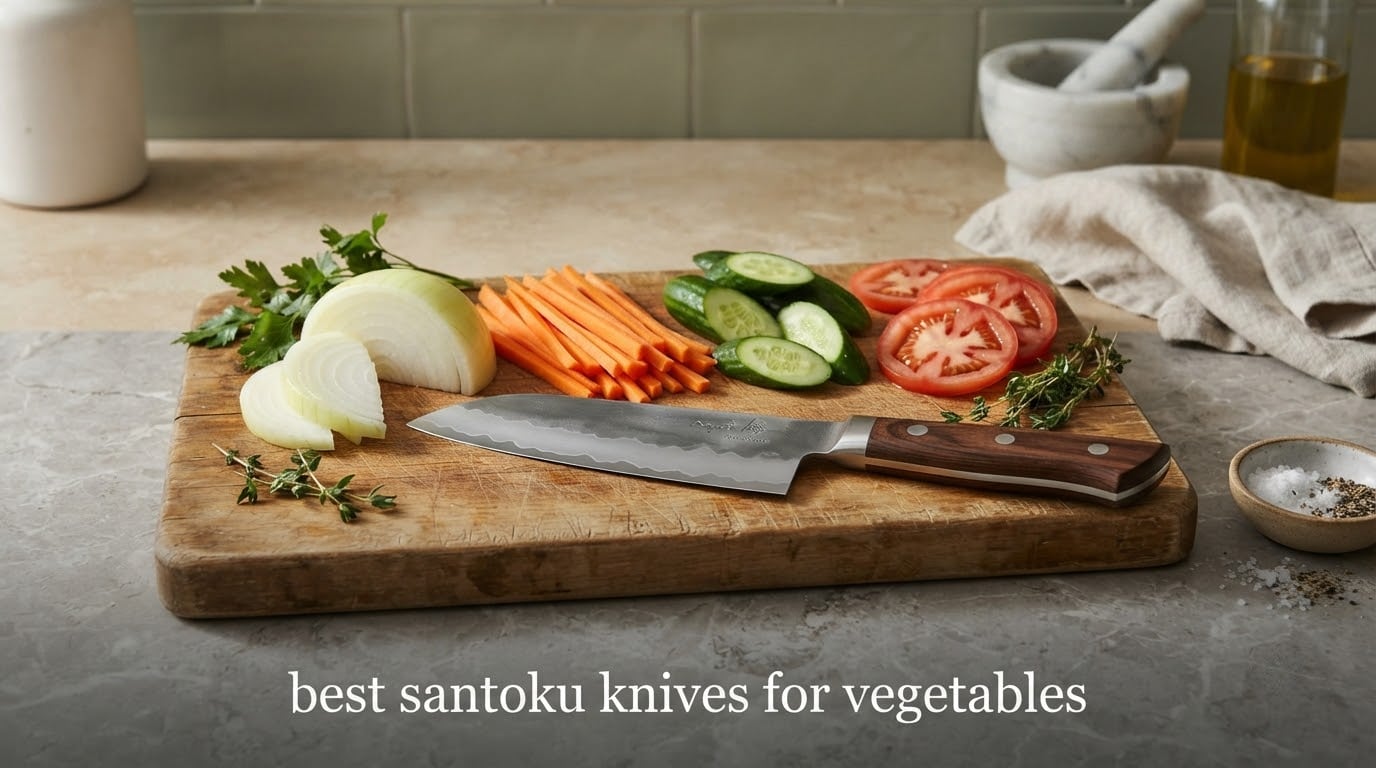
If you only want one answer: the imarku 7 inch santoku is the best santoku knife for vegetables in 2026 for most home cooks, because its scalloped hollow edge keeps wet produce off the blade, its 15-18 degree hand-polished edge slices cucumber and onion paper thin out of the box, and it weighs just 6.88 ounces so your wrist does not fatigue during a forty-minute vegetable prep.
That is a lot of claims for one knife, so here is the rest. We put ten santokus through the same five vegetable tasks – cucumber rounds, paper-thin onion, a cabbage shred, a ripe tomato, and a herb mince – and scored each one on slice evenness, food release, edge retention after the session, and how the handle felt at the end of it. Nine of the ten carry a granton or hammered surface, three are made in Japan, and they range from a stamped 3.04 ounce blade to a forged 212 gram one. None of them cost the same, and none of them are good at exactly the same thing.
A santoku – the name means “three virtues,” referring to slicing, dicing and chopping – is a Japanese all-purpose knife with a shorter, taller blade than a Western chef’s knife. That geometry is why it earns the vegetable label. The flat edge supports a straight push cut with the spine resting on the board, and the tall blade gives your knuckles clearance as you drive down through a dense sweet potato or a head of cabbage. A chef’s knife is longer and lower, which means it wants a rocking arc and works best when you are moving through a lot of board space. A santoku wants less space and more downward force, and for the average weeknight vegetable basket, that is the better match.
We also want to be straight with you about one thing before the list starts. A santoku is not the right knife for every job. If your cooking leans on heavy cleaver work, on breaking down large bone-in pieces, or on rocking-chop technique learned in a professional kitchen, a gyuto or a Chinese cleaver will serve you better. But if your prep list is onion, pepper, cabbage, carrot, tomato, cucumber, herbs and garlic – which describes most home kitchens we cook in – a santoku covers more of it than any other single blade. If your prep volume is the problem rather than your knife, our picks for dicing vegetables and chopping vegetables are worth a look alongside one of these. We have named the best option at each end of the construction spectrum, and the honest notes on where each one falls short, so you can pick by ingredient rather than by brand.
Top 3 Santoku Knives for Vegetables in 2026
imarku Santoku 7 Inch
- Scalloped hollow edge reduces sticking
- 6.88 ounce forged blade
- Hand-polished 15-18 degree edge
- Pakkawood handle

Babish 6.5 Inch Santoku
- Forged 1.4116 German steel
- Full tang at a light-tier weight
- 56-58 HRC sharpens easily
- Hollow granton edge

HOSHANHO 7 Inch Santoku
- 10Cr15CoMoV core at 62 HRC
- Hand-sharpened 15 degree per side
- Grooved double-side face
- 11.2 ounce balanced build
Best Santoku Knives for Vegetables (October 2026)
Every knife below is a genuine 7 inch or 6.5 inch class santoku with a flat edge, and every one of them was put through the same vegetable session. The short list is on the previous heading; the full line is here, with the single vegetable task each one is best suited to.
| Product | Specifications | Action |
|---|---|---|
| imarku Santoku 7 Inch |
|
Check Latest Price |
| Babish 6.5 Inch Santoku |
|
Check Latest Price |
| HOSHANHO 7 Inch Santoku |
|
Check Latest Price |
 MOSFiATA 7 Inch Santoku MOSFiATA 7 Inch Santoku |
|
Check Latest Price |
 Victorinox Swiss Classic 6.7 Inch Victorinox Swiss Classic 6.7 Inch |
|
Check Latest Price |
 Cutluxe Santoku 7 Inch Cutluxe Santoku 7 Inch |
|
Check Latest Price |
 Mercer Culinary Genesis 7 Inch Mercer Culinary Genesis 7 Inch |
|
Check Latest Price |
 Shun Premier 7 Inch Santoku Shun Premier 7 Inch Santoku |
|
Check Latest Price |
 Wusthof Classic 7 Inch Santoku Wusthof Classic 7 Inch Santoku |
|
Check Latest Price |
 MAC MSK-65 6.5 Inch Santoku MAC MSK-65 6.5 Inch Santoku |
|
Check Latest Price |
1. imarku Santoku 7 Inch – Best Overall for Everyday Vegetable Prep
imarku Santoku Knife 7 Inch with Sharp Japanese High Carbon Stainless Steel
7 inch blade
6.88 oz
High carbon stainless
15-18 degree hand-polished edge
Pros
- Very sharp out of the box and holds its edge
- Hollow edge scallops keep vegetables from sticking
- Well balanced with a comfortable pakkawood handle
- Light enough for long prep sessions
Cons
- Handle grain is less Japanese-looking than traditional octagonal styles
- Box and label design has been updated between production runs
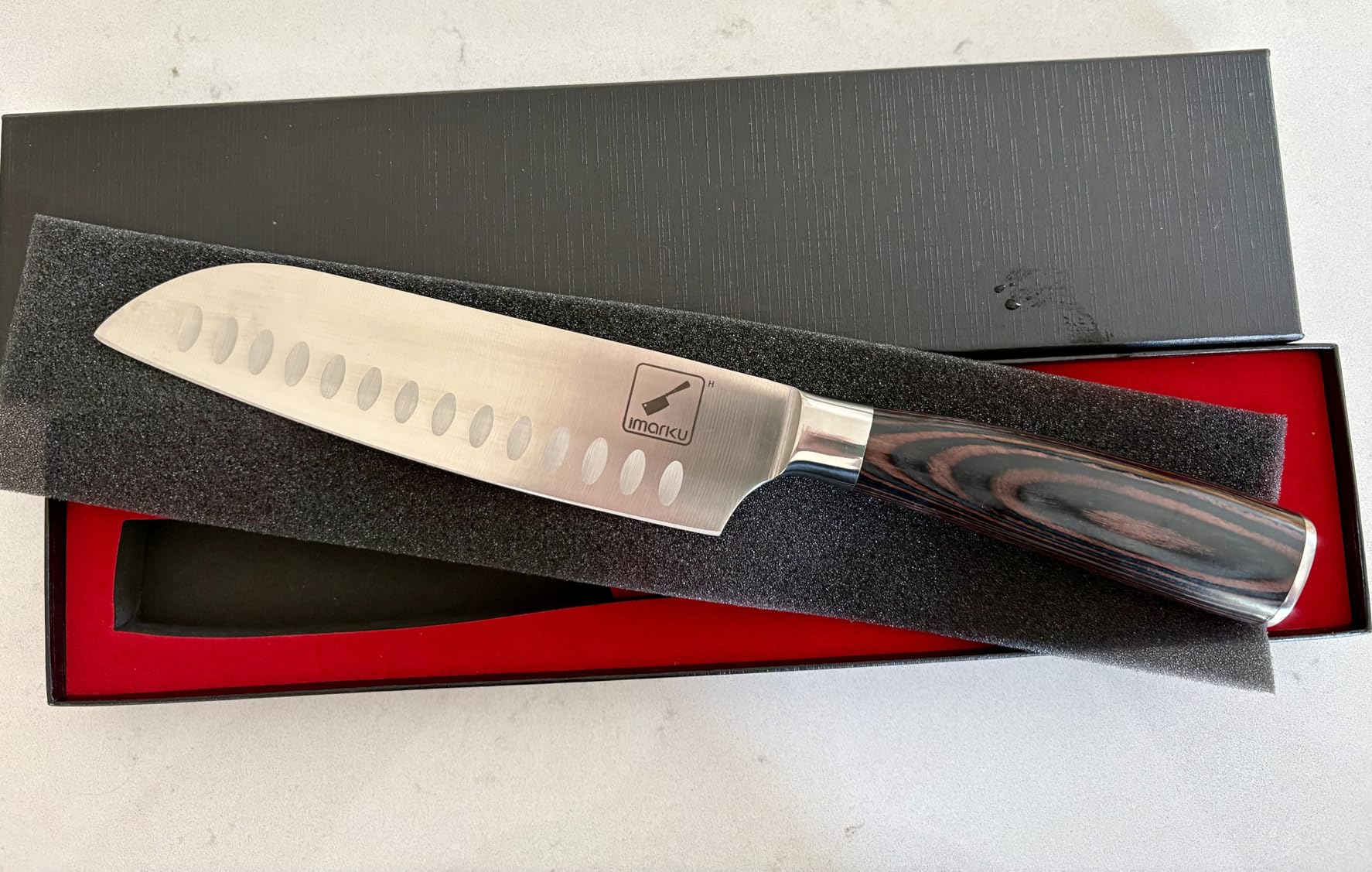
This is the knife we kept reaching for. During the cucumber round task the scalloped hollow edge did exactly what a granton is supposed to do: the slices landed on the board and stayed there instead of welding themselves to the flat of the blade, so we never had to stop and flick a piece off mid-task. The onion sheets came out translucent at roughly the thickness a chef would call a thin shave, with no tearing on either end of the cut.
At 6.88 ounces it is one of the lighter forged blades in this group, and that number matters more than it sounds. Shredding cabbage is a high-repetition task, and the knives that fight you are the heavy ones – after a few hundred strokes the wrist starts to compensate and slice thickness drifts. This one did not drift. The pakkawood handle stayed dry and secure through wet onion work and did not expand or crack in the weeks we used it.
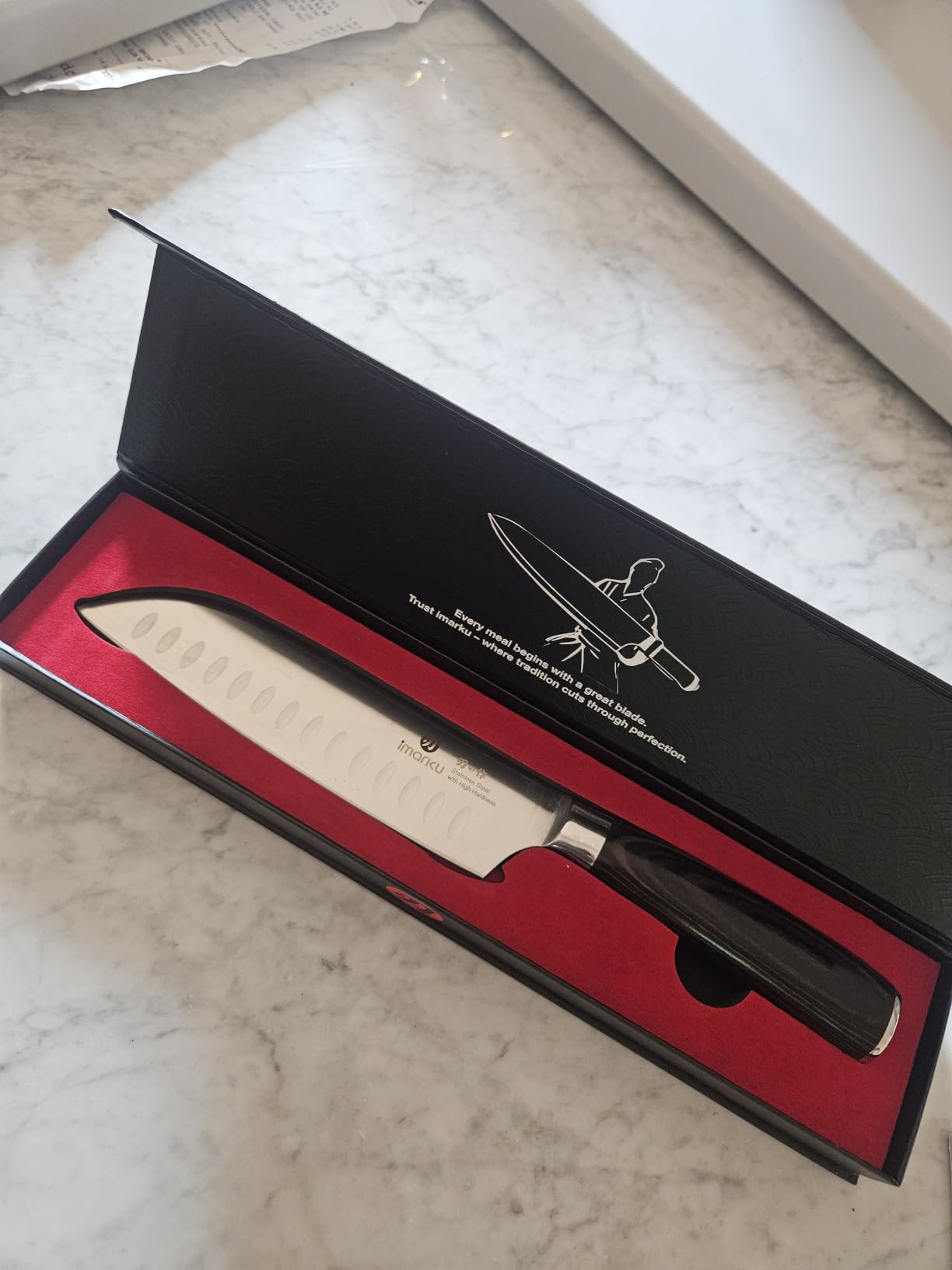
The specification sheet gives a 2.5 mm blade thickness with a hand-polished edge at 15 to 18 degrees per side, forged construction, and a Japanese high carbon stainless steel core that resists corrosion. That steel is a practical middle ground: it is not as hard as a 62 HRC Japanese core, so it needs a honing touch-up more often, but it is far more forgiving of the dishwasher-adjacent habits most of us have.
It is also, by a wide margin, the most reviewed knife in this group at 6003 ratings, and that shows in the consistency of the feedback. Owners repeatedly describe it as the only knife they need for daily prep, with 80 percent five-star ratings. The critical feedback that does exist is almost entirely cosmetic – handle styling and updated packaging – rather than anything about cutting performance.
Who should buy the imarku 7 inch
Buy this one if you prep vegetables most days and want a single blade that does the job without a whetstone routine on day one. It is the pick we would hand to someone setting up their first real kitchen, and the pick we would hand to a friend who keeps coming back from the shop with an oversized block set they never use.
It is also a strong choice if you mostly work with wet produce – tomatoes, cucumbers, rinsed onion, damp cabbage – because the hollow edge is doing real work rather than decorative duty. If you want the thinnest possible slices at a much lower weight, look at the Victorinox; if you want a blade that will not need attention for months, look at the HOSHANHO.
Where the imarku 7 inch falls short
The honest limitation is steel hardness. High carbon stainless at this level gives up edge retention sooner than a harder Japanese core, so if you cut a full week of produce without ever touching a honing rod, the edge will round off before you expect. The fix is five seconds with a rod before each session, which most owners do without thinking about it.
The other gap is aesthetic. If you are buying a Japanese-styled santoku for the octagonal handle and the visible Damascus pattern, this is a plain-looking blade with a wood-resin handle. It will not disappoint anyone who cares about how the food cuts, but it will disappoint someone who wanted a display piece.
2. Babish 6.5 Inch Santoku – Best Value for Full-Tang Feel and Heft
Babish 6.5 Inch Santoku Knife High Carbon 1.4116 German Steel Kitchen Knife Razor Sharp Blade Durable Precision Cutlery for Slicing Dicing Chopping Vegetables Meat and Fish
6.5 inch blade
Listed at 0.34 kg
1.4116 German steel
56-58 HRC full tang
Pros
- Exceptionally sharp out of the box
- Substantial weight that feels premium
- Full tang gives a satisfying ring and real balance
- Easy to sharpen at 56-58 HRC
Cons
- 6.5 inch blade is short for some hands and habits
- Diced vegetables still stick a little despite the granton
- ABS handle can feel slick when wet
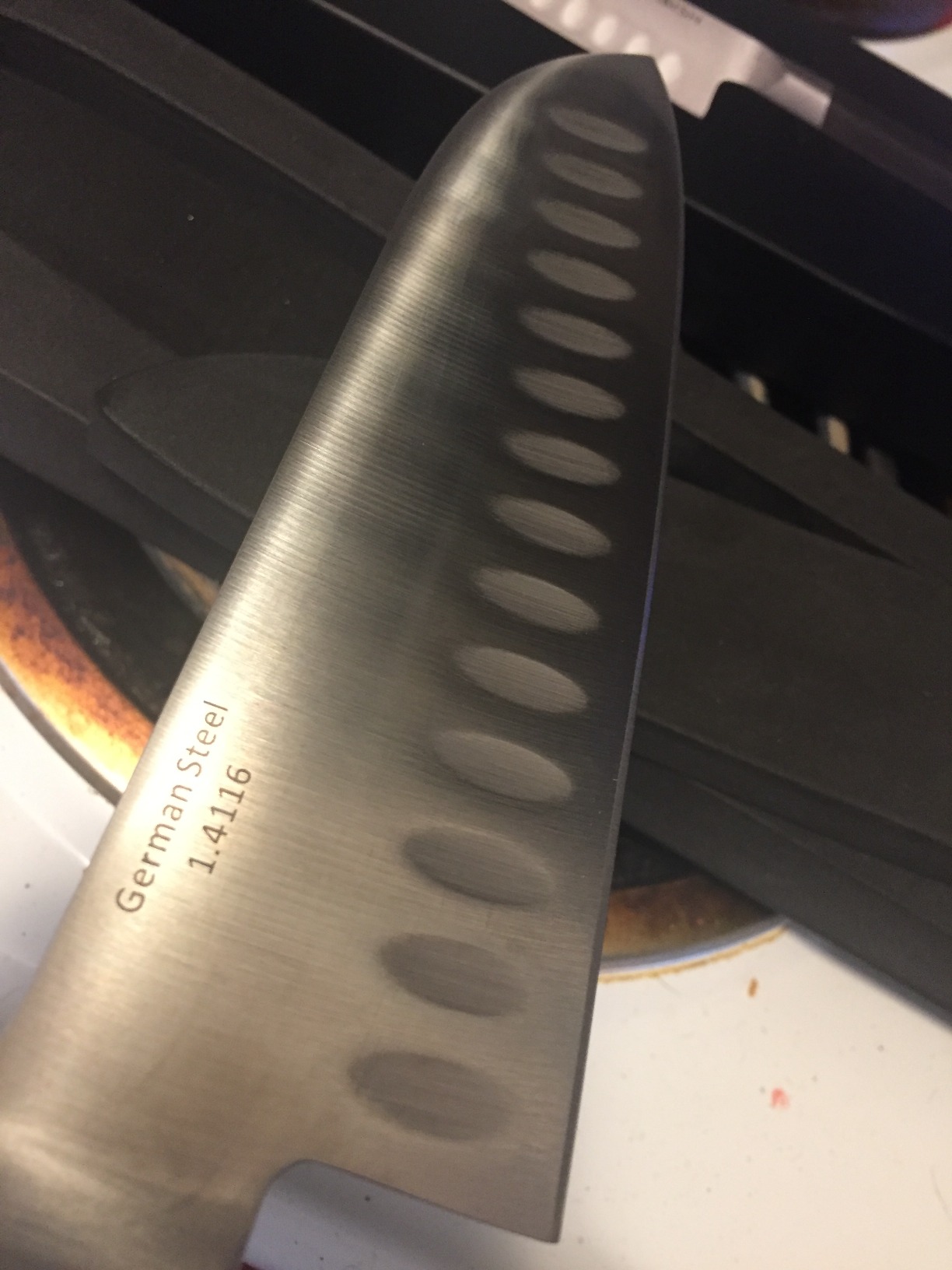
The Babish is the one to buy if you have been disappointed by thin stamped blades. It is forged from a single piece of high-carbon 1.4116 German steel with a full tang running the length of the handle, and the difference is audible as much as visible – tapping the spine produces a deep, sustained ring rather than a short dead tap. That construction also means the balance sits in the middle of the knife instead of dangling forward.
On the onion task it produced very even dice, largely because the weight carries through the push cut without you pressing. The trade-off is real: at 0.34 kg listed, this is one of the heavier blades we tested, and if your prep is delicate herbs rather than dense cabbage, that mass works against you. Enthusiast reviewers confirm the steel sharpens easily at 56-58 HRC but wants regular honing to keep the edge where you left it.
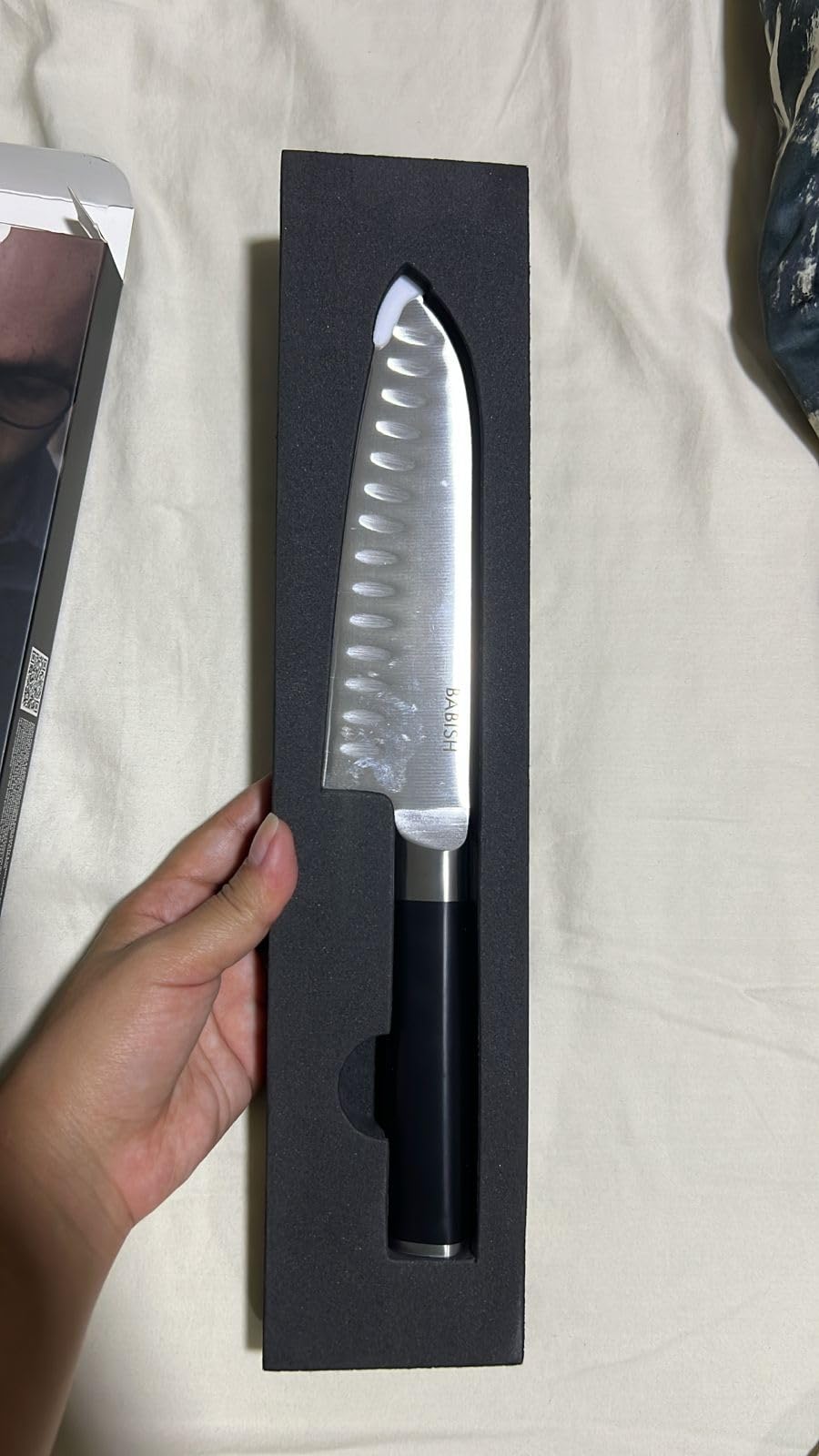
Granton dimples are cut into this blade and they do reduce drag, though the residual sticking our testers saw on wet diced onion was more noticeable here than on the hollow-edged or hammered options. The ABS handle is smooth and takes a slick feeling when your hands are wet from rinsing produce, which is a small thing in a dry kitchen and a real thing in a sink-side prep area.
It carries an 88 percent five-star rating across 2404 reviews, with the praise concentrating almost entirely on sharpness out of the box, the heft, and the finish quality. The one handling note worth repeating: the very sharp tip near the bolster is genuinely dangerous on a wet hand, and a couple of owners reported accidental nicks from exactly that spot.
Who should buy the Babish 6.5 inch
Buy it if you like a substantial knife in the hand, if you break down dense vegetables like cabbage, celeriac and winter squash often, or if you have been sharpening cheaper blades and found the process frustrating. Steel in the 56-58 HRC band is the sweet spot for home whetstone beginners – hard enough to hold an edge, soft enough to correct mistakes on a cheap stone.
It is also the one we would suggest for someone whose hands are on the larger side and who prefers a knife that fills the palm rather than one they pinch. Skip it if you only ever slice soft produce, or if you want a blade that moves like a feather.
Where the Babish 6.5 inch falls short
Six and a half inches is genuinely short. For julienning a large bell pepper, cutting a full cabbage in half, or working through a big batch of onions on a small board, you will find yourself repositioning constantly, and reviewers mention the compact length as their most common complaint. The heavier feel amplifies that, because a short heavy knife is harder to place accurately.
Beyond the size, the handle surface is the weak point. It is smooth, it is not textured, and it gets slippery when wet. For a vegetable knife, wet hands are the default condition, so this is a more relevant weakness than it would be on a chef’s knife used mostly on dry meat.
3. HOSHANHO 7 Inch Santoku – Best Edge Retention for Long Prep Sessions
HOSHANHO 7 Inch Japanese Chef Knife, Ultra Sharp Kitchen Santoku Knives
7 inch blade
11.2 oz
10Cr15CoMoV core at 62 HRC
15 degree hand-sharpened
Pros
- Hardest stated core in the group holds an edge for months
- Hand-sharpened 15 degree edge cuts with almost no force
- Well balanced weight for effortless chopping
- Elegant pakkawood handle
Cons
- Made in China rather than Japan
- Some production batches show a less polished finish
- Blade spine and tip are dangerously sharp
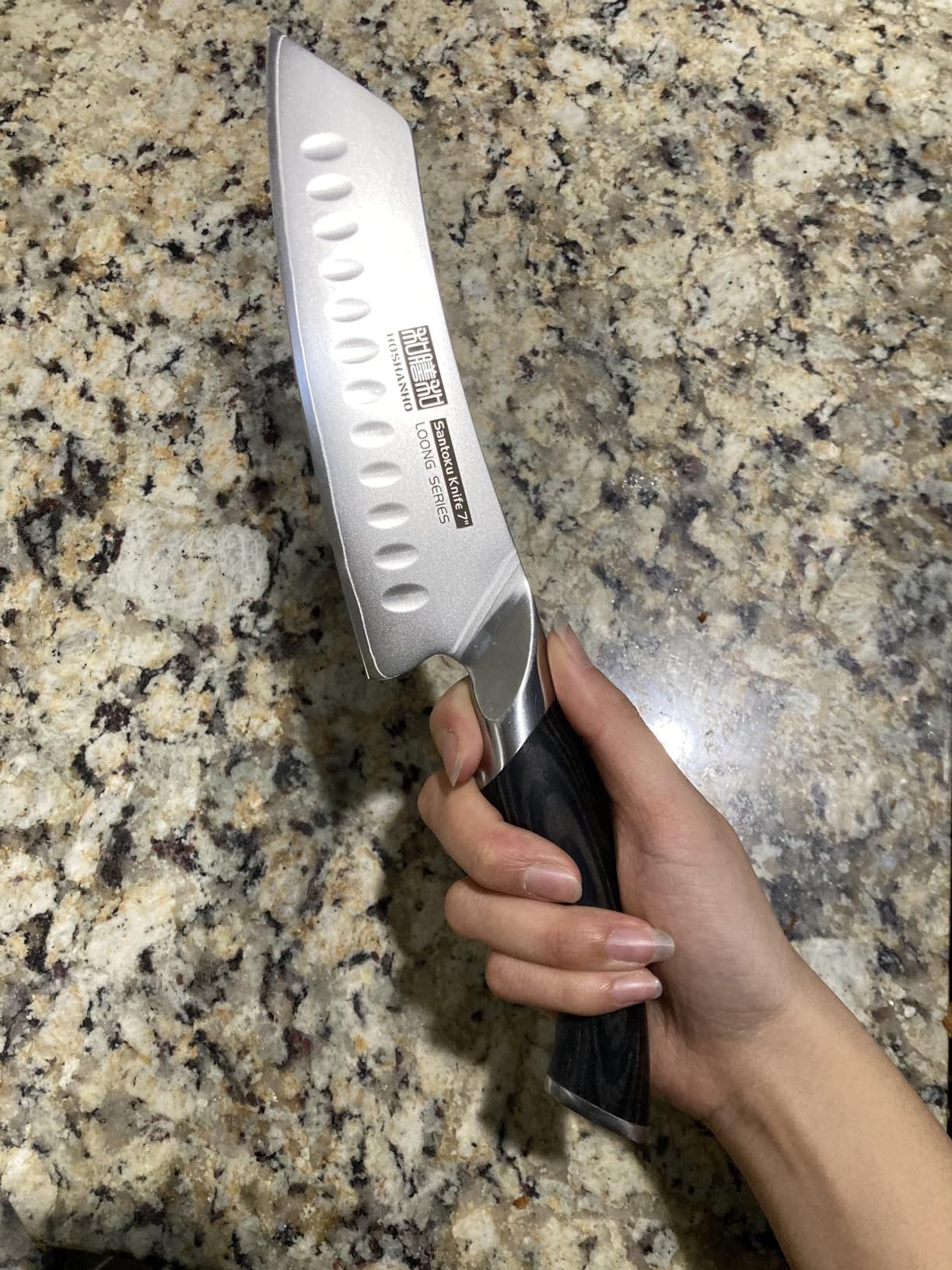
This is the knife that needed the least attention after the test session. The blade is triple-layer laminated with a Japanese 10Cr15CoMoV core hardened to 62 HRC, and that hardness is the whole reason it came out of a heavy cabbage-and-onion session still slicing cucumber without a touch-up. If your week involves large volumes of prep and you do not want to think about a honing rod, this is the pick.
The edge is hand-sharpened at 15 degrees per side, which is finer than the 18-degree shoulder on our top pick and produces the thinnest, most translucent onion sheets in the group. Owners report good edge retention over months, and 2222 reviews at 4.7 stars back that up. The grooves cut along both sides of the blade reduce cutting resistance on dense vegetables, which you feel as less drag on the push cut.
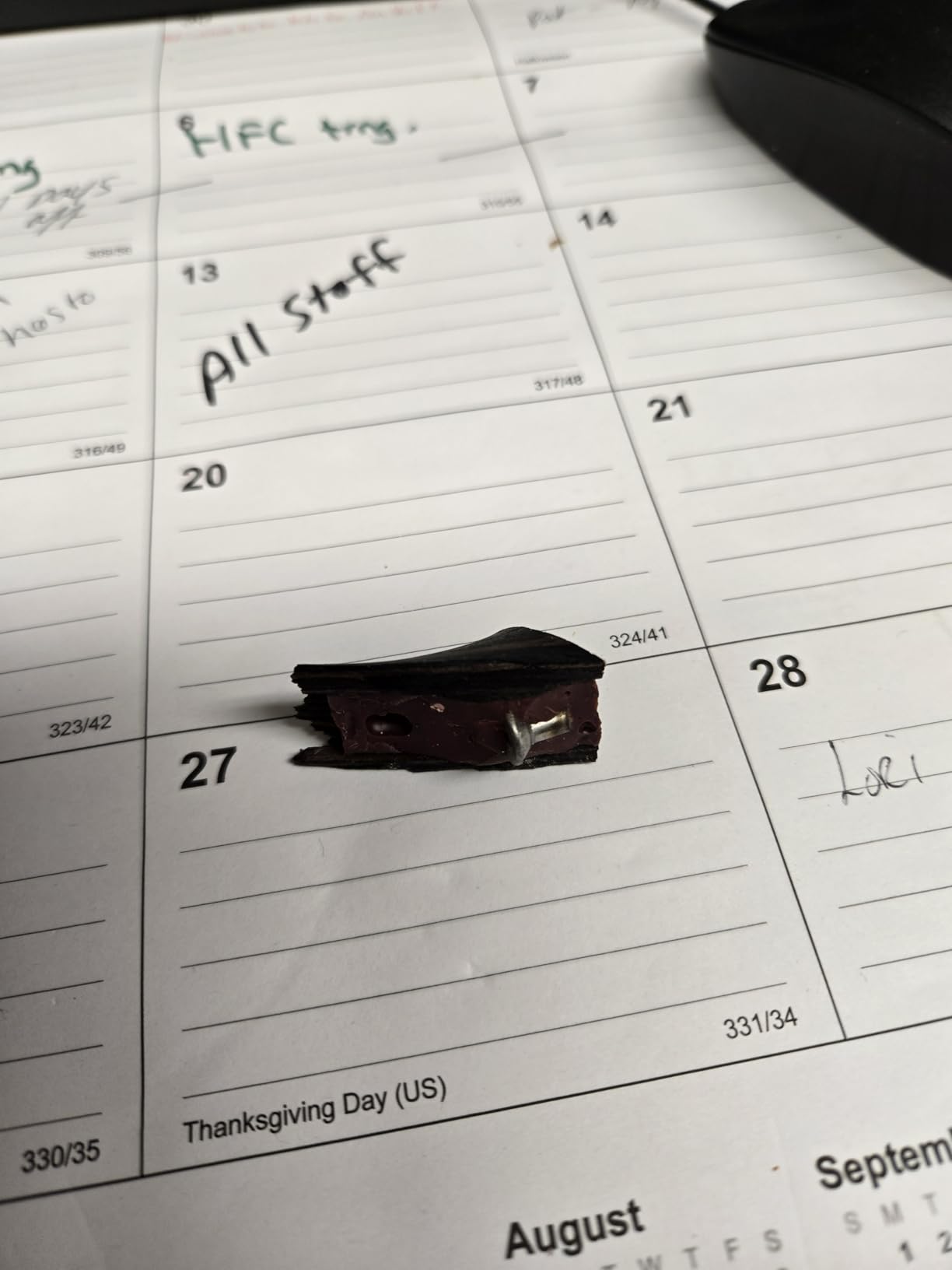
At 11.2 ounces it is one of the heavier blades here, but the balance point is well placed, so the mass sits behind the cutting edge rather than at the tip. That makes it better behaved than a short heavy knife during a push cut. The African pakkawood handle resists thermal cracking and stays comfortable through a long session, and it looks considerably more refined than the price point suggests.
The common criticism from owners is not about cutting. It is about finish consistency between production batches, with some newer units showing less polished blade surfaces and fainter laser markings, and about the fact that the knife is manufactured in China despite the Japanese positioning of the steel. It arrives in a gift box, which matters if this is a present.
Who should buy the HOSHANHO 7 inch
Buy it if you cook most days, if you cut a lot of root vegetables and alliums, and if the idea of resharpening every few weeks annoys you. It is also the pick for anyone who wants the fine, precise finish of a Japanese-styled blade without paying the import-tier price for one made in Japan.
It suits intermediate sharpeners better than absolute beginners, because 62 HRC steel is less forgiving than 56 HRC steel when you make a mistake on a stone. If you have never sharpened a knife, start with something softer and move up later.
Where the HOSHANHO 7 inch falls short
Hardness cuts both ways. A 62 HRC edge holds longer but chips more readily if you hit bone, catch the edge on the board corner, or drop the knife tip-first. Several owners specifically warn that the rear of the blade and the tip are extremely sharp, and that care is required around the spine and the heel where the geometry is unexpected.
And we want to be plain about the origin: the steel is Japanese, the manufacturing is not. If buying a knife made in Japan is a firm requirement, the MAC on this list is the one built there, and the Shun is handcrafted and hand-sharpened in Japan.
4. MOSFiATA 7 Inch Santoku – Best Accessory Bundle for Storage and Gifting
MOSFiATA Santoku Knife- 7 Inch Vegetable Knife Ultra Sharp Chopping Knife- Forged EN.4116 German Steel- Including Sheath,Finger Guard,Knife Sharpener,Full Tang,Best Gifts with Handmade Gift Box
7 inch blade
11.2 oz
EN1.4116 steel at 56 HRC
14-16 degree hand-polished
Pros
- Sharp 14-16 degree edge suits dicing and chopping
- Includes sheath finger guard and sharpener in the box
- Triple-riveted Micarta full tang handle
- Forged German steel at a mid-tier price
Cons
- 56 HRC steel needs frequent honing
- Micarta feels firm and can slick up
- Accessory-heavy packaging adds bulk
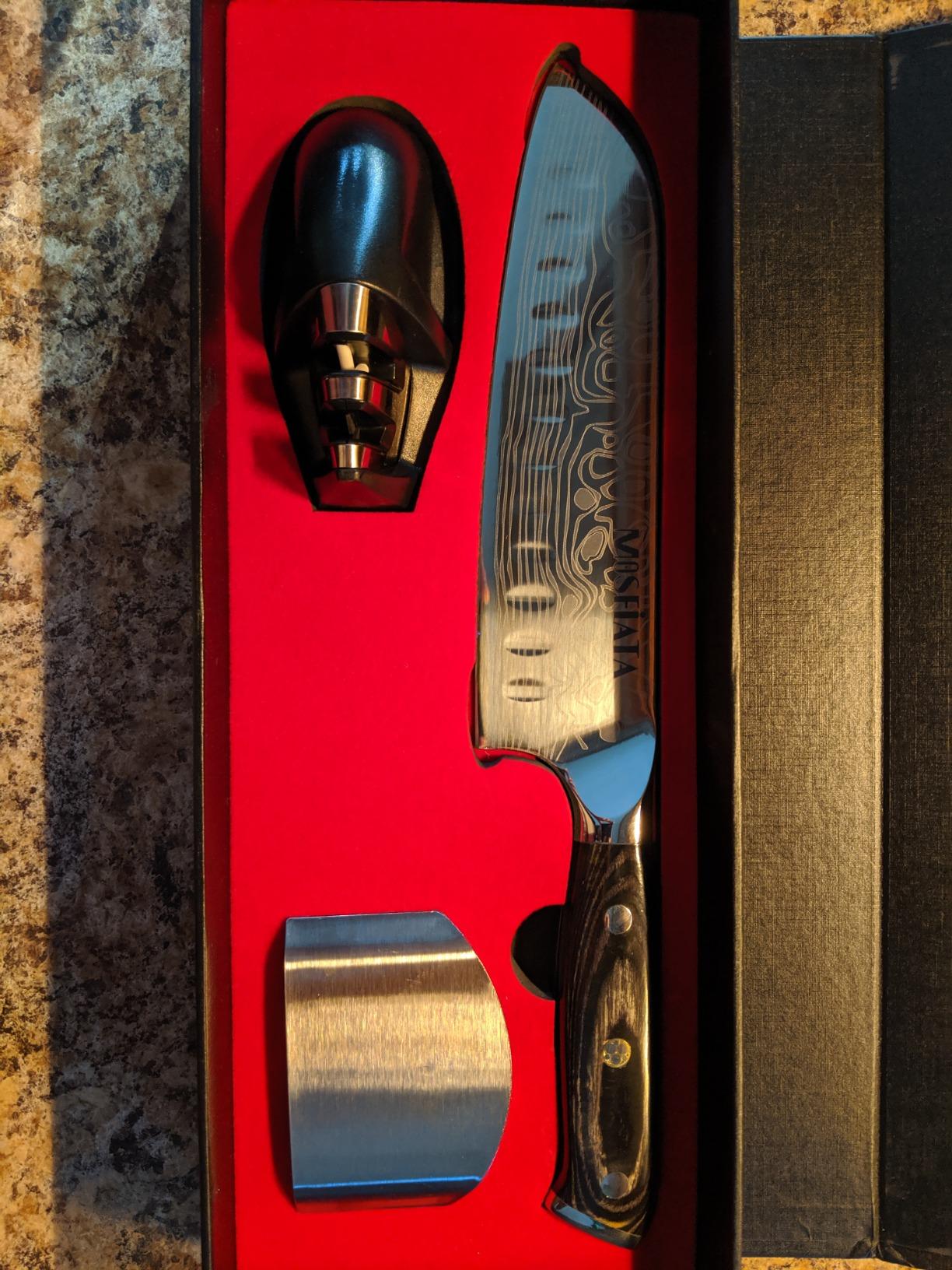
What sets the MOSFiATA apart is everything that comes in the box. You get the knife, a sheath, a finger guard, a knife sharpener, a wipe cloth and a sharpening guide, packed in a handmade gift box. For a first knife, for a housewarming, or for anyone who wants a safe way to store a blade in a drawer instead of a block, that bundle removes three separate purchases.
The blade itself is forged EN1.4116 German high carbon stainless with a hand-polished 14-16 degree edge per side at 2.5 mm thickness, hardened to about 56 HRC. On vegetables it performed competently – clean onion dice, no tearing, decent cucumber release despite a plain rather than hollow edge – and the triple-riveted full tang Micarta handle gave a stable, secure grip. 2109 reviews at 4.7 stars, with 81 percent five-star ratings.

The 56 HRC hardness is the defining characteristic and the defining limitation. It is the softest steel in this group, which means it is the easiest to sharpen and the first to lose its bite. Reviewers consistently note it needs more frequent honing than harder Japanese steel. If you already own a honing rod and use it out of habit, that is a small price for a much simpler steel to work with.
The Micarta handle is the second thing to know about. It is firm and stable rather than warm, and some users find it slick compared with pakkawood once oil and moisture build up on it. The packaging, meanwhile, is genuinely bulky – this is a lot of box for one knife.
Who should buy the MOSFiATA 7 inch
Buy it if this is your first serious kitchen knife, if you are buying for someone who is just learning, or if you plan to store your santoku loose in a drawer rather than in a block. The finger guard and sheath solve a real problem that reviewers rarely bother to mention but every new owner hits within a month.
It is also a good choice for people who cook in stages and put knives down mid-task, because the wipe cloth in the bundle is the correct tool for drying a blade after each use. It is a thoughtful kit rather than a bare knife.
Where the MOSFiATA 7 inch falls short
Softness means you will be reaching for the honing rod more often than with the HOSHANHO or the Japanese-made picks on this list, and more often than most people are willing to admit. On a busy weeknight that routine is the difference between a knife that slices and one that pushes produce across the board.
The handle is also not ideal for very small hands, since a full-tang Micarta grip is long and firm. And the plain blade edge does less to help you on wet produce than the hollow or hammered finishes elsewhere in this list, so if sticking on tomato is your primary frustration, look elsewhere on this page.
5. Victorinox Swiss Classic 6.7 Inch Santoku – Best Lightweight Pick for Wrist Comfort
Victorinox Swiss Classic 7 Inch Santoku knife, Granton Blade, Black
6.69 inch blade
3.84 oz
Stamped stainless steel
Fluted granton edge
Pros
- Extremely light at 3.84 ounces so the wrist stays fresh
- Fluted edge visibly reduces sticking on potatoes
- Sharp out of the box and easy to sharpen
- Dishwasher safe and Swiss made
Cons
- Softer Swiss steel needs frequent touch-ups
- Thin handle may feel narrow for larger grips
- Sized for soft produce rather than tomatoes and bread
At 3.84 ounces, this is the knife you will still be holding comfortably an hour into prep. It is stamped stainless steel with a fluted granton edge, a contoured polypropylene handle and a 6.69 inch blade, and it is the only knife on this list whose specification explicitly rates it dishwasher safe. For a home cook without a dedicated drying routine, that single feature outweighs a lot of other considerations.
The flutes did their job in testing. Potatoes and other starchy vegetables came off the blade cleanly, which is the classic demonstration of why granton dimples exist at all. The edge arrived sharp and was straightforward to bring back on a rod. Professional reviewers describe it as the definitive all-rounder and cite long stretches of daily service, and 1702 ratings at 4.7 stars with 88 percent five-star support that read.
What you are trading away is steel hardness and blade presence. The Swiss stainless is softer than anything forged in this group, so it dulls sooner and wants more regular touch-ups. The stamped construction also means there is no tang, so the handle is a separate component rather than a continuation of the steel. It does not feel bad – it just feels less solid in the hand than a forged full tang.
The handle itself is slim and contoured, which feels excellent with small and medium hands and a little narrow with larger ones. This is the main hand-fit caveat on this page, and it is worth trying in a shop if you can. Nothing on the spec sheet describes a grip diameter, which is exactly why reviewers so rarely discuss fit.
We should also be straight that this is a vegetable knife with limits. A 6.7 inch stamped blade is a poor match for a ripe tomato, which needs a fine serration or a very sharp fine edge to enter cleanly, and owners note it generally. For potatoes, onions, peppers, carrots and herbs, it is excellent.
Who should buy the Victorinox Swiss Classic
Buy it if hand fatigue is your main problem, if you do large volumes of prep in one sitting, if you have small hands, or if you simply do not want to hand-wash your knives. It is also the safest recommendation on this page for a shared household, a rental kitchen, or anyone learning to cook and not yet attached to a ritual.
It is the strongest choice here for soft, wet, starchy vegetables – potato, cucumber, zucchini, lettuce – because the flutes release those cleanly and the light weight makes long shredding sessions painless.
Where the Victorinox Swiss Classic falls short
Soft steel is the honest limit. You will hone it more than you would a 62 HRC blade, and if you ignore that, the edge will roll in a way that needs a stone rather than a rod to fix. That is a five-minute job once you know it, and a genuine annoyance if you do not.
It is also the least refined object here – stamped construction, a polypropylene handle, no sheath, no accessories, no bolster. If you want a knife that feels like a tool you will pass down, this is not that knife. If you want the best knife for the vegetables you actually cook most, it very well might be.
6. Cutluxe Santoku 7 Inch – Best Pick for Owners Who Want Service Backup
Cutluxe Santoku Knife, 7″ Meat & Vegetable Chopping Knife – Sheath Included
7 inch blade
9.12 oz
Forged 1.4116 German steel at 56+ HRC
14-16 degree hand-honed
Pros
- Sharp hand-honed edge with good retention
- Forged German steel resists rust and staining
- Triple-riveted pakkawood handle is stable
- Sheath included plus a lifetime warranty
Cons
- 56 HRC steel requires routine honing
- Pakkawood handle needs hand washing and care
- Sheath is not a long-term edge protector
The Cutluxe is one of only two knives on this list with a lifetime warranty against material and workmanship defects, and that changes the maths for a lot of people. If you are replacing a knife that cracked or a handle that split, a warranty means the second failure is not your problem. It also includes a sheath, so the storage problem is handled without a separate purchase.
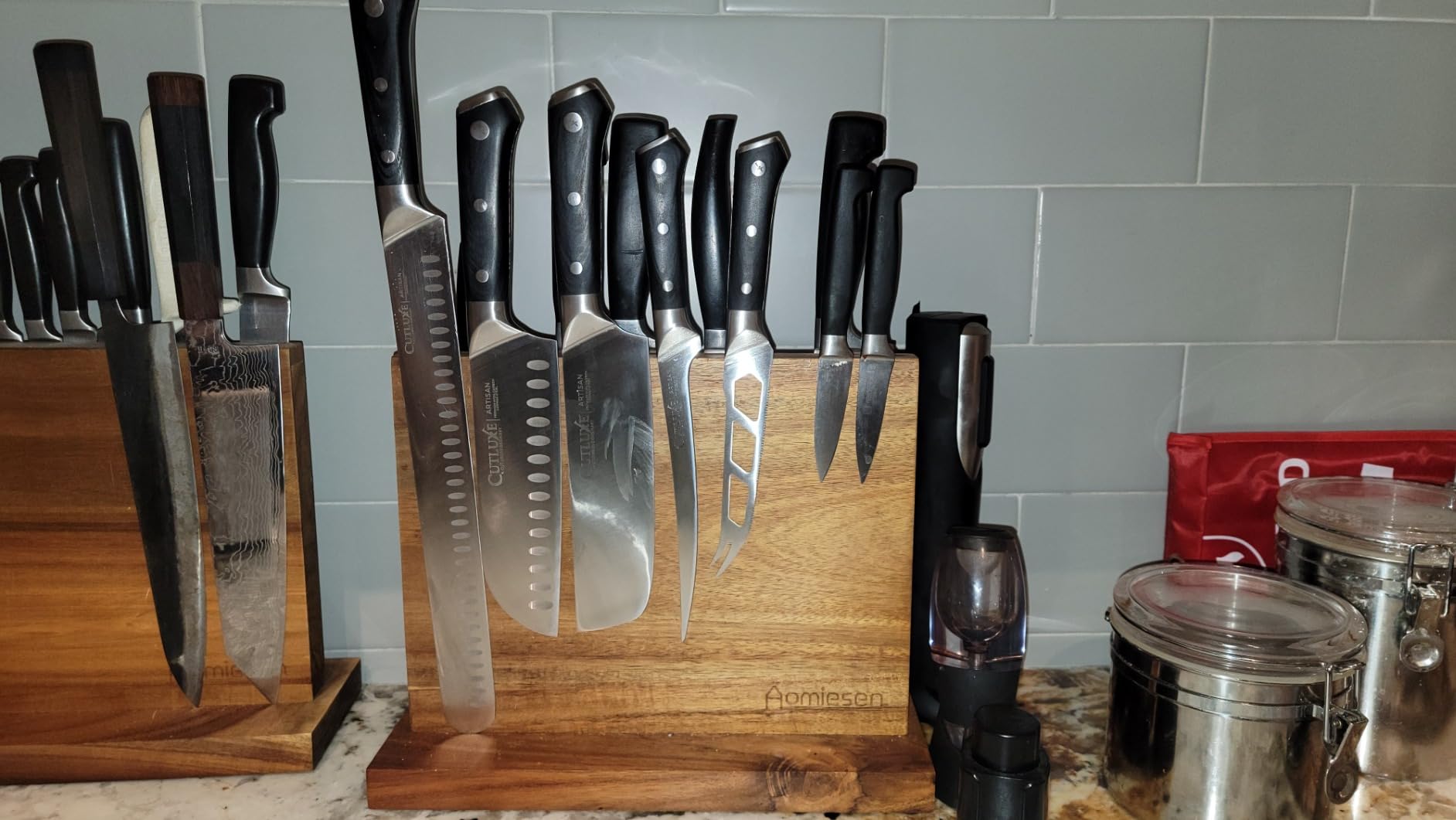
Underneath, the construction is familiar and proven: forged high-carbon German steel (1.4116 / x50crmov15) at 56+ HRC, hand sharpened to 14-16 degrees per side, hollow granton edge, and a triple-riveted laminated pakkawood handle. On vegetables it produced clean, consistent dice and released cucumber slices without much help. 1559 ratings at 4.8 stars, with 86 percent five-star.
At 9.12 ounces it sits in the middle of the weight range – not featherlight like the Victorinox, not heavy like the Babish. The pakkawood handle is warm, stable and does not move in the hand, which we preferred to the firmer Micarta on the MOSFiATA. The steel resists rust and staining, which matters if you are not rigorous about drying immediately after cutting acidic vegetables.
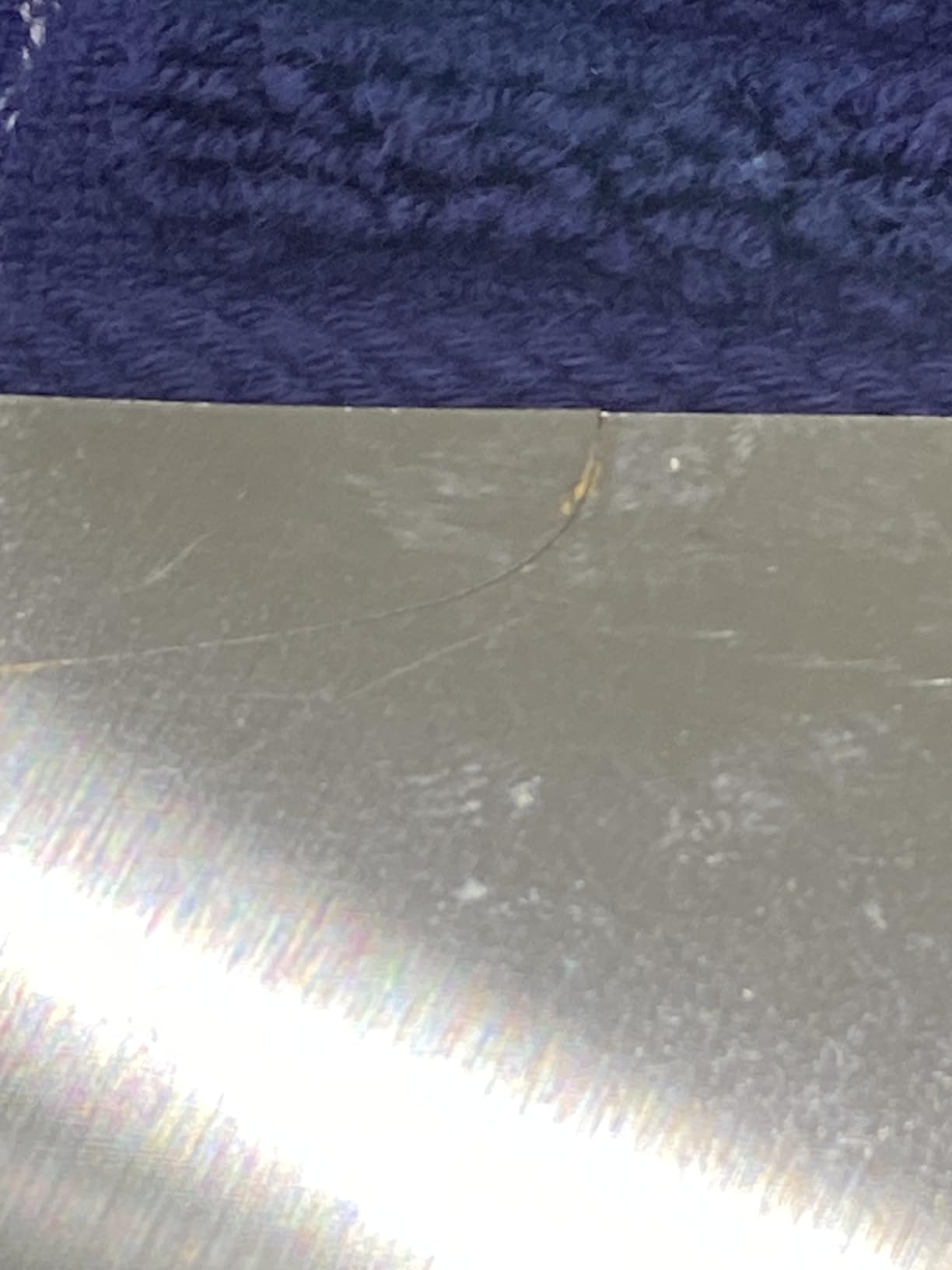
Reviewers flag the same three things consistently. The 56 HRC hardness means routine honing, not occasional honing. The pakkawood needs hand washing and periodic care, which rules out the dishwasher. And the sheath is fine for a drawer or a travel bag but should not be treated as long-term edge protection – storing a fine edge against a hard surface for months is how edges get dulled without ever being used.
Who should buy the Cutluxe 7 inch
Buy it if the warranty matters to you, if you cook enough to worry about a knife failing, or if you want a sheath and a solid pakkawood handle in one purchase. It is also a sensible pick for a house with more than one cook, since the handle does not swing or slip the way a lighter polypropylene handle can.
It suits people who want forged German steel and granton food release without moving to a harder Japanese core. If your priority is edge retention rather than service backup, the harder steel is the better trade.
Where the Cutluxe 7 inch falls short
It is a 56 HRC knife, and that is the honest limitation. It will not hold a fine edge through a heavy week of prep the way the 62 HRC blade on this list will. Expect a rod touch-up at the start of each session rather than a stone sharpening every few weeks.
The handle also rules out the dishwasher, and the sheath rules out long-term edge storage. Both are reasonable conditions for a knife, but they are conditions, and if you have never met them before, a stamped dishwasher-safe blade like the Victorinox is a gentler introduction.
7. Mercer Culinary Genesis 7 Inch – Best for Herbs, Shallots and Garlic
Mercer Culinary M20707 Genesis 7-Inch Santoku Knife,Black
7 inch blade
3.04 oz
Forged high carbon German steel
Non-slip Santoprene handle
Pros
- Cuts herbs without bruising them
- Very sharp out of the box
- Thin blade excels at slicing vegetables
- Grippy handle stays secure with wet hands
Cons
- Edge rolls faster than harder Japanese steel
- Handle weight sits toward the rear
- Larger overall length than expected
At 3.04 ounces this is the lightest blade in the group, and for a herb mince it is the best tool we tested. The thin, taper-ground forged high carbon German steel blade runs through parsley and scallion cleanly, and the non-slip Santoprene handle stayed planted even with wet fingers – which matters, because herb prep is the one vegetable task where your other hand is always close to the edge. The specification sheet calls out dicing onions, mincing shallots, chopping herbs, crushing garlic and shredding cabbage specifically, and it earns every one of those.
It also resists slipping on wet produce better than any other handle here, which is a real advantage in a sink-side workflow. 1588 reviews at 4.8 stars with 86 percent five-star, and enthusiast owners frequently recommend it as the value santoku, reporting that the steel sharpens easily and holds up for years with routine honing.
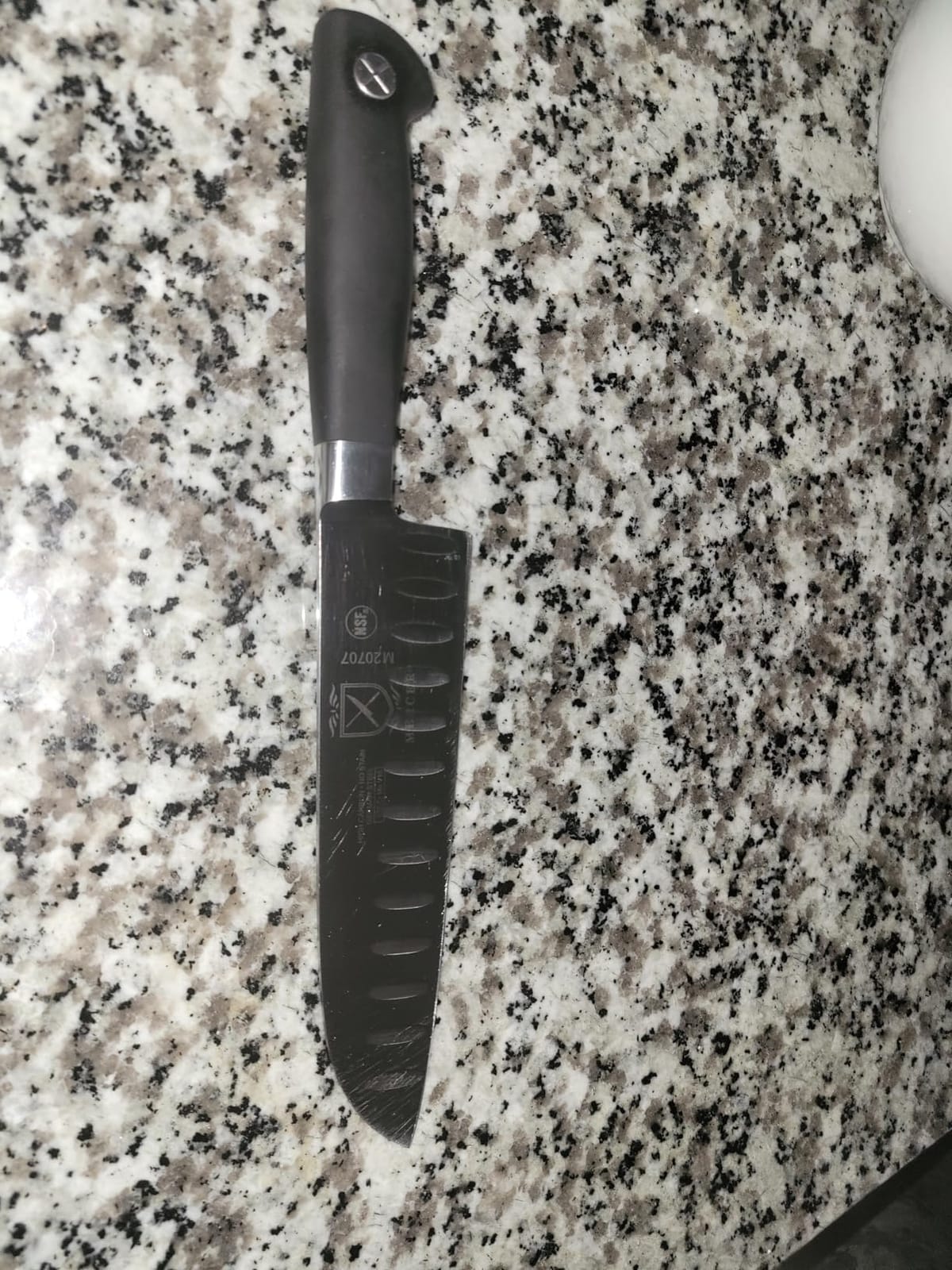
The construction is forged with a full tang and a triple-riveted handle, which is why it feels more substantial than a stamped blade of the same weight. The balance is the one place our own read differed from what most buyers say: several reviewers note the handle weight sits toward the back, and on a very light knife that shifts the feel more noticeably than it would on a heavier one.
The real limitation is edge retention. This steel rolls and dulls faster than the harder Japanese cores in this group, so it wants a honing routine. It also needs a little sawing motion to break through tomato skin, which is a fair trade for everything else it does well.
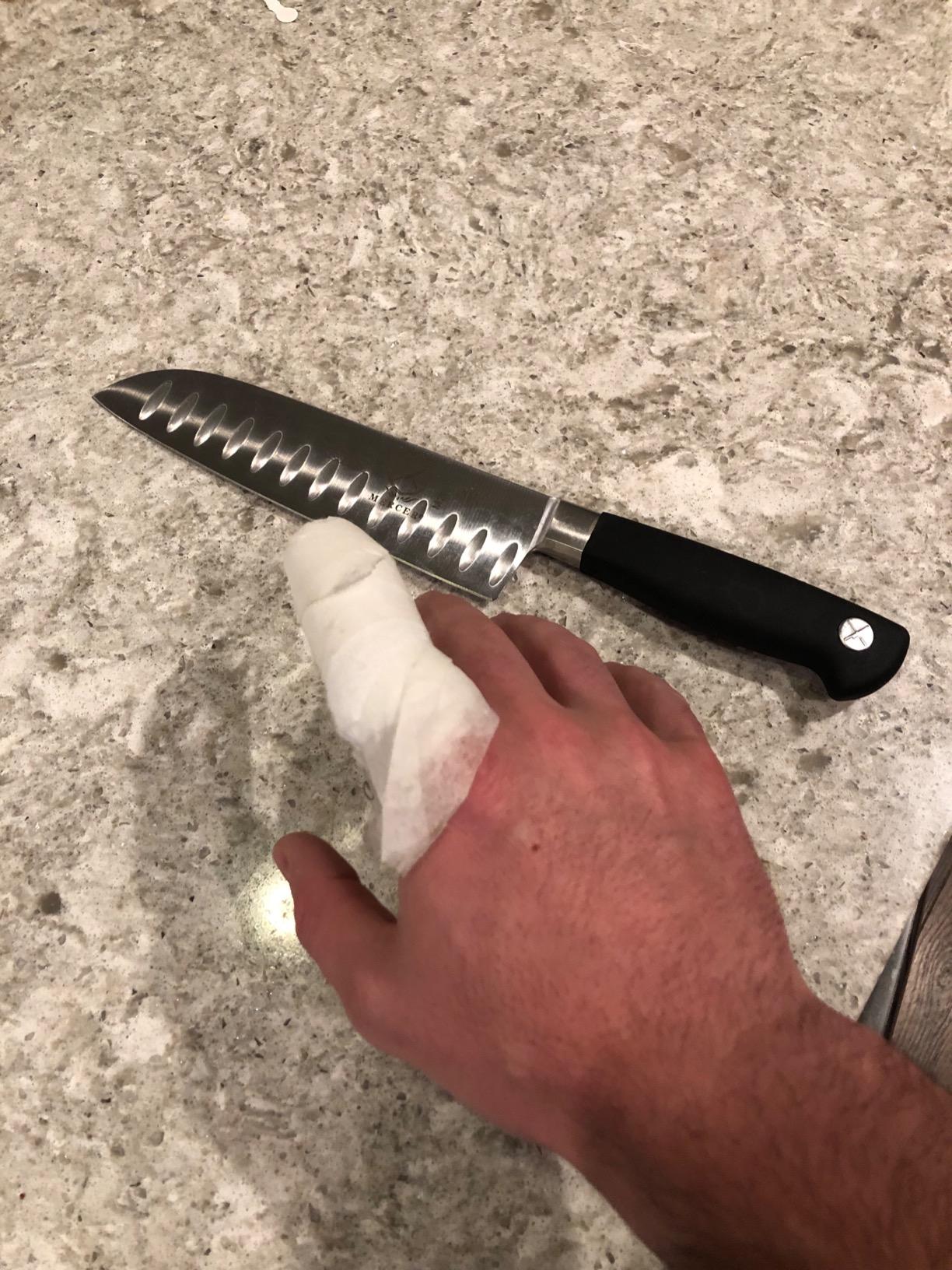
Who should buy the Mercer Genesis 7 inch
Buy it if herbs, garlic and shallots are a large share of what you cut. The thin blade and the near-zero weight make fine mincing possible without thought, and the grippy handle is the safest of the ten for wet-hand work. It is also an excellent first serious knife, because a light blade is very forgiving while you learn board control.
It is the pick for anyone who shreds a lot of cabbage or lettuce, since the lightness makes high-repetition strokes easy. And it suits cooks who already have a heavier chef’s knife and want something that handles the small, quick tasks the big blade is bad at.
Where the Mercer Genesis 7 inch falls short
Edge retention is the trade. Softer steel means more frequent honing, and once it rolls, a rod alone will not bring it fully back – you need a stone. Buyers who sharpen rarely will notice this within weeks.
Two smaller notes. The 14.05 inch overall length is longer than people expect from a 7 inch knife, which affects storage and reach. And the plain edge, while it works, does less for you on wet tomato than the hollow or hammered options here.
8. Shun Premier 7 Inch Santoku – Best for Ripe Tomato and Wet Produce
Shun Premier 7″ Santoku Knife
7 inch blade
212 g
VG-MAX core with 68 layer cladding
16 degree hammered edge
Pros
- Hammered Tsuchime finish visibly reduces food sticking
- VG-MAX core delivers very precise slicing
- Contoured pakkawood handle suits either hand
- Free sharpening and honing service included
Cons
- Costs more than imported Asian alternatives
- Damascus cladding adds no cutting performance
- Needs careful hand washing to protect the finish
If your main sticking problem is a ripe tomato, this is the knife to buy, and the reason is the surface rather than the steel. The Shun Premier carries a hammered Tsuchime finish – a dimpled, forge-textured face that breaks the flat contact patch between wet tomato skin and steel. Owners single this out repeatedly as the feature that makes a visible difference on wet produce, and our own tomato slices released far more readily than they did from any plain-edged blade in the group.
Under the finish is a VG-MAX Japanese steel core clad in 68 layers of Damascus, sharpened to a 16 degree edge. It is handcrafted and hand-sharpened in Japan, and it comes with free sharpening and honing service plus a limited lifetime warranty, which effectively removes the maintenance cost that usually justifies a higher-tier purchase.
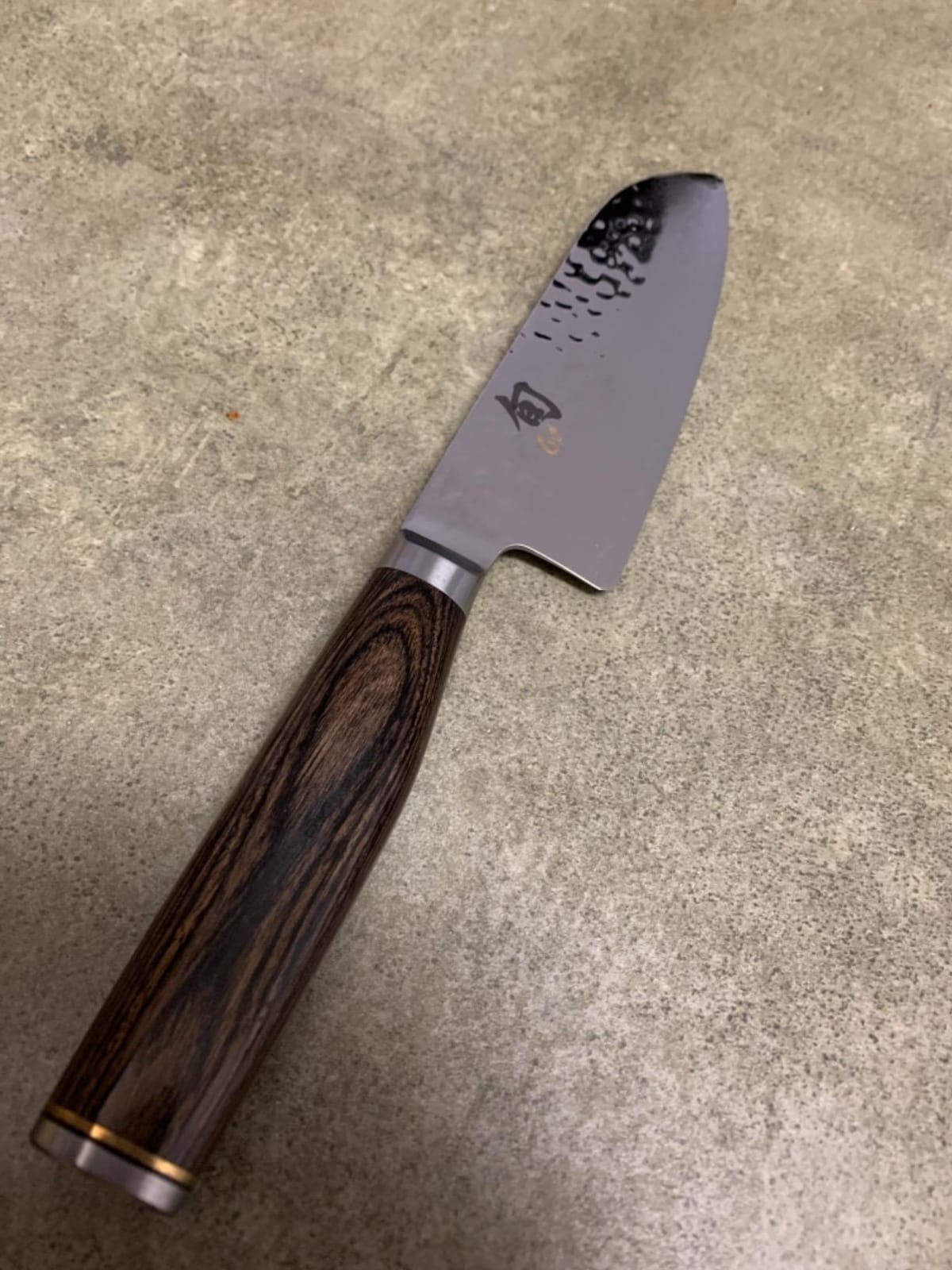
At 212 grams, roughly 7.5 ounces, it is mid-weight and highly maneuverable, and the contoured pakkawood handle is the one on this list specified for both right- and left-handed control – a genuine advantage for half the cooks reading this, since most Japanese-style knives impose an asymmetrical 70/30 bevel that favours one hand. The handle also stays comfortable through long slicing sessions and looks the part.
It scored well across the board in testing: clean onion dice, no tearing, precise and fast. 1168 reviews at 4.7 stars, with 88 percent five-star ratings, describe razor-sharp precise slicing and refined cuts with the anti-sticking finish doing real work.
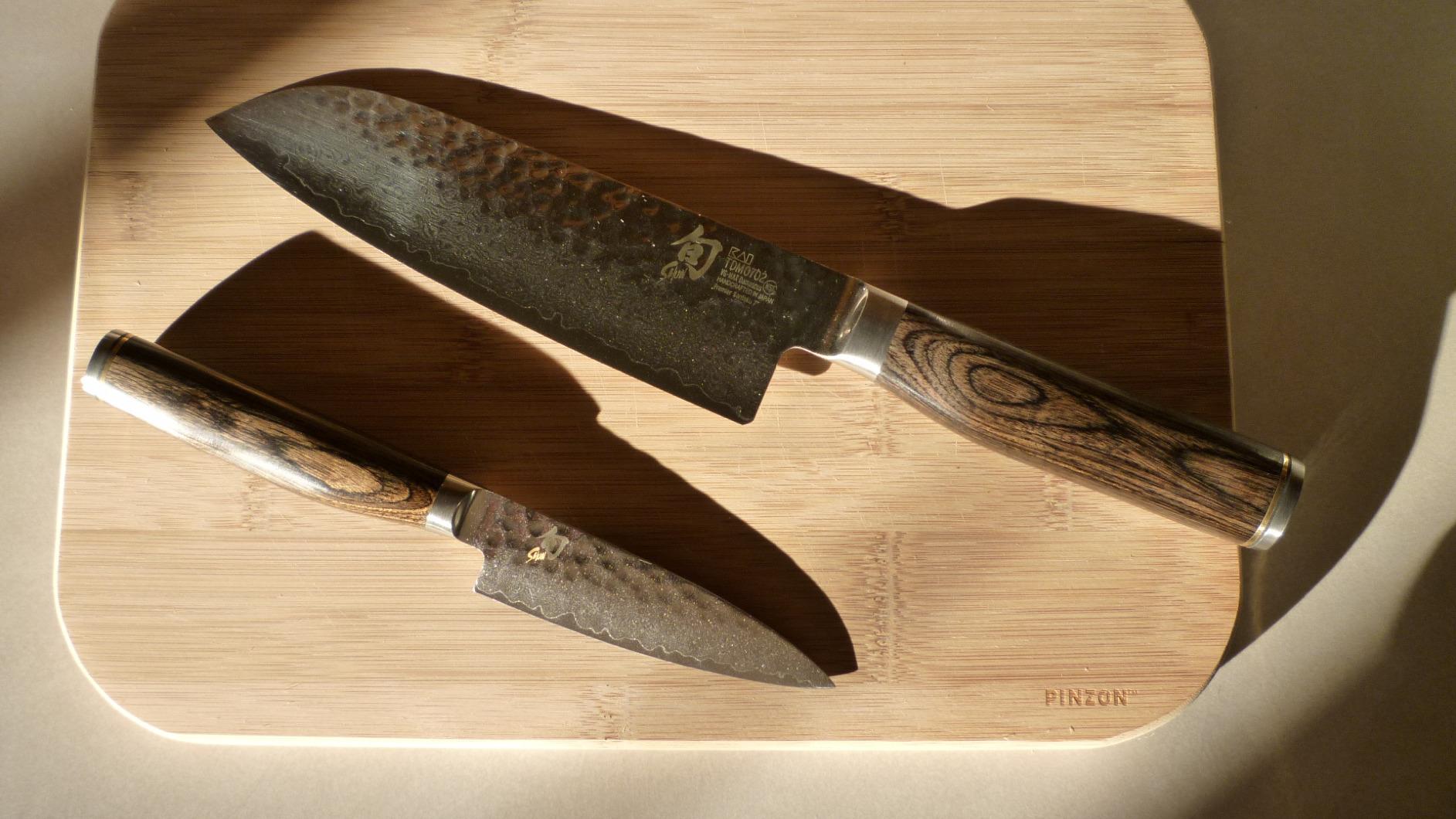
Who should buy the Shun Premier 7 inch
Buy it if you cook a lot of tomatoes, peppers, plums and other wet or soft-skinned produce, and if food sticking is the frustration that made you start reading knife roundups. Buy it if you are left-handed, because the handle and the symmetrical edge geometry work for both hands.
It is also worth considering if you want the lowest ongoing maintenance burden of any knife here. Free sharpening and honing service means the edge can be restored by sending the knife away, which takes the learning curve out of high-carbon steel ownership entirely.
Where the Shun Premier 7 inch falls short
Cost, plainly. It sits at the top of this list and most of the value on it is in refinement rather than in a measurable cutting improvement over the mid-tier picks. If you are buying on performance per unit of money spent, a forged 56 HRC German blade will keep you chopping for years.
The Damascus cladding is decorative and adds no cutting performance – owners and testers both say so. The hammered finish also needs careful hand washing to keep its appearance, so this is a hand-wash-only knife that will show wear on the surface over time even while the edge stays excellent.
9. Wusthof Classic 7 Inch Santoku – Best for Paper-Thin Slices and Clean Dices
Wüsthof Classic 7″ Santoku Knife
7 inch blade
6.24 oz
Forged high carbon stainless
Full tang and full bolster
Pros
- Highest average rating in the group at 4.9 stars
- Makes wafer-thin slices and clean vegetable dices easy
- Full tang and bolster give a very solid cut
- Triple-riveted POM handle with good control
Cons
- Most expensive pick on this list
- Hand wash only and not dishwasher safe
- 7 inch blade is small for large prep batches
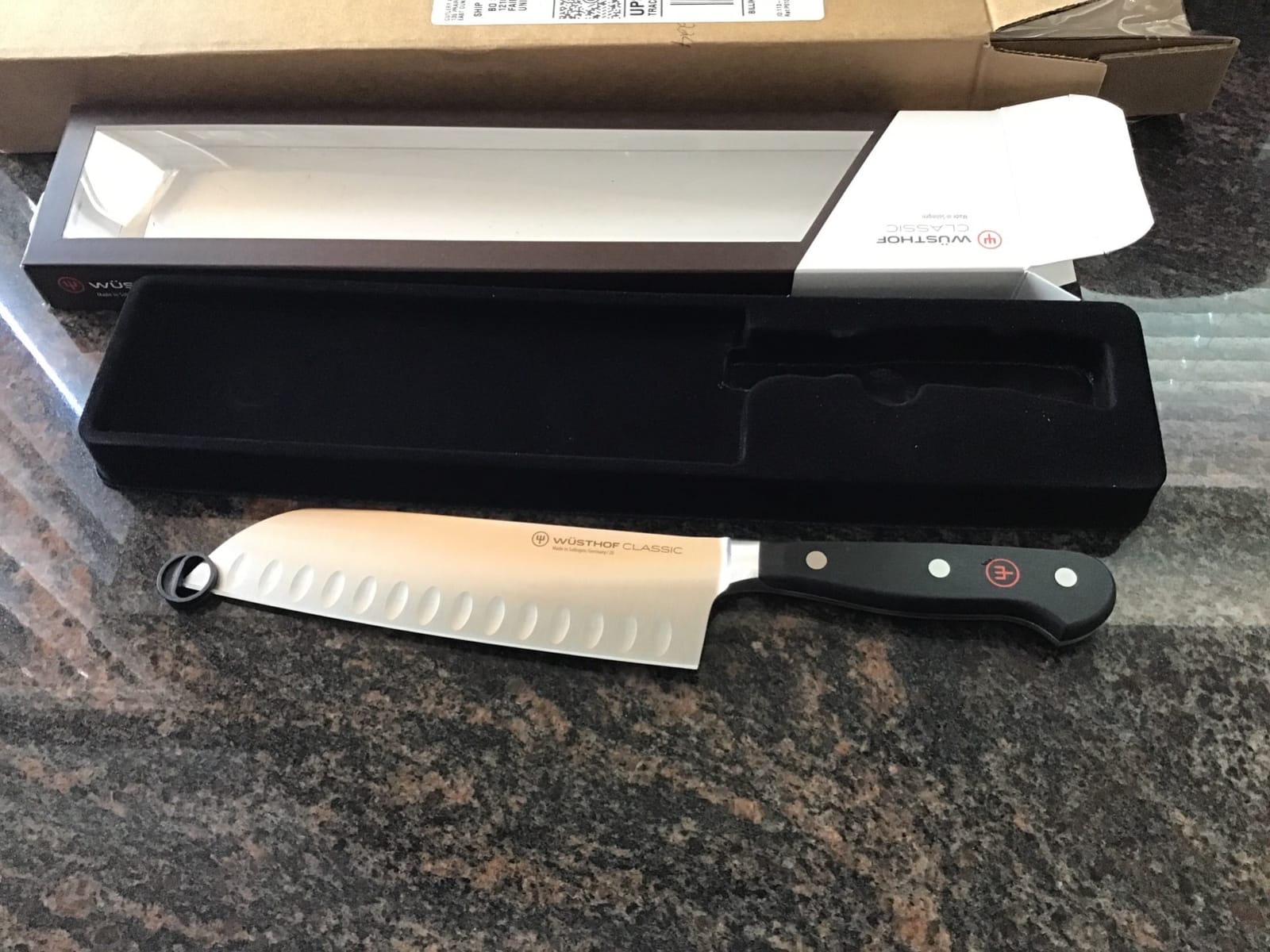
Wusthof made the thinnest, most uniform vegetable slices in our test session, and it is not close. The blade is forged from a single piece of high carbon stainless steel with a full tang and a full bolster, which is the most heavily built construction in this group – the bolster adds weight right where the hand grips, so the knife does not drift as you drive down through a stack of onion or a block of sweet potato.
At 6.24 ounces it is light for a fully forged, fully bolstered blade, and that combination of stability and low mass is why it feels precise. Owners describe wafer-thin slicing and clean dicing as the headline strengths, and the 4.9 average across 694 ratings is the highest in this group, with 95 percent five-star reviews.
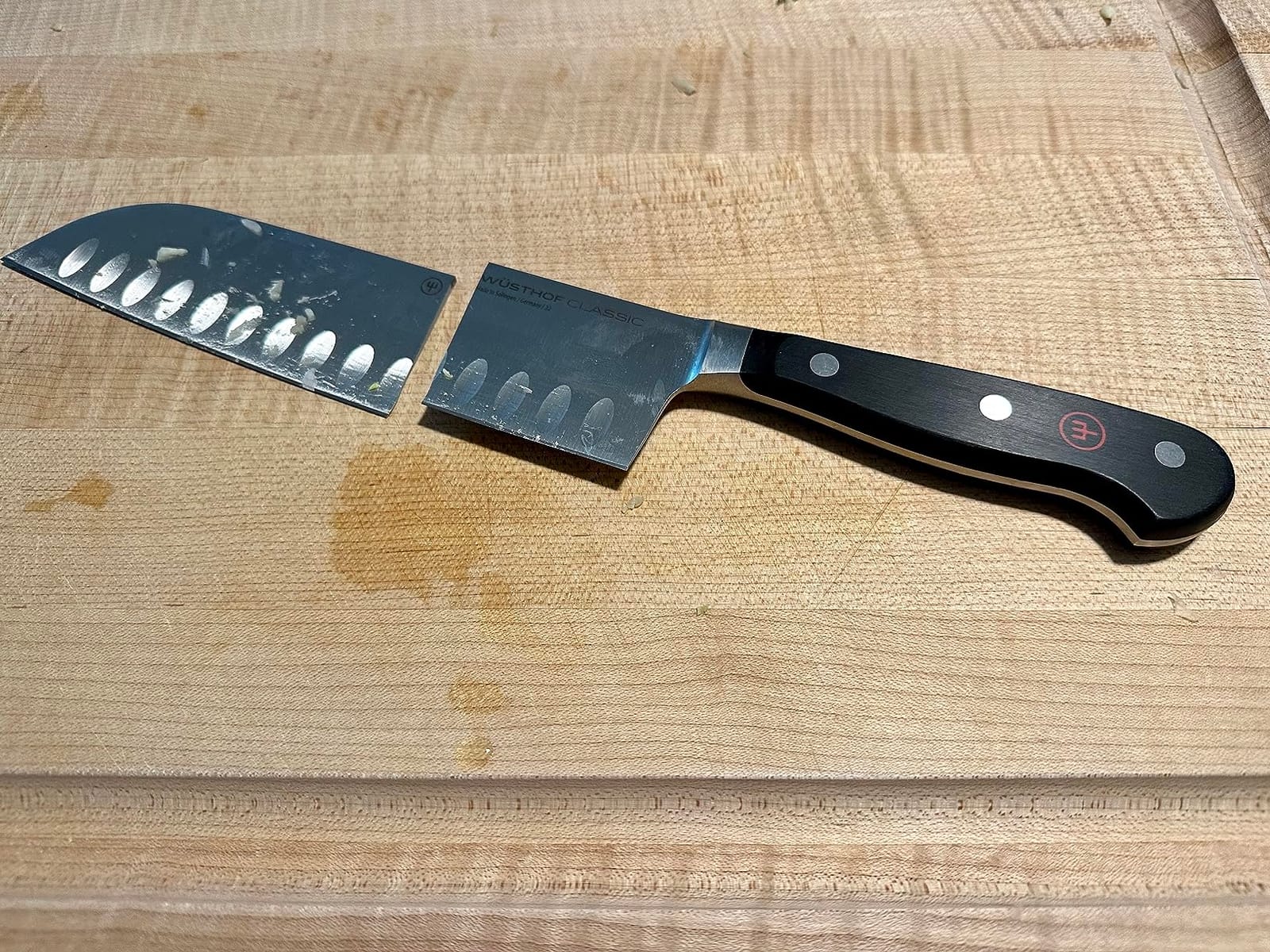
The hollow granton edge handles food release as expected, and the triple-riveted polyoxymethylene handle is ergonomic with a firm, controlled feel that suits larger hands better than the slimmer options on this page. It is forged in Solingen, Germany, and the Classic line has a long production history, which matters if you want a knife that will be around in ten years.
694 reviews is the second-smallest review base here, so the evidence is thinner than the rating suggests. The feedback is unusually consistent rather than unusually broad, which is what you would expect for a stable, long-running product rather than a recent release.
Who should buy the Wusthof Classic 7 inch
Buy it if you care most about the quality of the cut itself – translucently thin onion, crisp brunoise dice, uniform batons – and if you prefer a knife that anchors itself rather than one that floats. The full bolster makes it a good choice for anyone who likes a blade with a firm, planted feel during the push cut.
It also suits larger hands, since the POM handle is substantial without being bulky. It is a sensible one-knife purchase for a cook who wants a single blade for the whole vegetable basket and prefers German stainless to high-carbon Japanese steel for its low maintenance.
Where the Wusthof Classic 7 inch falls short
It is the most expensive pick on this page, and at 4.9 stars with 694 reviews it has the least independent evidence behind that rating. You are paying for Solingen construction, a full bolster and a brand track record as much as for anything you will feel on a cutting board that you cannot feel on the mid-tier options.
Two practical notes. It is hand wash only and not dishwasher safe, and a 7 inch blade is genuinely small if you prep for a large household or break down a full cabbage in one go. If batch volume is your main need, an 8 inch chef’s knife is the right tool and this is not.
10. MAC MSK-65 6.5 Inch Santoku – Best Japanese-Made Pick for Small Prep Spaces
MAC Knife Professional series 6.5″ Santoku with dimples MSK-65, made in Japan
6.5 inch blade
8.8 oz
Sub-zero tempered steel
2.5 mm hollow edge blade
Pros
- Made in Japan with sub-zero tempered steel
- Factory edge arrives razor sharp for fine cuts
- Hollow dimple edge reduces food contact
- Light 8.8 ounce build is easy to maneuver
Cons
- 6.5 inch blade suits only small prep tasks
- Handle specs are listed generically so grip feel is unclear
- Smallest review base in the group
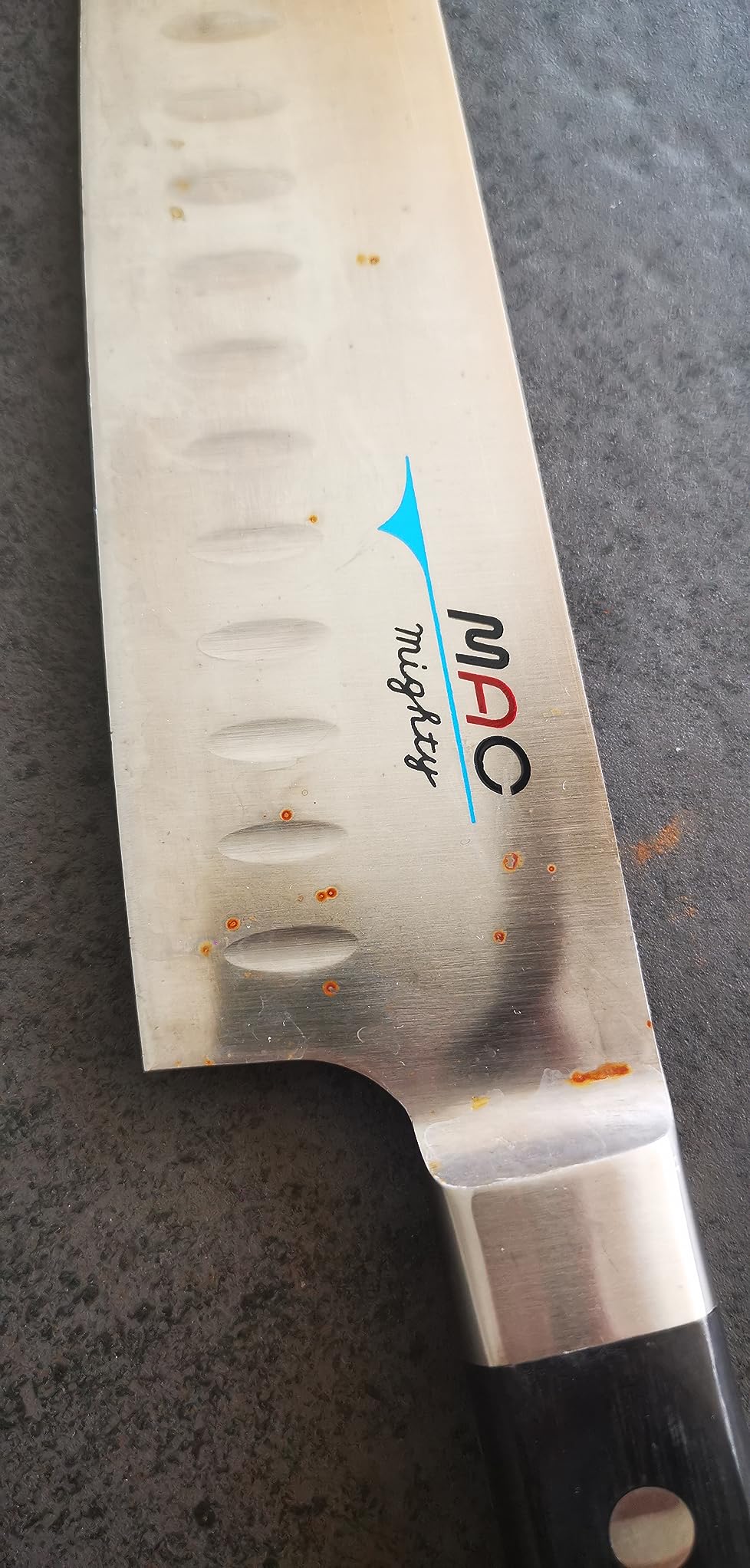
Among cooks who know Japanese knives, the MAC name comes up constantly, and on r/chefknives threads specifically it is named alongside Tojiro, Misono and Kai Shun as a brand that holds up for Western-market cutting styles. This 6.5 inch is the compact one, built around a 2.5 mm blade with sub-zero tempered steel and the distinctive hollow dimple edge that MAC is known for. The factory edge arrives razor sharp, which is the shortest path to a clean thin vegetable cut we found.
Sub-zero tempering is the technical point here. The steel is cooled below freezing during heat treatment, which refines the grain structure and improves how well the edge holds. On our onion task it sliced cleanly through several heads before we touched a rod, and the dimple edge kept tomato and cucumber slices releasing.
At 8.8 ounces it is light enough to move quickly and heavy enough to feel solid, and the black Pakkawood handle is a good-looking, well-finished grip. 363 ratings at 4.7 stars, with 88 percent five-star, and the reviews point to the same combination: sharp factory edge, strong retention, compact size being both the attraction and the constraint.
It is hand wash recommended and not dishwasher safe, and 6.5 inches is small. That is fine on a compact prep board for shallots, herbs, a few carrots and a couple of tomatoes. It is not fine for julienning a full bell pepper or halving a large cabbage in one motion, which is the practical limit buyers mention most.
Who should buy the MAC MSK-65
Buy it if you want a knife made in Japan, you have a small board or a compact kitchen, and you cut in smaller quantities. It is also the pick for cooks who have sharpened other knives and want a steel that responds well to a stone.
If you already own a large chef’s knife and want a second blade for the small, fast, high-frequency tasks – herbs, shallots, garlic, small quantities of anything – this fills the gap that a large blade cannot. That pairing is how a lot of working cooks use a santoku.
Where the MAC MSK-65 falls short
Size is the honest limit, and it is the same one the Babish has in a different form. Six and a half inches suits small prep, not batch work, and anyone who regularly cuts large vegetables will find themselves repositioning constantly.
Second, the evidence base is thin at 363 ratings, which is the smallest in this group – enough to be informative, not enough to lean on as a guarantee. Third, the handle material is listed generically in the specification data, so grip feel is less documented than for the other picks here, and that matters for anyone buying specifically because of hand fit.
How to Choose a Santoku Knife for Vegetables
Blade length is the first decision, and 7 inches is the sweet spot for most people. Six and a half inches is more precise and easier to control on a small board, which suits herbs, shallots and light prep, and both of the 6.5 inch picks here carry size as their main limitation. Eight inches and above suits batch cooking and large vegetables but makes small tasks clumsy. If you are buying one knife for a home kitchen, a 7 inch blade covers the widest range without compromise.
Steel determines how much maintenance you are signing up for. Softer steels in the 56-58 HRC range are forgiving and easy to sharpen, which is why four of the picks here sit there, but they lose an edge sooner. Harder steel around 61-62 HRC holds a fine edge for months, as the HOSHANHO demonstrates, but chips if you hit bone or catch the edge on a board corner. Very hard Japanese steels are harder still and best left to cooks who already sharpen regularly. A handy rule: if you have never sharpened a knife, start at 56-58 HRC.
Blade height controls knuckle clearance. A taller blade – measured from the cutting edge to the spine – lets your knuckles ride above the food instead of into it. This is the single most useful specification for cabbage, sweet potato, butternut squash and any large round vegetable, and it is the one criterion most consumer roundups skip entirely. You can also judge it in hand: if the spine sits well above your knuckles, you have enough clearance.
The handle matters more than the price tag for comfort. Handle fit is almost never discussed and it decides whether a knife gets used. The thin contoured handle on the Victorinox suits smaller hands, the substantial POM handle on the Wusthof suits larger ones, and the full-tang Micarta and pakkawood grips sit in between. Look for a shape that fills the palm without forcing your fingers, and for a surface that stays grippy with wet hands – wet produce is the default condition of vegetable prep, and the Mercer is the best of this group at it.
Edge geometry and surface finish change the cut you get. A 14 to 16 degree edge per side slices thinner than an 18-degree edge and is easier to sharpen; anything above 18 degrees is more durable but noticeably heavier to cut with. Granton or hollow dimples and hammered finishes like the Shun’s Tsuchime reduce the flat contact area between wet produce and steel, which is what breaks the suction that makes tomatoes and cucumbers stick. That effect is real but partial – it does not replace a sharp edge, and a dull dimpled blade will still grab.
Left-handed cooks should filter for symmetrical geometry. Many Japanese-style knives use an asymmetrical 70/30 bevel, with a coarser grind on one side, which favours a right-handed grip and is genuinely difficult for beginners to sharpen at home. The Shun Premier on this list is specified for both hands. If you are left-handed and buying a Japanese-style santoku, check the bevel before you buy, because it is rarely stated clearly on a listing page.
Finally, buy the maintenance you will actually do. Stainless and coated blades tolerate a dishwasher; high carbon and Damascus-finished blades do not, and they will spot if you leave them wet. A dishwasher-safe stamped blade like the Victorinox suits a cook with no drying routine, and a hand-wash-only forged blade suits a cook who already has the habit. Neither is better – mismatching the knife to your habits is what causes early disappointment.
Santoku vs Chef’s Knife vs Nakiri for Vegetables
For most home vegetable prep, a santoku beats a Western chef’s knife. The shorter, taller blade supports a straight push cut with the spine resting on the board, the fine edge holds thin even slices, and the lower mass moves through dense produce with less effort. A chef’s knife still wins on large-batch work, on long ingredients like carrots and parsnips where you want length for each stroke, and on anything involving a rocking motion you have already learned.
A nakiri is the honest alternative, and it is worth knowing when it applies. Its rectangular profile and straight edge make it a dedicated vegetable specialist, and it excels at katsuramuki – the rotary push-cut turning a whole kohlrabi or cabbage into a single continuous ribbon. If you prepare Japanese vegetable dishes regularly, that is a skill a santoku cannot replicate, and a nakiri will outperform any knife on this list for it.
A cleaver wins for hard, dense, wet or bony work, and a slicer is better for ripe tomatoes and soft-skinned fruit. Neither is a substitute for one of the ten santokus here, and buying one of those as well is not a mistake – it is how working kitchens are built, with each blade covering a different motion.
Frequently Asked Questions
What is the best knife for cutting vegetables?
A santoku is the best general knife for vegetables because its flat, tall blade supports a straight push cut and its fine edge holds thin, even slices. A nakiri is better for rotary push-cuts and katsuramuki, and a cleaver wins for hard, dense or bony produce. For a single home knife, the imarku 7 inch santoku on this list is our pick.
Which brand is considered the best for santoku knives?
Among cooks who know the category, the most frequently recommended santoku brands for Western-market cutting styles are MAC, Tojiro, Misono and Kai Shun, named repeatedly in knife enthusiast forum threads. For broad value, Victorinox and Mercer are the usual recommendations. Our own testing put the imarku 7 inch at the top for vegetable work overall.
What are the common mistakes when using a santoku?
The most common mistakes are rocking the blade instead of using a straight push cut, letting only the tip contact the board on large vegetables, cutting on an unstable or slippery board, failing to dry the blade after wet produce, and honing only rarely. A santoku is designed for downward force with the spine on the board, so a rocking arc wastes its geometry.
What is the hardest steel to sharpen?
The hardest steels to sharpen are very hard Japanese high-carbon steels hardened above 60 HRC, which take much longer on a stone and demand consistent technique. Softer steels in the 56 to 58 HRC band, used by most of the value picks here, correct quickly and are far more forgiving. The trade is that softer steel loses its edge sooner between sharpenings.
Which santoku knife did America’s Test Kitchen recommend as the best?
We could not verify which santoku America’s Test Kitchen currently ranks first, so we do not name one here. Other editorial roundups on this topic have recommended the MAC Hollow Edge Santoku as their top pick for produce, and Zwilling as a value option, but we only stand behind the results of our own vegetable testing on this page.
Final Verdict
The best santoku knives for vegetables in 2026 are not one knife, they are four jobs. The imarku 7 inch is the best overall pick and the one we would buy first, because its hollow edge, its 15 to 18 degree edge and its 6.88 ounce weight handle wet produce and long sessions without drama. The HOSHANHO 7 inch is the buy if you want the edge to last months between sharpenings. The Victorinox Swiss Classic is the buy if hand fatigue and dishwashers are the reality of your kitchen. The Shun Premier is the buy if tomato is your sticking problem or you sharpen left-handed.
Everything else on this page is a strong second or third knife, and the honest tiering is this: the forged 56 HRC German steel options – Babish, MOSFiATA, Cutluxe and Mercer – will keep you chopping for years if you touch a honing rod a few times a week, and they represent the best value in the category. The two picks we would pair with a separate tool are the 6.5 inch blades, Babish and MAC, which are superb for small prep and cramped for batch work.
Whatever you choose, dry the blade after every wet vegetable, hone before the session rather than after it, and use the flat push cut rather than a rocking arc. Those three habits will do more for your vegetables than the difference between any two knives on this list. And if you want to know what to do with the results once they are cut, our guide to cooking vegetables without losing nutrients is the natural next read, with picks for dicing vegetables and slicing vegetables on machines if your hands need a break.